




Abstract
A transdisciplinary approach to the learning experience offers students a preparedness for life beyond the classroom by enhancing disciplinary knowledge and understanding, developing skills of metacognition, or encouraging collaboration to effectively address increasingly complex societal challenges. To evaluate whether such claims are true from a learner perspective, this article aims to investigate perceived student value of a recently completed marketing module that adopted a transdisciplinary approach within its pedagogic design. A qualitative methodology was deployed to encourage participant reflection, with specific inquiry focused upon distinct dimensions of the learning experience. Findings offer evidence regarding perceived benefits of engaging with a transdisciplinary learning framework. This included the freedoms of intellectual inquiry to appreciate disciplinary connections, the development of personal transferrable skills, increased accessibility within collaborative learning activities, and observed confidence and autonomy within assessment. Practical implications and limitations are discussed, including complexity issues that may inhibit knowledge development, time restrictions that constrain effective inquiry, and personal motivation when adopting a self-regulated learning method. The value of this study permits critique of a renewed and increasingly recognized teaching approach as a solution to enhance the learning experience and prepare graduates to address complex challenges within society.
Keywords
Introduction
Can a learning strategy of the past help prepare students for the challenges of the future? The ever-evolving expectations of graduates’ skills and knowledge are perhaps only matched by the rate of transformational change and complex challenges that exist outside of the learning institution, as new technologies and disruptive events require students to be instilled with a preparedness for life after formal education (Kurtzke & Setkute, 2021). Universities are expected to be aware of such demands from both students and the wider marketplace alike (Schlee & Karns, 2017). However, as university graduates themselves continue to report lacking relevant work experience, key skills, or feel a general unpreparedness for employment (Pauli, 2021; M.-S. Smith et al., 2023), sentiments also shared by senior leaders (Belkin et al., 2023), there is increased urgency to address such knowledge and skills gaps during their education. Solving this problem requires developing a curriculum that cultivates both knowledge and meta-skills in the creation of a readily employable graduate calibrated to the complexity and uncertainty within their future world of work (Rohm et al., 2021).
A renewed interest of adopting a transdisciplinary approach to transform the curriculum in achieving these aims is observed (Budwig & Alexander, 2020). Its ability in advancing marketing education specifically is also recognized (Crittenden & Peterson, 2019). Defined as “the unity of intellectual frameworks beyond the disciplinary perspectives” (Stember, 1991, p. 4) and “a way of addressing complex societal problems by enabling productive border-crossing between different knowledge domains and communities of practice” (van Baalen et al., 2021, p. 25), a transdisciplinary pedagogic approach to curriculum development is not a revolutionary new proposition nor latest innovative concept of disseminating knowledge to students or developing their key competencies. The topic has been well evaluated within educational literature for more than five decades (Apostel et al., 1972; Ellis, 2022). It allows educators to consider the role and responsibility of their university within society (Robertson, 2000; Scholz, 2020), unify disciplines (Satterfield et al., 2009), incorporate higher-order thinking (Wagner et al., 2014), and offer alternative approaches to design and delivery of a curriculum through recognition of contemporary student learning needs combined with the university’s role in preparing students for life after formal study (Allinson & Mahon, 2022; Budwig & Alexander, 2020; Park & Son, 2010).
However, there is little empirical evidence to support these claims (Takeuchi et al., 2020) and limited literature on pedagogies that guide the development of this learning experience (Adefila et al., 2022). Consequently, the promises of a transdisciplinary approach to innovate the curriculum and instill the demanded qualities of graduates are challenged. Critics argue that an oversimplification of advocated key advantages leads to accusations of a learning style whose outcomes lack tangibility (Daneshpour & Kwegyir-Afful, 2022; Grossman et al., 2000). Given the multifaceted design of a transdisciplinary education, an understanding of its effectiveness is limited to literature often only describing the learning process (Horn et al., 2024). Consequently, calls for further research into transdisciplinary education are made (Brown, 2022; Daneshpour & Kwegyir-Afful, 2022; Horn et al., 2024). In response, this article seeks to extend knowledge regarding the educational impact and perceived value of a transdisciplinary curriculum, along with evaluating the practicalities of such offering. With grounding in a constructivist-based approach to the development and facilitation of a transdisciplinary curriculum, this article aims to explore whether the claimed benefits of this learning approach are true from the student’s perspective. This includes what, if any, skills, knowledge, and competencies are cultivated to deal with the anticipated challenges and complexities within their future employment.
A review of key literature explores the value of a transdisciplinary approach upon the learning community before evaluating practical considerations of curriculum design. Student reflections of a transdisciplinary study experience are captured through the deployment of a qualitative research investigation, allowing for critique of associated pedagogic design factors. The findings offer three primary contributions to transdisciplinary educational literature. First, this research offers evidence that a transdisciplinary approach supports the development of disciplinary knowledge and understanding in addition to stimulating higher-order thinking and metacognitive skills during learning activities. When applied, they offer wider value during activities that seek to investigate and address real, complex problems. Second, findings highlight the effectiveness of the learning experience in promoting learner engagement when contextualized as developing expected competencies demanded by future employers. Third, findings show how practical considerations including time, student motivation and commitment to a self-regulated study method, along with wider complexities associated with a constructivist pedagogic approach, may negatively impact the experience. Implications of the findings including practical advice for educational practitioners seeking to develop or deploy a transdisciplinary curriculum are discussed.
Literature Review
Various pedagogical approaches for the integration of multiple disciplines within a teaching curriculum are presented within the scientific and educational community, each advocating different perceived benefits to the learning experience, knowledge advancement, and skills development (Baumber et al., 2020; McGregor, 2017; Phenix, 1964). However, many learning and teaching frameworks suffer from ill-defined, inconsistent terminologies or definitions when seeking to describe the assimilation of multiple, different disciplines (Choi & Pak, 2006; Greig & Priddle, 2019). Practical difficulties may occur when integrating multiple disciplinary perspectives within a curriculum, which includes the facilitator possessing the relevant prerequisite knowledge needed to synthesize and produce one whole consistent offering (Strachan et al., 2023; Weinberg & Sample McMeeking, 2017). A misguided, misinformed, or superfluous experience may only ever be achieved as a result (Fishman et al., 2014). Stember’s (1991) typology, a widely accepted continuum of disciplinary definitions, seeks to clarify learning and teaching terminologies by considering their functional attributes, from identifying a single, isolated disciplinary approach evolving into integrated higher-order transformative disciplinary unities (Figure 1).
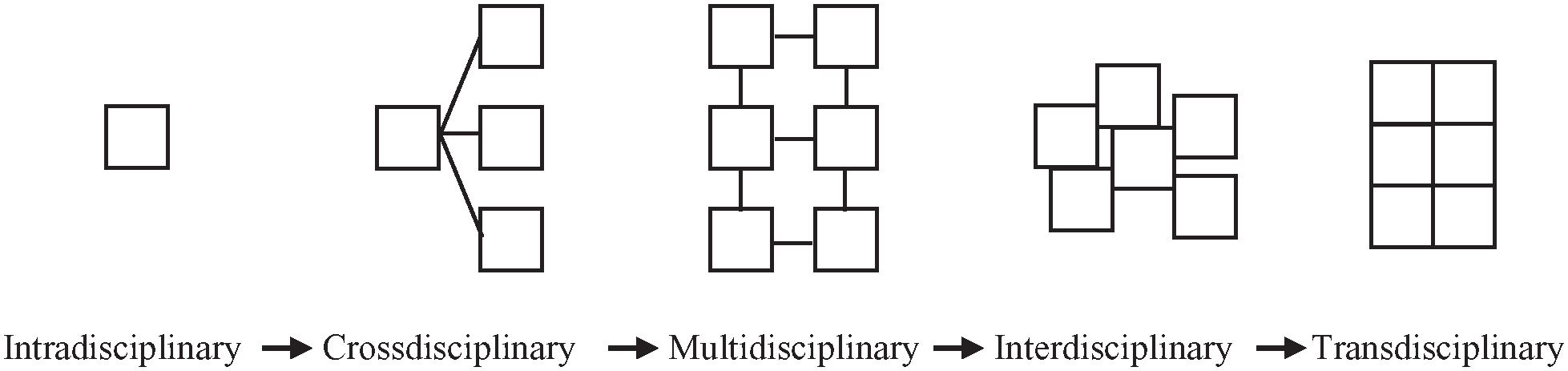
Stember’s (1991) Typology of Disciplinary Definitions.
An intradisciplinary approach, the first in Stember’s (1991) typology, utilizes specific knowledge from within a single discipline to develop core understandings and address learning objectives (Adams & Kerr, 2022). Cross-disciplinary fosters an awareness of ideas that exist outside the boundaries of a single discipline, often with minimal integration other than interpreting ideas or addressing learning objectives via the perspective of another disciplinary point of view (Machemer & Crawford, 2007). Valuing the importance of collaboration, multidisciplinary presents organized narratives using different scholarly insights yet defines the boundaries between them, although may connect and contextualize differing perspectives when addressing real-world problems (Kara, 2018). Interdisciplinary relies upon a synthesis of disciplinary knowledge integration through a defined strategy, seeking to offer novel insights to solving problems (Stentoft, 2017). This approach attempts to broaden the boundaries of specific disciplines yet requires diverse disciplinary insight in the creation of a coherent narrative, including recognizing the importance of balancing the appropriate depth and integration (Augsburg et al., 2013). The framework culminates in the multifaceted approach of transdisciplinary, seeking to create a unity of intellectual knowledge that transcends individual disciplinary boarders to address fundamental, complex challenges that exist within society (Drake & Reid, 2021; Pearce et al., 2018).
Definitions of transdisciplinary teaching and learning vary within educational literature, often influenced by the authors or stakeholders involved (Velez et al., 2021). For this article, “transdisciplinary teaching” captures the pedagogic and practical factors of designing a curriculum underpinned by the concept of transdisciplinarity (Daneshpour & Kwegyir-Afful, 2022; Velez et al., 2021). “Transdisciplinary learning” focuses on the learner themselves, the educational environment, and the development of metacognitive skills and knowledge, framed in the context of complexity, collaboration, and criticality (J. Y. Klein, 2018). Both are explored in the following sections.
Transdisciplinary Teaching and Learning
Transdisciplinary teaching seeks to connect knowledge and understanding via a synthesis of more than one discipline, including critically evaluating real-life experiences in the pursuit of exploring and addressing wider societal problems (Renn, 2021). This approach is common in the areas of ethics (Cockburn & Cundill, 2018), sustainability (Horn et al., 2023), and responsibility (Kubisch et al., 2020). When applied to the curriculum, transdisciplinary teaching generates deeper methods of learning, inquiry, and problem-solving built upon the foundations of disciplinary cooperation and knowledge integration to address complex challenges (Ciesielski et al., 2017; Godemann, 2008). Such perspective is necessary given how societal problems are rarely defined within the context of one single academic discipline but instead exist as a series of interconnected poly-crises influenced by a diversity of antecedents and consequences (Stember, 1991). Therefore, it is argued that any successful inquiry must not be restricted by limited contextual scope or defined disciplinary boundaries (Lawrence, 2010). The integration of relevant knowledge and multiple perspectives is required if any meaningful solutions are to be found (Remington-Doucette et al., 2013). Considering marketing education specifically, integrating disciplinary knowledge across social science subjects including economics, psychology, and sociology is a recognized valuable approach of addressing complex consumption practices (McGregor, 2013).
Transdisciplinary curriculum design embraces a nonlinear delivery facilitated through a constructivist approach to knowledge creation that permits the flexibilities required for methods of inquiry unrestrained from disciplinary boundaries, with increased focus on lived experiences and real-world issues (Exter et al., 2020; S. A. Levin, 1999; T. Levin & Nevo, 2009; Russell et al., 2008). This allows for integratory freedoms of different scholarly perspectives within the learning experience to address complexities in context (Jeder, 2014). As T. Levin and Nevo (2009) summarized, based upon the insights of Freire (1970) and Grundy (1987), a transdisciplinary curriculum is characterized by (a) practical application of theory that underpins the learning experience, (b) addressing student learning and skill development requirements via the freedoms of an unconstrained approach of inquiry, and (c) transformation from a discipline-based to a contextual-based curriculum that serves to solve complex problems. The educational experience becomes enriched as both learner and facilitator develop scholarly knowledge and personal skills resulting from a dynamic, augmented application of theoretical insight to practice (T. Levin & Nevo, 2009).
Transdisciplinary learning activities address multifaceted and complex socially relevant issues (Horn et al., 2023). They are often ill-defined and adopt unstructured methods of inquiry that principally place the interests of concerned stakeholders first when attempting to seek solutions (Reilly & Reeves, 2023; Scholz et al., 2006). Such activities are conceptually different to the case study approach, as focus is typically placed upon historic events where the “phenomena investigated cannot be separated from its context” (Scholz et al., 2006, p. 228). Scholz and Tietje (2002, p. 6) define case studies as “considered from a specified perspective and with special interest” highlighting the scientific, structured method of inquiry in addressing a problem that limits knowledge development to an explicit event.
Pedagogical Considerations of a Transdisciplinary Approach to Curriculum Development
Knowledge specialization facilitates disciplinary fragmentation, thereby impeding the learning experience as isolated topics create an inhibited curriculum delivery (Bernstein, 2015). Encouraging criticality or delivering context to insulated subdisciplines force boundary changes that can further the development of disciplinary knowledge (J. T. Klein, 1996; Takeuchi et al., 2020). The creation of a learning community that cultivates intellectual inquiry, encourages exploration, and facilitates problem-solving is significant to the experience (McGregor, 2017). A transdisciplinary pedagogy is claimed to require such a constructivist paradigm, where an interactive and dynamic offering permits students to create their own knowledge and understandings via experience, collaboration, and reflection (T. Levin & Nevo, 2009; Park & Son, 2010). Practical constructs and learner outcomes are explored in the following sections.
The capability to question and a proficiency in problem-solving are regarded as essential skills to be developed within the transdisciplinary experience through inquiry-based and problem-based learning (Savin-Baden, 2016). Learning via practical approaches of active participation and collaboration creates a Community of Inquiry (CoI) where individuals engage in critical debate to construct personal meaning and shared understanding (Cleveland-Innes et al., 2018; Garrison, 2013). The formation of a transdisciplinary team allows students to act as experts in their field, enabling an agile cooperative response to learning activities (Rohm et al., 2019).
The CoI framework, first conceptualized by Garrison et al. (2000), represents a practical constructivist approach to the development of a learning curriculum that seeks to facilitate intersubjective collaboration by offering an authentic method of inquiry for addressing real problems, with knowledge embedded in a social context (Dumitru, 2012; Pardales & Girod, 2006; Shields, 2003). The framework integrates three interdependent elements within the educational experience. The first, cognitive presence, is defined as “the extent to which learners are able to construct and confirm meaning through sustained reflection and discourse” (Garrison et al., 2001, p. 11). It aims to encourage critical thinking that initiates interest, encourages exploration, and integrates subject-specific insight to offer solutions and demonstrate knowledge (Garrison, 2017). Second, social presence is “the ability of participants to identify with the community, communicate purposefully in a trusting environment, and develop interpersonal relationships by way of projecting individual personalities” (Garrison, 2009, p. 352). This emphasizes the effectiveness of collaboration within the learning experience. Finally, teaching presence is defined as the “design, facilitation, and direction of cognitive and social processes for the purpose of realising personally meaningful and educationally worthwhile learning outcomes” (Anderson et al., 2001, p. 5), recognizing the responsibility of the facilitator to design a curriculum underpinned by criticality and collaboration in the pursuit of addressing problems (Lu et al., 2014).
The integration of disciplinary perspectives and generating knowledge in the pursuit of solving real problems develops metacognition, the skills of self-regulated learning, and critical thinking (Budwig & Alexander, 2020; Dinsmore et al., 2008). Metacognition, defined generally as “cognition about cognitive phenomena” (Flavell, 1979, p. 906), is argued as being separate from intelligence (Ohtani & Hisasaka, 2018), although its definition is fluid across disciplines. Within educational psychology, metacognition is presented as a central tenet of self-regulated learning (Norman et al., 2019). Metacognition possesses two distinct components as summarized by Lai (2011): Cognitive knowledge being an understanding of oneself as a learner (Jaakkola et al., 2022), awareness of the learning process itself (Teng, 2021), or reflecting upon held knowledge (Lee & Tseng, 2024; Pintrich, 2002). Cognitive regulation is the ability to identify, select, and apply appropriate knowledge in context yet possess an awareness of one’s own performance and engage in self-evaluation (Modrek et al., 2019; Whitebread et al., 2009). Similarly, Rivas et al. (2022) recognize two metacognitive components: declarative referring to knowledge of oneself and the task, and the other procedural, orientating such knowledge toward a goal through a self-regulated approach to study adopted by the learner. Strategies seeking to enhance metacognition can exist throughout the learning experience (Darling-Hammond et al., 2020). This includes self-regulated learning activities to encourage learner autonomy (Victori & Lockhart, 1995) or develop confidence (Jiang & Kleitman, 2015).
Associated with higher-order inquiry is critical thinking. Whether this skill is a component of metacognition or exists within the practice of self-regulated learning is debated (Dinsmore et al., 2008; Rivas et al., 2022). An accepted, agreed definition of critical thinking within literature, however, is seldom found, given the many cognitive components or practical considerations associated with it (Davies, 2014; Halonen, 1995). Magno (2010) believed that critical thinking occurs when metacognitive skills are employed. Ku and Ho (2010) argued that being a competent critical thinker allows for increased engagement with activities that require metacognition. Similarly, Jansen et al. (2019, p. 2) stated that learners who are self-regulated and take ownership of their studies are “metacognitively, behaviourally and motivationally active.” Such perspectives reinforce personal characteristics of behavioral regulation including time management or an ability to seek assistance (Zimmerman, 1986) and motivational regulation of continued commitment to inquiry (Pintrich, 1999). However, varying and interchangeable definitions of metacognition, critical thinking, and self-regulated learning exist, a recognized limitation of educational studies when seeking to evaluate the concept (Azevedo, 2020; Dinsmore et al., 2008; Livingston, 2003; Skinner, 1976).
Assessment within a transdisciplinary curriculum requires demonstrative understanding of disciplinary knowledge yet simultaneously allows students to exhibit metacognitive and reflexive skills (Drake & Reid, 2018; Jeder, 2014). For example, assessment aims may require students to value the connections between disciplines and apply the necessary metacognitive personal skills to solve issues (Remington-Doucette et al., 2013). Derry and Fischer (2005) offered practical recommendations of assessment aims, including connecting general activities that promote reflective participation or engagement within learning communities, activities that measure metacognitive skill and ability through the critical evaluation and integration of different information sources in different contexts, and activities that demonstrate the identification and understanding of social or global issues. Criteria for assessing student understanding rely upon disciplinary grounding, cognitive advancement through practical integration, and a critical awareness of differing perspectives or alternative explanations (Boix Mansilla & Duraising, 2007; Remington-Doucette et al. 2013). However, limited recommended strategies for assessing the skills afforded by a transdisciplinary learning experience exist given disagreements of scope and definition (Brown, 2022; Fortuin & van Koppen, 2016; E. Smith, 2011).
Integrating different disciplines within a curriculum may offer superficial understandings at best (Budwig & Alexander, 2020; Drake, 2012). Critics of a transdisciplinary design suggest that it offers nothing more than idealized descriptions of the educational environment built upon unsubstantiated claims of enhanced student knowledge and ability (Grossman et al., 2000). However, critics of traditional approaches highlight how conventional university structures or institutional operations are often inward-focused or restricted by bureaucracy which becomes detrimental to the learning experience and overall student preparedness for the future (Bezanilla et al., 2019; Evans, 2015). A transdisciplinary focus is therefore important to instill higher-order skills, including qualities of responsibility and confidence, that develop the learner and instigates change (Ashby & Exter, 2019; Parkes & Blewitt, 2011). These outcomes of the learning experience are recognized as advantageous to future career opportunities (Derry & Fischer, 2005), particularly within marketing (Bacon, 2017).
In summary, the benefits of a transdisciplinary approach are recognized within literature, from developing disciplinary knowledge (Fam et al., 2018) to solving practical issues (Pearce et al., 2018), or developing higher cognition (Soublis, 2017). However, descriptions of a transdisciplinary learning experience often assume these benefits. As Horn et al. (2024) critically reflect upon a lack of understanding from a student perspective existing within literature, there is opportunity to explore whether a transdisciplinary curriculum offers any perceived value to the learner. Previous, albeit limited, qualitative studies attempting to capture student views have uncovered both theoretical and practical implications (i.e., Lage-Gómez & Ros, 2023). However, Budwig and Alexander (2020) argued a need for further research into such implementation efforts. This article answers the call for research into how curricula “designed in the spirit of transdisciplinarity” (Horn et al. 2024, p. 10) offer the potential to transform the learning and teaching experience, including what benefits students derive from it. Doing so presents a critical awareness of the practical considerations required for successful implementation. This also includes assessing whether the claimed benefits of transdisciplinarity, as presented within this literature review, are true from the learner’s perspective.
Method
This study collected insight from undergraduate students reflecting upon their experiences of completing a marketing module, titled Consumer Behavior, that integrated a transdisciplinary approach to pedagogic design and associated learning activities. Specifically, theoretical knowledge from multiple disciplines including marketing, management, psychology, sociology, and behavioral economics underpinned core learnings. This introduced students to the advantages of disciplinary collaborations (as influenced by the suggestions of McGregor (2013) who emphasized demonstrating the value of connecting such disciplines within marketing contexts. Guest speakers from industry were invited to frame examples and strengthen the community ties between theory and practice.
The curriculum was designed in consultation with key members of an education committee whose body represents colleagues from different disciplines. This ensured accuracy, appropriateness, and validity of the module and its outcomes. The module required 200 hr of study time, consisting of 14 synchronous teaching sessions totalling 28 hr. The remainder asynchronous activities were facilitated more than 10 weeks. Although the module was positioned within a business and management program, being an open module allowed students from different academic disciplines to join from across the institution. A review of the module’s curriculum design and data collection procedures is presented within the following sections.
Learning Activity Design
The module design and associated learnings adhered to the transdisciplinary principles of Freire (1970) and Grundy (1987), as summarized by T. Levin and Nevo (2009). This first meant distinguishing theory from practice (or a praxis curriculum) and acknowledging “interaction between elements and people to foster learning” (T. Levin & Nevo, 2009, p. 443). Students were provided with the opportunity to use theoretical knowledge from their own disciplines to explore real-world marketing-related phenomena, consumer behavior, or related concepts. For example, when investigating consumer response to the climate crisis, asynchronous learning included self-determined research to identify key examples of interest. Alternatively, synchronous learnings encouraged live critical discussion with others to explain current marketing issues via the student’s own disciplinary theoretical lens. The second principle, being responding to students’ needs, permitted smaller group teaching activities to address knowledge gaps and were partly guided by avenues of specific, purposeful exploration. For example, if a psychology student wished to learn more about behavioral perspectives from a sociological lens, synchronous activities would bring such students together for knowledge sharing and debate. The final principle was to ensure a contextual learning experience (rather than solely discipline-based) that permitted solving authentic problems. For example, asynchronous activities required students to identify a marketing problem of interest (not dictated to them) and propose a system of inquiry to critique and offer solutions. Given the diversity of the student body, each small group enjoyed the uniqueness of critical debate and discussion that encouraged a defense of personally held perspectives or ideas, a key facet of the learning experience (T. Levin & Nevo, 2009).
Metacognitive Skills Development
The CoI framework (Garrison et al., 2000) underpinned collaborative activities to develop and instill metacognitive skills. In the pursuit of identifying real-world marketing problems, such as the cost-of-living crisis affecting disadvantaged societies or influencing greater sustainability in shopping, students were encouraged to work together within small-group settings to integrate their disciplinary knowledge. This created a community that were committed to developing strategies and propose solutions. For example, synchronous activities required students to evaluate observed consumer values from key theoretical perspectives to generate new marketing ideas in the context of identified real-world issues. Asynchronous assessment activities adopted the practical recommendations of Derry and Fischer (2005), requiring students to demonstrate and apply both disciplinary knowledge and metacognitive skills of critical evaluation and reflexivity. A component of the assessment task included identifying practice-based issues, critiqued via theoretical perspectives, to propose new marketing strategies and reflect upon such recommendations. Reflection within assessment is recognized as an opportunity to assess individual competence development relating to these personal skills (Redman et al., 2021). This is particularly relevant within a transdisciplinary learning experience where reflection is used to develop new actions when addressing complex challenges that require both theoretical and practical knowledge (Acevedo-Osorio et al., 2020; Fortuin & van Koppen, 2016).
The goal of interdisciplinarity is to “integrate concepts, methods and principles from different disciplines” (Lawrence, 2010, p. 127), where the purpose of activities is often to connect knowledge or demonstrate how disciplines interact with each other (McPhee et al., 2018). However, activities in this learning experience were developed using the transdisciplinary aims summarized by Lawrence (2010). This allowed learners to confront complexity (e.g., the multifaceted causes and solutions of the climate crisis as context for learning), accept uncertainty (students are made aware there is no one correct answer or that the problem is even solvable), and engage collaboratively to allow for practical reasoning (where students propose, defend, and work together to complete activities) while ensuring that activities were action-oriented (where students develop a marketing strategy or response underpinned by the previous learning and activities). Example activities are presented in Table 1.
Example Learning Scenarios (Based Upon the Transdisciplinary Principles of T. Levin and Nevo (2009).

Data Collection and Analysis
This study adopted a targeted, purposive sampling method of participant recruitment. Sixteen individuals who completed the module delivered at a large university within the United Kingdom were recruited for interview to ensure representation of students from different disciplinary backgrounds. Being an open module, represented within the sample include students from business management (n = 2), economics (n = 2), psychology (n = 2), natural sciences (n = 3), social sciences (n = 3), law (n = 2), and sport sciences (n = 2) programs. The sample consisted of a 7:9 male/female ratio, with an average age of 20 and were of U.K. nationality. Although a relatively small sample, previous studies with similarly sized samples have contributed to advancing understanding of a transdisciplinary learning experience (e.g., Horn et al., 2024; Orozco & Cole, 2008; Payne & Jesiek, 2018).
Data were collected once all teaching and assessment activities had ended. Participants were informed that the purpose of the investigation was to reflect upon their experience of studying the module. This allowed insight regarding perceived value of key components of the transdisciplinary learning experience to be captured. Participants consented before engaging with the study and they were informed that involvement did not have any bearing on their university performance. Questions asked were open (e.g., In your opinion, what do you think the value is of collaborating with students from different programs to complete tasks?) and reflective (e.g., has completing the module developed any skills you feel will be relied upon in your future studies?). Questions were influenced by T. Levin and Nevo’s (2009) approach of assessing the impact of a transdisciplinary curriculum.
The first category of questions sought to elicit perceived student value of integrating different disciplinary perspectives to identify, explain, and solve issues relating to marketing problems within society. This allowed for a critique of T. Levin and Nevo’s (2009) transdisciplinary principles in practice. The second category explored perceived benefits of engaging with the module’s learning activities to apply knowledge and achieve objectives, including self-directed and community-based learning scenarios. This permitted a critique of the CoI framework (Garrison et al., 2000). Finally, the third category of questions explored the practical pedagogic elements of demonstrating knowledge and skills, particularly within a project-based final assessment (instead of an essay-based one). These practical reflections allowed for a critique of Derry and Fischer’s (2005) recommendations.
Responses were analyzed using QSR International’s NVivo 14 software. Using the thematic protocols of Braun and Clarke (2006) and best practice guidance of qualitative analysis by Byrne (2022), the data were iteratively examined to identify emergent key themes across multiple categories. The generation of initial codes assisted in identifying semantic or latent themes. For example, a semantic theme of having investigatory freedoms was explicitly (“the assessment gave me the freedom to engage with a variety of topics”) and inexplicitly (“I don’t like being spoon fed”) identified. Following a recursive review of the potential themes emerging from the data, themes and subthemes were identified which assisted in creating a coherent narrative of findings (as presented within the following section). Once themes and subthemes were defined, quotational evidence was recorded to support emergent reflections within responses and a thematic map produced (Figure 2).
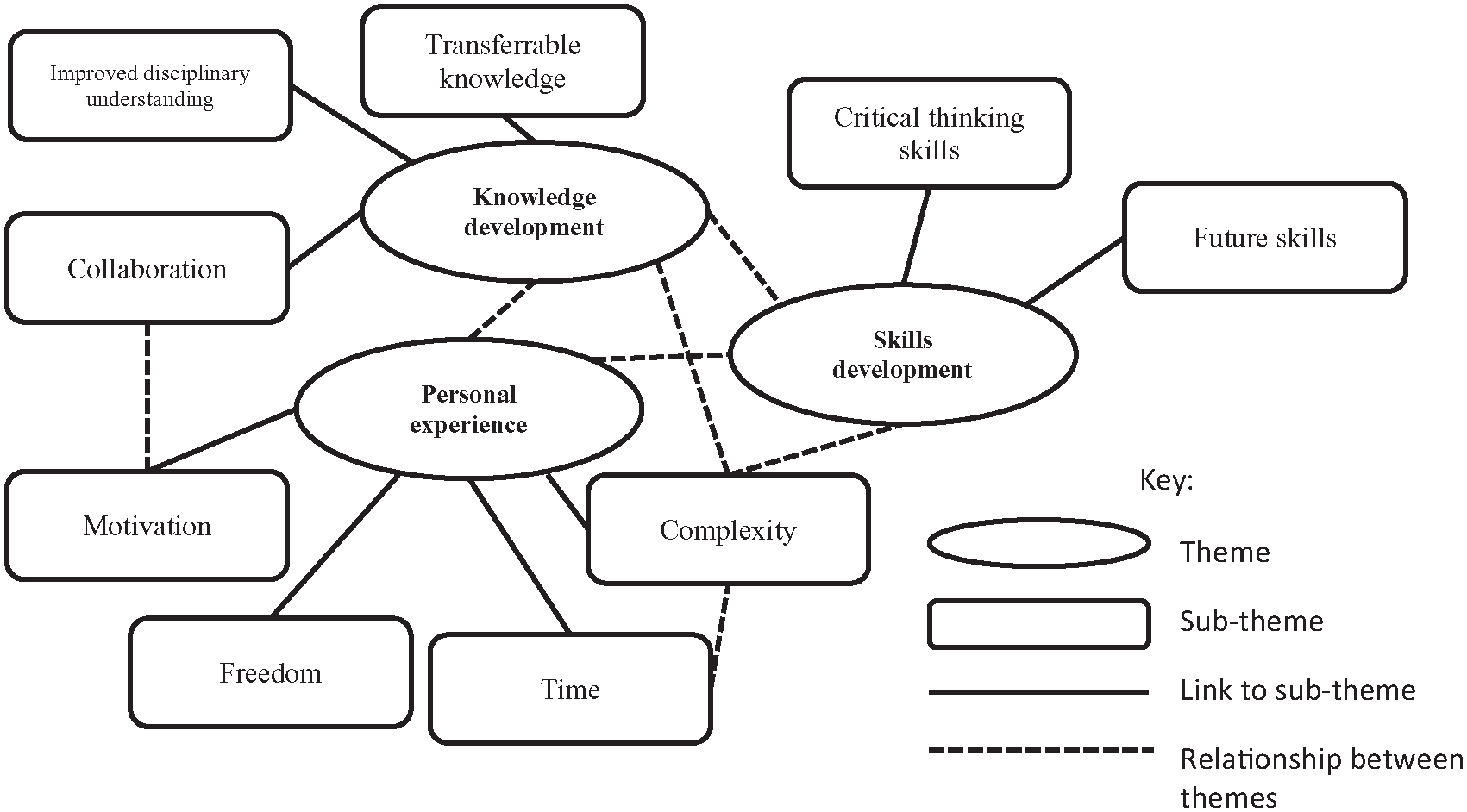
Thematic Map of Key Findings.
Key Findings
Findings are organized into higher-order themes: (a) knowledge development, (b) skills development, and (c) personal experience. Interconnected subthemes were identified as illustrated within the thematic map (Figure 2). Each theme is presented, evidenced, and discussed within the following section.
Knowledge Development
Participants noted the value of integrating different disciplinary knowledge and alternate perspectives in addressing learning objectives, resulting in improved disciplinary understanding. This supports the ideas of T. Levin and Nevo’s (2009) transdisciplinary principles to achieve such aims:
Connecting different topic disciplines gives a more comprehensive understanding of the subject as it encouraged [me] to think more broadly . . . as opposed to thinking of each section in isolation. There was a lot to learn, but it was made easier once you understood how things connected. (Natural sciences student)
Opportunity to demonstrate improved disciplinary understanding within assessment activities is emphasized by Drake and Reid (2018). Derry and Fischer (2005) advocate how assessed tasks that facilitate knowledge integration and engage metacognition in the pursuit of understanding real issues enhance the learning experience. The significance of doing so was reflected upon:
It was a meaty assessment, something to really get my teeth into. I felt that what we learnt in the lectures and seminars really helped, it was clear how they both contributed to the assessment. It was challenging, but being able to present a solution to a problem I was interested in I felt really did push me in my understanding of the topics but also how I applied them to the investigation. (Sports sciences student)
A key advantage of the transdisciplinary learning experience was the ability to engage with and develop transferrable knowledge, resulting in increased accessibility to topics that where initially unfamiliar to many (Derry & Fischer, 2005). Reliance upon “own” discipline-specific knowledge to remove boundaries and engage with the module was commented upon:
It allowed me to analyse and understand [the module] from different perspectives which perhaps I didn’t initially consider. Also, coming from a sports degree helped me adjust to the module in a more transferable manner as I could pull previous knowledge from my sport psychology module for example to help understand consumer psychology. (Sport sciences student)
Knowledge and understanding can be developed further via the construction of an investigatory team or learning community (Garrison, 2013). This encourages critical debate and sharing ideas when solving problems (Cleveland-Innes et al., 2018). The value of collaboration, particularly collaborating with students from different or unfamiliar programs who possess alternative views and bring with them new knowledge, was recognized as a key advantage to the learning experience:
There were a lot of students from different departments studying different topics which made group discussions rather interesting as people were able to share their own perspectives on the tasks using ideas from their own discipline. This made the activities rather interesting, and I learned a lot from this. (Psychology student)
Supporters of transdisciplinary learning claim that reliance upon insular disciplinary knowledge or defined avenues of inquiry limit attempts at furthering understanding or addressing complex real-world problems (Bernstein, 2015). Similar sentiments were also shared by participants, where value was attributed to an unrestrictive learning approach:
It allows students like me to gain a comprehensive understanding of the module and thus enable us to advance our critical thinking skills as it requires us to not only identify the links between the varied topics, but also explain how they’re connected. I think it’s quite important for students to engage in a learning style that doesn’t restrict them to one perspective. (Business management student)
Skills Development
A transdisciplinary approach facilitates higher-order skills development, particularly within the many facets of metacognition (Budwig & Alexander, 2020; T. Levin & Nevo, 2009). Offering students opportunity to address complex, real-world challenges via theoretical knowledge integration within activities was recognized as a method to build valuable critical thinking skills:
Critical thinking was one of the most fundamental skills needed for successful participation. Although a basic understanding of the theoretical concepts was essential, the workshop relied on us to be able to apply this to real-life problems and offer our explanations for the issues. (Business management student)
Engaging in activities designed to encourage criticality allowed for other complementary personal skills to be developed. This included scholarly independence and confident exploration (McGregor, 2017). This complemented structural knowledge development (J. T. Klein, 1996), as one participant reflected,
The ability to critically assess sources and information is paramount if one wants to do well. Similarly in work the ability to have confidence in not knowing something about a certain topic and being able to go away and research and return with a coherent argument for a question or issue is a valuable skill. (Economics student)
Grounding the learning experience and associated activities within complex, real-world issues orientated participants to the future, where the value of understanding how organizations may engage in similar methods of problem-solving was recognized:
This practical project was particularly useful as it felt like a window into knowing how a real-life business operates. It gave me a realistic view of how they go about identifying and presenting solutions. I think this will come in useful. (Business management student)
A preparedness for the future is regarded as a demanded characteristic of both students and employers alike (Schlee & Karns, 2017). Participants reflected positively on activities designed to simulate experiences they may encounter in their future employment, noting specifically,
Addressing real-world issues is massively beneficial because it allows one to apply their knowledge to a situation that is likely to occur in a business setting. This gives the student a more realistic approach when analysing creative solutions to issues. (Business management student)
Personal Experience
A final key theme emerging from the data was the experience of studying a transdisciplinary module itself, where participants noted differences when comparing the module with that of others. Increased personal engagement and commitment to the study experience was observed within responses, with participants commenting how refreshing the module was:
The module felt open and free which kept things fresh and interesting. Sometimes you’d go into the lectures and not know what to expect next, which kept me coming back. Just having that variety alone helped me understand things a lot better. It was a rather different experience. (Business management student)
Positive reflections on both intellectual and investigatory freedoms were observed throughout discussions, a recognized advantage of transdisciplinarity (T. Levin & Nevo, 2009). Participants noted how the unrestricted methods of inquiry and an ability to choose topics of interest enhanced personal development and the wider learning experience, particularly within assessment:
[The assessment] gave me the freedom to engage with a variety of theories and topics that I found interesting and that I was confident in knowing and using. I really found the autonomy of the assessment refreshing whilst being able to showcase my skills. I felt I put more effort into this assessment. (Psychology student)
The full benefits of transdisciplinarity are only realized if a student is committed and engaged (Jansen et al., 2019). Varying levels of motivation were recorded within responses, with participants claiming they were motivated but observed instances where fellow students were not. This had consequences on the learning experience. From a self-regulated learning perspective, increased motivation within assessment activities was noted:
I felt I was more motivated to complete this assessment than others I’ve done as I was able to choose something I was passionate about and interested in. It made it more enjoyable. I don’t like being spoon-fed. (Natural sciences student)
However, not all experiences were encouraging. Disruption occurred where students were not behaviourally or motivationally active in their learning, particularly during collaborative, community-based activities. This caused detriment to the experience of others. As such, a key vulnerability to the method was uncovered:
The group activities required students to be fully engaged, active and willing to participate to complete the tasks. But if people did not understand the core topics then it either took longer for them to get caught up to speed which wasted time, or they would not be able to share and contribute. (Law student)
Nevertheless, methods were employed during collaborative learning activities to boost engagement where possible, particularly within synchronous small-group sessions. This included empowering students to rely upon their own disciplinary knowledge to aid debate or lead discussions. These methods were considered advantageous, as one participant remarked,
The workshop’s intended purpose of boosting engagement from all students is undoubtedly significant, particularly for students that are too shy to contribute or international students that may not be as confident in their language abilities. I think this learning style fosters a more engaging environment for all students. (Social sciences student)
Complexity was an emotive sub-specific theme observed. This was poignant to the personal experience of students but relevant to the wider facets of this transdisciplinary approach. Transdisciplinarity, by definition, seeks to address complex challenges (Stember, 1991). What results is a complex pedagogy and possible unfamiliar learning experience when applied to the curriculum. It requires both multidisciplinary knowledge and personal characteristics that may not be suited to all types of learners, given the diversity of learning styles that may exist within a cohort (Park & Son, 2010). Regarding disciplinary knowledge in particular, one respondent reflected,
Incorporating multiple disciplines can perhaps be confusing and overwhelming at times as there is a range of subject areas to learn and focus on. I became distracted by the different perspectives and lost sight of the overall objective at times. (Law student)
Negative feelings or emotions experienced during the study experience were recorded, with particular reference to the nonlinear and undirected methods of inquiry that defines a transdisciplinary approach. These emotions were often heightened during individual activities:
It was sometimes difficult to determine which theories and frameworks were relevant to the assessment. There was some uncertainty whether I was linking them to the assessment in the right way which made me nervous and anxious. It was a bit complex. (Business management student)
Integrating multiple theoretical and disciplinary perspectives in the pursuit of solving problems is a key cornerstone of any transdisciplinary investigation (T. Levin & Nevo, 2009), although was another facet that participants considered complex:
Not only was I expected to grasp the core theories, but I then had the added complexity of having to think about how the different sections connect and interact with each other. I felt myself having to take the time to read more on this module when compared to my others. (Business management student)
Although many critical reflections were acknowledged regarding the complexity of the learning experience, participants also recognized the value of being challenged by a learning style that developed broad knowledge and personal skills:
I found this learning experience both challenging and fascinating. It allowed for flexibility and the application of different ideas to serve a unique purpose. Despite its complexity, engaging with this subject has led to a significant expansion of my knowledge. (Economics student)
One final subtheme emerging from reflections regarding the personal, complex study experience was the importance of time. Critiques of transdisciplinarity argue that superficial knowledge is only ever produced when integrating different disciplines within a curriculum (Drake, 2012). Such issues may be compounded if sufficient study time is unavailable for students to fully engage with, or benefit from, the complexities of a transdisciplinary approach. Curriculum design considerations are important, but the amount of time to engage with it appears to be a key concern, as one participant noted,
Longer teaching time of this module was needed. Limited to only one term impacts what can be achieved during this time. It might be more basic instead of the in-depth exploration of broader topic disciplines. If students only know little about the subject or don’t possess enough knowledge at the beginning, it’s going to take even more time to learn the key topics. (Social sciences student)
Discussion of Key Findings
The results from this exploratory qualitative investigation provide both critique and practical considerations of a transdisciplinary learning experience. To address the initial question posed at the beginning of this article, findings indicate how a transdisciplinary learning strategy of the past can assist in the development of skills, qualities, and experiences required to deal with anticipated challenges of the future. The findings are presented in the context of graduates and employers reporting a lack of personal attributes that contribute to a perceived unpreparedness for employment (Belkin et al., 2023; Pauli, 2021; M.-S. Smith et al., 2023). The following section discusses the impact of a transdisciplinary approach to curriculum development, with research questions provided to build upon the findings and direct future avenues of investigation.
First, conceptualizing activities as real, complex issues requiring creative solutions offered key advantages to students when applying theoretical knowledge to practice. A connection to reality grounded the transdisciplinary learning experience and was valued among participants. The associated methods of inquiry into real issues simulated authentic business practices, instilling a sense of preparedness and considered a window into genuine, anticipated activities within future careers. Subsequently, the first research question to develop these observations and expand transdisciplinary education literature is identified: Does simulating real investigative business and marketing practices within transdisciplinary learning activities develop a preparedness for future employment? Incorporating fundamental and functional multidisciplinary components of marketing practice within learning activities that simulate authentic business activities may offer applied pedagogic solutions in response to both graduate and employer concerns of lacking experience or readiness for employment. A deeper, empirical understanding is recommended to identify if insights of business operations offer practical benefits to students and allows for the aims of a transdisciplinary curriculum to be achieved.
Second, the value of personal and transferrable skills development, particularly when engaging with synchronous or asynchronous activities, was another key finding. Participants reported increased confidence during independent research or assessment activities, partly supported by possessing investigatory freedoms when solving problems. Similarly, collaboration activities that required discussion, defending personally held knowledge or ideas, and working together toward shared goals further developed communication and team skills that were recognized as having wider relevance. These findings offer a second research question: Do the development of personal skills such as metacognition, critical thinking, or collaboration resulting from a transdisciplinary learning experience have wider consequences during studies or future careers? There is opportunity to critically explore how transferrable skills relevant to both study and employment can be effectively developed and nurtured within transdisciplinary curricula. A longitudinal study that seeks to explore the wider consequences of effective personal development strategies or an empirical study that examines the employability of graduates as an outcome of a transdisciplinary educational experience are just some opportunities for future investigation.
Finally, the process of constructing multidisciplinary personal knowledge and understanding was regarded as another key component of the learning experience. Facilitating this were activities that allowed students from different disciplinary backgrounds to engage, share, and debate. Given the collaborative activities that underpinned the transdisciplinary curriculum, a final research question is offered: Is a constructivist approach to facilitating knowledge development within a transdisciplinary curriculum the most effective learning strategy, compared with other learning frameworks such as behaviorism or cognitivism? The primary goal of transdisciplinarity is to allow students to engage with and connect topics at a much deeper level of learning (Stember, 1991). Constructivism is a recommended learning theory to achieve these aims (T. Levin & Nevo, 2009) and adopted within this study. However, other theoretical frameworks of developing learner knowledge and understanding exist. There is opportunity therefore to critically explore and evaluate the individual components that support a transdisciplinary learning experience, including what underpinning learning framework is the most effective in achieving transdisciplinary aims. Furthermore, studies that capture comparative academic performance with other non-transdisciplinary curriculums may assist in grounding claims. This would develop understanding into whether transdisciplinarity offers not only perceived value as captured within this study, but also actual value in terms of measured, assessed skills and wider academic performance. An awareness of these two distinctly different value constructs is vital to contributing to any research seeking to develop marketing education strategies (Bacon, 2016).
Practical Considerations for Educators
The findings also revealed design and implementation considerations necessary for a transdisciplinary curriculum. Participants noted the complexity of the module within all areas of questioning. Solving complex societal problems increases the complexity of the learning experience itself, as knowledge becomes integrated from both multiple theoretical disciplines and lived experiences. A nonlinear delivery of a transdisciplinary curriculum to encourage freedom of thought and unrestrained methods of inquiry is often advocated as a learning design strategy (Freire, 1970; Grundy, 1987; T. Levin & Nevo, 2009). However, participants reflected upon the complexities that such approach engenders. In response to the practical concerns observed within the findings, recommendations for educators are offered in the following section.
Freedom, autonomy, and creativity are the central tenets of a holistic approach to transdisciplinary curriculum design (Jeder, 2014). However, participants reported feeling overwhelmed by the multitude of exploratory possibilities afforded to them. Furthermore, an uncertainty of knowing if what was being produced was correct or expected compounded issues. This often resulted from the autonomy students possessed in selecting relevant disciplinary knowledge to complete activities. A recommended solution is to encourage students to begin any inquiry from the perspective of their own discipline first. Approaching activities by grounding them within the familiar and utilizing already held knowledge from the outset, students can then build confidence to expand their inquiry outwards into new, unfamiliar directions. This creates connections between other disciplines and overcomes practicality concerns of augmenting multiple disciplinary concepts within a transdisciplinary curriculum (Augsburg et al., 2013).
Sufficient time to explore, critique, and assimilate knowledge or develop understanding is required. Otherwise, unrealized potential from a superfluous learning experience could impede efforts (Fishman et al., 2014). To address concerns regarding the time available to engage with an unrestricted learning approach, the educator may be tempted to define the boundaries of exploration. Doing so, however, would deny the flexibility and freedoms required of a pedagogic method that necessitates an unrestrained inquiry across disciplinary boundaries (S. A. Levin, 1999; T. Levin & Nevo, 2009; Russell et al., 2008). To overcome this practical paradox and instead of defining boundaries, it is recommended that students are supported in the personal skills required for critical exploration. For example, encouraging students to define key objectives of their exploration and planning effectively beforehand will likely create a focused investigation that has achievable aims. Such efforts would seek to guide the student yet allow them to recognize when the outcomes are achieved or when to stop.
Another key finding was how unengaged students disrupted the learning experience of others during collaborative activities. Students must be behaviourally and motivationally engaged in what is possibly an unfamiliar learning style, yet this unfamiliarity may contribute to disengagement. It is vital that the educator promotes equal contribution among students, as findings indicated that an engaged team increased accessibility. Effective collaboration within learning activities empowered students who may have otherwise remained silent. This demonstrates how a transdisciplinary approach may provide equitable access or reduce barriers to learning, a recognized area of importance within social justice education research that ensures all students have an equal chance at participating (Burgh & Yorshansky, 2011; Mueller Worster & Rohde, 2020). It is recommended, therefore, that strategies are employed to establish principles of respectful debate and team working before any activity is initiated. This may include agreeing principles of student commitment and contribution from the outset or develop mechanisms to monitor discussions. Furthermore, opportunities that allow students to take ownership of their knowledge and share their findings may also foster increased contribution.
Limitations
This research offered a critical exploration of a transdisciplinary approach to curriculum development. However, a recognized contextual limitation lies within the disagreement of what exactly a transdisciplinary curriculum is, including its scope or design. Limited recommendations for assessing its impact on student learning and performance also exist (Fortuin & van Koppen, 2016; E. Smith, 2011). Such ambiguity makes it difficult to fully claim if the learning experience offered and under critique within this investigation is a true and actual account of a transdisciplinary approach. Interchangeable definitions regarding metacognition, critical thinking, and self-regulated learning (Azevedo, 2020) may also limit the claims presented. Defining the components of the learning experience under investigation within this study attempts to overcome these limitations by providing accounts of the pedagogic design, learning experience, and associated perceived value claims.
The methodological limitations are also acknowledged, specifically as the study employed a non-probability sampling approach and therefore is not representative of the entire population (in this case being the student body). Future studies may adopt an empirical approach to obtaining claims of value using a representative sample strategy to complement and build upon these findings. Although the relatively small sample size limits the opportunity for wider generalizations of the results presented, this article sought to contribute to a renewed interest and advance discussions of a transdisciplinary experience (Budwig & Alexander, 2020). Along with the research questions offered, this article echoes the call of Horn et al. (2024) for further investigation of transdisciplinary programs.
Conclusion
Although inherently complex, the immense development and execution required of a transdisciplinary curriculum is arguably offset by the advantages offered to the learner. As this study has found, this includes instilling learners with a preparedness for the future as an engaged citizen, fostering a mindset calibrated to identifying complex societal problems, and deploying a suit of disciplinary knowledge and metacognitive skills to deal with the challenges of tomorrow. Opportunity exists for educational researchers to critically evaluate and contribute to a renewed interest in transdisciplinary curriculum development by considering the research questions within this article. Teaching facilitators seeking to offer a transdisciplinary experience may wish to consider the practicalities of doing so given how time, complexity, and other institutional factors can be potential barriers to successful implementation. By critiquing the key components of a transdisciplinary curriculum, this article seeks to provide an increased understanding of a learning approach that offers advantages both within and beyond the classroom.
Footnotes
Declaration of Conflicting Interests
The author(s) declared no potential conflicts of interest with respect to the research, authorship, and/or publication of this article.
Funding
The author(s) received no financial support for the research, authorship, and/or publication of this article.
