




Abstract
In this paper we take stock of the current state of People Analytics and identify ways to increase business impact. We suggest a fourth wave of people analytics, which focuses on impact in MY company, not compared to someone else (benchmarking, reporting), not just mimicking someone else (best practice), and not being enamored with the research methodologies (predictive analytics). This pivots people analytics towards answering questions of value to your key stakeholders (employees, senior management and boards inside and investors, customers and communities outside the organization) instead of questions mostly relevant to HR professionals or regulators. We outline a guidance framework for how people analytics can help shape practical solutions for your company to outperform in areas relevant for you. We argue a focus on guidance will amplify the business impact of people analytics, making it more relevant for management actions.
Introduction
People or HR analytics has received increased attention because people and organization are more central to business results (Farndale et al., 2023; Ferrar & Green, 2021; Storey & Wright, 2023). More macro, classic human capital theory (Becker, 1964) explains how analytics helps firms allocate scarce resources (Barney, 1991; Collins, 2021), reduce transaction costs (Coase, 1937; Williamson, 1981), manage information and signals (Guest et al., 2021), make evidence-based decisions (Boudreau & Jesuthasan, 2011; Rousseau, 2006), and adapt to contingencies (Luthans & Stewart, 1977).
At a more micro level, analytics also informs the impact of choices and options of HR development practice areas (Jabarkhail, 2023) including training and development (Baldwin et al., 2017; Garavan et al., 2015), career development (Kenny et al., 2018), diversity, equity and inclusion (Byrd, 2018), cross cultural human resource development (Rahmadani, et al., 2019), employee engagement (Saks & Gruman, 2014) and sustainability (Egan & Kim, 2023). All of these HRD activities are going through change (Torraco & Lundgren, 2020) where analytics can help improve decision making.
While theories to explain why and how analytics operates have grown (Wright & Ulrich, 2017), so has attention to the practice of analytics. People analytics (by whatever name: business intelligence, evidence-based management, decision science, or HR analytics) has burgeoned with increased research and training for HR professionals (Ulrich et al., 2021), people analytics conferences, think tanks, numerous research reports from many audiences (academics, consultants, practitioners, research centers, producers of people analytics software), and even daily (Behbahani, 2023) and monthly (Green, 2023) summaries of the extensive people analytics efforts. These practice-focused analytics efforts encourage data access and reporting to improve decision making.
While there has been increased theoretical attention to and practical application of analytics to both HRM in general and HRD in particular, Rasmussen and Ulrich (2015) warned that people analytics could become either a theoretical void or a management fad if it took only an academic theory or data reporting approach. We want to help move people analytics forward by turning theoretical insights and data reports from merely providing insight or information to having increased business impact (Anwar & Abdullah, 2021; Duncan, 1974), for example, by identifying how hiring, promotion, training, and rewards initiatives for frontline customer support employees lead to an improved employee experience (via better retention, capability and engagement) and through that to better customer service, serving both internal (employees, executives) and an external stakeholder (customers).
Linking Data Insights to Sustainable Impact
Simply having data and insight does not guarantee sustainable impact. For example, there are 1000s of studies about having a healthy lifestyle (nutrition, exercise, sleep, social connections), but physical and mental health continue to decline in the developed world. Even more insight on a healthy lifestyle is not likely to make a huge difference on individual behaviors – people know broccoli is healthier than ice cream but still eat almost 3.5 times more ice cream than broccoli per year (20 vs. 6 pounds). Insights on a healthy lifestyle lead to impact when the information is used with a clear ‘so that?’ (e.g., I will walk the dog three times per week in the morning, so that I increase my energy levels and find it easier to eat more healthy food).
Likewise, regarding people analytics, moving from data-based insights to ideas with business impact will require answers to the “so that” question about analytics as well as different skillsets and focus. The “so that” addition focuses on the implications and outcomes of an activity. Advancing analytics to have more business impact comes from the connection between a primary focus of some academics to provide insights on generic causes with analytical and statistics rigor and significance (Wright & McMahan, 1992) and HRD practitioners (who improve specific business performance via optimal use of human resource interventions). Increasing science and rigor in HRD practice makes sense, but business impact is too often overlooked or overshadowed by tracking activity metrics (ISO, 2018; Naden, 2019) more than stakeholder outcomes (Ulrich, et al., 2012). Most people analytics teams still spend 80% or more of their time analyzing data to produce simple reports, often tracking and comparing past activity (training, recruitment, internal movement, diversity, attrition, headcount, cost, etc.) or employee attitudes and perceptions through recurring surveys, and rarely analyzing to create practical interventions for how investments in HR activities create stakeholder value (Peeters et al., 2020; Ulrich et al., 2017). The impact of interventions on stakeholder value is too often only an afterthought to the descriptions derived by people analytics, not sufficiently answering the ‘so that?’ question that focuses on the outcomes of an activity not just the activity. For example, instead of just reporting training, recruitment, or internal mobility activity data, add the “so that” to each insight for example, we will invest X money or days of training so that employee productivity, strategic revitalization, customer share, investor confidence, or community reputation goes up Y percent.
A decade ago, the allure of people analytics caused many to start collecting data to respond to the calls to be in the information age and was made simpler with the spread of Cloud ERP systems housing most people data. Indeed, companies have more access to people-data and technology than ever before (McCartney & Fu, 2022), however, just collecting and analyzing data does not mitigate five analytics risks still associated with people analytics (Rasmussen & Ulrich, 2015): 1. The analytics on analytics research suggests that just having more information does not improve decision making and impact. Going from insights to action requires considerable business knowledge and stakeholder management skills often lacking in people analytics teams. The risk of more data without impact is that people become cynical of endless reports and surveys with fewer results (Cascio & Boudreau, 2015). 2. More data, even with technology and digitally enabled access to data (generative AI e.g.), does not necessarily improve performance. Asking the right questions with a starting point in the business or stakeholder relevance is what drives analytics with impact, not quantity of data analyzed (Boudreau, 2010). The risk of analytics before questions leads to what we call warehouses of data that do not have impact. 3. The gap between academic rigor and managerial relevance is larger than ever (Harley, 2019). Too often, academics focus on elegant theory and meticulous research that says more about narrower problems while business leaders seek timely solutions that are relevant and doable. The risk of disconnecting theory and practice is that neither has full impact. 4. Analytics done by a small group of technical researchers working in isolation from business realities continues to create a disconnect between analytics and business needs (Agrawal et al., 2020). The risk of analytics experts being isolated from the business is more rigor and less relevance. 5. Analytics often tests what has been rather than explore what could or should be. Often predictive analytics is more about interpreting the past than creating a future. The risk is that the past may not be a prologue to a changing future.
These five risks (and others) continue and while the requirement for and preponderance of potential for people analytics to create value is higher than ever, the realized impact often lags. We propose a logic of how to move analytics forward so that the insights from theory and research have real and sustainable impact, not just by the data that is produced but also by the value created from the information. People analytics will have more impact when it focuses on differentiated value generation for key stakeholders, leading to improved decision making.
Evolution of People Analytics
One of the reasons that people analytics continues to lag in the value creation paradigm is that the logic of people analytics remains rooted in the past, focused on producing metrics and reports because that’s what everyone has always done rather than exploring how data analytics could deliver stakeholder value. We see three common stages or outcomes of doing analytics that fail to live up to people analytics’ potential: 1. 2. 3.
As we noted, these traditional analytics approaches primarily measure activity more than outcomes. We want to suggest a fourth wave of analytics that builds on these previous waves, and that focuses on impacting the future of MY company, not just comparing to someone else (benchmarking), not just mimicking someone else (best practice), and not being enamored with what worked in the past (predictive analytics).
A focus on impact starts with the value a firm wants to create for all stakeholders inside an organization (employees or strategic realization) and outside (customers, investors, and communities) (Phillips & Phillips, 2022). This perspective pushes people analytics to consider stakeholders that traditional HR activities often overlook. When people analytics exclusively focuses on understanding the needs of employees or other HR professionals, its potential impact will be limited to these stakeholders. People analytics will have its greatest impact when it recognizes its impact can extend to all business stakeholders, including customers, communities, investors, directors, senior executives, and other individuals or groups affected by the firm (Chang & Ke, 2023; Laplume et al., 2008), and not just employees or other HR professionals. This process begins by understanding the interests and values of each stakeholder type.
By starting people analytics with the question of how stakeholders receive sustainable value, analytics is less about what is or has happened and more about the impact of what could and should happen. When people analytics can demonstrate stakeholder value, it becomes a decision tool for improving choices and investments. Knowing the impact a company wants to create with its key stakeholders, leaders can then source and analyze data to determine which initiatives or investments will deliver the desired results. Using the healthy lifestyle metaphor, individuals who start by defining what healthy means to them may be more likely to identify the habits and actions that work to help them reach their goals. For some this may be more exercise, for others better nutrition, and yet for others more (or less) socialization. Likewise, to have impact through people analytics, leaders are less worried about comparing themselves to others, stealing ideas from others, or using the latest statistical tools and methods, and more focused on how they can achieve goals they care about for them and their organization. We call this guidance for impact, and it builds on and moves beyond benchmarking, best practices, and predictive analytics to inform decision making that delivers value for your company. This information can then be used by senior executives to prioritize human capability investments, boards of directors to oversee an organization’s culture, and investors to monitor intangible value and reduce investment risks.
Where to Start to Have Guidance for Impact
Impactful people analytics does not start with data, methods, technology, or statistics but identifying relevant and important business problems by asking critical questions (Barends & Rousseau, 2018). Without asking the right questions, the answers and insights people analytics provide may lead HR and the business towards the wrong targets. Too often people analytics explores the wrong questions. Sometimes this occurs with obvious studies (e.g., toxic cultures create negative outcomes; working remotely leads to loneliness; good team leaders matter; people should treat each other with respect), studies on somewhat trivial topics with marginal potential benefit (e.g., using a 4 or 5 point Likert scale to measure performance; differences between 9 or 12 items measures of engagement), or studies of phenomenon that are already well understood (e.g., causes of turnover; participation in decision making). To use analytics for guidance, relevant questions include: How well do we understand the outcome we care about? Is delivering this outcome something worth learning more about? How will what we learn help deliver outcomes that matter to key stakeholders?
The right questions often start by exploring stakeholder value and what each stakeholder might want from their interaction with the organization. Figure 1 (Charan, 1998, 2021; Kottler & Lee, 2004; Ulrich, 2015, 2022; Ulrich et al., 2015; Ulrich & Smallwood, 2007) identifies seven stakeholders who receive value from human capability investments. Research reported for each stakeholder identifies what each stakeholder values from improved human capability (including HRM overall and HRD) investments. People analytics stakeholder framework.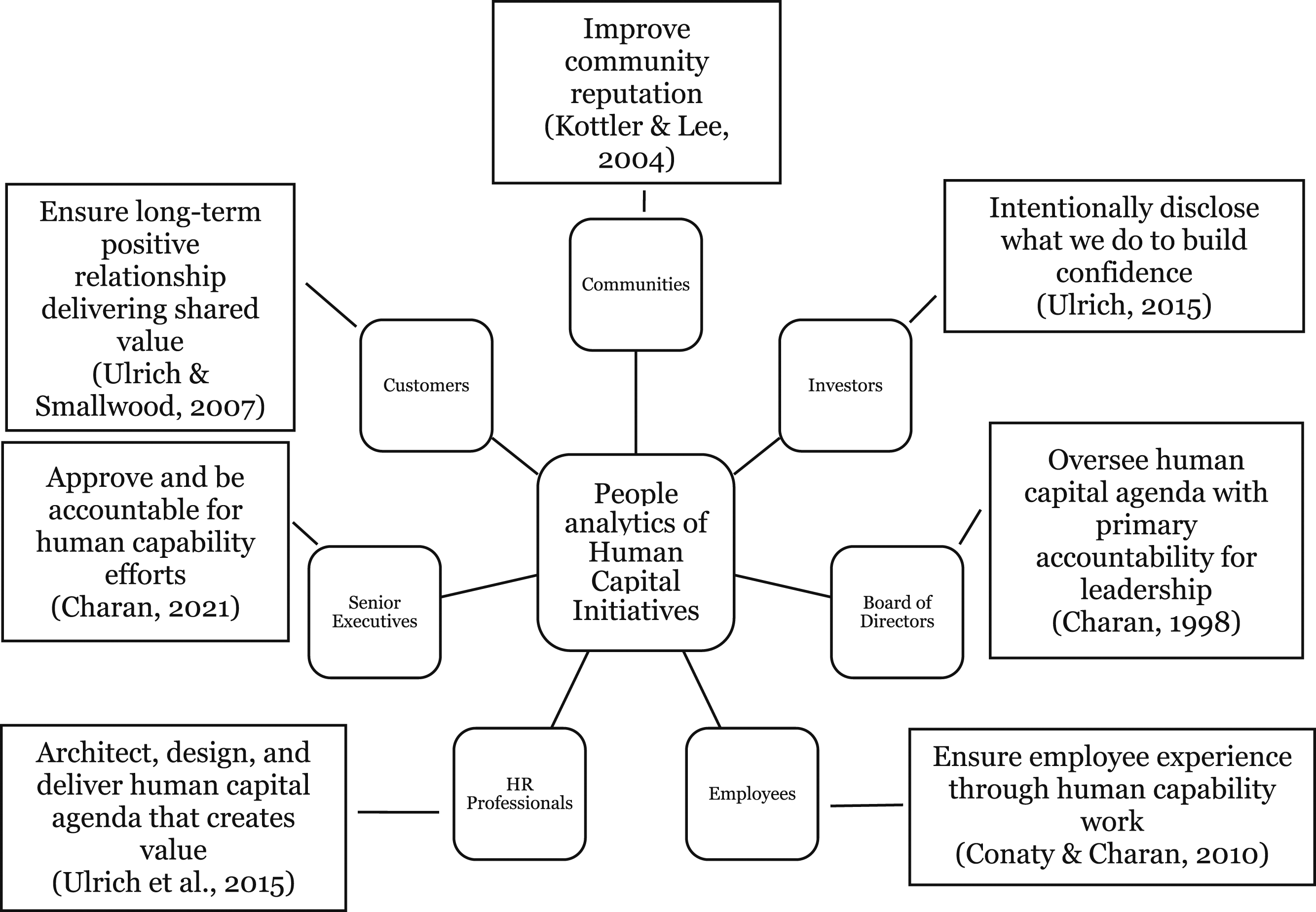
By starting with stakeholders’ desired outcomes, analytics can help determine which human capability initiatives will most impact stakeholder value. For example, will customer share (measured by revenue per customer) or investor confidence (measured by stock price or cost of capital) increase more by upgrading individual competence and talent (investing more to hire the right people, implementing new compensation systems, paying attention to diversity, increasing employee experience, improving learning interventions) (Conaty & Charan, 2010), leadership (defining leadership competences, developing new leadership trainings) or organization capabilities (investing more in delivering innovation, building culture, using technology, creating strategic purpose, or moving with agility)? Each of these human capability initiatives can be measured, then the relative impact of each initiative on desired outcomes can be assessed to guide decisions regarding these initiatives.
What to Measure?
Starting with questions about stakeholder value (dependent variables), impactful people analytics research uses a host of independent variables defined as initiatives in human capability (talent, leadership, organization, or HR). Using analytics to test human capability initiatives on stakeholder value goes beyond descriptions to provide prescriptive guidance (Ulrich, 2022b). Descriptions benchmark others; prescriptions link HR practices to outcomes and guide decisions that will result in positive impact, for example, what is the impact of an HR practice on employee, business, strategy, customer, or investor results. This information helps with the “so that” question that focuses on outcomes of investing in the activity: If we invest X (money, attention) in Y (human capability initiatives), we will likely get Z (stakeholder outcome).
People Analytics Methods, Data, and Outcomes.
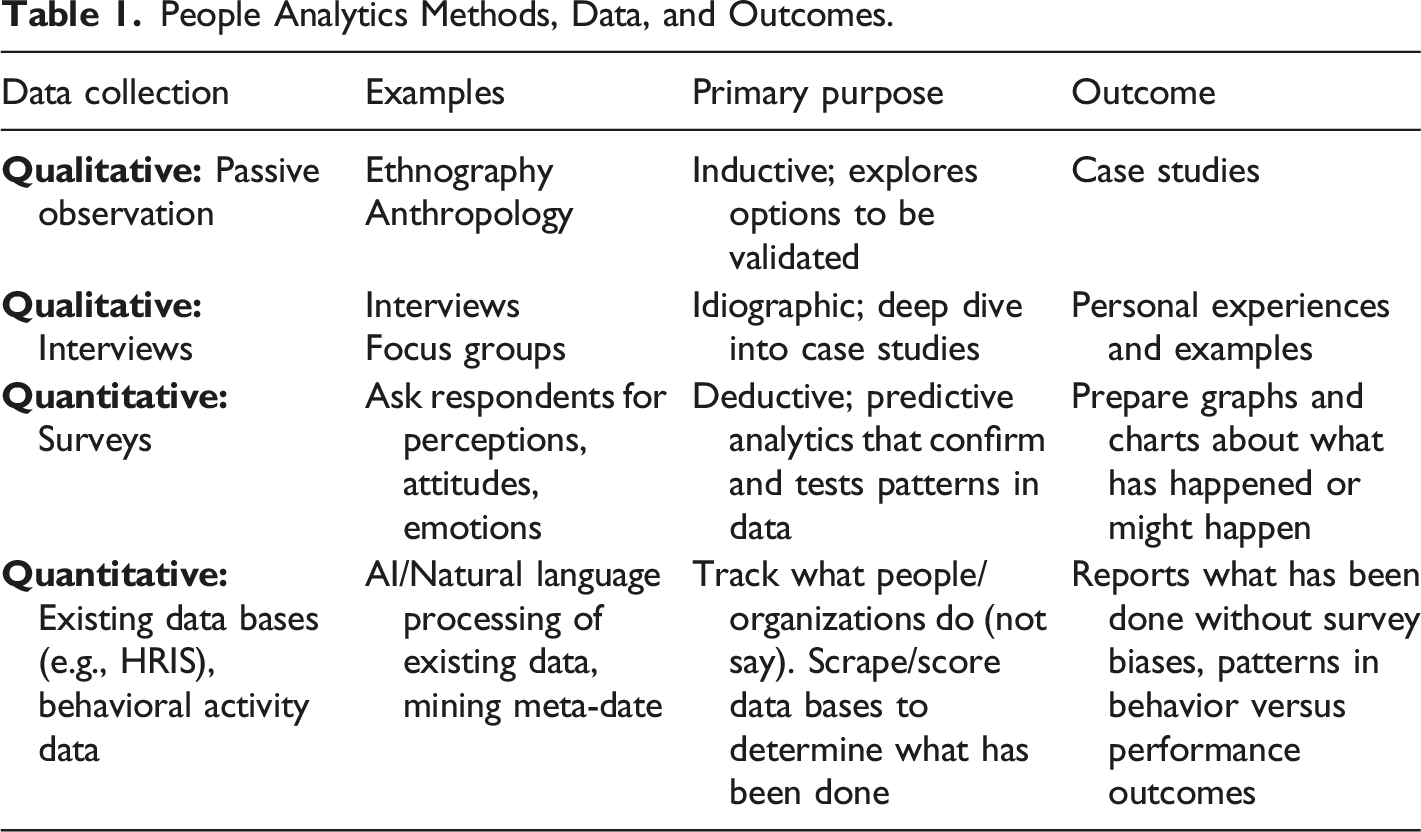
Currently, people analytics over-relies on survey/self-reported data that often misrepresents say-do gaps that are well documented in the academic literature (e.g., Rynes et al., 2004). These say-do gaps are often key entry points for powerful interventions. An example is leaders self-reporting how much time they spend in 1-1 conversations with their direct reports, often stating they do so weekly, versus behavioral data (e.g., from mining calendar meta-data) showing 30% only have conversations every 6 weeks (with the intervention being to showcase actual 1-1 time to those leaders to increase the frequency and quality, with positive impact on employee engagement and customer satisfaction, as the key stakeholder outcome).
The one thing people analytics must do to create impactful insights is to include outcome data: customer satisfaction or share, financial performance, safety performance, operational excellence, sales revenue, share price, community reputation (social citizenship), and other stakeholder outcomes. These business outcomes determine what the people analytics story needs to lead with: to increase Y business outcome X%, you need to pull A, B, and C HR levers, and this is what that would look like and cost in our company. When analytics links one HR variable to another (e.g., employee engagement → how leaders are rated by their teams) there may be little business relevance so few business leaders care. But business leaders will care if analytics show how better leaders drive team engagement which leads to better safety, higher customer satisfaction and sales revenue for the company. The key questions to ask are: what outcome measure (or stakeholder value) matters most? How can investments in human capability impact this stakeholder outcome? What would the intervention look like to improve outcomes? What do the possible interventions cost? By considering these types of questions, you begin to build the key elements of an impactful business case fueled by insights from people analytics.
People analytics can also increase the value delivered by more complex interventions and leverage multi-level modelling—when data about individuals, teams, units, organizations, or time periods are integrated into the same analysis—instead of looking at individual, team, organizational outcomes separately and in isolation (Alfes et al., 2021). Individuals are part of teams within an organization, and organizations operate within industries and geographical regions. Effect-sizes are often nested and often mutually dependent across these levels. Multi-level modelling also makes it easier to create practical interventions with elements at different levels simultaneously, and often yields new insights (Katou et al., 2021). A great example is the research on team psychological safety by Higgins et al. (2020), counterintuitively showing that team level psychological safety hurts performance when not supplemented by organization wide felt accountability for performance delivery. People analytics teams need to be mindful that individual, team, and organization level effects in some cases don’t all serve stakeholder needs, and to make the right trade-offs when recommending interventions.
How to Organize and Use Information?
Turning complex data into information that impacts stakeholder value becomes a critical part of the analytics process. Moving from data to insights requires a clear sense of the theory of why strategic HRM and HRD matters (Jiang & Messersmith, 2018). From the theory, information can be prepared and reported that has an impact (Salian, 2023). It requires showing the financial impact of human resource initiatives (Cascio & Boudreau, 2015). Sometimes, research reports share data in charts, figures, or graphs that are not readily interpretable. We have found that information shared should be tied to the research question, and intuitive to interpret for people not trained in scientific analysis — there’s little purpose in reporting complicated tables or figures if your audience can’t understand them.
As noted above, research questions are generally about decisions or choices leaders make to increase stakeholder value and offer insights on how the information can inform the decision. We also find it dangerous to overstate the findings. This is often seen in so called whitepapers from consultancies, that tend to find effect sizes that are 10 times greater than what can be found in peer reviewed research (and is thus essentially marketing material masquerading as rigorous science, e.g., when McKinsey states that increased scores on their Organizational Health survey leads to a 300% increase in total return to shareholders). Most research offers a percent of impact (on the dependent variable) and should build on previous work (e.g., quote the latest meta-analysis on the topic from a top journal in a footnote) (Hamadamin & Atan, 2019).
We have found that a key to interpreting data is to tell a story that emerges from the data often with analogies to decisions made in daily life, for example, human capability portfolio choices are like managing healthy living. Like insights presented well in academia, people analytics insights are stories to be told well, and used by decision-makers as they prioritize resources, that would otherwise be spent elsewhere. That means at a minimum, a positive return on investment is needed. We have also found that the simple one-slide HR approach works well when presenting people analytics insights and the ‘so that?’, showing the suggested interventions, cost, and expected impact. Likely because the one-slide format forces the author to only show the key point (i.e., human capital interventions’ impact on an important stakeholder outcome), and not fall in the trap of presenting how formal researchers do — leaders who need to make practical decisions rarely care about all the work done, detailed explanations of the statistical methods, etc., though this information should be readily available upon request. People analytics should make easily understanding and interpreting results and implications for improved decisions as simple as possible for the audience.
Research without action is like reading how to do a hobby but never doing it. Research reports have impact when the data encourages debate and dialogue about implications for choices about how to allocate resources (money, time, attention) or create policies that have impact. The actions do not always have to be definitive, but good research should propose implications that allow for good-enough solutions that are practical to implement.
Composition and Role of PA Teams
We suggest that people analytics professionals have an opportunity to improve business performance by delivering value to key stakeholders versus supporting linear progress towards competitive norms. This requires an HR function that adds value (Jo et al., 2023; Kim et al., 2023) and does a few things well. We see these conditions as key for people analytics teams: 1. Direct access to business discussions on priorities for key stakeholders, often based on current versus aspired state. This has implications for where the people analytics team sits organizationally and how access is facilitated. Placing analytics within HR Operations, or too far down in the organization, often hampers its ability to access and share information to pursue the most value adding questions. Analytics has the most potential when integrated into multiple stages of business decisions and used by business leaders, not when operating as a separate function or activity. 2. Freedom from operational reporting and recurring processes. The bulk of time for people analytics teams should not be spent producing recurring reports with historical data or running recurring surveys, as that leaves little time for high value analytics work. An analogy is a hospital, where janitors, nurses and doctors are all needed, but it is unwise to have the doctors spend most of their time moving patients around, or to have nurses perform surgery. It may sound mundane but allowing people analytics teams to spend most of their time doing analytics, rather than routine reporting, is likely a key lever to increase impact. This may mean investing resources to outsource or automate routine reporting, freeing up resources to more value-adding work. 3. Analytics experts with stakeholder management skills and business acumen. This is likely the hardest part to fix and is often overlooked when forming people analytics teams (Ulrich et al., 2021). Deep experts in analytics are rarely also the best at gauging which questions to pursue and to tell (and sell) the compelling story based on insights to the business. The best people analytics teams may work closely with their colleagues in Internal Communication to that end. Stakeholder management skills can also be improved with training and coaching, or by making sure the expert team has strong sponsorship from and direct access to business facing HR and business executives. This can become a catch-22 for people analytics teams: business facing HR executives will not spend time with them because they don’t see high-value insights, but the people analytics team needs such access to generate them. Business facing HR executives must invest time with the people analytics team to reap the benefits, and people analytics leaders must insist on getting the access and sponsorship. 4. The courage to say no to low value analytics work. People analytics teams must focus relentlessly on the most important questions and avoid getting preoccupied with traditional analytics that have always been done because they’ve always been done, not because they matter (e.g., simple learning ROI, often finding small effect sizes; correlating one HR variable to another, which rarely is of interest to key stakeholders). We can’t expect to change the impact of analytics if we keep looking for value in the same places just because we can, not because we should. 5. People analytics teams also must be able to diplomatically share disappointing news with enthusiastic stakeholders from time-to-time. Often a proud sponsor of some initiative (say coaching training) will expect much larger effect-sizes than what happens in the real world, and from time-to-time people analytics may also find evidence that some HR activities actually have a negative return on investment and destroy value (i.e., the company would be better off not doing the activity). Grounding the work in the research on the discrepancy between what HR professionals believe impacts outcomes versus what actually impacts outcomes is a must do for people analytics teams (e.g., Wright et al., 2005).
We have found that the best people analytics teams keep an evergreen portfolio of projects, with the bulk of them addressing key questions for stakeholders and using relevant business outcome data, and often with a healthy balance of low-risk projects (i.e. where the external science shows there is a high likelihood of finding an effect size of practical relevance) and moon-shot projects (where there is considerable risk that no practically relevant effect size is found given limited research on the topic externally, but where a finding would make a major difference to key stakeholders of the company).
The best people analytics teams work closely with their colleagues in IT, analytics teams in other parts of the business (Finance, Customer Service, Strategy, Operations, etc.) and internal advisors from legal and data-privacy. People analytics must always do projects that follow the law, respect data-privacy, and are ethical (i.e., where you would be proud telling a colleague in the canteen about the project and the value it delivers to important stakeholders).
That means you need a team of highly trained experts with broad stakeholder management and communication skills, that can work well with business facing HR executives, other analytics teams, and other internal key partners. It also means that the successful delivery of people analytics is as much dependent on having the right network in the organization as the team with deep analytics expertise.
Discussion and Implications
While people analytics theory and attention has increased in the last decade, its practical impact has not kept up. Based on our work, we envision a number of implications for upgrading people analytics. 1. Make analytics part of any business discussion. As investors, boards of directors, and business executives set strategic, customer, financial, and business goals, make sure that decisions are made and resources allocated based on relevant analytics. 2. Have business leaders become owners who oversee people analytics efforts and who are accountable for people metrics in their personal performance. 3. Ensure analytics professionals bring deep expertise about both business requirements and analytics tools and techniques. 4. Evolve analytics from benchmarking others, learning best practices, and performing predictive analytics to analytics for impact through guidance. 5. Move to analytics impact through guidance by clarifying stakeholder expectations and questions and making sure that analytics information delivers these stakeholder outcomes. HRD needs to deliver more research with key outcomes (e.g., customer satisfaction, employee productivity, financial performance, safety, operational performance) that results in actionable guidance for business leaders and HR practitioners. 6. Invest in HR Development programs that can be linked to business outcomes by asking and answering the “so that” question when considering any human capability development initiatives. This analytics focus will help move HR development initiatives from “good to do” to “business impact.” 7. Combine practitioner (business and HR leader) requirements for solutions that are relevant with academic standards for rigor and research (Fang, 2023). Elegant insight without impact is pointless, but so is elegant practice without insight that sustains the practice. Build collaboration between academics and practitioners by putting them on analytics teams and encouraging them to respect and learn from each other. People analytics practitioners can contribute to that by partnering with academics to publish more of their work in peer-reviewed journals, helping academics see what is relevant for practice, and sharing knowledge with other people analytics teams (e.g., van der Togt & Rasmussen, 2017). These collaborative efforts between practitioners and academics can be mutually beneficial, pushing academics towards greater relevance and practitioners towards greater rigor.
In brief, people analytics teams should focus on the high value questions, work the network in their organization including business facing HR executives, prioritize and deliver value adding HR development initiatives, and should seek to ensure they have the right conditions for success (e.g., enough time to do the analytics, the right skills and sponsorship). It is crucial that employees are included as a key stakeholder group for people analytics (re Figure 1), as their acceptance of initiatives is key (along with always respecting data privacy laws and ethics). Often, impactful people analytics initiatives serve external stakeholder needs via serving employees' needs (e.g., when retention of frontline customer service staff is improved via better reward, carer opportunities, training, etc. leading to better customer service). It is however also important to recognize that people analytics needs to balance the needs of all stakeholders (see Figure 1), and not exclusively focus on employees.
Our work also has implications for future theory and research on people analytics. For example, research can empirically examine the relative impact of different people analytics stages on firm outcomes. Such work could not only explore how much people analytics activities affect outcomes, but under what conditions these activities are best suited, and how these relationships may evolve with the capabilities of people analytics teams and competencies of individual people analytics professionals.
Relatedly, future research should also explore how people analytics teams evolve, and at what point certain capabilities and skills should be added (McCartney & Fu, 2022). Many of the people analytics risks we previously discussed may stem from how people analytics teams are formed. People analytics teams and functions are often organically created in response to HR-specific demands, rather than intentionally organized around stakeholder needs or strategic priorities. This process often begins with a single HR professional with some quantitative skill who is assigned to help produce reports, and slowly grows as reporting demands increase (Ulrich et al., 2021). Many people analytics teams never evolve beyond these role responsibilities, yet others transform into formalized functions, with delineated responsibilities and structure, and empowered to create strategic value. Research could thus inform the composition of people analytics teams, and what skills are needed to reach different types of impact.
Our work has several additional opportunities for future research including the types of questions people analytics can answer, the relative importance of technical (e.g., statistical modelling, information systems) versus soft skills (e.g., stakeholder management, communication), the importance of technology and digitalization, data integrity and management, when or what types of work should be outsourced or done in-house, and ethical challenges regarding employee rights and privacy.
As previously discussed, many of these future research opportunities will require more sophisticated statistical techniques, including multi-level models or machine learning, as well as novel qualitative methodologies (Lester, 2023). This increased complexity creates a risk of decreased interpretability and application. We strongly encourage all such future work to maintain a focus on practical solutions that can be integrated and adopted by people analytics and business leaders. We also reemphasize that research must maintain focus on stakeholders beyond and including employees and HR professionals and incorporate the perspective and desired outcomes of all strategic stakeholders of the business.
Conclusion
People analytics has matured but still has considerable challenges to overcome, and when done correctly it paves the way for differentiated HR, amplifying the impact of people on business outcomes. That has more to do with the right focus of people analytics and decision making for impact than incremental improvements in the quality of statistical analysis or technologies. We are ambitious and optimistic on behalf of people analytics and the HRD profession, and hope our suggestions contribute to driving progress and impact.
Footnotes
Declaration of Conflicting Interests
The author(s) declared no potential conflicts of interest with respect to the research, authorship, and/or publication of this article.
Funding
The author(s) received no financial support for the research, authorship, and/or publication of this article.
