




Abstract
Human Resource Development (HRD) finds itself at a critical juncture given the rapidly changing landscape of work and a shift of focus in HRD research and practices. This provides momentum for the HRD discipline to explore new models of workplace learning that exceed the boundaries of one’s own organization. Public and private organizations increasingly understand that by joining forces and cocreating knowledge, they are better able to address these challenges and thereby stay innovative. In this paper, we propose a conceptual framework for Public-Private Learning Communities (PPLCs) as a promising approach to prepare organizations and employees for the rapidly changing future. By drawing on the concept of interorganizational learning and learning-network theory, we distinguish essential building blocks that relate to the PPLCs’ strategy, structure, process, and culture. With this conceptual paper, we aim to break new ground for HRD theory-building and offer novel directions for HRD researchers and practitioners.
Keywords
Introduction
Human Resource Development (HRD) – as a legitimate discipline (Ruona, 2016) – finds itself at a critical juncture given the rapidly changing landscape of work on the one hand, and a shift of focus in HRD research and practices on the other hand (Brandhorst et al., 2023; Han et al., 2017; Torraco & Lundgren, 2020). Regarding the former, employers and employees are confronted with complex challenges due to unprecedented breakthroughs in digital technologies and AI, the increasing urgency to act on climate change, geopolitical and demographic shifts, and lasting effects of the COVID-19 pandemic which led to abrupt shifts in work arrangement and dynamics (Rotatori et al., 2021; Snell et al., 2022; Torraco & Lundgren, 2020). This rapidly changing environment has tremendous impact on how organizations attract, develop, and retain employees, and urges employers to increasingly focus on what skills and lifelong learning mindsets employees need in their current job and in the (near) future (Kohlström, 2021; McDonald & Hite, 2018). In fact, employers estimate that 44% of workers’ skills will be disrupted in the next five years and 60% of the workers will require significant training (reskilling and upskilling) before 2027 (World Economic Forum, 2023). This urges employees to organize their own learning and development activities to sustain or enhance their career prospects and update their competences and skills (Poell et al., 2018). These developments call on HRD professionals to become “architects of new learning systems that can respond to the continuous learning demands of new forms of work” and increasingly extend the traditional boundaries of one’s own organization (Scully-Russ & Torraco, 2020, p. 83).
The shift of focus in HRD research and practices reflects the rapid evolution of the HRD field and the momentum for HRD researchers and practitioners to redefine the discipline’s core theories, perspectives, boundaries, roles, practices, and models of training, education and workplace learning to effectively prepare employees for rapidly changing job landscapes (Crocco & Grenier, 2021; Han et al., 2017; Scully-Russ & Torraco, 2020; Torraco & Lundgren, 2020). As such, Scully-Russ and Torraco (2020) put forth an agenda for future HRD research advocating for the acquisition of new skills and expertise, the development of innovative workplace learning models, and the cultivation of new leadership skills to address the increasingly complex issues arising from the rapidly changing nature and organization of work. This research agenda was proposed in the context of emerging network structures of the platform economy arguing that “the discipline of HRD must expand its knowledge and practices to look beyond the idealized organization template that emphasizes the experience of firms to examine the experience of workers as they engage in work outside the traditional boundaries of a job” (Scully-Russ & Torraco, 2020, p. 67). One of the ways in which the HRD field could expand its knowledge and practices, is through conceptual papers that contribute to the “process of building theory, providing a bridge to practitioners and broadening our ability to think, design, and have a meaningful impact on the field” (Rocco et al., 2022, p. 115).
Amidst the rapidly changing landscape of work, one relevant stream of HRD research pertains to organizing learning through flexible, multidisciplinary and interorganizational collaboration between relevant stakeholders (Gray et al., 2011; Schruijer, 2021). More specifically, this entails collaborative arrangements between private companies and public organizations (e.g., educational, knowledge and governmental institutions) to collectively address the abrupt shifts in work arrangement and dynamics (Rotatori et al., 2021; Snell et al., 2022; Torraco & Lundgren, 2020) and “to develop innovative solutions to complex, unstructured problems” (London, 2022, p. 18). In the context of the energy transition, for example, organizations from the energy, logistics, and IT sector could closely collaborate with universities to jointly reduce the carbon dioxide emission. In these public-private arrangements, HRD practitioners increasingly play an essential role in designing and implementing new learning ecosystems that focus on the continuous improvement of employees’ skills and work performance (Pereira et al., 2022; Scully-Russ & Torraco, 2020; Seeg et al., 2022).
While acknowledging the rich body of existing research on public-private collaboration in other disciplines, HRD research has predominantly focused on intraorganizational team learning (London, 2022; London et al., 2012). Garavan et al. (2004), however, shed light on the community and societal level of analysis (i.e., macro-level) in HRD research, with a focus on “how HRD enhances the social capital of the economy” (Garavan et al., 2004, p. 424). More specifically, they describe how HRD at this level is concerned with “the provision of education and the development of human capital toward improving national competitiveness and the quality of life of citizens” p. 423). However, HRD research has, to date, rarely considered interorganizational learning in a public-private context (Scully-Russ & Torraco, 2020). As a result, we identify multiple research gaps – which coincide with the previous mentioned shifts in HRD –regarding public-private collaboration as a means to address the HRD challenges associated with the rapidly changing labor market and the need for continuous learning at work.
First, learning in interorganizational arrangements has often been considered as merely sharing knowledge and ideas between organizations (Chiu et al., 2006). Yet, the current challenging times require new, innovative ways of public-private collaboration that go beyond ‘simply’ knowledge sharing, and should instead focus on deep level mutual learning and cocreation, using the unique expertise and perspectives of the public and private parties involved (Nyström et al., 2014; Smith & Thomasson, 2018).
Second, as public-private collaboration is generally described from a systems perspective (e.g., Chai et al., 2018), little attention has been paid to the individual agency – the learner perspective – within public-private arrangements. This perspective is crucial for organizing learning as “individuals are key stakeholders in HRD, because they are the only ones who can decide what and how they want to learn” (Poell, 2022, p. 3).
Third, although literature on public-private collaboration often stresses the context-specificity of and dynamics within these partnerships, little is known about learning and cocreating that take place in these underorganized work settings (Schruijer, 2020). After all, understanding team learning in public-private arrangements “requires a multi-level approach that focuses on individual members, their tasks and social interactions, and the interaction patterns of the team” (London, 2022, p. 17).
The three previously mentioned gaps show the lack of an unambiguous conceptualization in the HRD literature of how to organize learning in public-private arrangements (Li et al., 2009a). Hence, contrary to a rich body of research on team learning within organizations (e.g., London, 2022), there is no agreement on how learning should be organized in forms of interorganizational collaboration (Hodge & Greve, 2007). In this conceptual study, we use the learning-network theory (Poell et al., 2000) as a starting point to examine how learning in public-private arrangements can be organized in order for new knowledge to be created and for innovation to take place. This theory assumes that employees are the central actors of their learning and helps to describe what, how, and where learning processes take place between the members of the learning network (Katz & Earl, 2010; Poell et al., 2000). With the introduction of the conceptual framework of Public-Private Learning Communities (PPLCs), we aim to “break new ground” (Jaakkola, 2020, p. 25) within the HRD literature, by expanding its perspective on workplace learning from the intraorganizational level to the public-private interorganizational level. By taking a multi-level perspective (e.g., Carbery & Garavan, 2007; Garavan et al., 2004; Quélin et al., 2017) in our framework, we aim to adhere to the ambitious call for conceptual papers that “bridge existing theories in interesting ways, link work across disciplines, provide multi-level insights, and broaden the scope of our thinking.” (Gilson & Goldberg, 2015, p. 128).
In the following sections, we will first argue why the concept of PPLC is important for HRD research and practice. Subsequently, we provide a theoretical basis for our conceptual framework of PPLCs with its essential building blocks for learning in interorganizational settings. We conclude this paper with a discussion on the implications for both HRD research and practice, and directions for future research.
Theoretical Background
Expanding the Focus of Human Resource Development: Public-Private Learning Communities
Since the term HRD was first coined by Leonard Nadler in 1969, the HRD discipline underwent an evolution in which roughly three development stages – or ‘waves’ – could be distinguished (Han et al., 2017). These waves represent consecutively: (1) the establishment of an academic and professional identity for HRD, with a dominant emphasis on learning and individuals; (2) a paradigm shift from a focus on individual learning to organizational learning, as well as a shifting focus from learning to performance; and (3) the expansion and diversification of HRD to unchartered and cross-disciplinary areas (Han et al., 2017). Throughout this evolution, in which HRD became known as a multidisciplinary field “which owes its foundation to external academic fields” (Jeung et al., 2011, p. 88), the key aim for HRD remained to enable “individuals, groups, organizations or host systems to learn, develop, and change behavior for purpose of improving or enhancing their competence, effectiveness, performance, growth” (Hamlin & Stewart, 2011, p. 213).
Although mainly the first wave was characterized by struggles and confusion (Han et al., 2017), HRD continues to be criticized for (1) lacking alignment with the organization’s strategy and business needs; (2) failing to demonstrate its effectiveness and return-on-investment; (3) offering marginal programs with limited or no impact on the organization’s performance; (4) providing content without a thorough needs analysis; and (5) having insufficient knowledge of work and the workplace context (Torraco & Lundgren, 2020).
As a result of this criticism and the major developments in HRD research and practice, HRD researchers increasingly stress the need for working across and beyond disciplines where representatives from various disciplines “work together to develop timely, evidence-based, and comprehensive solutions that address the development of people and organizations” (Ruona, 2016, p. 561). Yet, contrary to the extant HRD literature on learning within organizations (London, 2022) and interorganizational learning (Mariotti, 2012), only limited HRD research has so far focused on learning in such transdisciplinary public-private arrangements (Chai et al., 2018), which we refer to as PPLCs.
In this study, we conceptualize a PPLC as a social learning system (Wenger, 2000) consisting of two or more legally independent public and private organizations that join forces to address a shared and complex concern or opportunity – which they are not able to address as a single organization – while at the same time also serving the interests of the individuals and their organizations (Le Pennec & Raufflet, 2018; Schruijer, 2021). What makes PPLCs unique is that they add a new dimension to already existing forms of social learning systems, such as Communities of Practice (Wenger, 1998), Professional Learning Communities (Stoll et al., 2006), Networked Learning Communities (Katz & Earl, 2010), Virtual Communities (Rajabion et al., 2019; Rogers, 2000), and Innovation Networks such as Field Labs (Stolwijk & Seiffert, 2016), Living Labs (Nyström et al., 2014), and User Communities (Hienerth & Lettl, 2011). This new dimension relates to the explicit focus on learning and innovating in the workplace context beyond the boundaries of one organization, using both public and private perspectives, expertise and resources of the PPLC members to build a shared understanding and cocreate new knowledge, tools, products, or processes. More specifically, PPLCs are (1) cross-sectoral (public and private); (2) intentional (e.g., aimed at solving real innovative issues that apply to all parties involved); (3) multi-layered: at the individual, organizational and societal level, all actors may benefit from participating in PPLCs (Mariotti, 2012); and (4) focused on the development of the participating individuals in PPLCs (Schipper et al., 2022).
Interorganizational Learning
A growing body of literature focuses on public-private collaboration as an important hybrid organizational form that can yield innovative solutions to address society’s most complex challenges (Le Pennec & Raufflet, 2018; Villani et al., 2017). Katz and Earl (2010), for example, argued that “innovative solutions arise when people in networked learning communities draw on outside explicit knowledge and combine it with tacit knowledge in response to authentic problems” (Katz & Earl, 2010, p. 28). However, it is unclear how learning in public-private arrangements is organized and promoted, and what role HRD professionals (could) play in shaping and implementing team learning on the boundaries of organizations. In fact, the focus in HRD research is generally on learning within organizations, addressing different forms of learning such as formal learning, informal learning, incidental learning, adaptive learning, and innovative learning (Coetzer et al., 2017), whereas little attention has been paid to how learning in interorganizational public-private arrangements takes place. A notable exception are Garavan and colleagues (2004), who wrote that “researchers are also beginning to focus on how HRD enhances the social capital of the economy” (p. 424). The authors proposed a strand of analysis at the level of community and society that includes the notion of learning communities. They argued that learning communities are “considered as an umbrella term to describe a range of situations where learners come together to meet, share resources and competences, and meet unique learning needs” (Garavan et al., 2004, p. 424). Despite their arguments for the importance of this community-societal level of analysis, the HRD research community has yet to extensively explore it, nearly two decades after their publication.
Different terms have emerged to describe learning in interorganizational settings of which interorganizational learning, learning networks, and network-level learning are most commonly used (Mariotti, 2012). In her review paper on interorganizational learning, Mariotti (2012) argues that “the lack of a clear-cut definition and common terminology has contributed to generate confusion” (p. 218). She describes interorganizational learning as a multilevel concept that involves learning at the individual, group, organizational, and interorganizational level. Interorganizational learning can be perceived as “the process by which actors in imaginary organizations create collective knowledge by converting their individual knowledge into interorganizational knowledge” (p. 217), and the developed interorganizational knowledge is “a common repertoire of experiences and know-how from which the participating firms can draw” (p. 219). Although this conceptualization provides a good foundation for studying learning across organizational boundaries, literature on interorganizational learning has, to date, spent very limited attention to conceptualizing learning in public-private contexts.
Despite the very limited HRD research on public-private learning, we know from team learning literature (London, 2022) and cross-boundary teaming literature (Edmondson & Harvey, 2018) that teams with diverse team members “are expected to develop innovative solutions to complex, unstructured problems” (London, 2022, p. 18). In public-private settings, where team members come from various disciplines and have different perspectives, “knowledge diversity expands the range of perspectives that teams can draw upon to innovate” (Edmondson & Harvey, 2018, p. 348). There is some evidence at the individual level showing that participants in public-private collaboration gained new knowledge and skills (e.g., in project management, self-evaluation, and entrepreneurship), which ultimately led to personal satisfaction and self-confidence (Le Pennec & Raufflet, 2018). Furthermore, a South-Korean study showed how the national government closely collaborated with private enterprises, educators, instructors, and HRD practitioners to jointly address increasing unemployment rates, skill mismatches between the skills of new employees and skill requirements from the organization, and increasing costs to reskill new employees (Chai et al., 2018). Despite promising outcomes for participants, organizations, and the government, the study also shows some limitations in terms of misalignment between the government’s plan and the organizations’ demands due to the “one-size-fits-all approach” that coincides with the scale of such a national program (Chai et al., 2018, p. 422). Edmondson and Harvey (2018) also stress that evidence on learning across organizational boundaries has been ambiguous and that “the diverse knowledge of cross-boundary team members will not be brought to bear on the task to boost team performance, without focused effort to ensure the inclusion of unique knowledge” (p. 349).
Learning-Network Theory
In a rapidly changing knowledge society where individuals are increasingly expected to organize their own learning activities to update their skills (Poell et al., 2018), the learning-network theory may offer a useful lens to study how learning can be organized in public-private arrangements (Poell et al., 2000). This theory has been receiving increased attention in HRD research (Lundgren & Poell, 2023) and assumes that employees are the “central actors who co-organize their learning on the basis of their ideas and interests, instead of reducing their participation to being at the receiving end of a training course” (Poell et al., 2000, p. 32). Learning-network theory combines actors, processes, and structures, and describes how learning is organized in the context of organizations (Lundgren & Poell, 2023). The theory posits that there are three essential components: (1) the learning actors from within and outside the organization, (2) learning processes that take place between the members of the learning network, and (3) learning structures which relate to the organizational structure and responsiblities, the learning climate, the nature of the learning activities, where these activities take place, and whether they are more learner-directed or facilitator-directed (Poell et al., 2000). Learning-network theory is also used to describe how individual employees can create and drive coherent and meaningful learning activities; so-called learning paths (Poell et al., 2018).
Although Poell and colleagues (2000) provided four useful archetypes of learning networks – one of them specifically related to external learning networks, which are coordinated from outside the organization (i.e., professional associations) – the literature currently does not offer a conceptual framework for learning networks in a public-private setting. Hence, we use the learning-network theory as a starting point to study how learning in PPLCs is organized in order to build and cocreate knowledge which, in turn, could drive innovation.
Conceptual Framework of Public-Private Learning Communities
Conceptualization of the Public-Private Learning Communities Framework
Our PPLC framework (Figure 1) provides an integrative model to further examine and organize learning in public-private arrangements. We arrive at this framework by drawing from literature from HRD and other disciplines that have captured essential building blocks for learning in interorganizational settings (e.g., Chai et al., 2018; Edmondson & Harvey, 2018; Katz & Earl, 2010; Mariotti, 2012; Nyström et al., 2014; Poell et al., 2000; Stolwijk & Seiffert, 2016). We particularly address the three essential components from the learning-network theory (Poell et al., 2000) which relate to the learning actors, learning structures, and learning processes.
In our framework, the overarching aim of a PPLC relates to addressing HRD challenges that arise in the rapidly changing landscape of work and require a public-private collaborative approach (illustrated in the upper part of the model). This, for example, refers to the earlier mentioned challenges around rapidly changing jobs, increasing skill mismatches, and misalignment between HRD programs and the organization’s strategy and ambitions (Chai et al., 2018; Torraco & Lundgren, 2020; World Economic Forum, 2023).
Following our analyses of the relevant literature, we distinguish essential building blocks that are essential in addressing the aforementioned HRD challenges, which can subsequently be clustered into four pillars of the PPLC: strategy, structure, process, and culture. We stress that working in PPLCs is a dynamic process (Schruijer, 2020, 2021), and therefore our conceptual model should not be interpreted as a static or sequential model (illustrated by the two arrows in the model). Yet, following literature on workplace innovation (Oeij et al., 2021), we argue that a logical starting point of a PPLC is by jointly setting a clear strategy and corresponding goals in relation to the HRD related challenges. Arriving at a shared goal is critical for a community’s viability and can vary in scope (Li et al., 2009a; Vangrieken et al., 2017).
At the bottom of the model, we include contextual elements at different levels that influence the strategy, structure, processes and culture in a PPLC (Edmondson & Harvey, 2018). In line with Mariotti’s (2012) conceptualization of interorganizational learning as a multilevel concept, we distinguish contextual elements on the individual (e.g., motivation, knowledge, and skills), organizational (e.g., the learning culture within an organization and leadership), and macro-level (e.g., societal and technological trends and developments).
In the following sections, we elaborate on each pillar and its building blocks. We use HRD examples from various sectors to illustrate how these building blocks could work in practice. Conceptual framework for Public-Private Learning Communities.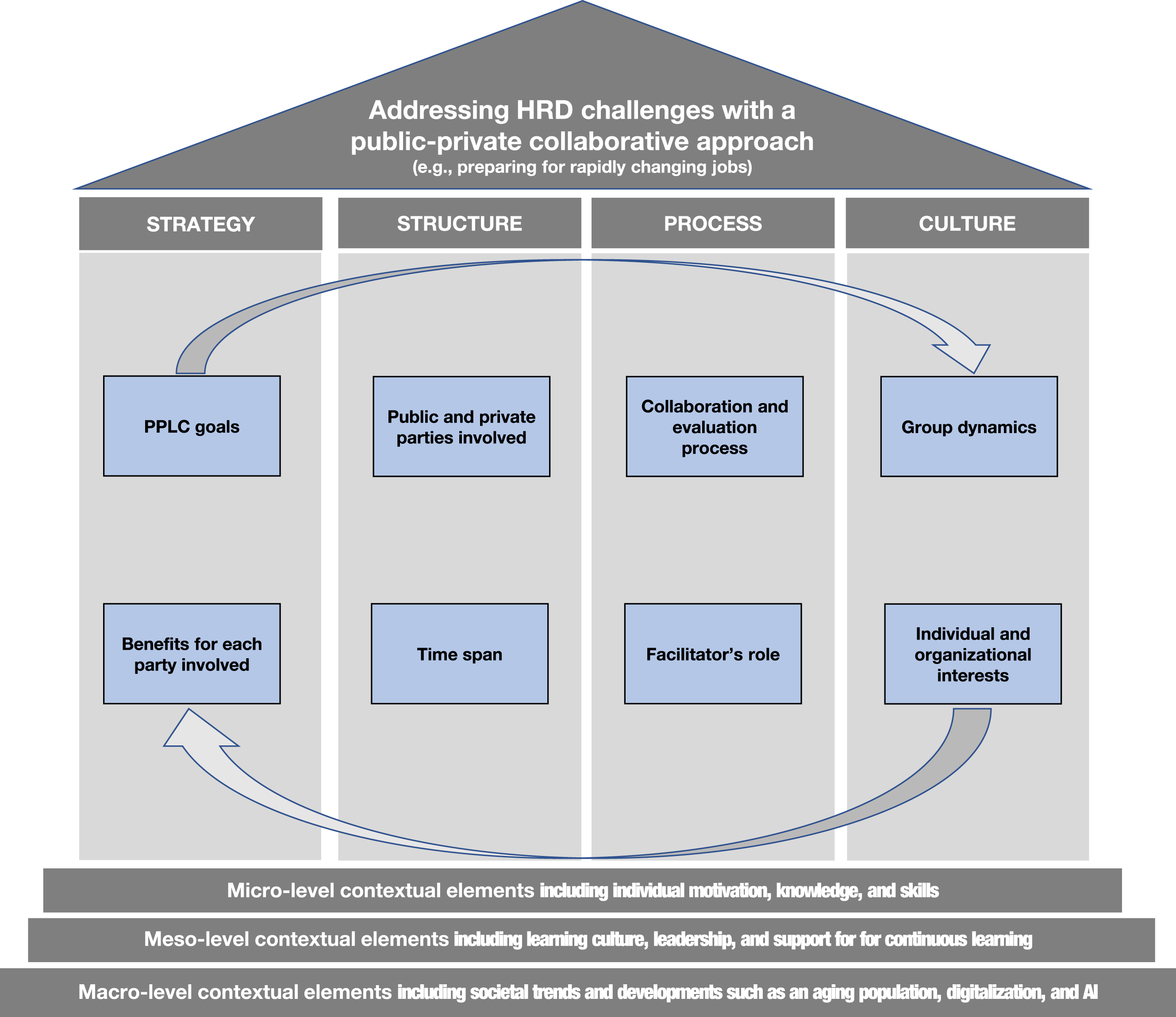
Strategy
In general, a strategy can be defined as “the determination of the long-term goals and objectives of an enterprise, the adoption of courses of action and the allocation of resources necessary to carry out these goals” (Oeij et al., 2021, p. 201). In the context of PPLCs that address complex HRD challenges in a rapidly changing landscape of work, a clear HRD strategy is fundamental and needed to incorporate a clear focus on people development (Gangani et al., 2006; Heraty, 2004; McCracken & Wallace, 2000). In fact, a clear HRD strategy is essential to align critical business imperatives and the development of people and skills within organizations (Gangani et al., 2006), and can be perceived as a proactive, system-wide intervention that links the human capital agenda to the wider organizational strategy (McCracken & Wallace, 2000). It entails, among others, that HRD interventions are integrated with organizational ambitions and goals, leadership support, HRD policies and plans, strategic partnerships with HR and line management, recognition of the organizational culture, and continuous evaluation (Garavan, 1991; McCracken & Wallace, 2000).
In a public-private alliance, however, formulating a clear HRD strategy may result in complex situations as a result of the involvement of multiple organizations, each with their own organizational strategies, interests, and purposes (Brinkerhoff & Brinkerhoff, 2011). In addition, these PPLCs are not only concerned with organizational learning, but particularly focused on learning across organizational boundaries (Mariotti, 2012). In order words, PPLCs are challenged with formulating a collective strategy that addresses the learning needs of all participants from various organizations involved as well as the strategies of each participating organization.
For instance, in the logistics sector, the use of data and algorithms has grown exponentially as supply chains have become more complex (Yu et al., 2018). Logistics companies increasingly focus on implementing new data-driven innovations in their primary processes. This forces HRD professionals and managers in logistics companies to find new ways to equip their workforce with the right skills and to address potential skill gaps. The strategic goal for logistics companies in this example is to actively collaborate with public parties, such as universities and local governments, and other organizations from the supply chain. This helps to find ways to jointly create evidence-informed products, services or processes that support these companies in enabling their workforce to meet the required demands of their work (i.e., re- and upskilling), and driving their organization’s innovation and revenues. Universities, in this example, may benefit from participating in a PPLC by examining and contributing to the state-of-the-art innovations in these companies, developing new knowledge about the products, services and processes being cocreated, and allowing their employees to learn new skills and adapt to a changing, uncertain environment (Arghode et al., 2022). A further strategic motivation for universities to join a PPLC is to ensure that their curricula meet the demands from the rapidly developing logistics sector, and thus equip future logistics professionals with adaptive skills to be prepared for a constantly changing labor market. For (local) governments in this example, interorganizational cocreation is of particular interest as they are looking for opportunities to stimulate economic growth and drive the regional labor market.
In the logistics example, the strategic goal for learning is multileveled (Mariotti, 2012): individual participants join the PPLC to enhance their knowledge and skills which allow them to perform better in their work, which, in turn, stimulates them to pursue their career in logistics. Participating organizations join the PPLC as they believe they can benefit from the different perspectives, expertise, and resources of public and private organizations, which may be a catalyst to stimulate further skill development and lifelong learning mindsets of their employees (Drewery et al., 2020). From an output perspective, they also join as they believe that participation may lead to cocreating new knowledge, products, and processes, which, in turn, make them more impactful in terms of business revenues or societal impact.
Relating this example to the literature, it can be argued that there needs to be a strong “shared curiosity in the problem among collaborators and a felt need for innovation and adaptation” (Van de Ven, 2007, p. 274), with strategic motives (both instrumental and normative aims) for public and private organizations to join a PPLC (Brinkerhoff & Brinkerhoff, 2011). In the aforementioned example, this would mean that all parties need to feel the urgency to jointly invest resources in finding new ways to address these complex HRD challenges of re- and upskilling the workforce in the logistics sector. Achieving consensus around a shared strategy between organizations, however, can become particularly challenging given the diverging interests of public and private partners, their different institutional logics (Ashraf et al., 2017; Smith & Thomasson, 2018), and the lack of a formal leader or structure (Schruijer, 2021). The public partners in our exemplary PPLC in logistics may emphasize a focus on high-level societal or regional development goals with a long-term perspective, such as increasing the digital literacy and skills of the workforce in the coming years as part of their strategic workforce planning (Gangani et al., 2006). Logistics companies may rather focus on short-term business outcomes and return on investment, such as being able to commercialize a specific digital tool, and may therefore not be completely open and constructive due to potential competitive interests (Aarikka-Stenroos et al., 2017; Möller & Halinen, 2017). This underlines the importance of comprehending the different perspectives and aligning the PPLCs common goal(s) between organizations (Caldwell et al., 2017; Van Bockhaven & Matthyssens, 2017). As such, key factors to consider while determining the strategy of a PPLC and, in turn, key factors for success in the public-private collaboration in PPLCs, are “creating common goals; overcoming cultural differences; working across organizational boundaries; securing equal commitment from all parties involved, including all stakeholders; and establishing forms of communication as well as roles” (Smith & Thomasson, 2018, p. 194).
Structure
Due to their temporal and often unstructured nature, PPLCs generally take place in “underorganized” work settings (Schruijer, 2020, p. 18) or “imaginary organizations” (Holmqvist, 1999), without a formal leader or legitimate authority, but with the aim to address non-routine HRD issues with a high degree of complexity and multiple partner interdependence (Schruijer, 2020; Swärt, 2016). Following the learning-network theory (Poell et al., 2000), a central issue in defining and forming the structure of a PPLC is concerned with the learning actors and learning structures of the PPLC. This relates both to the participating organizations, the representatives of each organization in the PPLC, and the time span (duration) of the PPLC (Filieri et al., 2014; Li et al., 2009a; Stoll et al., 2006; Xie et al., 2016), as well as the content structure of what PPLC participants learn about in the PPLC (Lundgren & Poell, 2023). The ‘who is involved’ question is – besides the definition that at least two legally independent public and private parties are involved – mainly depending on the specific challenge or issue the PPLC wants to address and how the participating organizations want to promote the learning of individual participants. Hence, Lundgren and Poell (2023) argue that organizations “have been found to differ rather substantially from one another in terms of their learning network, and also to change their learning network over time” (p. 180).
To illustrate the structure pillar of our conceptual PPLC framework, we draw on an example of PPLCs from the construction and installation sector (Corporaal et al., 2021; Van Rees et al., 2022), where small- and medium-sized installation companies collaborate with post-secondary vocational education and universities (of applied sciences) to address energy transition related challenges. As new technologies are increasingly used and implemented in this sector, installation workers are confronted with new requirements and client expectations in terms of their required knowledge and skills. The PPLCs in this example are intentionally kept relatively small (6–10 participants) as the participating organizations want to work on specific challenges that a technical installation company is facing and want to be agile in their way of working. The PPLCs are accessible to employees of installation companies who continuously need to invest in their professional development, as well as students and employees (teachers/researchers) of educational institutions who are responsible for translating the gained knowledge and cocreated products in the PPLC into the curricula of their study programs (Van Rees et al., 2022). By participating, they gain insight into the most recent developments in the installation sector and work on their own professional development as well.
Despite several studies addressing the topic of an ideal size of a network in terms of the number of participants (e.g., Prenger et al., 2017; Xie et al., 2016), consensus about a clear demarcation in terms of a minimum or maximum amount of members is lacking. Xie and colleagues (2016) argue that a large number of organizations involved in network learning may have a positive effect on knowledge transfer as it increases the access to and flow of information resources (Wagstaff et al., 2022). However, in the context of interorganizational collaboration in innovative ecosystems, it is also argued that the likelihood of disagreement and conflict increase when the number of partners involved gets bigger (Davis, 2016). As such, “more partners seem to create more problems” due to the variety of interests, roles, relationships, as well as uncertainty that comes with innovation in a constantly changing labor market (Davis, 2016, p. 623). Including too many members in a PPLC may also disturb the process of establishing a professional and reflective dialogue in PPLCs to promote the learning of its participants (Davis, 2016; Prenger et al., 2017; Vangrieken et al., 2017). Hence, it can be argued that the larger the number of organizations and participants, the more difficult it is to engender a strong identification with the community in which learning takes place (Stoll et al., 2006).
Another important factor related to the structure of PPLCs, is whether the PPLC’s composition is homogeneous or heterogeneous, which is also referred to as the network diversity (Wagstaff et al., 2022). Xie and colleagues (2016) examined collaborative innovation networks in the business context and refer to the concept of network heterogeneity, which is concerned with differences in knowledge, technology, ability and size of members in the network (i.e., structural heterogeneity). Network heterogeneity also refers to actors with different professions working together. Lundgren and Poell (2023), for example, describe the process of collaborating between HRD professionals and business managers in terms of emergent partnering in four areas: strategic partnering, co-designing content, co-delivering programs, and forming sustainable alliances for impact. A higher degree of network heterogeneity can, but does not necessarily have to lead to increasing knowledge sharing as a result of the different perspectives on the same objective, which, in turn, could lead to higher performance (Rock et al., 2016). At the same time, a more homogeneous community could result in a more agile way of working in the PPLC with less delays and interruptions caused by conflicts between participating organizations. Therefore, in the example of PPLCs in the installation sector (Van Rees et al., 2022), only one installation company was part of the PPLC which reduced the earlier described issues of conflicting interests between private companies.
In terms of the ideal time span of a PPLC, there are various examples of the duration in innovation ecosystems where multiple organizations work together on joint technological challenges, which may run from a few months to 45 months (Davis, 2016). In the example of PPLCs in the installation sector, the participating organizations adopted a Scrum format with cycles of ten weeks, consistent with the private company’s way of working. During cycles of ten weeks, participants of the PPLC collaborated to achieve specific objectives (Corporaal et al., 2021). After each cycle, the participating organizations reflected on the learning process and the outcomes, and subsequently decided whether a next cycle would be initiated. This bottom-up approach is likely to create participants’ support for PPLCs as they do not need to give a long-term commitment prior to participation when it is not fully clear what is expected from them and what they can learn from participating.
Process
There are many elements that relate to the processes taking place in PPLCs. Most elements discussed in extant literature focus on the actual collaboration process (Davis, 2016; Smith & Thomasson, 2018). In her conceptualization of interorganizational learning, Mariotti (2012) identifies three main processes that constitute interorganizational learning: (1) learning about collaboration (which relates to identifying who possesses what capabilities and how to become a member of a certain network), (2) learning to share knowledge, and (3) learning to create interorganizational knowledge. The process pillar in our PPLC framework relates to formal and informal working methods and procedures, how members discuss their professional practices, issues or problems, how they collaborate to improve those practices, and whether reflective dialogues take place in which participants reflect on the collaborative efforts and their own learning (Prenger et al., 2017; Stoll et al., 2006). It has been argued that such reflection is key for knowledge creation and learning (Katz & Earl, 2010). To strengthen the learning and innovation outcomes of a PPLC, it is important to periodically evaluate and follow-up on suggestions for improvement that emerge from the evaluation. One potential evaluation method is Reflexive Monitoring in Action (RMA). RMA “offers a useful set of instruments for short-cyclical mapping and promotion of the various forms of learning at actor and network level during the various phases of the iterative innovation process.” (Veltman, et al., 2020, p. 5).
The way of working and collaborating in PPLCs partly depends on the various formal and informal roles participants may take in PPLCs, and the type of learning network, where horizontal learning networks, for example, have a relatively egalitarian organizational structure and organic learning processes (Lundgren & Poell, 2023). Nyström and colleagues (2014) distinguish twelve role-related tasks for actors in innovation networks that are also valuable in the context of PPLCs. These role-related tasks range from initiating network connections, making decisions and influencing others, to balancing actions and relationships in the network to avoid conflicts. The role of the (formal or informal) leader, is often stressed as well (Nyström et al., 2014; Prenger et al., 2017; Stoll et al., 2006). This role is generally described as facilitative and supportive to members (Prenger et al., 2017; Stoll et al., 2006), but it is not fully clear what role leaders – who often do not have a formal leading position in these interorganizational structures (Schruijer, 2021) – generally play in PPLCs and how this influences the process and outcomes. Research about interorganizational innovation in the computer industry also points to forms of rotating leadership, but it is not clear either whether this would be effective (Davis, 2016).
In PPLCs, meetings can take place physically, digitally, or in a hybrid format where several members are physically present while others join digitally (Li et al., 2009b). A critical concern in virtual environments is knowledge sharing and developing a shared identity and language (Chiu et al., 2006). Participation, knowledge sharing and learning are affected by factors such as trust, reciprocity and identification with the group (Chiu et al., 2006; Swärt, 2016), which are arguably more difficult to develop in digital environments. The formation of social relationships between community members obviously benefits from frequent interaction (Ashraf et al., 2017; Filieri et al., 2014).
Another important element that relates to the process of PPLCs is whether a facilitator is assigned to the PPLC. A facilitator guides the PPLC members through the day-to-day activities (Li et al., 2009b) and “provides possibilities and resources but does not interfere in the process” (Nyström et al., 2014, p. 485). A facilitator can play a pivotal role in creating a safe and stimulating environment, and in community building by coaching PPLC members in setting goals, sharing ideas and knowledge, and experimenting with new ways of working (Becuwe et al., 2016). An important condition for facilitators is that they “should be culturally proficient and understand the local culture in which they work in order to promote the transfer of learning” (Brion, 2022, p. 4), which is particularly difficult in contexts with different organizational subcultures. Variations in the role of facilitator can arise, ranging from a fixed role to a rotating role among the PPLC’s members (Vangrieken et al., 2017), an external or internal facilitator’s role (Van Rees et al., 2022), or the role of a ‘knowledgeable other’ (Takahashi & McDougal, 2016). A study in the context of a PPLC in the energy transition describes how a facilitator enhanced the learning process of participants by “asking questions and connecting all individual perspectives to the collective goal” (Van Rees et al., 2022, p. 5). Another study about PPLCs in the context of logistics shows how the facilitator structures the process by planning the meetings and inviting content knowledge experts to sessions, sets clear rules for collaboration, and guides the participants in formulating clear goals and monitoring the process (Hofstra et al., 2021). Despite these PPLC examples, there is not yet a consensus about what this facilitator role fully entails. Facilitator tasks may vary from process-based guidance, such as scheduling meetings, tracking time or determining meeting agenda’s, to content-based guidance, such as linking theory with practice (Schipper et al., 2017). A committed facilitator is considered a determinant of community success (Li et al., 2009b; Ranmuthugala et al., 2011).
Culture
PPLCs are implemented in the third space (Cornelius & Stevenson, 2018) – in and between organizations – where they have to deal with existing cultures. At the same time, PPLCs create their own (sub-)culture given the notion that for “communities to effectively share their knowledge, they need to develop a common set of norms, standards, and language that provide appropriate context for the community knowledge” (Lesser & Storck, 2001, p. 840). PPLCs consist of participants who do not always know each other at the start of the joint process. PPLCs are shaped by the social relationships between participants, and how these participants learn collectively is “mostly expressed in their ways of working together, patterns of interaction, and dependencies with one another” (Yorks et al., 2003, p. 113). Additionally, the participants do not only have individual interests, but also represent their organization. Edmondson and Harvey (2018) describe these different or competing interests as pragmatic boundaries between organizations in which individuals follow their own situated rationalities where they look for what is valuable to them. Particularly in the beginning of the collaboration, there may be conflicting interests, tensions, intergroup stereotyping, distrust, and collusion in PPLCs (Schruijer, 2021). Hence, PPLCs go through “a developmental process where relationships are built, identities and interdependencies are explored, trust is developed, and a collaborative climate is jointly shaped” (Schruijer, 2020, p. 2). It takes time “to establish a culture of trust” and this process is vulnerable when PPLC members leave or new members join (Vangrieken et al., 2017).
This particularly plays a role in PPLCs where public and private partners are not used to such collaboration. This, for instance, applies to a PPLC in the health sector where healthcare organizations, technology companies, and universities are jointly working towards solutions that enable people with dementia to improve their quality of life by making use of technology (IJsselsteijn et al., 2020). Participants from these organizations (healthcare professionals, technology professionals and researchers) have completely different interests and ways of working. For such a PPLC to be effective – i.e., when people learn and innovate in the workplace context – it is essential to establish a culture of trust. A facilitator may play a pivotal role in creating this by enabling participants to take time to reflect, facilitating an open dialogue, and stimulating engaging, creative, and enabling collaborative practices (Schruijer, 2020).
Creating a culture where people feel safe and motivated to contribute to the joint goals, depends to a large extent on the group and power dynamics as “power shapes group dynamics and consequently, team learning” (Yorks et al., 2003, p. 111). In their integrating research on cross-boundary teaming, Edmondson and Harvey (2018) show that knowledge boundaries between and across organizations can be “thick or thin” (p. 348), depending on differences in beliefs, content expertise, industry experience, language, interests, and other elements that relate to their distinguished types of team diversity (separation, variety, and disparity). Filieri et al. (2014) studied a successful pharmaceutical network in which multinationals and academia collaboratively worked on innovative output in a high-technology setting. They found that frequent interactions were important to stimulate active participation and to develop a cohesive network with high levels of trust and reciprocity, where participants learn, and explicit and tacit knowledge is shared. As such, group dynamics and the network’s tie-strenght (Xie et al., 2016) play an essential role in PPLCs. Network tie-strength refers to the degree of intimacy, trust, interdependence, and interaction between members of a network or community. A higher degree of these elements (i.e., a strong tie-strength) will obviously “lead to more frequent knowledge flows and communication” (Xie et al., 2016, p. 5211). In addition, mutual trust between the members has shown to be an important element in PPLCs (Nyström et al., 2014; Stoll et al., 2006; Vangrieken et al., 2017). It can even be seen as a crucial factor for the success of a PPLC as mutual trust can have a direct impact on the group dynamics and the learning outcomes in a community. It appears to be important in generating new ideas as “members are not afraid to try something new” (Vangrieken et al., 2017, p. 55).
Contextual Elements
As PPLCs are highly contextualized approaches (Hadfield & Jopling, 2016), an innumerable, yet often relevant amount of contextual elements, may influence the strategy, structure, processes, and culture of PPLCs (the four pillars of the model), and subsequently the outcomes of the PPLC. Edmondson and Harvey (2018) describe these contextual elements in terms of the larger social system (environment), the tasks the PPLC participants are addressing, time (different time spans), and leadership. Even though the contextual elements are not the core focus of this paper, we briefly describe three levels of contextual elements that are often interrelated and may impact the efficacy of PPLCs. These micro-, meso-, and macro-levels are in line with the distinguished levels of analysis by Carbery and Garavan (2007), who proposed a conceptual framework for explaining manager participation in career-focused learning and development.
At the micro-level, we refer to contextual elements that relate to individual’s aspects such as motivation, job experience, skills, competencies, abilities, learning preferences, commitment, and educational attainment, and the level of received training (Carbery & Garavan, 2007; Dachner et al., 2019). There is a vast amount of literature on motivation theories showing that “individuals need to be motivated to learn and the organization needs to provide the necessary culture and resources that empower individuals to learn” (Dachner et al., 2019, p. 2). Therefore, when formulating the strategy and deciding on the structure of PPLCs (first two pillars of the model), it is important to take these contextual elements into account before implementing PPLCs, as realizing the intended aims largely depends on the individuals who take part in PPLCs. When PPLCs are implemented, it is vital to address these individual characteristics in the processes and culture of the PPLC (third and fourth pillar).
At the meso-level, we refer to contextual elements within organizations that impact the interorganizational team learning process that takes place in a PPLC (Knapp, 2010). This organizational level of analysis “understands HRD to be a specialized set of developmental activities or interventions that focus on supporting the achievement of organizational objectives” and captures “a range of organizational characteristics, including environments, work processes, and group and individual variables” (Garavan et al., 2004, p. 421). More specifically, this refers to the learning and developmental climate in organizations, the professional learning culture in the participating organizations, leadership and organizational (HR) support, expertise of staff, time facilitation, and an orientation toward learning and innovations within the organizations involved (Carbery & Garavan, 2007; Tynjälä, 2013; Vangrieken et al., 2017). These elements also relate to existing socially constructed, historical patterns in organizations, which can create tensions, instability, and conflict between organizations when these organizational patterns are not aligned (Ashraf et al., 2017; Thornton & Ocasio, 1999). Important at this organizational level is that HRD priorities “are determined by organizational decision makers rather than by individuals” (Garavan et al., 2004, p. 422). In the context of PPLCs, this adds extra complexity as there are decision makers involved from various public and private organizations.
At the macro-level, we refer to regional, national and global developments and policies that affect the human capital agenda of organizations, as well as to the sector in which the PPLC is implemented, whether governments and economic development agencies are involved, and cross-cultural differences between members of the PPLC (Carbery & Garavan, 2007). This also relates to the pace at which educational institutions can follow and address the labor market developments in terms of updating their curricula without too much legislative hindrance (Schoen & Fusarelli, 2008), and to available funding for innovative public-private human capital projects in the context of major transitions such as climate change, an aging population, digitalization, and AI.
Conclusion and Discussion
As conceptual papers are “a step in the process of building theory, providing a bridge to practitioners and broadening our ability to think, design, and have a meaningful impact on the field” (Rocco et al., 2022), we proposed a framework for PPLCs as a means to address the rapidly changing landscape of work and the transformation of the HRD discipline (Brandhorst et al., 2023; Schruijer, 2021; Scully-Russ & Torraco, 2020). We argued that the recent technological and societal developments (e.g., the energy transition) place increasing emphasis on new models of workplace learning in public-private arrangements, which fundamentally change the role of HRD professionals in terms of designing and implementing new learning ecosystems that focus on the continuous improvement of employees’ skills and work performance (Pereira et al., 2022; Scully-Russ & Torraco, 2020; Seeg et al., 2022). We distinguished three research gaps in HRD literature which we aim to address by proposing our PPLC framework: (1) the current challenging times require learning in public-private arrangements that goes beyond merely knowledge and idea sharing between organizations but should entail deep level learning and actual cocreation; (2) learning in public-private arrangements is generally described from a system perspective, whereas the learner perspective (agency) and the organizational context is crucial for organizing learning in these arrangements; and (3) little attention has been paid to how learning and cocreating take place in these underorganized work settings (Schruijer, 2020) that characterize PPLCs.
In essence, our conceptual framework provides initial guidance, insights, building blocks and a common ‘language’ that can be used to facilitate the learning of participants in PPLCs. In line with HRD literature on team learning and approaching learning from a multi-level perspective, we argue that understanding learning in PPLCs requires a multilevel approach (e.g., Carbery & Garavan, 2007; Garavan et al., 2004; London, 2022) where the individual, organizational and regional interests should be taken into account. Drawing on interorganizational learning theory (Mariotti, 2012) and learning-network theory (Poell et al., 2000), we described the multifaceted nature of learning in PPLCs and show how the learning-network theory offers a useful lens to study learning in PPLCs. In the following section, we provide implications of our study for HRD research by showing how we address the aforementioned research gaps with our PPLC framework.
Implications for Human Resource Development Research: Addressing the Research Gaps
First, with our conceptual paper, we aim to generate new ideas and to provide a foundation for empirical studies and theory development in the HRD discipline on learning in public-private arrangements (Rocco et al., 2022). More specifically, with our PPLC framework we propose an adaptive and innovative form of workplace learning that exceeds the boundaries of one’s own organization (Scully-Russ & Torraco, 2020) and thereby expands the perspective of the HRD literature on learning beyond the organizational level (London, 2022). As such, we answer the call from Scully-Russ and Torraco (2020) for HRD research to contribute to the development of innovative workplace learning models. We argue that interorganizational learning is not merely about knowledge and idea sharing between participants of different organizations, but also about collaboratively solving complex problems that arise in organizations faced with a rapidly changing workforce and nature of work (Crocco & Grenier, 2021; Han et al., 2017). In fact, the starting point of a PPLC is a collective HRD strategy that aligns the PPLC aims and motives – both instrumental and normative (Brinkerhoff & Brinkerhoff, 2011) – with the strategies of the participating organizations. Ultimately, the outcome of a PPLC should lead to new knowledge as well as tangible interorganizational results in terms of innovative products, services or processes. Ideally, this could be measured in either return-on-investment or more effective or efficient ways of working, work satisfaction, career progression or other HR metrics (Dulebohn & Johnson, 2013).
Second, we turn to learning-network theory to highlight the importance of the learner’s agency in PPLCs and argue that HRD research on learning in public-private arrangements requires a multileveled perspective (Mariotti, 2012), as opposed to a system perspective that is often used in literature on public-private collaboration (Quélin et al., 2017). For PPLCs, this learner perspective is crucial as earlier HRD research indicates that individuals are the key stakeholders in PPLCs who steer the direction of the learning outcomes (Poell, 2022). Yet, the learner perspective cannot be isolated from the organizational goals and interests, as organizational buy-in is essential for the success and continuation of PPLCs.
Third, we further advance the HRD literature on interorganizational learning by conceptualizing the conditions for learning in PPLCs. We do this by outlining the essential building blocks of the process and the culture pillars of our PPLC framework. Using the interorganizational learning conceptualization of Mariotti (2012), we described how learning in PPLCs in characterized by learning about collaboration, learning to share knowledge, and learning to cocreate interorganizational knowledge. To enable this, both formal and informal working methods and procedures need to be in place, there should be time for reflective dialogue and evaluation (Katz & Earl, 2010; Stoll et al., 2006), and the role of a facilitator should be considered as someone who understands the local structure and culture of a PPLC (Brion, 2022).
Limitations and Directions for Future Research
Despite our contributions to the HRD discipline, this paper has several limitations that call for additional research. First, our paper explores the complex and diverse field of (interorganizational) learning in PPLCs from a conceptual perspective. Conceptual papers may be grounded in a variety of knowledge bases and literature, but are not comprehensive (Elsbach & Knippenberg, 2020), and our model is not empirically tested. Therefore, future research should be focused on empirical studies in which the conceptual propositions made in this paper are further used and tested.
Second, our framework only indicates what elements are important to consider for a PPLC, but not specifically how these elements or building blocks should be operationalized and whether this differs between sectors and disciplines. Future research could address this by determining what building blocks could be regarded as generic or context-specific. This requires critical reflexive methodologies that capture context-specific elements and the insider perspective of PPLC participants (Crocco & Grenier, 2021). More specifically, future research could focus on the strategy forming process within the PPLC: how do PPLC participants collaboratively arrive at a shared learning objective that is both relevant for each individual participant as well as the organizations to which these participants belong.
Third, we described the multi-layered nature of the PPLC, but did not elaborate on the tensions that may arise between the different levels of analysis (i.e., the micro-, meso-, and macro-level) as “each level emphasizes particular philosophical orientations” (Garavan et al., 2004, p. 425). Garavan and colleagues (2004) argued that in the HRD context, these philosophical orientations are typically related to the “freedom to learn, whether learning is about harmony or critical reflection, whether learning is emancipatory, whether learners are independent or interdependent, and whether learning is about trust or power” (p. 425). In this paper, we did not address these tensions and philosophical orientations and we encourage other researchers to take on this challenge and to both theoretically and empirically refine and enrich our conceptual PPLC framework. Future studies could focus on empirically validating the framework in practice to better understand which elements in our framework are robust, and whether there are any other effective elements missing in our framework. Future studies could also examine what type of tooling, interventions or monitoring methods can be used to improve existing PPLCs, and increase and test their effectiveness.
Another important focus for follow-up research is examining the role of the actors as key stakeholders in PPLCs, and how they shape their learning paths (Poell et al., 2018). This refers to understanding how each participant “makes sense of the multitude of work-based and intentional learning experiences and their choices as they move from one such experience to the next” (Poell et al., 2018, p. 316). Moreover, future research could zoom in on the role of the facilitator in PPLCs which appears to be of crucial importance to guide the PPLC participants (Li et al., 2009b; Ranmuthugala et al., 2011). However, the various dimensions of this role, such as managing the process, procedures, relationships in a dynamic multi-party and context-specific environment, make it a highly complex role. It may be worthwhile to examine how HRD professionals could fulfill the role of PPLC facilitator and, as such, act as the architects of new learning systems (Scully-Russ & Torraco, 2020).
Longitudinal studies are also essential to evaluate whether and in what form PPLCs are an effective organizational form to best organize for the current and future HRD and organizational challenges. This also means that measurable success criteria should be developed for different maturity stages of PPLCs. However, as becomes clear in this paper, evaluating PPLCs should never follow a ‘one size fits all’ approach due to the highly contextualized settings in which PPLCs are organized (Hadfield & Jopling, 2016), both in terms of sector, geography, PPLC maturity and the personal characteristics of its participants (e.g., knowledge, motivation, and skills). After all, learning not only occurs within the PPLC, but is also part of everyday life.
Practical Implications
The proposed framework in this paper provides guidance and support for HRD professionals to organize employee learning at an interorganizational, public-private level. The framework assists them in understanding, designing, and facilitating PPLCs to address the learning needs of individual participants and align the learning objectives with the strategies of participating organizations. More specifically, HRD professionals could use the PPLC framework as a blueprint to adaptively configure the building blocks to the unique context in which the PPLC is implemented. For example, HRD professionals can use the model as a starting point to decide in a structured manner which time span and composition (structure pillar) and collaboration and evaluation process (process pillar) are most suitable for addressing the learning objectives, whilst considering the learning needs and backgrounds of the participants. In the earlier mentioned example of PPLCs in the installation sector, the participating organizations adopted a 10-week sprint format as this was consistent with their way of working (Corporaal et al., 2021). In other contexts, a different time span, composition, and format may be more suitable. Our model provides a theoretical base to critically reflect on these elements. HRD professionals could think of incorporating feedback and reflection moments and methods, and developing and incorporating specific challenging experiments that participants could apply in their own work context.
Furthermore, as the PPLC concept proposed in this study offers an attractive and multifaceted learning environment for (continuous) development of employees, it can enable HRD professionals in designing sustainable career paths (McDonald & Hite, 2018). As such, the concept may also prove instrumental for employers to captivate and retain talent in a drastically changing labor market (World Economic Forum, 2023). This is highly relevant for HRD given “its focus on leadership, development, and performance in the workplace” (Scully-Russ & Torraco, 2020, p. 85).
Another practical implication concerns the link to the internal learning and development offerings in companies. In fact, “considering that business managers show increased interest in organizing HRD activities” (Lundgren & Poell, 2023, p. 196), this may impact the way participating organizations in PPLCs structure and promote their learning offerings in their organization. This also applies to the impact on university curricula where university staff may rethink how students could participate and learn in PPLCs as meaningful learning environments.
Lastly, from a policy perspective, our PPLC framework may be of interest to governmental and regional policymakers aiming to address HRD issues, such as stimulating lifelong learning and up- and reskilling initiatives in the region. They can use and explore the concept of PPLCs as a way to stimulate and facilitate regional interorganizational collaboration that focuses on strengthening the regional economy (Cascio, 2017).
Footnotes
Acknowledgments
This research has been conducted as part of the Change Gear research project. We would like to thank all colleagues and companies involved in the consortium for their collaboration in this research project. We also thank the editors and reviewers for their valuable feedback and input throughout the review process.
Declaration of Conflicting Interests
The author(s) declared no potential conflicts of interest with respect to the research, authorship, and/or publication of this article.
Funding
The author(s) disclosed receipt of the following financial support for the research, authorship, and/or publication of this article: This research is sponsored by the Nederlandse Organisatie voor Wetenschappelijk Onderzoek (Dutch Research Council (NWO)), grant no. 439.19.300.
