




Abstract

Keywords
Now that Human Resource Development Review has celebrated its 20th anniversary, the question almost naturally arises what the field it covers will look like in another decade. Obviously, the future is notoriously difficult to predict; however, I'd like to use this editorial to speculate about the directions that Human Resource Development (HRD) as a field of practice and scholarship might take. Which themes could dominate the HRD discipline in 2032? I will also elaborate in this editorial on one of the themes I expect to become even more salient within HRD than it already is: the role of employees and managers in organizing learning.
As it happens, at the time of writing this piece on Christmas Eve of 2021, my colleague Joseph Kessels and I have just published a co-edited Dutch-language HRD handbook (Poell & Kessels, 2021), in which we also look ahead to the not-too-distant future. The topics covered in this third edition however already provide some clues in themselves, as does the handbook’s subtitle “organizing learning.” This motto broadly captures where we see HRD heading: toward creating and utilizing a diverse organizational landscape of work environments and experiences conducive to employee learning and development. By the end of this editorial, it will be clear that employees themselves and their managers are at least equally, if not more, important to this challenge than dedicated HRD professionals are.
The topics covered in the new handbook are testament to this key assertion. While the first part of the book still deals with HRD as a profession, making excursions into the fields of Human Resource Management (HRM) and sustainable innovation, the other seven (!) book parts focus on other organizational contexts where learning is prevalent. With nine chapters on learning in the workplace as well as six on learning in teams and communities alone, clearly employees and their supervisors are at the heart of HRD in this handbook. Other book parts look at talent development, leadership in HRD, designing learning practices, technology in HRD, and performance. There is a multitude of new chapter topics in these parts that did not even appear in the 2011 or 2001 editions of the handbook, for instance, life-long development, HRD as boundary crossing, learning of knowledge workers, a career perspective on HRD, strengths-based approaches to development, shared leadership, humanizing the organization, innovation as learning, the use of learning analytics, how knowmads (Moravec, 2013) learn and work online, and high-impact learning that lasts. Each of these is likely to become more important over the next decade. And most of them point to what employees and managers (can/should) do in organizing learning rather than to HRD professionals doing it for them (Poell & Kessels, 2021).
Now one thing I have learned myself in 30 years of studying people in organizations learning is that it is not very useful, and sometimes even detrimental, to apply HRD standards to how employees and managers organize learning. As educated HRD professionals, we tend to think in terms of determining learning needs, setting learning goals, designing interventions that will make people learn what is relevant, and evaluating to what extent this has happened and affected performance. As a matter of fact, even employees and managers are prone to first considering such formally structured approaches when asked about learning. In every-day practice, however, learning is a rather messy process that is very much tied in with doing one’s regular job, something not usually associated much with learning at all (Billett, 2001). Employees and managers do not normally think in terms of learning, let alone organizing learning; they think in terms of solving their work problems, feeling competent and appreciated, getting ahead in their careers, making a meaningful contribution, keeping up with what others around them do, and so forth (Poell, 2017). That they (need to) learn and develop themselves in pursuing these aims are obvious to us as HRD professionals but not necessarily to themselves. And I honestly doubt if the latter is even needed, something I will circle back to later in this editorial.
Another lesson I have learned myself over the years is that employees and managers not only have their own ways of (organizing) learning but also differ from one another in this respect. In other words, employees emphasize other aims, have other interests, and engage in other ways of learning compared to how managers think about these issues (Poell & Van Der Krogt, 2017). Perhaps this is obvious to some, but it is all too often assumed that every organizational member will adhere to an official strategy delineated by top management and implemented by line managers. When it comes to learning, however, in my experience as a researcher, there is great diversity in what employees want to learn, why they think that is important, and how they go about doing it (Poell, Lundgren, et al., 2018). This might be in line with what their supervisor (and top management) deems important or it could also take a different direction. Combined with the elusive nature of learning and the fact that employees and managers do not really have a proper language to discuss it, organizing learning becomes the messy process alluded to earlier. But that still does not imply that employees and managers should (or even could) all become seasoned and hard-boiled HRD practitioners. What might be a more useful approach here?
To answer this question, let us look at one pertinent empirical study that I conducted with my colleagues (Poell, Valk, & Van Der Krogt, 2018). This was a comparative case study into organizational change and professional development, using semi-structured interviews with 68 employees and 15 managers in three Dutch secondary schools. One key result from the analysis was that most employees and managers have few crystallized views about organizing HRD efforts, directions in which HRD should develop, and factors that are relevant in these respects. A second main finding was that employees and managers think and act rather differently when it comes to organizing employee learning. Let us look into these results in some more detail below.
Managers in this study used professional development of their employees mainly as an instrument to reduce their own problems and/or realize their own plans. They deployed professional development on an ad-hoc basis with organizational issues for which they felt primarily responsible (e.g., raising exam scores). Knowing they would need firm engagement from their employees, managers usually initiated projects to tackle these issues and from then on played a facilitating and supporting role. They exercised restraint when it came to the actual learning that employees engaged in, ranging from stimulating them informally to participate in individual professionalization activities to reacting positively to any learning initiatives that employees might take. Overall, managers in this study emphasized only certain aspects of HRD; there were no integral HRD strategies with clear ideas about the direction in which HRD should develop, and the strategies were not developed very explicitly nor substantiated (Admiraal-Hilgeman & Geurts, 2011; Van Driel, 2006; Van Veldhuizen, 2011).
Employees in this study, teachers to be precise, were engaged in professional development mostly to a rather limited extent, in terms of both participating in projects/learning programs and undertaking learning activities themselves. There was little interaction with internal and external colleagues around professional development. Employees undertook activities on an ad-hoc basis, seeking experiences relevant to their professional development. They participated in workshops, studied articles or books, and on occasion they deliberated with each other about mutual problems. They did not often give systematic thought to the way they did their work and to the possibilities to improve that and learn from it. Few performance interviews were conducted in which professional development was a topic of conversation. Overall, employees gave little direction to their professional development and, if so, not very explicitly. They mostly made ad-hoc use of the opportunities that presented themselves. Directing their professional development occurred with some employees, for instance, by determining subject areas of interest to them, by explicitly preparing for new tasks, or by taking an active interest in certain new topics. Employees mostly however operated strategically by reacting to opportunities that presented themselves (Poell, 2017; Seezink & Poell, 2010).
From these study findings, Poell, Valk, and Van Der Krogt (2018) derived four different ways in which employees can operate strategically (see Figure 1). Possibilities for Employees to Operate Strategically in Organizing Learning.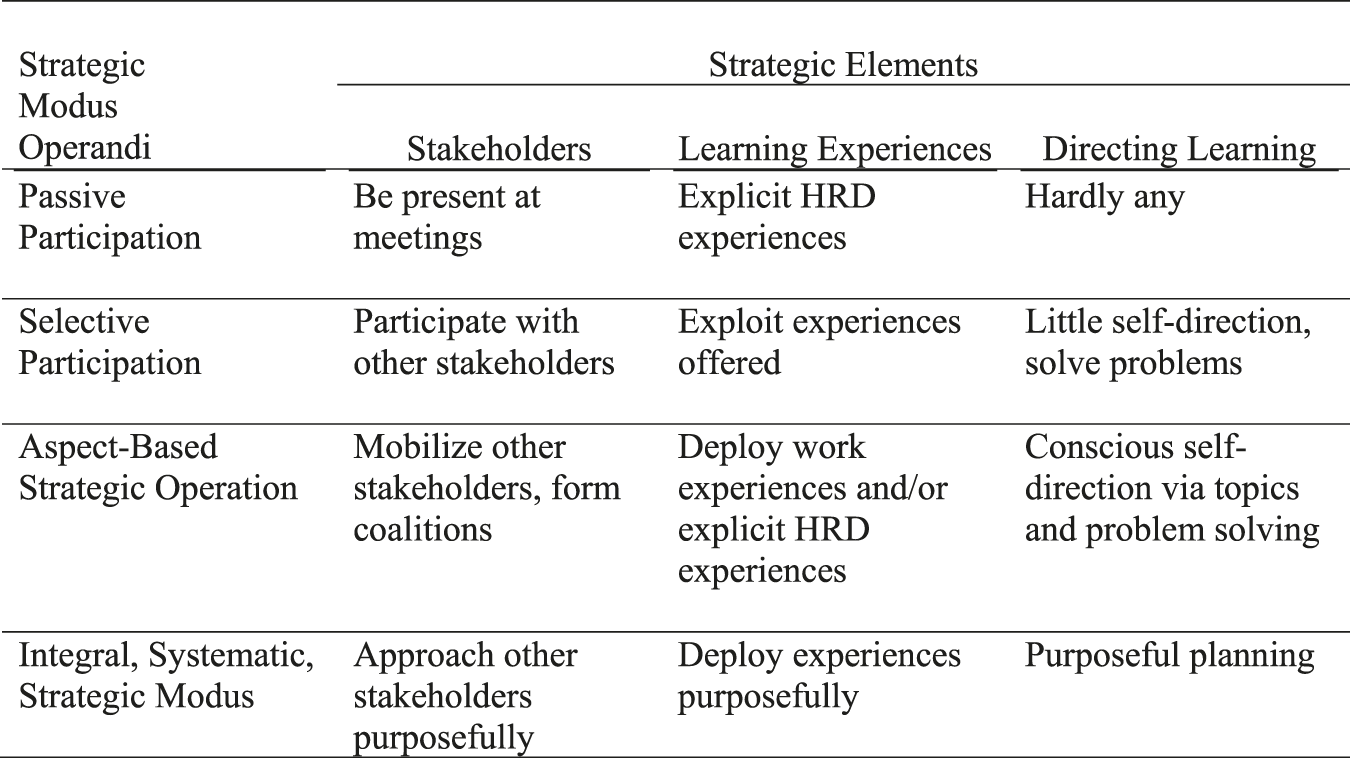
Employees’ four ways of organizing learning in Figure 1 include: • • • •
These four forms of employees operating strategically in organizing their learning can probably not be distinguished very precisely in organizational practice; they overlap each other and vary in the extent to which they are explicit. Even if most employees in our 2018 study (and in many previous ones) engaged in either passive or selective participation, the four variants do make it clear that employees can organize their learning in different ways according to their own views and skills. In doing so, they will be able to deal with the existing HRD structures and other stakeholders in their own distinct ways.
Circling back to the question of what might be a more useful approach to employees and managers organizing learning. I would argue that always expecting them to apply an integral, systematic, strategic modus operandi is neither realistic nor desirable. Even the piecemeal aspect-based strategy was employed by only a small number of employees in the 2018 study. It is crucial for HRD professionals to realize that employees can learn to their satisfaction and interests just by engaging in passive or selective participation as well. Explicit and integral HRD strategies are not always needed or wanted. Sometimes—for instance, when they are highly motivated to make a specific career step—employees may make their own HRD strategies somewhat more explicit and better substantiated. In addition, certain HRD issues that employees confront—for instance, when their supervisors offer little direct support to their learning—may give rise to them tackling specific HRD elements.
Employees and managers are obviously key strategic HRD stakeholders, because if employees do not learn and managers do not support them in doing so, then nothing at all can change in their organization. In that sense, HRD is too important to be left to HRD professionals alone nowadays. But where does this leave dedicated HRD professionals? What role do they still play when employees and managers have so many options to create, facilitate, and utilize learning at and from work, even if the latter are less structured and formalized in their HRD efforts?
In my vision of the future for HRD, dedicated HRD professionals play an important role as core experts in the field of organizing employee (and team) learning. HRD professionals have the expertise and (crucially) the language to bring employees and managers together to work on issues that both of them deem important and relevant. HRD professionals can translate organizational problems into learning challenges and engage employees and managers in trying to solve them. HRD professionals can support individual employees and managers in making sense of every-day learning that goes on in their jobs and teams, provide them with ideas for alternative ways of organizing learning, and help them understand how they can assess to what extent they see progress and improvement. HRD professionals can help management (and other) teams reflect on internal and external environments they operate in, on the extent to which their performance is satisfactory, and on ways in which their interactions with those environments can be improved (Lundgren & Poell, 2016). HRD professionals can teach managers to become better supporters and facilitators of their team members’ learning efforts, that is, to become better people managers besides being successful subject matter experts with a managerial position. HRD professionals can help employees become aware of the ways in which they operate strategically when it comes to organizing their learning, and which level of strategic modus operandi would be most suitable for which aim the employee wants to pursue.
Employees, managers, and HRD professionals organize learning together, as is clear from the above. Employees and managers are key stakeholders in HRD as well as HRD professionals are; however, each of them has their own role to play in function of their position and the aims they wish to pursue (which tend to differ). I hope that in 2032, when Human Resource Development Review celebrates its 30th anniversary, the profession of HRD will be even stronger than it now already is in organizing people’s learning. The thoughts I have expressed in this editorial are intended to inspire HRD professionals to work towards this collective aim, benefitting employees, managers, and organizations alike.
Footnotes
Declaration of conflicting interests
The author(s) declared no potential conflicts of interest with respect to the research, authorship, and/or publication of this article.
Funding
The author(s) received no financial support for the research, authorship, and/or publication of this article.
