




Abstract
This paper argues for recognition of Netnography as a necessary methodological innovation for HRD research, enabling the field to address emerging research questions and contribute to theory building at the intersection of technology, work and social life. The paper defines ‘netnography’ and introduces its key methodological underpinnings; illustrates its application and procedures; and considers its benefit to HRD research. We identify three opportunities where Netnography can deliver important advances to HRD theory and practice: investigating hard-to-access online work contexts, such as gig work and other forms of precarious working; exploring marginalised, ‘hidden’, or under-researched voices in online spaces; and extending knowledge of learning in hybrid work environments where physical and digital dimensions are intertwined. We conclude with a call to action by HRD scholars to take forward, and further develop, the Netnographic methodology to contribute to new and inclusive theorizing as a basis for advancements in HRD scholarship and practice.
Introduction
This paper proposes Netnography as a methodological innovation with potential to benefit HRD research in an increasingly digital and technologically mediated work and social environment. The interaction between technological infrastructures and employment practices has profoundly affected the nature of work, giving place to a flexibilization of work practices, a virtualization of organisations, and a critical reflexivity on work arrangements (Kingma, 2019). Increasing deployment of Information and Communication Technologies (ICT) has caused a multiplication of new work practices (Aroles et al., 2019) including digital nomadism (Woldoff & Litchfield, 2021), gig and other forms of precarious working (Woodcock & Graham, 2019), remote and hybrid working (Gifford, 2022) and crowd work (Howcroft & Bergvall-Kåreborn, 2019).
In such a context, important HRD research questions about the experience of precarious and sub-contracted work and how learning occurs – or does not occur – when work and learning are virtualized, have gone unanswered. Specifically, the HRD research base lacks coherent analysis of how formal and informal, tacit and explicit learning occur in hybrid work contexts. Further research questions about the interaction of digital networks with physical and ‘space based’ dimensions of work and learning require attention. Scant research has so far probed into issues of virtual teamworking and its implications for work relationships, ‘social climate’, and employees’ mental health and wellbeing. In an environment described as a digitally dynamic [industry 4.0] post-pandemic world (Thite, 2022, p.15), Crocco and Grenier (2021) argue that new and different “paradigms, explanations, and wandering into the breadth and depth of voices, perspectives, and experiences” (p. 62) has become a priority for HRD research and scholarship.
From this perspective, we contribute a much-needed exposition of Netnography; a methodology that focuses on the study of online traces and variegated semiotic elements – texts, videos, images – that people and organisations produce and share online (Kozinets, 2020). We argue that while Netnography is an increasingly established research methodology, it is still new to the HRD field, despite its potential to represent and support theorisation of emerging configurations of digital systems and forms of data in relation to HRD in a way that is approachable, innovative, and expedient (Paulus & Lester, 2022; Pink, 2022). We propose Netnography as a methodology that can enable the HRD qualitative research field to address emerging research questions and contribute to theory building to better represent unique and rich voices in emerging digital work and social life contexts.
The paper will define and frame ‘netnography’; introduce its key methodological underpinnings and illustrate its application and procedures; compare it with other qualitative research designs such as ethnography, action research and grounded theory, and consider its benefit to HRD research and theory-building. We address the following questions. First, what are the principle assumptions and techniques of Netnography? Second, what are the principal Netnographic data collection and analysis procedures? Third, how can Netnography contribute to HRD research and theory-building to better explain new and emergent learning spaces, actors, and contexts shaped by digital dimensions?
Netnography
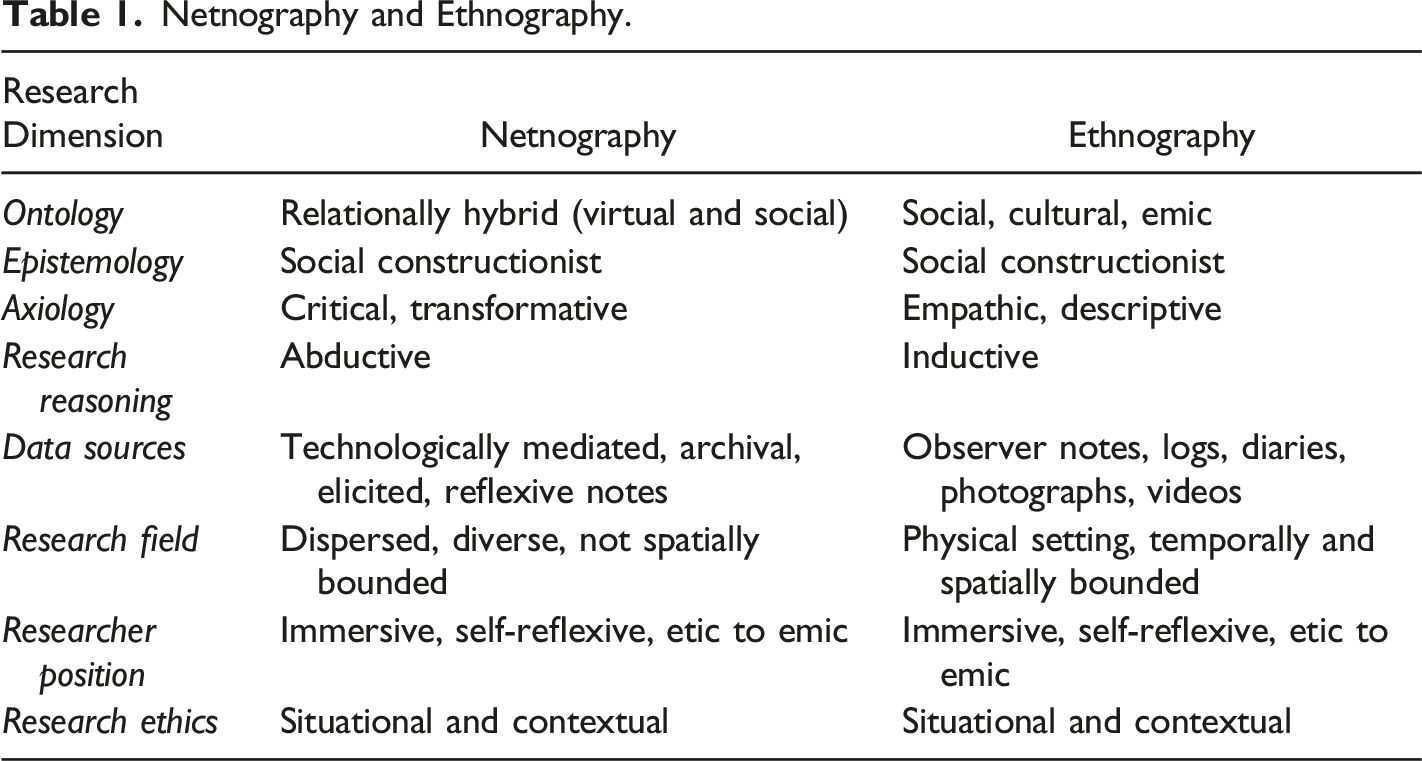
Netnography and Ethnography.
Most ‘histories’ of Netnography as applied in business and management suggest that it was originally developed as a coherent set of specific research practices in the field of marketing, consumer behaviour and public relations and was consolidated and advocated by Robert Kozinets (2010, 2015, 2020). However, there is also evidence that researchers have used electronic media to track actions of computer users and computer systems as early as in the mid-1990s (Corrêa & Rozados, 2017). Over time, the methodological basis of Netnography has been refined and clarified as it has been utilised in different disciplines such as education, including adult education (Ngo & Eichelberger, 2020), sociology (Addeo, et al., 2019) and political science (Jester, 2022), while methodological papers are currently exploring opportunities and challenges afforded by Netnography to different fields, such as accounting (Jeacle, 2021), tourism (Tavakoli & Wijesinghe, 2019), and geography (Wu, 2022). However, its application in the HRD and related fields has so far been limited to a very few studies (see, for example, Keshtiban et al., 2021; Parth et al., 2021).
The Netnographic Methodology
Before we advance our argument that Netnography has important potential benefits to HRD research inquiry and theory-building, we first describe its methodological and methods related features and compare these issues with assumptions that comprise other qualitative methodologies such as ethnography, action research and qualitative case studies.
Netnography and Ontology
As indicated in Table 1, distinctive from ethnography, Netnography is based on assumptions about hybrid and relational online and offline dimensions of digital communication and relationships as features of social reality. Netnography focuses on revealing ‘thick’, complex, processual and constantly evolving features of reality that arise from interaction between technology and social and organizational experience. Contrary to ethnography, it rejects a singular focus on people or groups, but is ontologically relational, focusing on configurations of relations (Lucarelli & Giovanardi, 2019) grounded in the assumption that the online and offline worlds are inherently interwoven (Kozinets, 2015). Methodologically, therefore, Netnography assumes that online and offline social worlds are intermeshed and intertwined spaces where reality is continuously produced, navigated and reproduced by individuals and organizations. This relational ontology recognizes the ‘digital’ as a dynamic, processual force that is inherent in social life. Social reality, in turn, is understood to comprise hybrid features of both the ‘virtual’ and the ‘physical’, which are constantly mobile, processual and always-already mediated (Discetti & Anderson, 2022).
Netnography and Epistemology
Epistemologically, Netnography shares common ground with other research approaches, such as ethnography, that value knowledge construction from participant observation. In common with other qualitative methods such as action research, Netnography also regards research participants as participative co-creators of knowledge. A key principle of Netnography is the primacy of the emic rather than etic point of view, whereby research participants are recognized as part of the research and knowledge generation community. However, in contrast with ethnography, epistemological value is recognized also in knowledge sources that are technologically mediated and archived. In addition, Netnography as a methodology draws on an abductive rather than an inductive stance towards research reasoning and theorization. As such, it is epistemologically focused on explanatory rather than descriptive knowledge generation. In recognizing value and validity in technologically mediated source material, Netnography challenges a binary separation between participation and passive observation considering this to be a continuum that includes several degrees and nuances (Wu, 2022). Therefore, Netnography recognizes the temporal, historical and cultural as the basis for meaning-making but further acknowledges technologically mediated processes and interactions from which identity, language, imagery, meanings, histories and values are constructed (Morais, et al., 2020). The ephemeral nature of the online data field shifts the nature of the research engagement from participation and participant observation, as they are conceptualised in ethnography, to ‘immersive engagement’ that does not necessarily require action but that is chronicled through the researcher’s reflective and introspective immersion journal (Kozinets, 2020).
Netnography and Axiology
Netnography is also distinctive from ethnography in its axiological stance, being grounded in a critical and transformative positionality. Netnography recognizes values associated with identification of power dynamics embedded in digital spaces and attempts to confront or re-balance them. Therefore, notwithstanding a stance towards participant observation, Netnography requires a level of researcher ‘estrangement’ to provide a basis from which it is possible to question and critique power structures that are maybe supported and sustained by technologies controlled by, or benefitting, corporations, individuals or groups. Within the HRD field there has, thus far, been limited use Netnography, but the work of Keshtiban et al. (2021) illustrates its potential to advance understanding of social movements and horizontalism as features that can challenge traditionally understood power hierarchies. In summary, the Netnographic axiological stance focuses on potential for betterment of society; openness to decolonizing online spaces; confrontation of structures of power; and a stance towards social change through social movements.
Netnographic Data Gathering and Data Analysis
Unlike ethnography, action research, case study research approaches, where the research field comprises in person observation in a boundaried context, the increasing prevalence of technology, ‘big data’ and data analytics as features of social life mean that, for Netnography, the concepts of research ‘field’ and ‘site’ are fluid and subject to change. In common with these approaches, however, the intertwining of physical and digital spaces in work and organizational life (Akemu & Abdelnour, 2020) makes possible the use of a range of data types, for example, text-based, observational, audio-visual, visual and photographic.
Forms of Data
Within this variety of data forms, depending on the research question to be addressed, Netnography can make use of differently sourced data which can be characterised into three distinct types. One such type is archival data that are collected or gathered online, and which pre-date the researcher’s work in a naturalistic way. Examples of archival and naturalistic data are work blogs or online employees’ diaries, and data accessed from social media platforms such as Facebook, LinkedIn, Youtube, and WhatsApp. These constitute a means to understand workers’ perspectives of the workplace and corporate cultures that might not be available through traditional forms of data or analysis (Schoneboom, 2011). An example of this form of data is a study by Boell et al. (2016) where postings and comments made about online articles debating telework were analysed to examine workers’ experiences of telework.
The second form of data are elicited data, co-created communicatively between the researcher and the participants. Elicited data can take the form of online surveys, interviews or video-calls, and can be both synchronous and asynchronous. For example, asynchronous communication with research participants can occur through online forums and other microblogging sites such as Twitter and Instagram. Synchronous communication processes, for example online interviews and video calls, are also considered valid forms of data.
The third form of data is generated by the researcher in the form of their immersive engagement and reflexive field notes, which record personal and human-level experience and positionality reflections as the research proceeds (Kozinets, 2010). As with many qualitative methodologies it is usual, but not mandatory, for Netnographic research to use different combinations of these forms of data in alignment with the research purpose and questions. These forms of data provide for an agile, economical and less invasive process than might be the case in other qualitative methodologies such as action research, case studies or ethnography. Although immersive engagement occurs, the technological mediation of data gathering means that the data gathering process may also have less effect on the research setting than for other qualitative methodologies.
Data Collection
In common with other qualitative methodologies, Netnographic data collection and analysis is interrelated and non-linear. In addition to the protocols of research design that require a clear identification of research focus, Netnography requires that data collection is preceded by an intentional and careful determination of the research environment or data site(s). Research questions that are appropriate for Netnography concern the interaction of technological and work-related or social activity. Therefore, the potential research environment may be dispersed and loosely structured; it may be a cultural or geographical space or a virtual space. Research questions might also prompt selection of data sources that focus on a specific issue or ‘topic’ within a data site rather than on the entirety of the data ‘space’ (Kozinets, 2015).
An important step in the determination of the research environment or space is what Kozinets (2020) refers to as ‘localizing’ the research environment. This involves the use of careful data search strategies using key words in search engines and, as appropriate, on appropriate social media platforms to establish the ‘locality’ or boundary of the inquiry. As with other electronic search mechanisms (Paulus & Lester, 2022) this stage requires skills to manage and record search workflows and outcomes as a basis for a robust and replicable research field localization process along with the use of software tools to locate, evaluate and organize potential data sources. This process also involves initial exploration into potential data sites and filtering processes to narrow down the range to those parts of the site that are most appropriate. Scouting, and ultimate selection of data sites, is based on their richness and relevance to the research questions. Further evaluation of the selected site(s) can also underpin decisions about whether further elicited data sources may be required and, if so, the form that these sources should take. In alignment with other iterative research processes that are common in qualitative inquiry, the localization of the research environment will also feature some data ‘collection’ and recording achieved through data capture methods such as screen shots or copy-paste. Alternatively, it may involve data scraping whereby information is imported from the original web-based source into a spreadsheet or other project file.
Further data collection processes, where elicited data are required to answer the research question occur through different data gathering mechanisms. The protocols for online or text-based interviews or conversations have become familiar to most qualitative researchers whose opportunities for in-person interaction with research participants was inhibited by social isolation requirements brought about by the Covid-19 pandemic (Paulus & Lester, 2022). An alternative option for elicited data can come from posting comments and interacting with research participants in online fora or by setting up research project web-pages, promoted through social media, and inviting comments. Further participant interaction can be achieved by eliciting digital diaries or blogs from research participants.
As researcher immersion is an important feature of Netnography, a further source of data is what Kozinets (2020) refers to as ‘reconnoitering’ by the researcher. This involves a regular process of review and evaluation of ongoing data collection and the researcher’s initial sense-making and interpretation. In addition, in common with many other qualitative research approaches, regular and intentional recording of the immersion process and reflections on the experience in the researcher’s journal constitutes a reconnoitering practice. As indicated in Table 1, Netnography adopts an abductive stance towards research reasoning and theorizing and so provisional theoretical insights or tentative initial sense-making are also likely to feature as a part of the researcher’s early immersive processes.
Data Analysis
The wide range of different forms and type of data that are ‘within scope’ for Netnography mean that different analytical tools will be required. As with other qualitative research approaches, data analysis skills are required in (de)coding, translating and sense-making from large quantities of data that may well be unstructured and diverse. In common with other iterative and emergent qualitative data analysis strategies, further filtering, formatting and organizing of raw data is necessary as a basis for any analytical outcomes. Qualitative coding protocols are necessary to break down, extract and assign meaningful labels within the data set. Once this coding process is completed and verified as robust (Anderson, 2017), second order or analytical codes and patterns may be identified and evaluated. This process often will require procedures of constant comparison to establish analytical boundaries, potential relationships and theoretical linkages. The process of analysis may also require visualization or mapping of different features of the codes and themes as part of a more holistic and abductively orientated sense-making and theorization process.
Netnography, therefore, requires processes of analysis that are both abductive and intuitive as a basis for theme assembly, evaluation and revision. However, Netnographic analytical reasoning is holistic rather than reductionist, focusing on the ‘whole’ rather than the discrete parts. The abductive process at this stage is described by Kozinets (2020) as moving between emic and etic and the axiological stance of Netnography further prompts the analyst towards critique of taken for granted assumptions and ideas. Dependent on the research questions and the forms of data within the research inquiry, different techniques and tools are required that may combine textual and observational analysis as well as features of big data analytics or discourse analysis.
A further feature of the analytical process in Netnography, which is shared with other qualitative methods, is the requirement for assessment of researcher positionality recognising that knowledge generation as inherently “human-centred, participative, personally, socially, and emotionally engaged” (Kozinets, 2015, p. 96). Positionality is an important feature of analysis in Netnography, understood as an ‘introspection’, which requires the researcher to reflect on their story as it unfolds and interacts with the research process itself. Heiland (2021) and Huang (2022) provide examples of such analytical reflexivity where interviews and Netnographic observations of gig workers in Germany and China, respectively, were combined with autoethnographic experiences of working for the food delivery platforms under examination, as a means to traverse the research sites both as researchers and as workers.
Research Ethics
Tuikka et al. (2017) suggest that the most common approach to ethical issues associated with digital data access is to consider online data as being publicly available (see also, Townsend & Wallace, 2016). However, the definition of ‘publicly available data’ is problematic in relation to social media platforms as protocols for anonymization and privacy protection are ephemeral and fragile, and confidentiality is easy to breach (Zimmer, 2020). Therefore, for Netnographic research ‘situational ethics’ (BSA, n.d.) underpinned by ‘contextual integrity’ (Markham & Buchanan, 2017) is important in making ethical choices concerning research design.
Some ethical principles are established for Netnography and these include requirements that identity and research purpose deception is unacceptable. In addition, written consent is necessary for elicited data such as text-based ‘chat’ or technology mediated interviews. A further principle is that participant’s identities should be concealed or recognizable, consistent with risks associated with degrees of publicity or vulnerability (Lehner-Mear, 2020). However, in other areas, no consensus has yet emerged with regard to anonymity. In some instances, research participants do not wish to be recognised or recognisable, for fear of repercussions from their employers (for example, the case of trade unionist employees studied by Cohen & Richards, 2015). In other cases, participants consent to be acknowledged and named (for example, the case of the bloggers and creative workers studied by Patrick-Thomson & Kranert, 2021). Further challenges are evident with regards to informed consent as it may be difficult to identify and access participants. For example, Cohen and Richards (2015) study of the role of social media in self-organised employee resistance involved substantial “time negotiating access to participants, including attempts to develop an insider status within the Facebook group” [which] “dwarfed the actual time spent arranging and conducting interviews” (p.227). In other studies, initial consent from ‘gatekeepers’ such as group administrators and moderators has been obtained before researchers engage in Netnographic immersion, for example, Patrick-Thomson and Kranert’s (2021) study of creative industry workers.
Limitations and Challenges
Although we argue that Netnography is a methodological innovation with potential value to the HRD field, it is important to acknowledge its limitations and challenges. First, as discussed, data gathering issues of research population, sample and research environment are not easily defined in Netnography and so a challenge is to ensure that full empirical representation is achieved, requiring careful researcher assessment of their own positionality and openness to potential dissonance in the way that findings are presented. In addition, as we have identified, Netnography presents ethical challenges as boundaries between public and private spaces become diffuse, contested and difficult, sensitive and complex subject areas are probed (Kozinets, 2015). A further challenge in some Netnographic data sites is the reported occurrence of ‘fake profiles’; ‘trolling’ and ‘non-human’ (bot) generated’ posts on social media platforms that require researchers to become familiar with technologies to detect ‘fake news’ (Cruz et al., 2018; Lugosi & Quinton, 2018; Morais, et al., 2020). Being attentive to the potential of data contamination by large volumes of false information is not limited to Netnography, but meeting this challenge requires robust evaluation of researchers’ ability to ‘read’ scenarios, contexts, and discourses and draw on available technologies to evaluate data sets (Kozinets et al., 2018).
Netnographic Opportunities for HRD Research
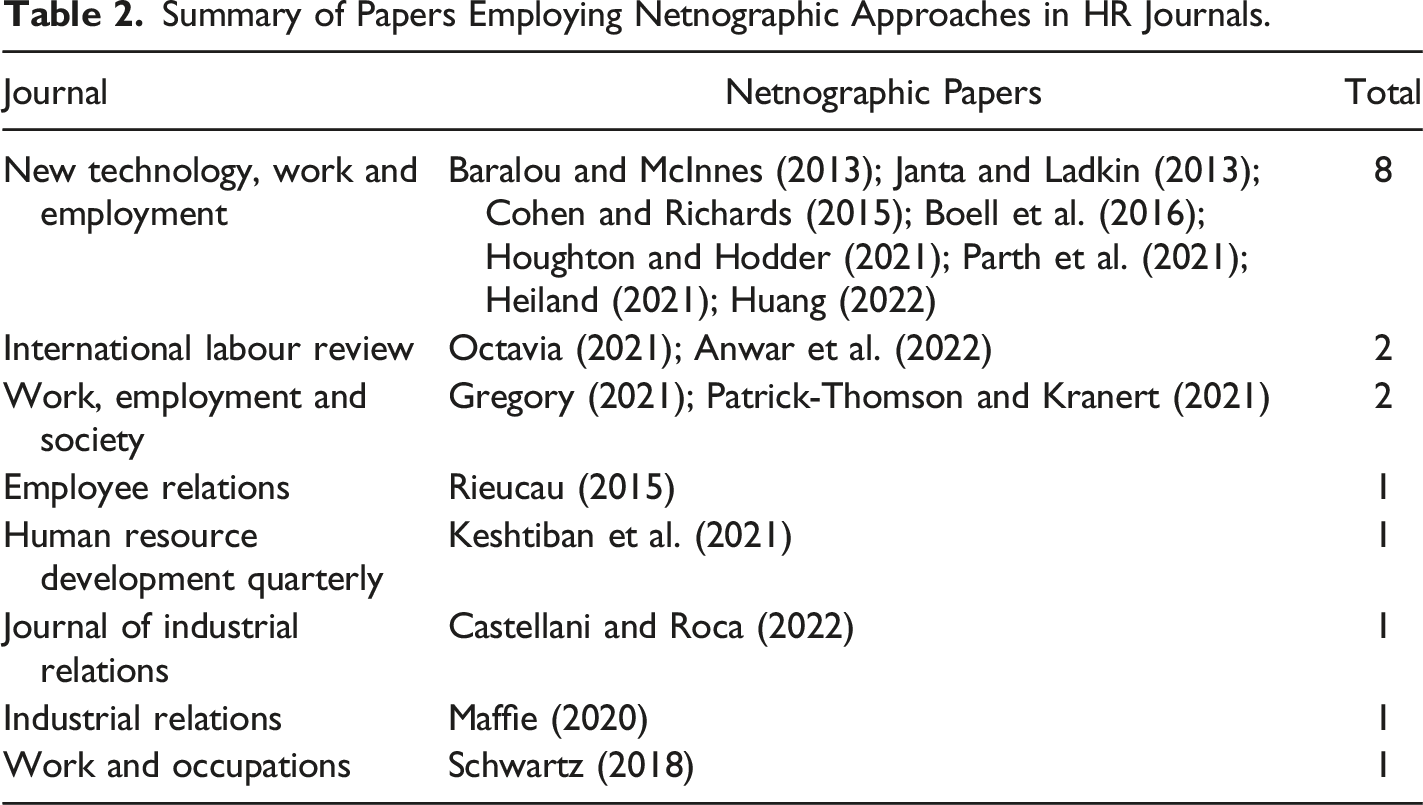
One premise of this paper is that few studies in the HRD research field have focused on the interaction of technology with workplace learning and development. With the exception of Anderson et al. (2020) most studies are located in disciplines such as Computer Science, Medical Education, or Technology Enhanced Education (e.g., Abdullah & Ward, 2016; Balatsoukas et al., 2015; Egloffstein & Ifenthaler, 2017; Šumak et al., 2011) and focus on technology adoption rather than its integration with other work and learning processes. A further motivation for the paper is the increasing recognition of the value of Netnography in a range of management and organizational disciplines (for example, Del Vecchio et al., 2020; Heinonen & Medberg, 2018; Tavakoli & Wijesinghe, 2019). Netnographic research reports are increasingly evident in mainstream and top tier journals. For example, a search of ‘netnography’ on Google Scholar yielded 1300 results, and 4000 results in 2014 (Kozinets, 2015). By September 2022, we found that the same search yields over 18,000 results.
Summary of Papers Employing Netnographic Approaches in HR Journals.
Netnography and Ethnography Papers Published in Key HR Journals.
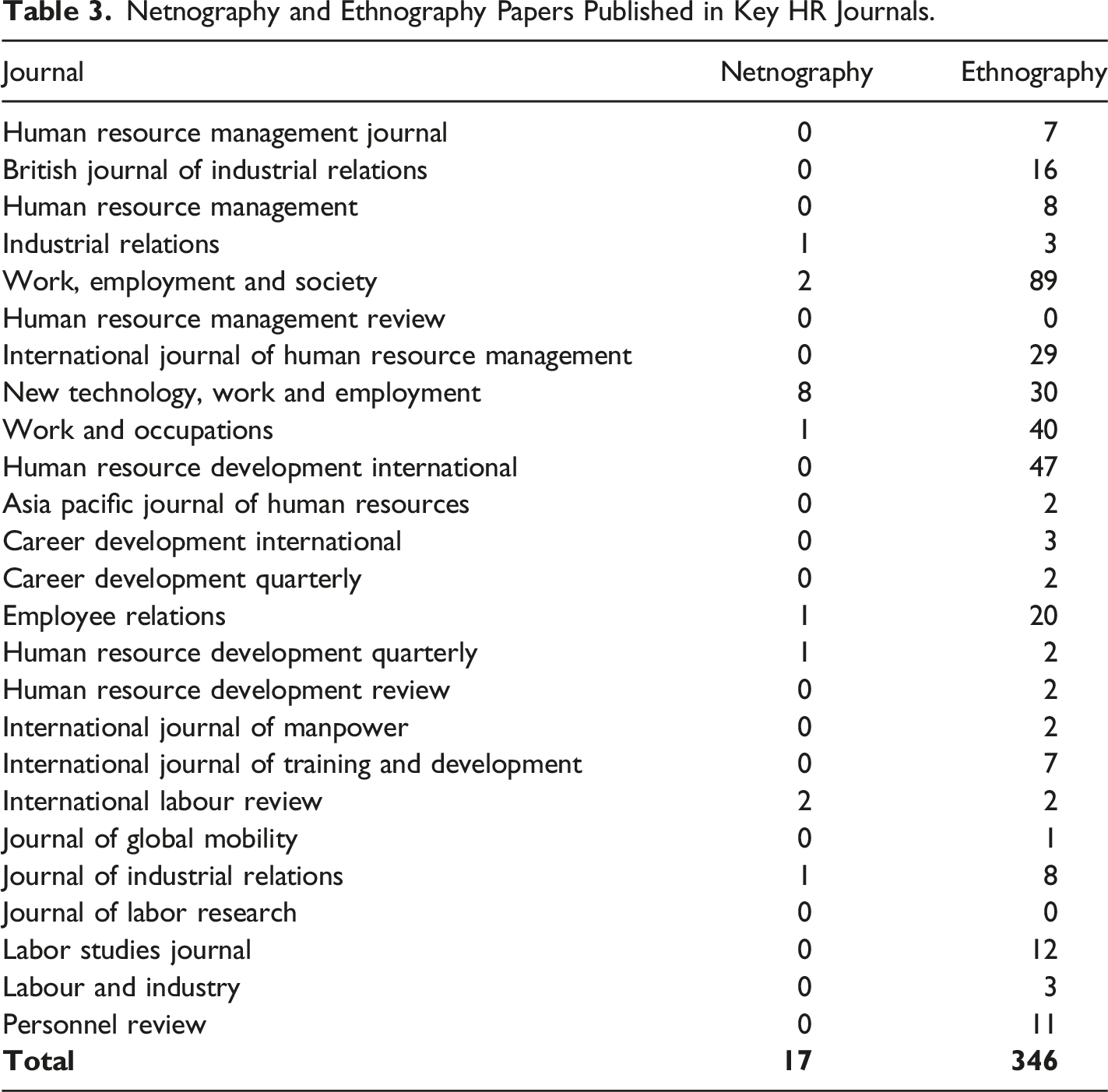
HRD practices and organizational change processes are, and will continue to be, profoundly interrelated with technology, given the prevalence of online and remote working and increasingly digitized learning, training and people management and development processes. Established and emerging social networking tools and the ‘blogosphere’ represent important means by which HRD stories are told. With the exception of Keshtiban et al. (2021), the opportunities of an explicit Netnographic approach are thus far absent from the HRD journals. Therefore, we argue for recognition of Netnography as a necessary methodological innovation in the HRD research field. We use the term methodological innovation as it has been characterised by Le and Schmid (2022, p. 208) as ‘the introduction and application of ideas, processes, and procedures, new to the field, with potential to significantly benefit the (HRD) field’. We specifically consider in this part of the paper how Netnography can benefit HRD research and theory building by opening up new theoretical understanding of work, learning and struggle that occur in digitally mediated spaces and contexts.
HRD Empirical Research Opportunities
We identify three distinctive opportunities where Netnography can deliver important advances to both HRD theory and practice. We illustrate our proposals with examples of Netnographic studies in related domains. We first identify how Netnography can exploit previously underused HRD data sources generated in hard-to-access online work contexts, such as gig work and other forms of precarious working to examine how formal and informal, tacit and explicit learning can interact with precarious and technologically mediated forms of work. Second, we propose that, as shown by Keshtiban et al. (2021), Netnography can add to critical HRD research and theorising through access to previously ‘hidden’, overlooked or under-researched voices. Third, we show how Netnography can extend HRD knowledge of learning in hybrid work environments where physical and digitized networks and dimensions are intertwined in work and learning environments.
Gig Work and Precarious Work
We propose that Netnography is ideally suited as a means to access collective learning experiences or to identify tactics of resistance in emerging work spheres, such as gig work and precarious work, especially related to grassroots processes of solidarity, resistance, and collective action. Social movements and grassroots organising are two under-researched areas from which HRD researchers and professionals have a lot to learn (Keshtiban et al., 2021), yet little exploration of social movements has characterised the HRD field so far (Grenier, 2019). An example of the empirical research opportunities presented by Netnography is platform work, also known as ‘gig work’. In the context of individualised and isolated forms of labour, geographically and temporally dispersed, there are few opportunities for workers to meet, something that is further hindered by management efforts to limit opportunities for workers’ collectivisation (Woodcock & Graham, 2019). In such contexts, digital spaces represent a key opportunity for communication. Social media and online chat processes constitute an important spatial resource for workers. Digital data, accessed through Netnography, represents a key resource for HRD researchers whose research questions require access to these spaces and discourses. For example, Heiland (2021) explored food delivery labour in Germany through a combination of Netnography and autoethnography: the researcher worked as a ‘rider’ for different platforms and as a consequence was invited to join online chat groups and forums where workers shared experiences and met virtually. Heiland’s Netnographic engagement with digital traces revealed how workers use online chats as a resource to organise against platforms’ exploitative practices and ‘tight’ management. Similarly, Maffie’s (2020) study of Uber riders Facebook groups found that workers use online spaces to share grievances and build collective identity, which in turn is associated with more positive views on unions and improved interest in joining a labour association. An emerging body of literature in several empirical contexts, such as Indian app-based cab drivers (Parth et al., 2021), Kenyan Uber workers (Anwar et al., 2022), Scottish on-demand food couriers (Gregory, 2021), and Indonesian platform-based domestic workers (Octavia, 2021) is providing insights into how digital communication spaces and social media groups enable collective processes of solidarity and workers’ resistance to work around management’s restrictive practices. Given the increasing prevalence of gig work, platform work, and crowdwork in the contemporary labour market, Netnographic research represent an indispensable methodology from which to empirically chart and understand collective identity construction, resistance and struggle in these otherwise inaccessible contexts.
Netnography also offers access to thus far unrecognized tacit learning and knowledge sharing. A study by Patrick-Thomson and Kranert (2021), for example, explored how precarious workers in the creative industry use social media and digital spaces to empower themselves, support each other, share learning regarding dealing with bad client behaviour, and ultimately organise to improve labour conditions in the industry. Similarly, Schwartz’s (2018) study of a crowdsourced work online community showed how creative freelancers use the online space as a tool to navigate the challenges of crowdsourced work, build community, and find purpose and meaning in their work. In relation to critical HRD research, social media and chat-based applications represent important discursive spaces that provide workers with resources and practices able to organise resistance against exploitative practices. For example, Cohen and Richards’s (2015) study of self-organised employee resistance in non-unionised labour, and Wood’s (2015) study of Walmart workers’ mobilisation and strikes in the US uncovered several positive functions played by social media groups, such as fostering employees’ creativity, resourcefulness and resilience, intensifying communication and participation, and facilitating the organisation of protests and strikes.
Therefore, our contention is that Netnography provides the basis for empirical studies to examine how workers, both individually and in groups, through formal and informal networks, can learn, organise and enact change. While several studies are available to show how online users support each other, for example in health forums (Howard et al., 2021; O’Connell et al., 2021; Tuckey et al., 2022), or in social movements (Bozarth & Budak, 2020; Stewart & Schultze, 2019; van Haperen et al., 2018), few studies have explored these issues in work-related contexts, which represents an untapped potential for HRD researchers.
‘Hidden’, Overlooked or Under-Researched Voices
We further argue that Netnography provides HRD researchers with opportunities to access ‘voices’ that might otherwise be inadvertently silenced by traditional organisational research. Marginalised and hidden voices might be those of migrants (Castellani & Roca, 2022; Janta & Ladkin, 2013), illiterate precarious workers (Parth et al., 2021), protesters and activists outside mainstream networks (Keshtiban et al., 2021), or women and ethnic minority workers carrying out remote work (Akemu & Abdelnour, 2020). An example of the potential of the Netnography in such circumstances is Janta and Ladkin (2013) who examined online employment practices in the hospitality sector in international migration contexts. This study, which accessed data from online forums, provided first time access to voices of aspiring migrants with no English language skills that would otherwise be marginalised and under-represented in empirical research. The findings from this study showed the informal learning processes enacted between more experienced forum members and migrants who were newer to the locality. This form of grassroots and collective learning and development for marginalized members of the labour market would otherwise have been invisible or undetected. Collective action to address language deficiencies and unfamiliar cultural codes was common also in the experience of Southern European precarious migrants studied by Castellani and Roca (2022).
A further example of marginalised voices accessible through Netnography is Parth et al. (2021) analysis of workers’ online chat in food delivery companies. They revealed the experience of gig workers who were not sufficiently literate for social media but could learn digital skills such as vocal messages, taking pictures and screenshots, and recording and sharing video files from more experienced workers which in turn generated increased collective identity and micro-political participation. These examples demonstrate the opportunities Netnography provides for HRD research into the opportunities presented by technology for flexible and inclusive work (for example, for workers with disabilities or with care responsibilities) but also to critically probe risks and vulnerabilities relating to unpaid labour, platforms’ lack of transparency, work-time intensity and poor working conditions (Rani & Furrer, 2021).
Online and Physical Dimensions of Work and Learning
We further propose that Netnography provides HRD researchers with opportunities to empirically address new research questions about forms of learning in virtualised organisations, and about processes of connection, collaboration and inclusivity (or exclusivity) in work cultures that encompass hybrid digital and physical spaces. This is a significant opportunity as technologically mediated communication has an increasingly profound effect on the spatiality and the temporality of contemporary forms of works, learning and organisations. The social space of work has morphed into new digital spatial configurations such as the ‘home office’, the ‘virtual office’, work arrangements described as digital nomadism, hot desking, telework, collaborative entrepreneurship, and co-working spaces; while temporality has shifted away from the 9a.m. to 5p.m. employment model towards an ‘always-on’ approach, enabled by digital platforms and connectivity on social media (Aroles et al., 2019). Therefore, empirical examination of hybrid work experience to consider workers’ knowledge sharing and empowerment, alongside forms of organizational surveillance, and the paradoxical interplay between independence and control in technologically mediated work environments (ibid.) is a priority for the HRD field. In addition, research into emergent temporal and spatial configurations of digital work spaces and tools can be conducted using Netnography to take forward a comparative research agenda across different sectors where flexible, remote or digital working is normalised (Felstead & Reuschke, 2020).
Netnography also provides opportunities for HRD research into the effect of boundary ‘blurring’ between the private and the public in work organizations that social media and other forms of technology has provoked. Studies into boundary contestation and other ethical and privacy-related issues with implications for individual, team and collective voice, engagement and learning are urgently needed (McDonald & Thompson, 2016). Matters of employee autonomy and technologically mediated surveillance also arise in relation to trade union activity or other workplace participation (Geelan, 2021) alongside the opportunities presented by broader ‘digital audiences’ that can revitalize participation and avoid employer counter-mobilisation (Panagiotopoulos, 2021).
Netnographic benefits for HRD theory development
Bergh et al. (2022) point out that disciplinary advances are dependent on two intertwined pillars: refinements in theory and refinement in empirical data access methods. In this section we focus on the potential of Netnography to contribute to HRD theory building, which, following Lynham (2000, p.161) we define as: “the purposeful process or recurring cycle by which coherent descriptions, explanations, and representations of observed or experienced phenomena are generated, verified, and refined”. We argue that Netnography, can form part of the ‘craft’ of qualitative theory development (Rivard, 2021) through the opportunities it presents for continuous, iterative interaction between empirical data traces and sources, construct development and conceptual refinement to reflect the digital and platform features of work and employment. In making this case we draw on Storberg-Walker’s (2006) theory building framework to show how Netnography can contribute to conceptual development, operationalization, and validation and refinement (Figure 1). New opportunities for HRD theory development enabled by Netnographic methods.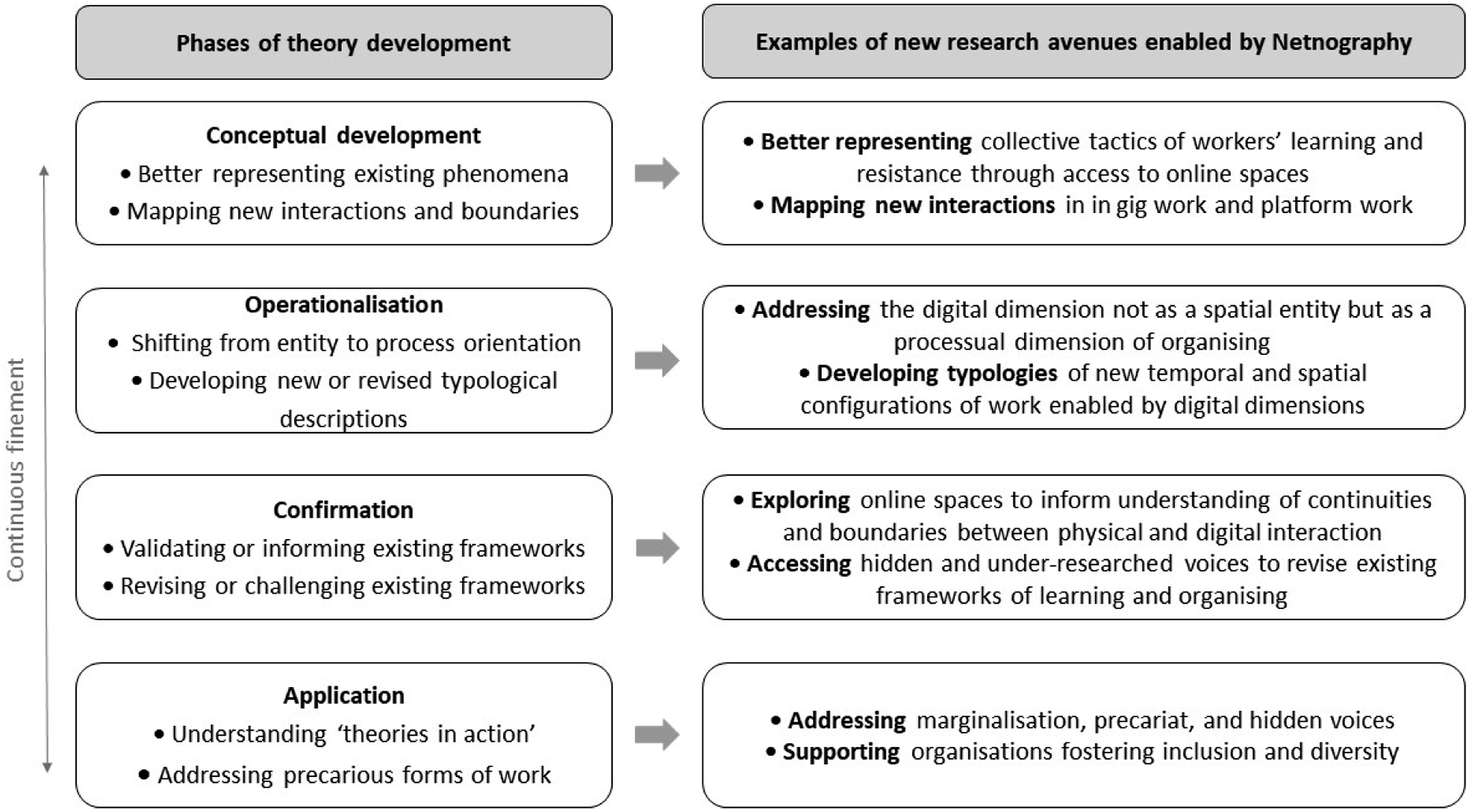
Conceptual Development
As discussed already in this paper, Netnographic inquiry can ‘explore new terrain’ and give voice to previously unheard or neglected perspectives which have been inadequately represented in established conceptual descriptions and theoretical framings. Netnography can generate valuable data sources that prompt problematization or re-categorization of established concepts to better describe HRD-related phenomena, issues, or problems in contemporary digital or platform environments (see, for example, Patrick-Thomson & Kranert, 2021). In addition, studies carried out using Netnography may identify anomalies or tensions between established theoretical assumptions and propositions and provide opportunities for mapping of relationships and interactions in specific digital contexts (see for example Hamblin (2022) study of the potential of technology for care workers and care patients). In this way, Netnography provides opportunities to achieve greater clarity about boundary contexts in theorisation of digital and work spaces, for example, establishing patterns of change in relationships between workers, organizations and communication structures over time (see, also, Schoneboom’s (2011) analysis of work blogging).
A further example of the conceptual potential of netnography is Keshtiban et al.’s (2021) study of the Occupy movement where interviews with activists, ethnographic observation and Netnography featured in the research design. After the activists were evicted from the physical space of protest, it was the Netnographic research that enabled analysis of how the movement continued organising online and in digital protest spaces and led to the identification of horizontal, participative and distributed leadership distinctive from conventional hierarchical and individual-mediated leadership patterns mostly reported in the HRD research field.
Operationalization
Netnography is also relevant to the phase of theory building described by Storberg-Walker (2006) as operationalization. Netnography can contribute to an ontological shift in HRD towards a processual rather than a ‘variance’ orientation (Rivard, 2021). For example, the analytical and explanatory focus can shift from instructional or e-learning design (as a stable entity) towards a more holistic understanding of processes of learning as they occur in digital and platform contexts. Virtual teamwork environments are characterised by co-creation of emotions (Baralou & McInnes, 2013) and the complexity of virtual environments requires a dual emphasis in HRD theorization on formal and informal learning that brings into view previously unrecognized explicit and tacit learning modes occurring through virtual environments and remote work processes (Bennett & McWhorter, 2022). Netnography offers a means to navigate this dual emphasis and provides opportunities to assess homogeneity, independence, or heterogeneity of experiences and meanings in digital spaces. Additionally, Netnography provides an opportunity to investigate the power dynamics and gendered work patterns in digital spaces (see for example Akemu & Abdelnour, 2020; Chung & Van der Lippe, 2020). In this way, it can provide the basis for nuanced theory building and the development of new or revised typological descriptions to more holistically explain multiple and complex patterns of reflection, learning, and knowledge sharing activity.
Confirmation
Netnography can also add value to the confirmation/refinement phase of theory building. By providing new sources of data and analytical processes that may ‘surprise’ of ‘sit uncomfortably’ against expectations generated through existing theoretical framings, Netnography can inform, support, revise or refute existing frameworks or explanations. As Keshtiban et al. (2021) argue, this makes possible an important criterion of conceptual and theoretical ‘currency’ in emergent, applied settings.
Following Scully-Russ and Torraco (2019) we argue that Netnography provides an important way to stimulate HRD theorization of skills, expertise development and upskilling to take better account of the changing nature of work and the erosion of traditional jobs by newer forms of freelance and contingent work. As we have also suggested through the examples of Netnographic studies we have identified in the work, employment and HR journals, Netnography can contribute to theorisation of social, work and professional identity development in new work contexts. For example, Petriglieri et al. (2019) argue that traditional understandings of identity development in work settings fail to take account of the platform economy context. As illustrated in the studies we have cited in this paper, Netnography also provides a basis to explain how digital contexts confer social identities and to examine processes of identity work and its emotional underpinnings where formal organisational affiliation no longer represents a boundary condition (Ashforth et al., 2008).
Application
We argue here that Netnography provides opportunities for HRD study, inquiry, and understanding of HRD ‘theories in action’ that include rather than exclude digital and platform environments which are increasingly dominant features of work and socio-cultural settings. This can provide opportunities for theory building to explain HRD processes in contexts where the digital workplace progressively restructures employment relationships and professional identity formation (Fenwick et al., 2012; Petriglieri et al., 2019). For example, Evans (2019) research into HRD professional identity development which draws on data from two Twitter chat events, characterises previously unidentified processes of ‘enterprising selfhood’ that challenge previous explanations of professional formation and development and suggest a need for conceptual ‘fusing’ of lifelong learning, the psychological contract and employee engagement that better reflect digital and precarious work contexts. Additionally, in a context where managerial practices are increasingly mediated by algorithmic and Artificial Intelligence practices (Manley & Williams, 2019; Rani & Furrer, 2021), which deepen processes of exploitation of workers and control (Moore & Woodcock, 2021), Netnography can meet the urgent need to examine and conceptualise nuanced, complex and automated online interactions, relationships and dynamics (Pink, 2022).
To summarise, Netnography provides theory building opportunities that can observe or question technologically mediated work events in formal and informal ‘everyday spaces’ (Shepherd & Suddaby, 2017) to build more robust explanations of work, learning and change in contemporary settings.
Conclusion
In making the case for Netnography as an HRD methodological innovation we have set out its methodological principles and described the main Netnographic data collection and analysis procedures. We have argued that Netnography overcomes the limitations of other qualitative methodologies, such as ethnography, action research and qualitative case studies. We have further argued that HRD research and theorizing has not thus far taken sufficient account of ways in which new forms of work and employment, digitally mediated learning and patterns of social and organizational meaning-making are intertwined with digital and technologically mediated spaces and contexts.
A limitation of our paper is the small number of examples of Netnographic research we have identified in HRD journals such as Human Resource Development Quarterly, European Journal of Training and Development, Advances in Developing Human Resources and Human Resource Development International. This limitation reflects the underrepresentation of Netnography in the HRD field of research and scholarship. However, HRD scholars must grapple with research and theorization of interaction between technological infrastructures and HRD processes as the nature of work and learning shifts towards the digital, the flexible, the distributed and the precarious. Our assessment is that, although the value of Netnography is increasingly recognized in other management and business disciplines, researchers in the HRD field, with the welcome exception of Keshtiban, et al. (2021) have not yet capitalized on its potential benefit. This lack of methodological innovation in the current HRD research literature has motivated this paper as we concur with Pink (2022) that new methodologies are needed to provide (HRD) researchers and professionals with pathways to re-shape organisations that are more diverse and inclusive.
Therefore, we conclude with a call to action by HRD scholars to take forward, and further develop, the Netnographic methodology to advance qualitative, critical and engaged research into work, learning and development in digital and hybrid spaces and contexts. In a context where virtual and asynchronous learning occurs alongside and intertwined with embodied and synchronous processes, Netnography provides the HRD field with opportunities to identify and access new and previously overlooked data sites and forms of data. It can prompt new research questions, give voice to thus far overlooked participant perspectives, and contribute to new and inclusive theorizing as a basis for advancements in HRD scholarship and practice.
Footnotes
Declaration of Conflicting Interests
The author(s) declared no potential conflicts of interest with respect to the research, authorship, and/or publication of this article.
Funding
The author(s) received no financial support for the research, authorship, and/or publication of this article.
