



Abstract
Objectives
This study aimed to examine the effects of location-tracking devices on persons living with cognitive impairment, investigate facilitators of and barriers to using the devices, and provide future directions for the use of the devices.
Methods
An integrative review was conducted using 5 databases: PubMed, Embase, Web of Science, CINAHL, and Scopus. From the 1429 initially identified studies, 10 were included in the review.
Results
Location-tracking devices benefited persons living with cognitive impairment and their informal caregivers. The devices brought more independence to persons living with cognitive impairment, allowing them to go outside and feel safer there. Furthermore, the devices reduced the caregivers’ worries about their loved ones being lost.
Conclusions
Location-tracking devices have the potential to increase independence in persons living with cognitive impairment and to decrease psychological stress in informal caregivers. In the future, ways to minimize the barriers to using location-tracking devices need to be determined.
Keywords
Significance Statements
• Using location-tracking devices had various positive outcomes for both persons living with cognitive impairment and their caregivers. • With location-tracking devices, persons living with cognitive impairment had greater independence and were relaxed about going outside. • Facilitators of location-tracking device use included accuracy, ease of use, design, and technology-related abilities.
Introduction
The prevalence of cognitive impairment is increasing worldwide. 1 The worldwide prevalence of cognitive impairment is reported to range from 5.1% to 41% with a median of 19%. 2 As persons living with cognitive impairment undergo progressive cognitive decline, various behavioral and psychological symptoms, such as wandering, aggressive behaviors, agitation, or depressive moods, frequently occur.3,4 Wandering, which refers to “individuals walking away from a particular location and not being able to retrace their steps,” 4 is a common symptom.5,6 When wandering occurs, it brings negative outcomes to both persons living with cognitive impairment and their informal caregivers.4,6
For persons living with cognitive impairment, wandering increases the risks of being lost and injured.4,7 People who wander may experience falls or sustain fractures or injuries, 8 whereas others may experience serious illness or death. 6 For example, persons who wander outside can easily become lost and could be at risk of sustaining a physical injury that can lead to fatal consequences.9-11 Additionally, persons wandering outside may face death due to hypothermia. 6
Wandering is problematic not only for persons living with cognitive impairment but also for their informal caregivers. Informal caregivers of persons living with cognitive impairment experience increased worry and burden.4,6,12 When their loved ones perform risky wandering behaviors, many informal caregivers feel burdened by the care6,12 and experience increased fatigue, sleep problems, and depression. 13
As an effort to assist persons living with cognitive impairment who wander, non-pharmacological interventions for wandering have been designed. 14 According to a systematic review of non-pharmacological interventions for the wandering behavior of persons living with cognitive impairment, various methods have been applied, such as exercise, walking therapies, environmental modifications, and behavioral modifications. 14 However, many interventions were focusing on creating a safe home environment. 14 Considering that persons living with cognitive impairment who live at home can wander outside, new interventions to ensure their safety are needed.
For decades, surveillance technology, such as environmental sensors, video monitoring, and tagging systems, has been utilized in the daily care of persons living with cognitive impairment. 15 With technological advancements, portable location-tracking devices, such as those that use the global positioning system (GPS), have emerged recently. Such location-tracking technology allows the monitoring of a person’s location. Tracking one’s location may have the potential to support persons living with cognitive impairment and reduce the worry of their informal caregivers about them being outside alone.16-18 Location-tracking technology can play a crucial role in preventing persons living with cognitive impairment who may wander from becoming lost and in ensuring their safety. 19 This is especially important because the first 24 hours are often considered critical in locating a lost person, thereby reducing the potential risks they may face. 10
With the emergence of the technology, many researchers have also reported ethical concerns about providing location-tracking devices to persons with cognitive impairments.20-22 These ethical concerns include dilemmas in balancing the safety and privacy of persons living with cognitive impairment.20-22 For example, while informal caregivers may want to use location-tracking devices to ensure safety, persons living with cognitive impairment may be hesitant due to privacy concerns.20,21 Location-tracking devices are likely to be perceived positively when they enhance the autonomy of persons living with cognitive impairment while reducing the risk of wandering. 22 Despite the ethical concerns, because location-tracking devices have many advantages, efforts have been made to provide location-tracking devices to persons living with cognitive impairment over the past decade.23,24 To improve the technology provided to persons living with cognitive impairment and their informal caregivers, it is important to synthesize the results of previous studies to provide directions for the future. Therefore, in this review, we aimed to synthesize the results of previous studies that used location-tracking devices for persons living with cognitive impairment and their caregivers. The specific aims of this study were to examine the effects of using location-tracking devices by persons living with cognitive impairment, investigate facilitators of and barriers to using the devices, and provide future directions for applying the devices.
Materials and Methods
This study was an integrative review that included various types of empirical studies to facilitate a comprehensive understanding of a phenomenon. 25 Integrative review is frequently equated to the terms “mixed studies review” 26 and “mixed research synthesis,” 27 as it includes both quantitative and qualitative studies. This type of review can include different types of empirical studies, such as case, cross-sectional, phenomenological, and grounded theory studies. 25
Data Sources
A literature search was conducted using 5 databases: PubMed, Embase, Web of Science, CINAHL, and Scopus. Search terms such as “Global Positioning System,” “GPS,” and “tracking,” with the combination of the terms “dementia,” “Alzheimer,” and “cognitive impairment,” were used. The search algorithms for each database can be found in the Supplementary Materials (Table S1). We included not only studies of persons diagnosed with dementia but also those with mild cognitive impairment to comprehensively explore the effects of their use of location-tracking devices. The searches were limited to studies published before August 7, 2023. We did not limit the start date because tracking technology is relatively new.
Study Selection
Figure 1 shows a flowchart of the literature search and extraction for the review, which was prepared using the Preferred Reporting Items for Systematic Reviews and Meta-Analyses (PRISMA) guidelines.
28
A total of 1429 studies were identified from the databases. After 278 duplicate records were removed, titles of 1151 studies were screened for relevance, then 1033 studies were removed because they were not related to the purpose of this study. Next, 118 abstracts were screened for eligibility for a full-text review. The inclusion criteria for a full-text review were as follows: empirical experimental studies that (1) applied location-tracking devices, (2) explored the effects of applying such devices, (3) included a population of persons living with cognitive impairment who live in their own homes, not in short time care or in nursing homes, and (4) were published in peer-reviewed journals. Finally, 35 studies that were eligible for a full-text review were reviewed. Additionally, a manual search was conducted to ensure comprehensive results. Two authors (JK and MH) independently conducted the screenings. When inconsistencies were found, researchers met in person to resolve any disagreements until a mutual agreement was achieved. Consequently, a total of 10 studies were included in this review. Flowchart of the literature search and extraction.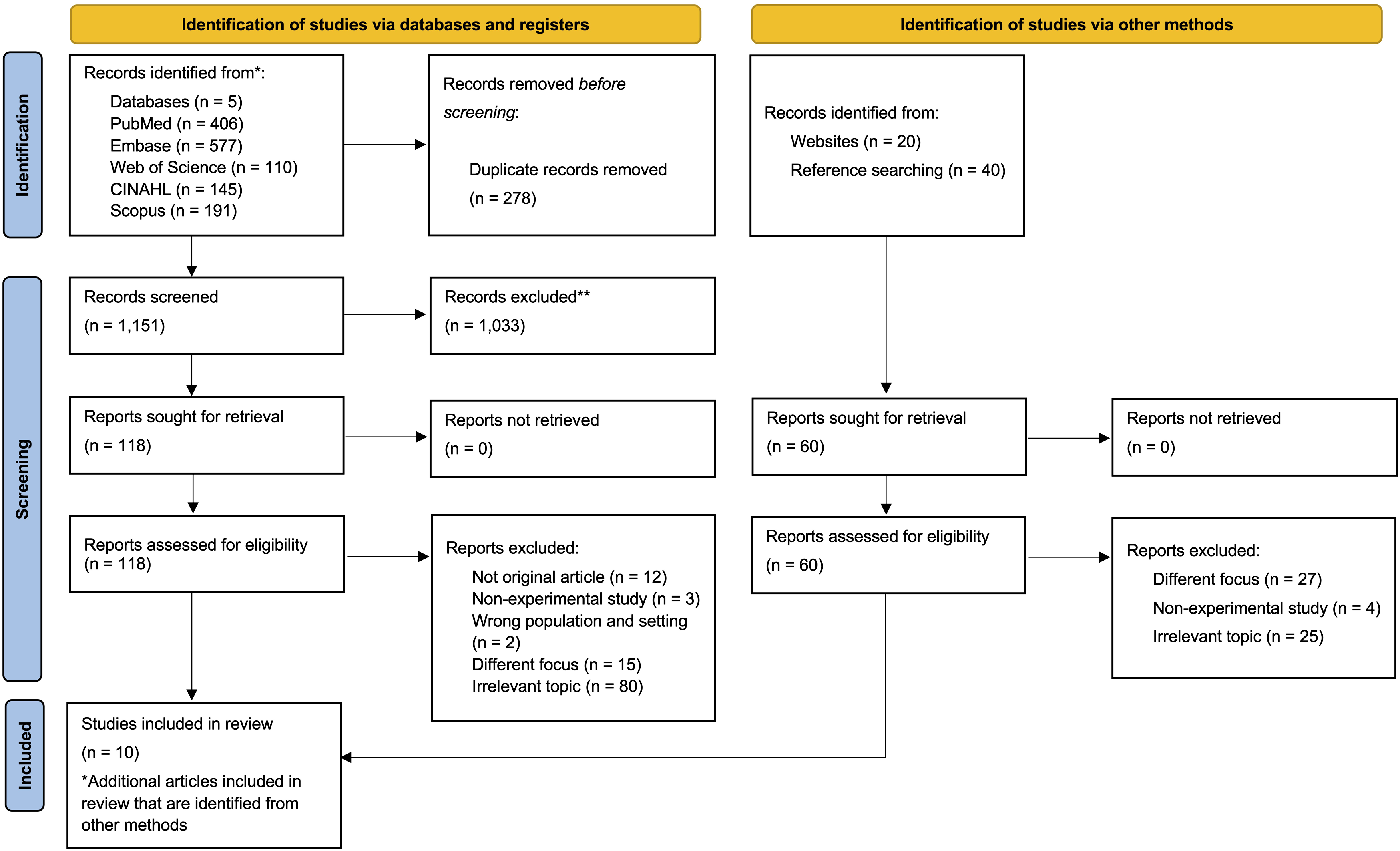
Quality Assessment
Quality assessment was performed using the Joanna Briggs Institute (JBI) critical appraisal tools.29,30 Depending on the study design, the JBI Critical Appraisal Checklist for either Quasi-Experimental Studies or Case Studies was used to assess study quality. Because each critical appraisal tool had a different number of items, comparing the appraisal results was challenging. Therefore, we used percentage scores to facilitate easier comparison of each quality assessment score. The outcomes of the quality assessments are presented in the Supplementary Materials (Table S1).
Data Synthesis
A narrative synthesis method was used to synthesize the results from the various types of studies included in this review. To organize the facilitators of and barriers to using the location-tracking devices, we used the unified theory of acceptance and use of technology (UTAUT). 31 This theory identifies 4 core constructs that determine an individual’s intention to use a certain technology: performance expectancy, effort expectancy, social influence, and facilitating conditions. 31 Performance expectancy refers to the perceived usefulness or advantages of using the technology. Effort expectancy indicates the perceived ease of using the technology or the features that are easy to use. Social influence refers to subjective norms or social factors that lead to the use of technology. Finally, facilitating conditions are other factors that may facilitate the use of the technology, for example, the perceived sense of control or knowledge necessary to use the technology. We used these 4 constructs to organize the facilitators of and barriers to using the location-tracking devices.
Results
The included studies were conducted in 8 different Western countries: Netherlands, Germany, Sweden, United Kingdom, United States, France, Australia, and Canada. Study designs varied among the 10 studies reviewed. Five studies were quasi-experimental studies,23,24,32-34 4 were case studies,18,35-37 and 1 was a qualitative intervention study that used interviews to explore the user experience of device use. 38 These studies were published in health- or human life-related journals.18,23,24,32-38
The studies used different approaches to examine the effects of using the devices or to explore experiences of using the devices. Two studies were mixed-method studies, which utilized quantitative data and qualitative interviews,24,33 and 4 quantitative studies employed a pretest–posttest design.23,32,34,37 Additionally, 2 studies incorporated pretest–posttest interviews,35,38 and 2 studies relied solely on post-interviews.18,36
These studies aimed to explore the user experience of location-tracking devices,23,38 to examine the feasibility or acceptability of the location-tracking devices,24,32-36 to examine whether the devices increased independent outdoor activities of persons living with cognitive impairment, 37 and to identify the effectiveness of applying the location-tracking devices.18,32,37
Characteristics of Study Participants
While 9 studies included dyads of persons living with cognitive impairment and their caregivers as study participants,18,23,24,32,33,35-38 1 study included a mixture of persons living with cognitive impairment and those with other chronic conditions as study participants. 34 The number of dyads in the included studies ranged from 1 to 45.18,23,24,32-38 The mean age of persons living with cognitive impairment was 74.41 ± 6.44 years (min-max: 64-84), with 31.3% being female. The mean age of their informal caregivers was 66.96 ± 4.48 (min-max: 61-74), with the majority being female (68.7%). One study didn’t provide detailed information regarding age or gender of the participants. 24 The severity of cognitive impairment varied across the studies. One study exclusively involved participants with mild cognitive impairment, 18 whereas others included those with moderate impairment32,33,35,36 or a combination of mild and moderate severities.23,24,37,38
Application of Location-Tracking Devices
The reviewed studies used a wide range of location-tracking devices. In most studies, 1 type of device was used with specific instructions.18,23,32,35-38 For example, the location-tracking devices were worn on one’s belt,32,35 worn on the wrist as a watch, 36 or carried in one’s pocket.18,37,38 1 study used a mobile application for location tracking. 23 In contrast, a study conducted by Williamson and colleagues 34 gave 3 different types of location-tracking devices to the study participants including a location-tracking pendant, a location-tracking watch, and a mobile phone–like location-tracking device. There were studies which did not specify the types of location-tracking devices used.24,33
The duration of applying the location-tracking devices varied from 1 day to 3 years in studies where only 1 device was used.18,23,24,32,33,35-38 However, in Williamson et al 34 study, where 3 different types of location-tracking devices (ie, a pendant, a watch, and a mobile phone–like location-tracking device) were applied, each device was used for 2 weeks with a weeklong break between trials.
In addition to the location-tracking function, the devices had various additional functions. In 7 studies, the location-tracking devices had a messaging function that could send an alarm automatically to a designated person when the person living with cognitive impairment left a predefined area.23,24,33-35,37,38 In 4 studies, a call function, which allowed persons living with cognitive impairment to contact their caregivers, was available.18,23,32,34 Some location-tracking devices had a speaker function that enabled caregivers to contact their loved ones 32 or an emergency alarm function that could send an alarm to a certain person when the person living with cognitive impairment pressed the emergency button.18,23,34,35 Some devices had additional functions, such as an accelerometer, heart rate monitor, 36 speed alert, 34 inactivity detection function, 35 or fall detection function.34,35
The information from the location-tracking device about the location of a person living with cognitive impairment was provided mostly to their caregivers.23,32-35,37,38 However, in 1 study, the information was sent to a service center that caregivers could contact to obtain the location of their loved ones. 18 In 2 other studies, the information was provided to both a service center and the caregivers.24,36
Effects of Applying Location-Tracking Devices on Persons Living with Cognitive Impairment
In general, using location-tracking devices led to positive outcomes among persons living with cognitive impairment. Specifically, it improved their ability to go outside independently,32,33,37,38 provided them more independence from caregivers, 32 reduced their worries of being outside unaccompanied, 32 made them feel safer 33 and more relaxed, 18 and increased their confidence. 33 Additionally, persons living with cognitive impairment experienced less conflict with their caregivers about going outside alone. 32 Although many studies reported positive outcomes of providing location-tracking devices to persons living with cognitive impairment, 1 study reported that there were no significant improvements in the well-being or irritability scores of persons living with cognitive impairment. 37 In this study, 37 the participants’ well-being and irritability were measured by simple questions on scales from none to extremely high, rather than by validated scales.
Although some participants initially reported that using the device made them feel like they were under surveillance, they later found reassurance in its use. 24 Overall, many participants showed high satisfaction and acceptance of using the location-tracking devices.34,36,38 Satisfaction and acceptability of the device were measured either by a researcher-created question in the quantitative study 34 or by interviews in the qualitative studies.36,38
Effects of Applying Location-Tracking Devices on Informal Caregivers
Providing location-tracking devices to persons living with cognitive impairment also had positive outcomes for informal caregivers. It allowed the informal caregivers to provide more freedom to persons living with cognitive impairment.24,32,33,38 It also decreased informal caregivers’ worries about their loved ones being outside unaccompanied32,37 and provided them with more private time. 32 The use of location-tracking devices also reduced conflicts with persons living with cognitive impairment about going outside on their own without worrying about getting lost. 32 After providing the device to persons living with cognitive impairment, many informal caregivers experienced peace of mind24,33 and became more relaxed and less anxious. 18
Additionally, the location-tracking devices were useful in saving lives and money. 33 In case of being lost, the devices reduced the time spent searching for the lost person. 24 Overall, informal caregivers showed high satisfaction with and acceptance of using the location-tracking devices.34,36 Some expressed their desire to continue using the devices 38 and showed a willingness to purchase them.23,34
Although many positive caregiver outcomes of providing location-tracking devices to persons living with cognitive impairment were found, no significant changes were found in role overload, 32 burden, 23 efficacy, 23 anxiety, 24 or depression 24 among caregivers.
Facilitators of Applying Location-Tracking Devices
Performance Expectancy
When study participants in the included studies evaluated the usefulness of the location-tracking devices, the reliability of the devices was important. In other words, they considered location accuracy to be a very important feature of the location-tracking devices. 34 Receiving coordinates without delay was also important for the study participants. 34
Effort Expectanc
The participants in the reviewed studies preferred user-friendly, comfortable, and easy-to-use location-tracking devices.18,23,34,36,38 In 1 study, informal caregivers rated ease of use as the most important feature of the devices, and persons living with cognitive impairment ranked it as the second most important feature. 34
Social Influence
Social influence, defined by an individual’s perception of significant others’ beliefs about their use of technology, facilitated the usage of location-tracking devices. Informal caregivers’ social influence was positively associated with both caregivers’ and their loved ones’ intentions to use the device. 33 In 2 studies, persons living with cognitive impairment accepted the device to please their caregiver and to reassure them, although the device made them feel controlled and limited their freedom. 35
Facilitating Conditions
The study participants’ ability to use the location-tracking devices had an impact on their use.34,35,38 Informal caregivers who were familiar with new technology felt more comfortable and confident in using the devices compared with those with low technological skills. 38 Other facilitating conditions included the appearance of the devices. Many participants reported that they were more likely to use a location-tracking device if it had a stylish and trendy appearance.34,36 Additionally, some preferred a design that was inconspicuous so that others would not notice it. 35 In 1 study, participants reported that they wished they could have small wearable devices to avoid stigma. 23 Overall, persons living with cognitive impairment valued a small location-tracking device with stylish design that would not stigmatize them.23,35
Barriers to Applying Location-Tracking Devices
Performance Expectancy
When inaccurate coordinates were provided by location-tracking devices, many informal caregivers expressed dissatisfaction with the devices.18,23,24,33-35 If there was a delay in updating the device in real time, it could not quickly obtain a person’s location. 24 Additionally, when inaccurate coordinates were provided, caregivers often received false alarms indicating that the persons living with cognitive impairment had left the predefined area.24,33 Technical issues resulting in the devices not functioning properly were also identified as barriers to using them.23,24
Effort Expectancy
When the devices had complicated interfaces and complex functions, caregivers were worried about their use by persons living with cognitive impairment.18,23,34,36 In fact, instances were reported of persons living with cognitive impairment having some problems in remembering the correct button,18,34 which led to unintentional actions such as turning the device off.34,36 Some caregivers suggested that having no or fewer buttons would be better considering how easily the settings are changed by mistake.18,36
Facilitating Conditions
Design and technical issues of the device could negatively influence location-tracking device use. Several studies implied that a device’s appearance might have led to dissatisfaction with the device.24,34,35 For example, the large and unaesthetic design of 1 location-tracking device led persons living with cognitive impairment to be dissatisfied with the device. 35 Similarly, when a device looked too childish and bulky, the participants were dissatisfied with it. 34
Some caregivers were not in favor of a device that has to be carried or a device that can be easily taken off.35,36 If it can be taken off by the persons living with cognitive impairment, they may go out without taking it with them.35,36 The caregivers who used this device faced challenges in managing it and expressed concerns about the possibility of persons living with cognitive impairment losing it. 35 In fact, there was an incident in which the location-tracking device was taken off by a person living with cognitive impairment and was temporarily lost; this incident added to the caregiver’s burden. 23
Moreover, a range of concerns related to the battery were expressed. For example, short battery life,32-35 absence of a low-battery indicator,33,34 or charging difficulties 24 were common. Sometimes persons living with cognitive impairment were not able to take the device with them when they went outside because of its low-battery status. 32 There was also an incident when a person living with cognitive impairment got lost and required police intervention because the battery had failed. 24
Discussion
This study examined the effects of providing location-tracking devices to persons living with cognitive impairment who live at home and investigated the facilitators of and barriers to using the devices. Overall, location-tracking devices generated many positive outcomes for persons living with cognitive impairment and their informal caregivers. The location-tracking devices allowed persons living with cognitive impairment to go outside independently and safely.32,33,37 Individuals living with cognitive impairment were less worried about being outside without being accompanied by someone else. 32 Many persons living with cognitive impairment reported satisfaction with the device use.34,36
Location-tracking devices were helpful not only to persons living with cognitive impairment but also to their informal caregivers. Informal caregivers were less worried about their loved ones being outside unaccompanied32,37 and enjoyed peace of mind.24,33 As informal caregivers allowed persons living with cognitive impairment to go outside alone, they were able to have more free time as well as less conflict with their loved ones about going outside. 32 Location-tracking devices were especially helpful when the person living with cognitive impairment was lost because the devices allowed the caregivers to promptly find them.24,33 Many informal caregivers expressed satisfaction with the devices,34,36 and some even showed a willingness to keep using the devices after the intervention had finished.23,34,38
Although many studies showed positive effects of providing the location-tracking devices, instances with no significant improvements to persons living with cognitive impairment or their informal caregivers were also reported.23,24,32,37 For example, applying the location-tracking devices was not effective in improving caregiver burden,23,32 caregivers’ self-efficacy, 23 or caregivers’ quality of life or well-being.24,37 These mixed results may be due to the small numbers of study participants and the low methodological rigor of the studies. Because location-tracking technology became widely available only recently, many were pilot studies, and the number of methodologically rigorous studies was limited. An integrative review can include case studies 25 ; nevertheless, the results should be interpreted with caution. The number of the study participants in the reviewed studies ranged from 1 to 45 dyads. Considering that only 1 study conducted a power analysis for the sample size, 33 many studies might not have had sufficient power to show the effects of using the location-tracking devices. Future studies need to consider methodological rigor and conduct power analyses to calculate appropriate sample sizes.
Recommendations for Practice and Future Research
In this study, we examined the facilitators of and barriers to using location-tracking devices based on the UTAUT 31 because user acceptance is essential in applying such technology. In terms of performance expectancy, we found that informal caregivers of persons living with cognitive impairment preferred devices that were sufficiently accurate to determine one’s location without any delay. In future studies, an accurate location-tracking function should be considered a top priority when designing such devices for persons living with cognitive impairment. If persons living with cognitive impairment get lost outside, accurate location information will reduce the time required to find them and will give informal caregivers peace of mind.
In terms of effort expectancy, persons living with cognitive impairment and their informal caregivers preferred easy-to-use devices. Considering that many persons who live with cognitive impairment may forget how to operate the devices, they must be sufficiently simple to be used without difficulties. Furthermore, the devices should be protected against any unintentional actions, such as turning off, so that informal caregivers can monitor their loved ones even when they push incorrect buttons.
Social influence was also important for device acceptance. In particular, when informal caregivers were influenced by others to use the device, it affected their and the care recipients’ intentions to use the device. As informal caregivers’ intentions are important when providing such devices to persons living with cognitive impairment, future research and stakeholders should focus on encouraging informal caregivers to try such location-tracking devices and sufficiently explain the necessity of the devices to informal caregivers.
Several interesting findings were reported on conditions facilitating the use of the devices. First, persons living with cognitive impairment valued stylish designs that would not stigmatize them.23,35 Additionally, they preferred devices that were sufficiently small to avoid any potential stigma. 23 Informal caregivers preferred devices that could not be easily taken off by the persons living with cognitive impairment. Based on the findings of the reviewed studies, wearable devices are preferred over carried devices, as wearing a device lessens the probability of losing it. Moreover, short battery life was a critical barrier to using the location-tracking device. The device should function properly anytime, anywhere. Given that the device becomes meaningless when the battery fails, enhancing battery life is essential in future practice.
In this review, we found that no randomized controlled trials had been conducted. In future research, we recommend conducting methodologically rigorous studies to examine the effects of providing location-tracking devices to persons living with cognitive impairment. In addition, because wandering may be exacerbated in persons living with severe stages of dementia, this population should receive attention.
Strengths and Limitations
This review had several strengths. First, it provided a comprehensive review of existing studies that utilized location-tracking devices, a relatively new technology, by examining how the devices were employed and their effects on persons living with cognitive impairment and their informal caregivers. Specifically, we included various types of research, both quantitative and qualitative studies, which allowed for a comprehensive understanding of the state of the science. Another strength of this study was that it provided practical implications by analyzing facilitators of and barriers to applying location-tracking devices based on the UTAUT. 31 This analysis provides valuable insights into the current usage landscape of location-tracking devices and can guide researchers and stakeholders in advancing these technologies. This review also suggests effective methods for deploying these devices within the population living with cognitive impairment.
Additionally, it is important to note that the integrative review method suggested by Whittemore and Knafl 25 has challenges and limitations, such as requiring considerable time and effort to synthesize large volumes of data from diverse sources and necessitating methodological expertise in both quantitative and qualitative analysis. Although this method demands significant time and effort, the limited number of studies on applying location-tracking devices to people living with cognitive impairment made synthesizing the results relatively manageable in this study. The senior author of this study has expertise in both quantitative and qualitative research and has previous experience conducting integrative reviews. This expertise ensures methodological rigor in utilizing the Whittemore and Knafl 25 method.
The study also had several limitations. First, due to the relatively recent emergence of the technology, available research on location-tracking devices was limited. While it would be beneficial to propose practical suggestions for the future, such as intervention duration, it was challenging to offer specific suggestions. Furthermore, it would have been ideal to analyze the findings based on the stage of cognitive impairment. However, because some of the reviewed studies included individuals with both mild and moderate cognitive impairment and some studies did not specify the cognitive stages of their participants, we were unable to integrate the findings based on cognitive stages. Another limitation of this study was the inclusion of studies with compromised methodological rigor. Therefore, the results of this review should be interpreted cautiously. However, it is also noteworthy that the review of various studies allowed a comprehensive understanding of device applications in various settings and stages of cognitive impairment.
Conclusions
This study provides a comprehensive overview of the feasibility and effects of providing location-tracking devices to persons living with cognitive impairment. Overall, location-tracking devices have brought numerous positive outcomes to persons living with cognitive impairment and their informal caregivers. Persons living with cognitive impairment were able to go out independently and safely with the assistance of location-tracking devices, resulting in reduced concerns and burden of their informal caregivers. The key factors influencing the use of these devices by persons living with cognitive impairment included device accuracy, ease of use, social influence, design, and battery life. Considering the potential benefits of providing location-tracking devices to persons living with cognitive impairment and their informal caregivers, efforts to minimize barriers to employing these devices are needed.
Supplemental Material
Supplemental Material - An Integrative Review of the Feasibility and Effects of the Use of Location-Tracking Devices by Persons Living With Cognitive Impairment
Supplemental Material for An Integrative Review of the Feasibility and Effects of the Use of Location-Tracking Devices by Persons Living With Cognitive Impairment by Jayeong Kim, Mina Hwang, and Yeji Hwang in American Journal of Alzheimer's Disease & Other Dementias®
Footnotes
Declaration of Conflicting Interests
The author(s) declared no potential conflicts of interest with respect to the research, authorship, and/or publication of this article.
Funding
The author(s) disclosed receipt of the following financial support for the research, authorship, and/or publication of this article: This work was supported by the National Research Foundation of Korea (NRF) grant funded by the Korea government (Ministry of Science and ICT) (RS-2023-00272821).

Data Availability Statement
Data sharing not applicable to this article as no datasets were generated or analyzed during the current study.
Supplemental Material
Supplemental material for this article is available online.
Appendix
References
Supplementary Material
Please find the following supplemental material available below.
For Open Access articles published under a Creative Commons License, all supplemental material carries the same license as the article it is associated with.
For non-Open Access articles published, all supplemental material carries a non-exclusive license, and permission requests for re-use of supplemental material or any part of supplemental material shall be sent directly to the copyright owner as specified in the copyright notice associated with the article.
