




Abstract
Objective:
To investigate knowledge, attitude and preventive practice of dementia care among high school students in Macao.
Methods:
Questionnaires was developed and distributed to 10 randomly selected high schools in Macao and 586 valid questionnaires were returned.
Results:
Knowledge, attitude and preventive practice of dementia care were 56.27 ± 24.90, 73.97 ± 7.72 and 68.34 ± 14.05. There were positive relationships between preventive practice and attitude, and knowledge. The students of 2 high schools had participated or organized lectures or events related to dementia scored higher knowledge, attitude and preventive practice than those hadn’t. Knowledge and attitude of female students were significantly higher than male students. Knowledge and preventive practice of the high school students were significantly lower than primary health professionals in Macao.
Conclusion:
Most high school students in Macao had insufficient knowledge and inappropriate preventive practice of dementia care. Enhanced dementia education should be a strong agenda for high school students in Macao.
Introduction
Dementia is a chronic neurodegenerative disease that mostly affects older people. In 2018 there were 50 million people living with dementia globally, expected to triple to 152 million by 2050, as more people live longer. 1 Macao is a Special Administrative Region of China with a local population of 555,000, of which older people aged 65 years and above accounted for 14.6 percent in 2019. 2 There were about 4 thousand people living with dementia, with a prevalence of 4.98% among older persons in Macao. 3 Age is the major risk factor for dementia and it is expected that the number of people with dementia will increase rapidly. A wide variety of services and support, including home care, 12 day-care centers, respite care, and 22 nursing homes, were provided for people with dementia and their caregivers in Macao. 4 In Macao dementia friendly community, high school students as a youth generation are in a pivotal position to provide their respects and care to older people to foster inter-generational harmony, 5 however, high school students in Macao learned only the basic anatomy and physiology knowledge related to neuroscience in the curriculum of biology and they did not know too much about dementia, a chronic neurodegenerative disease. 6 There were few studies to concern on the issue among high school students; whether they have sufficient knowledge and practice of dementia care is questionable. Therefore, investigating the knowledge, attitude and preventive practice of dementia care among high school students in Macao will help to develop the content and methods of public education of dementia care for high school students in Macao.
This study aimed to investigate the knowledge, attitude and preventive practice of dementia care among high school students in Macao.
Methods
Research Design
A cross-sectional survey of high school students in Macao was conducted in November 2018, when there were no any special promotion programme related to dementia in the TV show or radio in Macao.
Participants and procedure
There are totally 49 high schools throughout Macao, among which most are private (n = 46, 93.9%), and all the students enjoy free or subsidized education. The teaching language for the 10 high schools, randomly selected from 49 high schools throughout Macao, are majorly in Chinese and few of them would reinforce with English. The high schools in Macao, generally at the level of Form 4 or Form 5, have the similar curricula related to basic neuroscience knowledge and healthcare. 6 The sample comprised Form 4 to Form 6 students from the 10 high schools being randomly selected. Each participant received a 30-item questionnaire of knowledge, attitude and preventive practice of dementia care.
Survey instrument
The 30-item questionnaire of knowledge, attitude and preventive practice of dementia care was developed, based on the relevant questionnaires from Chinese communities, 7 -9 and subsequently was validated prior to being sent to participants, by 5 experts including a specialist in geriatric medicine, a specialist in public health, a senior nurse in geriatric ward, a geriatric scholar, and a social worker. The Content Validity Index (CVI) of the questionnaire was 0.973 and Cronbach’s r was 0.808 consequently. 10 The questionnaire investigated high school students’ knowledge, attitude and preventive practice of dementia care. Participants were asked to choose true/false for each question in knowledge domain, strong agree/agree/no comment/disagree/strong disagree for each question in attitude domain, all of the time/most of the time/some of the time/a little of the time/none of the time for each question in preventive practice domain. The single domain score of knowledge, attitude and preventive practice ranged from 0 to 100 separately, with higher scores indicating better knowledge, more positive attitude and more appropriate preventive practice. Finally, participants’ characteristics were requested.
Data Management and Analysis
Data were entered into IBM SPSS Statistics 25 where all statistical analyses were executed. The data were analyzed by an experienced statistician in 2 stages beginning with descriptive statistical analysis producing measures of mean, standard deviation, frequency, and percentage. The second stage involved utilization of inferential statistical analysis (t-test and Pearson Correlation).
Results
Characteristics of Participants
A total of 586 valid questionnaires were returned. The ages of the 586 participants ranged from 14 to 20 years old with a mean of 16.5 years, of whom most of them were 16-18 years (n = 448, 77.5%), the second were below 16 years (n = 101, 17.5%) and the least were above 18 years (n = 29, 5.0%). Over half of the participants (58.9%, n = 345) were male students and 41.1% were female students (n = 241). The top 3 ways for the high school students to get the information related to dementia care were TV/radio (n = 322, 55.6%), website (n = 245, 42.3%), and newspaper/book (n = 162, 28.0%).
Knowledge, Attitude and Preventive Practice of Dementia Care Among High School Students
The scores of high school students’ knowledge, attitude and preventive practice of dementia care were 56.27 ± 24.90, 73.97 ± 7.72 and 68.34 ± 14.05 respectively. The study also indicated there were positive relationships between preventive practice and attitude (r = 0.254, p < 0.001), and knowledge (r = 0.086, p = 0.038) and positive relationship between attitude and knowledge (r = 0.267, p < 0.001) (Table 1). Moreover, the high school students of School 3 and School 4 demonstrated more sufficient knowledge (Table 2), more positive attitude (Table 3) and more appropriate preventive practice (Table 4) than others. Knowledge (t = 4.496, p < 0.001) and attitude (t = 5.664, p < 0.001) of the female students were significantly higher than the male students (Table 5). Knowledge (t = 22.182, p < 0.001) and preventive practice (t = 8.859, p < 0.001) of the high school students were significantly low, comparing with the primary health professionals in Macao. 11 The findings showed that the top 3 incorrect answers for knowledge were “environment changing frequently is helpful” (n = 401, 68.5%), “hypertension and diabetes mellitus are not risk factors” (n = 385, 66.5%), and “dementia is part of normal aging” (n = 335, 57.3%) consequently.
Correlationsa Among Knowledge, Attitude, Preventive Practice, and Characteristic.

a Pearson correlation coefficient.
* Statistically different at p < 0.05.
** Statistically different at p < 0.001.
t-Testsa Between High Schools in Macao for Knowledge of Dementia Care.

a Significance verified by independent-samples t test.
*Statistically different at p < 0.05.
**Statistically different at p < 0.001.
t-Testsa Between High Schools in Macao for Attitude of Dementia Care.

a Significance verified by independent-samples t test.
*Statistically different at p < 0.05.
**Statistically different at p < 0.001.
t-Testsa Between High Schools in Macao for Preventive Practice of Dementia Care.
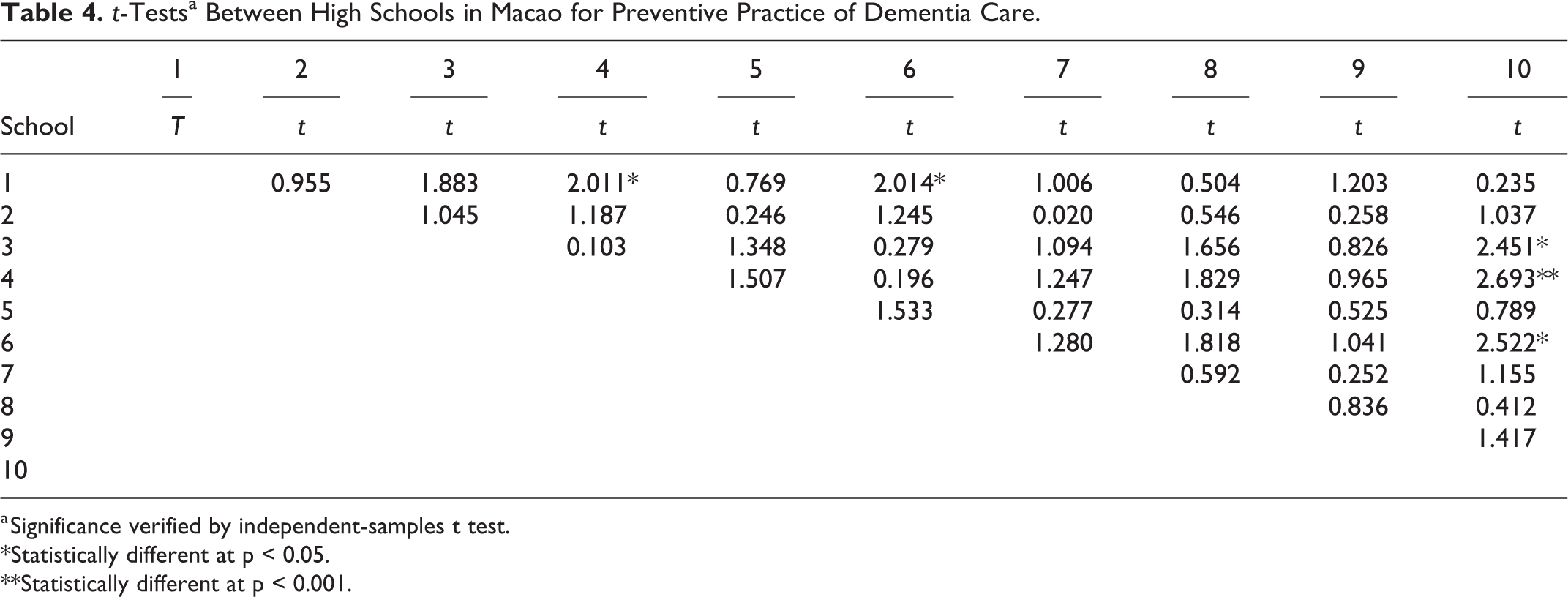
a Significance verified by independent-samples t test.
*Statistically different at p < 0.05.
**Statistically different at p < 0.001.
t-Testsa Between Knowledge, Attitude, Preventive Practice, and Gender.

a Significance verified by independent-samples t test.
**Statistically different at p < 0.001.
Discussion
Insufficient Knowledge of Dementia Care Among High School Students in Macao
The findings demonstrated that high school student in Macao had insufficient knowledge of dementia care (56.27 ± 24.90), which was significantly lower than (t = 22.182, p < 0.001) the primary health professionals (87.02 ± 14.01) in Macao. 11 This might be related to that there were no integrated and systematic educations on dementia care provided for high school students in Macao and they learned only the basic anatomy and physiology knowledge related to neuroscience in the curriculum of biology and the ways which students got information about diseases were very limited to TV/radio, websites, and newspaper/book. 6,12,13 Moreover, the findings also indicated there were still many misunderstandings, such as “environment changing frequently is helpful” (68.5%), “hypertension and diabetes mellitus are not risk factors” (66.5%) and “dementia is part of normal aging” (57.3%) among high school students in Macao. It was well known that the misunderstanding of “dementia is a part of normal aging” among family members including high school students, would directly result in delayed diagnosis and management of older people with dementia, causing their worse prognosis and poorer quality of life. 14 The youth generation knew little about the risk factors of dementia and then they would not take any effective preventive intervention, leading that the prevalence of hypertension and diabetes mellitus became more popular, 15 might cause earlier onset and worse condition of dementia among the youth generation. 16
However, the results showed that the high school students of School 3 and School 4 demonstrated more sufficient knowledge, more positive attitude and more appropriate preventive practice than others, which might result from that the School 3 and School 4 had previously participated and organized lectures and events related to dementia for students. School 3 invited experts of Hong Kong Alzheimer’s Disease Association and Sir Charles Kuen Kao who was a winner of Nobel Prize in Physics and was living with dementia to hold a conference on dementia for the high school students and encouraged high school students to participate frequently in studies about dementia and in Dementia Youth Ambassador programme. School 4 organized high school students to hold an exhibition board show related to dementia in the school, to visit Dementia Medical Center and to act a drama on prevention of dementia for the public in community and for other high school students. Similar findings were reported previously. 17,18 The students could learn knowledge about disease and reflex from their service-learning and scenario-based learning. 19 The findings also demonstrated the top 3 ways to get information related to dementia was through TV/radio (55.6%), website (42.3%), and newspaper/book (28.0%). It had also been argued that public education through TV and radio were believed to be the most efficient and accessible media to disseminate knowledge related to dementia to the public, including young generation. 20 Furthermore, the new media, such as YouTube, Facebook, WhatsApp, and WeChat could be the suitable ways to be utilized in education for young generation to get the knowledge of dementia. 21
Inappropriate Preventive Practice of Dementia Care Among High School Students
The results indicated that high school students could not carried out preventive practice appropriately on dementia care (68.34 ± 14.05), which was significantly lower (t = 8.859, p < 0.001) than the primary health professionals in Macao. 11 As discussed above, the high school students had insufficient knowledge of dementia care (56.27 ± 24.90) and the study found that there was positive relationship between high school students’ preventive practice and knowledge (r = 0.086, p = 0.038), by which might cause them could not carried out preventive practice appropriately on dementia care. Therefore, enhanced dementia education to improve knowledge of dementia should be still a strong agenda for public awareness of high school students and then they could carry out the appropriate preventive practice of dementia care. 9
More Sufficient Knowledge and Positive Attitude of Dementia Care of the Female Students
The findings showed that knowledge (t = 4.496, p < 0.001) and attitude (t = 5.664, p < 0.001) of the female high school students were significantly higher than the male students in Macao. Similar results that female middle school students had better knowledge and attitude related to health and diseases than male students were reported previously, 12,22 which might be caused that female high school students grew up more maturely in physical and intelligent aspects than male students at the same age. 12 Therefore, more concerns to develop the content and media of public education on dementia care should be drawn to meet the needs and characters of the male students in high schools. 22
Limitations
The study sample of high school students was limited to 10 high schools throughout Macao, so caution is advised in applying findings elsewhere.
Implications for Practice
The results of the present study along with supporting literature provided baseline information with which to compare results of the further investigations and to measure progress toward developing a dementia friendly community in Macao. Enhanced dementia education with a focus on knowledge and preventive practice of dementia care was a strong agenda for the public education for high school students, especially for male students, to foster inter-generational harmony in Macao dementia friendly community. Future research could use the study findings and the validated 30-item questionnaire of knowledge, attitude and preventive practice of dementia care to assess different groups for comparison.
Conclusion
This study provided initial insight into the dementia care situation among high school students in Macao and found they had insufficient knowledge and inappropriate preventive practice of dementia care. The results highlighted the need for enhanced dementia education with a focus on knowledge and preventive practice of dementia care for high school students, especially for male students, to foster inter-generational harmony in Macao dementia friendly community.
Footnotes
Acknowledgments
The authors would like to thank all the high school students who participated in this survey.
Declaration of Conflicting Interests
The authors declared no potential conflicts of interest with respect to the research, authorship, and/or publication of this article.
Ethical Standards
Ethical approval was obtained through the Medical Ethical Committee of the Centro Hospitalar Conde de São Januário, the Government of Macao Special Administrative Region, China.
Funding
The authors disclosed receipt of the following financial support for the research, authorship, and/or publication of this article: The authors disclosed receipt of the following financial support for the research, authorship, and publication of this article: The research was funded by Health Bureau, the Government of Macao Special Administrative Region, China.