



Abstract
Keywords
Introduction
Anxiety symptoms occur in up to 75% of patients with dementia, 1 –4 and 5% to 15% meet criteria for generalized anxiety disorder (GAD). 2,5 Significant anxiety can lower quality of life and impair activities of daily living in patients with dementia. 6 In addition, patients’ anxiety increases caregiver burden and is associated with earlier nursing-home placement. 7
Despite the high prevalence and impact of anxiety in dementia, there is limited research regarding its recognition and understanding. 4,8 Only a few studies examine demographic and clinical differences associated with GAD and dementia. Prevalence of GAD in men and women with dementia is equivalent, unlike the more typical pattern of increased GAD prevalence in women without dementia. 9 There are inconsistent reports on the prevalence of both GAD and other anxiety disorders across levels of dementia severity. 2 However, anxiety symptoms are generally equally prevalent at mild and moderate levels of severity but decrease at the severe and profoundly demented stage. 9
Patients with GAD and dementia have higher rates of co-occurring psychiatric symptoms than those without GAD. 2 Mild-to-moderate Alzheimer’s-type dementia is associated with higher rates of anxiety, depression and irritability in those with GAD. 2 Depressive disorders are frequently comorbid in patients with GAD and dementia. 9,10 The increased psychiatric symptoms in patients with GAD and dementia are associated with reduced quality of life and functioning limitations.
The criteria for GAD within the Diagnostic & Statistical Manual of Mental Disorders – IV include excessive worry and anxiety that is difficult to control, along with at least three of the following associated anxiety symptoms for 6 months: feeling on edge, fatigue, concentration problems, irritability, physical tension, and sleep disturbance. Excessive worry is the key feature of GAD. Increases in worries about health and family and decreases in worries about work and school are reported in cognitively intact older adults both with and without GAD, 11,12 but there is limited description of worry content and prevalence in patients with dementia, with and without GAD. The description of worries in patients with GAD and dementia could be helpful in understanding their relevance and function in a person with cognitive decline
Overall, assessment and diagnosis of GAD in persons with dementia are complicated by difficulty distinguishing anxiety and dementia symptoms, and inconsistencies in patient and caregiver reports. 13,14 The overlapping symptoms, particularly concentration, fatigue, and restlessness contribute to difficulty identifying GAD in persons with dementia. The questions are whether these overlapping symptoms should be used as criteria for GAD in patients with dementia, and what characteristics best define GAD in persons with dementia.
To address these questions, Starkstein and colleagues 5 examined whether anxiety symptoms measured with the Hamilton Anxiety Rating Scale predicted the core and distinguishing feature of GAD, chronic excessive worry in individuals with dementia. Based on results of regression analysis, revised criteria for GAD in dementia were proposed. The criteria require chronic excessive worry and at least three of the following associated anxiety symptoms: restlessness, irritability, muscle tension, fears and respiratory symptoms. On the basis of the revised criteria, 10% of the sample obtained a diagnosis of GAD compared with 15% when using DSM IV criteria. The revised criteria may provide a more sensitive diagnostic framework for this population. However, before the revised criteria are adopted, anxiety symptoms in GAD should be examined in other samples of people with dementia.
Given the prevalence of GAD in dementia, it is important to gain a better understanding of the common clinical characteristics and key distinguishing features of GAD among people with dementia. The characteristics of patients with anxiety and dementia were examined in the current study. Patients were recruited for participation in a clinical trial of CBT for anxiety. Demographic characteristics, dementia severity, anxiety symptoms, and worry content were compared in anxious patients with and without coexistent GAD. Worry severity in the patients with dementia was compared with worry severity in large samples of older adults without dementia. Next, we identified associated anxiety symptoms that differentiated patients with and without GAD and determined which demographic and anxiety symptoms best predict GAD in persons with dementia. Anxiety symptoms assessed were those in the DSM-IV-TR diagnosis of GAD and those assessed by Starkstein and colleagues. 5
Methods
Participants
Patients with dementia and anxiety were recruited in the context of a randomized clinical trial of CBT for anxiety in dementia. Recruitment occurred in outpatient clinics and community day centers for older adults with dementia. Inclusion criteria were as follows: a) age 50 or older; b) dementia diagnosis confirmed in the medical records; c) presence of a family member or caretaker (collateral) who spent at least 8 hours a week with the patient willing to participate; c) ability of the patient and collateral to speak fluent English, d) Neuropsychiatric Inventory for Anxiety (NPI-A) score > 4 according to collateral report of the patient’s symptoms, and e) a Clinical Dementia Rating 15 (CDR) score of 0.5 – 2. Patients with a primary diagnosis of major depression, and those with active psychosis, bipolar disorder, active suicidal intent, or recent verbal or physical aggression were excluded.
One or two sessions were required for screening and evaluation of inclusion/exclusion criteria. At an initial appointment, the NPI-A was administered to the collateral. If the score was less than 4, the interview was terminated. At a second assessment session, the CDR, Dementia Rating Scale (DRS) 16 and the Mini Mental State Exam (MINI) 17 diagnostic interview were administered. DRS scores were used in place of the memory subscale of the CDR. Clinicians administering the MINI took into account input from both the participant and the collateral about the patient’s behaviors, thoughts, and feelings. Clinical judgment was used to determine how to weigh the patient’s and the collateral’s answers to determine the appropriate diagnoses. Principal diagnoses were those with the greatest severity. CDR and MINI interviews were audio taped, and a random 20% were rated by a second clinician. The diagnosis for GAD had 91% agreement between raters (kappa = .79), and the CDR had 100% agreement between raters. Final CDR ratings and MINI diagnoses were determined by consensus at a team meeting attended by clinical staff, a geriatric psychiatrist, social worker, and psychologist.
Of the 107 patients and collaterals who scheduled a consent and screening appointment, 31 did not consent due to lack of interest (n = 13), collateral withdrawal (n = 1), no problem with anxiety reported at initial meeting (n = 16), or a current psychotic episode (n = 1). Of the 76 who completed consent, 7 withdrew and 26 did not meet inclusion criteria, resulting in 43 included patients.
Measures
Worry content was assessed with a list of possible worry topics from the Anxiety Disorders Interview Schedule for DSM-IV (ADIS-IV), 18 including minor matters, finances, work, family, social/interpersonal, own health, others’ health, and world affairs. Worries were coded as present on each topic if either the patient or collateral endorsed the item in the interview.
The eight-item, self-report Penn State Worry Questionnaire-Abbreviated (PSWQ-A) 19 was used to measure worry severity. The patient rates amount of agreement with worry-related statements on a Likert scale from 0 (not at all typical) to 5 (very typical). The PSWQ-A has strong psychometric properties and significant correlation with the full PSWQ in nondementia populations. 19 The PSWQ-A was used to assess worry in an open trial of CBT for late-life anxiety in patients with dementia. 20
Anxiety severity was assessed using the Rating for Anxiety in Dementia. 21 The RAID is an 18-item, clinician-rated interview administered to both patient and collateral to assess patient’s anxiety symptoms in the previous week. Items assess symptoms rated 0 (absent) to 3 (severe) in four categories: worry, apprehension and vigilance, motor tension, and autonomic hyperactivity. The RAID has good inter-rater reliability, internal consistency, and convergent/divergent validity. 21 –23
Procedures
The worry content interview was administered to all participants by a trained graduate student during the diagnostic assessment. The interview was conducted with both the patient and collateral present. All other measures were administered by an independent evaluator at the patient’s home or in the clinic as part of a larger baseline assessment battery after inclusion status was determined. Assessments were audio recorded and, 11 RAID interviews (20% of the first 20 and 10% of the remaining interviews) were randomly selected as reliability cases and coded by two raters. Averaged across all 18 items, inter-rater reliability was adequate (Cohen’s Weighted Kappa = .71). The patient and collateral each received $20 for completing the assessment.
Data Analysis
Comparisons of demographic and clinical characteristics for patients with dementia and with and without GAD were completed using the Wilcoxon Mann-Whitney two-sample tests and Fisher’s exact test. The Wilcoxon Mann-Whitney and Fisher’s exact test were chosen due to the small sample sizes
To examine potential differences in late-life GAD among people with and without dementia, demographic and clinical characteristics of patients with dementia and GAD were compared with published data from community and clinic samples of older adults with and without GAD, but no cognitive impairment 24 . Gender ratios between samples were compared with the binomial exact test, and age and PSWQ-A means were compared using independent sample t-tests.
Fisher’s exact test was used to determine differences in associated anxiety symptoms between the patients with and without GAD. The symptoms associated with GAD in the DSM-IV-TR and assessed by the RAID are feeling restlessness, keyed up/on edge, muscle tension, fatigue, irritability, and difficulty sleeping. Shortness of breath was assessed due to the previous finding that it was one of the symptoms that predicted GAD in patients with dementia. 5 We chose not to correct for multiple comparisons so as not to unreasonably restrict type II erro, r given the small sample size and need of available research on anxiety in dementia. Associated anxiety symptoms were assessed as either the presence (moderate/severe; RAID rating = 2 or 3) or absence (absent/mild; RAID rating = 0 or 1) of at least moderately interfering symptoms on the RAID. Logistic regression determined the best predictors and overall variance predicted by clinical characteristics and anxiety symptoms identified from the Fisher’s exact and Wilcoxon Mann-Whitney comparisons.
Results
Descriptives
Descriptive data are presented in Table 1 . Twenty-one patients (48.85%) had a GAD diagnosis. For 52% of patients with GAD, a coexistent depressive disorder (dysthymia, major depressive disorder or depression not otherwise specified [NOS]) was diagnosed. For those without GAD, Anxiety NOS was the most common psychiatric diagnosis.
Demographics and clinical characteristics of patients with dementia
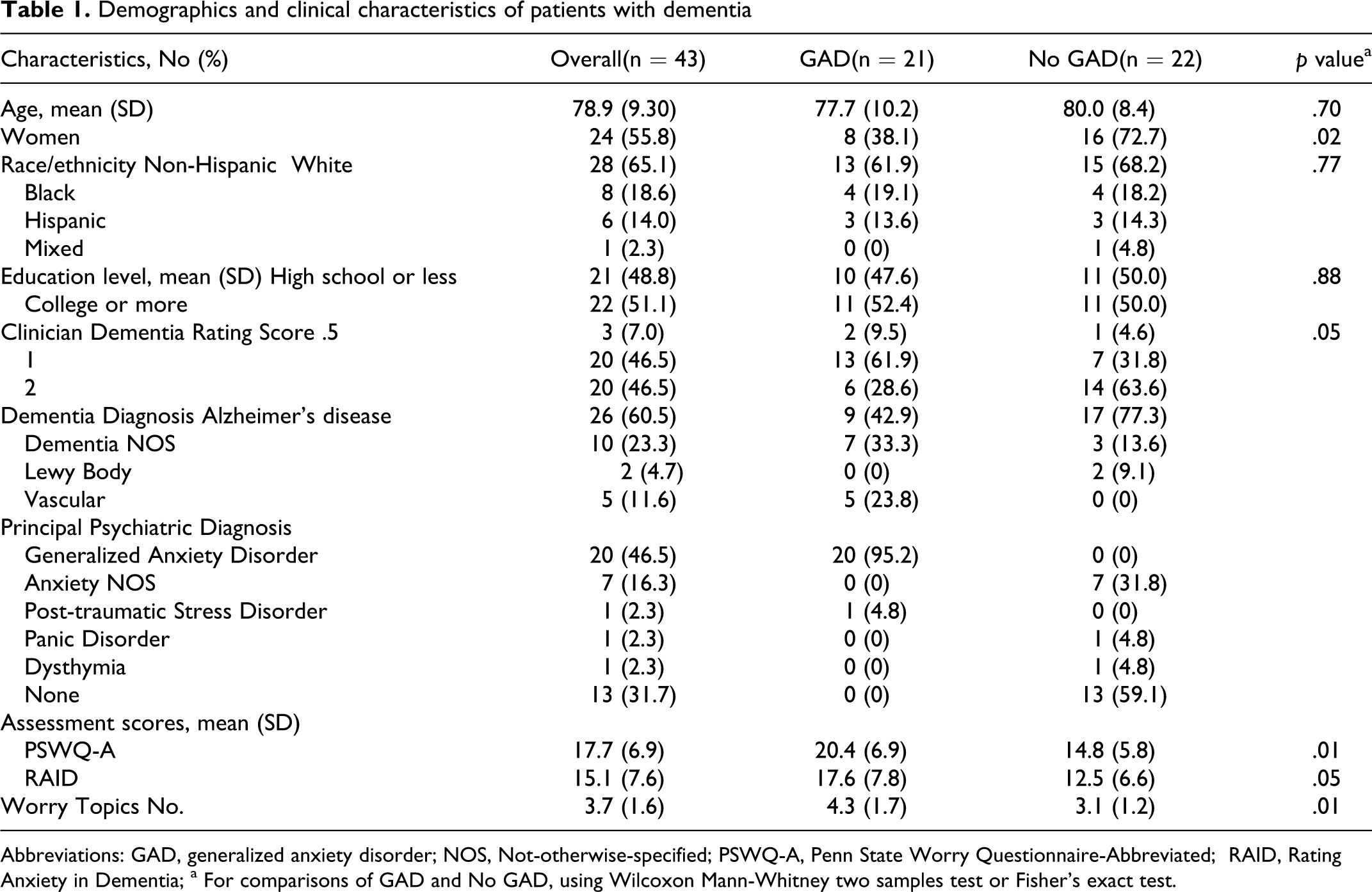
Abbreviations: GAD, generalized anxiety disorder; NOS, Not-otherwise-specified; PSWQ-A, Penn State Worry Questionnaire-Abbreviated; RAID, Rating Anxiety in Dementia; a For comparisons of GAD and No GAD, using Wilcoxon Mann-Whitney two samples test or Fisher’s exact test.
Comparisons between dementia patients with and without GAD
A higher percentage of men than women were diagnosed with GAD (68% vs. 33%, Fisher’s exact test, p = .02). The GAD subgroup was characterized by more scores in the mild range (0 to 1) on the CDR, indicating lower severity of dementia (p = .05). In patients without GAD, 64% obtained a CDR of 2, indicating moderate cognitive impairment compared with only 29% of patients with GAD. Two patients did not complete the PSWQ-A, or RAID, leaving 20 patients without and 21 patients with GAD in the following analyses. See Table 1 for means. Patients with GAD endorsed more severe worry (PSWQ-A; M = 20.4 vs. M = 14.8, p = .01).
Patients with dementia and GAD, compared with those with dementia and no GAD, reported a higher number of worry categories (M = 4.3, SD = 1.7 vs. M = 3.1, SD = 1.2; p= .01; See Table 1), but there were no significant differences between groups in worry topics. The most common worry for both groups was about the patient’s own health and the health of his/her family.
Comparisons between patients with dementia and GAD and those with GAD and no dementia
Data on worry severity in older adults without dementia were extracted from Hopko et al. 24 The sample included 160 adults age 60 and older with principal or co-principal GAD, diagnosed with the ADIS– IV, recruited in the context of CBT treatment studies. The GAD sample without dementia was on average younger (M = 66.6 years; t = 4.1, p < .001) and had a higher proportion of women (78%; p < .01). The patients with GAD and dementia scored lower on the PSWQ-A than did older adults with GAD and no dementia (M = 20.4 vs. 30.9, t = -6.9, p < .0001).
Associated anxiety symptoms in GAD and dementia
Frequency of associated symptoms according to the RAID is presented in Table 2. Muscle tension and fatigue were endorsed more frequently in patients with GAD (ps = .01, .02). A logistic regression was calculated with GAD as the dependent variable and significant demographic and anxiety symptoms as the predictors, including gender, CDR scores, muscle tension and fatigue. Those with low and high muscle tension have significantly different odds of having GAD even after controlling for all the CDR scores and fatigue (see Table 3). In our sample, women and men also had different odds of having GAD.
RAID associated worry symptoms in patients with and without GAD
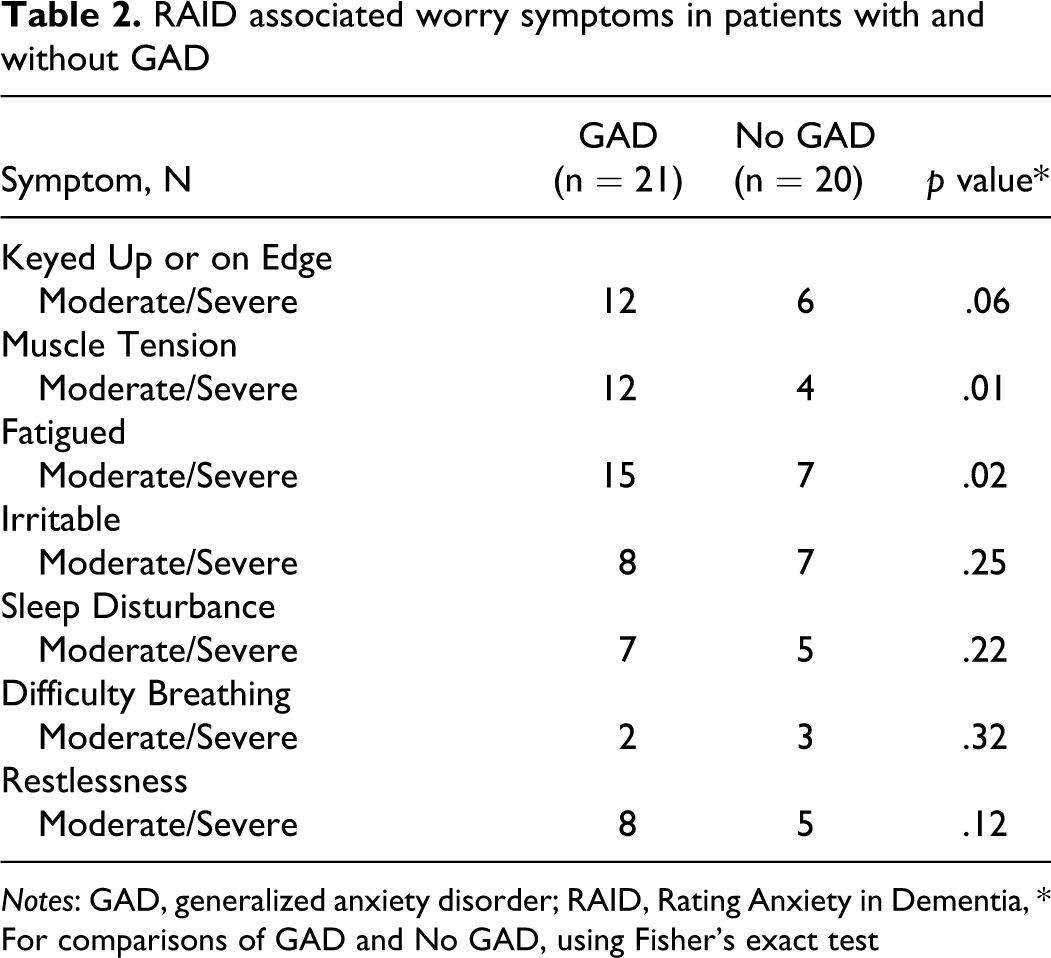
Notes: GAD, generalized anxiety disorder; RAID, Rating Anxiety in Dementia, * For comparisons of GAD and No GAD, using Fisher’s exact test
Logistic regression analysis predicting GAD
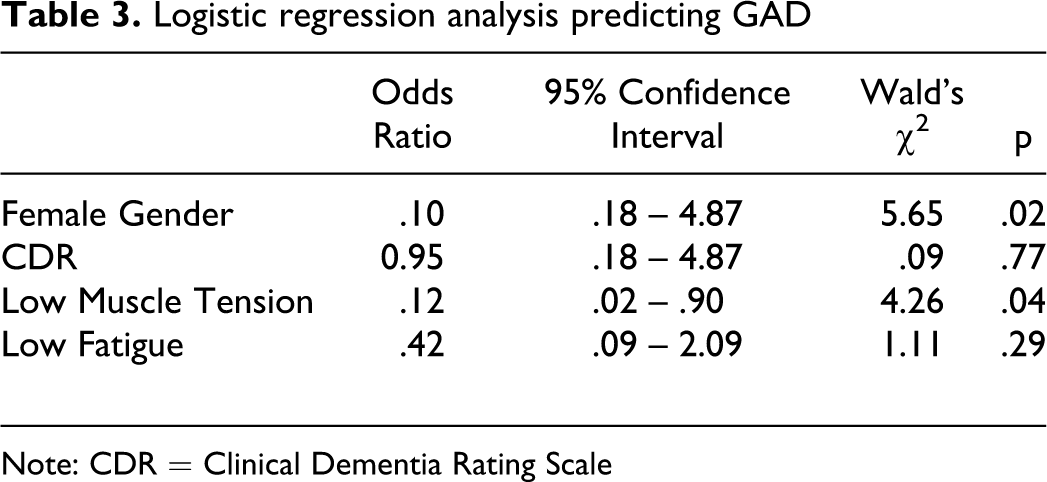
Note: CDR = Clinical Dementia Rating Scale
Conclusions
Overall, the study identified demographic and clinical characteristics that distinguish anxious older adults with dementia who do and do not have GAD. GAD was diagnosed less frequently for participants whose CDR scores indicated greater cognitive impairment, as expected from prior research. 9 More severe cognitive impairments may limit the ability to accurately assess worry/anxiety or may reduce the prevalence of anxiety. The increased likelihood of male participants to be diagnosed with GAD compared with females in this study is not consistent with other late-life anxiety literature and needs to be replicated to ascertain whether this is a unique characteristic of anxiety in dementia. The sample recruited participants from several sites including a VA Hospital, where prevalence of anxiety in general is high. Thus, the increased rate of GAD among men here may result from the inclusion of Veteran patients. Future studies will need to examine any differential association of GAD diagnoses in Veteran and non–Veteran men,
Results of the measurement of worry severity and worry topics in patients with GAD and dementia followed similar patterns to those of older adults without dementia. In this sample of patients with dementia, no one particular category of worry was more prevalent in those with or without GAD, although those with GAD worried about more topics. This pattern of worry is found in other late-life anxiety studies, 11 suggesting that the content of worries does not change with the presence of dementia. However, those with dementia and GAD in this study had lower worry-severity scores than a sample of older GAD patients without cognitive impairment. 24 It is possible that, among those with dementia, GAD is associated with less severe self-reported worries and more behavioral symptoms. 25 Adults with dementia may be less aware of worries but continue to endorse other symptoms of GAD (e.g., interference, physical symptoms, distress). Awareness of worry is a key component of GAD in the current DSM-IV-TR, and revised diagnostic criteria that focus more heavily on non-cognitive components may be important for identifying GAD among people with cognitive impairment 25 .
The associated symptoms that distinguished patients with GAD from those without were muscle tension and being easily fatigued, and the strongest predictor of GAD was muscle tension. Our results suggest that in clinical practice, assessing fatigue and muscle tension may help to identify GAD in patients with dementia. Starkstein et al. 5 also reported muscle tension and being easily fatigued as predictors of excessive worry in his sample. Muscle tension may be more specifically associated with GAD, in general, compared with other anxiety or depressive symptoms, 26 and results here suggest it is the strongest anxiety symptom associated with the diagnosis of GAD even among patients with dementia. Endorsing high levels of fatigue may be an indicator of interfering and distressing psychological symptoms among older adults. Future studies might also examine whether muscle tension mediates the relation between fatigue and GAD in persons with dementia.
We did not find associations between GAD and other symptoms noted by Starkstein et al., 5 including restlessness, irritability, respiratory symptoms or fears. Our sample was smaller, and weaker associations may not have been significant. We also used the RAID, a clinician-rated measure developed to assess anxiety symptoms in people with dementia; while Starkstein et al. used the Hamilton Anxiety Rating Scale, and some results could be measure specific. Both studies found that concentration and sleep difficulties did not distinguish between people with and without GAD. Concentration and sleep difficulties are also both overlapping symptoms of dementia and not helpful distinctions for recognizing GAD in patients with dementia.
The current study was limited due to small sample size, and all participants reported anxiety as one of the inclusion criteria for the study. Future work would be improved with larger samples that include patients with dementia and no anxiety. A mix of dementia types was also included in the study, although most had Alzheimer’s disease. It is not clear from previous research if people with different subtypes of dementia would experience different types of anxiety or anxiety symptoms.
Despite sample size and restrictions in anxiety level, the study demonstrates differences between anxious patients with dementia with and without GAD. Given the limited amount of literature on clinical characteristics and descriptions of GAD in patients with dementia, the results provide a starting point for clinical recognition and assessment of GAD in dementia. Understanding the characteristics of GAD among people with dementia can increase recognition of distressing and disabling anxiety symptoms and guide the development of tailored treatments.
Footnotes
The content is solely the responsibility of the authors and does not necessarily represent the official views of the NIMH, the National Institutes of Health, the Veterans Administration or Baylor College sof Medicine. The NIMH had no role in the design and conduct of the study; the collection, management, analysis and interpretation of the data; or the preparation, review or approval of the manuscript.
The author(s) declared no potential conflicts of interest with respect to the research, authorship, and/or publication of this article.
The author(s) disclosed receipt of the following financial support for the research, authorshipand/or publication of this article: This work was supported in part by a grant from the National Institute of Mental Health (R34 -MH078925) to M.S. and by the Houston VA HSR&D Center of Excellence (Houston Center for Quality of Care & Utilization Studies [HFP90-020]).