




Abstract
Background:
About 20 different types of staphylococcal enterotoxins are produced by Staphylococcus aureus, in which type A is more common in food poisoning syndrome. Also staphylococcal enterotoxin A superantigen is a potent inducer of cytotoxic T lymphocyte activity and cytokine production and could stimulate T cells containing T-cell receptor beta chain domains when binding to major histocompatibility complex class II molecules. Hence, it is an important reagent in cancer immunotherapy.
Methods:
For the construction of pET-21a/entA cassette, the staphylococcal enterotoxin type A gene was isolated from S aureus strain HN2, cloned into pET-21a, and introduced into Escherichia coli strain BL-21(DE3). Consequently, Western blot analysis showed pET-21a/entA cassette expression inserted entA gene successfully. It is the first prompt using a pET-21a as a cloning vector for entA gene and expression of construct in BL-21(DE3). In addition, this study examined the ability of standard staphylococcal enterotoxin A and cloned staphylococcal enterotoxin A to activate T cells in vitro. Lymphocyte cells derived from lymph node BALB/c mice were exposed to standard staphylococcal enterotoxin A and cloned staphylococcal enterotoxin (1.10, 102,103, and 104 ng/µL) in order to evaluate the magnitude of proliferation, activation, and apoptosis of lymphocyte cells based on MTT and apoptosis assays, respectively.
Results:
Our investigation showed that the function of cloned staphylococcal enterotoxin A was same as standard staphylococcal enterotoxin A, and the optimal concentration for the activation of lymphocyte cells and induction of apoptosis was 100 ng/µL and 1000 ng/µL (P < .05), respectively. Quantification of cytokines clearly showed that lymphocyte cells exposed to standard staphylococcal enterotoxin A and cloned staphylococcal enterotoxin A significantly secreted higher interferon γ and tumor necrosis factor α compared to control.
Conclusion:
According to our results, the biological activity of standard staphylococcal enterotoxin A and cloned staphylococcal enterotoxin A is identical; therefore, these procedures may be approved as an efficient method to express and purify this protein in a large scale.
Keywords
Introduction
Staphylococcus aureus is the principal cause of the food poisoning syndrome worldwide. 1,2 Staphylococcal enterotoxins (SEs) are the known cause of intoxication staphylococcal food poisoning syndrome; the greatest risk of SEs is still remaining, and improper hygienic activities during the preparation of food is a major possibility of contamination. 3 The S aureus has several enterotoxins that are classified into the major antigenic types that have been recognized as staphylococcal enterotoxin type A (SEA) to staphylococcal enterotoxin type J (SEJ) and also in recent times, several enterotoxins such as SEK, SEL, SEM, SEN, SEO, and SEU have been identified. 4,5 Another classification on the basis of sequence similarity was divided into 3 groups and SEA is in the same group with SED and SEE. 6 Also, it is known that 95% of staphylococcal food poisoning outbreaks are caused by the enterotoxins SEA to SEE. 7 Among these SEs, SEA is the most important food poisoning enterotoxin and is associated with about 70% of the verified cases of staphylococcal food poisoning (European Commission, 2007). The entA gene is composed of 771 base pairs (bps) and encodes an enterotoxin and a precursor of 257 amino acid residues. 8 A 24-residue N-terminal hydrophobic leader sequence is apparently processed, yielding the mature form of SEA.
Unlike conventional antigens, superantigens (SAgs) bind to certain regions of major histocompatibility complex (MHC) class II molecules on antigen-presenting cells outside the classical antigen-binding groove and concomitantly bind in their native form of T cells at specific motifs of the variable region of the beta chain of the T-cell receptor. This interaction triggers the proliferation of the T lymphocytes and leads to the in vivo or in vitro release of large amounts of various antitumoral cytokines and other effectors by immune cells. 9 Moreover, though SEs are the cause of intoxication, they are powerful inducers of cytotoxic T-cell activity and cytokine production in vivo 10 ; concentrations of <0.1 µg/µL of bacterial SAgs are sufficient to stimulate T lymphocytes. 11 Therefore, SEA as SAg, trigged the activation of the targeted T lymphocytes and leads to the in vivo or in vitro release of large amounts of various cytokines and other effectors by immune cells. It has been useful when used as SEA fused with other proteins like single chain Fv (SEA-scFv) and could be an important reagent in cancer immunotherapy. 12 Si and colleagues showed that transmembrane (TM)-anchored SEA fused with B7-1 could induce efficient antitumor immunity in vitro and in another study, they reported that SEA is used as an antitumor vaccine. 13 Tumor cells escape protective immune response because they lack or downregulate stimulator surface antigens. Introduction of immunostimulatory antigens, such as MHC I, MHC II, or B7-1, into the tumor cells can induce antitumor immunity as demonstrated by the rejection of parent tumor in vivo. 13 In 2011, Sun et al showed that by fusing EGF to target SEA to the solid tumor, it is possible to retain tumor-unspecific T lymphocytes in the tumor site. The fusion protein EGF–SEA stimulated T cells to release the tumoricidal cytokines interferon γ (IFN-γ) and tumor necrosis factor α (TNF-α). Intratumoral CTLs secreted near the surface of carcinomas cause the death of many tumor cells. 14
The aim of this study was to clone the entA gene to the pET-21a vector for the construction of pET-21a/entA. We could also express this construct in Escherichia coli strain BL-21(DE3) successfully. Moreover, we examined the effects of S-SEA and C-SEA in the proliferation of lymphocyte cells. The production of recombinant functional SEA was another important aim of our study.
Materials and Methods
Bacterial Strains, Plasmid, and Media
For cloning and subcloning of entA gene polymerase chain reaction (PCR) products, pJET1.2 (Fermentas, Germany) and pET-21a (Invitrogen, USA) vectors were used, respectively, E coli strains Top10F′ and BL-21(DE3; Invitrogen) were used as the host strains for the recombinant plasmids. Bacteria were cultured in LB broth or on LB agar (Merck, Germany) with or without 30 µg of kanamycin/mL (Sigma, USA). pET-21a vector was used as the expression vector.
DNA Isolation and Purification
The genomic DNA from S aureus strain HN2 was extracted using an AccuPrep Genomic DNA Extraction Kit (KB-1041; Bioneer, Korea). The plasmids were extracted using Gene JET Plasmid Miniprep Kit (Fermentas). All the kits were used according to the manufacturer’s instructions. Plasmid DNA concentrations were determined by spectrophotometer (NanoDrop-1000, Wilmington, Delaware). All DNA preparations were stored at −20°C until used.
Cloning of the entA Gene
The specific primers were designed according to the entA sequences of S aureus strain HN2 from National Center for Biotechnology Information (GenBank accession no: c2052229-2051). The amplifications were carried out in 25 µL volumes containing 0.5 µM of each primer (forward: TATACATATGAAAAAAACAGCATTTACA and reverse: ATATCTCGAGACTTGTATATAAATATATATCAAT [italics indicates restriction site of NdeI and XhoI on forward and reverse primers, respectively]), 2.5 µL 10× PCR buffer, 1.5 mM MgSO4, 0.2 mM nucleotide (dATP, dCTP, dGTP, and dTTP), 2.5 U of Pfu DNA polymerase (Fermentas), and 200 ng genomic DNA. Polymerase chain reaction was carried out in a master gradient thermocycler (Eppendorf, Germany). The gene amplification conditions were as follows—94°C (4 minutes), 35 cycles consisting of 94°C (60 seconds), 56.2°C (60 seconds), and 72°C (60 seconds), and an additional extension time at 72°C (10 minutes). The PCR product was separated by electrophoresis on 1% (w/v) agarose gel (Fermentas) and the desired fragment was recovered from the gel using High Pure PCR Purification Kit (Roche, Germany) (Table 1). The amplified target fragment (1080 bp; Figure 1) was ligated into a linearized pJET1.2 (Fermentas) vector. After ligation and transformation, plasmids were introduced into E coli strain Top10F′ by a chemical method (CaCl2). A recombinant clone (pJET/entA) was confirmed by sequencing.
Primers Used in This Study.a

aItalic text indicates restriction site of NdeI and XhoI on forward and reverse primers, respectively.

Results of polymerase chain reaction (PCR) on genomic DNA, Staphylococcus aureus strain HN2. Lane 1 is the negative control. Amplicon size is 1080 bp (lanes 2-5). Lane 6 is 1-kb DNA ladder and arrow indicates 1-kb band.
Subcloning and the Construction of Expression Plasmid
For subcloning of the entA amplified, the vector was digested by NdeI and XhoI restriction enzymes. The entA was ligated to the pET-21a vector at 4°C for 12 hours. Then the ligation product was analyzed on agarose gel for its integrity and transformed into competent E coli strain Top10F′ by a chemical method (CaCl2); finally, bacterial transformation was selected on LB agar plates containing 30 µg kanamycin/mL. Then plasmid was isolated using the Gene JET Plasmid Miniprep Kit (Fermentas). The selected clones were further evaluated by restriction enzymes and PCR and as a final point sequenced by a commercial facility using universal forward and reverse T7-promoter.
Expression of entA Gene in E coli Strain BL-21(DE3)
For expression, the recombinant plasmid, pET-21a/entA, was transformed into competent E coli strain BL-21(DE3). Escherichia coli cells containing expression vector pET-21a/entA were grown in LB medium supplemented with kanamycin (30 µg/mL) and at 37°C to an optical density (OD)600 of 0.8. For induction, isopropyl-β-
Purifications and Detoxifying of C-SEA Protein
To purify the protein, ToxinEraserTM Endotoxin Removal Kit (GenScript, China) was used according to the manufacturer’s instructions. This kit enables to remove any LPS from the purified protein. Moreover, the LAL test was carried out for further evaluation of the presence of LPS.
Sodium Dodecyl Sulfate-Polyacrylamide Gel Electrophoresis and Western Blot Analysis
The protein was analyzed by SDS-PAGE on 12.5% polyacrylamide gels and strained with Coomassie brilliant blue R-250. For Western blot analysis, 20 µL of cultured cells were electrophoresed and transferred to the nitrocellulose membranes (Hi-bond Amersham Biosciences, USA) by using a semidry blotting system (Bio-Rad, Hercules, California) in tris/glycine buffer with pH 8.4, containing 20% (v/v) methanol. The membrane was blocked by 0/1% (w/v) Tween 20 according to the standard procedures. The monoclonal anti-his6 (Roche, Cat No: 04905270001), diluted with phosphate-buffered saline (PBS) 0.1% (v/v) Tween 20 and a final anti-his6 concentration of 0.4 µg/mL was added and membrane was incubated for 3 hours at 4°C with shaking. The block membranes were washed with PBS-Tween 20 and incubated with sheep antimouse horseradish peroxidase conjugate antibody (Bio-Rad), at a 1/5000 dilution in PBS-Tween 20. Membranes were then washed 3 times with PBS-Tween 20 and were developed using DAB solution (Sigma, St Louis, Missouri).
Mice and Injection Program
Female inbred BALB/c mice (6- to 7-week old) were purchased from the Pasteur Institute (Tehran, Iran). A total of 18 mice were divided into 3 six-mice groups designated as the following—group PBS, intravenous injection of PBS (negative control); group S-SEA, intravenous injection of 100 ng S-SEA; and group C-SEA, intravenous injection of 100 ng C-SEA. 15 These challenges were performed every 72 hours for 2 weeks by methods described previously. 10 Animal experiments in this study were done in compliance with Baqiyatallah University of Medical Sciences guidelines.
Cell Preparation and Cell Culture Conditions
The lymphocytes were isolated from axillary and inguinal lymph nodes of BALB/c mice. Isolated lymph nodes were cut into small pieces, rinsed twice with PBS, and minced with forceps and scalpels. The suspensions were passed through a 100-µm stainless steel mesh to obtain a single-cell suspension, and erythrocytes were lysed at room temperature using ACK lysis buffer (0.15 M NH4Cl, 1 mM KHCO3, and 0.1 mM Na2-EDTA). The cells were washed and resuspended in RPMI-1640 (Invitrogen, Carlsbad, California) supplemented with 10% fetal bovine serum (FBS; Invitrogen) and incubated at 37°C in 5% CO2 with appropriate humidity.
Cell Proliferation Analyses by 3-(4,5-Dimethylthiazol-2-yl)-2,5-Diphenyltetrazolium Bromide (MTT) Assay
The 1 × 10⁵ cells/100 µL of cells were cultured in RPMI-1640 medium (Invitrogen) supplemented with 10% FBS (Invitrogen), penicillin (100 U/mL), and streptomycin (100 µg/mL; Sigma-Aldrich, Munich, Germany) with 1, 10, 102, 103, 104 ng/µL of either S-SEA or C-SEA and incubated at 37°C in the 5% CO2 with appropriate humidity (Figure 2). Stimulation of mice lymphocytes was measured by MTT assay. After incubation, an aliquot of 100 µL of MTT reagent (0.5 mg/mL final concentration) was added to each well and incubated for another 4 hours. Then the OD was measured at 540 nm using a UV microplate reader (Tecan Austria GmbH, Austria). The stimulation index (SI) was calculated according to the following formula:

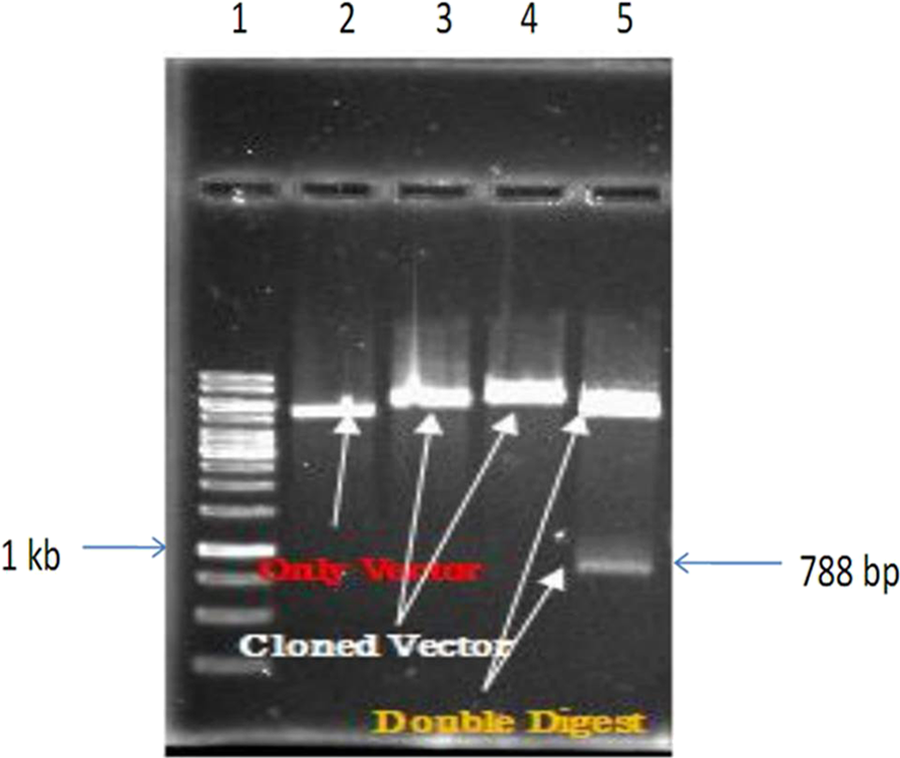
Restriction digest analysis of pET-21a/entA using NdeI and XhoI enzymes. Lane 1 (1-kb DNA ladder), lane 2 (single digest of pET-21a), lanes 3 and 4 (cloned entA gene in pET-21a), lane 5 (double digestion of pET-21a/entA). The entA gene is composed of 788 base pairs.
Phytohemoagglutinin (1 ng/µL) was used as the positive control and sterile PBS as negative control. Each assay was repeated 3 times. 16,17
In Vitro Apoptosis Assay
A lower dose than the reported LD50 for SEA 15 was used to activate lymphocytes. 18 Induced apoptosis caused by S-SEA and C-SEA was examined by staining with Hoechst 33258 (Wako, Osaka, Japan) 19 ; a total of 1000 lymphocytes were randomly observed under the high-power field (×400 magnification) to evaluate the number of apoptotic cells under different conditions; the ratio of apoptotic cells per 1000 lymphocytes was calculated. 20 The lymphocytes exposed to different concentrations of S-SEA and C-SEA were cultured for 72 hours; then the lymphocyte smears were prepared, fixed in 10% formalin, and stained with Hoechst 33258. Finally, the ratios of apoptotic cells were determined using a fluorescent microscope (Figure 3). In the next step, the optimal concentrations of S-SEA and C-SEA for generating apoptosis were determined by kinetic curve (1000) and then, this optimal concentration was further studied. The procedure was repeated 3 times (Figure 4).

A, The result of sodium dodecyl sulfate-polyacrylamide gel electrophoresis (SDS-PAGE). Lane 1, induced recombinant clone (pET-21a/entA) after 4 hours; lane 2, induced recombinant clone (pET-21a/entA) after 2 hours, lanes 3 and 4 are Escherichia coli with and without pET-21a strains, respectively, lane 5 is purified staphylococcal enterotoxin type A (SEA) protein, and lane 6 is molecular-weight marker. B, A Western blotting analysis of the target protein SEA from BL21(DE3) pET-21a-SEA strain. Lane 1, molecular-weight marker; and lane 2, target protein.
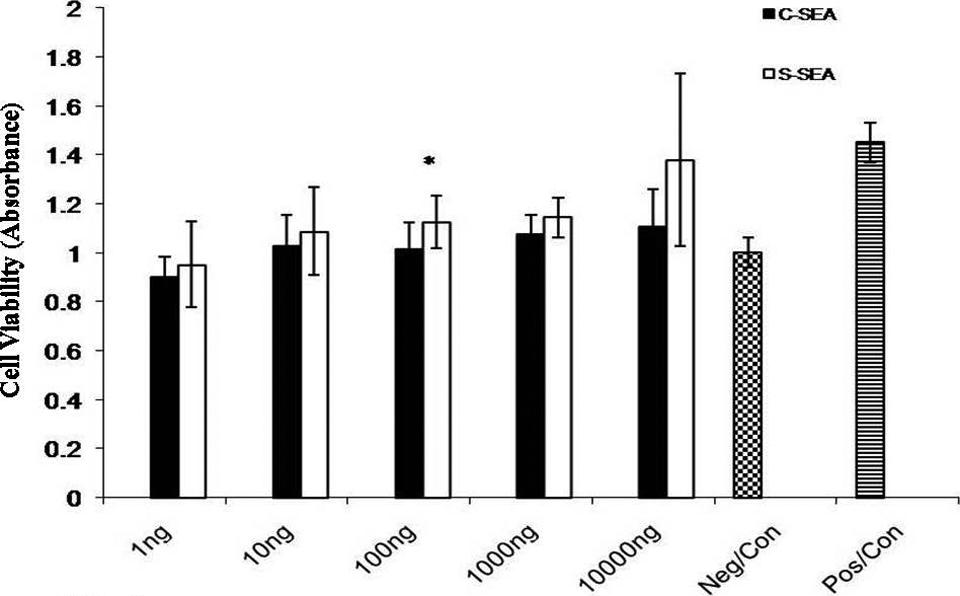
The proliferation rates of mouse lymphocyte cells (MTT assay) after 48 hours of exposure to cloned-staphylococcal enterotoxin type A (C-SEA) and standard-SEA (S-SEA) expressed as stimulation index (SI). The mean ± standard deviation (SD) of triplicate determinations are shown. Statistical analysis was performed using the 2-tailed Mann-Whitney nonparametric test, and a P value of <.05 was considered as a statistically significant difference. Phosphate-buffered saline (PBS) was used as the negative control (N), and phytohemoagglutinin (PHA) at 1 ng/µL was used as the positive control (P). The concentration of 102 ng/mL showed a significant difference of S-SEA and C-SEA in comparison to the PBS.
Enzyme-Linked Immunosorbent Assay for Measuring Cytokines
Mice splenocytes were isolated by the same methods used for isolation of lymphocytes from lymph nodes. Cells at a concentration of 1 × 10⁵ cells/100 µL were cultured with S-SEA and C-SEA at a concentration of 100 ng/µL. After 3 days of incubation, the supernatants were collected, and IFN-γ and interleukin 4 (IL-4) were measured by enzyme-linked immunosorbent assay kits (R&D, Minneapolis, Minnesota) according to the manufacturer’s instructions.
Statistical Analysis
All experiments were performed 4 times, and the mean ± standard deviation was calculated. Statistical analyses were performed using the 2-tailed Mann-Whitney nonparametric test and a P value of <.05 was considered statistically significant. All statistical analyses were conducted with SPSS 13.0 software (SPSS Inc, Chicago, Illinois).
Results
Cloning of entA Gene
Specific primers were designed to amplify the entA gene from the S aureus strain HN2. The expected size of the PCR product, about 1080 bp, was obtained (Figure 1). The amplified entA gene was blunt-end fragment, purified from gel and inserted into linearized pJET cloning vector yielding pJET/entA.
Construction of the pET-21a/entA
After confirmation of pJET/entA via sequencing, it was used as a template for amplifying exact gene with NdeI and XhoI restriction sites. Then, 788 bp entA gene was double digested and subcloned into the pET-21a as an expression vector. The pET-21a/entA was detected by digestion (Figure 2), and finally, the identity and orientation of entA in the construct were confirmed by DNA sequencing.
Expression of entA gene and Western Blot Analysis
The E coli BL21(DE3) was transformed with the pET-21a/entA and accumulated large amounts of a protein migrating in SDS-PAGE with an apparent molecular weight of approximately 30 kDa (Figure 3A, lane 5). Both supernatant and the pellet of cell lysates were tested for the presence of recombinant proteins. The majority of the expressed protein was detected in the pellet. The SEA protein was purified, and the major band was observed in SDS-PAGE (30 kDa). Then Western blot analysis was done with monoclonal anti-his6 and specific band was detected with DAB (Figure 3B).
Cell Proliferation Assay (MTT Assay)
For the assay of lymphocytes cell proliferation, cells were cultured in RPMI-1640 containing graded concentrations of mitogens S-SEA and C-SEA for 48 hours and were examined by the MTT assay. The results were shown only in 1 × 10² ng/mL concentration of S-SEA and C-SEA; there is significant difference between S-SEA and C-SEA in comparison to the PBS (negative control). Therefore, we set the concentration at 102 ng/μL for proper activation of lymphocytes (Figure 4). With regard to toxin LD50 and other details, the optimal concentration was 102 ng/μL, and its activation ability in comparison to other concentrations was significantly better. 15
In Vitro Apoptosis Assay
For in vitro apoptosis assay, Hoechst 33258 staining was used. Typical examples are shown in the Supplemental Figure. As shown in Figure 5, the results obtained suggested that concentrations of 103ng/μL of S-SEA and C-SEA seemed optimal for stimulating apoptosis. However, a statistically significant difference between S-SEA and C-SEA in comparison to the PBS was observed (Figure 6A).

Kinetic curve of apoptosis evaluation in mouse lymphocyte cells after exposure to varying concentrations (10, 102, 103, 104 ng/μL) of cloned-staphylococcal enterotoxin type A (C-SEA) and standard-SEA (S-SEA). We found that concentrations of 103 ng/μL of C-SEA and S-SEA were optimal for the induction of apoptosis.

A, Evaluation of apoptosis caused by optimal concentrations of cloned-staphylococcal enterotoxin type A (C-SEA) and standard-SEA (S-SEA; 103ng/μL, as determined by the kinetic curve) in mouse lymphocytes. The mean ± standard deviation (SD) of triplicate determinations are shown. Significant differences were found by Mann-Whitney nonparametric test (P < .05) in comparison to the negative control (phosphate-buffered saline, PBS). B, Interferon γ (IFN-γ) and interleukin-4 (IL-4) production by splenocytes. Splenocytes were cultured in vitro with clonedstaphylococcal enterotoxin type A (C-SEA) and standard-SEA (S-SEA; 102 ng/μL). After being cultured for 3 days, the supernatants were harvested, and IFN-γ and IL-4 releases were measured by enzyme-linked immunosorbent assay (ELISA). The mean ± standard deviation (SD) of triplicate determinations are shown (n = 5 mice per group). The S-SEA and C-SEA showed significant higher levels of IFN-γ-producing ability in comparison to the negative control phosphate-buffered saline (PBS; P < .01)
Level of IFN-γ and IL-4 After the S-SEA and C-SEA Injection
After spleen was challenged with S-SEA and C-SEA, their ability to produce IFN-γ and IL-4 was evaluated. Results are shown in Figure 6B. Although no significant differences in the IL-4-producing ability were observed, S-SEA and C-SEA showed significant higher levels of IFN-γ-producing ability in comparison to the negative control PBS (P < .01). These results showed that C-SEA has biological activity same as that of S-SEA and suggest that the concentration of 102 ng/μL level can be a good candidate for tumor therapy because it can induce IFN-γ by utilizing the response of immune system.
Discussion
Conventionally, preparation of native SEA for in vitro studies is time-consuming; so large amounts of bacterial culture, complicated technical instrument, and the process of several purification steps that generally lead to a low yield are required. Hence, developing a method to overcome the conventional approaches to obtain high yields is a benefit. In the present study, recombinant DNA technology was applied to obtain SEA. The entA gene from a library of S aureus strain HN2 was cloned into E coli strain TOP10F′ via pJET; then entA gene was expressed when inserted into the vector pET-21a. Cloned toxin was provided by transforming recombinant vector to E coli and recombinant protein was purified with 6 histidine residues.
pET-21a vector carries 6 histidine residues in the C-terminal of the fusion protein. The SEA protein was soluble but nonsecreted and contains His tag; then for the purification of protein the Ni–NTA His.Bind system was used.
Although SEA is the cause of most food poisoning outbreaks by S aureus, 21 -23 it is well known as a very potent activator of T cells that can elicit strong immune responses both in vitro and in vivo. 24,25 Ma and colleagues showed that cloning the entA gene in the pET-28a. This gene was fused with TM sequence form a c-erb-B2 gene derived from human ovarian cancer. 9 In another study, Lu and colleagues found that the construct obtained from fusing cloned-SEA into pLXSN with linker-CD80TM can be used as an antitumor agent. 26 The studies of Yue et al and Xu et al used pET42b (+) and pET-22b (+) as expression vectors for cloning of SEA, respectively; they also used BL21(DE3) as an expression host, 27,28 whereas in our study, entA gene was cloned into the pET-21a vector and we believe that, this is the first report of expression of entA gene into pET-21a as an expression plasmid; also in our study, BL21(DE3) was used as an expression host like the other study mentioned above.
In this research, the forward primer, containing NdeI restriction site, had 1 ATG codon as a part of NdeI restriction site, which we use from this ATG as start codon in entA gene. With the use of NdeI restriction site, other start codon in start site of gene was not required.
Finally, according to the Western blot result, we confirmed that entA gene inserted into pET-21a vector was expressed in BL21(DE3) successfully. Extremely purified recombinant protein was attained after purification. The achievement of cloning and expression of SEA in E coli supplies basis for studying the preparation of diagnostic reagent and monoclonal antibody. In this research, we cloned, expressed, and purified the recombinant SEA into pET-21a as an expression plasmid, which has not been reported before. In addition, cytotoxicity and apoptosis assay demonstrated that S-SEA and C-SEA have same bioactivity effects. Quantification of cytokines clearly showed that lymphocyte cells were exposed to S-SEA and C-SEA significantly and secreted higher IFN-γ and TNF-α compared to control. The SEA protein approach represents a novel approach for anchoring immunostimulatory proteins into living tumor cells. We hypothesize that SEA can induce an augmentation of immunity resulting in enhanced antitumor response. The antitumor effects of the cell-based tumor vaccine SEA in vivo are currently being investigated.
Conclusion
According to our results, the biological activity of S-SEA and C-SEA is identical, therefore, these procedures may be approved as an efficient method to express and purify this protein in a large scale. Also, production of these recombinant proteins in our country could improve cancer therapy and create new way in cancer therapy. Furthermore, it is appropriate for studying its action mechanisms and therapeutic applications.
Footnotes
Abbreviations
Declaration of Conflicting Interests
The author(s) declared no potential conflicts of interest with respect to the research, authorship, and/or publication of this article.
Funding
The author(s) disclosed receipt of the following financial support for the research, authorship, and/or publication of this article: This study was extracted from thesis and supported by grants from the applied microbiology research center of Baqiyatallah University of Medical Sciences.

References
Supplementary Material
Please find the following supplemental material available below.
For Open Access articles published under a Creative Commons License, all supplemental material carries the same license as the article it is associated with.
For non-Open Access articles published, all supplemental material carries a non-exclusive license, and permission requests for re-use of supplemental material or any part of supplemental material shall be sent directly to the copyright owner as specified in the copyright notice associated with the article.

