




Abstract
Background:
Excessive UV radiation causes increased melanoma incidence. Postoperation chemotherapy will destroy lymphocytes and compromise immune response. Immunodepression is also detected in patients with cancers. Previous studies suggested that polysaccharide–protein complexes manifested immunomodulatory and antitumor activities. Radix Astragali (RA) extract is a product of polysaccharide–protein complexes, which has been used in the treatment of a variety of diseases because of its low toxicity to the host. Tanshinone (TA) is a derivative of phenanthrenequinone isolated from Danshen, which is suggested to inhibit tumor growth by inducing apoptosis in tumor cells. Carboplatin (CA) is a commonly used chemotherapeutic drug in melanoma treatment. Therefore, we hypothesized that the combination of RA and TA will help CA better inhibit the B16 cell growth.
Purpose:
The study will test that the efficacy of growth inhibition of tumor cell produced by CA + RA + TA is better than CA + RA or CA + TA.
Methods:
The B16 tumor cells were injected to Swiss-Hauschka (ICR) mice subcutaneously. Twenty-four hours later, mice received CA intraperitoneally, CA + RA (RA were administered gastrically at the dosage of 10 g/kg body weight), CA + TA (TA were administered gastrically at the dosage of 0.5 g/kg body weight), or no treatment (model group). Tumor weight, volume, latency, incidence, the percentage of CD4+ and CD8+ in spleen, and natural killer (NK), and cytotoxic lymphocyte (CTL) activities were measured and compared among different groups.
Results:
Compared with mice treated with CA + RA, CA + TA, or CA alone, the mice treated with CA + RA + TA showed (1) significantly smaller tumor weight and tumor volume; (2) significantly longer tumor latency; (3) significantly lower tumor incidence; and (4) significantly increased percentage of CD4+ and CD8+ in spleen and increased activities of NK and CTL.
Conclusion:
Combination of RA and TA can help CA produce more effective inhibition on B16 cell growth.
Introduction
The incidence of melanoma is increasing because of excessive UV radiation. 1 –3 Standard treatment protocols involve treatment of the skin cancer followed by chemotherapy. 4 The disadvantages of chemotherapy are a lack of specificity and normal cells, including lymphocytes that are destroyed, 4 which will compromise immune responses, especially cellular immunity in patients with cancer. In addition, immunosuppression 5 and decreased numbers of circulating natural killer (NK) cells with lower cytotoxic activities were also found in patients with cancer. 6 The NK plays an important role in defending a host from tumors. 7 Thus, agents which can enhance immune response, especially cellular immune response, will help chemotherapeutic drugs inhibit tumor growth. Previous reports showed that polysaccharide–protein complexes manifested immunomodulatory and antitumor activities. 8 Radix Astragali (RA) is a traditional Chinese medicine, which has been used in the treatment of a variety of diseases because of its low toxicity to the host. 9 The commercial RA product is a polysaccharide–protein complex, an aqueous extract from RA, which has been found to be able to improve the immune system functions of patients receiving chemotherapy. 10,11 Tanshinone (TA) is a derivative of phenanthrenequinone isolated from Danshen, which is a traditional Chinese herbal medicine. 12 Reports suggest that TA helps inhibit tumor growth by inducing apoptosis in tumor cells. 13 –15 Carboplatin (CA) is a commonly used chemotherapeutic drug in melanoma treatment, and CA can cause some side effects, such as compromising the immune system functions of the patients with melanoma. Since RA can assist in improving the immune system functions of patients receiving chemotherapy, TA is able to inhibit the growth of tumor cells by inducing apoptosis. 13 Therefore, it is hypothesized that a combination of TA and RA will help CA produce more effective inhibition on B16 cell growth. Thus, the aim of the study was to investigate whether RA + TA will have stronger efficacy to help CA inhibit B16 cell growth and improve the immune system functions of experimental animals.
Materials and Methods
Reagents
Carboplatin was manufactured by Qilu Pharmaceutical Corporation Limited, China. Tanshinone was manufactured by Hebei Xinglongxili Pharmaceutical Corporation Limited, China. Radix Astragali was produced by Harbin Zhenbao Pharmaceutical Corporation Limited, China. Phycoerythrin (PE) anti-mouse CD8 and CD4 were purchased from BioLegend (San Diego, CA). Lactate dehydrogenase (LDH) release assay kit was purchased from Nanjing Jiancheng Bioengineering Corporation, China.
Animal Experiments
All the procedures were approved by the Jilin University Institutional Animal Care and Use Committee. Male and female ICR mice were purchased from the Laboratory Animal Center of Jilin University, China. Mice were allowed to adapt to the environment for 1 week, after which the mice were assigned to 1 of 5 groups, each group comprising 10 mice, and the groups are model, CA, CA + TA, CA + RA, and CA + TA + RA. The mice were treated as follows: Model group mice: 1.5 × 10⁵ B16 cells in 0.2 mL phosphate-buffered saline (PBS) were injected subcutaneously in the right thigh; CA group mice: 1.5 × 10⁵ B16 cells in 0.2 mL PBS were injected subcutaneously in the right thigh; 24 hours later, 0.5 mg CA was injected to the mice intraperitoneally for 4 consecutive days and followed by 4 days without administration until the mice were killed; CA + TA group mice: 1.5 × 10⁵ B16 cells in 0.2 mL PBS were injected subcutaneously in the right thigh; 24 hours later, 0.5 mg CA was injected to the mice intraperitoneally for 4 consecutive days and followed by 4 days without administration, TA (0.5 g/kg body weight) was administered to the mice through gastric injection every day until the mice were killed. CA + RA group mice: 1.5 × 10⁵ B16 cells in 0.2 mL PBS were injected subcutaneously in the right thigh; 24 hours later, 0.5 mg CA was injected to the mice intraperitoneally for 4 consecutive days followed by 4 days without administration, RA (10 g/kg body weight) was administered to the mice through gastric injection every day until the mice were killed. CA + TA + RA group mice: 1.5 × 10⁵ B16 cells in 0.2 mL PBS were injected subcutaneously in the right thigh; 24 hours later, 0.5 mg CA was injected to the mice intraperitoneally for 4 consecutive days followed by 4 days without administration, TA + RA (0.5 g/kg body weight + 10 g/kg body weight) was administered to the mice through gastric injection every day until the mice were killed.
Body Weight and Tumor Latency Recording
Body weight of the mice was recorded every 2 days. The tumor latency was recorded for the appearance of the first palpated tumor in each group.
Tumor Weight Recording and Tumor Volume Calculation
When each and every mouse in the model group developed a palpated tumor, the mice from all groups were anesthetized and killed. The tumor was removed, the weight was recorded, and the volume of tumors was calculated based on the formula, tumor volume = 1/2ab2, where a is the largest diameter and b is the perpendicular diameter. 16
Determination of CD4+ Cells and CD8+ Cells in Spleen
The spleen was removed from each of the mice in a sterilized hood. After the spleen was ground, collected by PBS, and filtered through a 200-mesh sieve, ammonium chloride was added to the cells to lyse erythrocytes. After lysis, the cells were washed with PBS 3 times. The cells were counted, and 1 × 10⁶ cells suspended in 200 μL PBS were aliquoted into 1.5 mL microtubes. PE anti-mouse CD8 2.5 μL and FITC anti-mouse CD4 1 μL were added to the cells. The cells were incubated at 4°C in the dark for 30 minutes. After 30 minutes, the cells were washed with PBS. After the supernatant was discarded, 500 μL PBS was added to the cells and flow cytometry (BD, Franklin Lakes, New Jersey) was used to count CD4+ and CD8+ T cells.
Cytotoxic Assay by Lactate Dehydrogenase
P815 mastocytoma cells were used as target cells and splenocytes as effector cells. The splenocytes were collected as described earlier. The splenocytes were counted and plated in a 96-well plate, and the P815 cells were added to the splenocytes at the ratio of effector cells to target cells of 20:1 and incubated for 24 hours. After 24 hours, the supernatant was collected, and the CTL activity was determined by lactate dehydrogenase release assay according to the manufacturer’s procedure. The percentage of cytotoxicity was calculated as follows: (E − C)/(M − C) × 100, where C is the background release in medium alone, M is the maximal lysis obtained with Triton X-100, and E is the value for the experimental supernatant.
Assay for NK Cell Activity
YAC-1 cells were used as target cells and splenocytes as effector cells. The cytotoxic assay protocol was executed similarly as the cytotoxic assay.
Data Analysis
Software SPSS13.0 was used to do the statistics analyses. The results were expressed as mean ± standard deviation and analyzed by one-factor analysis of variance.
Results
Effects of CA, RA, and TA on Body Weight Growth
Body weight gain in mice treated with a combination of CA, RA, and TA was significantly higher than those treated with CA + RA or CA + TA (P < .05); the body weight gain in mice treated with CA + TA or CA + TA was significantly higher than those treated with CA alone (P < .05); and the body weight of mice treated with CA alone was higher than those in the model group (P < .05). The mean final body weight of mice treated with CA, RA, and TA was significantly higher than those treated with CA + RA, CA + TA, CA alone, or model group (P < .05; Figure 1).

Effects of combination of carboplatin (CA), Radix Astragali (RA), and tanshinone (TA) on body weight growth. A, Body weight growth and (b) comparison of mean final body weights of mice from different groups. Results are mean ± standard deviation (SD), n = 10. ΔP < .05 compared with control; *P < .05 compared with model group; # P < .05 compared with CA; + P < .05 compared with CA + RA + TA.
Effects of CA, RA, and TA on Tumor Latency
The appearance of the first palpated tumor in mice treated with combination of CA, RA, and TA was on day 15 after tumor cell injection, mice treated with CA + RA or CA + TA was on day 14, and day 13 in treatment with CA alone.
Effects of CA, RA, and TA on Tumor Growth
The tumor weight and volume in mice treated with combination of CA, RA, and TA were significantly smaller than those treated with CA + RA, CA + TA, or CA alone (P < .05). The tumor weight and volume in mice treated with CA + RA or CA + TA were significantly smaller than those treated with CA alone (P < .05). There was no significant difference in tumor weight or volume of mice between CA + RA group and CA + TA group. Tumor weight and volume comparison were shown in Figure 2.
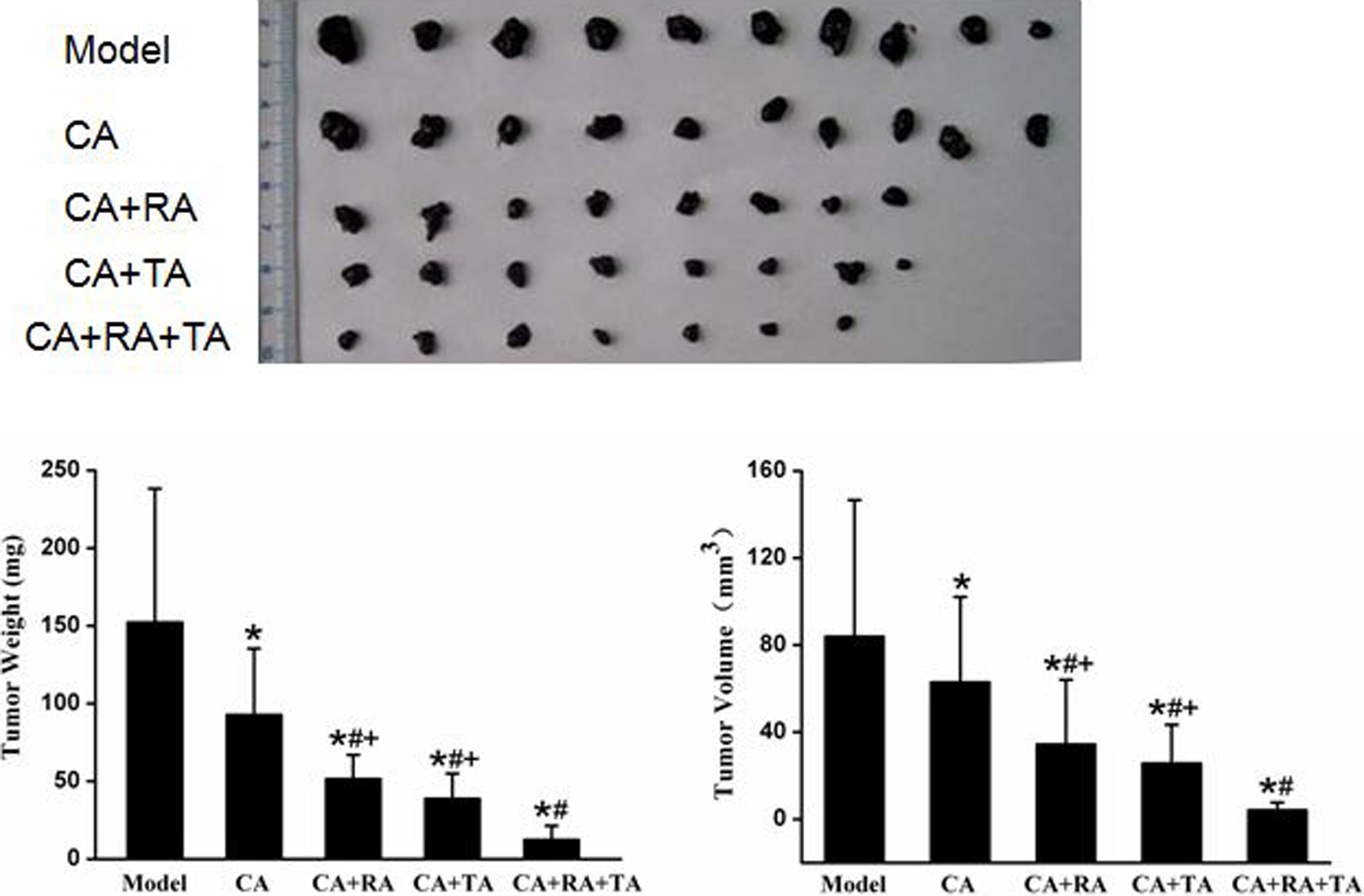
Tumor weight and volume comparison among carboplatin (CA), CA + Radix Astragali (RA), CA + tanshinone (TA), and CA + RA + TA groups. Results are mean ± standard deviation (SD), n = 10. *P < .05 compared with model group; # P < .05 compared with CA; + P < .05 compared with CA + RA + TA.
Effects of CA, RA, and TA on Tumor Incidence
The incidence of tumor in mice treated with CA + RA + TA was 70%, whereas the incidence in mice treated with CA alone or model group was 100%.
Effects of CA, RA, and TA on CD4+ and CD8+ Cells
Figure 3 shows that the treatment with CA + RA, CA + TA, or CA + RA + TA caused an increase in the percentage of CD4+ and CD8+ T subpopulations in spleen compared with treatment with CA alone.

Effects of carboplatin (CA), Radix Astragali (RA), and tanshinone (TA) on CD4+ and CD8+ T subpopulations in spleen. Results are mean ± standard deviation (SD), n = 10. ΔP < .05 compared with control; *P < .05 compared with model group; # P < .05 compared with CA; + P < .05 compared with CA + RA + TA.
Effects of CA, RA, and TA on Thymic and Splenic Relative Weights
Relative thymus and spleen weight of mice treated with CA + RA + TA increased significantly compared with mice treated with CA + RA, CA + TA, or CA alone (P < .05; Figure 4).

Effects of carboplatin (CA), Radix Astragali (RA), and tanshinone (TA) on thymic and splenic weights. Results are mean ± standard deviation (SD), n = 10. ΔP < .05 compared with control; *P < .05 compared with model group; # P < .05 compared with CA; + P < .05 compared with CA + RA + TA.
Effects of CA, RA, and TA on Natural Killer and CTL
The NK activities in mice treated with CA + RA + TA increased significantly compared with those treated with CA + RA, CA + TA, or CA alone (P < .05). CTL activities in mice treated with CA + RA + TA increased significantly compared with those treated with CA + RA, CA + TA, or CA alone (P < .05; Figure 5).
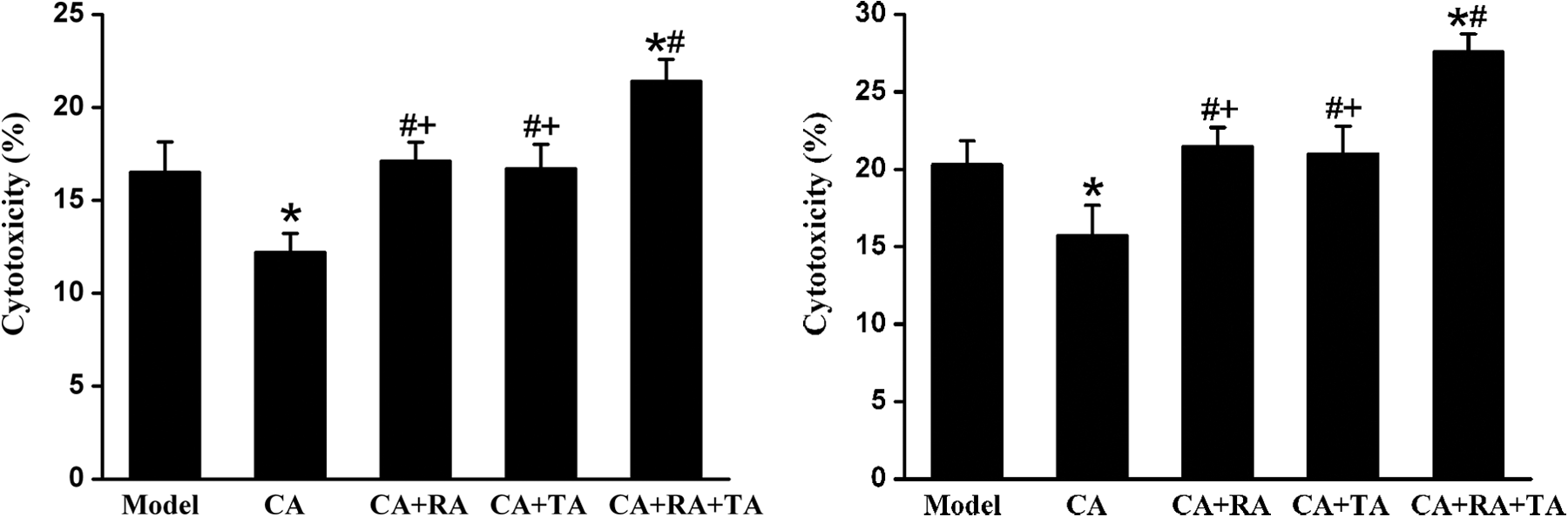
Effects of carboplatin (CA), Radix Astragali (RA), and tanshinone (TA) on natural killer (NK) and CTL. Results are mean ± standard deviation (SD), n = 10. *P < .05 compared with model group; # P < .05 compared with CA; + P < .05 compared with CA + RA + TA.
Discussion
We have one major finding in our study. The finding is that RA + TA can help CA produce more effective inhibition on the growth of B16 cell. Tumor weight and volume of mice treated with a combination of CA, RA, and TA are significantly smaller than those treated with CA alone; tumor latency of mice treated with combination of CA, RA, and TA is longer, and incidence is significantly lower than those treated with CA alone. All these results indicate that efficacy produced by RA + TA + CA in inhibiting tumor cell growth is better than that by RA + CA or TA + CA.
One of the mechanisms by which RA and TA help CA inhibit the tumor growth is that CA and TA can increase the percentage of CD4+ and CD8+ subgroups in spleen. As shown in our study, the percentage of CD4+ and CD8+ subgroups increases in the spleen of mice treated with CA + RA + TA compared with those treated with CA + RA, CA + TA, or CA alone. Another mechanism that the combination of RA + TA with CA produces more effective inhibition of B16 cell growth is that TA can induce the apoptosis of tumor cells as suggested by Akaberi et al. 17 As suggested by Zhao et al, 8 polysaccharide–protein complexes possess immunomodulatory activities, which is a major reason that we combine RA with TA. The RA is known as a low toxicity polysaccharide–protein complex. It is believed that RA helps CA inhibit the tumor growth mainly through immunomodulatory activities. The results of our study support our hypothesis that the combination of chemotherapy with RA and TA will result in improved immune system functions. As demonstrated in our study, the percentage of CD4+ and CD8+ subgroups and the activities of NK and CTL increase in mice treated with CA + RA + TA. Thus, our study suggests that the combination of chemotherapy with some herbal medicines, such as TA and RA, will produce better outcome for the patients with tumor, that is, more effective inhibition of tumor growth and improved immune system functions.
Conclusion
RA + TA can assist CA produce more effective inhibition on B16 tumor growth, which suggests that herbal medicine can be used in tumor treatment to assist chemotherapeutic drugs.
Footnotes
Declaration of Conflicting Interests
The author(s) declared no potential conflicts of interest with respect to the research, authorship, and/or publication of this article.
Funding
The author(s) received no financial support for the research, authorship, and/or publication of this article.