




Abstract
Visual learning, through graphics, diagrams, and other visual tools, has been shown to significantly enhance information retention, with studies indicating that up to 83% of learning is visual. In the field of radiation oncology, where continuous education is critical to the safe and effective treatment of cancer, the complexity and text-heavy nature of traditional resources can pose barriers to effective learning. This editorial examines the transformative potential of generative artificial intelligence (AI) in supporting cancer care professionals by enhancing comprehension of radiation oncology documents through tailored, visual learning modules. Using the AAPM TG-100 report “Application of risk analysis methods to radiation therapy quality management” as a proof of concept, the authors first developed web-based infographics manually and then demonstrated how AI tools such as ChatGPT, ClickUp, and NotebookLM dramatically expedite the process. These tools not only automate the creation of high-quality visuals but also support personalized and multimodal learning, including AI-generated podcasts for auditory learners. By making complex oncology-specific content more accessible, AI empowers radiation oncology clinicians and trainees to better understand, implement, and innovate in cancer treatment.
Keywords
Introduction and Problem
The American Association of Physicists in Medicine (AAPM) Task Group 100 (TG-100) 1 report represents a paradigm shift in the approach to quality and safety in radiation oncology. By introducing prospective risk analysis methods such as Failure Modes and Effects Analysis (FMEA) and process mapping, TG-100 moves the field beyond traditional reactive quality assurance and toward proactive, process-based quality management. This methodology enables clinics to identify, prioritize, and mitigate potential failures before they impact patient care.
Implementing TG-100 across all cancer clinics worldwide2–9 would ensure a standardized framework for improving safety, enhancing treatment reliability, and optimizing clinical workflows, yet its adoption has been limited by many factors, including radiation oncology practitioners challenge in learning this report. Visual learning could potentially facilitate the adoption of TG-100 in radiation oncology clinics.
According to Wikipedia, visual learning “utilizes graphs, charts, maps, diagrams, and other forms of visual stimulation” to improve the ability to effectively process and retain complex information. 10 Many studies show that visual learning plays a critical role in effective education.11–14 A study by the U.S. Department of Labor on how people learn and retain information found that approximately 83% of learning occurs visually, with the remaining 17% attributed to hearing, smell, taste, and touch. 15 A study also reported learning retention rates over a three-day period as follows: 10% of what is read, 20% of what is heard, 30% of what is seen, 50% of what is both seen and heard, 70% of what is said, and 90% of what is said while doing. 16
Radiation Oncologists and Medical physicists are life-long learners due to the ever-involving technology we work on. While there is no quantitative study on the learning styles of physicians and physicists, we can only assume they are no different in our reliance on visual learning. The AAPM and ASTRO provide a wide range of text-based reports, including notably those TG reports, which often serve as national guidelines and are publicly accessible content on its website. The reading and studying scientific and professional reports are a common educational activity among radiation oncologists and medical physicists, especially those in training. However, many radiation oncology clinicians find TG reports lengthy and challenging to interpret. Adult learning of complex radiation oncology technical reports is often challenged by time constraints, cognitive changes, fixed mindsets, technology gaps, and the need for practical, supportive learning environments that align with real-world clinical tasks. 17 This editorial paper highlights the empowering role of generative artificial intelligence (AI) in enhancing clinicians’ learning of TG reports through the development of customized visual learning techniques.
Proposed Solution
Before the emergence of generative AI, we had the interest of using Python, HTML, CSS, and JavaScript to develop the infographic learning modules to aid radiation therapy professionals to understand the AAPM TG reports. We selected the TG-100 as a proof-of-concept example and converted the central ideas of risk analysis methodologies into visual aids. The resulting visual teaching modules contain infographic techniques and a web-based learning module. 18 Figure 1 is a demonstration of transforming the complex TG-100 risk analysis methodology to visual expression. This approach leverages radiotherapy clinicians’ existing knowledge while incorporating user-friendly interfaces for enhanced learning. This web-based learning module for TG-100 was presented at an annual meeting of AAPM before the emergence of generative AI. 18
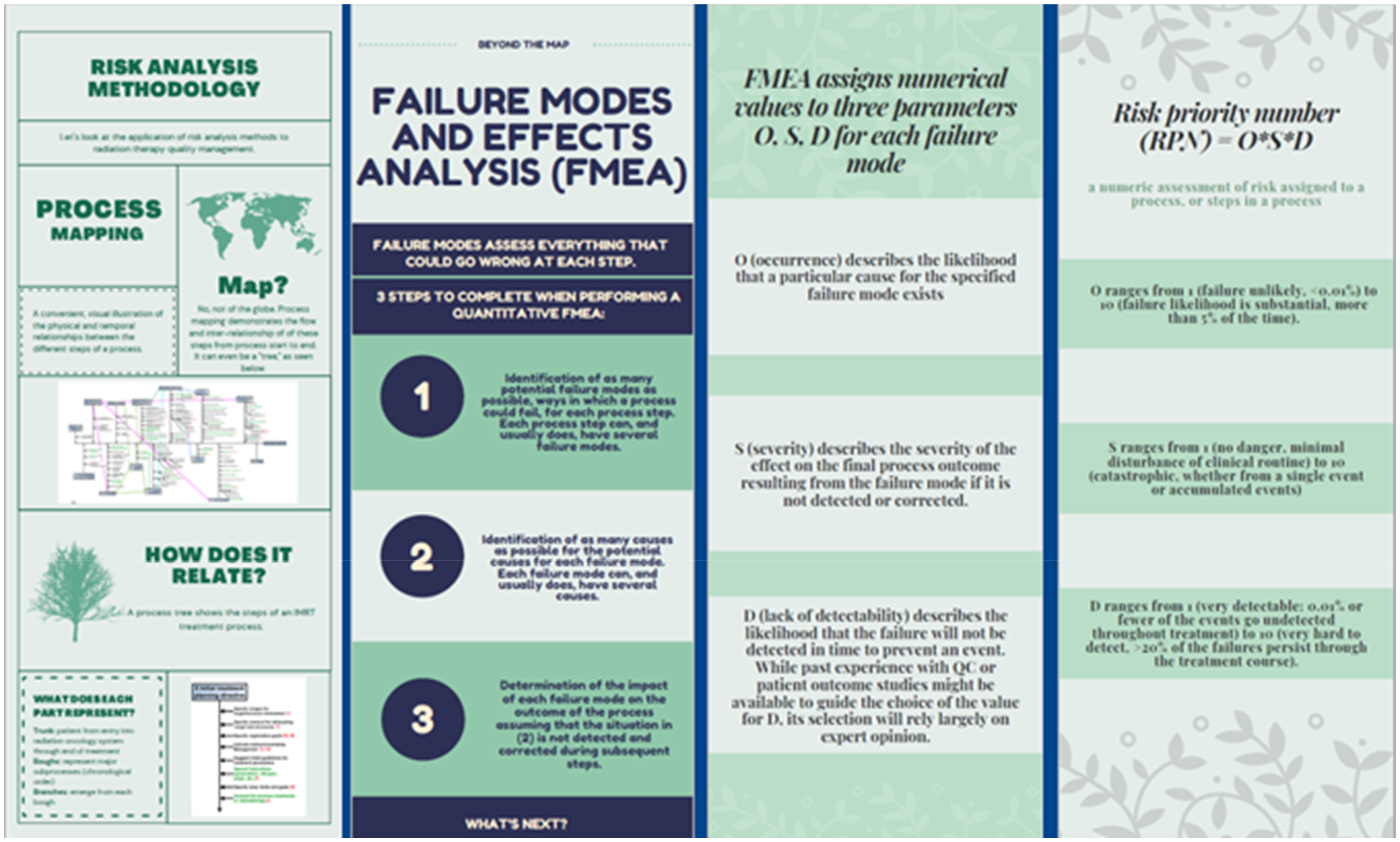
Displays the Infographic Form of Risk Analysis Methodology from TG-100.
Ideally, a radiation oncologist or medical physicist can search any AAPM TG reports by keywords and a relevant TG report would be available as a web-based learning module. Any TG report would be displayed in an infographic style with details expanding upon each concept. However, the amount of effort involved in converting all TG reports are nearly prohibitive. More crucially, any such infographic rendering is a fixed product that does not necessarily represent each learner's own challenge or interest. The rapid advancement of generative AI presents a new opportunity. Infographic-based learning can be significantly enhanced through AI-augmented capabilities. Figure 2 illustrates this evolution in how radiation oncology professionals interact with TG reports: from traditional hardcopy and/or online access to visual learning with presentations and graphics. The future involves AI-empowered infographic learning and AI-augmented workflow generation, utilizing tools like ChatGPT, ClickUp, Gemini, and similar platforms.

The Evolution of Adult Learning Timeline From Text-Based Copy of Radiation Oncology Physics Technical Reports to AI Era. Image Generated Using the Prompt “Generate an Image of the Evolution From Printing, Digital, Infographic, to AI-Empowerment AAPM TG Reports Learning” by Chatgpt.com, June 29, 2025. (https://chatgpt.com. User Login Is Required for Image Generation.)
Numerous free, generative AI tools can now facilitate the creation and comparison of learning modules for any ASTRO or AAPM practice guidelines report. These AI platforms are capable of generating visual learning templates and modules and are ready to respond to a wide range of user commands and follow-up questions. Let us revisit AAPM TG-100, but this time with AI assistance. Figure 3 demonstrates an AI-assisted learning module for the TG-100, highlighting a dramatic increase in efficiency. While the infographic module in Figure 1 required hours to days of human effort to generate, the AI-powered version in Figure 3 was created by Clickup.com in just a few minutes. Please note that it is not necessary to input the entire TG-100 report into the AI platform. Typing “AAPM TG-100” in the prompt alone is sufficient. Following the generation of an infographic, the AI can suggest some follow-up questions such as:
“Can you help me create a presentation based on this infographic?” “What are the key differences between traditional QA and risk-based QA?” “Can you provide more details on the FMEA process?”

Proposed AAPM TG-100 Learning Modules. Note. Image Generated Using the Prompt “Create an Infographic Learning Module of the AAPM TG-100,” by Clickup.com, June 29, 2025. (https://app.clickup.com. User Login is Required for Image Generation).
The AI software will continue to provide further actions or learning materials based on user prompts. Users can customize the complexity of this workflow based on their learning objectives: whether they are at an entry, intermediate, or advanced level. These levels are based on experience and need.
Finally, while this editorial focuses on visual learning using AI, AI can also assist learning with other sensory media, such as a podcast review of a TG report or a scientific paper. For instance, Google NotebookLM has demonstrated this capability by generating a podcast on a review of implanted devices in radiotherapy, 19 a top-two Advances in Radiation Oncology download in 2022. As the original authors of this paper, we judge the AI-generated Podcast mostly accurate, with a few minor “misunderstanding” by AI, but not egregious or consequential.
Learning radiation oncology physics with the assistance of large language models (LLMs) offers benefits, such as rapid access to explanations, simulated exam preparation, and retrieval of relevant references . However, LLMs are known to introduce hallucinations that may lead to false or flawed understanding. To ensure safe and effective learning, LLM-assisted learning should be guard-railed by the following practices:
1.
“Based on AAPM TG-100, how is the Risk Priority Number (RPN) scored?” This approach directs the model to align its response with the referenced guideline, minimizing the likelihood of fabricated content.
2.
Ultimately, all LLM-generated content, especially in contexts involving dose calculations, treatment planning, or clinical protocols, should be cross-checked against published reports, peer-reviewed literature, or clinical guidelines to ensure accuracy and reliability.
Conclusion
This work contributes to the fields by demonstrating how generative AI can facilitate education through customized visual and multimodal learning tools, making complex information more accessible, understandable, and engaging. Generative AI has the potential to strengthen cancer care by transforming complex radiation oncology guidelines into clear, visual, and personalized learning tools. This empowers clinicians and trainees to better understand and apply best practices. As ChatGPT aptly states, “AI doesn’t replace TG-100; it amplifies human vigilance”. 20 We believe AI is not a substitute for learning, but a powerful tool augmenting the comprehension of text-based materials through customized visual and auditory support.
Footnotes

Author Contribution Statement
Maria Chan and Dongxu Wang have made a substantial, direct and intellectual contribution to the work, and approved it for publication.
Funding
The author disclosed receipt of the following financial support for the research, authorship, and/or publication of this article: Partially funded through the NIH/NCI Cancer Center Support Grant P30 CA008748
Declaration of Conflicting Interests
The authors declared no potential conflicts of interest with respect to the research, authorship, and/or publication of this article.