




Abstract
Purpose:
To uncover potential diagnostic biomarkers for endocervical adenocarcinoma (EAC) and adenocarcinoma in situ (AIS).
Experimental design:
Quantitative label-free liquid chromatography-electrospray ionization-tandem mass spectrometry (LC-ESI-MS/MS) peptidomics strategies were employed to profile 8 cervical mucus (CM) samples, including 3 EAC cases, 2 AIS cases and 3 normal controls (Ctrl).
Results:
Among the 3721 exclusive peptides identified, 12 (5 up-regulated and 7 down-regulated) endogenous peptides were significantly expressed in EAC compared to healthy controls (EAC/Ctrl); 10 (7 up-regulated and 3 down-regulated) endogenous peptides were significantly expressed in AIS compared to healthy controls (AIS/Ctrl); 11 (6 up-regulated and 5 down-regulated) endogenous peptides were significantly expressed in EAC compared to AIS (EAC/AIS) (absolute fold change ≥1.5, Benjamini-Hochberg adjusted p-value ≤0.05). Among these identifications, annexin A1 (ANXA1) was found to be down-regulated both in EAC and AIS, and its unique peptide (FIENEEQEYVQTVK) may be promising indicators for cervical glandular epithelial lesions.
Conclusion:
This is the first study to utilize CM peptidomics in cervical glandular malignancies, which may reveal the novel noninvasive biomarkers for EAC and AIS.
Introduction
Cervical cancer, the fourth most frequent malignancy and the fourth leading cause of death in women worldwide, had about 570,000 cases and caused 311,000 deaths in 2018. 1 Covering a heterogeneous group of invasive tumors, cervical carcinomas fall into 3 general categories: squamous cell carcinoma (SCC), endocervical adenocarcinoma (EAC) and other epithelial tumors. 2 Early screening of cervical carcinoma using cervical cytology inspection and high-risk type human papillomavirus (HR-HPV) testing has markedly decreased the proportion of SCC. By contrast, the absolute number of EAC cases has doubled since 1998. 3 -6 The limitations of current cytology screening of EAC and the existence of non-HPV related adenocarcinoma may cause missed diagnosis of EAC and adenocarcinoma in situ (AIS), the precancerous lesion of EAC. Clinically, EAC patients are given a therapy similar to that of SCC patients, but quite a few observations have indicated worse prognosis, poorer survival and mortality rates of EAC compared with SCC even when matched for tumor stages. 7 -10 Thus, new biomarkers for early detection of EAC and AIS are urgently needed.
Cervical mucus (CM) covers the lower female genital tract and stabilizes the local microenvironment. The changes of CM properties and components can reflect the physiological and pathophysiological status of the reproductive tract in both pregnant and nonpregnant women. CM mainly derives from endocervix and a little can be secreted by endometrial decidua and amniochorion. The changes of CM proteome have been proved associated with benign diseases like premature rupture of membranes and endometriosis. 11 More importantly, CM proteome contains potential markers of cervical (pre)cancer. Using a label-free quantitation approach based on liquid chromatography tandem mass spectrometry (LC-MS/MS), aberrant expression of 27 proteins in SCC was identified and some were regarded as potential biomarkers (alpha-actinin-4, vitronectin, annexin A1 (ANXA1), cyclase-associated protein 1, annexin A2, and Mucin-5B). 12 Other studies also found a dozen proteins (14-3-3 protein epsilon, actin-related protein 3, alpha-actinin-4, annexin A2) with statistically different expression in precancerous lesions of SCC. 13,14 However, the role of mucous peptides and proteins as candidate diagnosis markers for EAC and AIS remains unrevealed.
Branched from proteomics and introduced in 1996, peptidomics can be used for systematic analysis of the endogenous minute proteins and peptides, especially peptides ≤20 kDa, in biological specimens within a defined time. 15 Compared to proteins, weak immunogenicity, rapid blood elimination, whole-body diffusion and the ability to reflect protease changes have anointed peptides as prospective biomarkers in clinical diagnosis, prognosis, surveillance and therapy. 16 For example, a combination of 22 polypeptides in urine is considered as a highly sensitive and specific diagnostic biomolecule for urothelial carcinoma, meanwhile fibrinopeptide A is identified as a prominent marker. 17 Another 5 peptides derived from serum have been reported to be associated with tumor recurrence and efficacy evaluation in adult lymphocytic leukemia. 18 From another perspective, these cases also illustrate that biofluids are the source of a myriad of peptides, which allows new excavations of complementary markers in medical practice. CM bathes the cervical canal and vagina and possesses a quantity of proteins and peptides, making it an available and meritorious source for potential biomarkers of cervical diseases.
The purpose of this study was to characterize the CM peptide changes in patients with EAC and AIS. Hopefully, the results of this study can shed light on the potential of these peptides as non-invasive biomarkers of EAC and AIS.
Materials and Methods
Patients
The CM samples were collected from 8 women without any treatment. Among them were 3 EAC patients and 2 AIS patients diagnosed by 2 experienced pathologists based on WHO Classification of Tumors of Standard of Female Reproductive Organs (2014) after panhysterectomy, together with 3 healthy age-matched women as control after a cervical biopsy. CM samples were collected by gentle aspiration from the cervical canal during the proliferative phase of the menstrual cycle and then stored in -80°C immediately until peptidomic analysis.
Peptide Sample Preparation
For peptide extraction, each biological sample was individually incubated in lysis buffer (8 M urea/100 mM TEAB, pH 8.0) containing 1 mM PMSF, 2 mM EDTA and 10 mM DTT. The suspension was sonicated for 15 min on ice and then centrifuged at 4°C, 13,000 g for 30 min. The supernatant was reduced with 10 mM DTT at 56°C for 30 min and alkylated with 50 mM iodoacetamide (IAM) at room temperature for 30 min in the dark. Then the sample solutions were filtered with 10 kDa MWCO filter tube by centrifugation (4°C, 10,000 g) to remove proteins and peptides larger than 10 kDa. The flow-through was collected and the peptides were purified by C18 columns. The eluates were vacuum dried and stored at -20°C until MS analysis. Wuhan GeneCreate Biological Engineering Co., Ltd. accomplished these experimental procedures.
LC-ESI-MS/MS Analysis Based on Triple TOF 5600 Plus
Each fraction was dissolved in 30 µL of 2% acetonitrile/0.1% formic acid and analyzed using TripleTOF 5600+ mass spectrometer coupled with the Eksigent nanoLC System (SCIEX, USA). Peptide samples were loaded onto a C18 trap column (5 μm, 100 μm×20 mm), and eluted at 300 nL/min onto a C18 analytical column (3 μm, 75 µm×150 mm) over a 90 min gradient. The 2 mobile phases were buffer A (2% acetonitrile/0.1% formic acid/98% H2O) and buffer B (98% acetonitrile/0.1% formic acid/2% H2O). For IDA (information dependent acquisition), survey scans were acquired in 250 ms and 30 product ion scans were collected in 100 ms/per scan. MS1 spectra were collected in the range 350-1500 m/z, and MS2 spectra were collected in the range of 100-1500 m/z. Precursor ions were excluded from reselection for 15 s.
Data Analysis
Protein identification and quantification were performed using ProteinPilot 4.5 Software (July 2012; AB Sciex). MS/MS spectra were searched against a UniProt-swissport-human protein database. The search parameters were set as follows: the instrument was TripleTOF 5600, iTRAQ quantification, cysteine modified with iodoacetamide; biological modifications were selected as ID focus; the Quantitate, Bias Correction and Background Correction were checked for protein quantification and normalization. Detected peptide threshold [Unused ProtScore (Conf)] was 0.05 (10.0%); FDR Analysis tab was checked. All identified proteins had an Unused Protscore of >1.3 (corresponding to proteins identified with >95% confidence), as calculated by the software, and a global false discovery rate (FDR) of ≤1% was determined at the protein level by the PSPEP algorithm. The differentially expressed proteins were defined to have a P value <0.05, as calculated by the software.
Bioinformatics
To determine the biological and functional properties of all the identified peptides, the peptide sequences were mapped with Gene Ontology (GO) Terms (http://geneontology.org/) using blast2go. The homology search was first performed for all the identified sequences with a localized NCBI blast program v2.6 (ftp://ftp.ncbi.nlm.nih.gov/blast/executables/blast+/2.6.0/) against NCBI or animal database, which was created by a tool named taxomias (https://github.com/wegnerce/taxomias) software. The P value was set to be less than 1e-5, and the best hit for each query sequence was taken for GO term matching. To identify biological functions related to candidate biomarkers, we employed hypergeometric test to perform GO enrichment with our in-home program.
Statistics
For biological or technology replicate experiment, the ratio of median expression between cases and controls was defined as fold changes. Statistically significant difference in the expression levels of proteins between samples was determined by student’s t-test. For protein and peptide abundance ratios measured, a 1.5-fold change was adopted as the threshold and P < 0.05 was used to identify significant changes.
Results
Clinical and Histomorphological Features of Enrollees
The study surveyed CM specimens of 8 women aged between 34 and 47 (median age: 40) years. The most common clinical manifestation in women with EAC or AIS was abnormal vaginal hemorrhage, which was found in 3 subjects (3/5). For the rest 2 patients, one (1/5) had abnormal leucorrhea, and the other (1/5) had no apparent performance. Among the 7 participants (7/8) receiving cytology and HR-HPV test, only one had positive cytology interpretation in EAC (1/7), and 4 patients with glandular malignancy (4/7) were HPV-positive. One EAC patient (1/8) was exempt from these 2 detections due to the cauliflower-like endocervix as observed in the gynecological examination and then received targeted biopsy. The clinicopathological features and tumor information of all the individuals in our study are present in Table 1.
Characteristics of Study Participants.

Abbreviations: TCT, Thinprep cytologic test; HPV, high risk type human papillomavirus test; TS, tumor size; FIGO, International Federation of Gynecology and Obstetrics stage.
ASCUS, atypical squamous cells-underdetermined significance; NK, not known; NT, no tumor; NA, not applicable; -, negative; +, positive.
Hematoxylin and eosin (H&E) staining was performed in all the 8 cases. The typical morphology of the 3 groups were shown in Figure 1. For the healthy control group, benign uterine cervical glands showed smooth shapes, affluent mucinous cytoplasm, small and neatly arranged nuclei, and no nuclear fission (Figure 1A, 1B). While pathologic evaluations of the EAC group revealed irregular adenoid architecture, interstitial infiltration, eosinophilic cytoplasm, disordered pattern and distinct cellular heteromorphism (Figure 1C, 1D). Besides, the neoplastic epithelium of AIS cases differentiated itself with scant cytoplasm, pseudo-stratified nuclei, high mitotic rates and intralobular growth pattern (Figure 1E, 1F).

Representative histomorphological images of samples. (A, B) Cervical mucous glands possess a round borderline (×100), displaying low nuclear-cytoplasmic ratios with abundant intracellular mucus in healthy control (×400). (C, D) Tumor tissues infiltrate into the cervical stroma with an irregular adenoid architecture in EAC (×100), exhibiting significant cellular heteromorphism (×400). (E, F) Dysplasia of glandular epithelial without lobule structure destruction in AIS (×100); partial gland lined by pseudo-stratified cells adjacent to benign epithelium with clear mitosis and apoptotic bodies (×400).
Differentially Expressed Peptides in EAC and AIS Groups
MS-based analysis and database search were utilized to identify and quantify the changes of CM peptidomic composition in healthy individuals and patients with EAC and AIS. On the whole, 3721 endogenous peptides originated from 344 unique protein precursors were identified from the 8 samples. For identified peptides, the distribution of precursor tolerance (molecular mass difference between the theoretical and the measured peptides) was verified in a narrow range of ±1 Da (Figure 2A). The length distribution of peptide segment showed that most peptides stayed within the confines of 9-23, which was consistent with the molecular weight range recognized by mass spectrometer (400-1200) (Figure 2B).

Qualitative and quantitative analysis of CM peptides Distribution of precursor tolerance in all identified peptides. (B) Length distribution of all identified peptides. (C) Distribution of fold change of all quantifiable peptides. The abscissa represents the value of fold change after logarithm transformation. The parts >/< 0 indicate up-/down-regulation of expression, respectively. (D) Number of differentially expressed peptides in EAC/Ctrl, AIS/Ctrl and EAC/AIS groups.
Taking the logarithm of the fold change for each peptide based on 2, a distribution of peptide specific value (logarithm) conforming to the normal distribution was produced (Figure 2C). In the subsequent relative quantitative study, 12, 10 and 11 confident peptides with differential expression were recognized in EAC/Ctrl, AIS/Ctrl and EAC/AIS, respectively. 5 up-regulated and 7 down-regulated peptides were found in EAC/Ctrl, 7 up-regulated and 3 down-regulated peptides in AIS/Ctrl, and 6 up-regulated and 5 down-regulated peptides in EAC/AIS (Figure 2D). With regard to those specific identifications, the following information was recited: peptide sequence, peptide mass, protein IDs, P value and difference state (Table 2). Among these identifications, ANXA1 was found to be down-regulated both in EAC and AIS.
Information of Peptides Showed Differential Expression in EAC/Ctrl, AIS/Ctrl and EAC/AIS.

ANXA1 Protein Expression in Specimens
ANXA1 expression was studied by immunohistochemical staining on aforementioned samples. It turned out that ANXA1 expression showed a homogeneous pattern between endocervical malignant gland and normal gland. ANXA1 immunoreactivity was absent or weak in ECA tissues (Figure 3A), and neither in AIS tissues (Figure 3B). But strong cytoplasmic positivity was observed in the healthy controls (Figure 3C).
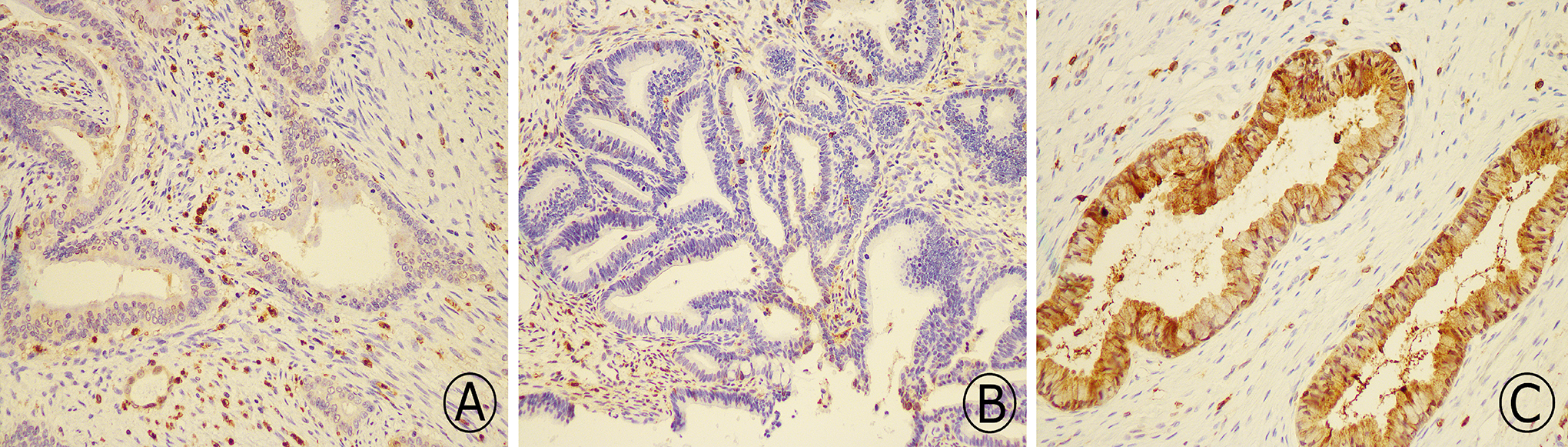
Immunohistochemical analysis of ANXA1 expression. Absence of ANXA1 expression in (A) EAC and (B) AIS glandular epithelial cells (×200). (C) Normal cervical mucus epithelium with high ANXA1 cytoplasmic expression (×200).
Functional Analysis of Differentially Expressed Peptides
The results of GO annotation and GO enrichment were adopted to reveal the biological significance of identified proteins in CM. 314 out of 344 proteins (since not all proteins have annotation information) covered 14 molecular functions (Figure 4A), with binding (48.92%) ranking the first, then followed by catalytic activity (17.51%) and structural molecular activity (10.65%). In term of cellular component, the proteins were split into 10 classes (Figure 4B), including cell (16.04%), cell part (16.04%), extracellular region (15.10%) and other classes. The biological process consisted of 26 categories (Figure 4C), including cellular process (9.76%), metabolic process (8.2%) and biological regulation (7.81%) and other categories. By GO enrichment analysis, proteins with statistically significant expression identified in EAC/Ctrl reported a major beneficiation of cytoskeleton (4/6) in cellular component and tissue development (5/6) in biological processes (Table 3A). As for AIS/Ctrl, differential proteins were mostly located in cell-cell junction (3/9) of cellular component, calcium ion binding (4/9) of molecular function, and response to organic nitrogen (4/9) in biological processes (Table 3B). The number of differential proteins in EAC/AIS was too small to obtain significant enrichment results.

Profiles of identified proteins according to (A) molecular function, (B) cellular component and (C) biological process.
Molecular Function Analysis of Differential Proteins in (A) EAC/Ctrl and (B) AIS/Ctrl.a

a Hypergeometric tests were used to identify GO items that were significantly enriched in differential proteins compared with all protein backgrounds. The calculation formula is:

Abbreviations: N, the number of proteins with GO annotation information in all proteins; n, the number of differential proteins in N; M, the number of proteins annotated to a GO term in all proteins, m, the number of differential proteins annotated to a GO term.
CC, cellular component; BP, biological process; MF, molecular function.
Discussion
Cervical cytology and high-risk HPV screening are 2 most pivotal tests for early diagnosis of cervical neoplastic lesions. Unlike neuroendocrine and gastrointestinal tumors, the clinical features of gynecological malignancies may not be unique. For example, abnormal vaginal bleeding, a consequential indication for cervical cancer with 55.9-84.0% complaints, is more common in benign lesions. 19,20
In this study, 7 out of 8 women went through Thinprep cytologic test (TCT) prior to treatment, and negative results were found in all the subjects except for one EAC patient whose positive result was misinterpreted as atypical squamous cells-underdetermined significance (ASCUS). Yet, ASCUS was only one of the abnormalities for squamous epithelial cells according to the Bethesda system (TBS). 21 The predictability of cervical cytology for glandular epithelial lesions has been reported to run below expectation. For example, the median atypical glandular cell (AGC), a type of abnormal glandular cell, reporting rates of Conventional Papanicolaou Tests, ThinPrep and SurePath were 0.1%, 0.2% and 0.2% respectively, according to a questionnaire by the College of American Pathologists (CAP). 22 Another CAP Q-Probes study of 22,439 matched cervical cytology-biopsy cases reported that 52% of AGC cases followed up were found to have severe pathological changes; most (40%) were squamocellular lesions and only 5% were glandular diseases. 23 Similar results were reported in an analysis of 3,007 histologic specimens of AGC, in which high-grade cervical intraepithelial neoplasia (CIN) and endometrial carcinoma were the most common severe lesions in younger and elder patients, respectively, while AIS and EAC only made up a very small proportion (1.9%). 24 These data indicate that cytological examination of the uterine cervix have comparatively weak sensitivity and specificity predictions for endocervical glandular lesions. The ineffectiveness of glandular screening is prevalent in cytopathological diagnosis and largely restricted by sampling and interpretation. 25
Previous studies have confirmed that HPV is associated with a variety of cervical diseases, ranging from relatively benign diseases like genital warts to fatal invasive cervical cancer. To date, over 200 genotypes of HPV have been isolated and classified as high-risk (HR) and low-risk types in the light of their carcinogenicity. 26 Persistent HR-HPV infection is the same pathogenic process shared by EAC and SCC. In our study, among the 7 participants who underwent HR-HPV testing, 2 EAC and 2 AIS patients (4/7) showed HPV positivity while 3 healthy controls (3/7) showed negativity. These results indicate that HPV detection is relatively effective in the primary screen of glandular epithelial lesions. However, unlike SCC patients who are nearly 100% HPV positive, roughly 20% to 25% of EAC cases lack HPV relevance, mainly comprised of gastric adenocarcinoma, clear cell carcinoma and mesonephric adenocarcinoma, of which patients are confirmed with significantly worse clinical prognosis. 27,28 Further, the application of HPV vaccinum will lead to a relative ascension of these malignant and premalignant lesions, which cannot be detected by HPV-based screening projects.
For peptides quantification and bioinformatics inspection in CM, a total of 3721 intrinsic peptides were identified among the 8 samples. The distribution of precursor tolerance was basically clustered within ±1 Da, indicating highly accurate identification results. Generally speaking, a normal tissue and its origin tumor tissue, or the various phases in the tumor development of a same histologic tumor type, have a certain degree of similarity in protein composition. Therefore, the expression level of most proteins in samples remains constant, and the distribution of peptide ratio (logarithm) also conforms to the normal distribution. In relative quantification, our results showed that the peptide ratio distribution approximately fit the normal distribution. Among the differentially expressed CM proteins, ANXA1 was found to be down-regulated both in EAC and AIS. ANXA1 is a suppressor or promoter of defferent tumor tissues and closely associated with a broad spectrum of cell biological activities, such as signal transduction, proliferation, differentiation and apoptosis. 29 Experiments on CIN and SCC have shown that tumors with lower ANXA1 expression have poorer differentiation and increased progression. ANXA1 is also decreased in B-cell lymphoma, larynx cancer, nasopharyngeal cancer and hilar cholangiocarcinoma. 29 For all of the samples in our study, 314 out of 344 unique protein precursors were used for GO profile. Binding, cell (as well as cell part) and cellular process were expected to rank as the first GO term of molecular function, cellular component and biological process, respectively. The enrichment analysis of statistically differential proteins of EAC/Ctrl indicated a chief concentration in cytoskeleton and tissue development. In AIS/Ctrl, cell-cell junction, calcium ion binding and response to organic nitrogen were the main cluster GO terms. CM is mainly secreted by cervical glandular epithelium cells, and its changes in molecular function, cellular component and biological process may indicate the occurrence of malignant glandular epithelial diseases. Therefore, CM can be used to detect these diseases.
In conclusion, the peptidomic changes in CM with glandular epitheliopathy were reported for the first time. Using a label-free and LC-ESI-MS/MS based analysis, 12, 10 and 11 endogenous peptides in CM were found to be differentially expressed in groups of EAC/Ctrl, AIS/Ctrl and EAC/AIS, respectively. Among these identifications, ANXA1 was found to be down-regulated in both EAC and AIS, and its unique peptide (FIENEEQEYVQTVK) may be a promising indicator to detect cervical glandular epithelial lesions. Considering the limitations of cervical cytology and HPV screening on glandular malignancies, the functions of these peptides are worth further study to verify whether one particular peptide or the combination of them would be a complementary or alternative diagnostic marker of EAC and AIS.
Footnotes
Abbreviations
Author Contribution
Feng Shi and Xiaohui Li make equal contributions to this work.
Ethics Statement
This study was approved by the Ethical Committee of Women’s Hospital of Nanjing Medical University, Nanjing Maternity and Child Health Care Hospital (2019-KY-009). Each enrollee provided a signed informed consent prior to participation.
Declaration of Conflicting Interests
The author(s) declared no potential conflicts of interest with respect to the research, authorship, and/or publication of this article.
Funding
The author(s) disclosed receipt of the following financial support for the research, authorship, and/or publication of this article: This work was supported by grants from the National Natural Science Foundation of China (81802105), the Jiangsu Provincial Key Research and Development Program (BE2017619) and the Nanjing Technological Development Program (201605049). The author(s) received no financial support for the research, authorship, and/or publication of this article.
