




Abstract
Once I walked as an accidental autoethnographer through the entrance door of a repurposed children’s orphanage. There on the doorstep, I witnessed a former resident in the final moments of a secular pilgrimage of unforgetting and cradling. Unforgetting is understood, in this article, as a metaphor for the thousands of women and children robbed of their truth, agency, and sometimes their future in state and religious-run orphanages. Cradling is understood as a metaphor for a desiring, sensual, performative, and singular/universal reparation. Influenced by phenomenological writings on the buildings we inhabit and those that inhabit us, and embodied, rhythmic, sensory, and experimental qualitative inquiry writing, I challenge the erasure of violence-toleration in official discourses of church and state-run institutions through a performative aesthetic of witnessing, evoking, and inscribing the lost sensations of a denied, difficult, and violent past into the grand narratives of mothers, children, and childhood.
Keywords
Performers
The Author, The Narrator, Brighid (mother and former resident of the orphanage), Hannah (Brighid’s daughter), The Archivist, The Teacher, The Casual Observers, The Counterpointing Poets, and The Scholarly Community.
Archivist
[Speak] On January 12, 2021, the Government of Ireland published the Final Report of the Commission of Investigation (Mother and Baby Homes and certain related matters). In the press release announcing the publication of the report, Roderic O’Gorman, Minister for Children, Disability, Equality, Integration and Youth, commented: The publication of the Commission’s report is a landmark moment for the Irish State. The Commission’s investigation reveals the truth of what happened, within the walls of Mother and Baby Homes and beyond them, to many thousands of women and children. Importantly, it also inscribes for posterity, those journeys, those heartbreaks, those truths in the words of those who experienced them first-hand. The report makes clear that for decades, Ireland had a stifling, oppressive and brutally misogynistic culture, where a pervasive stigmatisation of unmarried mothers and their children robbed those individuals of their agency and sometimes their future. Publication of the Commission’s report is an expression of truth. For decades, Irish society was defined by its silence, and, in that, its complicity in what was done to some of our most vulnerable citizens. With its publication, we are affirming that their stories and their truth, will be heard, acknowledged and understood. (Government of Ireland, 2021) [Press Release]
Narrator
[Speak] In publishing the report, the government stated that it is hoped the report provides acknowledgment, recognition, truth, and, through this, healing for former residents.
[Speak/sing/gesture with the eyes of the skin and a thinking hand]
Narrator
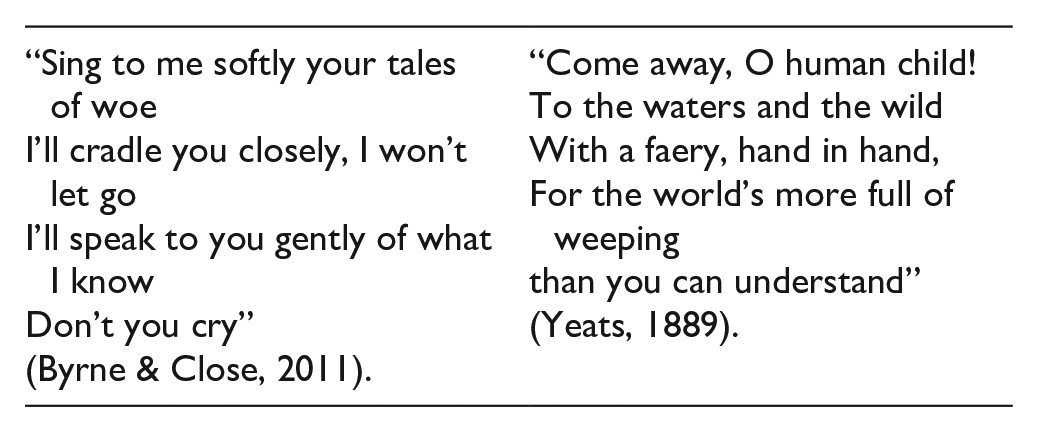
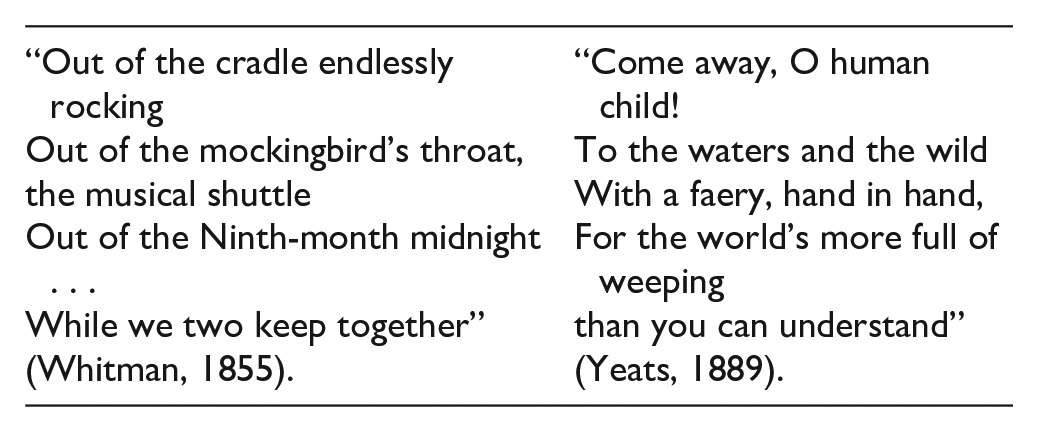
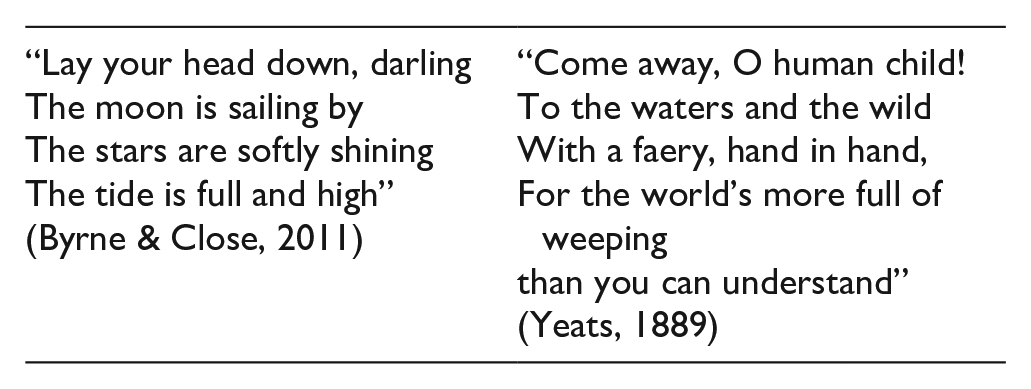
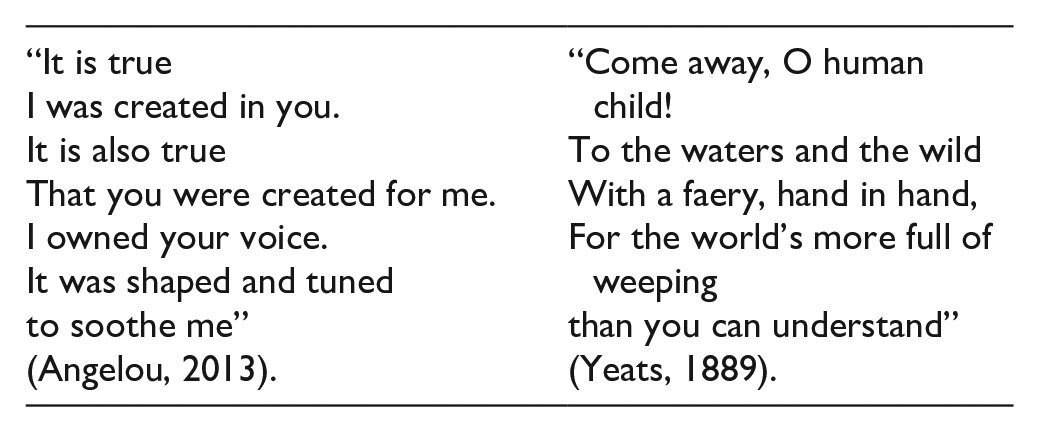
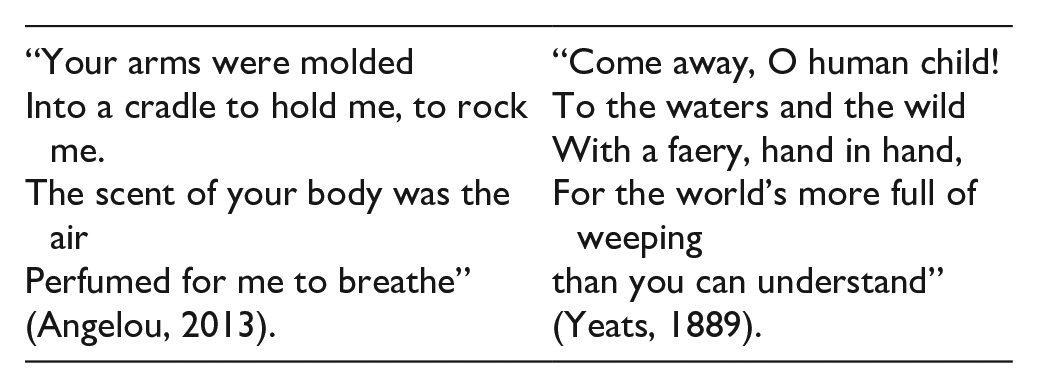
[Speak] What you have just seen and heard, entitled The Virgin’s Lullaby or in the Irish language, Suantraí na Maighdine is a variant of found poetry (Butler-Kisber, 2010). It draws on references to cradling and mothering in traditional and contemporary music and poetry (Hughes & MacCathmhaoil, 1904). In the remainder of this performative autoethnography, each of the selected verses is juxtaposed with the same four-line refrain from the Irish poet, playwright, and senator William Butler Yeats’ (1889) poem, The Stolen Child. This poem uses fairy mythology and legends to evoke the allure of the magical world of the fairies and the harsh and mundane world of humans. In this poem, Yeats expresses his longing for a return of innocence and freedom which has been lost due to religious and political conflicts. The refrain serves as a reverberating echo for the central and animating themes of unforgetting, cradling, and witnessing, and the embedded themes of separation, loss, trauma, and reparation. A symbiotic line drawn down the middle of the frame represents the contested push and pull of the “counterpointing poets,” the cradling of a baby by the mother, on one side, and the taking of a baby into state care, on the other, the play of dissimilar forces, mother versus state.
Author
[Speak] In this performative autoethnography (Adams et al., 2022; Alexander & Weems, 2021; Conquergood, 2002; Denzin, 2018; Madison, 2018; Pelias, 2021; Pink, 2006; Poulos, 2018; Speedy, 2015; Spry, 2016), I am writing as an “accidental autoethnographer” (Levitan et al., 2020; Poulos, 2018) about my witnessing of the concluding moments of the secular pilgrimage of one of the former residents of the orphanage. In doing so, I am also writing in a particular vein of memoria histórica (Gibbons, 2007; Grever & Adriaansen, 2017; Huyssen, 2002) to recover the moment-to-moments that lie in the underbrush of official discourses and against those that stigmatized, judged and rejected the residents of state and religious-run institutions. In this way, I am writing back a story of hidden injuries and long-lasting wounds into the grand narratives of children and childhood and women and motherhood in Ireland.
Narrator
[Speak] There on the smooth, well-trodden, and highly polished granite doorstep outside the grand paneled entrance door to the repurposed orphanage, Brighid’s journey culminated in a performative series of cradling and gesturing on the spot where she was first cradled in swaddling clothes as a newborn baby, some 50 years earlier.
Author
[Speak] In this performative autoethnography, I bear witness to Brighid’s arrival at the entrance door of the repurposed orphanage and the “double witnessing” of my witnessing of Brighid’s “affective witnessing” (Richardson & Schankweiler, 2019) of the early days of her newborn life, or “how force hits bodies, how sensibilities circulate,” as Stewart (2013) writes, “and become, perhaps delicately or ephemerally, collective (p. 66). Following the “affective turn” (Clough & Halley, 2007) in the social sciences and humanities, Richardson and Schankweiler (2019) described “affective witnessing” as the encounters, embodiments, affects, and experiences present in all acts of witnessing, shifting back and forth, across temporal, spatial and attitudinal realms.
Narrator
[Speak] For a number of decades the gothic structures that housed the residents of orphanages stood like citadels, that could not be breeched or pierced, hewn from locally quarried limestone, looming behind ivy-clad convent walls and situated down long winding avenues, in cities, towns, and villages throughout the country. By the mid-1970s, many state and religious-run institutions were derelict, others demolished, and more disused. A number were rescued from ruin in recent decades and then repurposed anew. One rescued and repurposed orphanage standing among the gothic ruins is the backcloth for this performative autoethnography.
Author
[Speak] My inquiry invariably turns on themes and evocations of beauty and sadness, rites and rituals, presences and absences, ephemera and sensibilities and, more specifically, the senses and the sensate—what I describe as the “haunting realms” and “surrounding objects” in the play of light and the dance of “restless shadows” in the dimly-lit hallways and recessed alcoves in the building (Jennings, 1985, pp. 243–244). My understanding of “unforgetting” as a political metaphor owes much to Roberto Lovato’s (2020) book, Unforgetting: A Memoir of Family, Migration, Gangs, and Revolution in the Americas. Unforgetting (2020), for Lovato, is a call to remember the violence of imperialist interventions and underworlds in his native El Salvador, while simultaneously, refusing to forget the love, hope, agency, and struggles of the people themselves.
Narrator
[Speak] Following Lovato (2020), “unforgetting” is used here as a metaphor for both material and human culture, as well as academic and popular articulations of history, with the spotlight on the thousands of women and children robbed of their truth, agency, and sometimes future in state and religious-run institutions. While Lovato (2020) organizes his narrative with reference to the splicing power of “the machete of memory” (xvii), “cradling a newborn” is used here as a metaphor for a desiring, sensual, and singular/universal reparation.
Author
[Speak] Taken together, these metaphors show unsettling evocations of dread and fear and, paradoxically, belonging and comfort. They combine evocations of the (un)heimlich (Freud, 2003, p. 124) or the un/homely strangeness, eeriness, and terror of the place and, paradoxically, the heimlich (p. 124), or the homely sense of the familiar, belonging and comfort, yet the potentially secretive and closed nature of the very same place.
Narrator
[Speak] The French author and philosopher, Gaston Bachelard (2014) wrote about cradling as a central and animating theme, and prior and anterior to other intimate spaces such as “nests” (p. 111), “shells” (p. 125), “corners” (p. 155), and “drawers, chests, and wardrobes” (p. 95) in his writings on the poetics of space.
Gaston Bachelard: Author and Philosopher
[Speak] The House . . . is body and soul. It is the human beings first world. Before he is cast into the world, as claimed by certain hasty metaphysics, man is laid in the cradle of the house. And always, in our daydreams, the house is a large cradle. (Bachelard, 2014, p. 7).
Narrator
[Speak] In counterpoint to Bachelard’s (2014) poetic images of relational materiality, compression of time, and aesthetic space, feminist writers such as Simone de Beauvoir (2010), Luce Irigaray (1993) and Marion Iris Young (2005), albeit with variations on the themes of home, dominance, oppression, freedom, choice and sexuality, remind us that the comforts and supports of the house and home have historically come from the sacrifice, service, and nurture of mothers. These perspectives draw attention to a restricted sense of self as consequences for supporting male subjectivity and fixed identity in a dominant male patriarchy. More recently, writers on critical masculinities have dismantled the presumed naturalness of gender and highlighted the existence of a plurality of masculinities, the diversity of existence, and the ways men are stratified within this plurality (Ralph & Roberts, 2020). Others have examined the possible connections, between feminisms and masculinities, especially with reference to intersectional theorizing (Beasley, 2019).
Author
[Speak] Using sociological walking methods (O’Neill & Roberts, 2019) in combination with performative devices such as non-linear, self-contained scenes, narrative interruptions, storyline turns, purposeful repetitions, gesturing, found poetry and pedagogical moments, I am bringing forward stories of separation, loss, trauma, and reparation evoked in the play of the self of those former residents who were there then and those who are still living in their long and restless shadows. In this way, I am writing a performative politics of witnessing “m/othering loss” (Jones, 2005, p. 113), along the lines of Spry’s (2016) call for a performative autoethnography that both unsettles the “I” and represents the Other, with equal commitment (pp. 14–15).
[Speak/sing/gesture with the eyes of the skin and a thinking hand]
Author
[Speak] I am influenced by two key narrative and performative writing sources about reimagining remembrance, creatively. The first is a clutch of phenomenological writings on the architecture of the senses—“polyphony of the senses”—originally discussed by Bachelard (2014), and developed by the Finnish architect, writer, and teacher, Juhanni Pallasmaa in his seminal works on haptic touch, The Eyes of the Skin: Architecture and the Senses (2006), The Thinking Hand: Existential and Embodied Wisdom in Architecture (2009), and The Embodied Image: Imagination and Imagery in Architecture (2011).
Narrator
[Speak] Pallasmaa’s (2006) spiritual, sensory and human-centered paradigm of an “architecture of the senses” serves as a conceptual scaffolding for seeing the haunting realms and touching the “evocative objects in the repurposed building, ‘things we think with,’ ‘thought companions,’ ‘life companions’ (Turkle, 2007, p. 9), ‘what seems close, but ‘off,’ distorted enough to be creepy’” (p. 8).
Author
[Speak] The second is a word and image methodological source, by the Irish philosopher Richard Kearney and the Irish artist Sheila Gallagher, entitled: Twinsome Minds: Recovering 1916 in Images and Stories (Kearney & Gallagher, 2017). Their framing and retelling of seminal historical moments, using a series of micro-narratives, loosely connected scenes, and multimedia performed talk serves as a complimentary conceptual scaffolding in this performance. Their approach shows crossings of memory and imagination and the hidden moments that have been eclipsed in the grand narratives of rhyming hope and history.
Narrator
[Speak] There is a popular perception locally that the building is haunted—a spooky place with circulating accounts in the popular press and official records of fires, poisonings, disease, and death. It is a place, purportedly, inhabited by disembodied spirits, and spectral whisperings, a place where you “walk with ghosts” (Byrne, 2020), or otherworldly creatures. For others, it is a place where you walk with the ghosts that lie within the self.
Author
[Speak] My interests have less to do with the building’s perception as “haunted,” a place where ghosts and specters roam in a supernatural world, and more to do with the realm of “haunting,” where the past is tightly braided with the present and our experiences of the senses, beauty, desires, memories, texts, poems and images are sutured between a remembered past and an immanent present—a place of profound emotionality—a place of secular pilgrimage for a number of its former residents, now in the autumn of their lives—a place of dread—where the forbidden, the unknown and the unnatural roam and, paradoxically, a place of belonging, comfort, safety, security, and the sacred.
Narrator
[Speak] The building could be described as the destination point at the end of a “long walk back” over a number of decades—a walk to fulfill a mothering and desiring journey to the place “where it all began” for the former residents of one state and religious-run orphanage.
Author
[Speak] This article originated in a series of serendipitous encounters (Fine & Deegan, 1996) with a number of former residents of the orphanage, ranging in age from 50 to 70 years. In complement and counterpoint to those on the long walk back, I walked a walk of my own as an “accidental autoethnographer” (Poulos, 2018) through the building, sporadically, colliding and communing with former residents who were returning here, after been there, some 50 years earlier, “the collisions and communions of bodies and souls collective” (Spry, 2016, p. 15). In this way, insight, chance, and discovery fuelled my continuing pursuit of a political aesthetics of children, childhood, schooling and the senses, and a performative autoethnography that “unsettles power” (Spry, 2016, p. 65), while remaining ethically mindful of the hidden injuries and spectral voices of the other.
[Speak/sing/gesture with the eyes of the skin and a thinking hand]
Juhanni Pallasmaa: Author and Architect
[Speak] “During the Renaissance, the five senses were understood to form a hierarchical system . . . of the cosmic body; vision was correlated to fire and light, hearing to air, smell to vapour, taste to water, and touch to earth” (Pallasmaa, 2006, p. 15).
Narrator
[Speak] The Austrian architect, literary critic, and social reformer, Rudolf Steiner (1981) in a series of lectures on anthroposophy, a spiritual pathway to developing a conscious awareness of one’s humanity, claimed that we have senses that go beyond the traditional five senses that we commonly know. Steiner’s conceptual framework of 12 senses, with some related to thinking and others related to feeling, includes touch, life, movement, balance, smell, taste, sight, warmth, hearing, speech, thinking and, most notably, in terms of performative and autoethnographic things, the sense of “I,” which he described as the most profound sense and the one that most closely relates to our self-awareness and individuality.
Author
[Speak] My interest in the senses is not about the number and order of things but about the interactivity and irreducibility of the senses in real-world contexts.
Narrator
[Speak] Along with the Italian architect Anna Barbara, the Swiss architect, Peter Zumthor, the Mexican architect Alberto Pérez-Gomez, and the American architects, Steven Holl, Joy Monice Malnar and Anthony Perliss, Pallasmaa (2006) deals with the phenomenology of architecture and the loss of a multi-sensory design in a vision-dominated world.
Pallasmaa’s (2006, 2009, 2011) corpus of writings draw attention to the vital simultaneity of the senses or the “polyphony of the senses” [of sight, hearing, touch, smell, taste, skeleton and muscle] in public buildings, commercial offices and state institutions. In his vision of the senses, the central and animating theme of “polyphony” is not a singular or essentialist notion, neither is it the combination, aggregation or sum of the senses. It is a primary constitutive element in the molecular interactivity of all the senses working together.
Author
[Speak] Following the writings of the French phenomenologist and public intellectual, Maurice Merleau-Ponty (2012), author of the seminal book, Phenomenology of Perception, in which he advanced the concept of the self as embodied subjectivity, or the simultaneity of mind and body, Pallasmaa (2006) described “polyphony” as the “unique structure of the thing, a unique way of being, which speaks to all [the] senses at once” (p. 51).
Narrator
[Speak] Notwithstanding the strong emphasis that phenomenologists such as Merleau-Ponty (2012) and the British anthropologist, Tim Ingold (2021) place on the “synergy,” “correspondences” and “intertranslatability” of the senses, Pink (2010) reminds us of the “sensory dissonances” (p. 335) that can potentially occur in different physical and cultural contexts and, more specifically, the use of materials and tools in diverse routines, rituals, and with reference to different values, actions, and beliefs in any particular social and cultural milieu, at any given time
Author
[Speak] In mid-career, Pallasmaa shifted from a constructivist vision of architecture focused on abstract, austere, and cubist influences, designed to reflect modern industrial society and urban space, using industrial assemblages of steel, glass, and concrete to an “affective architecture” (Micieli-Voutsinas & Person, 2021; Pallasmaa, 2006, 2009, 2011; Zumthor, 2006) focused on a numinous, sensory and human-centered paradigm of architecture in places of heritage. Architects like Pallasmaa, Micieli and Person, and Zumthor often discuss affective architecture in terms of the building that inhabits the person, as opposed to the person who inhabits the building, using a philosophy of care with a poetics of space.
Narrator
[Speak] On the expansive gable of the building, coursed with thousands of limestone blocks, the rainwater cascades down the dull and dreary façade for most of the year. In Proustian terms, the chameleon gray and washed backcloth “colours the vast edifice of memories” for the former residents, those who cared for them, and the children in orphanages throughout the country. What we know now is that many of these children were “disappeared” to places and people unknown, some to unconsecrated burial grounds in the dead of night, more to Magdalene laundries across the country, and some on flights from Shannon to New York and Boston for “other voices, other rooms” (Capote, 1948), and beyond for adoption in the United States.
Author
[Speak] What was once the entrance door over a granite doorstep leading into a mosaic-tiled porch is now a transit-crossing for the comings and goings of the staff in the repurposed building; what was once the highly polished balustrades of the grand staircase remain stoically intact, with a honeyed-sheen; what once housed the giant, single-ended bath in the bathing room is an administrative office; and where once the big and small front parlors with their sunny aspect, high ceilings, sash windows, and white shutters were located, seminar rooms, board rooms, and staff offices can be found today.
Narrator
[Speak] These buildings which were built originally to solve social, medical, and educational problems, later evolved into “walls of containment” (Quinlan, 2021) to hide unmarried mothers and their newborn children from public gaze and curiosity.
Author
[Speak] The Swiss architect and author, Peter Zumthor (2006), held that the materiality and the physicality of a space keeps the users confined to a worldly experience and that the senses fill them with long lasting-impacts and enable them to measure the space through their intangibility.
Peter Zumthor: Author and Architect
[Speak] “And suddenly there’s an interior and an exterior. One can be inside or outside. Brilliant! And that means—equally brilliant!—this: thresholds, crossings, the tiny loophole door, the almost imperceptible transition between the inside and outside, and incredible sense of place, an unbelievable feeling of concentration when we suddenly become aware of being enclosed, of something enveloping us, keeping us together, holding us—whether we be many or single.” (Zumthor, 2006, p. 46)
Narrator
[Speak] Beyond the bustle at the front door with its formal brass fittings, and inside the labyrinthian maze of rooms, hallways, and stairwells lie the singular, collective, and official biographies of the former residents.
Juhanni Pallasmaa: Author and Architect
[Speak] “These [architectural] entities permit and invite: the floor invites movement, action and occupation; the roof projects shelter, protection and experiences of insideness; the wall signifies the separation of various realms and categories of spaces, and it creates, among other things, privacy and secrecy. Each one of the images can be analysed in terms of its own ontology as well as its phenomenological essence.” (Pallasmaa, 2011, p. 129)
Author
[Speak] Architectural space is about layering for all the senses. The strongest memory of a place is often from a sense of scents. The Austrian novelist and poet, Rainer Maria Rilke (1992), describes the images, scents, and traces of a past life in a demolished neighbor’s house in terms of “the sickness and the exhaled breath,” “the gray reek of potatoes,” “the sweet, lingering smell of neglected infants . . . and the fearsmell of children . . . (pp. 47–48). Like so many buildings of its kind and type, and notwithstanding the shimmer of contemporary interior design, with its bold and playful colors, the smell of pungent polish is redolent in the seasoned oak furnishings and balustrades in the repurposed orphanage.
Narrator
[Speak] There is always a whiff and specter of the gothic and the eerie to be sensed in the light and shadow in the stillness of the former nursery on the top floor. The dance of light and shadow evokes the literary construal of the “restless shadow” (Jennings, 1985, pp. 243–244), a favorite narrative device of the English novelist, Charles Dickens—the dance of a furtive presence, in the dark, light, and half-light, a silhouette in the mind’s eye.
Author
[Speak] “In great architectural spaces,” Pallasmaa (2006) writes, there is constant, deep breathing of shadow and light, shadow inhales, illumination exhales light” (p. 51). If you standstill and lean into the building for a moment, you can sense the inhalations and exhalations of the former residents in the mosaic-tiled hallways, recessed alcoves, on the grand balustrades, and below in the white-tiled laundry in the basement in the building.
Narrator
[Speak] It is the kind of place where passers-by cast their eyes toward the church, the tower, the ascending steeple, and the hanging sky, and ponder the following questions: What if these walls could talk? What edificial testimonies lie within? What stories would they tell? What stories have not been told? What stories have yet to be told? What lies in the haunting realms and fluctuating objects contained in and surrounding the building?
[Speak/sing/gesture with the eyes of the skin and a thinking hand]
Teacher: The Pedagogical Moment
[Speak] PAUSE.
Things are interrupted here for a moment of quiet reflection on: unforgetting cradling witnessing the polyphony of the senses, the eyes of the skin the thinking hands embodied images ideas in objects injuries wounds or disappointments the pregnant or learning moment the illuminative epiphany the response . . .
Author
[Speak/gesture] I pressed down on the door handle of the heavy, wooden, paneled, shiny black colored-door, and to my surprise, there was a woman on her knees in front of me in a devotional position on the granite doorstep. Surprised to see someone kneeling in such a position, I moved aside while simultaneously attempting to break into a conversation with her.
The Casual Observers
[Speak/gesture] The casual observers, individually and collectively, passed by.
Author
[Speak/gesture] Are you ok there?
Brighid
[Speak/gesture] Yes.
Author
[Speak/gesture] Have you lost something?
Brighid
[Speak/gesture] No.
Author
[Speak/gesture] While kneeling, she reached out, stroked, and caressed the granite doorstep in moment-to-moments of supplication. She touched the granite for shape and form. She traced the open palms of her hands down and across the threshold. She poked in the crevices and followed the blemishes and cervices. Her blurry silhouette could be seen through the watery sunshine on the threshold. She wrapped her arms around her chest and looked down at her image in the glinting sheen of the black patina and beaded raindrops, as if she was holding a recumbent baby in a warm, passionate, gesturing, and cradling moment.
Brighid
[Speak/gesture] No, I haven’t lost anything like that? I just wanted to return to the place where it all began for me. It has been a long, long time but I always said I would do this.
Narrator
[Speak] Brighid’s daughter, Hannah, stood two feet behind her mother, protecting her mother’s time, space, and moment from the individual and collective casual observers.
Hannah
[Speak/gesture] This is my mother, Brighid. She was here a long time ago when she was brought here as a newborn baby. That was 56 years ago. She always said, she would travel back with one of the family one day.
Brighid
[Speak/gesture] Over there in that building with the blue doors was where the “house girls” like me went to school and over the wire fence next door, where you can hear the kids playing now, is where the children with mothers, fathers, brothers, sisters, aunties, uncles, and grandparents went to school.
Soren Kierkegaard: Author and Philosopher
[Speak] “Concepts, like individuals, have their histories and are just as incapable of withstanding the ravages of time, as are individuals. But in and through all of this they retain a homesickness for the scenes of their childhood.” (Kierkegaard, 1965, p. 47)
Narrator
[Speak] The building Brighid mentioned had been used previously as stables, then as a primary school and, more recently, repurposed anew as a learning center.
Hannah
[Speak/gesture] I came here with my mother from Canada. She’s been planning this moment for a long time. She knows exactly what she wants to do. It is something between herself and her mother and now me and my mother. That’s why I’m here. I’m here to support her. This day has been a long time coming. We’ve read about places like this back home in Canada but it is so very different when it literally comes to your own doorstep.
Brighid
[Speak/gesture] I wanted to wait until the children were reared and I had the time to do this. They are all grown up now and making their own way in the world.
Author
[Speak/gesture] That’s a long way to come in more ways than one. Would you like to come in for tea or coffee and take a better look at the place again?
Brighid
[Speak/gesture] No. That’s fine. What I need to do is here on this very spot.
The Casual Observers
[Speak/gesture] The casual observers, individually and collectively, passed by.
[Speak/sing/gesture with the eyes of the skin and a thinking hand]
Author
[Speak/gesture] It’s a very different place today than when you were here all those years ago as a little girl. You might like to see what we’ve done on the inside. You wouldn’t recognize the nursery on the top floor. It’s completely changed.
Brighid
[Speak/gesture] No. I don’t want to see what has changed. It’s just as I remember here on the outside. I don’t want to see the inside. Nothing has changed, as far as I can see.
Hannah
[Speak/gesture] She doesn’t want to go into the building. She just wants to touch the spot. This shiny, black granite doorstep is where she first came into the world as a newborn baby. This is just something that she needs to do for herself and something she has been talking about for so long. She doesn’t want to stay long.
Brighid
[Speak/gesture] This is where my mother dropped me off in a blanket some 56 years ago, they told me. This is where my mother last saw me, touched me, heard me, and where I last saw her and touched her.
Author
[Speak/gesture] Then Brighid stood up, helped by Hannah, leaving go of the haunting realms and the walls of containment, the vast edifice of memories, the surrounding fluctuating objects, the restless shadows in the light and the half-light, the primal images of stone, wood, and pervious intimacies, and claimed a version of things in the materiality, physicality and profound emotionality in her own origin story, on the shiny patina of a well-worn granite doorstep, a doorstep made smooth and glossy by the footfall of countless generations of women and children. In doing so, Brighid found a singular/universal way of remembering through a polyphony of senses, with the eyes of the skin, a thinking hand, and an embodied wisdom, and in the slant rhyming of unforgetting, cradling, and witnessing. And in this series of “illuminative epiphanies” (Denzin, 1989, p. 17), I began to understand the hidden potential of performative materiality, nearness, intimacy and, most especially, the polyphony of the senses for former residents of the orphanage; a truth that only becomes manifest in “seeing [different] things” (Heaney, 1991), differently. In this way, I am challenging the erasure of violence-toleration in official discourses of church and state-run institutions, through a performative politics of witnessing m/others, m/othered, and m/othering. Away from official discourses, governmental reports, and state commission findings about what happened in these institutions, where individual and small group differences are often neglected and forgotten, I am writing performatively about alternative ways of evoking and inscribing the lost sensations of a denied, difficult, and violent past into the grand narratives of mothers, children, and childhood.
Teacher: The Pedagogical Moment
[Speak] PAUSE.
Things are interrupted here for a moment of quiet reflection on: unforgetting cradling witnessing the polyphony of the senses, the eyes of the skin the thinking hands embodied images ideas in objects injuries wounds or disappointments the pregnant or learning moment the illuminative epiphany the response . . .
The Casual Observers
[Speak/gesture] The casual observers, individually and collectively, passed by.
Author
[Speak/gesture] Like a ship passing through the narrow channel between the sea monsters, Scylla and Charybdis, in Greek mythology, one biting, the other swallowing, with only the flight of an arrow between them, State and Church, Brighid walked out through the silver, encrusted, wrought-iron, finial-lined gates of the repurposed orphanage, over the edges of this particular canvas and into the avenues, streets, roads, and world beyond, mining the past for healing and recovery, crossing the small things with the grand narratives of children, childhood, and mothering, a kind of letting go, finding a future in the past, mother, daughter, mother, in a moment of sublime, sensing, gesturing, exhaling, desiring, and cradling in the hollow of the hand.
Footnotes
Declaration of Conflicting Interests
The author(s) declared no potential conflicts of interest with respect to the research, authorship, and/or publication of this article.
Funding
The author(s) received no financial support for the research, authorship, and/or publication of this article.
