




Abstract
Journalists in the US regularly are thought to publish climate change news that uses less negative language than the terrorism reporting they provide. Using data from eight major newspapers, we show this supposition is true. However, we also show that terrorism news’ more negative tone is an epiphenomenon of the events journalists cover. When presented with identical climate change and terrorism stories, journalists report on these threats using roughly the same language. This result, based on data from five experiments, calls the idea that journalism’s principles and practices are the source of the differential coverage people receive into question. Instead, the result is consistent with the idea that journalisms institutions homogenize the news.
Studies of terrorism and climate change news suggest that these threats are represented to Americans differently. In the US, terrorism reporting uses frightening language (Stewart, 2023) that motivates audiences to take precautionary measures (Wallace, 2021) and demand government responses (Gadarian, 2010). Climate change reporting, in contrast, uses more moderate language that depresses people’s defensive impulses (Stecula & Merkley, 2019).
But why these prominent threats to the health and safety of Americans are covered in US newspapers with different levels of negativity is unclear. The answer cannot be that climate change is less dangerous than terrorism since climate change is a larger mortality risk in the US than terrorism (Miller & Jensen, 2017; Shi et al., 2015). Since events drive both climate change (Bolstad & Victor, 2024) and terrorism news (Liu, 2025), the negativity gap cannot be attributed to differences in the strategies journalists use to report on these subjects. Arguments about partisanship are also problematic. Liberals typically worry about climate change more than terrorism (Poushter & Huang, 2019). Still, newspapers with left-leaning audiences and journalists (e.g. The New York Times) cover climate change (Patronella, 2021) using less negative language than they use in their terrorism reporting (Hoffman, 2025).
Perhaps the simplest explanation for the differences in coverage is that the events that animate climate change and terrorism news are distinct from one another. Climate events are not designed to appeal to the news media’s sensibilities to the same extent as terrorism, which may account for the reasons journalists use different language in their coverage of these threats.
This argument, however, is difficult to evaluate. Asserting that climate change and terrorism are covered differently because climate change and terrorism events differ begs an evaluation of the counterfactual: that climate change and terrorism reporting would be the same if journalists covered identical climate change and terrorism events. This rarely happens, though, in practice. Consequently, using published news to draw inferences about the causes of linguistic differences in the coverage of climate change and terrorism is bound to result in unreliable conclusions.
Our research contribution addresses the challenge of observing how journalists cover identical climate change and terror threats. These theoretically significant, but empirically unusual situations shed light on the reasons climate change and terrorism news differs, a significant issue given that attitudes about threats (Feick et al., 2021) and national priorities (Blum & Parker, 2019) are influenced by the language journalists use (Diamond & Urbanski, 2022). Indeed, terrorism news’ more negative tone is likely one of the reasons Americans react more strongly to terrorism than to climate change (Soroka & McAdams, 2015).
We start by confirming that there are differences in the ways US newspapers cover climate change and terrorism. This adds to the research literature that establishes reporting differences outside the US context (Lewis, 2012). Then, across five experiments, we assessed differences in the quality of reporting holding the threats from climate change and terrorism constant. Surprisingly, in nearly every case, journalists wrote so similarly about the scenarios they considered that we were unable to reject the null hypothesis of no difference across our experimental treatments. Seven of eight Bayesian t-tests we conducted further support the conclusion that there were no systematic differences between the climate change and terrorism reporting our participants produced.
Many observers suggest that journalistic institutions require reform to produce better climate change and terrorism reporting (Gunster, 2017). Our findings, however, suggest that these changes are unlikely to eliminate differences in reporting because events contribute to terrorism news’ greater reliance on negative words relative to positive ones. Reducing differences between climate change and terrorism news requires journalists to examine events differently as well.
Background
In the US, experts and the public disagree about the dangers climate change and terrorism pose. Scientists call climate change an “emergency” (McHugh et al., 2021) but many Americans doubt this claim. In contrast, experts treat terrorism as a less significant threat to human health than automobile accidents (Stewart, 2023). Still, 43% of Americans say they worry either “a great deal” or a “fair amount” about terrorist attacks in the US (Saad, 2024).
Representations of climate change and terrorism by the news media encourage these divergent judgments. Although it is not entirely clear why, US newspapers historically framed global warming’s dangers in uncertain terms (Stecula & Merkley, 2019) and overstated the risks of future terrorist attacks (Jungblut et al., 2024). The tendency of journalists to rely on people who benefitted by either downplaying climate change or exaggerating terrorism threats as sources is part of the story (Russell, 2023; Waśko-Owsiejczuk, 2020), but it also appears that newspapers represented terrorism as a bigger problem than climate change even after the press reduced its reliance on compromised sources. Descriptions of climate change as an “emergency” only started appearing in newspapers in 2019 (Feldman & Hart, 2021) even though the influence of climate deniers on the news has been steadily declining since the 1980s (Merkley & Stecula, 2018).
Two studies of climate change and terrorism reporting in US newspapers that employed the same dictionary-based research methods provide the most direct evidence of differences in the tone of reporting on these topics. Patronella's (2021) study of eleven US newspapers between 2010 and 2020, found that climate change articles averaged between one and eight percent more positive words than negative ones. Hoffman and Jengelley's (2020) study of terrorism news published in the top-20 circulating newspapers in the US between 1997 and 2014 (a sample that includes ten newspapers Patronella (2021) studied) found the reverse. Terrorism articles used between one and three percent more negative words than positive ones.
Events and the Negativity Gap Between Climate Change and Terrorism News
Our first hypothesis turns the comparison we did of research by Patronella (2021) and Hoffman and Jengelley (2020) into a formal test. Direct comparisons of climate change and terrorism news have not been conducted using US news sources. To fill this research gap, we hypothesize the following:
Major US newspapers cover climate change using fewer negative words relative to positive ones than they use when covering terrorism.
The question is, why would the tone of climate change coverage differ from the tone of terrorism reporting? One explanation is that climate change and terrorism events differ: Storms and rising temperatures are unlike bombings and kidnappings. They have different causes and consequences and are discussed using different language. “Storms,” “bombings,” and “kidnappings” are negative terms, but the phrase “rising temperatures” requires context to reveal its problematic nature. The tone of climate change and terrorism news reflects differences like these.
But not all theories commonly used to explain the production of news suggest that this conclusion about events is warranted. Instead, several theories cast at different levels of analysis (see Shoemaker & Reese, 2013) imply that journalists would produce less negative climate change than terrorism news even when writing about identical climate change and terrorism scenarios. These arguments are reflected in our second hypothesis:
Journalists who cover identical climate change and terrorism events report on them differently, with climate change coverage being less negative than terrorism news.
From the perspective of human evolution, the expectation expressed in hypothesis 2 reflects the human survival instinct to react more intensely to direct threats from human beings than from non-human sources and to react less intensely to slow moving threats, like climate change, than to respond to fast moving threats, like terrorism (Olson & Rejeski, 2018; Sunstein, 2007). Since standardizing the surface elements of climate change and terrorism events cannot standardize the underlying differences between climate change and terrorist threats, journalists can be expected to report more negatively about terrorism even when events are held constant. Differences in the tone of reporting on climate change and terrorism reflects the innate responses journalists (and all people) have to different types of threats.
A second argument suggests that the profit orientations of newspapers influence journalists to cover terrorism more negatively than climate change (Dunaway, 2008). While all news organizations pursue profits, those that are publicly traded, owned by large, private chains, or private equity firms emphasize short term profits more than other news organizations. This short term profit orientation produces more sensational terrorism reporting, since bad news stories are attention getting (Zhang et al., 2024) and terrorism is easier to represent in conflictual terms, a valuable framing in the news industry (Boukes et al., 2022; Shoemaker & Reese, 2013). Standardizing events cannot change these differences and, therefore, is unlikely to reduce differences between climate change and terrorism news.
Finally, societal attitudes about terrorism and climate change may influence reporting on these topics. Americans consistently express less concern than Europeans about the dangers of climate change (e.g., Poushter et al., 2025). Terrorism, in contrast, has a special place in US political discourse that makes attacks easier for journalists to recall (Sunstein, 2007) and write about vividly. This context suggests that US journalists will write about terrorism more negatively than climate change even when they consider identical events.
Events and Professional Norms in Climate Change and Terrorism Coverage
Events play a more important role in theories focusing on journalistic institutions--common norms, rules, and practices that journalists adhere to in the conduct of their work (Ryfe, 2012, 2023; Shoemaker & Reese, 2013). Arguments focusing on journalistic institutions suggest that the tone of climate change and terrorism news is similar when reporters consider similar climate change and terrorism events. This expectation stems from the idea that journalistic institutions homogenize the content that becomes news.
When it comes to writing, journalists follow norms that are designed to produce sobor accounts of events. The norm of objectivity (Velloso, 2026) requires journalists to cover events as accurately as possible, while the ethical principle of minimizing harm to readers calls on journalists to avoid sensational language (Hoffman, 2025). Reporters who stray from these principles may be disciplined by editors (Konieczna & Santa Maria, 2023). Taken together, these principles and enforcement mechanisms encourage reporters to cover events using neutral language. Therefore, the tone of reporting can be expected to be the similar when events are held constant.
When events vary across subjects, however, the tone of the news cannot be expected to converge across issues because of the uniqueness of those issues and events. For example, events involving fatalities produce more negative news than events that kill no one (Sufi, 2022). The tone of the news also may reflect the chances journalists encounter negative language from sources. When reporters cover Congressional speeches about extreme weather (see Guber et al., 2021) only two of the ten most used words they hear, “flood” and “drought,” are negative. In contrast, four of the ten most used terms in Congressional terrorism legislation (the closest analogue we found to Congressional speeches in the research literature, see Blomberg et al., 2011) are negative: “terror,” “attack,” “9/11,” and “victim.” These differences can influence what reporters write about the events they cover.
Since variation in events interferes with the homogenization of news, presenting journalists with identical climate change and terrorism events is likely to result in similar coverage across subject areas. Under these conditions, therefore, we can expect the null hypothesis to hold:
The valence of news produced by journalists who cover identical climate change and terrorism events will be similar.
Research Design
Using observational data and experiments, we examine whether journalists who work for US newspapers report on climate change and terrorism differently measured in terms of the negativity of the language they use to cover these subjects. This approach assumes that it is meaningful to compare the valence of what reporters write even if the words they use differ.
Here, we outline the strategies we used to test the hypotheses laid out above. To test hypothesis 1, we gathered, at random, roughly 100 articles (50 climate change, 50 terrorism) published per year between 1997 and 2015 in each of the following major US newspapers: The Atlanta Journal Constitution, Austin American Statesman, New York Post, Philadelphia Inquirer, Minneapolis Star Tribune, New York Times, Tampa Tribune, and USA Today. We selected these newspapers to ensure regional and ideological variation in the publications we examined.
Next, we used Lexicoder (Young & Soroka, 2012), an automated dictionary designed for political news, to count the number of positive, negative, negated positive (e.g., “not good”), and negated negative (e.g., “not bad”) words in the articles we gathered. Following Soroka & McAdams, 2015, we calculated the tone of each article (our dependent variable) with this formula:

Then, we examined whether the subject of reporting (i.e. climate change vs. terrorism) predicted differences in the tone of reporting using OLS regression with year and publication fixed effects.
For hypothesis 2, we conducted five “externally invalid” (Mook, 1983) experiments, including a pre-registered study (registration materials are available here), examining whether journalists use different language to report on identical climate change and terrorism scenarios. By externally invalid experiments, we mean ones that rely on conditions that emerge so rarely, if ever, that the only place they can be observed is in a laboratory. The advantage of studies like these is that they help evaluate theoretical claims that would otherwise be impossible to test.
Our registered experiment builds on four similar IRB approved exploratory studies. We conducted the first study (Study 1) in person at a national journalism conference in 2017. We used studies 2-4, conducted between 2018 and 2020, to translate Study 1 into an on-line format. Changes we made to studies 2-4 included removing ineffective treatments regarding journalists’ job security and nonessential questions. We recruited participants for studies 2-4 at random from a list of people who followed the Society for Professional Journalists’ Twitter (now X) posts.
We conducted the IRB approved, pre-registered study between April and June 2021. We invited a sample of journalists who work for US newspaper to, “[p]lease imagine a situation in which you are covering a Federal Emergency Management (FEMA) report warning <climate change/terrorism> poses a threat to US water supplies.” Participants were told to, “[a]ssume that your report will appear as the day after story on your news organization’s web platform.” Freelance reporters were told stories would appear on their local newspapers’ website.
In addition to these instructions, participants were supplied with a set of “facts” that they uncovered through their reporting about this FEMA report and its release: • The report says 20% of the hydropower resources in <your state> were at risk from this threat. • The report warned that damage to hydropower resources could rival events such as the Laurel Run dam failure in Johnstown, PA that killed 40 people and did 5.3 million dollars of damage. • A geologist quoted in the report said, “I travel around the country reviewing emergency protocols and what I consistently find is that our nation’s infrastructure managers are working with emergency protocols that are likely to fail during a crisis.” • An outside expert, who did not contribute to the report, told you the report understates the potential risk to the public. • A second expert you consulted, who also did not take part in writing the report, said that the report’s conclusions about the danger to the public is overblown. • An unconfirmed report that representatives of the National Hydropower Association, fearing increased regulation and oversight, lobbied to prevent the release of this document.
This setup means that differences in climate change and terrorism news cannot stem from choices journalists make about what to cover. Focusing on ledes addresses concerns that climate change and terrorism reporting differs because of the complexity of the issues. Ledes are for basic facts, not complex details. In several of our pilot studies, we also asked participants to write headlines for the stories they crafted (see below) but did not do so in our registered study because only some reporters write headlines as part of their jobs.
We recruited journalists at random via e-mail from the largest circulating and one or more randomly selected newspapers per state and offered $5 gift cards to volunteers. Nine percent of the reporters we contacted participated in our study; twenty percent of volunteers requested gift cards.
Based on a preliminary study, we estimated needing 128 participants to have 80% power to detect a medium effect (d = 0.50). A “planned peek,” however, revealed significant differences in reporting across our treatment condition. Therefore, we stopped gathering responses after 122 journalists, from 35 states and Washington DC, completed the study.
We tracked demographic characteristics that might influence reporting, including gender, partisan affiliations, and the market orientations of the newspapers that employed them. Nearly 63% (62.5%) of participants identified as women and 37.5% identified as men. Two people declined to answer. Ten people declined to reveal their party affiliations, but 45% of participants identified as Democrats, 3% as Republicans, and 42% as Independents. Approximately 42% of participants (41.6%) worked for publicly traded companies, 20% worked for small chains, 13.3% for large chains, 11.6% for single holding companies, and 13.3% worked for either non-profits or some other kind of newspaper (e.g., employee-owned). Eighty-five percent of participants were journalists for more than 10 years, 10.8% for 5-10 years, and 5% for less than 5 years. Additionally, we asked participants to rate their concerns about climate change (M climate = 5.92, SD climate = 1.26) and terrorism (M terror = 4.79, SD terror = 1.29) using seven-point Likert-type scales (strongly agree = 7).
Participants confirmed their status as journalists for US newspapers and identified where their readers primarily lived before reading one of two randomly selected scenarios. Participants then wrote ledes covering the situations they received and completed attention checks to demonstrate that they could identify the threats they read about correctly. The study ended with a debriefing and invitation to share email addresses through a separate survey to receive a gift card.
Following our registration, we used t-tests and regression to analyze and explore our experiment data, but we ultimately deviated from this plan. The more we read through the ledes we received, the more we worried that our original analyses might misrepresent differences across our experimental groups. Initially, for example, we did not program Lexicoder to treat “climate change” as a negative term. Thus, ledes that used this phrase were at a negativity disadvantage relative to those that included “terrorism.” We also allowed Lexicoder to change the tally of positive and negative words in the ledes when it encountered words in proper names like “new” (e.g., “New York”) that would otherwise be coded.
We corrected these imbalances by increasing the count of negative words in every lede that contained the phrases “climate change” or “global warming” by one. This ensured that varied references to agencies and places would not bias our results.
We effected these outcomes in two ways. First, we eliminated extraneous comments and replaced proper names with neutral placeholders (e.g., “New York” = “state”). Second, we replaced the phrases “climate change” and “global warming” with “climate threat” or “global threat” and reappraised the ledes using Lexicoder. Adding the word “threat” made sure that Lexicoder would recognize the negativity of the phrases in question.
We then reanalyzed all five experiments using the modified tone scores using R version 2025.09.1 + 401. When we failed to reject the null hypothesis, we turned to Bayesian t-tests using JASP, an open-source statistical program that uses R (https://jasp-stats.org/). We did this because Bayesian t-tests are designed to examine situations of equality that classical statistical tests assign to the null hypothesis.
We set our prior expectations about the size of the negativity gap between climate change and terrorism ledes using a Cauchy distribution centred around zero and a width parameter of 0.40. This conservative width parameter (the JASP default width parameter is .707) corresponds to a probability of 80% that the effect size of our treatment, measured using Cohen’s D, lies between −1.25 and 1.25. These boundaries are informed by our observational research on the relative negativity of climate change and terrorism reporting in US newspapers (see below).
Observational Results: Hypothesis 1
Our fixed effects regression analysis of data drawn from published news supports hypothesis one that terrorism reporting in the newspapers we studied is significantly more negative than the climate change reporting that appears in those publications (b = −0.42, p < .01, 95% CI [−0.45, −0.39]). This over time reporting pattern as manifested in The New York Times is depicted in Figure 1.
1
The other newspapers we studied followed similar patterns (see Appendix). The tone of climate change and terrorism articles randomly sampled from The New York Times, 1997-2015 (n = 1680). Note. Scores represent the difference between positive and negative words measured as a percentage of total words per article. Articles with negative scores contain more negative than positive words. Negative and positive words identified using Lexicoder (Young & Soroka, 2012). Moving averages modeled using loess smoothing.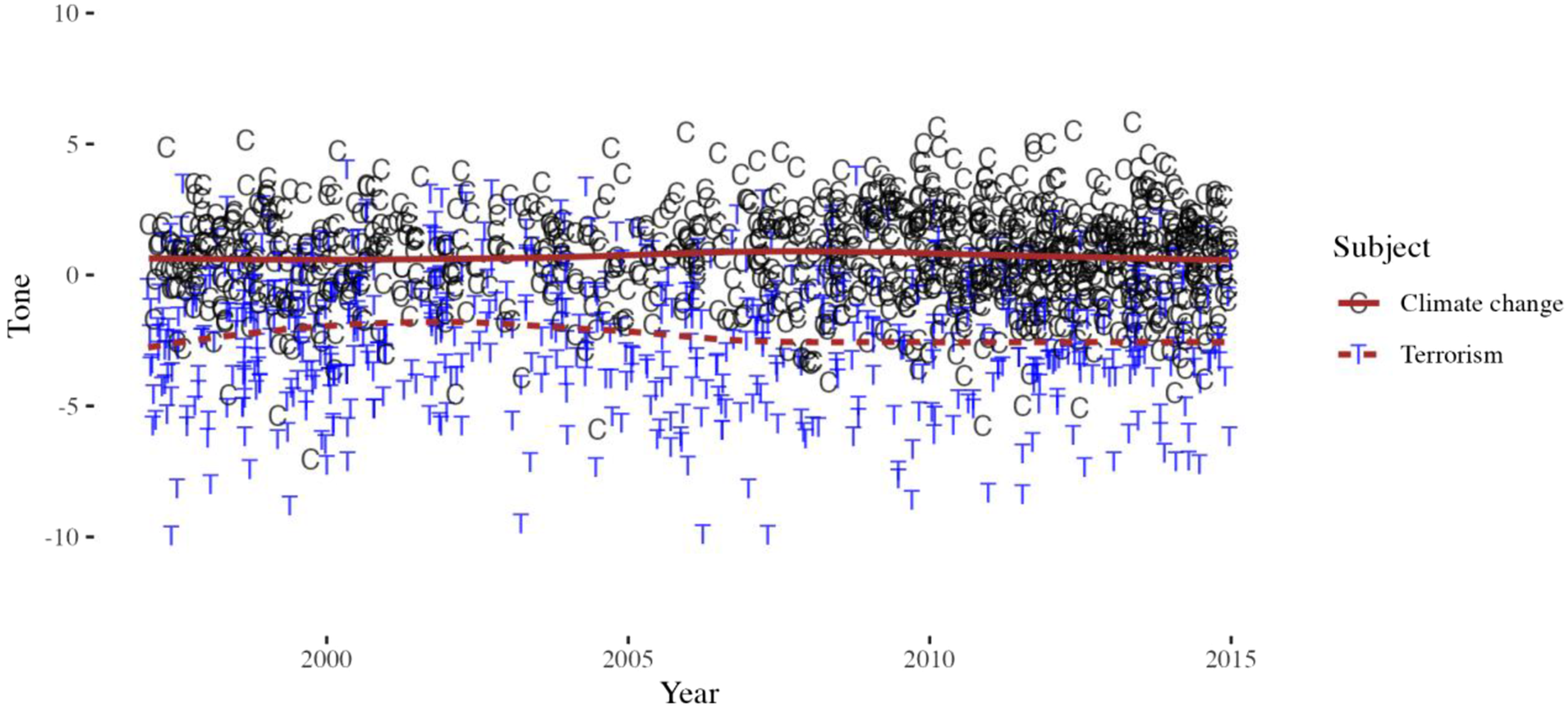
Experimental Results: Hypothesis 2
We focus our discussion of our experimental research on the findings associated with our treatments. The findings from our experimental research are more complicated than the findings from our observational research, so this decision simplifies our presentation without masking important auxiliary results: None of our tests suggest that the correlates of coverage we gathered change our conclusions about the effects of our treatments on the tone of climate change and terrorism coverage. We direct readers to the appendix for details of the analyses we conducted that included other correlates of coverage. This material includes reports on planned exploratory mediation and moderation analyses using the data we gathered on, for example, the partisanship of our participants and their levels of concern about climate change and terrorism.
Our initial findings, after excluding responses from seven participants who failed a post-treatment attention check and one who worked outside the US, suggest that journalists reported 1.77 times less negatively when climate change threatens U.S. water supplies (M climate = −13.00, SD = 11.00) than when terrorism does (M terror = −23.00, SD = 10.00), t (111) = −4.89, p < .001, 95% CI: [−14.10, −5.96], d = −0.92. We also confirmed this result emerges using responses from all 122 participants (see Appendix).
Hypothesis 2: A Closer Look
As noted above, we re-examined our results after recognizing that our initial interpretation might be misleading. We first confirmed that editing and standardizing had little effect on our findings. They did not. Consistent with hypothesis 2, the edited and standardized climate change ledes remained less negative than the edited and standardized terrorism ledes t (97.81) = −4.88, p < .001, 95% CI: [−24.60, −14.07], d = −0.93.
Then, we examined the consequences of the threat corrections we introduced. These changes cut our treatment effect by more than 50%, t (93.61) = −2.16, p = .03, 95% CI: [−9.38, −0.39], d = −0.41. And when we removed two outliers that Lexicoder coded poorly, we no longer could reject the null hypothesis of no difference in the tone of the ledes across our experimental conditions t (101.13) = −1.65, p = 0.10, 95% CI: [−7.34, 0.67], d = −0.32.
When we re-examined our pilot studies, we once again found a pattern of null results. Our findings from Study 1 are typical of this pattern (see the Appendix for our reanalysis of the other pilot studies). In Study 1, we asked reporters to write ledes and headlines in response to the climate change or terrorism scenarios they received. Once again, the scenarios were identical except for the threat that animated them.
Using the original (uncorrected) data from Study 1, we found that journalists wrote less negative climate change ledes (M climate = −3.61, SD climate = 19.10 vs. M terror = −9.51, SD terror = 18.41), t (304) = 2.75, p = .006, 95% CI: [1.68, 10.12], d = 0.31 and headlines (M climate = −12.40, SD climate = 24.20 vs. Mt error = −23.91, SD terror = 27.93), t (355) = 4.29, p < .001, 95% CI: [6.23, 16.79], d = 0.44. These conclusions changed, however, when we switched to the threat corrected versions of the ledes t (259) = −1.29, p = .20, 95% CI: [−6.0, 1.24], d = −0.16, and headlines, t (353). = 0.538, p = 0.591, 95% CI: [0−.033, 0.058], d = 0.057. Terrorism reporting no longer appeared to be systematically more negative than the climate change reporting our participants produced.
No Differences or Small Differences? Bayesian Tests of Equivalence
The null results we found are consistent with the idea that journalistic norms and practices encourage journalists to write the same way about similar events, but they do not permit us to distinguish between no systematic differences between the conditions and small differences between the conditions. What we need to assess this question are estimates of the probability that the null hypothesis is true conditional on the observed data.
Bayesian t-tests we conducted provide modest evidence in favor of this no difference conclusion. We calculated Bayes factors (BF01) of 1.60 using the ledes from our registered study and 4.42 and 2.19 using the headlines and ledes from Study 1. These results imply that the probability that there is no difference between climate change and terrorism ledes holding events constant is between 1.60 and 4.42 times more likely than the alternative hypothesis that there is a difference in the negativity of the reporting on these subjects.
Bayes factor robustness checks we conducted using data from our registered study suggest that we would have found BF01 = 2.32 in our registered study (see Figure 2) and BF01 = 7.44 (headlines) and BF01 = 3.46 (ledes) for Study 1 had we started with JASP’s default Cauchy width parameter. Wider width parameters, that is, provide more evidence in favor of the null hypothesis. Prior and posterior plots and Bayes Robustness checks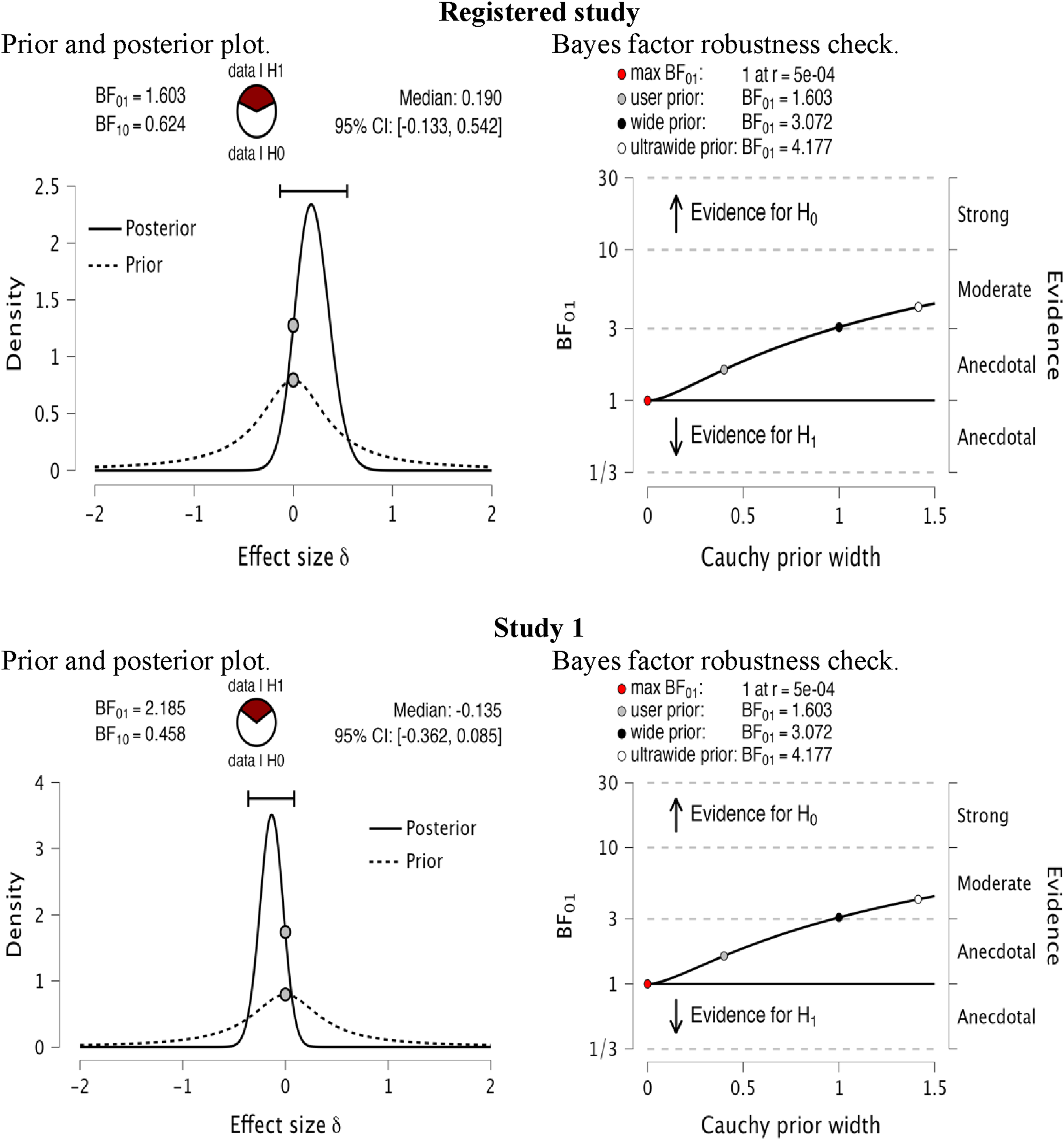
Narrower width parameters (i.e., <.40), in contrast, provide less evidence in favor of the null hypothesis. Nevertheless, any width parameter greater than zero favor the null hypothesis over H2 at least weakly in every study but one (Study 4: BF01 = 0.83).
Discussion
Critics worry that newspaper audiences are not getting coverage of climate change and terrorism that accurately conveys the relative dangers of each threat (Lewis, 2012). Consistent with this concern and our first hypothesis, we found that major US newspapers regularly publish news that uses more negative language to report on terrorism than to report on climate change. This result emerges even though climate change is a more serious threat to public health and safety. It is also consistent with reporting patterns found in the British press (Dando et al., 2014; Lewis, 2012).
When the climate change and terrorism scenarios that journalists consider are held constant, however, the coverage disparity we observed in published news disappears. Across five experiments, we found that reporters who are asked to cover similar climate change and terrorism events produce news that relies on similar ratios of positive to negative words. Indeed, seven of eight Bayesian t-tests we conducted offer more support for the null hypothesis of no difference between climate change and terrorism news than for the second hypothesis that journalists would use less negative language to cover climate change than to cover a similar terrorism scenario.
These results surprised us. When we started this research, we believed that differences in the tone of climate change and terrorism coverage reflected differences in the instinctive reactions people have to these threats. We expected, therefore, that standardizing climate change and terrorism events would not close the negativity gap between published climate change and terrorism news. Instead, what we found suggests that the negativity gap between climate change and terrorism reporting narrows substantially when journalists cover identical climatic and terrorist events. This effect is difficult to infer from published news because the negativity of the language used by reporters reflects elements of the events they cover that are unusual to each subject area. Indeed, the only place the effects of identical climate change and terrorism events truly can be observed is in a laboratory because laboratories are the only setting in which the details of climate change and terrorism events can be equalized.
Taken together, our tests demonstrate two points. First, major newspapers in the US consistently publish news about climate change that is substantially less negative than the terrorism news they publish. This tendency predates the serious economic challenges newspapers are experiencing and the rise of editorial practices designed to increase the demand for news, like search engine optimization. Second, our experiments imply that differences in the tone of published climate change and terrorism reporting are attributable to differences in the events that reporters cover across these subject areas. This finding, which is difficult to test outside of a laboratory, is consistent with a counterfactual claim by neo-institutionalist theories that suggest that news content is homogenized by journalistic reporting principles, norms, and practices.
To be clear, just because we worked with externally invalid experimental settings does not mean that our findings should be dismissed as uninformative. Our experimental setup made it possible to evaluate the quality of otherwise untestable theoretical predictions about a counterfactual. Seen in this way, what this research provides is a way of thinking about theories used to explain journalistic behavior. With respect to new institutionalist theory, this research helps illuminate a condition under which news homogenization is likely. It also suggests that traditional norms about journalistic writing persist even as recent research suggests that newspaper content is diversifying (Hendrickx & Van Remoortere, 2024). Our work suggests that the sources of this diversification are the result of journalists embracing new principles for writing about the news.
We are not claiming, however, that we identified a universal rule of journalistic behavior. We did not recruit journalists who work for non-mainstream print outlets or on radio or television. It is unclear that the journalistic institutions we think are producing our results govern these reporting communities. Similarly, we cannot say what would have happened if more Republicans participated in this research. We recruited a diverse participant pool, enabling us to conclude that our treatment effects operate independently of known correlates of news production. We did not, however, work with a representative sample of journalists. Even if we did, we cannot say that either our tests strongly favored the null hypothesis of no difference in the tone of climate change and terrorism coverage or that our results are sensitive to the scenarios we presented our volunteers. Replicating these results with different participant pools and a wider range of experimental scenarios are both areas for future research.
What we can say is that this research raises questions about the idea that people in the US are hard and soft wired to react more strongly to terrorism than climate change (Sunstein, 2007). Our findings provide evidence to the contrary by showing in the theoretically important, but empirically unusual situation when climate change and terrorism events are identical that journalists write about these events using similar levels of negativity. Our research also raises questions about the idea that the reporting practices journalists use explain differences in the tone of climate change and terrorism coverage. Instead, these results suggest that journalistic practices homogenize the news, an effect that is difficult to detect in major newspapers because the events that reporters cover across subject areas often differ drastically.
Conclusion
Newspapers help encourage Americans to believe that terrorism is a greater danger to their health and safety than climate change through the valence of their reporting, a result that has encouraged scholars and journalists to consider changes to the ways they cover these subjects. Reporters can interview fewer climate skeptics and terrorism alarmists and find ways to convey complex scientific information more simply. Journalists can develop a greater appreciation of the relative risks associated with climate change and terrorism.
Nevertheless, our research suggests that eliminating defective journalistic practices may be insufficient to equalize news about these subjects. As long as climate and terrorism events differ, so too will the language reporters use to cover these subjects. Changing that result requires revising journalistic institutions in ways that also influence how reporters assess threats and communicate about them. Given the relative risks climate change and terrorism pose to Americans, the good news is that US based journalists are not inclined to see terrorism as the more serious problem. The bad news is that the way reporters write about climate change and terrorism are likely to continue to produce news about these issues that do the public a disservice.
Supplemental Material
Supplemental material - Climate Change and Terrorism News: Similar or Different?
Supplemental material for Climate Change and Terrorism News: Similar or Different? by Aaron M. Hoffman and Dwaine H. A. Jengelley in American Politics Research
Footnotes
Acknowledgements
Thanks to Pablo Balcazar, Prateek Malik, Joshua Meyer-Gutbrod, Mikaela Meyer, Mark Pickup, and Stephanie Walsh for their help on this project. Initial funding for this research came from a generous grant from the Purdue University Honors College.

Ethical Considerations
The experiments reported in this manuscript were approved by the Purdue University Institutional Review Board, Study # 1706019372 and the Simon Fraser University Office of Research Ethics, Study # 30000036.
Funding
The authors received no financial support for the research, authorship, and/or publication of this article.
Declaration of Conflicting Interests
The authors declared no potential conflicts of interest with respect to the research, authorship, and/or publication of this article.
Data Availability Statement
Supplemental Material
Supplemental material for this article is available online.
Note
References
Supplementary Material
Please find the following supplemental material available below.
For Open Access articles published under a Creative Commons License, all supplemental material carries the same license as the article it is associated with.
For non-Open Access articles published, all supplemental material carries a non-exclusive license, and permission requests for re-use of supplemental material or any part of supplemental material shall be sent directly to the copyright owner as specified in the copyright notice associated with the article.
