




Abstract
It is almost impossible to change the United States Constitution, yet members of Congress (MCs) continue to introduce resolutions to do so. Why do they do this? I argue that the sponsorship of constitutional amendments in modern congressional politics is a unique form of low-cost position-taking. Examining the House of Representatives across four decades of constitutional stagnation, I analyze which members engage in amendment sponsorship, and when they do so. First, I find that more ideologically marginalized members are more likely to sponsor amendments. Second, I show that MCs sponsor amendments when they are more electorally vulnerable and institutionally weak. I also find that the role of ideology is asymmetric and time-variant. Among MCs who entered Congress prior to 1997, more conservative Democrats were more likely to become amendment sponsors. Today, sponsorship is more closely related to ideological extremity among both Democrats and Republicans.
Keywords
Adam Schiff just introduced an AMAZING Constitutional Amendment to overturn Citizens United!! We can finally put an end to Dark Money. Co-Sponsor this AMAZING bill NOW… - Text messaged received from End Citizens United, July 26, 2022
Like the thousands of other proposed constitutional amendments introduced over the last half century, Representative Adam Schiff’s proposal to reinstate limits on campaign contributions was doomed from the start. Over the past five decades, Congress has passed only two amendment proposals—the Equal Rights Amendment and the DC Voting Representation Amendment—both of which failed to be ratified by the states. In today’s highly polarized Congress, the requirement for an amendment to pass two supermajority votes is virtually insurmountable, to say nothing of the odds of ratification by 38 state legislatures. Despite these limited prospects for constitutional change, members of Congress (MCs) like Schiff continue to introduce many amendment proposals each year. If failure is all but guaranteed, why do they do this?
In this paper, I undertake the first comprehensive analysis of the MCs who introduce constitutional amendment proposals. Focusing on the House of Representatives from 1979–2020, I argue that the modern sponsorship of constitutional amendments has largely served as position-taking behavior. While bills are often sponsored for position-taking purposes, I posit that amendment proposals are worthy of further study due to their distinct substantive and symbolic importance. Unlike typical messaging bills, these proposals both (1) ask to change the nation’s foundational, and often sacralized, text, and (2) often aim to make radical changes to the structure of American government or society.
Using two datasets of MCs at the member and member-term level, I ask two core questions: which MCs are likely to sponsor constitutional amendments, and when are those MCs likely to do so? Across both sets of analyses, I find strong evidence that these proposals are an exercise in position-taking by members who are ideologically and institutionally marginalized, as well as those who are electorally vulnerable. I additionally explore asymmetric partisan behavior in relation to amendment sponsorship, showing that the ideological correlates of amendment sponsorship have changed over time.
This paper makes two major contributions to the scholarship on constitutional amendments and bill sponsorship. Consistent with the literature on position-taking, I first show that members who are on the ideological, electoral, and institutional margins are the most likely to introduce constitutional amendments. MCs who are ideologically distant from their party are significantly more likely to sponsor these proposals throughout their careers. Furthermore, the members who propose constitutional amendments are most likely to do so when they are in the minority party, in the opposite party of the president, and when they are more electorally vulnerable.
Second, I find significant partisan differences in amendment sponsorship. Across my full data, the most conservative members in each party, extreme Republicans and moderate Democrats, are the most likely amendment sponsors. However, I additionally show that these relationships have shifted over time. Democratic amendment sponsors who entered Congress prior to 1997 were more likely to be moderates, while those who entered afterwards have been more likely to be progressives. The relationship between extremity and amendment sponsorship among Republicans, on the other hand, has emerged to a significant degree in the most recent period. I explore the substantive explanation for these differential trends, positing that they are tied to the strategic nationalization of politics and the 1994 Republican Revolution (Bonica & Cox, 2018).
The United States Constitution may be in a stagnant period, but constitutional politics remain more active than many realize. Studying the sponsorship of amendments can offer new insights into position-taking behavior, help us better understand the connection between legislators and the attentive public, and shed light on the electoral connection in the process. In a landscape dominated by partisan polarization and legislative gridlock, MCs are often left with little but symbolic gestures. It is thus more important than ever to understand these position-taking tactics, and what differentiates those who take part in them from those who do not.
The Difficulties of Amending the Constitution
The substantive and symbolic importance of constitutional amendments to American politics has been evident since the drafting of the Constitution itself. A central failure of the Articles of Confederation, the United States’ first government, was that they required unanimous consent to approve any alterations—something that proved impossible among the fractious thirteen colonies. At the 1787 Philadelphia Convention, George Mason, a delegate from Virginia, expressed an early conviction that “amendments therefore will be necessary, and it will be better to provide for them, in an easy, regular and Constitutional way than to trust to chance and violence” (Farrand 1911, pp. 202–203). James Madison wrote a similar sentiment in a letter to Thomas Jefferson during the period of ratification, noting that “the friends of the Constitution …are generally agreed that the system should be revised” (Madison, 1788). The method of amendment that the Framers built in Article V has been more successful than that of the Articles of Confederation, but at the same time has still proven to be exceptionally difficult to navigate.
Article V provides two ways by which proposed constitutional amendments can be sent to the states for ratification. The first is the congressional path, which requires two-thirds approval in both the House and the Senate. All 27 successful constitutional amendments were proposed in this manner. The second method allows two-thirds of the states to call a “convention for proposing amendments,” and though many have tried over the centuries, no convention call has cleared this threshold (Neale, 2016). Once proposed, an amendment must then be ratified by three-fourths of the states, either by their legislatures or by ratifying conventions. This threshold has become markedly more difficult to reach as the number of states has increased. Where the assent of 11 of 14 states was sufficient to ratify the Bill of Rights in 1791, a modern amendment needs the approval of 38 of the 50 states.
Political scientists and legal scholars of constitutional amendments have focused mainly on procedure and the difficulties associated with formal constitutional change (Kay, 2018; Manfredi, 1997; Manfredi & Lusztig, 1998; May, 1987). Woodward-Burns (2021) notes that the last four decades have been marked by a shift from federal to state constitutionalism amid repeated congressional failure. Two notable defeats were those of the Balanced Budget Amendment in 1995, and the Flag Desecration Amendment in 2006. Both measures passed in the House, and subsequently lost by a single vote in the Senate. To get this close to passage is far from the norm: since 1979, only 44 proposals—1.7% of those introduced across both chambers—have received a final roll call vote. Just eight of these proposals have passed, the most recent in 2006. 1 More than 12,000 amendment proposals have been introduced since 1789, and just 27 (0.2%) have been ratified. In contrast, 75% of the nearly 5,000 state constitutional amendments introduced between 1980 and 2018 were successfully ratified (Woodward-Burns, 2021). Furthermore, constitutional amendments have a much lower rate of passage than other kinds of legislation. Of the more than 250,000 bills introduced in Congress between 1979 and 2020, around 6% have been enacted into law (GovTrack, 2022). Amendment proposals evidently face uniquely high barriers compared to other bills, yet MCs still propose them each year.
Amendment Proposals as Symbolic Position-Taking
If the Constitution is so unchangeable, why do MCs spend time on these proposals? I argue that amendment proposals function as an important form of symbolic position-taking, providing MCs with a distinct venue to make relatively simple policy proposals on some of the most pressing social and structural issues of American politics.
Stohler et al. (2022) examine the topics of all amendment proposals between 1788–2020, investigating how the usage of Article V has shifted over time. Their findings suggest that amending activity has, since the mid-20th century, become a position-taking tool for MCs to respond to controversial judicial decisions and signal their opinions to their constituents. While this analysis makes a critical contribution to our understanding of amendment topics, I extend the position-taking theory to the members themselves. Some MCs may legitimately desire constitutional change, but amendment proposals are likely introduced with the knowledge that they will fail. The political behavior associated with amendment sponsorship should thus align with several characteristics previously associated with bill sponsorship as position-taking behavior.
Position-taking, defined by Mayhew (1974a), allows MCs to make their views on an issue known to constituents, donors, and interest groups to further their chances of winning reelection. Importantly, “the electoral requirement is not that he make pleasing things happen but that he make pleasing judgmental statements” (Mayhew, 1974a, p. 61). Position-taking is regularly studied through roll call votes (Bovitz & Carson, 2006; Crisp & Driscoll, 2012; Jones, 2003), as they are highly public moments when MCs must adopt a stance on an issue. However, a focus on the positions taken through voting ignores the rest of the legislative process, including the vast majority of bills.
Bill sponsorship has been increasingly studied as a form of non-roll call position-taking (Highton & Rocca, 2005; Koger, 2003; Rocca & Gordon, 2010). A key difference between bill sponsorship and roll call voting is the former’s voluntary nature (Schiller, 1995). MCs make the active decision of when to sponsor legislation, and they have discretion over the type and topics of bills they introduce. The positions taken through bills are likely more reflective of an MC’s preferences, and the intensity of those preferences, than the outcomes of yes or no voting (Finocchiaro & MacKenzie, 2018; Highton & Rocca, 2005). Positions taken via bill sponsorship may be intended as a signal not for constituents, but for the attentive public, which includes other MCs, key political actors outside Congress, and interest groups (Rocca & Gordon, 2010). Importantly, a position-taking argument implies that the decision to sponsor legislation is driven by electoral considerations (Maltzman & Sigelman, 1996; Mayhew, 1974a). 2
Schiller (1995) notes that sponsorship has “resource, opportunity, and political costs” which legislators must overcome (188). When the benefits (i.e., increased electoral support, campaign contributions) outweigh the costs (i.e., time spent drafting a bill and not engaging in other work), sponsoring legislation can be a valuable means by which to publicly stake out an opinion (Rocca & Gordon, 2010). The sponsorship of a constitutional amendment is a low-cost act, and may risk being seen as cheap talk (Koger, 2003; Rocca & Gordon, 2010). Amendment proposals are brief and formulaic (often copied directly from prior resolutions), and because of the immense barriers to passage, MCs are likely aware that no further action will be needed beyond the initial proposal. However, due to amendments’ unique status as salient symbolic legislation, they may still hold value as consequential position-taking behavior, especially for the attentive public.
Edelman’s (1964) seminal book on symbolic politics demonstrates that amendments can function as “condensation symbols,” in which a politically emotional topic is condensed into “one symbolic event, sign, or act” (6). Sponsoring a proposed constitutional amendment banning abortion may be “cheap talk” compared to a complex fiscal package, but the former carries with it an emotional symbolic weight that the latter likely cannot. Elder and Cobb (1983) and Tager (2009) highlight the symbolic and affective implications of constitutional amendment proposals, which suggest that unlike traditional legislation, efforts to make fundamental changes to the Constitution might spark uniquely emotional responses.
Conlan et al. (2014) also describe the importance of the “symbolic pathway” for legislation, emphasizing the Flag Desecration Amendment in the 1980s as an example of a “visceral and emotive” policy proposal (94). However, Conlan et al. (2014) explicitly focus on the use of symbolism as a means to achieve policy change, and not as a form of position-taking. The attempt to ban flag burning was one of the few active attempts to pass an amendment in recent years, and I argue that the bulk of modern amendment sponsorship bears closer similarity to the symbolic position-taking conceptualized by Edelman and Mayhew.
Expectations
Recent analysis by Stohler et al. (2022) on the historical development of constitutional amendment proposals examines their content, along with several case studies on specific proposals, to explore the theory that these resolutions have become a form of symbolic position-taking. I extend this argument towards the MCs, testing the conditions under which representatives engage in the sponsorship of constitutional amendments. I consider the interplay between a legislator’s ability to advance a substantive agenda and the appeal of symbolic action. I approach the topic with two key research questions. First, which members sponsor constitutional amendments? Second, when do those members introduce amendment proposals?
On a broad level, I expect that the legislators who resort to amendment proposals are more ideologically marginalized, and do so when they are more institutionally and electorally vulnerable than their peers. As gridlock stifles the substantive results of policy-making at the federal level, symbolic action has become an attractive avenue for influencing electoral outcomes and connecting with the public. This is especially true for MCs who don’t toe the party line, and seek to make a name for themselves as, for example, a staunch progressive or conservative firebrand. At the same time, gridlock affects members differently, and pathways for successful substantive change depend on an MC’s institutional position, legislative influence, and electoral safety.
First, I ask which MCs are likely to ever engage in the sponsorship of constitutional amendments. Legislators choose whether or not to invest their time in introducing these proposals, and I examine the characteristics that may shape their propensity to take part in this activity.
I expect an MC’s ideological distance to their party’s center to play an important role in this behavior. Research on legislators’ ideology has shown that absolute ideological distance is negatively correlated with outcomes including electoral margins (Carson & Williamson, 2018), participation in presidential nomination processes (Anderson, 2013), speaking time (Proksch & Slapin, 2012) cosponsorship (Harward & Moffett, 2010; Krehbiel, 1995) and legislative success (Krutz, 2005). Ideologically distant members are typically marginalized within their party, and bill sponsorship—specifically, constitutional amendment sponsorship—can function as a means to take stances that may clash with co-partisans.
In recent years, amendment proposals have touched on key political debates including abortion, same-sex marriage, free speech, the powers of government, taxation and spending, and the reform of electoral institutions. As these resolutions recommend significant changes to the status quo, and often deal with controversial topics that more party-oriented members may desire to avoid, I hypothesize the following:
This hypothesis suggests that this relationship is equivalent in both directions, such that, for example, a very liberal (extreme) Democrat is equally as likely as a very conservative (moderate) Democrat to sponsor an amendment. I also consider an alternative hypothesis, drawn from work including Maltzman and Sigelman (1996), Grimmer (2013), and Lazarus (2013), which posits that extremists—the most liberal Democrats, and the most conservative Republicans—will be the most likely to take these positions:
The ideological center of both parties has shifted substantially since 1979, yet most conventional measures of ideology interpret an MC’s ideology as a fixed characteristic. Because this temporal variation is largely driven by differences between members and not a change in an individual member’s views (Bafumi & Herron, 2010), I measure ideological distance as an average score across an MCs career. I expand on the rationale for this choice in the discussion of my data and in Appendix A.
Turning to my second research question, I ask when those members who sponsor amendments do so. As position-taking is an activity driven by reelection concerns (Mayhew, 1974a), I examine direct and indirect characteristics that could facilitate changes in an MC’s behavior.
If amendment sponsorship is an exercise in position-taking, it should be directly related to an MC’s electoral vulnerability. There are many ways that scholars have operationalized vulnerability (e.g., Ansolabehere et al., 1992; Eggers, 2017; Giger et al., 2020; Hall & Snyder, 2015; Hickey, 2019). Following work including Mayhew (1974b) and Lazarus (2009), I define vulnerable members as those with a marginal prior general election, such that a 10 percentage point swing in votes would change the result.
3
Representatives face a constant pressure to win reelection, and that pressure is likely to be strongest after a close victory. Members may thus use symbolic gestures like amendment proposals as a means to shore up their electoral chances. The target of these proposals, I argue, is the attentive public, and not necessarily a members’ voting constituency. Thus, while an amendment proposal may not make particular inroads with the median voter in a members’ district, it could function as an important ideological signal to interest groups to garner critical endorsements and donations in advance of the next election. Members will be more pressed to do this, I argue, when they feel most vulnerable.
I also consider two partisan-institutional factors which are indirectly linked to electoral behavior: (1) majority status and (2) presidential party. Members tend to sponsor more in the majority party (e.g., Rocca & Gordon, 2010; Schiller, 1995), as minority party MCs have a reduced ability to move bills. However, the inability of minority party members to enact a substantive agenda may shift their priorities. As Maltzman and Sigelman (1996) show, minority members are more likely to advance their agenda through public speeches during unconstrained floor time. On the legislative side, this should similarly translate into these members proposing more radical, symbolic bills, with no intention of passage and an eye toward the next election. I thus hypothesize the following:
Some historical evidence shows that minority party members use the promise of future amendment proposals as a campaign tool—the most prominent example being the Contract with America—but the position-taking theory suggests that this is largely bluster, and that serious efforts to pass or propose these amendments once a party regains the majority should still diminish.
Like majority status, I expect the party of the president to impact amendment sponsorship. Countless scholars (e.g., Barrett & Eshbaugh-Soha, 2007; Cohen, 2011; Fagan, 2018; Krutz, 2005; Marshall & Prins, 2007) have examined the influence of the president on legislation as it moves through congress. Though the president plays no formal role in the amendment process, the electoral connection implies that MCs have incentives to behave differently when in the opposite party of the president (Hickey, 2019; Koger, 2003). In a similar, but separate effect from minority status (as only 8 of the last 21 Congresses have had a House majority of the same party as the president), having an out-party president may motivate members to introduce more proposals that (1) are electorally salient and play well the attentive public; and (2) are under little pressure to become law in the immediate future.
4
This leads me to my final hypothesis:
Data and Methodology
As described in the prior section, I explore two linked research questions in this paper: which MCs take part in amendment sponsorship at some point during their careers, and in which sessions do legislators sponsor amendment proposals? To approach the first question, I study the population of MCs who served from 1979 to 2020, using a member-level dataset that contains one observation for each unique representative (N = 1,808). 5 My second question is concerned with timing of amendment sponsorship, and I thus build a panel dataset at the member-term level. This second analysis only considers the sample of members who have sponsored at least one constitutional amendment proposal over the course of their careers, and contains 3,253 member-term observations from 511 unique representatives. 6 I omit Senators from my analysis, as the pressures of reelection differ significantly across six-year terms. By focusing only on members in the House of Representatives, I am able to isolate the immediate impacts of electoral vulnerability across uniform 2-year intervals.
I analyze sponsorship since 1979 for two reasons. First, Congress last successfully passed a constitutional amendment in 1978 (the unratified DC Voting Representation Amendment). My data thus covers what is nearly the longest drought of successful amending activity in American history. Some proposals have nearly gone to the states during this period (on balancing the budget, banning flag burning, term limiting Congress, and banning same-sex marriage), but none have passed in both chambers. Second, 1979 also marks a critical rule change in the House allowing for an unlimited number of bill cosponsors. Cosponsorship first became a legislative tool in 1967, but until 1979, only 25 MCs could sign onto a bill. Members would thus frequently reintroduce identical bills with every 25 cosponsors acquired (Oleszek, 2021).
Figure 1 plots the total number of amendments introduced in the House from 1889 through 2020, with a dotted vertical line demarcating 1979. Though the object of this paper is not to investigate the spike in amendment proposals in the 1960s and 70s, a cursory examination at the period’s data suggests it may be related to (1) cosponsorship rules encouraging duplicate proposals, and (2) a number of key political events in the 1960s that spoke to constitutional change.
7
Total number of constitutional amendments introduced in the House of Representatives in each Congress, 1889–2020. LOESS trend line is displayed with 95% confidence interval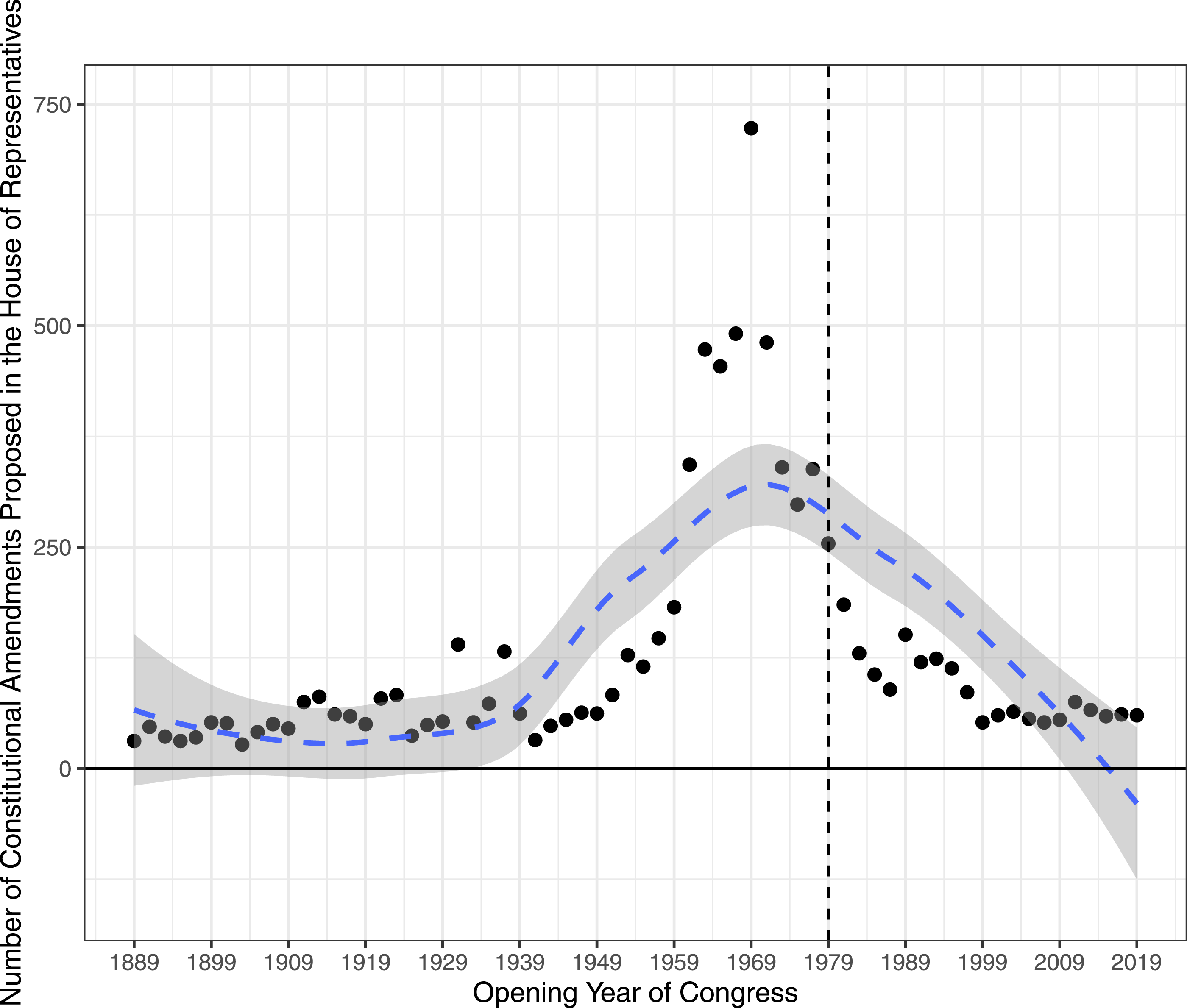
Recognizing these conditions before 1979, I narrow my study on the MCs who, between the 96th and 116th Congress, introduced 1,997 amendments in the House. These proposals cover a wide range of topics, the most popular of which are plotted across each Congress by party in Figure A.1 in Appendix A. With nearly 500 proposals, the Balanced Budget Amendment has been by far the most popular topic in this period. It is followed in frequency by proposals on term limiting congress, banning abortion, instituting campaign finance regulations, and allowing for prayer in public institutions. Other common but less frequent amendment topics include a ban on flag burning, providing the president with a line item veto, and abolishing the Electoral College in favor of a national popular vote for president. While the top Republican amendment types—balanced budget and term limit amendments—have been relatively consistent, the kinds of Amendments sponsored by Democrats have fluctuated over time. The top Democratic amendments in the 1980s and 90s look relatively similar to Republican proposals, while today they consist most commonly of proposals to address campaign finance reform.
Who Sponsors Amendments?
To address this first question, I run a series of probit regressions with my member-level data. All variables in this dataset are captured at the career level, and can be considered relatively fixed characteristics. The dependent variable in these models is career amendment sponsorship: whether an MC sponsored a constitutional amendment at any point in this 42-year span. I code this binary dependent variable as 1 if an MC sponsored an amendment at least once in this period, and as 0 if an MC has never participated in amendment sponsorship. 511 unique representatives, or 28% of MCs, select into amendment sponsorship. This data comes from the National Archives’ Amending America dataset (Archives, 2016), with additional coding from https://Congress.gov to include the years 2014–2020.
The key explanatory variable is ideological distance, measured using the formula in equation (1). I operationalize this variable as a fixed characteristic using first-dimension DW-NOMINATE ideology scores (Lewis et al., 2022; Poole & Rosenthal, 1997). For each MC

Turning to the Ideological Extremity Hypothesis, I also split my single measure of ideological distance into two variables, representing ideological moderation and ideological extremism. All MCs whose average ideological distance places them between the centers of their party and the other party are given a moderation score equal to their ideological distance, and an extremity score of 0. The reverse is applied for those who are ideologically between their party’s center and the poles. Like ideological distance scores, the moderation and extremity scores are restricted to values greater than or equal to 0.
I also control for each member’s career service on the House Judiciary Subcommittee on the Constitution. The House Judiciary Committee has jurisdiction over amendment proposals, and prior research demonstrates the importance of committee membership to specific kinds of bill sponsorship (Finocchiaro & MacKenzie, 2018; Perkins, 1980, 1981; Schiller, 1995). Because the House Judiciary Committee covers a breadth of legislative topics, I look more narrowly at membership on the Subcommittee on the Constitution, which holds initial jurisdiction on amendment proposals. 9 I expect that members who spend time on this subcommittee during their career will be significantly more likely to propose this kind of legislation. This may be because of preexisting interest in constitutional amendments, or simply by virtue of their placement on the subcommittee. I gather committee service records from both C-SPAN’s committee database and the Congressional Directory (C-SPAN, 2022; Directory, 2022). MCs are scored as 1 if during any term between the 96th–116th Congresses they served on this subcommittee, and 0 if otherwise.
Additionally, I control for party, race, gender, and geographic region, to account for alternative partisan and demographic characteristics that may shape selection into sponsorship (Barnello & Bratton, 2007; Platt, 2015; Wilson, 2010). Finally, I control for first entry into Congress. Scholars have measured Congressional cohort effects across a number of issue areas (Cohen, 1981; Nye, 1993; Parker & Parker, 2009; Reed et al., 1998), and this control accounts for how periods of entry may shape the propensity of legislators’ to engage with amendment sponsorship. I use two dummy variables to represent three relatively broad cohorts, based on periods of entry: before the 96th Congress (prior to the cosponsorship rule change), the 96th through 104th Congress (through the failure of the Balanced Budget Amendment under the new Republican House majority), and the 105th Congress through the 116th Congress (the contemporary period of more limited sponsorship).
When Do MCs Sponsor Amendments?
I address this second question with my member-term panel dataset. Because this panel only considers career amendment sponsors, all observations for MCs who never sponsored an amendment are omitted from this analysis. Among the 1,808 representatives considered in the member-level data, only 511 are examined here. The panel analysis thus considers 3,253 member-term observations, censoring 6,000 member-term observations for the never-sponsoring MCs. The variables in this panel are dynamic, and measured at the term-level.
My second dependent variable is amendment sponsorship in a given term, conditional on an MC having proposed an amendment during their career. As before, this dependent variable is binary. An MC scores a 1 if they sponsored at least one amendment in a given term of Congress, and a 0 if they did not sponsor any that term. While some MCs have proposed multiple amendments in a single Congress, 72% of member-term observations in which an MC sponsors contains only a single amendment proposal (see Table A.3 in Appendix A). The low likelihood of sponsorship and limited dispersion in the data lead me to believe that a binary specification is warranted over a count model. 10 In these data, I observe amendment sponsorship in 40% of selected observations (1,327 member-terms).
To measure electoral vulnerability and whether a member is in a marginal district, I utilize Congressional elections data (FEC, 2022; MIT, 2022). For the election prior to each member-term observation, I calculate each MC’s margin of victory over the second-place candidate. As previously mentioned, I use a variation of Mayhew’s (1974b) definition of marginal districts, and create a dummy variable equal to 1 if an MC’s margin of victory is less than 10%, indicating that with a 5% swing in votes, the member would have lost the election. 11 Within the panel dataset, 11% of observations feature marginal elections.
In addition to majority status and presidential party, I control for a number of institutional factors that may impact an MC’s propensity to sponsor legislation or take positions in a given term. While my first set of models control for time-invariant characteristics (such as a legislator’s race, entry into Congress, and geographic background), these models control for characteristics that change, including leadership status, membership on the Subcommittee on the Constitution in a given term, seniority, and freshman status (see Appendix A for full description of these variables). In the fully specified model, I also employ two-way fixed effects (TWFE) at the member- and congress-level. Congress fixed effects account for changes in sponsorship rates, legislative techniques, and political context over time, while member fixed effects capture many of the innate characteristics that I measure in my first set of models. In each specification where I use the panel data, the models include robust standard errors clustered around each MC to reflect the repeated entrants in the data.
Results
Member-Level Results
Constitutional Amendment Sponsorship in the House of Representatives, 1979–2021
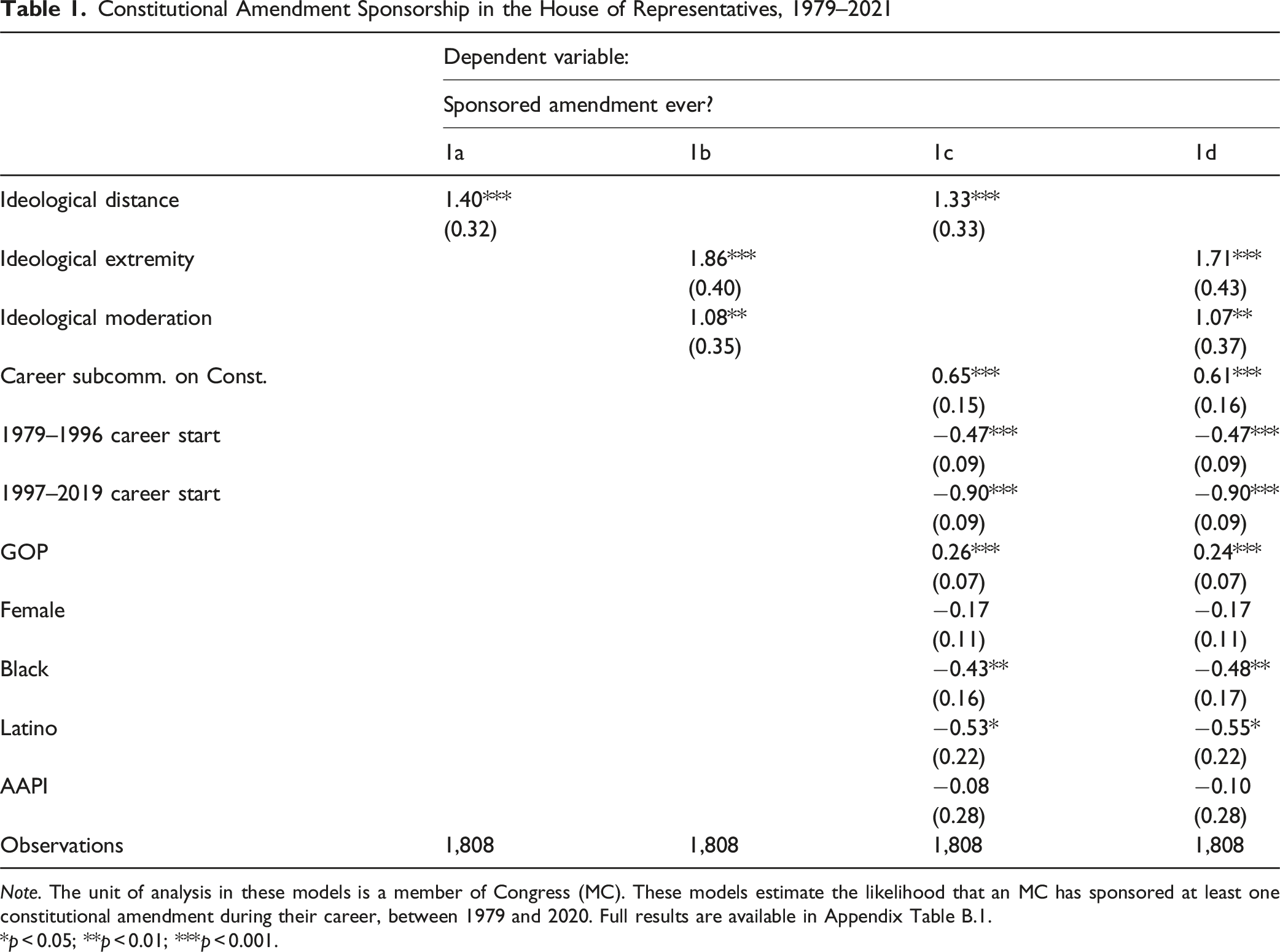
Note. The unit of analysis in these models is a member of Congress (MC). These models estimate the likelihood that an MC has sponsored at least one constitutional amendment during their career, between 1979 and 2020. Full results are available in Appendix Table B.1.
*p
As expected, greater ideological distance from one’s party is positively associated with sponsoring at least one constitutional amendment during an MC’s career. In support of the Ideological Extremity Hypothesis, the absolute magnitude of extremity is greater than that of moderation. However, both scores are positively associated with amendment sponsorship, and a linear hypothesis test suggests that in the fully specified Model 1d, the two coefficients are not statistically different at the
In Figure 2, I plot the predicted probability of career amendment sponsorship across a range of values for both ideological extremity and ideological moderation. These results suggest that a legislator who is very ideologically extreme from their party, akin to Barbara Lee (D-CA) or Jim Jordan (R-OH), has a 61% likelihood of sponsoring during their career, approximately 20 percentage points greater than a legislator at the party’s center, a grouping that includes Al Gore (D-TN) and Bobby Jindal (R-LA). An equally distant ideologically moderate MC—someone like Kyrsten Sinema (D-AZ) or John Katko (R-NY)—has around a 54% likelihood of sponsorship. These panels plot the predicted probability of career amendment sponsorship alongside an MCs average ideological extremity and moderation, respectively. These estimates were generated using Model 1d in Table 1.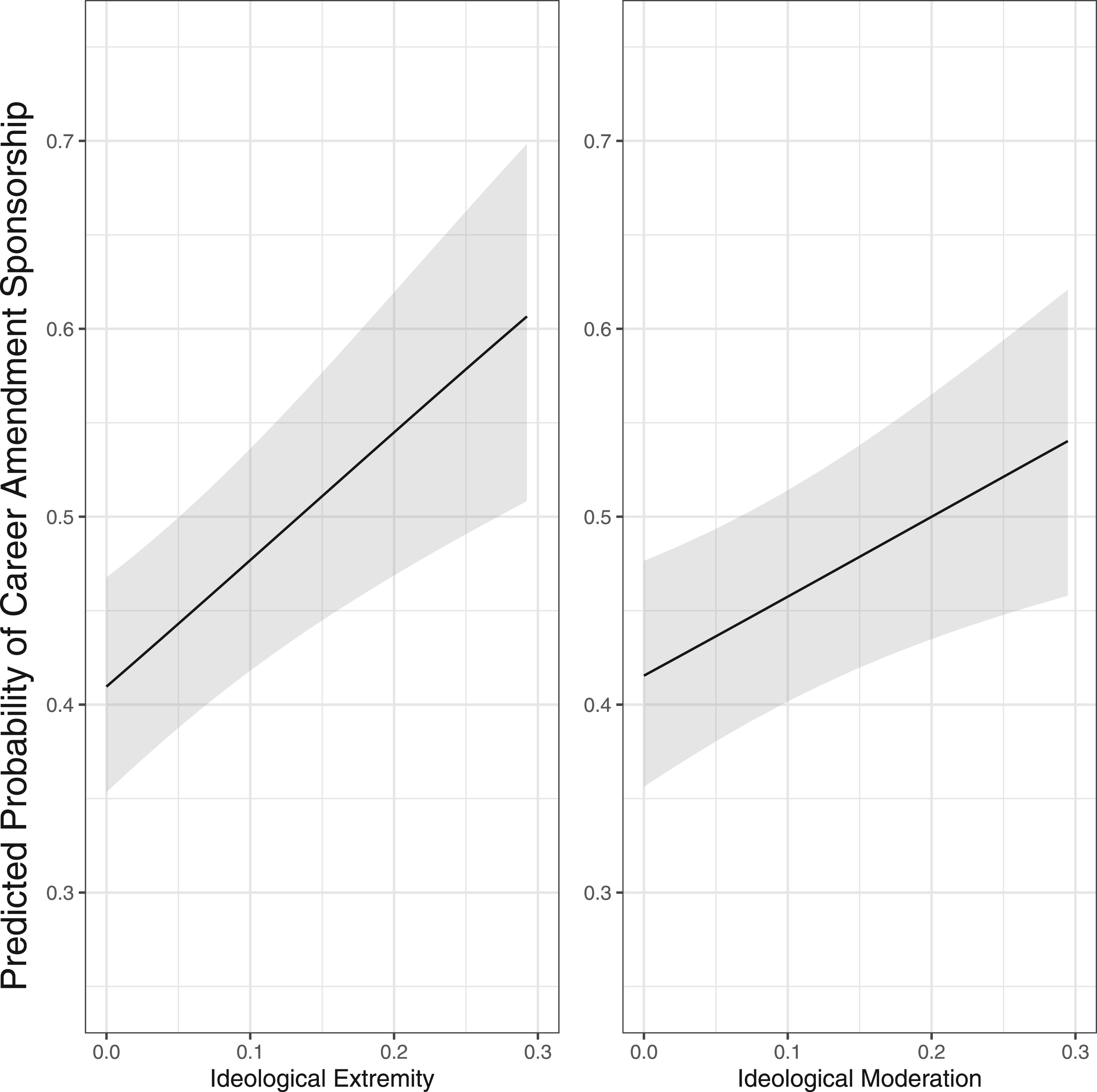
As expected, several of my control variables are also associated with career sponsorship of amendment proposals. MCs who are in the Republican Party, are white, held membership on the Subcommittee on the Constitution, and entered Congress prior to 1979 are all significantly more likely than others to have sponsored amendments over the course of their careers. However, the measures of ideological distance maintain the strongest magnitude across each model.
Panel Results
Constitutional Amendment Sponsorship in the House of Representatives by Term
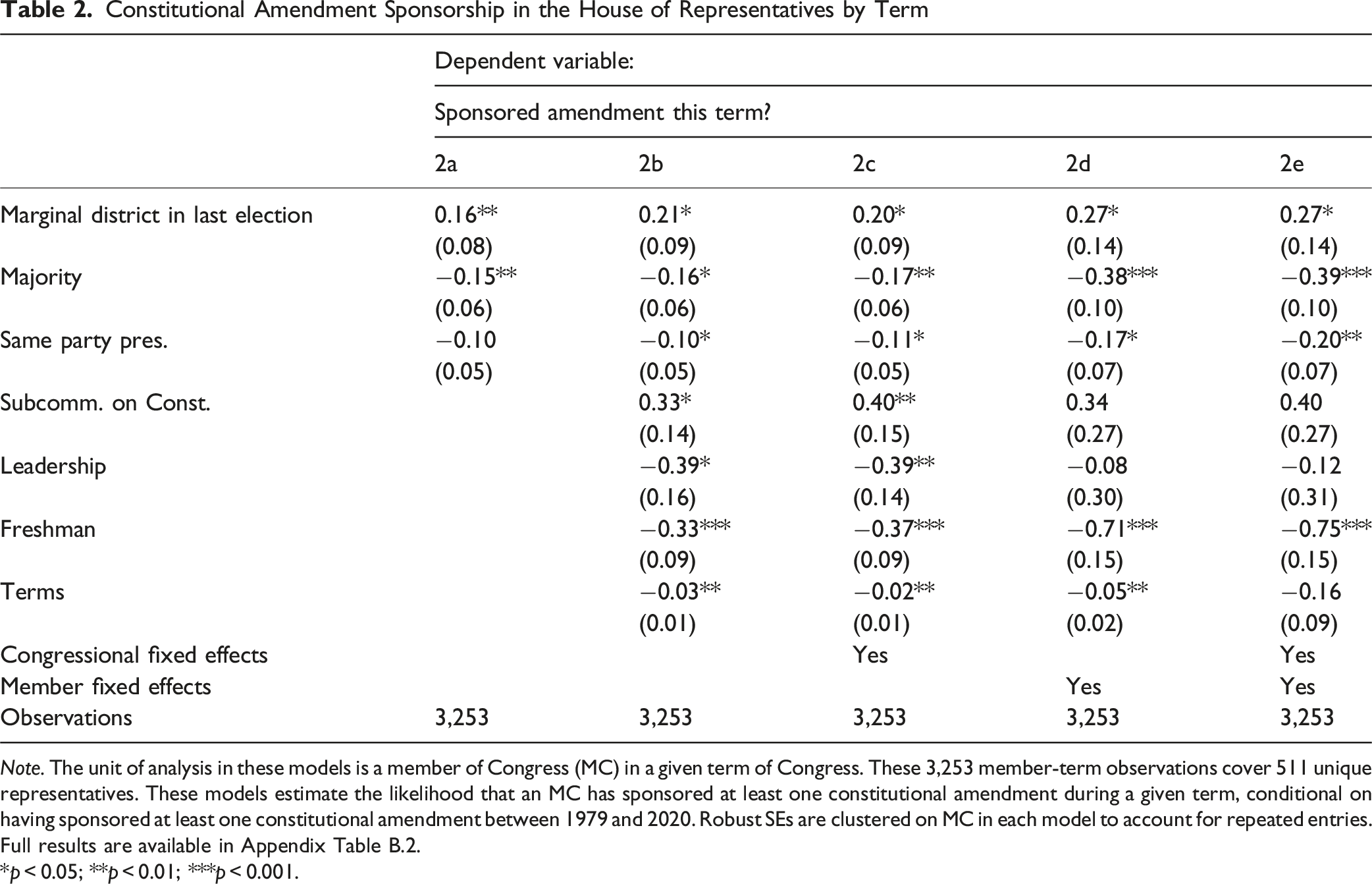
Note. The unit of analysis in these models is a member of Congress (MC) in a given term of Congress. These 3,253 member-term observations cover 511 unique representatives. These models estimate the likelihood that an MC has sponsored at least one constitutional amendment during a given term, conditional on having sponsored at least one constitutional amendment between 1979 and 2020. Robust SEs are clustered on MC in each model to account for repeated entries. Full results are available in Appendix Table B.2.
*p
Across each specification, I find support for the Electoral Vulnerability, Minority Party, and Out-Party President hypotheses. In a given term of Congress, MCs who had a close previous election are more likely to sponsor amendments, while majority party members and those who share a party with the president have a reduced likelihood to introduce a constitutional amendment proposal. These effects are particularly strong in magnitude when accounting for member fixed effects. For ease of interpretability, I graph the change in expected probabilities of sponsorship from Model 2e when moving along the ranges of the key explanatory and control variables in Figure 3. All other variables are held at their medians when simulating these expected probabilities. This figure plots changes in expected probability of an MC sponsoring a constitutional amendment, using Model 2e from Table 2. In each simulation, all other variables are held at their median values. These probabilities are simulated for the 106th Congress, with the member-fixed effect set to Representative Donald Manzullo (R-IL). Bars represent 95% confidence intervals. *The change in values for Freshman status also reflects a change in terms served from 2 to 1.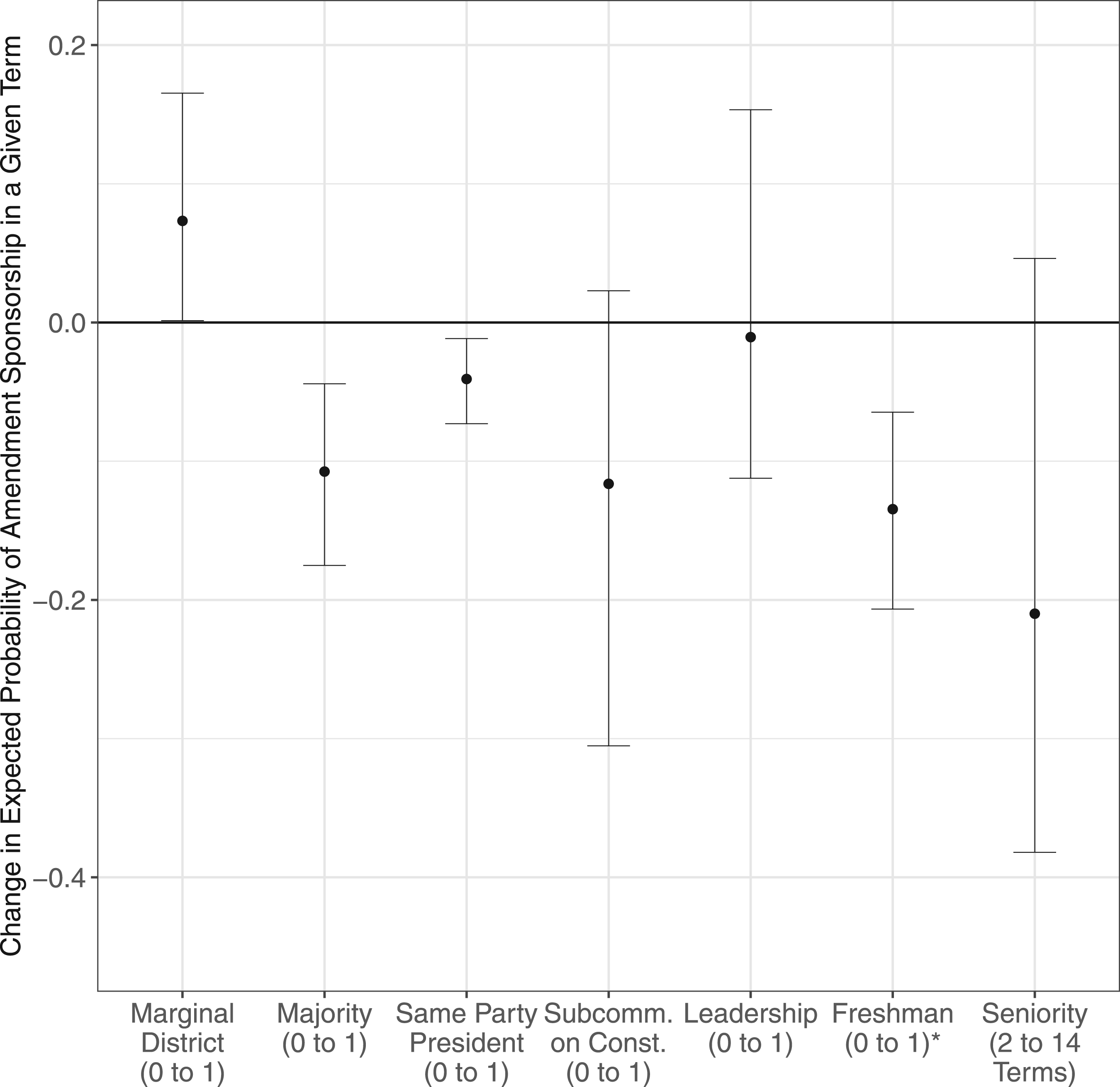
Of my main explanatory variables, the strongest effect can be tied to vulnerability—after facing a close election, an MC has a likelihood of sponsorship in the next term of 22%, around 7 percentage points more than a safe member. Being in the minority party as opposed to the majority almost doubles an MC’s likelihood of sponsoring amendments from 15% to 26%, and those in the same party as the president are 4 percentage points less likely to sponsor than opposition party members at 11%. Taken together, these findings support the theory that amendment sponsorship functions as a form of position-taking behavior.
I find mixed results across my control variables. While freshman MCs are much less likely than others to sponsor amendments across all specifications, the effects of leadership, subcommittee membership, and seniority vary with member-level fixed effects. This is not particularly surprising—when comparing across members, I find evidence that party leaders and more senior members are less likely to engage in this form of position-taking, while members who sit on the Subcommittee on the Constitution are more likely to do so. When comparing within members, however, these effects largely disappear, as these variables are not likely to shift much between Congresses for a given MC.
Robustness Checks
A potential issue in the results of the panel analyses is selection bias. As mentioned, the panel dataset consists of 3,235 member-term observations, reflecting the 511 MCs who selected into amendment sponsorship. These results, however, omit the 1,297 MCs (and 6,000 member-term observations) who never sponsored amendments. While the observations for non-sponsors are not estimable in the models that employ member-level fixed effects in Table 2, their omission may impact the results in the other models. Without accounting for non-random selection of MCs into amendment sponsorship, and the possible correlated disturbances between the models, there is a risk that the coefficients in the second set of models are biased. I address this through the use of a variation of a two-stage Heckman selection model. The results, described in Appendix Table C.2, and comparable to Model 2c in Table 2, show that while there is slight evidence of selection bias, this bias does not substantively effect the magnitude or significance of the coefficients for any of my core explanatory variables.
Do these results hold across the entire panel? In Appendix Table C.6, I test a specification across all 9,235 member-term observations, using the same set of covariates as in Model 2c in Table 2. While this model omits member-level fixed effects, it compares the likelihood of amendment sponsorship in a given term across all members, not just those who sponsored at some point in their careers. When these never-sponsor MCs are included in the panel, the significant effects for electoral vulnerability and presidential party disappear. This result is somewhat expected—the characteristics that most obviously separate amendment sponsors from non-amendment sponsors are largely ideological, as suggested by Table 1. It is only when I isolate the subset of potential sponsors, and compare outcomes within this group of more similar MCs, that these institutional and electoral effects become evident.
Finally, in Appendix Table C.7, I also combine my two main analyses into a single model that measures the effects of both fixed and time-variant characteristics. Again using the full panel data (9,235 member-term observations) and omitting member-level fixed effects, I regress sponsorship in a given term against the set of covariates from both Tables 1 and 2. 12 Using this single model, I find similar results to those in both of my main tables. The only major difference to note is that electoral vulnerability, as in the prior robustness check, does not correlate with amendment sponsorship under this specification.
Partisan Differences in Amendment Sponsorship
How does partisanship shape the relationship between ideological distance and amendment sponsorship? While many of my key variables in the panel data, such as majority status and presidential party, depend on cross-party comparisons, I turn back to the member-level data to better understand the impact of ideological extremity and moderation on this kind of position-taking behavior. As my data spans more than four decades, I also examine how partisan trends may have changed over time.
Constitutional Amendment Sponsorship by Party and Period of Entry
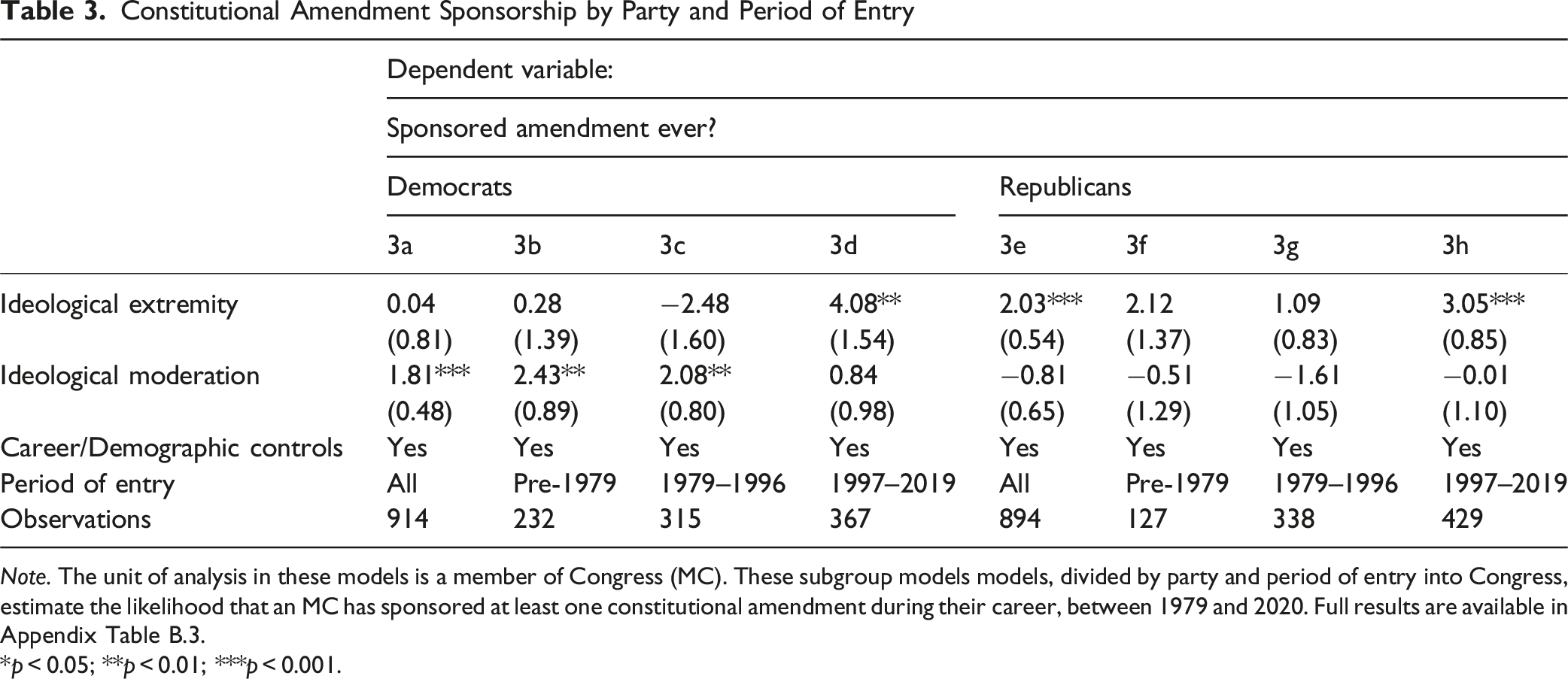
Note. The unit of analysis in these models is a member of Congress (MC). These subgroup models models, divided by party and period of entry into Congress, estimate the likelihood that an MC has sponsored at least one constitutional amendment during their career, between 1979 and 2020. Full results are available in Appendix Table B.3.
*p
A comparisons between Model 3a and 3e, which look at all members in each respective party, suggests that the effect of ideology on amendment sponsorship has broadly been driven by extremists in the Republican Party, and moderates in the Democratic Party. In other words, the more conservative members in each respective party have been the most likely amendment sponsors. This result pushes against both the Ideological Distance and the Ideological Extremity hypotheses, and suggests that within-party-conservatism has been a key predictor of the kinds of members who engage in this form of position-taking.
However, these results are further complicated when I break down the impact of ideology by Congressional cohorts. Ideological moderation is significantly related to the probability of being an amendment sponsor for Democratic MCs who entered Congress prior to 1997, but no later. On the other hand, ideological extremity does strongly predict sponsorship among Democrats who entered the House between 1997 and 2020. Among Republicans, ideological extremity predicts amendment sponsorship only in the most recent cohort. Moderation, meanwhile, is never a significant predictor of GOP sponsorship. The estimates in Model 3d and 3h thus suggest a particularly prominent relationship between ideological extremity and amendment sponsorship among members elected in and after 1996, regardless of party.
To better interpret these results, Figure 4 plots the expected change in probability of career amendment sponsorship based on large shifts in ideological moderation and extremity for each of the models in Table 3. These results suggest that among members who entered Congress in or after 1997, moving from the 5th to 95th percentile of ideological extremism increases the probability of career sponsorship by around 40 percentage points for Democrats, and around 30 percentage points for Republicans. While the confidence intervals for the estimate for Democrats are large, these results do provide conditional support for the Ideological Extremity hypothesis. Overall, these results suggest two different trends of amendment sponsorship: (1) a period prior to 1997 where more conservative Democrats were most likely to become constitutional amendment sponsors; and (2) a period following 1997 where more conservative Republicans and more progressive Democrats have been more likely to do so. Changes in expected probability for selection stage variables among Democrats and Republicans, divided by period of entry into Congress. In each simulation, all other variables are held at their median values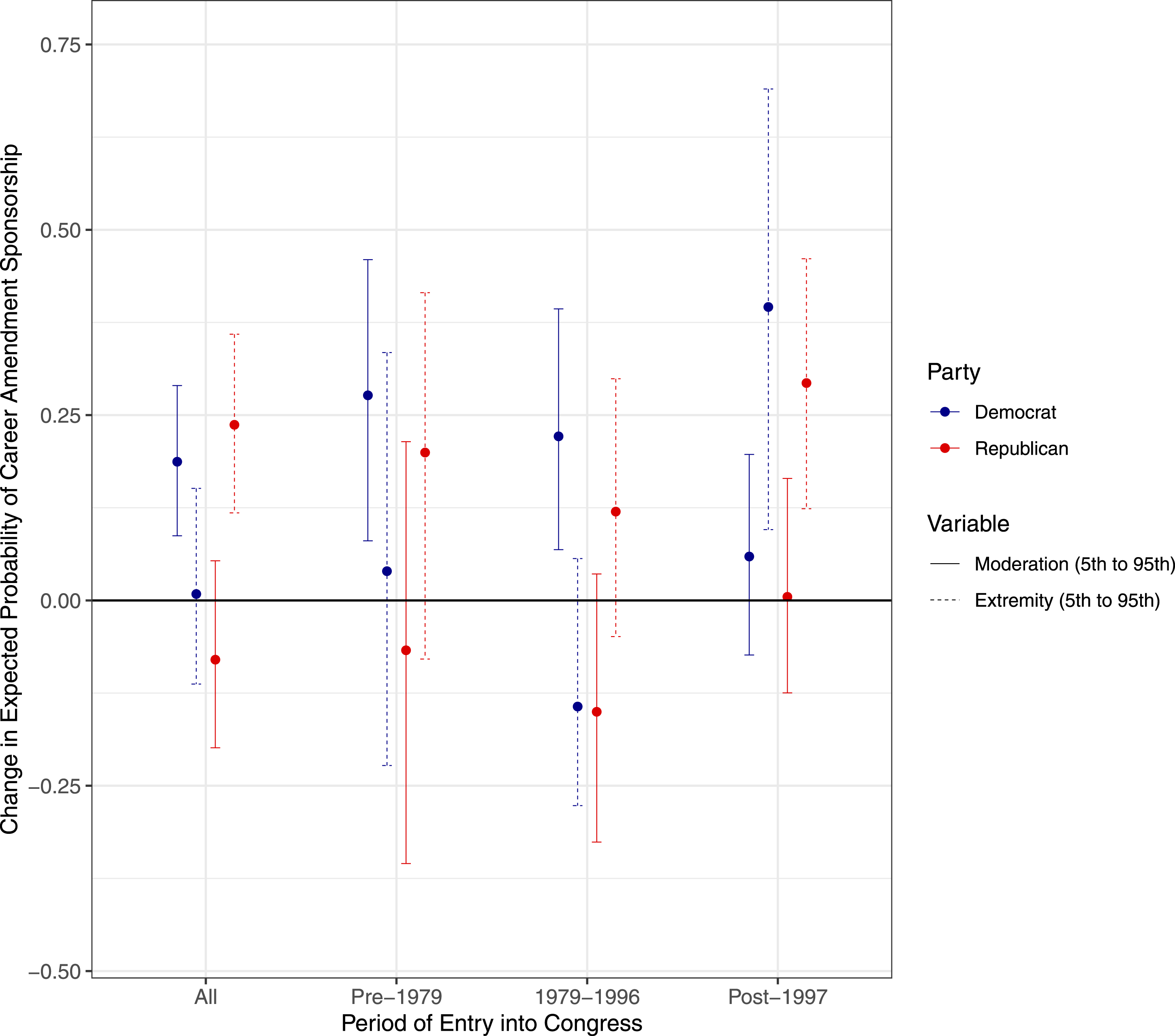
Why have the kinds of Democrats who introduce these proposals shifted from the most moderate to the most progressive? This phenomenon is potentially linked to the battles over House majority control that began in 1994. Similar to Bonica and Cox’s (2018) argument on the strategic nationalization of politics, as competition for a majority has become an increasingly core component of the electoral process, member’s incentives to engage in particular position-taking strategies have changed. Democrats who were elected between the 84th and 103rd Congress joined the House as part of a 40-year hegemonic majority. This long period of institutional power likely meant that many Democratic MCs, even those to the left of the party’s center, could channel their energy into substantive legislation and real policy change. At the same time, the beginning of data corresponds with the failures of the Equal Rights Amendment and DC Voting Representation Amendment, both of which were championed by the more progressive wing of the Democratic Party. It is possible that in the wake of their defeats, more ideologically extreme Democrats were more hesitant to return to this kind of legislation, even for position-taking purposes.
While the conservative coalition, comprised of Republicans and Southern Democrats, still held a significant amount of negative agenda setting power in this earlier period through key committee positions and chairmanships (Jenkins & Monroe, 2014), amendment proposals can be understood as an important avenue of position-taking for (1) conservative Democrats to express their ideological divergence with their party and (2) conservative Republicans to establish a wish-list agenda for a potential GOP majority. Indeed, the most frequent amendment proposals introduced by Democrats in my data who entered the House prior to 1979 were to ban abortion, balance the budget, and term limit members of Congress—all proposals popular with Republicans, the latter two of which were core to the 1994 Contract with America. After the GOP took control of the House and subsequently failed to pass the Balanced Budget Amendment in 1995, Democratic sponsorship of proposals on this subject plummeted.
In further alignment with Bonica and Cox (2018), position-taking via out-party policy is not a winning strategy in a world of nationalized politics. Democratic proposals in recent years—especially from members who entered in and after 1997—have centered instead on campaign finance reform, a charge led by the party’s progressive wing. I do not claim that moderate Democrats have abandoned position-taking or amendment sponsorship as political strategies, but these results do suggest that contemporary constitutional amendment proposals have become a more prominent vehicle for position-taking behavior among progressives, as well as among very conservative Republicans.
Discussion and Conclusion
This analysis offers several important findings about the sponsorship of constitutional amendment proposals. First, my results are consistent with the theory that amendment sponsorship in the contemporary period is a form of position-taking. Amendment sponsorship appears to be a protest activity undertaken by ideologically distant MCs in terms where they are more electorally vulnerable and hold less institutional power. These findings are relatively robust to alternate specifications, although the effect of being in a marginal district is only evident when analyzing the subset of members who, at some point in their career, sponsored amendments.
Second, I find that the relationship between ideology and sponsorship differs relative to partisanship and period of entry into Congress. Republican amendment sponsors have been relatively more conservative than their party since 1997, while the most likely Democratic amendment sponsors have shifted over time from moderates to progressives. I posit that these shifts are related to the 1994 Republican Revolution, the failures to pass any amendments under the GOP majority in the 104th Congress, and the subsequent nationalization of politics.
These findings offer insight into congressional behavior, opening a window into an understudied region of symbolic legislative politics. They also offer reflection on the current era of constitutional dormancy. The rise in elite partisan polarization and the slimming majorities in both chambers all mean that passing a partisan amendment proposal has become a much more arduous task than it was in the 1960s and 70s. The few attempts by Congressional majorities since have most often ended in dramatic and embarrassing failure. The results of these models suggest that members may be cognizant of these trends, and that successful constitutional change is not the intention of modern amendment proposals.
Even if most amendment proposals are primarily a low-cost, symbolic form of position-taking, that does not mean that the U.S. Constitution will never be amended again. Many of the amendments that were eventually added to the Constitution, such as the 17th, 19th, and 26th Amendments, were introduced by the same member(s) dozens of times across decades before they eventually passed. To do so again will certainly require a stark change in political conditions, but at numerous prior moments in American history, many were certain that the Constitution had reached its final form only to be quickly proven wrong (Kowal & Codrington, 2021).
Amendment proposals may be position-taking behavior, but are they consequential? Or is sponsoring an amendment a bit of cheap talk that goes virtually unnoticed? The symbolic argument, and historical evidence surrounding past amendment proposals such as the ERA, suggests there to be some significance to these proposals, but additional work is required to understand their reception. Future work on this topic should also consider the Senate, and whether behavior in the upper chamber mirrors that of the lower.
Of final note is the public messaging on amendments, the study of which could provide further insight into how sponsors frame these measures and potentially tie them to elections. Like the text message quoted at the beginning of this paper, this messaging may also demonstrate connections between amendment proposals, lobbyist and activist organizations, and political donations. After all, End Citizens United concluded their text with a link to donate to their organization. The “amazing” amendment, like all the others now proposed in Congress, had virtually no chance of passage or ratification. Yet as a position-taking device, and a tool to potentially motivate donation and collaboration between an MC and interest groups, constitutional amendment proposals may be working just as intended.
Supplemental Material
Supplemental Material - Constitutional Amendment Proposals as Position-Taking Activity in the U.S. House of Representatives (1979–2020)
Supplemental Material for Constitutional Amendment Proposals as Position-Taking Activity in the U.S. House of Representatives (1979–2020) by Alexander Cohen in American Politics Research.
Footnotes

Funding
The authors received no financial support for the research, authorship, and/or publication of this article.
Declaration of Conflicting Interests
The authors declared no potential conflicts of interest with respect to the research, authorship, and/or publication of this article.
Supplemental Material
Supplemental material for this article is available online.
Notes
References
Supplementary Material
Please find the following supplemental material available below.
For Open Access articles published under a Creative Commons License, all supplemental material carries the same license as the article it is associated with.
For non-Open Access articles published, all supplemental material carries a non-exclusive license, and permission requests for re-use of supplemental material or any part of supplemental material shall be sent directly to the copyright owner as specified in the copyright notice associated with the article.
