



Abstract
Despite a rich literature on gender stereotypes, few studies consider whether voters reward/punish women politicians differently than their men counterparts for their policy records. To study this question, we conducted a conjoint survey experiment with a quota-based nationally representative sample of 1495 American citizens. The experiment focuses on electing one of two hypothetical councillors (keeping their political experience constant) to become a mayor. We find that voters do not penalize women politicians more for breaking campaign promises. In fact, they are at least as likely to reward women politicians for keeping their promises compared to men politicians. This is true across genders and political parties.
Despite the notable increase in the number of women politicians in legislators over the last few decades, women continue to be severely underrepresented in legislatures almost everywhere around the world (Inter-Parliamentary Union, 2020). This is problematic because women’s underrepresentation is not simply symbolic, it has substantive consequences for the lived experiences of both women and men (Chattopadhyay & Duflo, 2004).
Existing scholarly work provides various explanations for the lack of women in politics, which include voter bias (Blais & Sevi, 2024; Golder et al., 2019; Sevi & Blais, 2023). This is the idea that voters may prefer to be represented by men rather than women. Yet, once the partisanship and incumbency status of candidates are controlled, research shows that there is no systematic bias against women candidates (Lawless & Pearson, 2008; Sevi, 2023). If voters, though, differentially evaluate women politicians once they are elected, biases against them could lead to women quitting politics at higher rates than men. If so, this could be one of the reasons why the unequal representation of women in politics continues to persist.
In this article, we build on a growing literature on gender and politics to investigate whether voters hold women politicians to higher standards. We examine the extent to which voters reward (or punish) women and men politicians differently for keeping (or breaking) their past campaign promises. We do this by conducting a preregistered conjoint experiment with a quota-based nationally representative sample of 1495 American citizens that focuses on the context of keeping/breaking past campaign promises. We find no evidence that women politicians are punished more than men. We also find that Republicans and women do not punish women more than men for breaking their campaign promises.
Through these findings, we make several contributions to research on gender and politics and representation. We depart from prior research in at least three important ways. First, consistent with existing research on promise keeping, we use hypothetical candidates (Dassonneville et al., 2020; Werner, 2019a, 2019b), but our focus is on electing one of two councillors (keeping political experience constant) to become a mayor. By examining city councillors seeking a mayorship, we introduce a novel context that enables us to isolate the effects of promise breaking or keeping outside the influence of partisan polarization. This approach allows for a deeper understanding of the impact of promise breaking or keeping in non-partisan races. Second, scholars have typically studied promise breaking or keeping in the context of one issue. We expand this context to three issues. 1 By focusing on three distinct issues, we are able to provide a more comprehensive understanding of the dynamics of promise fulfillment across various domains. Third, existing work on gender and political evaluations focuses on political candidates first entering politics (Dolan, 2004; Schwartz & Coppock, 2021; Sevi et al., 2019; Sevi et al., 2021). We add to this literature by examining whether once elected, women politicians are held to a different standard. It is important to examine not only the challenges faced by aspiring women politicians compared to their male counterparts but also the persistence of such biases once women are elected to office. This perspective is crucial for understanding the full spectrum of gender biases that women encounter throughout their political careers.
Previous Work and Expectations
Modern democracies revolve around the principle of representation where legislators are elected to represent citizens in government (Manin, 1997). The growing literature on accountability and representation suggests that voters generally punish legislators who break their campaign promises (See: Dassonneville et al., 2020; Werner, 2019a; 2019b). In keeping with this literature, our first hypothesis is therefore as follows:
But are women and men legislators evaluated differently for breaking/keeping their campaign promises? This question has not been answered in the existing literature. Research in other contexts suggests that women politicians are held to higher performance and qualification standards than men (Bauer, 2020; Costa, 2020; O’Brien, 2015; Reyes-Housholder, 2020) and that women are punished more for violating gender stereotypes (Armantier & Boly, 2008; Boussalis et al., 2021) and political norms (Stolberg, 2011).
Research on gender stereotypes suggest that individuals tend to perceive women as more honest and trustworthy compared to men (Schniter & Shields, 2020). This perception can influence various aspects of social interactions, including how women politicians are perceived by voters. When it comes to politics, voters may expect women politicians to behave in congruent ways with these stereotypes, particularly in terms of keeping promises (Schneider, 2014). This is because when women do not conform to what is expected of them, they can be penalized. In this regard, voters may hold women politicians to higher standards of honesty and ethical behavior. Therefore, if a woman politician breaks a promise, it could lead to stronger negative reactions from voters than if a male politician were to do the same. This reaction may stem from the perceived incongruence between the stereotype of women as honest and trustworthy and the politician’s failure to uphold their promise.
Empirical research on gender and politics provides many reasons to suggest why voters might treat women and men politicians differently. Women legislators face more burdens in office because they receive more requests (Richardson & Freeman, 1995; Herrick, 2010; Butler et al., 2022). Vraga (2017) shows that women candidates face harsher penalties for defecting from their party’s issue platform compared to men candidates. Women are thus evaluated more harshly, receive less credit for their work, and are penalized more for misconduct (Barnes et al., 2020; Bauer, 2020; Carlin et al., 2020; Esarey & Schwindt-Bayer, 2018; Fulton, 2014; O’Brien, 2015).
Other research shows, however, that in the aggregate, there is no evidence that women candidates are less successful than men in gaining elective office. When women run for office, they win at the same rates as their male counterparts (Lawless & Pearson, 2008; Schwartz & Coppock, 2021; Sevi et al., 2019; Sevi et al., 2021). This however does not mean that gender stereotypes do not influence electoral behaviour. Eggers et al. (2017) conduct a survey experiment to examine whether female politicians face greater punishment for misconduct. They find that women politicians face similar punishment for misconduct as their men counterparts. Similarly, de Geus et al. (2021) report that women political executives receive similar levels of credit for positive governing performance as their men counterparts. Finally, Kaslovsky and Rogowski (2021) show that while voters penalize women and men legislators similarly for policy incongruence, women legislators are rewarded more than men when they are aligned with their constituents. As such, the evidence for voter bias toward women candidates and politicians is mixed and have a more complex impact on the electoral process than is typically assumed. We expect voters to punish women more for breaking their campaign promises. Our second hypothesis is thus as follows:
We also examine two exploratory hypotheses designed to motivate more theoretical development. Existing work finds that women are more likely to reward honesty over dishonesty (Alexander & Andersen, 1993; Leeper, 1991). Eggers et al. (2017) show women punish women politicians more for misconduct. By the same logic, we expect women to punish women candidates more for breaking their campaign promises. Karpowitz et al. (2022) find that Republicans view feminine women as more likeable yet less competent than masculine women, which translates into an electoral disadvantage for feminine women. In contrast, masculine women win at similar rates as men. Moreover, they find that women are more electorally advantaged among Democrats. Furthermore, Winter (2010) provides evidence that the Republican party has become more masculine over time. As such, we expect Republican voters to be more likely than Democrats to punish women politicians who break their campaign promises.
Experimental Design
To test the extent to which voters punish women politicians more for breaking their campaign promises, we conducted a pre-registered conjoint experiment with a national sample of American voters recruited through Lucid theorem with quotas for age, race, gender, educational attainment, household income, Census region, and political party. 2 Our experiment was fielded in July 2021.
The survey comprised three parts. In the first part, we asked respondents to provide their informed consent and complete two attention checks (Aronow et al., 2020). 3 1495 citizens completed the survey and passed these attention checks. In the second part, we asked respondents to answer questions about their background and attitudes. This part included questions about their age, education level, gender, political identification, race, and policy priorities.
In the third part, we had respondents complete a candidate-choice conjoint experiment. We instructed them that “We’re now going to ask you to evaluate some hypothetical candidates for mayor of a city like yours. We’ll present you with 7 pairs of candidates, all of whom are currently city councillors, and ask you to choose the one that you’d be most likely to support with your vote.” 4 Building on the existing literature, we randomized five attributes: gender, leadership style, occupation, and policy priority. To test our expectations, we randomized each candidate’s previous record, stating that they either ‘kept all of their promises’ in their last term or ‘broke most of their promises’. We asked respondents to imagine that they lived in the city that the councillors served and to select which of the two candidates they would be most likely to vote for as mayor (S1 provides an example of a conjoint task).
Results
To determine the effect of each experimental factor in the conjoint, we calculated marginal means for the whole sample and subgroups.
5
Figure 1 shows the primary results. Circles denote marginal means and thin bars denote 95% confidence intervals. Conditional marginal means are grouped by experimental factor and denote the predicted probability that respondents select a candidate with a specific factor level, across all other factor levels. If the confidence intervals for a candidate attribute cross the 50% line (the grey vertical reference line), we cannot reject the null hypothesis that respondents equally like candidates with or without that characteristic. Respondents value candidates who keep all their promises. Note: Marginal means plot for the effect of candidate attributes on survey respondent selection. The circles represent the marginal means while the thin bars denote 95% confidence intervals. Circles on the left side of the grey line at 50% indicate that respondents are, all-else-equal, less likely to choose a candidate with the given characteristics on the vertical axis; those on the right are, all-else-equal, more likely to choose a candidate with the given characteristic. The unit of analysis is the respondent-choice profile. Hence, the N reported in our models below is the number of respondents (1495) multiplied by the number of pairwise choices (7) and individuals within those pairs (2). N = 20,930.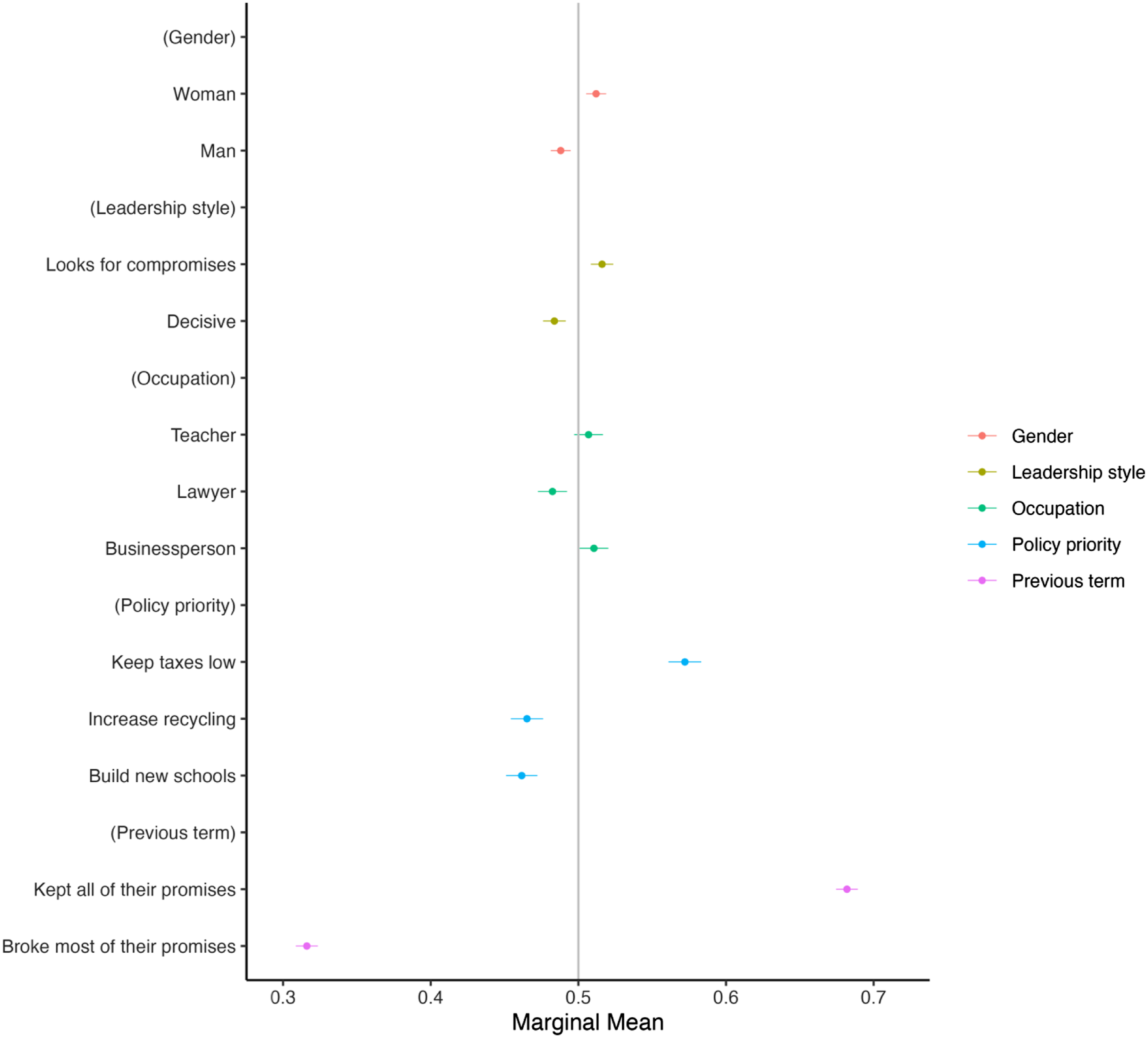
With that in mind, we turn to (H1) and examine the extent to which promise keeping influences candidate support. We find respondents strongly reward those who keep their promises, selecting them 68.2% of the time [67.4%–68.9%], and substantially punish those who do not, choosing them in only 31.6% of their opportunities [30.9%–32.4%]. Placing this effect in context of other candidate attributes, we see that it is the most important concern among respondents – the primary driver of candidate choice. The evidence from our conjoint strongly supports H1.
While the results above suggest that respondents care about whether candidates keep/break their promises, they cannot tell us if public demand for politicians who are true to their word is different for men and women political hopefuls. In other words, do women pay a bigger price for not keeping their electoral bargains with voters? To answer this question, we estimate the same model as shown in Figure 1 but interact the candidate gender treatment with all the other treatments. Conducting an analysis of deviance test to compare the two models, we find evidence for an interactive effect between candidate gender and other candidate characteristics (F < 0.01). Figure 2 plots the results of this interactive model.
6
It shows that, contrary to our initial expectations (H2), women candidates who broke most of their promises received slightly more votes (32.8% of votes [31.7%–34.0%]) for re-election than men who did the same (30.3% of votes [29.2%–31.5%]). Furthermore, women are rewarded a bit more for keeping their promises (69.5% of votes [68.3%–70.7%]) than men (66.8% of votes [65.7%–68.0%]). In short, women do not pay higher prices than men for breaking their promises, and we find no support for H2. Women candidates are punished less for breaking their promises compared to men candidates. Note: Conditional marginal means for the effect of candidate attributes on survey respondent selection by candidate gender. The circles represent the marginal means while the thin bars denote 95% confidence intervals. Circles on the left side of the grey line at 50% indicate that respondents are, all-else-equal, less likely to choose a candidate with the given characteristics on the vertical axis; those on the right are, all-else-equal, more likely to choose a candidate with the given characteristic. The unit of analysis is the respondent-choice profile. Hence, the N reported in our models below is the number of respondents (1495) multiplied by the number of pairwise choices (7) and individuals within those pairs (2). N = 20,930.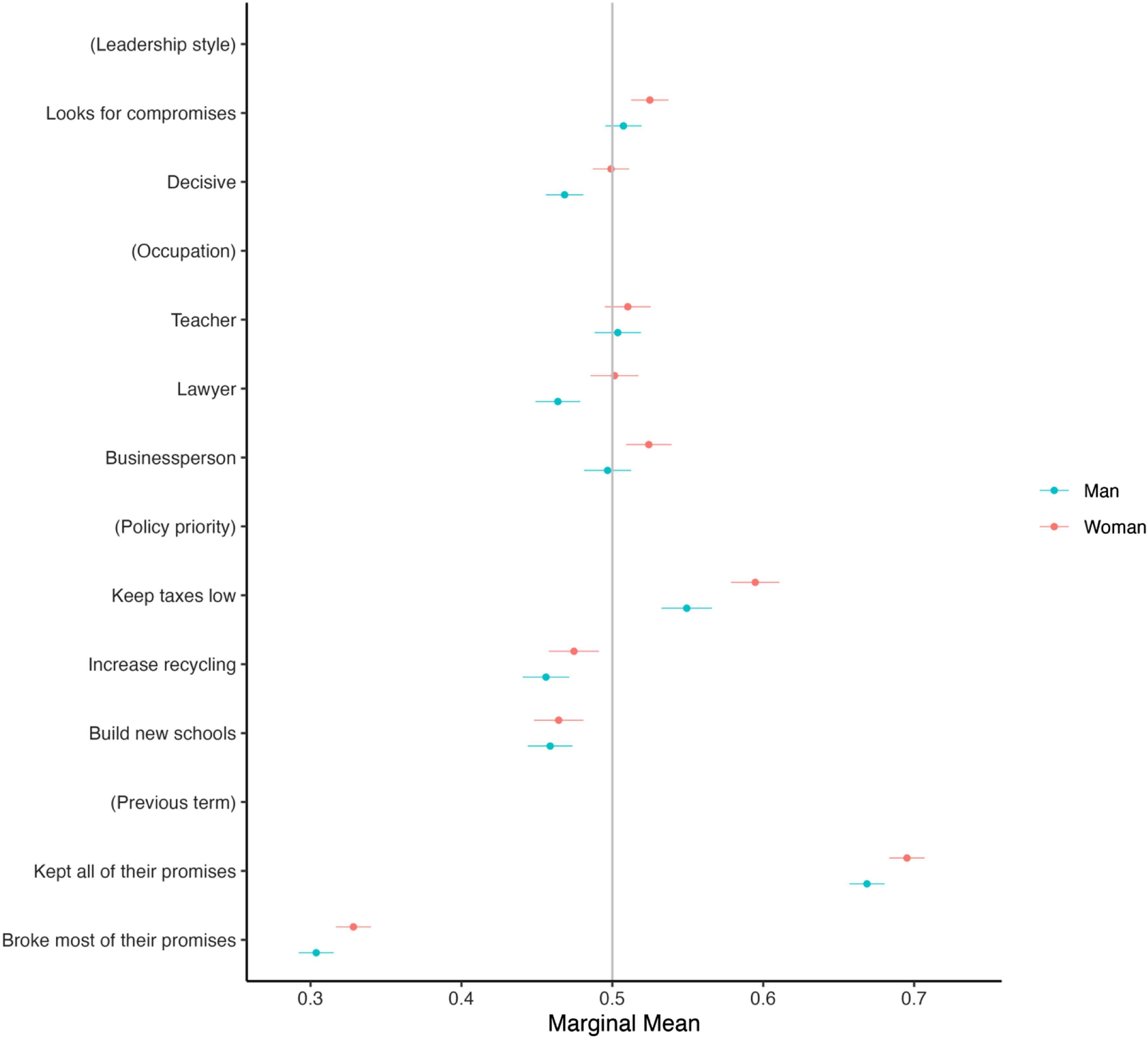
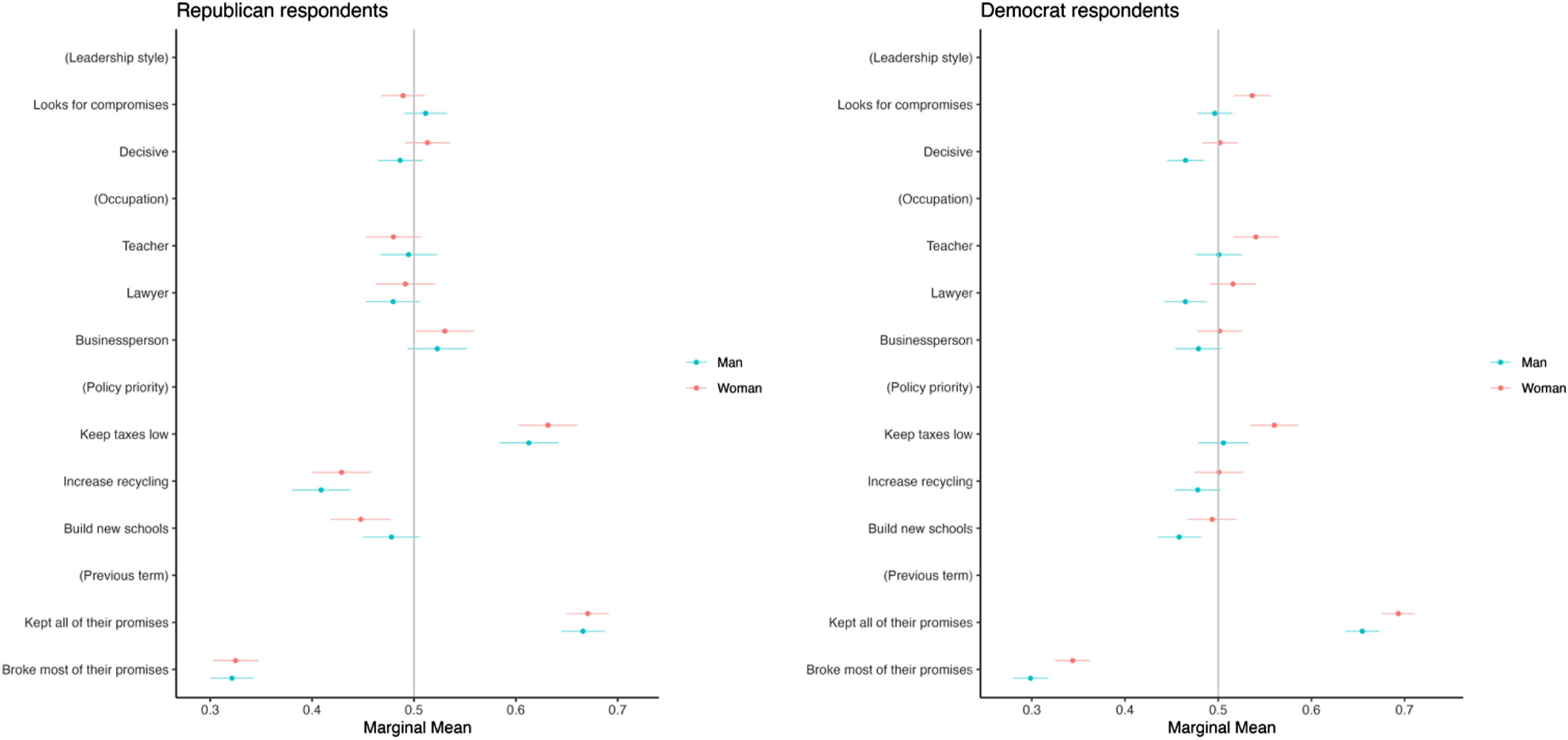
While we do not find that women candidates, on average, pay a higher price than men candidates, there might be important subgroup differences. While exploratory, we test our expectations regarding those differences in Figures 3 and 4. We examine the conditional marginal means of breaking a promise for women candidates across respondents’ gender and party identification, which we know often conditions treatment effects (Crabtree et al., 2022). Overall, the pattern is clear. Respondents across gender and party identification do not treat women worse than men for breaking their promises. However, women and Democratic voters are more likely to reward women who keep all their promises and less likely to punish them for breaking their promises. Results across respondents’ gender. Note: Conditional marginal means for the effect of candidate attributes on survey respondent selection by candidate gender and by respondent gender (top) and party identification (bottom). The circles represent the marginal means while the thin bars denote 95% confidence intervals. Circles on the left side of the grey line at 50% indicate that respondents are, all-else-equal, less likely to choose a candidate with the given characteristics on the vertical axis; those on the right are, all-else-equal, more likely to choose a candidate with the given characteristic. The unit of analysis is the respondent-choice profile. Hence, the N reported in our models below is the number of respondents (1495) multiplied by the number of pairwise choices (7) and individuals within those pairs (2). N = 20,930. Results across respondents’ party identification. Note: Conditional marginal means for the effect of candidate attributes on survey respondent selection by candidate gender and by respondent gender (top) and party identification (bottom). The circles represent the marginal means while the thin bars denote 95% confidence intervals. Circles on the left side of the grey line at 50% indicate that respondents are, all-else-equal, less likely to choose a candidate with the given characteristics on the vertical axis; those on the right are, all-else-equal, more likely to choose a candidate with the given characteristic. The unit of analysis is the respondent-choice profile. Hence, the N reported in our models below is the number of respondents (1495) multiplied by the number of pairwise choices (7) and individuals within those pairs (2). N = 20,930.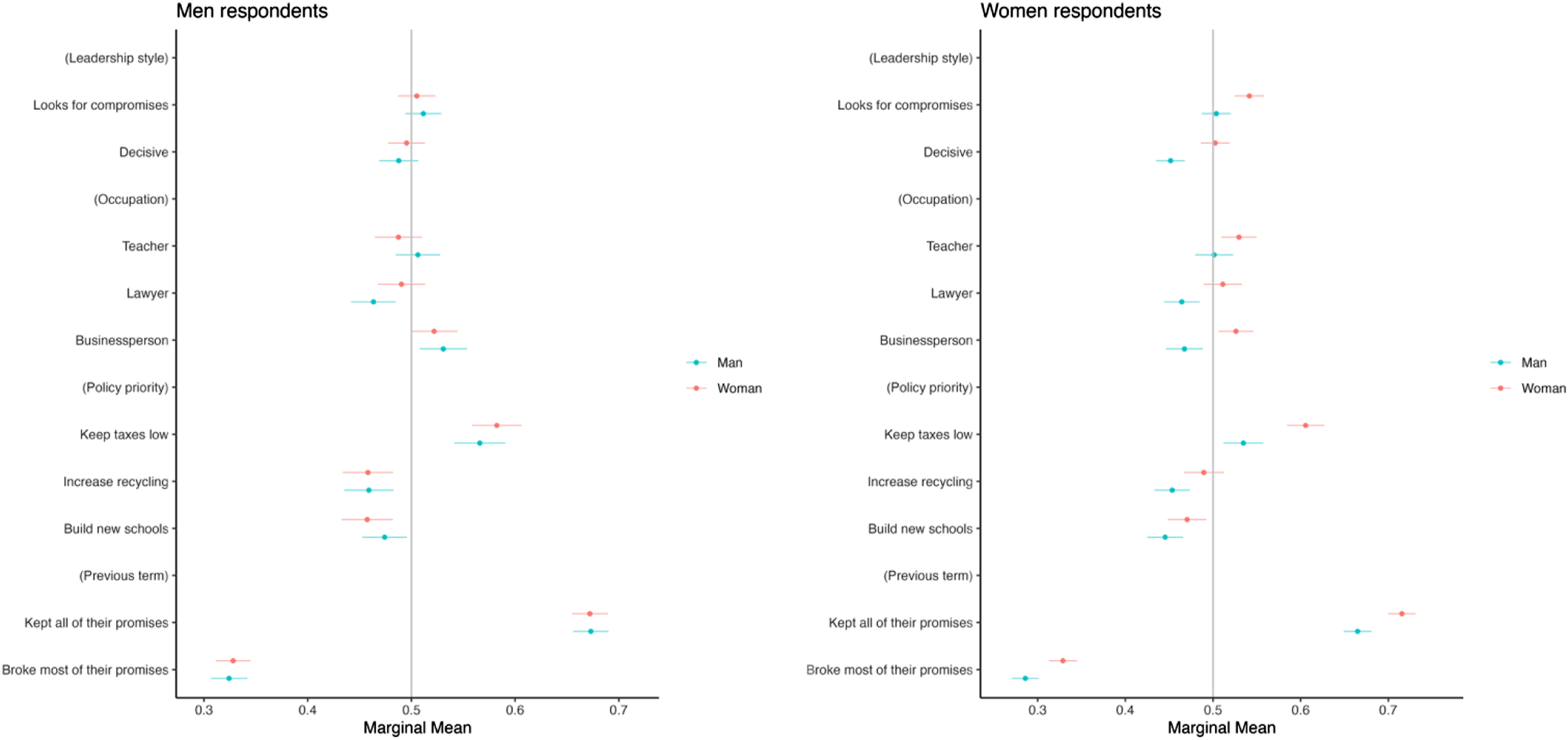
Discussion
A growing body of work finds no clear evidence of voter bias toward female candidates (Schwartz & Coppock, 2021; Sevi et al., 2019; Blais & Sevi, 2024). Yet a large body of literature suggests that women legislators have a different political experience from their men counterparts (Bauer, 2020b; Butler et al., 2022; Dittmar et al., 2018; Herrick, 2010; Richardson & Freeman, 1995) with voters preferring masculine self-presentations (Bauer, 2018) and candidates that are married and have children (Teele et al., 2018) resulting in a “double-bind” for many women (Lawless & Fox, 2004). This literature suggests that women politicians are held to a higher degree than their men counterparts. If they conform with masculine stereotypes they are seen as unlikeable. If they conform with feminine stereotypes they are seen as weak (Eagly & Karau, 2002). Either way, women politicians face a no-win “double-bind.”
If this is true, this would lead more women politicians to quit politics which would continue to have severe consequences for political representation and democracy. We investigate this possibility in the context of promise keeping/breaking and examine whether voters hold women legislators to higher standards compared to men legislators. We recognize that keeping/breaking most of their promises may be perceived as too simple. We invite future work to unbundle our treatments further by examining not only the impact of breaking high-salience promises but also of breaking certain types of promises (such as no new taxes, increased social welfare spending, etc…).
Overall, we do not find evidence that voters hold women politicians to higher standards than men for breaking their campaign promises, nor do we find any evidence that women candidates are punished more than men candidates by certain subgroups such as Republicans and women. This is good news. If women are underrepresented this is not because of voter bias. This suggests that the problem lies in the recruitment process.
Supplemental Material
Supplemental Material - Do Voters Punish Women Politicians More?
Supplemental Material for Do Voters Punish Women Politicians More? by Semra Sevi, Charles Crabtee and André Blais in American Politics Research
Footnotes
Acknowledgments
Semra Sevi would like to thank APSA’s Elections, Public Opinion, and Voting Behavior section and the Centre for the Study of Democratic Citizenship for their generous financial support that enabled the data collection for this research.
Declaration of Conflicting Interests
The author(s) declared no potential conflicts of interest with respect to the research, authorship, and/or publication of this article.
Funding
The author(s) received no financial support for the research, authorship, and/or publication of this article.

Supplemental Material
Supplemental material for this article is available online.
Notes
References
Supplementary Material
Please find the following supplemental material available below.
For Open Access articles published under a Creative Commons License, all supplemental material carries the same license as the article it is associated with.
For non-Open Access articles published, all supplemental material carries a non-exclusive license, and permission requests for re-use of supplemental material or any part of supplemental material shall be sent directly to the copyright owner as specified in the copyright notice associated with the article.
