




Abstract
We offer a candidate-centered amendment to incumbent-referendum models of presidential election outcomes that dominate the literature on post-WWII presidential elections. Our argument is that incumbent-challenger differences in character qualifications and issue concerns of the electorate should be included. These differentials, which recognize the advantage or disadvantage of the incumbent relative to the challenger party candidate have strong effects on election outcomes independent of the state of the economy, the number of years the incumbent party has held the White House, and presidential approval. Properly understood, in addition to the state of national affairs, presidential election outcomes are about the choice presented to the mass public. This added element means that candidates matter for election outcomes and electoral change in ways that have not been properly appreciated in existing scholarship.
While an enormous amount of research has been published on how individuals vote in presidential elections, 1 as a discipline we know much less about how electorates behave in these elections. More specifically, many of the attitudes and beliefs that Americans hold are quite stable from one election to the next, which means that they are of limited value for explaining electoral change (Stokes, 1966a; 1966b), especially in the short-term, from one election to the next. The classic example is party identification, which is the strongest correlate of choice by individual voters but is not useful for explaining electoral change because party voting on one side cancels out the party voting on the other, and aggregate party identification is relatively stable. 2 In contrast, what do change are “attitudes toward the candidates and issues,” and therefore has the potential to “explain the general shift in voting preferences” from election to election (Stokes et al., 1958, 369). Data limitations meant Stokes and colleagues were unable to analyze electoral change except in a descriptive and qualitative manner. And, subsequent systematic research shifted away from a focus on both candidates to one that emphasizes the incumbent and the incumbent party with attention to variables like economic performance, tenure in office, and presidential approval (e.g., Abramowitz, 1988; Achen & Bartels, 2016; Bartels & Zaller, 2001; Erikson et al., 2001; Hibbs, 2000).
This article advances scholarship through a serious consideration of the role “attitudes toward the candidates and issues” may have on aggregate presidential election outcomes and change. Specifically, we modify existing models of these elections to include relative candidate strength on issues and character. While research on these dimensions is abundant at individual level (e.g., Christenson & Weisberg, 2019; Goren, 2002, 2007; Hayes, 2005; Holian & Prysby, 2011, 2014; Miller & Shanks, 1996), their contribution to electoral change is under explored. 3 Further, not only do we include variables in aggregate models that have not been analyzed in this way before, we do so with a theoretical shift in emphasis. Existing models are premised on the assumption that presidential elections are referendums on the incumbent party. For instance, the relationship between economic performance and electoral outcomes is based on the notion that the electorate rewards or punishes the incumbent party based on how well the economy performs, without consideration of the issue positions or quality of challenger candidate. 4 In contrast, by focusing on candidate differentials, we consider both party candidates and therefore depart from the standard referendum models premised on the idea the electorate is only concerned with the incumbent. Our contribution is to challenge this model by demonstrating that the electorate’s comparisons between the incumbent and challenger candidates add significant explanatory and predictive power to the standard referendum model of presidential election outcomes. 5
The relevance of candidate differentials to explanations of electoral outcomes can perhaps best be explained by focusing on the candidates’ relative character strengths, although a discussion of issue differentials would closely parallel the question of character differentials at the election level. The key to recognizing the importance is to observe what changes from one election to the next are the candidates competing for the office. Because the candidates change, so, too, do the electoral advantages and disadvantages parties have from one election to the next. 6 By analyzing aggregate outcomes and changes in candidate differences on issues and character, we conduct systematic cross-election analyses that have not previously been attempted. While much has been learned from individual-level studies about the importance of different character-trait qualities and their relationships with candidate evaluations and vote choice, we show that at the aggregate level the referendum model is incomplete by failing to include information about the electorate’s assessments of candidate differences.
Background and Model
The most pervasive and robust relationship regarding presidential election outcomes is that the incumbent party’s success (or lack thereof) is related to national economic performance (e.g., Abramowitz, 1988; Achen & Bartels, 2016; Bartels & Zaller, 2001; Cohen et al., 2016; Erikson et al., 2001; Erikson & Wlezien, 2014; Fair, 2009; Hibbs, 2000; Holbrook, 1994; Lewis-Beck & Rice, 1992; Vavreck, 2009). This result is typically viewed as supporting a “referendum model” of presidential elections, in which the electorate holds presidents or their partisan successor nominees accountable for the health of the economy and other indicators of national well-being. An (often implicit) assumption of the model is that challenger characteristics and issue stands may be ignored since the out-party candidate’s electoral fortunes are wholly dependent on the incumbent’s performance.
While not disputing the significance of economic performance, we propose a potentially important candidate-centered modification. Because elections are about choices, omitting the challenger may be a significant oversight. More specifically, candidate differentials may matter (Kelley, 1983). If research on congressional elections is any guide, then differentials relating to the candidates’ relative qualifications (character and competence) and policy differences should be relevant (Mondak, 1995; Stone, 2017). Relative character assessments come into play because in representative government, voters seek candidates whom they can trust to conduct themselves competently and honestly even though monitoring their every move is costly or impossible (Bianco, 1994). At the same time, issue differences between candidates have been linked to voting choice at least since the Michigan studies (Stokes, 1966b; Stokes et al., 1958) and are central to spatial understandings of choice (Jessee, 2012). In what follows, we test these notions that “attitudes toward the candidates and issues” (Stokes et al., 1958, 369) add important explanatory power for understanding presidential election outcomes.
We begin with the model of presidential election outcomes that has been developed and refined by Achen and Bartels (2016). This “A-B” model posits that the incumbent party’s national vote margin (V) in a presidential election is influenced by two factors: short term economic performance (Economy) and the length of time the party has been in power (Tenure):

Then, we introduce two additional variables to capture candidate differentials on character qualities (Character) and issues (Issues):

Character and Issues are the difference between the electorate's view of the incumbent party’s and challenger party’s candidates:



Measures
To construct the Character and Issues measures, we rely on the open-ended “likes-dislikes” battery of questions included in every ANES presidential-year survey since 1952. 7 These items have only been coded for the years 1952-2008 which yields 15 presidential elections as our sample. The question format was: “Now, I’d like to ask you about the good and bad points of the two candidates for president. Is there anything in particular about [Democratic/Republican candidate name] that might make you want to vote for [against] him? (What is it?)” Respondents were asked in four follow-up questions whether there was anything else, for up to five reasons each for voting for or against each party’s presidential nominee. 8 Respondents could give any reasons they chose (including no reasons at all), and answers were coded by a detailed scheme that captured the gist of each stated reason. We rely on the coding rules developed by Gilens et al. (2007) to identify character and policy responses about the candidates, both positive and negative, in support of or opposition to either candidate. 9
The candidate differential calculated for any individual respondent (i) compares likes and dislikes related to the incumbent party’s candidate and the challenger candidate. Thus, the Character differential for a respondent is
10
:



The measure 11 implies that that reasons for voting for the incumbent party’s candidate are a combination of positive considerations about the incumbent and negative considerations about the challenger. Reasons for voting for the challenger are the reverse: positive considerations about the challenger and negative ones about incumbent.
In the case of Issues, we assume that respondents pick up policy-based signals about the candidates’ strengths or weaknesses on issues reasonably salient to the respondent. We make no assumption that the issues are the same from election to election, any more than we assume that character considerations from the likes-dislikes battery are constant across elections. Rather, the assumption in both measures is that respondents react to the campaigns and their observations of candidates’ issue positions (and character considerations) from evidence gathered during the campaign, including campaign events, news coverage, debates, and the opinions of trusted friends and associates.
To obtain election-level measures of Character and Issues, we aggregate the individual differentials. One option would be to simply compute the overall Character and Issues means. However, doing so would likely introduce bias in the measures that could affect our findings. The reasons have to do with partisan bias and the changing distributions of partisanship over the time period we examine. First, consider partisan bias, by which we mean the general tendency of partisans to view candidates of their own party more favorably and those from the other party less favorably. If a sample of respondents has more Democrats than Republicans, then because of partisan bias, the simple, overall sample mean will be biased in favor the Democratic candidate. If the distribution of partisanship did not change from one election/sample to the next, then the partisan bias would be constant across elections and would be less problematic because its magnitude would not change. But, this is not typically the case when analyzing long periods of time in American electoral politics including the period covered by our analysis. Thus, if we relied on simple, overall sample means, then partisan bias in our measures would vary across elections.
To address the problem, we construct measures of Character and Issues that do not depend on the changing distributions of partisanship and that give equal weight to Democratic and Republican partisans.
12
We do this by computing separate means of Character and Issues for Democrats (strong, weak, and leaning), Republicans, and Pure Independents in each year. We then weight those means equally to produce our estimates of Character and Issues (.45 for Democrats and .45 for Republicans) and Pure Independents as .10.
13
The candidate differentials for a given year (y) are given by:

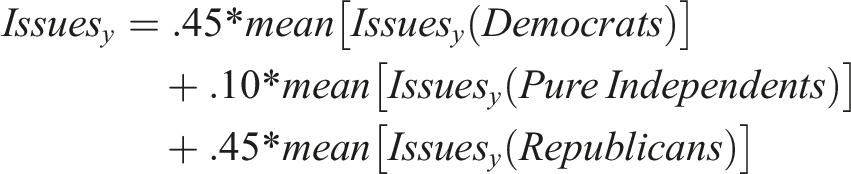
By doing this, when we compare across elections, changes in these two key variables will not be driven by changes in the underlying partisan distributions, but instead by changes in the public’s assessments of the candidates. 14
These likes-dislikes-based measures, whether they tap respondents’ relative advantage or disadvantage of the incumbent versus the challenger on character or policy, are designed to pick up signals from the campaign related to the relative strengths and weaknesses of both candidates. 15 The information contained in the signals from the aggregated candidate differentials is limited but simple: the degree to which one candidate or the other had the advantage in relative character- and issue-related assessments among the electorate.
Results
Figure 1 presents the simple bivariate relationships between the incumbent-challenger character and issue differentials and incumbent parties’ vote margins. As expected there is a positive relationship between each differential and vote margins. It is also clear that these relationships are noisy and other factors must help account for presidential electoral outcomes. This, too, is consistent with expectations. Our claim is not that candidate differentials offer a complete explanation of vote share, but they are an important factor and that the referendum model that focuses solely on the incumbent (and the “structure” of the electoral context) is incomplete. Incumbent vote and character/issue candidate differentials.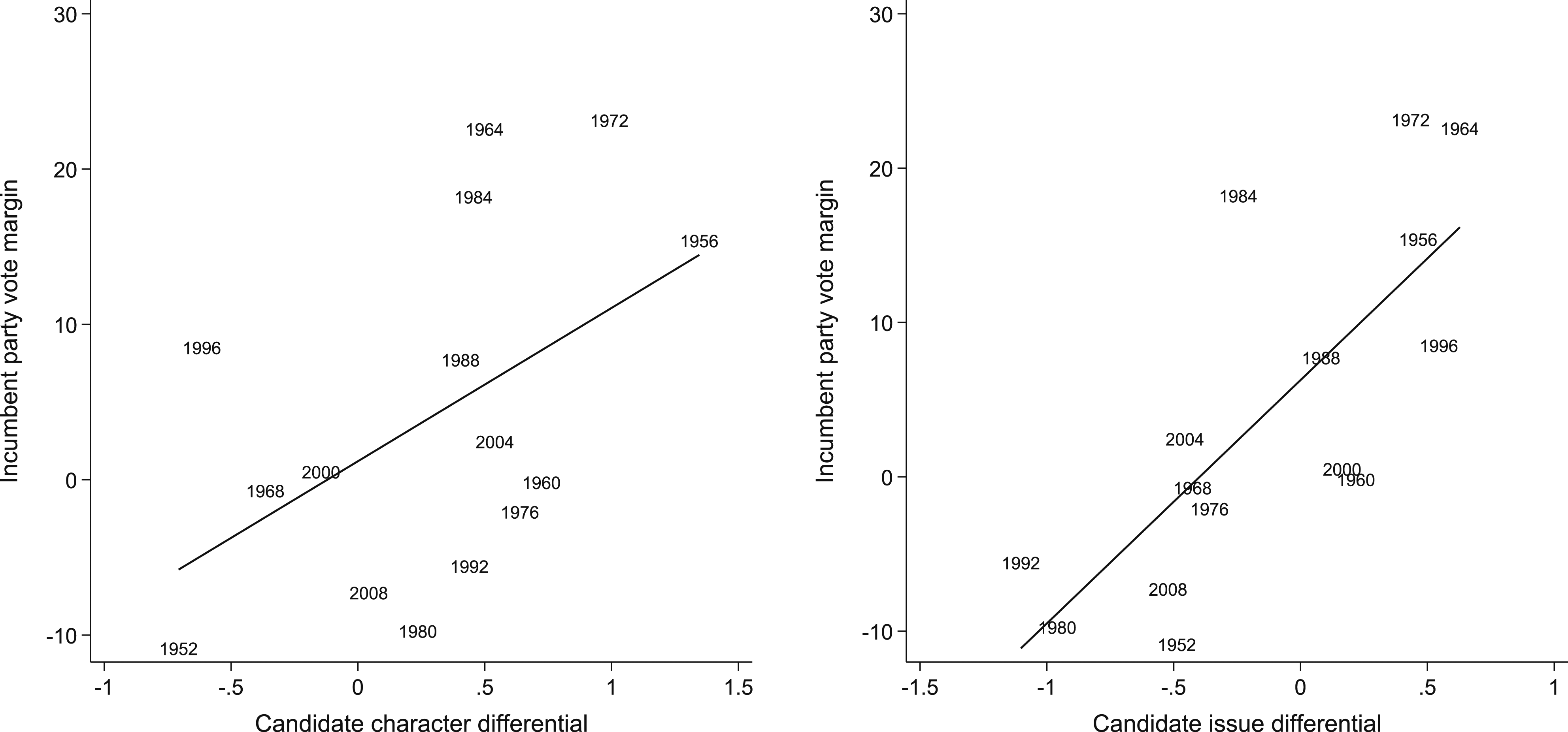
We also descriptively consider the joint relationship by dividing the elections into three categories. One category is elections where the incumbent party’s candidate was advantaged on both Character and Issues (n = 5). The second is elections where one party was favored on one of the dimensions and the other party was favored on the other dimension (n = 8). And, the third category is elections where the incumbent party’s candidate was disadvantaged on both Character and Issues (n = 2). Our expectation (if all else is equal) is that the incumbent party would do best in the first category of elections and worst in the last category. That is what we find in the data. When the incumbent party’s candidate was favored on both dimensions the average incumbent party vote margin was +13.7. When the parties’ candidates were split, the average margin was +.6. And, when the challenger party’s candidate was favored on both, the average incumbent party vote margin was −5.8.
Parameter Estimates of Incumbent Party Vote Margin With Referendum and Candidate Differential Factors.
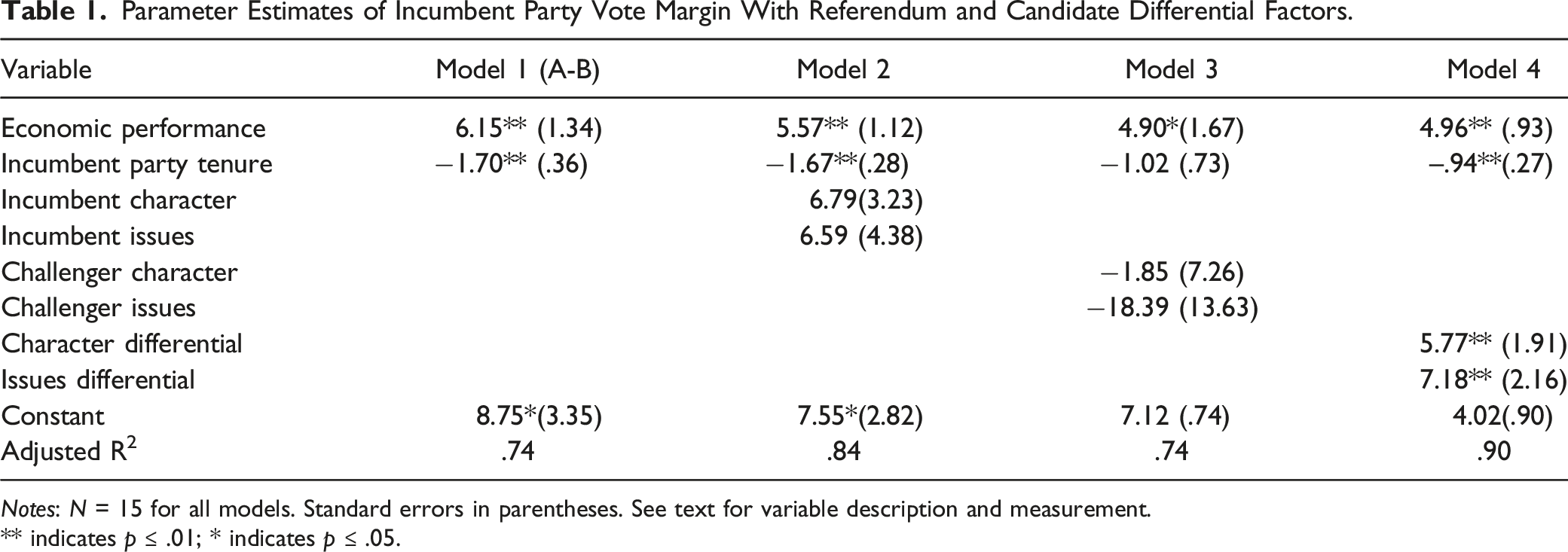
Notes: N = 15 for all models. Standard errors in parentheses. See text for variable description and measurement.
** indicates p ≤ .01; * indicates p ≤ .05.
Model 2 represents an extension of the referendum model by only including incumbent candidate character and issue ratings. The estimated effects of neither can confidently be distinguished from zero (p > .05) and the improvement in model fit is modest. Likewise, only adding the electorate’s ratings of challenger candidates on character an issues (Model 3) does not add notably to the A-B model. In short, Models 2 and 3 are consistent with the view that candidate characteristics do not add much, if anything, to the structural context of the election.
Our argument, though, is that candidate differentials may be important. This hypothesis is tested with Model 4, which includes the measures of Character and Issues based on both candidates as described earlier. The relationship between each differential can confidently be distinguished from the null hypothesis of no relationship (p < .05) and the adjusted R-square increases to .90 from .74 with the A-B model (Model 1), with substantial estimated effects of Economy and Tenure still evident. 16 Thus, it appears that our choice differential model supplements, rather than displacing, the referendum model.
Figure 2 shows the partial estimated effects of the covariates in Table 1, Model 4. It is clear from this figure that while the variables that define the referendum component of the model remain relevant, so too do the character and issue candidate differentials that are our focus. Incumbents’ electoral prospects suffer when economic performance is poor, and their reelection becomes more difficult the longer their party has been in office. At the same time, over and above these structural factors, when incumbents enjoy character and issue advantages over their challengers, their electoral prospects are improved. When the incumbent’s standing on these dimensions of choice put them at a disadvantage, their support declines. Partial estimated effects (based on model 4, Table 1).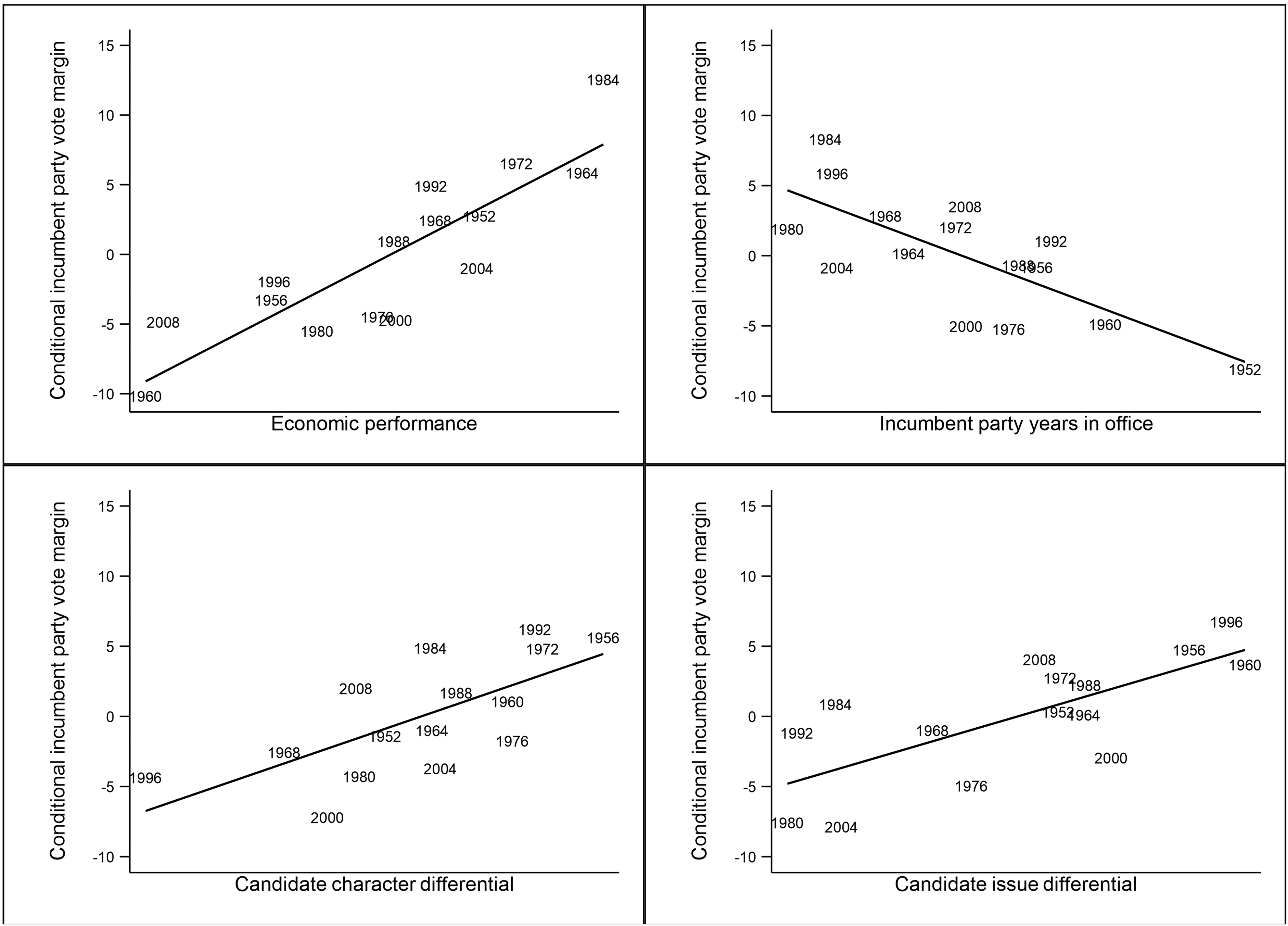
Conclusion
We have shown that there is room for improvement in the referendum model of presidential election outcomes. In addition to holding incumbents accountable for national well-being, our approach takes account of the choice between the opposing candidates on two fundamental dimensions of concern to voters: how the candidates compare on their personal qualifications to hold the presidency, and on the policy issues debated in the campaign. Simply put, we developed a model that accommodates candidate differences of fundamental interest to voters and found that they considerably improve our understanding of presidential election outcomes. To be sure, national conditions like economic performance matter. At the same time, so do both major party candidates. Properly understood, in addition to the state of national affairs, presidential election outcomes are about the choice presented to mass public. While this view is embedded in individual-level models of vote choice that account for different choices among voters, its application to the question of explaining aggregate outcomes and electoral change in this article is novel. The results show that that candidates matter for election outcomes in ways that have not been properly appreciated in existing scholarship.
Several other considerations are relevant to our claims. First, why candidate, not party, differentials? Downs (1957) provides strong theoretical pedigree to party differentials, but we are with Stokes et al. (1958) in thinking that in explaining variation in presidential election outcomes, candidates—and therefore candidate differentials—are paramount. Candidates are best situated to explain electoral change. Parties have long-term reputations and consequences for voters’ loyalties, but in the short-term, from one election to the next, the candidates change, and as they do, the issues and character considerations that come into play also change. 17
Second, we do not equate the issue differential as we measure it to a spatial model that captures the relative distance of the candidates to the electorate’s median voter in ideological space. Indeed, attempts to incorporate ideological differences between the candidates in an aggregate model so far have had mixed success, at best (Cohen et al., 2016; Rosenstone, 1983). In supplementary analyses, our investigation of relative candidate extremism finds that it is insignificant (as Cohen et al. (2016) finds) and that it leaves undisturbed the notable effect of the policy differential we employ.
Third, one could argue that the Achen & Bartels (2016) model does not do justice to the referendum model since incumbents may be accountable on questions beyond economic performance. Hibbs (2000) and Gartner (2008) show that war-time battle deaths can have an effect, and recent experience with the COVID epidemic seems to indicate how presidents handle a pandemic may be relevant. Crime, education, and non-belligerent foreign policy successes or failures may also become relevant as more elections occur and come under study. There is a suggestion of truth to this argument as demonstrated in previous research (e.g., Abramowitz, 1988; Erikson et al., 2001), showing that presidential approval has a significant effect when added to the A-B model At the same time, after replicating those findings, when we add the character and policy differentials to this “approval-enhanced A-B referendum model,” the candidate differentials remain undisturbed.
Finally, we recognize that many questions remain about the mechanisms involved in producing the effects of candidate differentials. Our results show that these differentials are related to presidential election outcomes, but without information about how or why. Does partisan polarization deter the electorate from focusing on character differences (Wattenberg, 2016)? Are domestic-policy issues always more important than foreign-policy considerations? How does variation in issue salience affect the impact of these differentials? These and many other questions must await a political history that produces more elections with, one hopes, the continued availability of high-quality survey research.
We now have enough presidential elections in hand with appropriate data to test Stokes’ et al. (1958) intuition made in the infancy of the American National Election Studies that we should “accord genuine motivational significance to attitudes toward the candidates and issues” in explaining presidential election outcomes. Our results provide strong evidence that the intuition was correct, and as a result we have a more complete—and also a more optimistic—understanding of how presidential electorates behave.
Supplemental Material
Supplemental Material - “Extending the Referendum Model of Presidential Election Outcomes: Both Candidates Matter”
Supplemental Material for “Extending the Referendum Model of Presidential Election Outcomes: Both Candidates Matter” by Benjamin Highton, Walter J. Stone in American Politics Research
Footnotes
Declaration of Conflicting Interests
The author(s) declared no potential conflicts of interest with respect to the research, authorship, and/or publication of this article.
Funding
The author(s) received no financial support for the research, authorship, and/or publication of this article.

Supplemental Material
Supplemental material for this article is available online.
Notes
References
Supplementary Material
Please find the following supplemental material available below.
For Open Access articles published under a Creative Commons License, all supplemental material carries the same license as the article it is associated with.
For non-Open Access articles published, all supplemental material carries a non-exclusive license, and permission requests for re-use of supplemental material or any part of supplemental material shall be sent directly to the copyright owner as specified in the copyright notice associated with the article.
