



Abstract
Citizens’ perceptions of the alt-right are not well explored in political science. We view the alt-right as a successor of the Tea Party movement. While the Tea Party described itself as organized around spending, the size of government, and the American Constitution, examinations of the movement found that the unifying concerns of people who identified with it or viewed it favorably were negative feelings about racial minorities and patriarchal views of gender roles. Using panel survey data, we show that whites with higher levels of hostile sexism, racial resentment, perceptions of discrimination against whites, and who were more favorable towards Donald Trump evaluated the alt-right movement more positively. We find no evidence that self-placed ideology informed these evaluations. On the whole, latent cultural conservatism appears to inform evaluations of the relatively unknown — at the time — alt-right movement.
The alt-right has become a focusing movement of a resilient and resurgent far-right in American politics (Hawley, 2017). Studies of the alt-right mostly examine the elite level - that is to say what people steeped in the movement believe and how they disseminate their beliefs (Main, 2018), profiles of salient members (Forscher, and Kteily 2020), or one aspect of their cultural attitudes (Boehme, and Isom Scott 2020). However, to wield power in a democracy, political movements must expand conflicts (Schattschneider, 1960) and appeal to those outside their cadre of supporters. While social scientists have examined the nature of the alt-right movement, there has been little work on how American citizens — who do not care much about or pay much attention to politics (Campbell et al., 1960; Converse, 1962; Delli Carpini & Keeter 1996) — perceive of the alt-right. What informs evaluations of the alt-right?
We view the alt-right as another iteration of far-right politics in the United States. This more general movement has existed in some form since the founding. Anti-change, reactionary politics take many forms in American history (Nash, 2014), but throughout them are the common position that at the present (whatever time the present may be), conditions for Black Americans and women are better than they have been in the past and that therefore the current grievances of those groups against individuals, institutions, and society at large are illegitimate (Robin, 2011). Because of this, we expect people who feel high levels of racial resentment and hostile sexism — two measures of opinion rooted in the legitimacy of these kinds of grievances — to evaluate the alt-right movement more positively. We further expect conservatives to view the movement more positively because it is a right-leaning group, so spatial and social considerations may make it appear sympathetic. Those who think that white Americans face racially motivated discrimination also ought to view the alt-right more positively because the group’s rhetoric is consistent with this belief, as should citizens with favorable views of Donald Trump, who often spoke positively of the alt-right and related groups.
We test these expectations using a panel survey commissioned by the Democracy Fund’s Voter Study Group. We focus on interviews conduced in late 2016 and early 2017. 1 We find evidence that racial resentment, hostile sexism, perceptions of discrimination against whites, and Trump favorability all positively correlate with evaluations of the alt-right. Ideological conservatism, on the other hand, does not appear to inform these affective evaluations.
These findings have two major implications for the study of far-right politics across the globe. They suggest that there is a relationship between (1) group-based prejudices and (2) a feeling that one’s own group is imperilled and affect towards the alt-right. These relationships appear similar to what online communities call redpilling: a sharp increase in these feelings from a latent position also results in the adoption of more far-right politics. Regardless of the change in perception of the alt-right after the Unite the Right Rally in Charlottesville, Virginia in 2017 (Atkinson, 2018), our results also imply a latent far-right set of attitudes that are activated by identity politics centering on grievances felt towards women and people of color (Achen & Bartels, 2016).
Explaining Evaluations of the Alt-Right
The term alt-right gained prominence in elite conservative intellectual circles throughout the Obama presidency (Hawley, 2017; Main, 2017). Though framed as a new perspective on conservative tradition in the U.S., it calls upon paleo-conservative and ethno-nationalist traditions that have long been part of American politics. The term alt-right gained main-stream understanding in the 2016 presidential election. By the end of 2016, news outlets were already beginning to rethink use of the term alt-right and instead chose to frame the movement and its leaders as white nationalists (Daniszewski, 2016). Like all ideologies, the alt-right is difficult to neatly define, both because the movement is internally slippery 2 about its policy preferences (Lombroso, and Appelbaum 2016) and that survey respondents do not consistently view the alt-right as different from conservatives on all notable deviations of the alt-right from mainstream conservatism (Cluverius et al., 2020). However, we define it as a white nationalist movement that mixes populism with white supremacy. This is consistent both with standard journalistic definitions of the movement (Speakman, 2021), the long ideological history of far-right movements in the United States (Hartzell, 2018), and how ordinary citizens think about alt-right relative to conservatism (Cluverius et al., 2020).
Studies of conservatism disagree about its nature; some see it as intellectual tradition based on reason and restraint (Nash, 2014), while others see it as a fundamentally anti-progressive movement based on maintaining order (Robin, 2011). We focus on the tradition of far-right American political movements in pseudo-conservatism, the use of conservative rhetoric to advance other, not explicitly conservative ideals (Adorno et al., 1950; Hofstadter, 1965). For instance, far-right activists have used discussions of states’ rights and federalism to advance support for segregation. Pseudo-conservatism is a tell of far-right movements, but is also used by mainstream conservatives who use increasingly abstract concepts to activate voters with anti-black attitudes (Lamis, 1990). 3
The Tea Party movement in America of the 2010s illustrates this pseudo-conservative tradition. After Barack Obama won the 2008 presidential election, the Tea Party emerged as a new far-right movement in America. Tea Party members used rhetoric that focused on the Constitution and government spending, but supported government programs that required large expenditures like Social Security, Medicare, and defense policy (Skocpol & Williamson 2016). However, members of the Tea Party also revealed that they were more likely to hold stereotypical views of Black Americans and to believe that claims of racism as a dominant force in American history and life were overblown (Parker & Barreto 2014). 4 Members of the Tea Party, including women, were also likely to score higher on measures of sexism like modern sexism, which captures respondents’ resentment of women using questions asking about special favors for women, antagonism towards the claims of women’s groups, and denial of the existence of continuing discrimination against women in employment, relationships, and broader cultural contexts (Cassese & Barnes 2019).
Recent research further suggests that sexist attitudes are associated with both political mobilization (Banda & Cassese, 2022) and support for right-leaning candidates like Donald Trump and other Republicans (Bock et al., 2017; Schaffner et al., 2018; Schaffner, 2022). Much of this research centers on the effects of hostile sexism 5 on support for Republican candidates. People who express higher levels of hostile sexism are explicitly opposed to attempts to challenge conventional gender norms and tend to view gender relations as a zero-sum game. Thus, they view the promotion of gender-based equality as politically illegitimate (Glick & Fiske, 1997, 2001). Such views are consistent with the messages espoused by members of the alt-right.
We argue that the alt-right is an extension of far-right movements like the Tea Party. Main, (2018) interviewed alt-right leaders who explicitly cite racial identity and white racial consciousness as making them distinct from previous iterations of white supremacists. The alt-right also treats racial thinking as a cornerstone of their political project (Hawley, 2017). This generates our first hypothesis:
As levels of racial resentment increases, whites will express more positive evaluations of the alt-right.
In addition, a return to chauvinistic gender roles centers the alt-right as well (Ratliff et al., 2019). The alt-right embraces a narrative of white male grievance that in measurable terms would cause a survey respondent to have high levels of hostile sexism. Thus, we expect white people with higher levels of hostile sexism to express more positive evaluations of the alt-right because the movement is sympathetic to those kinds of views. Some members of the alt-right see gender and gender attitudes as the defining characteristic of the alt-right. One of the first cultural skirmishes of the alt-right was over the involvement of women in the video game industry and the journalists who cover it (Bezio, 2018). People with high levels of hostile sexism express negative attitudes towards people who violate traditional gender roles, leading us to:
As levels of hostile sexism increases, whites will express more positive evaluations of the alt-right.
Racial resentment encompasses feelings about Black people, but classic measures of racial resentment do not include feelings white people have about their own place in contemporary society (D. R. Kinder & Sears 1981; D. R. Kinder & Sanders 1996). Racial resentment is one thing, but what about white people’s feelings about themselves?
6
The grievance aspect of white identity politics is a central tenet of the alt-right (Forscher, and Kteily 2020), and previous research on white victim ideology, which includes attitudes about discrimination against whites, strongly correlates white victim ideology with affiliation with the alt-right (Boehme & Isom Scott 2020). What is left, however, is what makes people feel good about the alt-right rather than merely identifying with it. This leads to a third hypothesis:
As beliefs in discrimination against whites become stronger, whites will express more positive evaluations of the alt-right.
Fourth, Cluverius et al. (2020) find that people view alt-right candidates as holding more right-leaning ideological and issue positions than conservative candidates. Given the logic of spatial models of voter choice (Downs 1957; Kropko & Banda 2018; Rabinowitz & Macdonald 1989), this implies that people who hold more right-leaning ideological preferences should view the alt-right more positively than people with less right-leaning positions. While they are extremists, members of the alt-right are, to self-identified conservatives, fellow travelers in the broader right-wing political project in America, and much like socialists are to liberals, potential allies in electoral and policy conflicts. In other words:
As ideological positions become more conservative, whites will express more positive evaluations of the alt-right.
Finally, there may be an additional looming effect in structuring voters’ feelings towards the alt-right movement: feelings toward Donald Trump. Trump is one of the most polariz-ing figures in American politics partially because he is so well-known; even before a single Republican primary vote was cast in 2016, more voters could form warm or cold feelings towards Trump than any other Republican candidate. Further, Trump supporters in the 2016 Republican primary were consistently disaffected by traditional politics and political structures (Dyck et al., 2018). Trump also elevated alt-right figures to high positions in his campaign and administration (Altman, 2016), making the alt-right more palatable to the broader Trump coalition (Selvanathan & Leidner, in press). Because voters are more likely to know about Trump than they are about the alt-right, they see the loop of positive comments between Donald Trump and the alt-right movement and its leaders
7
and believe the alt-right to be fellow travelers in the broader pro-Trump sphere (Kusz 2017; Nagle 2017). This leads us to our final hypothesis:
As evaluations of Trump become more positive, whites will express more positive evaluations of the alt-right.
Research Design
We use data commissioned by the Democracy Fund Voter Study Group and collected by YouGov 8 in December 2016 and again in July 2017. The Views of the Electorate Research (VOTER) survey (2017) is a multi-wave national panel survey of American adults that first began interviewing respondents in 2011, though we only use two waves for this analysis. Respondents were then interviewed in December of 2016 and again in July of 2017. The VOTER survey contains information about the demographic characteristics and political preferences of each respondent. Our analyses are restricted to the 4015 respondents who (1) completed both the 2016 and 2017 waves of the survey and (2) identified as white because of our interest in white grievance attitudes and the fact that hostile sexism and racial resentment operate in different ways across racial and ethnic groups (Frasure-Yokley, 2018; Kam & Burge 2018).
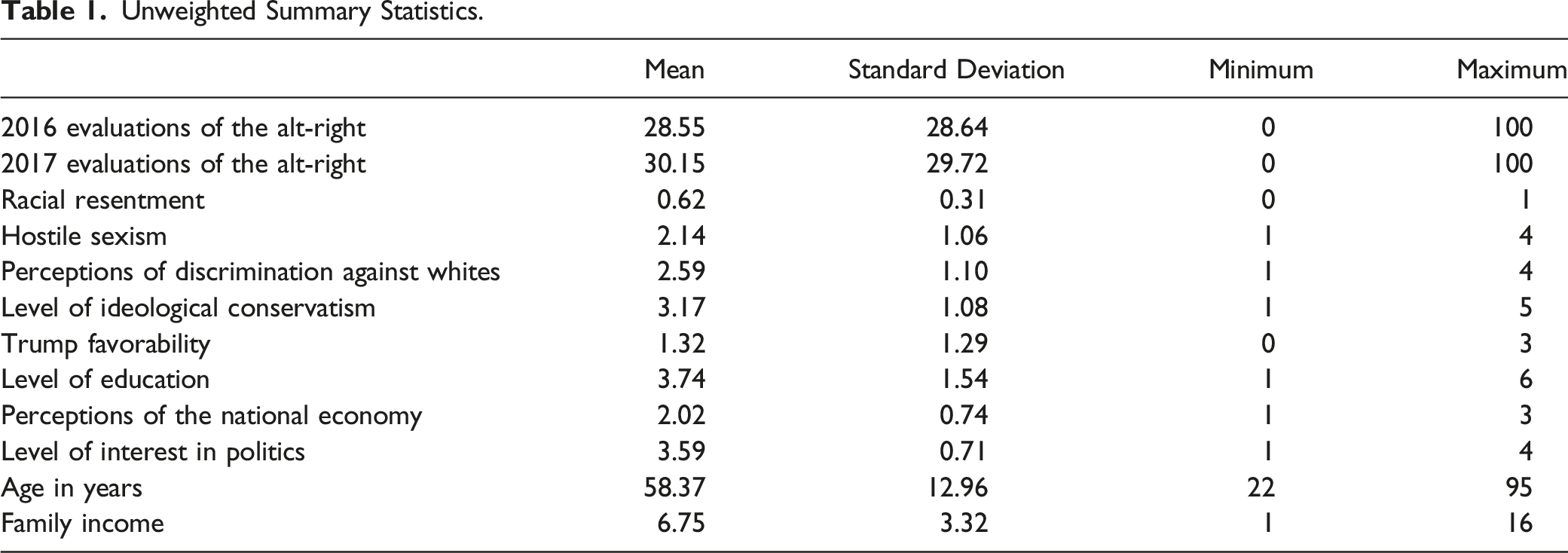
The dependent variable of our analysis is survey respondents’ affective evaluations of the alt-right. This is a standard 0 to 100 point feeling thermometer. Higher values indicate that respondents like the alt-right more. This item was included in the July 2017 wave of the survey. On average, respondents do not report positive evaluations of the alt-right. The mean evaluation is only 28.6 and 30.2 in the 2016 and 2017 waves, one of the lowest evaluated groups in the survey. 9
Our key independent variables of interest come from the December 2016 wave of the survey. We measure racial resentment using a battery of four standard survey questions that are often used to tap this concept (D. R. Kinder & Sanders 1996), each of which asked respondents how much they agreed with a given statement on a four point scale ranging from “strongly agree” to “strongly disagree.” These statements were: “Over the past few years, Blacks have gotten less than they deserve”; (2) “Irish, Italian, Jewish, and many other minorities overcame prejudice and worked their way up. Blacks should do the same without any special favors”; (3) “It’s really a matter of some people not trying hard enough; if Blacks would only try harder, they could be just as well off as whites”; and (4) “Generations of slavery and discrimination have created conditions that make it difficult for Blacks to work their way out of the lower class.” We combined respondents’ views on these items into a standardized scale ranging from 0 to 1 (alpha = 0.92). Higher values indicate higher levels of racial resentment.
We measure hostile sexism using a single item, which reads “when women demand equality these days, they are actually seeking special favors.” 10 To capture perceptions of discrimination against whites, we use a survey item reading “today, discrimination against whites has become as big a problem as discrimination against blacks and other minorities.” Responses to both items are coded from 1 (“strongly disagree”) to 4 (“strongly agree”), which means that higher values correspond with higher levels of hostile sexism and greater perceptions of discrimination against whites.
We use the latter question to capture the degree to which respondents believe that white Americans are being systematically discriminated against. The question asks respondents to compare the situation of white Americans to those of Black Americans and members of other racial minority groups, so it is perhaps a somewhat problematic indicator in that some respondents may believe that white Americans face a great deal of discrimination while other groups face little to no discrimination. 11 Regardless, this is the best survey item available in the data to capture this concept, but future research might consider how to improve the wording of the question.
We measure ideological conservatism using a question that says “in general, how would you describe your own political viewpoint?”Responses are 1 “very liberal,” 2 “liberal,” 3 “moderate,” 4 “conservative,” and 5 “very conservative.” Last, respondents were asked how favorably they viewed Trump. Responses are coded from “very unfavorable” (0) to “very favorable” (3).
Unweighted Summary Statistics.
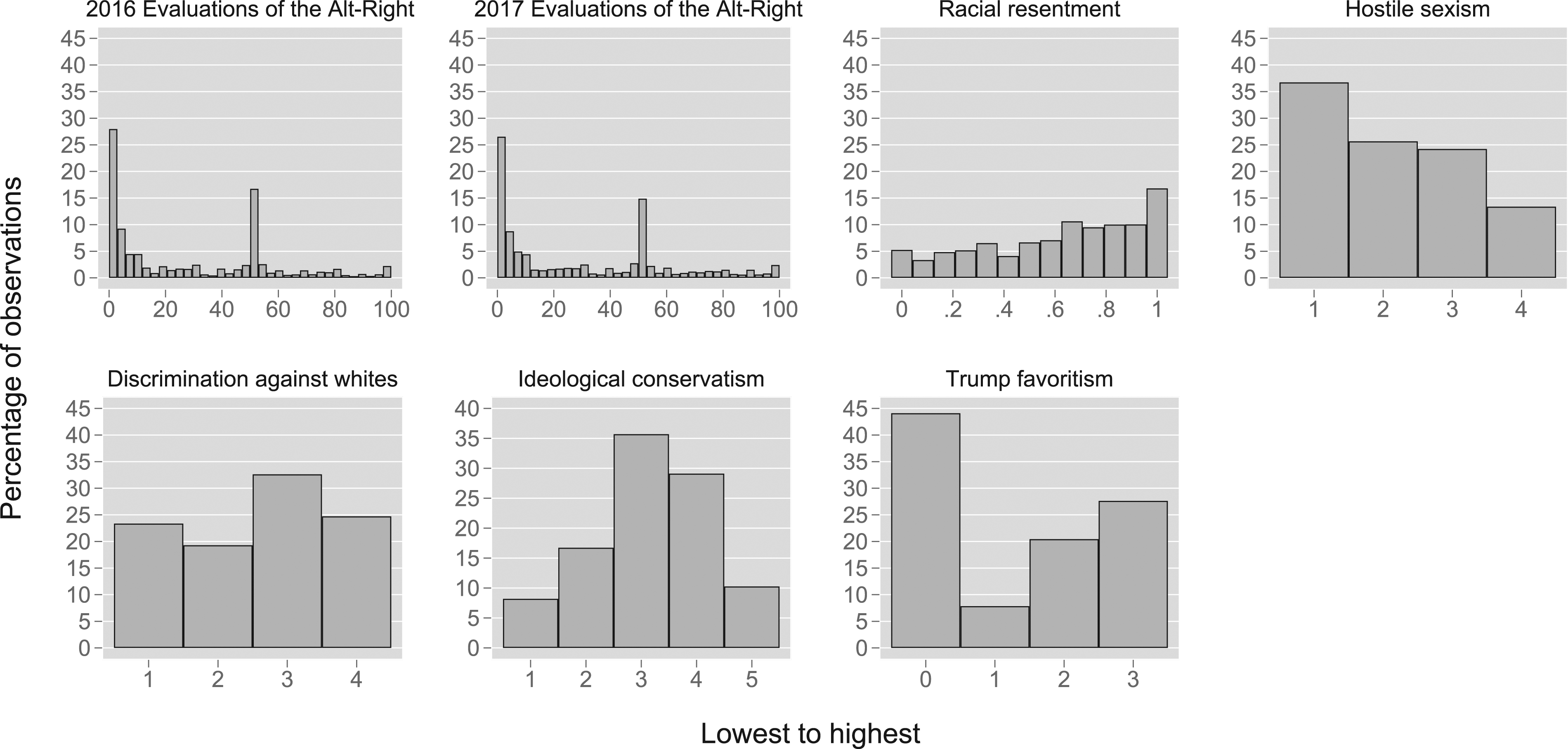
Distributions of key variables.
Results
Evaluations of the Alt-Right.
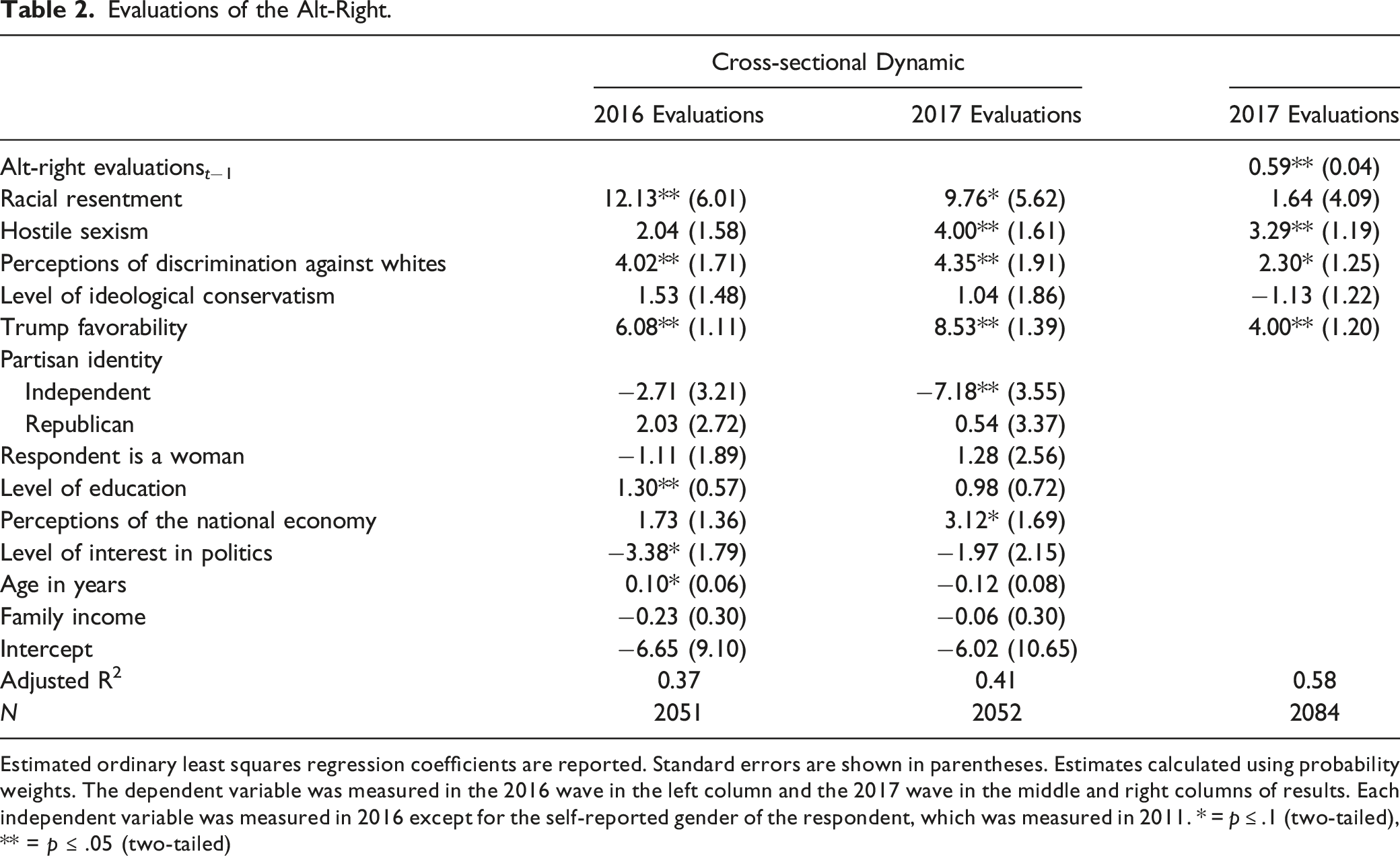
Estimated ordinary least squares regression coefficients are reported. Standard errors are shown in parentheses. Estimates calculated using probability weights. The dependent variable was measured in the 2016 wave in the left column and the 2017 wave in the middle and right columns of results. Each independent variable was measured in 2016 except for the self-reported gender of the respondent, which was measured in 2011. * = p ≤ .1 (two-tailed), ** = p ≤ .05 (two-tailed)
We first note that these results provide no evidence favoring Hypothesis 4. It does not appear as if people with more right-leaning ideological orientations view the alt-right more favorably. Ideological conservatism appears to be unrelated to people’s affective views of the alt-right, at least when controlling for the other concepts included in these models. The rest of the hypotheses, however, receive support.
Respondents higher in racial resentment on average view the alt-right more positively in both cross-sectional models. Moving from the lowest to the highest level of racial resentment leads respondents to view the alt-right 12.1 and 9.8 units more positively on average in the 2016 and 2017 models, respectively. Evaluations of the alt-right range from 0 to 100, so this is a substantively large effect. These two coefficients also differs significantly (p ≤ .05) from zero. The results of the dynamic model, on the other hand, do not suggest that racial resentment informs alt-right evaluations. These results offer mixed support for Hypothesis 1.
We further observe mixed support for Hypothesis 2. We are unable to reject the null hypothesis of no relationship in the case of the 2016 evaluations model, but it does appear as if increases in hostile sexism correlate with increasingly positive views of the alt-right in the 2017 cross-sectional and dynamic models. A one unit increase in hostile sexism corresponds with an average increase in 4 and 3.3 units in the 2017 and dynamic models respectively. Both coefficients differ significantly (p ≤ .05) from zero, and the effect sizes are meaningful when the full range of the hostile sexism measure (1–4) is considered.
The results of all three models provide strong support for Hypothesis 3. Whites who perceive of greater discrimination against white Americans view the alt-right more positively and these relationships surpass traditional (p ≤ .05) levels of statistical significance. A one unit increase in perceptions of discrimination against whites corresponds with 4, 4.4, and 2.3 unit increases in evaluations of the alt-right across the three models. The coefficients can be multiplied by 3 to observe the effects of increasing from the minimum to the maximum value of perceived discrimination.
Last, we consider the results for Trump favorability, which consistently support Hypothesis 5. All three coefficients are positive as expected and differ significantly (p ≤ .05) from zero. For each additional unit of additional Trump favorability, evaluations of the alt-right on average increase by 6.1, 8.5, and 4 units across the three models. This favorability indicator ranges from 0 to 3, so moving from the minimum to the maximum values of Trump favorability correspond with 18.3, 25.5, and 12 unit increases in alt-right evaluations.
Conclusion
We find consistent evidence that racial resentment, hostile sexism, perceptions of discrimination against whites, and Trump favorability encourage white Americans to view the alt-right more favorably. These results show clear connections between perceptions of this far-right movement and culturally conservative beliefs that the claims of unequal treatment made by women and Black Americans are invalid. We do not find any evidence that ideological conservatism informs evaluations of the alt-right.
This implies that there is an undercurrent of culturally conservative attitudes in America ready to attach itself to group labels that activate them. The second wave of the survey was conducted at the time that the alt-right at its zenith, before the murder of Heather Heyer later that summer in Charlottesville, Virginia. The alt-right might decline in popularity, but the audience for a similar movement that can cue similar culturally conservative ideas remains. The ways people described themselves might change over time, but our findings suggest that there will be an audience for far-right movements regardless of how salient movements like the alt-right are. Our findings also offer support for earlier theories of pseudo-conservatism; regardless of the message of far-right movements, attachment to them is shaped by reactionary attitudes about race and gender. The names of far-right movements might change, but people with hostile views towards women and members of racial and ethnic minority groups will likely still be drawn to them.
Our analysis shows that this effect is informed by latent attitudes. As respondents in the survey showed higher levels of hostile sexism and racial resentment in the 2016, their affect towards the alt-right increased at a greater rate in 2017. This effect of holding latent cultural conservative attitudes and attaching to nascent ideologies has been studied in content analyses of online forums (Dignam & Rohlinger, 2019; Hodapp, 2017), but rarely emerges in survey research and broad-scale public opinion work. This suggests that future work on the impact of racial and gender attitudes should consider these shifts as well. In order to understand the variance in how salient far-right movements are over time, we must first observe how people with far-right preferences express their views and attach themselves to those movements. Future research should more closely examine these dynamics and should also expand to include far-right groups that have become increasingly salient like Christian nationalists.
Footnotes
Declaration of Conflicting Interests
The author(s) declared no potential conflicts of interest with respect to the research, authorship, and/or publication of this article.
Funding
The author(s) received no financial support for the research, authorship, and/or publication of this article.
