



Abstract
This study exploits the introduction of a new type of public financing of elections—campaign finance vouchers—to estimate the effects of neighborhood-level political cross-pressure on citizens’ decisions to participate in low-cost political activities which vary in their publicness: voting (private) and vouchering (public). Does proximity to ideologically divergent neighbors affect one’s use of publicly disclosed campaign finance vouchers? We find that cross-pressured individuals are slightly more likely to use a campaign finance voucher than similarly situated individuals who are ideologically typical for their precinct. We also find evidence that precinct-level cross-pressure does not drive voucher users to shade their voucher donations toward candidates who are ideologically closer the precinct mean. While our study is limited to a relatively liberal city (Seattle), our results replicated across two election cycles in that city, and our methods can easily be extended to future elections. Finally, our findings raise questions about the empirical assumptions that have shaped the development of campaign finance jurisprudence since 1976.
Introduction
Most campaign finance regimes in the United States require public disclosure of private contributions to candidates in excess of a modest threshold ($200 in federal elections, less in many state and local elections). Critics of mandatory disclosure argue that it chills individuals from exercising their First Amendment right to speak and associate through the contribution of money to candidates, and that this chilling effect is particularly likely to occur among political minorities. Disclosure is said to muffle the voices of people who would otherwise contribute to the marketplace of ideas. In recognition of this risk, the U.S. Supreme Court requires disclosure exemptions for donors to minor parties and to independent candidates when there is a demonstrable risk of harassment. Buckley v. Valeo, 424 U.S. 1, 64–74 (1976).
Whether disclosure chills political participation is an empirical question (Wood, 2018). The relationship between disclosure and participation is difficult to untangle because no extant disclosure regime was randomly assigned or otherwise rolled out in a fashion that would allow researchers to isolate plausibly comparable “treatment” and “control” groups. Nor can researchers make headway on the question using a discontinuity design because donations below disclosure thresholds are not observed. In this study, we attempt to shed some new light on this old and difficult question by leveraging an innovative local campaign financing program. Although small-dollar public funding programs have been advocated for decades (see, e.g., Ackerman & Ayres, 2002; de Figueiredo & Garrett, 2005; Foley, 1994; Hasen, 1996; Overton, 2004), the first publicly funded system of campaign finance vouchers was adopted only recently, by the city of Seattle, Washington. Each registered voter receives four $25 vouchers, which may be assigned to candidates running for local office. The vouchers are accompanied by information about disclosure of the voucher contributions (Appendix A). Candidates who wish to redeem vouchers agree to various restrictions on private fundraising and demonstrate their viability by raising small private donations. Research concurrent with ours has shown that Seattle’s voucher program expanded the campaign finance donor pool (McCabe & Heerwig, 2018), though not yet to the extent that advocates have promised. 1 Because all voucher contributions are publicly disclosed, Seattle’s program allows us to analyze the effects of political cross-pressure on the decision to assign campaign finance vouchers.
Comparison of Different Modes of Political Participation.
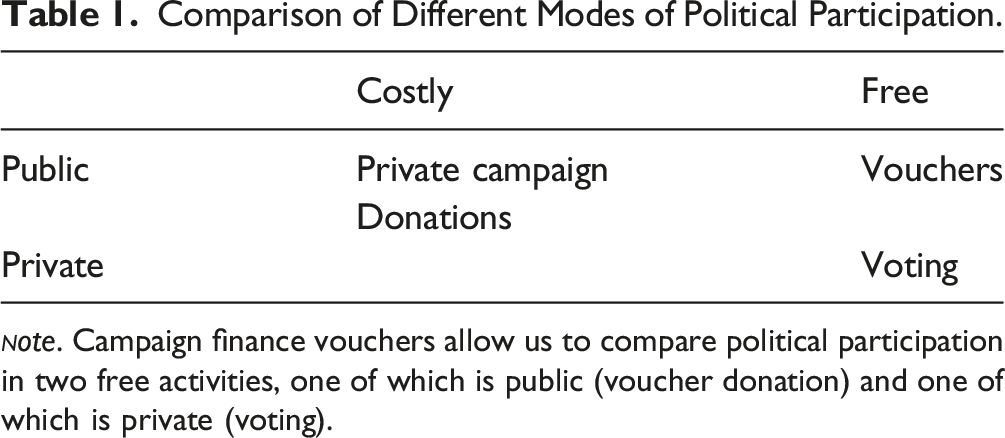
Our goal in this paper is to assess whether variations in the participation gap may be explained by neighborhood-level cross-pressure. Our strategy is to test whether voucher use varies systematically between individuals who are ideologically similar to their neighbors and individuals who are local political outliers, relative to baseline rates of turnout. Put differently, we estimate the treatment effect of neighborhood ideological cross pressure on registered voters’ private (votes) and public (vouchers) political participation decisions.
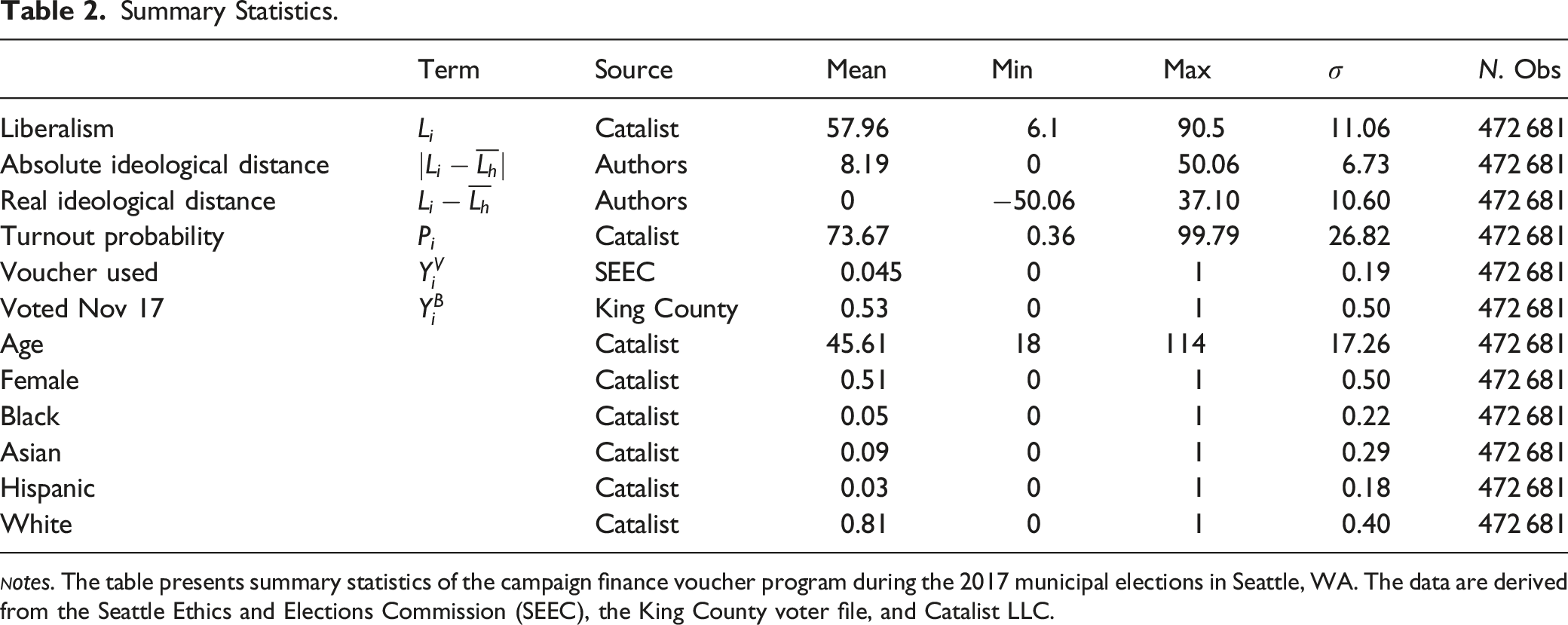
We use two matching strategies to estimate the effect of neighborhood cross-pressure on voting and vouchering. In the first analysis, registered voters in the treatment group (distant from their neighborhood’s ideological mean) and registered voters in the control group (similar to their neighborhood’s ideological mean) are matched on ideology and on a measure of their propensity to participate in politics. For the second analysis, which was not pre-registered, we do not match on ideology, in effect treating ideologically moderate Seattleites as counterfactuals for extremists (conditional on their propensity to participate in politics). We added the second design, which rests on much stronger assumptions, after discovering that there is little variance in the mean ideology of neighborhoods in Seattle. This means that the treatment dose in our pre-registered design is very small—the registered voters classified as distant from their neighborhood mean are in reality fairly close to it, just not as close as those who are classified as typical.
Results from both designs are similar and do not support the hypothesis that neighborhood-level cross-pressure causes local political outliers to participate less in public (vouchering) relative to private (voting) political activity. The observed effects of neighborhood-level dissonance on voting and vouchering are both very small and, if anything, local political outliers are less likely to vote but more likely to voucher than otherwise similar registered voters who are not local outliers. This cuts against the conventional wisdom about the supposed chilling effect of disclosure. We replicated our design on data from the 2019 election and find similar results for vouchering among politically cross-pressured voters, when compared to population matches who were not cross-pressured.
We also estimate the effect of neighborhood cross-pressure on donors’ choice of voucher recipients. Among pairs of voters matched on ideology and propensity to participate, we find that those who are neighborhood cross-pressured are less likely to give to candidates whose ideology is similar to the donor’s own ideology. Oddly, though, the vouchers assigned by these cross-pressured voters are not more likely to go to candidates who are close to the ideological mean of their neighborhood, relative to the vouchers assigned by the matched-pair voter in the control group. Thus, while cross-pressure appears to have some effect on the choice of whom to contribute, it is not the social-conformity (homophily) effect we hypothesize.
Our study is limited to a relatively liberal city (Seattle), and it remains to be seen whether our findings will generalize to other jurisdictions. But because we find no evidence of chilling or neighborhood-conformity effects, our results suggest that courts should be cautious about imposing an anonymity requirement on voucher programs. 3
Cross-Pressure, Ideology, and Campaign Finance Participation
Some people are embedded in ideologically congenial social networks. Other people are political minorities within their networks; they experience “cross-pressure” between their personal political beliefs and those of their friends, neighbors, co-workers, and the like. At least since Campbell et al. (1960)’s seminal study, The American Voter, social scientists have been trying to understand how cross-pressure from one’s social environment affects political participation. Mutz (2002) conducted two in-depth surveys with individuals who reported discussing politics with others. Respondents who were exposed to different viewpoints were much less likely to report having voted than respondents who had discussed politics with like-minded colleagues. Cross-pressured respondents also reported lower rates of public political participation (e.g., working for a campaign or attending a rally). McClurg (2006), used data from a 1984 survey of residents of 16 neighborhoods in South Bend, Indiana, and found that local political minorities are less likely to work on a campaign, display a bumper sticker or sign, donate money, attend political meetings, or vote. 4
Mutz (2002) notes that these effects of cross-pressure could be due to self-doubts induced by exposure to competing ideas, to a fear of being shamed by one’s peer group, or to a combination of these factors. If the mechanism is induced self-doubt, the effect should manifest equally with respect to anonymous (e.g., voting) and publicly visible (e.g., displaying campaign signs, making disclosed campaign contributions) forms of political participation. By contrast, if shaming or outright harassment is to blame, only visible forms of political behavior are likely to be affected. 5
Critics of campaign finance disclosure requirements often raise the specter of shaming and harassment. In Buckley v. Valeo, 424 U.S. 1 (1976), the Supreme Court assumed that disclosure would demobilize participation among supporters of independents and minor-party candidates, because of cross-pressure from supporters of the two main political parties who dominate the social environment. Id. at 70. The Court’s assumed mechanism of chilling is the risk of harassment (Torres-Spelliscy, 2012). On the other hand, it is possible that disclosure could actually encourage participation by some citizens—those who enjoy credibly signaling their support for particular candidates (Gilbert, 2013).
Three recent studies present mixed results about the relationship between campaign contributions, political cross-pressure, and social pressure. Using a survey experiment, La Raja (2014) finds that reminding respondents about disclosure depresses (hypothetical) campaign contributions among persons who report having different political views than their family, co-workers, and neighborhood. 6 Oklobdzija (2019) compared the ideological distribution of donors to a “dark money” organization, which took the conservative side on a ballot initiative, to the ideological distribution of donors to transparent groups on the same side. He found that donors to the non-disclosing group—donors who had a reasonable expectation of anonymity—were more liberal on average (per Bonica’s 2013 ideology scores) than donors to the disclosing groups. This could be evidence of disclosure chilling or “distorting” public contributions.
On the other hand, Wood and Spencer (2016) find little evidence that disclosure rules chill political participation among ideological outliers. Analyzing historical campaign contribution data in state elections, they leverage variation in the strength of disclosure policies between states and across time, finding that disclosure has a small negative effect on the willingness to contribute, but that the negative effect is statistically indistinguishable between mainstream donors and ideological outliers within zip codes. 7
Following existing theories and prior studies, our first hypothesis is that under a voucher regime with full disclosure, citizens who are political minorities in their neighborhoods will be less likely to use their vouchers than they would be if they lived in a neighborhood where they are politically typical. By contrast, we expect to find no effect of neighborhood cross-pressure on the private form of low-cost political support, that is, voting. Our second hypothesis is that the effect of neighborhood cross-pressure on voucher use will be larger among conservatives than among liberals. Conservative-elite opposition to vouchers and disclosure may legitimate opting out among the conservative masses, as a kind of protest against the voucher program or the disclosure requirement (Druckman et al., 2013; McGraw et al., 1995). Moreover, in a generally liberal city such as Seattle, conservative political outliers may face greater opprobrium for their choices than far-left outliers.
Third, we test the hypothesis that, conditional on using one’s voucher, neighborhood cross-pressure will induce insincere voucher assignments. Rather than giving to candidates who are close to her own ideology, the cross-pressured voter will give to candidates near the mean ideology of her neighborhood. This builds on recent work finding that donors who moved districts changed their donation patterns, donating a larger share of their contributions to Democrats once they moved to a more Democratic district (Kettler & Lyons, 2019).
As the next section explains, only candidates for city offices were eligible to receive vouchers in the 2017 election. To the extent that municipal politics are nonideological, this limitation would presumably render neighborhood cross-pressure irrelevant. But as Warshaw (2019) concludes, “recent work has overturned the longstanding consensus that local politics was essentially nonideological.” (see also Boudreau et al. (2015a, 2015b); Tausanovitch and Warshaw (2014, 2013)) Scholars who have undertaken to map local and national issue spaces find the same main left-right dimension of conflict (Cann, 2018; Tausanovitch & Warshaw, 2014). Moreover, the policies enacted by local governments are responsive to mass opinion, particularly in the domain of social policy (Warshaw, 2019). Many of the hot-button social issues of our day—policing, criminal justice, single-family zoning, school segregation, tolerance for public disorder, even guns and immigration—are the stuff of city politics.
As in many other big cities, some candidates run for office in Seattle as far-left vanguardists, while others style themselves as centrist problem solvers. For example, in the election we studied, city-council candidate Teresa Mosqueda ran as a “Progressive Labor Democrat,” promoting workers’ rights, racial equity, affordable-housing development, and higher taxes on big business. 8 Similarly, candidate Jon Grant urged high affordability mandates on housing development, a new corporate tax, safe-injection sites for drug users, and restorative justice programs in lieu of traditional policing and incarceration. 9 Candidate Hisam Goueli, by contrast, said that the city should reduce regulatory barriers to housing development. He argued that the affordable-housing mandates would backfire, “causing market-rate prices to soar, displacing even more middle-class families” 10 While we would not expect neighborhood cross-pressure to affect vouchering behavior in Seattle council races as much as it might in, say, a race for President or Congress, we certainly expect it to have some effect. We also suspect that the early adopters of vouchers (i.e., the residents who used their vouchers in the 2017 and 2019 elections) are probably relatively well informed about city politics and the political opinions of their neighbors. It is among this segment of the electorate where the effects of neighborhood cross-pressure are most likely to manifest.
Data and Research Design
The Seattle Voucher Program and the 2017 Election
Our study site is Seattle, Washington, home of Honest Elections Seattle, which is the first and, to date, only campaign finance voucher program in the United States. Seattle launched its voucher program in 2017. All Seattle residents who were registered to vote as of November 2016 were mailed four $25 campaign finance vouchers on January 2, 2017. 11 For each voucher assigned, Honest Elections Seattle discloses the name of the contributor, the name of the assignee (candidate), the date of assignment, and voucher ID number. In 2017, only candidates running for city council or city attorney were eligible to receive voucher assignments. To redeem vouchers, candidates had to make a showing of viability and accept private contribution limits and spending limits. In all, five candidates vying for a city council seat qualified to collect/spend vouchers in the August 1, 2017 primary election, and four of those five (two for each seat) proceeded to the general election where they remained eligible. The incumbent city attorney qualified for the program; his opponent did not.
The choice set on the ballot was very similar across precincts. 12 However, the choice set for voting was substantially different than the choice set for vouchering. The top-of-the-ticket race was for mayor, and mayoral candidates weren’t eligible to receive voucher assignments. Because the ballot choices were very similar across precincts in 2017, we assume there was no differential mobilization of ideologically similar people in different precincts. (This assumption is necessary to our design, as we treat the observed outcome of a voter in one precinct as the counterfactual outcome for a voter in another precinct)
Data and Notation
With respect to the subjects of our study, let i represent each individual who was registered to vote on the date of the first voucher mailing, with
With respect to geography, let h represent each neighborhood in Seattle, which we define as coterminous with voting precincts, and
We define the “participation gap” as the difference between the choice to use one’s vouchers (V) and the choice to use one’s ballot (B). Let 
Summary Statistics.
Identifying Assumptions and Matching Strategies
For each version of Y
i
(B for ballot, V for voucher, G for gap) we only observe Y2i (Y
i
for the treated units) if T
i
= 2 but not if T
i
= 0. Similarly, we only observe Y0i (Y
i
for the control units) if T
i
= 0 but not if T
i
= 2. Therefore, we must assume that, conditional on covariates, we can treat the observed voucher-participation decisions of residents who are ideologically typical for their neighborhoods as a proxy for the unobserved decisions that residents who are ideologically atypical for their neighborhood would make if they moved to a neighborhood where they were typical. Similarly, we must be able to treat the observed voucher-participation decisions of citizens who are ideologically atypical for their neighborhoods as a proxy for the unobserved decisions that citizens who are ideologically typical for their neighborhood would make if they moved to a neighborhood where they were atypical

We condition on ideology (L
i
), propensity to vote (P
i
), race (white/nonwhite), gender, and age. Ideology may well be correlated with voucher participation, owing to a liberal skew in the set of eligible donees (see Appendix D), or because citizens’ enthusiasm for the voucher program may vary with ideology. The propensity to vote may be correlated with voucher use to the extent that Catalist’s estimate reflects a latent orientation to participate in politics more generally. Our reported estimates correspond to a local average treatment effect,
One might worry that in matching on propensity to vote (or even ideology), we are matching on a post-treatment variable. It is true that we do not observe voters’ ideology or propensity to vote prior to their moving to the neighborhood where they lived during the election for which we have data. If most citizens become less likely to vote when living in a politically uncongenial neighborhood, and if Catalist’s propriety model for P i gives weight to eligible voters’ recent decisions to vote or abstain, then by matching on P i we may be selecting control units whose latent orientation to participate in politics, independent of neighborhood, is weaker on average than that of the treatment units. This could bias toward zero our estimate of the effect of neighborhood on political participation (voting or vouchering). However, as we show with QQ plots in Appendix B1, the distribution of P i is the same among registered voters who are neighborhood political outliers and registered voters who are not. This suggests that the Catalist propensity-to-vote measure is picking up latent characteristics of the citizen, rather than effects of the neighborhood on the citizen’s behavior. 14
We sort registered voters into 20 liberalism quantiles and 20 vote propensity quantiles and then match registered voters within each quantile for whom T = 0 with registered voters in that band for whom T = 2.
15
We require exact matching on liberalism quantiles and vote propensity quantiles and nearest neighbor matching on demographics (age, gender, race). The matching process reduces our data from 472,682 observations to 77,372. Figure 1 presents the absolute mean differences for the unadjusted and adjusted sample analyzed in our matching analysis. Matching improves balance for all variables, except for liberalism in the high-dose match, since we do not match on liberalism for that dataset.
16
Balance on covariates in low and high-dose designs. 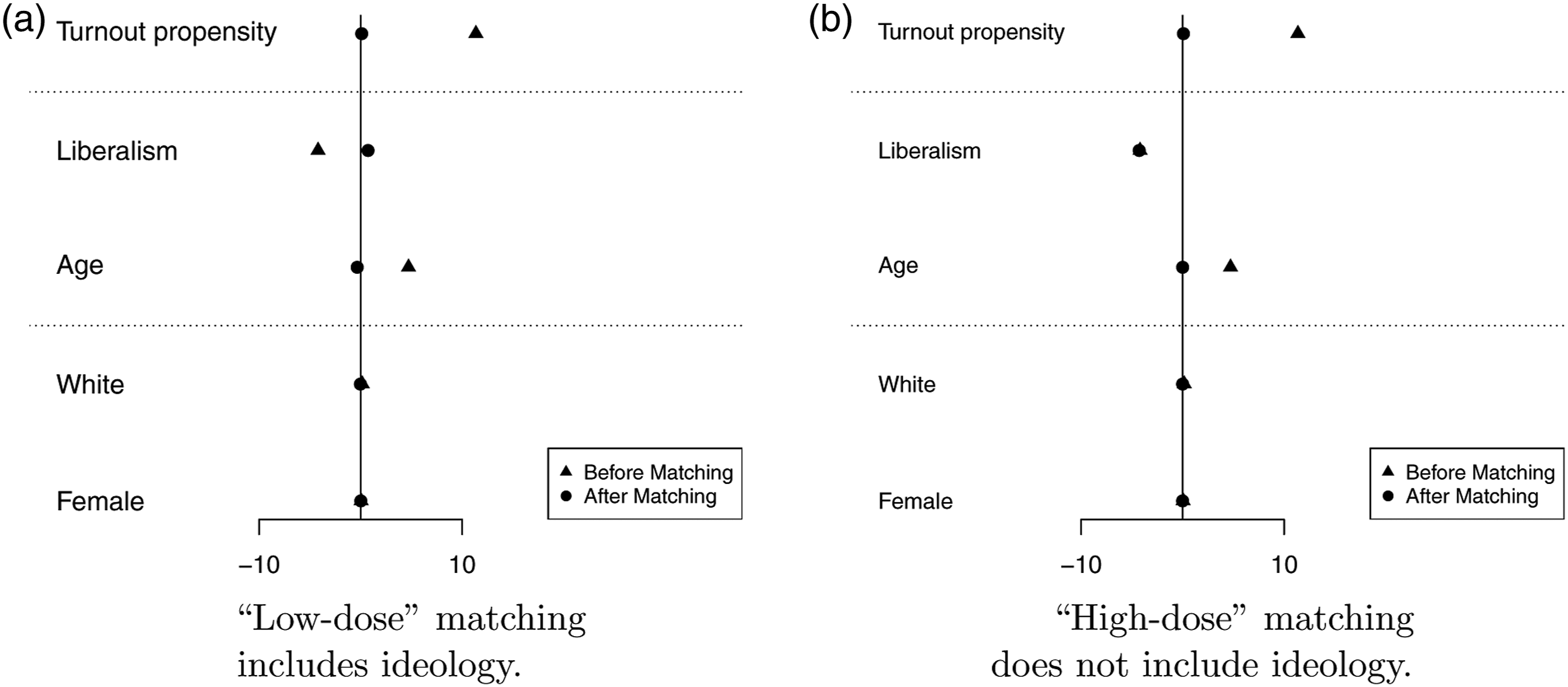
Figure 2(a) shows the common support on ideology for registered voters who are ideologically typical (T = 0) versus atypical (T = 2) of their precinct. Figure 2(b) shows the common support for treatment and control units on turnout propensity. These figures point to a difficulty with our pre-registered design: there is very little common support on ideology in the atypical (treatment) and typical (control) groups. The precinct means are clustered in a small moderate-liberal zone; the interquartile range of precinct means is 55.37–60.26 (see Appendix D1). In the area of common support, voters range from centrist to moderately liberal. While voters whose views are very dissonant with their neighbors may be chilled from contributing vouchers without anonymity guarantees, it strikes us as doubtful that centrist voters would be materially less likely to use their vouchers if they live in a center-left rather than a center-center precinct, or that center-left voters would be less likely to use their vouchers if they live in a center-center rather than a center-left precinct. Thus, the voters that we hypothesize are most likely to be chilled—those nearer to the ideological extremes—are never observed in neighborhoods where they are typical. Common support across liberalism and vote propensity. 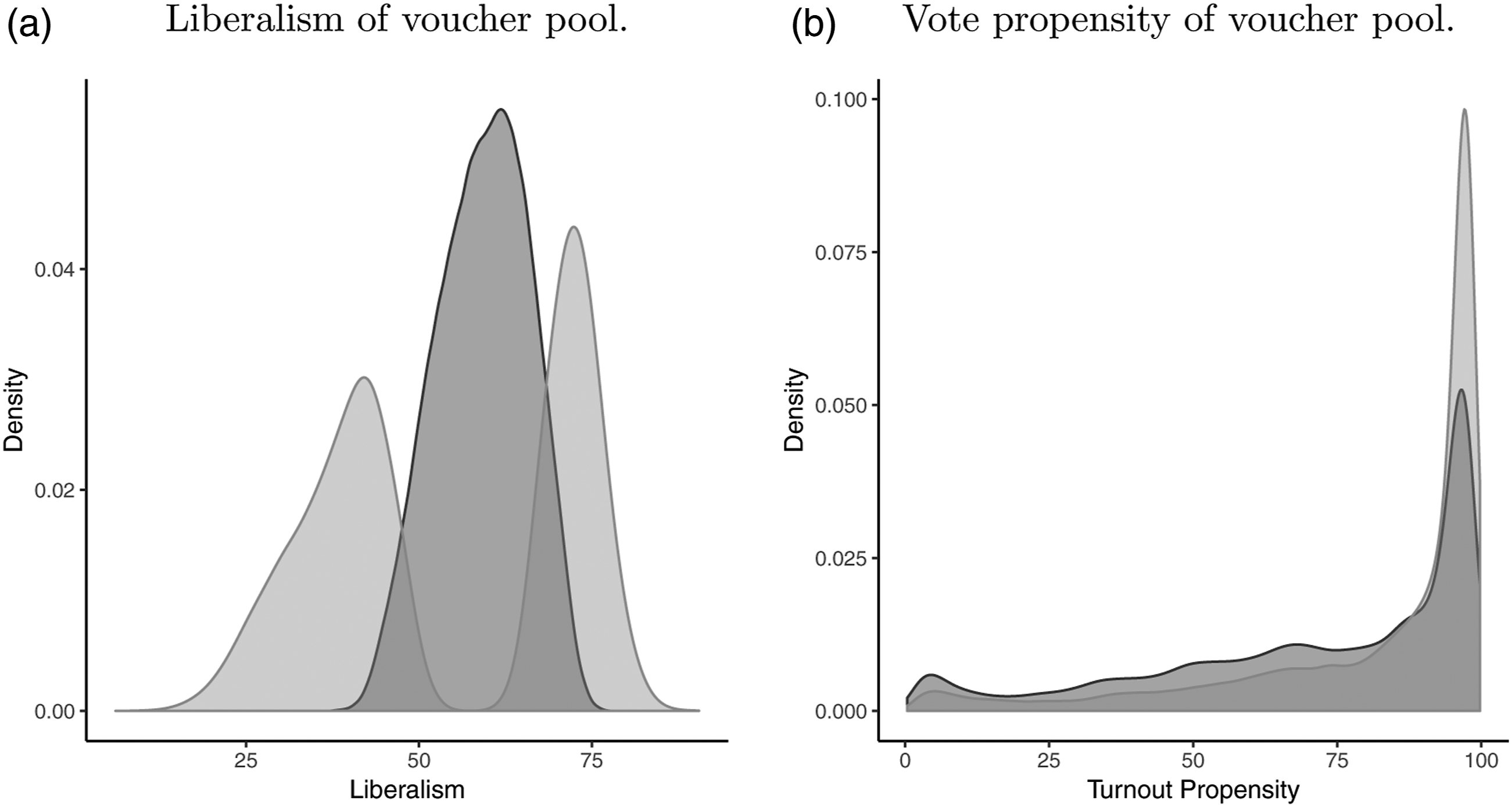
Given the limited area of common support, our pre-registered design is akin to a low-dose experiment. For comparison, the standard deviation of ideology among registered voters in Seattle is about 11, and the mean (and median) ideological distance of a treatment-group voter from her precinct mean is around 13.5. Only about half of the treatment-group voters have an ideology more than one standard deviation away from the average ideology of their precinct. Because of this limitation, which we did not foresee when we submitted our pre-analysis plan for this project, we also present results of a “higher dose” design where we drop ideology and match only on turnout propensity, age, gender, and race. This design allows us to make use of observations from voters who are very distant from their precinct mean, but it rests on the very strong assumption that, conditional on P i and demographics, these extreme voters have the same potential outcomes (voting and vouchering) in this election as the centrist and center-left voters who are near their precinct means. Put differently, the “high-dose” design assumes no differential mobilization by ideology.
Findings and Analysis
Neighborhood Effects on the Decision to Use Vouchers
Linear Probability Models of Voting and Vouchering by Political Cross-Pressure.
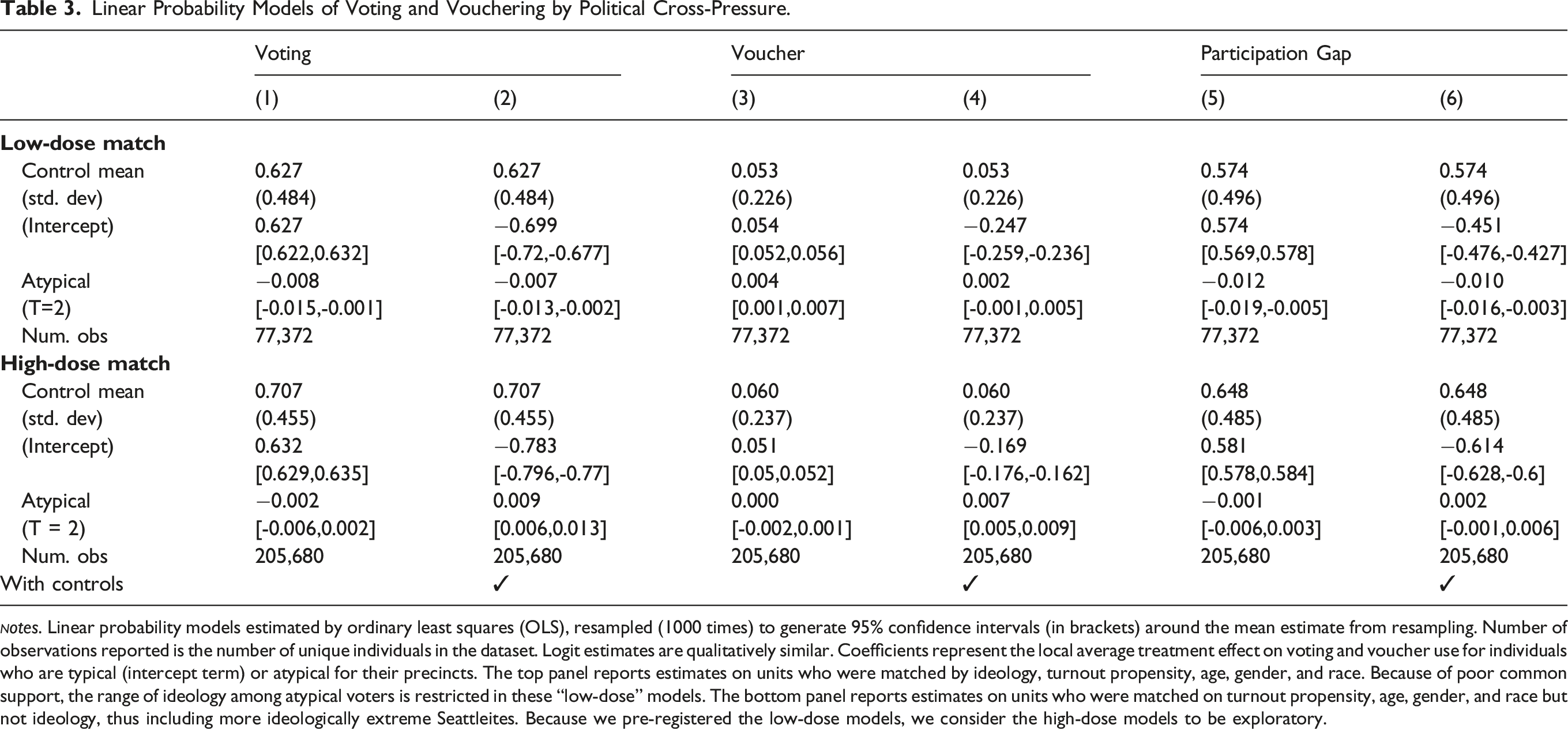
Although we only pre-registered models analyzing the 2017 election, we have since collected data from the 2019 election that allows us both to replicate our findings with new data and to conduct a longitudinal analysis comparing within-voter changes in behavior. Since these analyses were not pre-registered, they should be considered exploratory. More voters used vouchers in 2019 (6.6%) than in 2017 (4.5%), and cross-pressured voters in 2019 were, on average, 1.5 percentage points more likely to use vouchers and two percentage points more likely to vote than those not cross-pressured. (Again, bear in mind that the baseline rate of voting is an order of magnitude larger than the baseline rate of vouchering.) Between 2017 and 2019, about 25% of voters moved between precincts, allowing us to conduct difference-in-difference analyses comparing (1) those who moved into areas where they became cross-pressured in 2019 to those who were not cross-pressured in either year and (2) those who moved out of areas where they were cross-pressured in 2017 to those who remained cross-pressured in both years. Those who moved from a precinct where they were not cross-pressured in 2017 to one in which they were cross-pressured in 2019 were about 6.8 percentage points more likely to use vouchers and 12 percentage points more likely to vote in 2019 when compared to voters who moved between 2017 and 2019 but were not cross-pressured in either year (though the estimates are not statistically significant at conventional levels). Those who moved from a precinct where they were cross-pressured in 2017 to one in which they were not in 2019 were about as likely both to use vouchers and vote as those who moved but remained cross-pressured in both years. Results are reported in Appendix H.
Heterogeneous Neighborhood Effects by Ideology
Linear Probability Models of Voting and Vouchering Among Liberals and Conservatives.
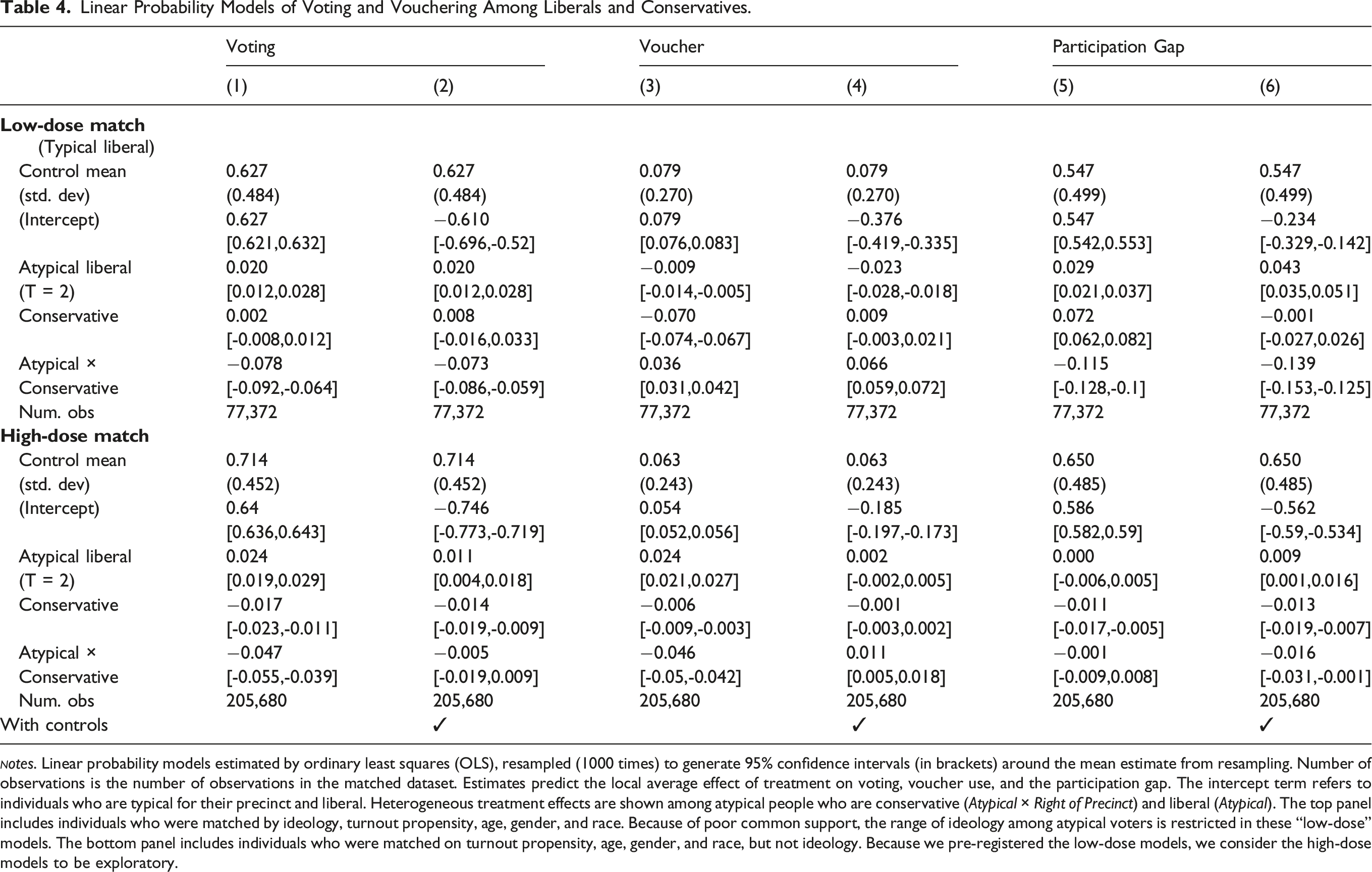
We find that conservatives who are ideologically atypical relative to their precincts are around 2.6 percentage points more likely to use their vouchers than conservatives who are locally typical, as shown in Model 3 (typical = 0.079–0.070, or around 1 percentage point; atypical = 0.079–0.070–0.009 + 0.036, or around 3.6 percentage points). Yet when it comes to voting, locally atypical conservatives are around 5.8 percentage points less likely to vote than their locally typical counterparts. In other words, among those who are relatively conservative compared to their neighbors, living in an ideologically dissonant precinct seems to discourage the private form of political activity (voting) but, if anything, encourages the more publicly visible political activity (vouchering). The pattern is reversed among liberals as illustrated in Figure 3. All of the voucher-qualified candidates in Seattle in 2017 were centrist to liberal, with Liberalism scores above 50. It is possible that we might observe neighborhood-based chilling of conservatives’ voucher assignments if more conservative candidates qualify to redeem vouchers (see Appendix E1).
19
Predicted rate of voting and vouchering, conditional on cross-pressure and ideology. 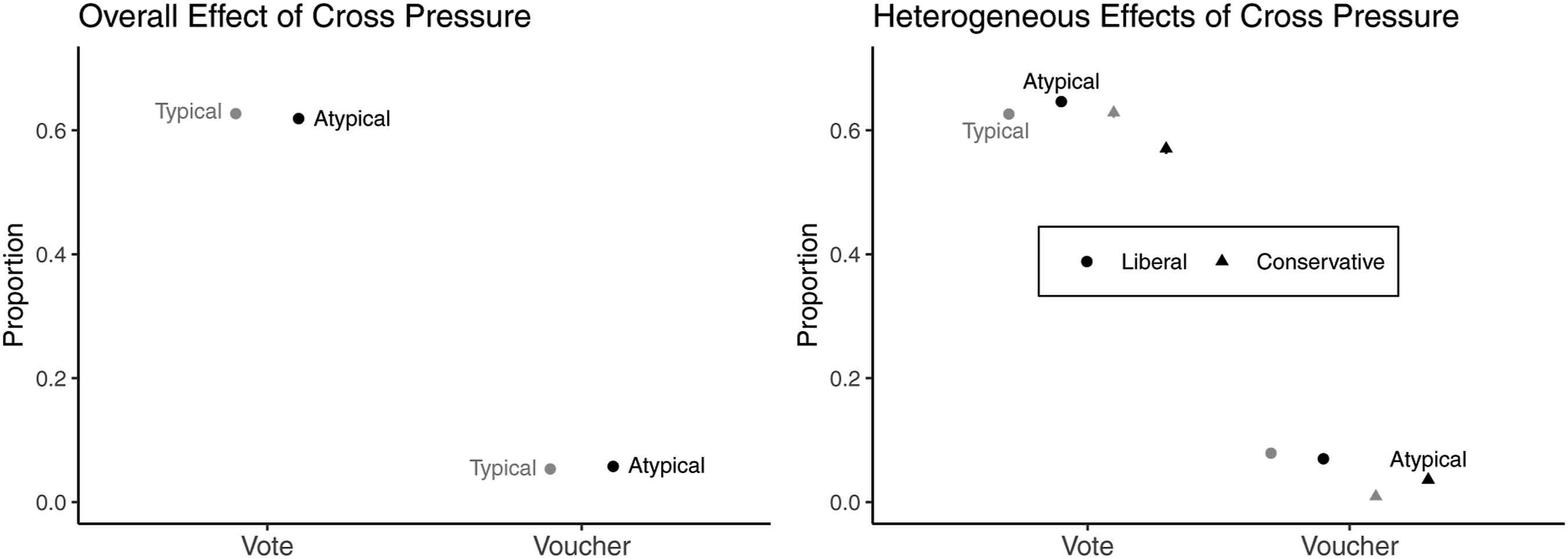
Sincerity of Voucher Assignment
Our final hypothesis is that local political minorities are more likely to bend to social cross-pressure and assign their vouchers to socially approved candidates rather than to candidates whom the voter personally prefers. We assume, to a first approximation, that candidates are personally preferred insofar as they are ideologically similar to the voter, and that candidates are socially approved when they are ideologically similar to the mean ideology of voters in the precinct.
Testing our hypothesis about the sincerity of voucher assignments requires an additional identifying assumption—namely, that every observed voucher user is an “always contributor,” meaning they would use their voucher whether or not they are local political minorities. The estimate must be defined in terms of always-contributors because the relevant counterfactual outcome is undefined for registered voters who would contribute only if they are close to the precinct mean, or only if they are far from the precinct mean. We acknowledge that this assumption is in competition with our first hypothesis, which predicts that individuals may be chilled by neighborhood effects. To the extent that political cross-pressures actually affect local outliers, we are agnostic a priori whether local outliers will respond by using their vouchers insincerely or by dropping out of the voucher market altogether (or some combination). In light of our finding above that neighborhood composition does not chill voucher participation, the assumption that observed vouchers come from always-contributors has some support.
We test the sincerity hypothesis in two steps, first with a dependent variable capturing the dollar-weighted proximity of voucher assignees to the contributor, 

Note that the possible values for
Sincerity Analysis of Voucher Use.
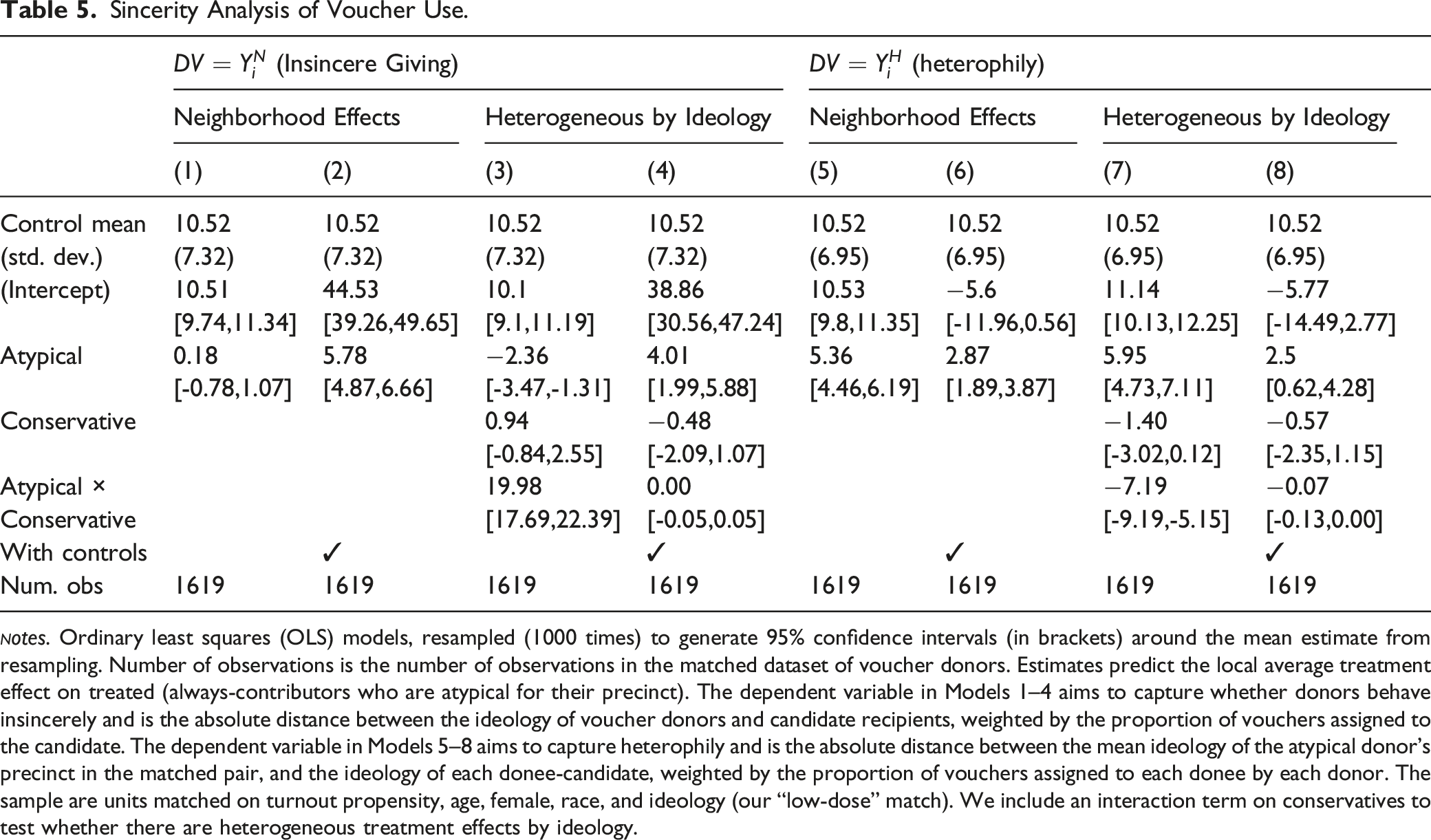
Among conservatives, ideologically typical donors gave to someone who, on average, is around 11 points (10.1 + 0.94) away from them on the ideology scale, and ideologically atypical conservatives gave to someone who is, on average, around 28.7 points away from them (10.1–2.36 + 0.94 + 19.98). These results reflect the fact that conservative voters are on average more distant than liberals from the available donees. 21 The effects are sensitive to specification, and effects among atypical conservatives are muted when we introduce controls.
Our finding that locally atypical donors may assign their vouchers to non-proximate candidates raises the question of whether these donors are signaling homophily with their neighbors. As models 5–6 in Table 5 show, there is no evidence for the hypothesis that neighborhood pressure induces donors to give toward the treatment precinct’s mean. In other words, locally atypical donors are not more likely than locally typical donors to give their vouchers to candidates whose ideology is close to the mean ideology of the locally atypical donor’s precinct. For control-condition (ideologically typical) donors, the average dollar-weighted distance between the voter’s donees and the mean of the corresponding treatment unit’s precinct is around 10.52. 22 If treatment (locally atypical) donors felt pressure to conform to the ideology of other voters in their neighborhood, one would expect the coefficient on Atypical to be negative. That is, among pairs of ideologically similar contributors, the donor who is atypical for her precinct would be more likely to shade her giving toward the mean of that precinct than the donor who lives among ideological compatriots. Instead, the treatment appears to cause a precisely measured increase in dollar-weighted ideological distance between the donor’s voucher recipients and the mean of the target (treatment) precinct. As columns 7 and 8 indicate, the overall increase is driven by atypically liberal donors giving to recipients to the donor’s ideological left. On average, locally atypical conservative donors giving insincerely may indeed be signaling homophily with their neighbors, with the average atypical conservative voucher donor giving to a candidate whose ideology lies closer to the mean ideology of her precinct than the donor herself. 23
To put this finding in terms of national politics, imagine a centrist Democratic voter in a conservative precinct, where the mean ideology is somewhere right of center—where a John Kasich-type candidate would do well. Our hypothetical centrist Democrat wants to put up a yard sign. Our sincerity finding implies that she will not put up the sign for her preferred Democratic candidate (e.g., Democratic moderate Amy Klobuchar). Instead, she’ll put up a sign for someone like Elizabeth Warren, whose politics are further to the donor’s left. Figure 4 illustrates. Predicted levels of vouchering by ideology. 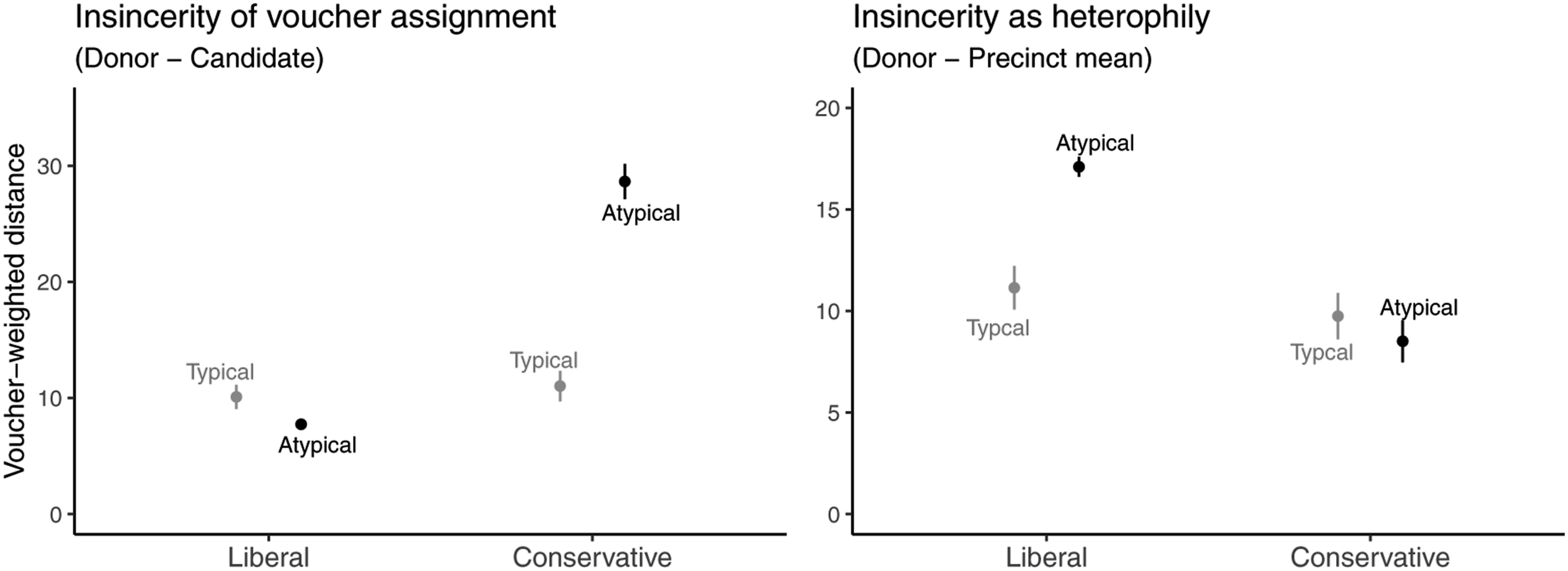
Discussion and Conclusion
We hypothesized that socially cross-pressured citizens are more likely to participate in low-cost political activities when they can do so privately (voting) than when the activity is publicly disclosed (voucher assignment). Using data from Seattle’s new campaign voucher program we find, contrary to our hypothesis, that ideological cross-pressure from one’s neighborhood has a negligible impact on voucher participation overall. There is some evidence, however, of a heterogeneous effect by ideology, with conservatives becoming less likely to vote but more likely to voucher in neighborhoods where they are ideologically atypical, and the opposite occurring among liberals. We also observe a small effect of neighborhood cross-pressure on the degree to which voters assign vouchers to ideologically proximate candidates. Yet rather than shading their voucher assignments in the direction of the neighborhood (precinct) mean, cross-pressured voucher donors actually give to candidates who are slightly farther from the mean of their precinct.
These findings, in a local, nonpartisan election, are notable, although one should bear in mind several important caveats. First, ideology is liberal or moderate for most of the voters in our sample, all of the competitive candidates, and all of the precinct means. Our study thus sheds no light on whether conservatives living in liberal neighborhoods would be deterred from giving to conservative candidates, or whether liberals living in a conservative neighborhood would be deterred from giving to liberal candidates.
Second, there may be significant measurement error in the Catalist ideology scores on which we rely, particularly when used as a proxy for ideology in the Seattle issue space. Although preferences in city politics and national politics are correlated (Cann, 2018; Tausanovitch & Warshaw, 2014), it’s possible that the Catalist score of one or more of the handful of candidates in our study does not accurately reflect their position on the local ideological spectrum. This possibility makes us particularly cautious about the sincerity of voucher assignment results.
Third, we only examine geographically defined cross-pressure based on where people live. Individuals may face cross-pressure from various other social networks including their families, workplaces, churches, and online communities (Brader et al., 2014). The literature we summarize above shows mixed results for political mobilization and demobilization from other kinds of cross-pressure, especially for state and national elections. Other sources of cross-pressure may affect voucher participation in ways we could not observe.
Fourth, the overall rate of voucher participation in our study was low, though within the program’s expected participation rate (Heerwig & McCabe, 2020). We recognize that because Seattle’s voucher program was brand new in 2017, it is likely that only the most civically enthusiastic residents had learned about or understood it. Such civic stalwarts may be particularly resistant to ideological pressure from their neighborhoods (or elsewhere).
Finally, in the 2017 election in particular, voting is an imperfect counterfactual for vouchering. On the one hand, both actions could be completed at no cost, and by mail. On the other hand, candidates in the top-of-the-ticket race for mayor were not eligible to receive vouchers in 2017. Because of this, and because many residents of Seattle may have been unfamiliar with the voucher program itself, our participation gap analysis is best taken as a proof-of-concept exercise.
All that said, this study sheds some light on the U.S. Supreme Court’s conjecture (shared by many political activists on the conservative side of the spectrum) that mandated disclosure of political activity deters participation among political minorities, and perhaps especially among conservative minorities. We find that precinct-level cross-pressure has no effect on one’s willingness to participate in politics in an important, public way: by assigning a campaign finance voucher. If anything, political cross-pressure has a slightly encouraging effect on this public mode of participation. Our findings also suggest that local conservatives in particular are not demobilized from public participation by geographic cross-pressure. These findings are important, because when campaign finance is publicly funded through equally sized vouchers, and the amount of individual vouchers are small, the standard anticorruption rationale for disclosure is quite weak. Our findings, showing no demobilization and no overall shading of voucher assignments toward the mean ideology of the precinct, suggest that campaign finance disclosure requirements may not have the costs normally recited by critics of mandated disclosure.
Our study is only a beginning. Voucher programs, long appreciated by academics and activists, may be catching on. The For the People Act of 2021 (H.R. 1) envisioned a nationwide program of publicly financed campaigns, with voucher programs playing a key role. The research design we employ in this paper can be replicated in any jurisdiction where scholars can gain access to the voter file and information on voucher uptake. The effects that we find in Seattle—a liberal city without great neighborhood political diversity—may or may not replicate in other jurisdictions, or for state and national elections. Nevertheless, future voucher programs are most likely to get their start in liberal cities and states, and careful studies of the Seattle program, made possible by its robust disclosure requirements, should be very useful to reformers across the nation.
ORCID iD
Abby K. Wood https://orcid.org/0000-0003-4583-5143
Nicholas G. Napolio https://orcid.org/0000-0002-8879-0726
Footnotes
Declaration of Conflicting Interests
The author(s) declared no potential conflicts of interest with respect to the research, authorship, and/or publication of this article.
Funding
The author(s) disclosed receipt of the following financial support for the research, authorship, and/or publication of this article: This study is supported by MIT Election Data Science Lab / Hewlett Foundation (Vouchers, Information, and Ideology).