




Abstract
We test how individual differences moderate the attitudinal effects of attack politics in two online experiments among US respondents, surveyed through Amazon’s Mechanical Turk (N = 1,408 and N = 1,081). Study 1 tests the moderating effect of personality traits (Big Five, Dark Triad) on the effectiveness of character vs. policy attacks. Study 2 investigates the difference between civil and uncivil attacks and explores the moderating effect of Big Five, Dark Triad, tolerance to negativity and conflict avoidance. Results suggest that the effects of negativity and incivility are not uniform across all respondents. For instance, evaluations of the sponsor are more negative after exposure to negative messages for respondents high in conflict avoidance; respondents high in psychopathy are more likely to have a more negative opinion of the target after being exposed to character attacks, whereas incivility worsen the perception of the target for individuals low in conflict avoidance and agreeableness. Harsher campaigns, in other terms, work particularly well for some – and are particularly rejected by others. The implications of these trends are discussed.
Keywords
Introduction
Negative Campaigning is a Matter of Taste
Negative campaigning is undoubtedly one of the most distinctive features of contemporary electoral competition. Yet, scholars disagree about its effectiveness (Lau et al., 2007). Are negative messages successful in degrading perceptions of the target of the attacks, or do they instead “backlash” against the sponsor (Fridkin & Kenney, 2004)? To be sure, negative messages come in many shapes and forms. For instance, several studies distinguish between different foci, that is, whether attacks are targeted against the policy or the personal characteristics of the opponent (Brooks & Geer, 2007; see also Hopmann et al., 2018), or consider varying degrees of (in)civility, that is, whether the attack includes “disrespectful, poisonous and hyperbolic [. . . language], breaking norms of conversation” (Otto et al., 2019, p. 89; see also Mutz, 2015; Mutz & Reeves, 2005). If political attacks are broadly disliked by the public at large (Fridkin & Kenney, 2011; Johnson-Cartee & Copeland, 1989), some attacks are particularly loathed. While criticizing the policy stances of opponents is the heartbeat of democracy, one could argue that ad-hominem attacks and invectives against personal traits of the opponents are normatively less useful from a democratic standpoint. Civil and nuanced criticism can foster a relevant and reasonable debate, whereas uncivil attacks will most likely poison the political discourse in the long run. These differences notwithstanding, negativity and incivility are in the eye of the beholder (Lipsitz & Geer, 2017; Sigelman & Kugler, 2003), so much so that different individuals might react differently to them. Beyond established factors such as, for example, individual resources (e.g., Fridkin & Kenney, 2004) or party identification (Ansolabehere & Iyengar, 1995), recent research claims that the effects of attacks depend on voters’ personality and their attitudes towards political discourse (Fridkin & Kenney, 2011, 2019), in line with the broader research highlighting the centrality of “negativity bias” in information selection (e.g., Bachleda et al., 2020). Weinschenk and Panagopoulos (2014) show that respondents high in extraversion are more likely to be mobilized by negative campaign messages; inversely, respondents high in agreeableness can be discouraged to participate when exposed to negativity. In a study by Kalmoe (2019) the usage of “aggressive metaphors” tend to mobilize voters with “aggressive traits” (associated with low agreeableness and extraversion, and high neuroticism) and demobilizes strong partisans low in aggression. Similarly, in the study by Bjarnøe et al. (2020) political news employing a conflict framing—that is, focusing on disagreements and clashes inherent in the political game—are more successful in mobilizing voters that score low in conflict avoidance (see also Maier & Faas, 2015). Inversely, Mutz and Reeves (2005) show that exposure to uncivil content lowers political trust especially in respondents high in conflict avoidance, Otto et al. (2019) suggest that individuals with lower levels of “tolerance to disagreement” are more affected by political incivility, and Fridkin and Kenney (2011, 2019) show the same for low “tolerance to negativity.”
All in all, these diverse studies suggest that some citizens are more “attuned” to negativity than others—or, in other terms, that individual differences are an important moderator when it comes to the effects of information framed in a negative way (Nai & Otto, forthcoming). Yet, to the best of our knowledge, the jury is still out regarding whether individual differences have the potential to matter, in fine, for the net effectiveness of negative political massages—that is, looking at both voters’ perceptions of the target and the sponsor of the attacks. Negativity might successfully depress perceptions of the target, as it intends to do, but is also likely to unintendedly backfire against the sponsor. Can we identify voters for which these effects are more (less) likely? Is negativity more successful for some voters to depress evaluations of the target—those that are more positively predisposed towards more confrontational and harsh components of the political game? Are some voters particularly likely to reject negativity, to the point of having a worse image of candidates that go negative? Given the increase of confrontational and antagonistic political figures worldwide (Nai & Martinez i Coma, 2019), and the fact that the personality of voters is likely to be associated with support for “harsher” political figures (e.g., Bakker et al., 2016), these questions are particularly topical.
In this article, we contribute to this a better understanding of the psychological roots of support for negativity in politics by testing the effects of personality traits and other proximate dispositional attitudes (conflict avoidance, tolerance to negativity) on the effectiveness of negative campaigning messages to shape attitudes for targets and sponsors of the attacks. To be sure, the contribution of this article is limited to candidate perceptions. Nonetheless, given the centrality of attitudes and candidate perceptions for ultimate voting choices (Costa & Ferreira da Silva, 2015; Garzia, 2013), the results described in this article are an important new step towards a deeper understanding of the role of individual differences for the electoral effectiveness of negativity in politics.
The Two Studies at a Glance
Is negativity a matter of taste? To clarify the moderating role of individual differences on the effectiveness of attack politics, we present in this article the results of two online experiment among US respondents, surveyed through Amazon’s Mechanical Turk in May 2019 and December 2019 (respectively, N = 1,408 and N = 1,081). Study 1 focusses specifically on differences in personality traits (Big Five, Dark Triad) and their moderating effect on the effectiveness of negativity and character versus policy attacks. Study 2 focuses on character attacks more specifically and investigates the difference between civility and incivility within this type of attacks; on top of assessing the moderating role of the Big Five and Dark Triad, study 2 also explores the moderating effect of tolerance to negativity and conflict avoidance.
The two studies were voluntarily set up in a way to maximize their differences, while keeping the main “moving parts” stable (the logic of the experimental protocols and the measurement of personality). Respondents in study 1 are exposed to fictive messages but about real political figures (Pete Buttigieg and Mitch McConnell), whereas study 2 uses fictive candidates. Study 1 involves attacks sponsored by a Democrat against a Republican, whereas study 2 does the opposite. Study 1 sets up the treatments as campaign speeches, whereas study 2 frames them as mock newspaper articles. Finally, the mock campaign messages in study 1 are on the issue of health care, whereas in study 2 they are on economic and taxation issues. Replicating the same protocol but using very different setups dramatically decreases the chances that results—if consistently found across the studies—are driven by the experimental setup at play. In other terms, such a “most different” approach includes already in its design cues to assess whether the results found are externally valid (e.g., Schram, 2005) and, potentially, generalizable.
Study 1. Personality and Type of Attacks
Expectations
Study 1 focuses on individual differences in terms of personality traits, looking both at the “Big Five” and “Dark Triad” inventories. The Big Five (McCrae & John, 1992) is undoubtedly the most studied personality inventory, at least when it comes to its effects on political behaviors and attitudes (e.g., Mondak, 2010). The inventory identifies five “general” personality traits: extraversion (sociability, energy, assertiveness), agreeableness (friendliness, amicability, and a proclivity for cooperative behaviors), conscientiousness (responsibility, dependability, and a tendency to plan ahead), emotional stability (low stress, low edginess, calm, satisfaction), and openness (intellectual curiosity, creativity, and a proclivity for new experiences). The Dark Triad inventory (Furnham et al., 2013; Paulhus & Williams, 2002) is less frequently studied in politics (but see, e.g., Blais & Pruysers, 2017; Jonason, 2014; Nai & Maier, 2018). The inventory identifies three “socially nefarious” traits: narcissism (ego-reinforcing behaviors, bombastic promotion of self, desire to be admired), psychopathy (callousness, incapacity to connect emotionally, impulsivity), and Machiavellianism (the tendency to use strategic behavior for the pursuit of self-beneficial objectives).
Starting with the Big Five, our prediction is that negative messages are “rejected”—that is, they are more likely to backlash against the sponsor and less likely to be effective against the target—for respondents high in agreeableness, conscientiousness, and extraversion, and low in emotional stability. Agreeable people tend to display a more compromising and accepting behavior (Lee & Ashton, 2004), but they can at the same time be expected to “shy away from things that are conflictual or disagreeable” (Weinschenk & Panagopoulos, 2014, p. 168). In this sense, we could expect them to reject negative and harsh campaigns. Conscientiousness is associated with lower impulsivity (Jones & Paulhus, 2011), caution and self-control (Lee & Ashton, 2004). Conscientious people can be expected to have a more traditional and sophisticated view of politics; they “have clear ideas about right and wrong and will not appreciate critical or inflammatory ads” (Weinschenk & Panagopoulos, 2014, p. 168). Similarly, extraverted individuals tend to favor positivity in all social experiences; “when politics turns ugly, the extravert likely turns elsewhere” (Mondak, 2010, p. 172). In this sense, we could expect them to also reject negative messages. Individuals low in emotional stability (high neuroticism) tend to avoid discussions that they find unpleasant and can potentially make them upset. For instance, Gerber et al. (2012) show that neurotics stay away from discussions with family members on issues on which they disagree. In this sense, we might expect low emotional stability to be associated with a greater rejection of harsh campaigns. Similarly, emotionally stable people are “relatively un-flappable and not prone to agitation” (Mondak, 2010, pp. 171−172; see also Weinschenk & Panagopoulos, 2014), which could mean that high levels of emotional stability are associated with low campaigning effects. Finally, we expect the effects of negativity to be generally weaker (both in terms of backlash against the sponsor and effectiveness against the target) for respondents high in openness. Individuals high in this trait tend to be more curious, politically sophisticated, and generally open to information that goes against their priors. In this sense, we might expect them to “be capable of looking past any given advertisement and [. . .] seeing the bigger picture” (Mondak, 2010, p. 171).
Turning to the Dark Triad, we globally expect respondents high on the Dark Triad to be less likely to “reject” negativity, especially in its harsher forms. People high in psychopathy usually show “a cognitive bias towards perceiving hostile intent from others” (Levenson, 1990, p. 1074). They are impulsive, prone to callous social attitudes, and show a strong proclivity for interpersonal antagonism (Jonason, 2014) and can thus be expected to have a higher tolerance for confrontational, antagonistic and aggressive styles of political competition. Narcissism has been linked to overconfidence and deceit (Campbell et al., 2004) and with engaging in aggressive behaviors and general uncivility in their workplace (Penney & Spector, 2002). Finally, people high in Machiavellianism are “characterized by cynical and misanthropic beliefs, callousness, a striving for argentic goals (i.e., money, power, and status), and the use of calculating and cunning manipulation tactics” (Wisse & Sleebos, 2016, p. 123). Behavioral evidence suggests that high Machiavellianism is associated with bullying at work (Pilch & Turska, 2015) and the use of more “negative” and aggressive forms of humor (Veselka et al., 2010). As discussed above, such reactions should be more intense for harsher attacks—in this case, character (vs. policy) attacks, that are more easily disliked by the public (Johnson-Cartee & Copeland, 1989).
In a nutshell, we expect exposure to negative messages to backlash against the sponsor particularly for respondents high in agreeableness (H1), conscientiousness (H2), and extraversion (H3), and low in emotional stability (H4). We however expect generally weaker effects (both against the sponsor and the target) for respondents high in openness (H5). Inversely, negativity should be more effective (lower backlash against the sponsor and more depressed evaluations of the target) for respondents high in narcissism (H6), psychopathy (H7), and Machiavellianism (H8). Finally, all these effects should be more marked for harsher (character) attacks (H9).
Methods
Participants and procedure
Participants (US residents) were recruited in May 2019 via the Amazon MTurk online platform and invited to fill in a short survey against a small compensation ($0.7; initial N = 1,508). Because they are opt-in convenience samples, MTurk samples cannot be assumed to be representative of the population. Nonetheless, evidence suggests that MTurk produces results that are similar to more traditional surveys. Berinsky et al. (2012) find that MTurk samples tend to be more representative of the US population than other types of convenience samples, whereas Clifford et al. (2015) report that MTurk samples tend to reflect the psychological divisions of liberals and conservatives in the US general population. All in all, the literature seems to suggest that MTurk offers a cheap and reliable alternative (Hauser & Schwarz, 2016; for a more critical take, see Ford, 2017; Harms & DeSimone, 2015). The questionnaires included an “attention check” (Berinsky et al., 2014); specific instructions—select the option “other” and write a keyword in the entry box—were embedded within a long and digressing question. Respondents that failed such attention check (N = 100, 6.6%) were assumed to only skim through the questions and were excluded. The analyses are run on a final sample of N = 1,408. The composition of the sample is described in Supplemental Table A1 (Appendix A).
Respondents were randomly exposed to one of seven different (mock) speech excerpts, reflecting varying levels and forms of negativity (see Supplemental Appendices B and C for more details). The sponsor of all messages was Pete Buttigieg, who had announced his candidacy for the Democratic nomination for US President a month earlier. All attacks targeted Mitch McConnell, then the Republican Senate Majority Leader. Our analyses focus on the distinction between positive (N = 200) and negative messages (N = 1,208), on the one hand, and within negative messages on the distinction between policy (N = 407) and character attacks (N = 801) on the other.
Big Five and Dark Triad
The questionnaire included batteries for the self-assessment of respondents’ personality traits, which respondents were asked to fill in before being exposed to the experimental components. For the Big Five we used the Ten Item Personality Inventory (TIPI; Gosling et al., 2003); the TIPI asks respondents whether they agree or disagree with a series of ten statements (e.g., “I see myself as extraverted, enthusiastic,” “critical, quarrelsome”). Pairs of statements are then used to compute the five traits. Reliability is only averagely high: α(Extraversion) = .67, α(Agreeableness) = .35, α(Conscientiousness) = .60, α(Emotional stability) = .70, α(Openness) = .44. With only two items per trait, capturing furthermore two slightly different facets of each trait, this is to be expected. For the Dark Triad, we used the Dirty Dozen inventory (D12) developed by Jonason and Webster (2010). The inventory is a battery of 12 statements asking respondents whether they agree or disagree with a series of statements (e.g., “I tend to want others to admire me,” “I tend to not be too concerned with morality or the morality of my actions”). Groups of four statements are averaged to measure the three “dark” traits of narcissism, psychopathy, and Machiavellianism. Reliability for the three traits is very high: α(Narcissism) = .86, α(Psychopathy) = .83, α(Machiavellianism) = .90. All personality scales vary between 1 “very low” and 7 “very high”; Supplemental Table A1 (Appendix A) presents the average scores on these eight constructs. Zero-order correlations among the eight traits are presented in Supplemental Table A2. Short scales like the ones used here have the advantage of being relatively quick to administer, while achieving satisfactory results—especially when compared with other short batteries (see, e.g., Rammstedt & John, 2007). Nonetheless it has to be noted that, with only a handful of items per trait, these “short” batteries cannot capture all nuances and facets of complex personality constructs (Bakker & Lelkes, 2018; Credé et al., 2012; Spain et al., 2014). Recent evidence suggests furthermore that the personality measures obtained from the TIPI, and especially its measure of openness, can vary as a function of the nature of the political events assessed - thus questioning whether such measures of personality are really exogenous to politics as it is assumed (e.g., Boston et al., 2018). It is hard to assess what the implications of such shortcomings are for our study. The most likely scenario is that nuances between the different traits are somewhat blurred, and as such trait-specific effects that are unrelated to other traits are unlikely. The fact that our expectations for the different traits somewhat converge (see above) makes fortunately this issue less prejudicial.
Target/Sponsor evaluation and partisanship
After exposure to the experimental treatment, respondents were asked to rate the sponsor (Buttigieg) and target of the message (McConnell) on six qualifying adjectives (“competent,” “likeable,” “funny,” “disagreeable,” “knowledgeable,” “qualified”; from 1 “disagree strongly” to 7 “agree strongly”). After reversing the negative adjective (“disagreeable”) we averaged the scores into an additive index of candidate perception, ranging from 1 “very negative” to 7 “very positive” (α(Buttigieg) = .90, α(McConnell) = .88). The two indexes are unsurprisingly negatively correlated, r(1406) = –0.25, p < .001.
Because of the overarching role of party identification in driving information processing and shaping political opinions (e.g., Taber & Lodge, 2006), all models are controlled by the party identification of the respondents. Party identification was measured following the protocol used in the American National Election Study (ANES), combining party identification with the strength of such identification, which yields a five-point scale, from 1 “Strong Democrat” to 5 “Strong Republican.” This scale is negatively correlated with respondents’ perception of Buttigieg, r(1406) = –0.46, p < .001, and positively correlated with respondents’ perception of McConnell, r(1406) = 0.48, p < .001. Supplemental Table A1 (Appendix A) presents the distribution of respondents according to their party identification.
Results
Direct effects
Negative messages backfire against the sponsor. Respondents exposed to a negative message have a significantly worse perception of the sponsor than respondents exposed to a positive message, b = –0.69, t(1405) = –7.24, p < .001. The same, albeit less strongly, is true for respondents exposed to a character attack compared to those exposed to a policy attack, b = –0.20, t(1405) = –2.59, p < .01. Turning to the evaluation of the target, negativity is “successful” to depress it. Respondents exposed to a negative message have a significantly worse perception of the target than respondents exposed to a positive message, b = –0.36, t(1405) = –3.86, p < .001. There is no significant difference between character and policy attacks on evaluation of the target; b = 0.06, t(1405) = 0.76, p = .446. Detailed results are presented in Supplemental Tables A4 (sponsor) and A5 (target), in Appendix A.
Moderated effects
The direct effects described above are in some cases a function of individual differences. Looking first at evaluations of the sponsor, Supplemental Table A6 (Appendix A) presents two separated models. The first (M1) regresses the evaluation of the sponsor on the respondents’ personality profile (Big Five and Dark Triad), exposure to negative (vs. positive) messages, and the interactions between the two. The second (M2) does the same but for exposure to character (vs. policy) attacks. Given the partisan nature of the treatments (Democratic sponsor and Republican target), both models are controlled by party identification. Adding the interaction terms does not increase substantially the explanatory power of the models. Nonetheless, two interactions are statistically significant for negativity. Conscientiousness moderates its effects on perception of sponsor, b = –0.18, t(1373) = –2.01, p = .044, and so does Machiavellianism, b = 0.17, t(1373) = 1.83, p = .067. To interpret these effects, we substantiate the coefficients via marginal effects with 95% Confidence intervals (Figure 1). The left-hand panel shows the interaction between respondents’ conscientiousness (x-axis) and exposure to a negative or positive message. Respondents high in conscientiousness are more likely to have a positive opinion of the sponsor, if exposed to a positive message, when compared to the same respondents exposed to a negative message. The reverse is true for Machiavellianism (right-had panel); respondents low in Machiavellianism are more likely to have a more positive opinion of the sponsor when exposed to a positive (vs. negative) message.
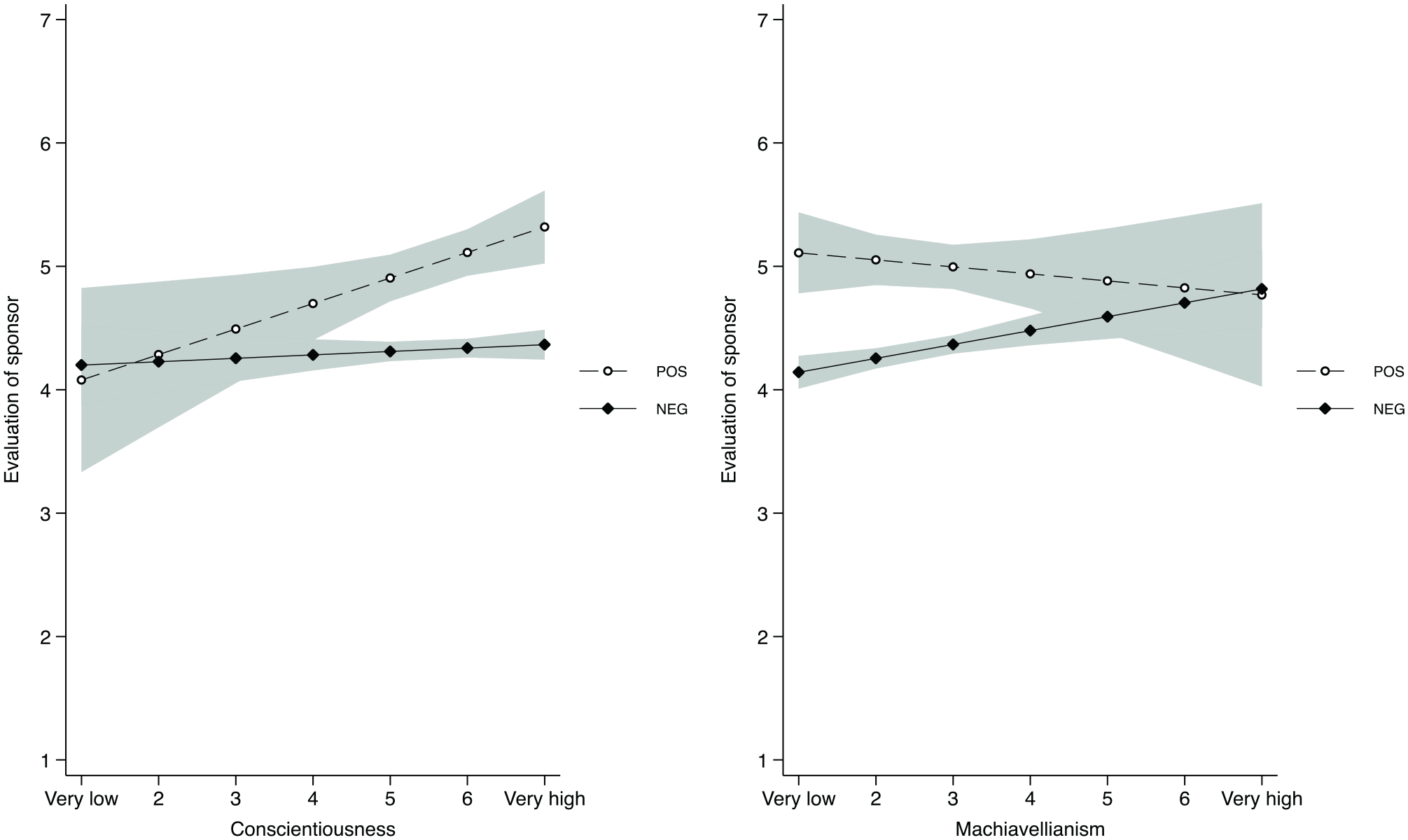
Study 1: Evaluation of the sponsor.
Supplemental Table A7 replicates the same models, but for evaluation of the target. We also see a handful of significant interactions, even if results are perhaps less clear cut. The clearest effect is for psychopathy, b = –0.19, t(1175) = –2.29, p = .022, substantiated with marginal effects in Figure 2 (right-hand panel). Respondents high in psychopathy are more likely to have a worse perception of the target when exposed to character attacks than when exposed to policy attacks—suggesting that harsher attacks “work best” for people high in psychopathy to depress evaluations of the target. Supplemental Tables A6 and A7 also report results for joint interaction significance tests (F-statistics) for the interactions between personality and exposure to negative messages.
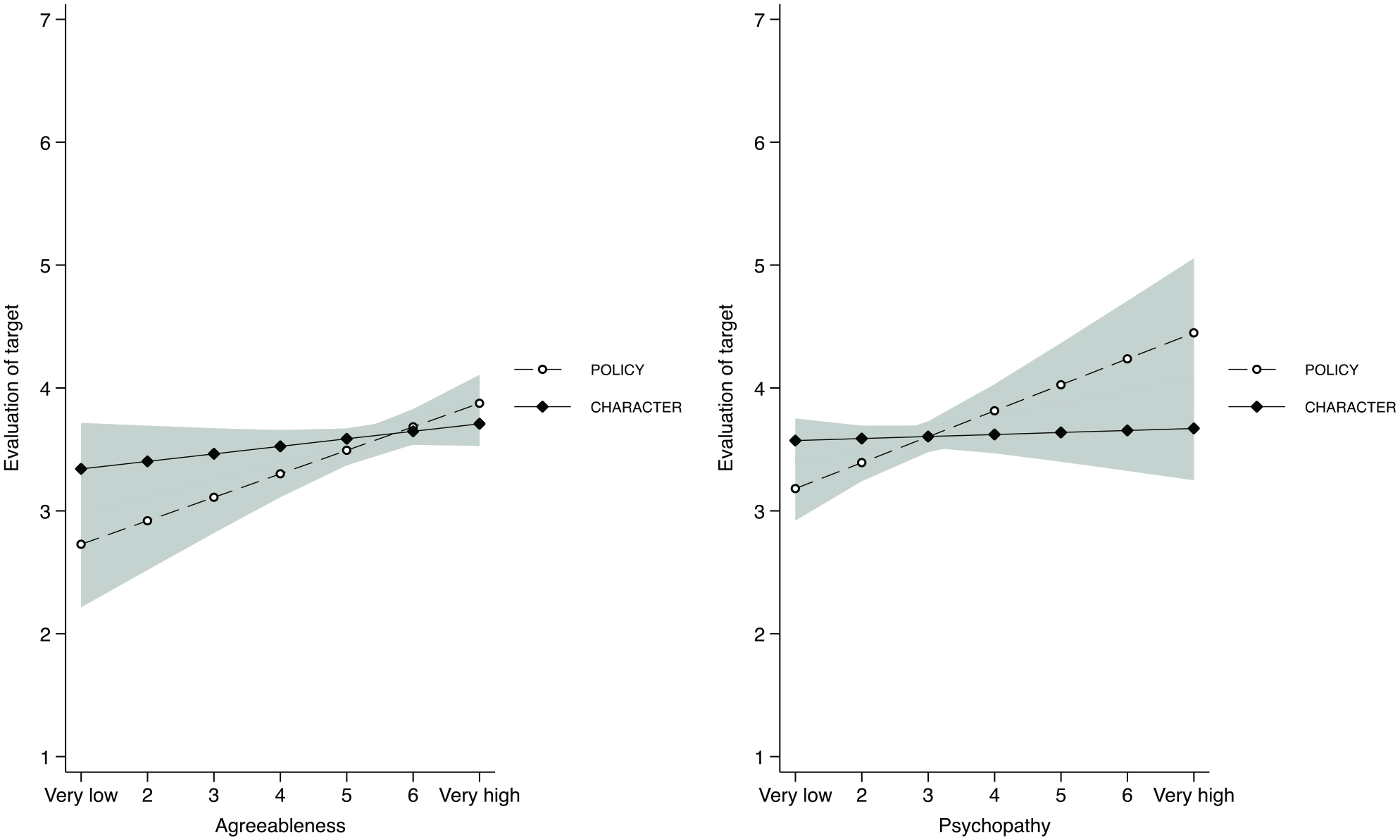
Study 1: Evaluation of the target.
Study 2. Individual Differences and Incivility
Expectations
The second study dives more deeply into the dimensions of character attacks and explores the effects of incivility in political messages. It is relatively safe to assume that people in general dislike incivility, which makes that they “disapprove of the speaker because it does reputational and emotional harm to the recipient” (Frimer & Skitka, 2018, p. 864). Studies show that incivility fosters the experience of negative emotions (Pearson & Porath, 2009), closed-mindedness (Borah, 2012) and the development of cynicism, while depressing political trust (Mutz & Reeves, 2005). Because of its more extreme characteristics in terms of political language, we might expect that incivility depresses perceptions of the sponsor, in such a way that it also does not depress perceptions of the target (negative backlash only). Yet, as for study 1, we might expect that incivility is (i) especially disliked by some, for which it should backlash even more strongly, and (ii) appreciated by others, for which it could be particularly “effective” (i.e., a better evaluation of the sponsor and a worsened image of the target).
Study 2 focusses on three of such individual differences: personality traits (Big Five, Dark Triad), tolerance for negativity—characterising “people who think any type of attack advertising is appropriate” (Fridkin & Kenney, 2011, p. 309)—and conflict avoidance—characterizing respondents that are “uncomfortable with and dislike conflict no matter what it is about” (Bjarnøe et al., 2020, p. 107). Expectations for the Big Five and Dark Triad are in line with what discussed in study 1. Expectations for conflict avoidance and (low) tolerance to negativity are even more straightforward, as those two dispositions have been associated in the past to some form of rejection of negativity and incivility (e.g., Bjarnøe et al., 2020; Fridkin & Kenney, 2011, 2019; Maier & Faas, 2015; Mutz & Reeves, 2005; Otto et al., 2019). We simply predict that these two dispositions moderate the reception of negative and uncivil treatments, so that negativity/incivility backlashes more against the sponsor and is less effective to lower perceptions of the target for respondents high in conflict avoidance (H10) and low in tolerance to negativity (H11). The effects should be more marked for incivility, in line with what discussed above (H12).
Methods
Participants and procedure
Participants (US residents) were recruited in December 2019 via the Amazon MTurk online platform and invited to fill in a short survey against a small compensation ($0.7; initial N = 1,106). As for study 1, the questionnaires included an “attention check” and respondents that failed it (N = 25, 2.3%) were excluded. The analyses are run on a final sample of N = 1,081. The composition of the sample is described in Supplemental Table A1 (Appendix A).
Participants were randomly exposed to a mock newspaper article where the a fictive Republican candidate (Paul A. Bauer) either advocated his policy proposals on automobile industry taxation or attacked his Democrat opponent (the equally fictive Carl B. Meyer) on that same issue, with varying degrees of negativity and incivility (see Appendix B and C for more details). Our analyses focus on the distinction between positive (N = 192) and negative messages (N = 889), on the one hand, and within negative character attacks on the distinction between civil (N = 394) and uncivil attacks (N = 395) on the other.
Big Five and Dark Triad
Measures for the Big Five and the Dark Triad were similar to study 1; α(Extraversion) = .66, α(Agreeableness) = .38, α(Conscientiousness) = .57, α(Emotional stability) = .66, α(Openness) = .41), α(Narcissism) = .89, α(Psychopathy) = .86, α(Machiavellianism) = .91. All variables vary between 1 “very low” and 7 “very high.”
Tolerance to negativity and conflict avoidance
For “tolerance to negativity” we used the measure discussed in Fridkin and Kenney (2019). Respondents were asked whether they agree or disagree with a series of four statements regarding negative advertisement and attack politics (e.g., “Some negative advertisements are so nasty that I stop paying attention to what the candidates are saying,” or “Hard-hitting commercials attacking the opponent are not helpful during election campaigns”). We combined the four items into an additive scale of tolerance to negativity (α = 0.67), which varies theoretically between 1 “very low” and 7 “very high” (M = 3.12, SD = 1.20).
We measured “conflict avoidance” via six items that are part of the conflict “avoidance” and “approach” subscales discussed in Bresnahan et al. (2009; see also Bjarnøe et al., 2020; Goldstein, 1999). Respondents were asked whether they agree or disagree with a series of six statements regarding conflict in politics (e.g., “I hate arguments”, “I believe that conflict is a reality we must live with,” or “I avoid conflict if at all possible”). We combined the six items into an additive scale of conflict avoidance (α = .73), which varies theoretically between 1 “very low” and 7 “very high” (M = 4.10, SD = 1.02). Tolerance to negativity and conflict avoidance are significantly and negatively correlated, r(1079) = –0.32, p < .001. All Zero-order correlations between tolerance to negativity, conflict avoidance, and the other personality measures, all measured prior to the experimental component, are presented in Supplemental Table A3 (Appendix A).
Target/Sponsor evaluation and partisanship
After exposure to the experimental treatment, respondents were asked to rate the sponsor and target of the message in terms of a series of eight qualifying statements (“competent,” “knowledgeable,” “has a strong leadership,” “decisive,” “honest,” “trustworthy,” “likeable,” “has a pleasant aura”; from 1 “disagree strongly” to 7 “agree strongly”). Rating were then averaged into an additive index of candidate perception, ranging from 1 “very negative” to 7 “very positive” (α(sponsor) = 0.95, α(target) = 0.95). The two indexes are not significantly correlated, r(1081) = 0.05, p = .125, most likely due to the use of fictive candidates in the experiment.
Respondents’ party identification, measured as for study 1, is positively correlated with respondents’ perception of the Republican candidate, r(1081) = 0.49, p < .001, and negatively correlated with respondents’ perception of the Democrat, r(1081) = –0.32, p < .001.
Results
Direct effects
Negative messages backfire against the sponsor (the fictive Paul A. Bauer, a Republican). Respondents exposed to a negative message have a significantly worse perception of the sponsor than respondents exposed to a positive message, b = –0.38, t(1078) = –3.72, p < .001. The same is true for respondents exposed to an uncivil character attack compared to those exposed to a civil character attack, b = –0.38, t(786) = –4.09, p < .001. Results then suggest that evaluation of the target (the fictive Carl B. Meyer, a Democrat) can be depressed successfully by negativity. Respondents exposed to a negative message have a significantly worse perception of the target than respondents exposed to a positive message, b = –0.27, t(1078) = –2.73, p = .006. There is however no significant difference between uncivil and civil character attacks on evaluation of the target; b = 0.12, t(786) = 1.37, p = .170. Detailed results are presented in Supplemental Tables A10 (sponsor) and A11 (target), in Appendix A. For both sponsor and target of attacks, these results are consistent with what found in study 1.
Moderated effects
The effects described above are in some cases a function of individual differences. Supplemental Tables A12 and A13 (Appendix A) regress the perception of the sponsor as a function of exposure to negative (vs. positive, Supplemental Table A12) and uncivil (vs. civil, Supplemental Table A13) campaign messages, the respondents personality (Big Five, Dark Triad, tolerance to negativity, conflict avoidance), and the interactions of the two. Adding the interaction terms does not increase substantially the explanatory power of the models. Nonetheless, first, negativity interacts significantly with conflict avoidance, b = –0.17, t(1077) = –1.73, p = .085, and psychopathy, b = 0.27, t(1063) = 2.53, p = .012 (Supplemental Table A12). These two effects are substantiated in the top panels in Figure 3, with marginal effects. Respondents scoring high in conflict avoidance have a worse perception of the sponsor of the messages (backlash) if they are exposed to a negative message, compared to those who are exposed to a positive message (top left-hand panel). Inversely, evaluation of the sponsor is lower for respondents low in psychopathy that are exposed to negative messages compared to those exposed to positive messages; low psychopathy and positive messages combine to create a better perception of the sponsor. We also see from Supplemental Table A13 (M1) a similar trend for tolerance to negativity (bottom-left panel in Figure 3), b = 0.14, t(785) = 1.81, p = .070. Respondents that have a low tolerance for negativity have a worse perception of the candidate when exposed to an uncivil attack.
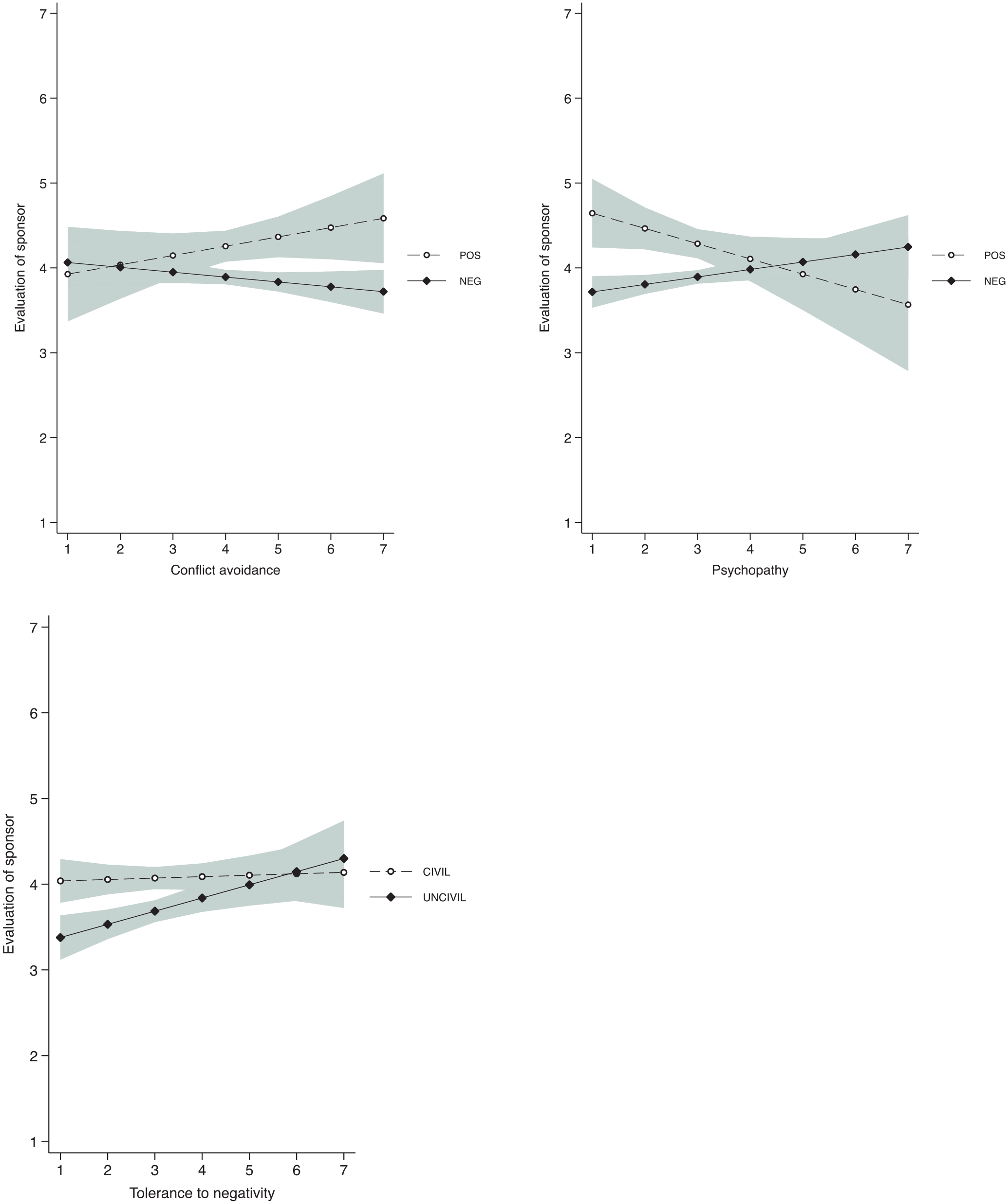
Study 2: Evaluation of the sponsor.
Supplemental Tables A14 and A15 (Appendix A) replicate the same models, but for the target of the attacks. We see first that negative messages (vs. positive, Supplemental Table A14) do not interact in any significant way with individual differences; in other terms, in study 2 we find no evidence that negative campaigns are more effective for some. We do however find that conflict avoidance and agreeableness moderate the effects of uncivil character attacks (Supplemental Table A15), as substantiated in Figure 4 via marginal effects. First, respondents low in conflict avoidance have a lower perception of the target when exposed to an uncivil attack than those exposed to a civil attack, b = 0.23, t(785) = 2.59, p = .010; in other terms, incivility works for low conflict avoidance. Even more, we also see evidence that people high in conflict avoidance “punish” the sponsor of the uncivil attack by having a more positive opinion about the target (left-hand panel). Second, and similarly, respondents low in agreeableness have a lower perception of the target when exposed to an uncivil attack than those exposed to a civil attack, b = 0.16, t(771) = 1.69, p = .092. Supplemental Tables A12 to A15 also report results for joint interaction significance tests (F-statistics) for the interactions between individual differences and exposure to negative and uncivil messages.
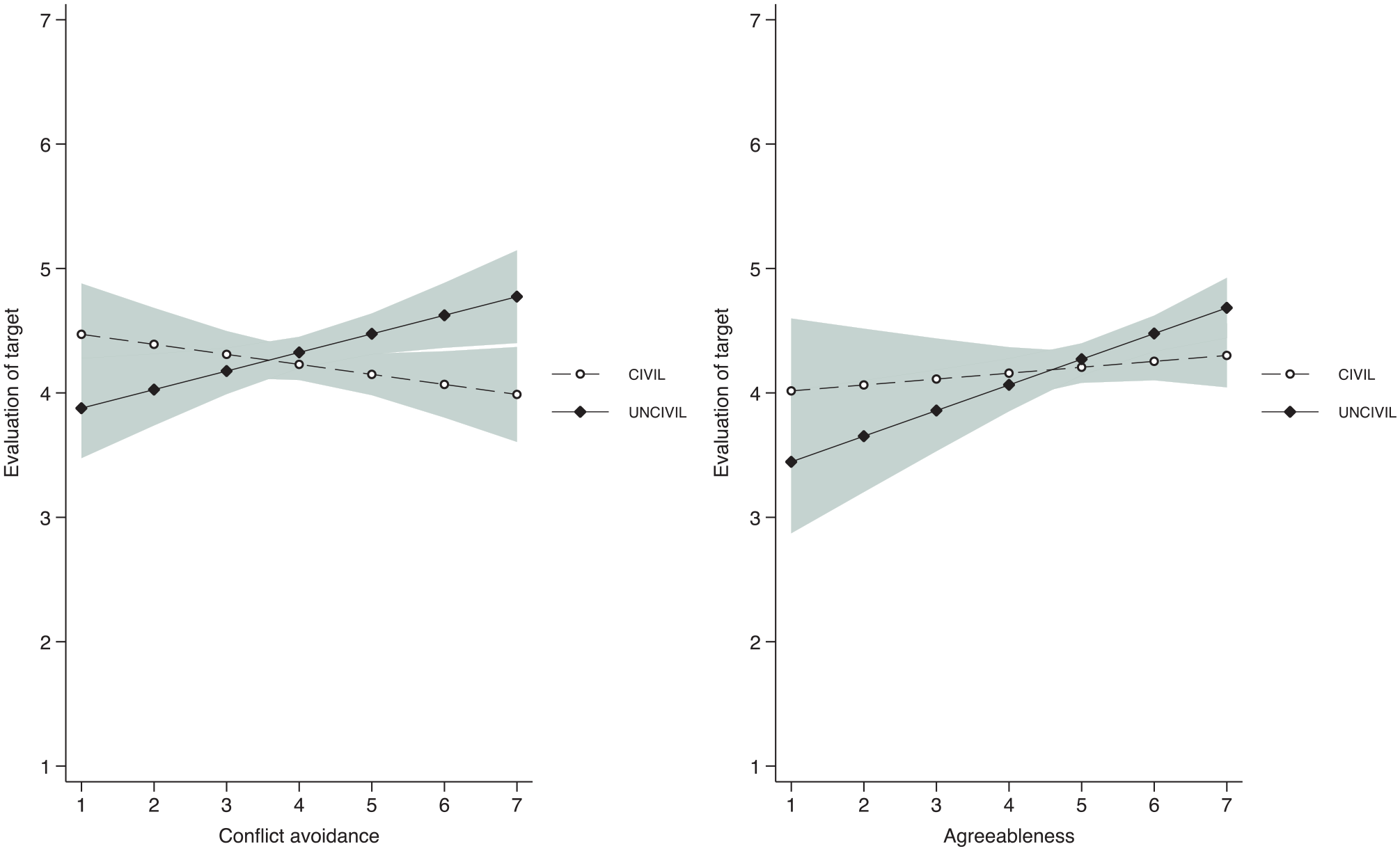
Study 2: Evaluation of the target.
General discussion
Politics is getting increasingly darker. High affective polarization makes voters hostile towards those they consider as their political “rivals” (Iyengar et al., 2012), disagreeable and aggressive political figures are on the rise in Western democracies and beyond (Nai & Martinez i Coma, 2019), and—central for our study—election campaigns are more often than not reminiscent of battlefields (Ansolabehere & Iyengar, 1995; Lau & Pomper, 2004). Yet, for all the attention provided to such negativity in recent years, the jury is still out when it comes to its consequences. Are negative campaigns effective to depress evaluation of the target, or do they instead backlash against the sponsor? And under which conditions?
This article intended to clarify the moderating role of individual differences for the effectiveness of attack politics. We discussed the results of two online experiment among US respondents in which respondents were exposed to different types of positive and negative messages; most notably, they were exposed to character versus policy attacks in study 1 (S1), and to uncivil vs. civil attacks in study 2 (S2).
Across the two studies, we find that harsh campaign messages backlash against the sponsor. This is the case for negative over positive messages (both studies), for character over policy attacks (S1), and for uncivil attacks over civil attacks (S2). Negativity is a risky business, and we find consistent support that voters tend to punish candidates that go excessively negative. This general trend holds across two studies, who differ in terms of partisan affiliation of sponsor and target, policy issues, types of attacks, and potential pre-experimental biases (S1 uses real political figures, whereas S2 uses fictive candidates). Yet, on top of this generalized backlash, we find in the two studies that some respondents are particularly likely to punish the sponsor when they go negative. Evaluations of the sponsor are more negative after exposure to negative messages for respondents low in Machiavellianism (S1), low in psychopathy (S2) and high in conflict avoidance (S2). Similarly, low tolerance for negativity makes respondents more likely to have a worse perception of the sponsor when exposed to an uncivil attack (S2). Inversely, evaluations of the sponsor are more positive for conscientious respondents exposed to positive campaigns (S1) but also for respondents high in psychopathy and exposed to negative campaigns (S2).
At the same time, negativity can be an effective tool to foster more negative candidate perceptions. Indeed, across the two studies we find that negativity works to generally create more negative perceptions of the target—but “harsher” messages (character attacks, and incivility) do not. The “harsher” forms of attack politics are nonetheless effective for some voters. Respondents high in psychopathy are more likely to have a worse opinion of the target after being exposed to character attacks (S1), and incivility “works” as intended and reduces positive perceptions of the target for individuals low in conflict avoidance and agreeableness (S2). Additional analyses show that these results are not fundamentally different for Democrat and Republican respondents (Supplemental Tables A8, A9 and A16−A19 in Appendix A), even if a handful of significant differences exist (e.g., Figures A5 and A6). Because of the partisan nature of the treatments, the moderating effect of individual party identification requires broader attention in future studies—including the interaction with the party affiliation of the sponsors and targets of negative messages. We voluntarily varied this factor across the two studies to ensure external validity, which however precluded us to specifically test for the presence of unique partisan effects—for example, the fact that some messages might be more efficient for some candidates.
Overall, our results strongly suggest that negativity (and harsher attacks, and incivility) are a matter of taste, and have different effects based on such preferences. The fact that these results, broadly speaking, converge across the two studies—which diverge quite considerably in terms of setup—indicates that they are perhaps generalizable, which suggests a certain degree of external validity (e.g., Schram, 2005). Nonetheless, moving forward, a replication outside of the US case seems necessary, towards a broader and more “universal” understanding of the psychological underpinnings of “preferential” treatment of negative campaign messages. Such research should, ideally, include “longer” personality scales, in light of evidence that “short” scales can be potentially problematic outside of “WEIRD” (Western, Educated, Industrialized, Rich, and Democratic) contexts (Ludeke & Larsen, 2017). Furthermore, additional research should ideally investigate the moderating role of underlying personality dimensions such as, for example, Digman’s (1997) alpha and beta “metatraits” or the underlying “dark core” (Jones & Figueredo, 2013), to account for the fact that personality traits within the Big Five and Dark Triad inventories are not orthogonal.
The implications of these results are manifold. First, from a theoretical standpoint, they suggest that focusing on the moderating role of individual differences is a promising way out of the conundrum in which the literature on the effectiveness of negative campaigns seems often to be stuck. To be sure, differences in tone and content of the attacks matter greatly - as our studies also show. Yet, the clearest indication coming from our results is that negativity is a matter of taste. Further research should furthermore expand on the important moderating role of individual differences if voters exposed to campaign messages, by also taking into account the (perceived) personality profile of candidates themselves. Consistent evidence suggests that voters tend to evaluate more positively candidates whom they see as sharing a similar personality profile with them (e.g., Caprara & Vecchione, 2017). Accounting for these additional dynamics could help disentangle the Gordian knot of the multiple interrelated causalities between voters’ preferences, (perceived) candidate profile, and the effects of their campaigns.
Second, from a practical standpoint, our result suggest that political consultants and campaign managers could benefit from identifying the (micro)targets of their attacks also in terms of their personality and individual differences. Knowing whether the population to be influenced is, say, high in conscientiousness rather than low in agreeableness could have profound implications on how campaign messages are tailored. Weinschenk and Panagopoulos (2014) make a very similar point. To be sure, the share of the electorate holding those specific personality traits can be rather small. For instance, according to a quick analysis of the 2016 American National Election Study using the TIPI inventory, only 9 percent of the US voters score lower than 4.0 (the midpoint of the 7-point scale) in agreeableness (α = .31, N = 3,610). Yet, the exponential development of campaign activities on social media and the entrenchment of the “one-step flow of communication” model (Bennett & Manheim, 2006), where candidates communicate directly with the public without the mediating role of gatekeepers, is likely to facilitate this endeavor. Questionable initiatives to harvest the personality of the public, like the “Cambridge Analytica” kerfuffle, are not unlikely to emerge again in the future, with significant implications in terms of privacy protection (e.g., Isaak & Hanna, 2018).
Finally, from a normative standpoint, our results challenge the intuition that negativity is necessarily detrimental for democracy. To be sure, for many this is indeed the case, and exacerbates the idea that politics is nothing but a boxing ring, occasionally amusing but overall not to be concerned with. Yet, for other voters negativity can also be a force for “good,” as it potentially creates a more positive image of competing candidates. People high in Machiavellianism and psychopathy and have a better image of politicians when they go negative, and people high in tolerance to negativity tent to particularly like candidates that use incivility. Some, quite simply, like it more negative (Nai & Otto, forthcoming). Additionally, and as a counterpoint, agreeable people tend to have a better opinion about the target of uncivil attacks - perhaps suggesting that the role of empathy and compassion in politics should not be underestimated.
Supplemental Material
online_appendix – Supplemental material for Is Negative Campaigning a Matter of Taste? Political Attacks, Incivility, and the Moderating Role of Individual Differences
Supplemental material, online_appendix for Is Negative Campaigning a Matter of Taste? Political Attacks, Incivility, and the Moderating Role of Individual Differences by Alessandro Nai and Jürgen Maier in American Politics Research
Footnotes
Acknowledgements
We are very grateful to the anonymous reviewers and journal editors for their constructive critiques and sound suggestions. All remaining mistakes are of course our responsibility alone. A previous version of this article was presented during the 2020 (virtual) annual meeting of the American Political Science Association (APSA), and during a LAB workshop of the Political Communication group at the University of Amsterdam in June 2020. A sincere thank you to all participants to these events, and in particular to Fabian Neuner, Bert Bakker, Katjana Gattermann, and Lukas Otto for excellent inputs.
Declaration of Conflicting Interests
The author(s) declared no potential conflicts of interest with respect to the research, authorship, and/or publication of this article.
Funding
The author(s) disclosed receipt of the following financial support for the research, authorship, and/or publication of this article: Alex Nai acknowledges the generous financial support from the Amsterdam School of Communication Research (ASCoR), University of Amsterdam, which allowed us to field the surveys used in this article.

Supplemental Material
Supplemental material for this article is available online.
Author Biographies
References
Supplementary Material
Please find the following supplemental material available below.
For Open Access articles published under a Creative Commons License, all supplemental material carries the same license as the article it is associated with.
For non-Open Access articles published, all supplemental material carries a non-exclusive license, and permission requests for re-use of supplemental material or any part of supplemental material shall be sent directly to the copyright owner as specified in the copyright notice associated with the article.
