



Abstract
Introduction:
Seha Virtual Hospital (SVH), established in February 2022, represents a significant development in the Saudi telemedicine health care system, aligning with the goals of Vision 2030. This study aims to analyze SVH’s growth, service delivery, and patient outcomes from 2022 to 2024.
Methods:
A retrospective descriptive analysis was conducted using data retrieved from SVH’s electronic health records and administrative files between 2022 and 2024. It assessed variables including the number of centers, medical staff, beneficiaries, types of medical cases, and patient outcomes. Data were analyzed to identify trends and patterns in service delivery and patient care.
Results:
SVH experienced substantial growth during the study period. From 2021 to 2024, the number of telemedicine centers, workforce, medical doctors, and beneficiaries increased substantially. Key medical cases, including oncology, cardiology, stroke, and pediatrics, saw notable increases, with oncology and stroke cases rising from 24 and 41 in 2022 to 714 and 4,393 in 2024, respectively. Outpatient visits dominated, increasing from 1,717 in 2021 to 27,896 in 2024. Patient satisfaction remained high, with 86% of outpatients reporting satisfactory outcomes in 2022 and 2024, though it dipped to 82% in 2023.
Conclusion:
SVH’s rapid expansion and the increasing demand for its services reflect the hospital’s pivotal role in enhancing health care access and quality in Saudi Arabia. The findings highlight SVH’s alignment with Vision 2030 objectives, particularly in expanding telemedicine infrastructure and improving patient care outcomes. This study provides valuable insights into future health care and telemedicine development strategies within the Kingdom.
Introduction
The health care sector globally has seen remarkable transformations in recent years, driven by technological advancements, the evolution of care models, and the integration of health systems aimed at providing comprehensive, efficient, and equitable care. 1 Within this broader context, the establishment of Seha Virtual Hospital (SVH) in February 2022 represents a critical step in advancing health care services at the national level. 2 SVH was developed as a telemedicine-based initiative under the Ministry of Health, designed to meet the growing demand for accessible, high-quality health care. It operates as the world’s largest virtual hospital, connecting over 224 hospitals across the Kingdom of Saudi Arabia (KSA) and offering more than 100 specialized and subspecialized services through virtual consultations, clinics, and multidisciplinary committees. SVH leverages cutting-edge technologies, including artificial intelligence, remote diagnostics, and digital platforms, to deliver expert medical care regardless of geographic location, thereby enhancing health outcomes and contributing to the overall well-being of the population.3,4 SVH was developed with the goal of meeting the increasing demand for accessible, high-quality health care while contributing to the overall health and well-being of the population. 5
Saudi Arabia’s Vision 2030, a comprehensive national transformation agenda launched in 2016, outlines ambitious reforms aimed at diversifying the economy and enhancing public sector services, including health care. 6 A key component of this vision is the modernization of the health care system, which seeks to increase efficiency, expand service accessibility, and improve health outcomes across the Kingdom. Vision 2030 places a strong emphasis on developing telemedicine infrastructures that are patient-centered, innovative, and integrated. 6 The government focuses on improving health care access through advanced digital platforms, the promotion of preventive care, and strengthening the overall capacity of the health care sector, which aligns with the goals of SVH. As part of this strategy, SVH seeks to contribute to broader national efforts by offering comprehensive telemedicine care that supports the Vision 2030 objectives of promoting wellness, reducing health care disparities, and improving the quality of life for all citizens. 5
In the context of these national health care goals, limited research has focused on the evaluation of newly established telemedicine facilities and their long-term impact on service delivery and health outcomes. Although previous studies have explored health care reforms in Saudi Arabia, such as those related to the Ministry of Health’s initiatives under Vision 2030, there remains a gap in understanding the operational characteristics and impacts of emerging health care institutions like SVH. Recent studies have featured the importance of evaluating health care systems at both the service delivery and policy levels to identify trends and assess outcomes.1,7 Retrospective analyses are particularly valuable as they provide insights into system performance, resource utilization, and patient demographics, which can be crucial for continuous improvement and future planning.8,9
Alasiri et al. (2022) offer a thorough overview of health care transformation in Saudi Arabia, highlighting the alignment between health care reforms and Vision 2030’s goals.5,6 Their work emphasizes the importance of establishing data-driven insights to monitor the success of health care initiatives and ensure that transformation efforts lead to sustainable improvements in service delivery and patient care. This study builds on their findings, contributing to the growing body of literature on health care system performance under the Vision 2030 framework. Hence, this study aims to address this gap by conducting a national retrospective descriptive analysis of SVH’s services, key performance indicators, and patient outcomes from its inception in 2022 through 2024. By examining the types of services provided, the number of beneficiaries, and the demographics of the patient population, this study will provide valuable insights into SVH’s role within the broader health care landscape and its alignment with the strategic objectives outlined in Vision 2030. The study also explores the hospital’s contribution to improving health care delivery and its impact on different population groups, providing evidence that can support ongoing efforts to enhance health care services across the country.
Methods
STUDY DESIGN
This study employed a national, retrospective descriptive analysis to examine the types of services, key indicators, and the number of beneficiaries at SVH from its inception in February 2022 through 2024. The population for the analysis comprised all services and practices delivered at SVH during the specified data collection period.
DATA COLLECTION
Data were collected from the Electronic Health Records and administrative files of the SVH platform, covering the period from February 2022 to December 2024. A consecutive sampling approach was utilized to ensure comprehensive retrieval of relevant data, including details on health care practices, service utilization, patient outcomes, and trends over the study period. No predefined eligibility criteria were applied to allow for an inclusive examination of Seha’s impact across different demographic groups and health conditions.
The study was designed to exclude any patient-identifiable information, ensuring that no ethical approval was required. Data were stored and processed in accordance with local regulatory laws and ethical standards as outlined in the Declaration of Helsinki.
DATA ANALYSIS
Descriptive statistics were used to summarize the data and identify key trends. Qualitative analysis methods were also employed to gain insights into patterns of service use and outcomes. These analyses provided an overview of SVH’s operational impact over the study period, highlighting both service delivery and patient care trends.
Results
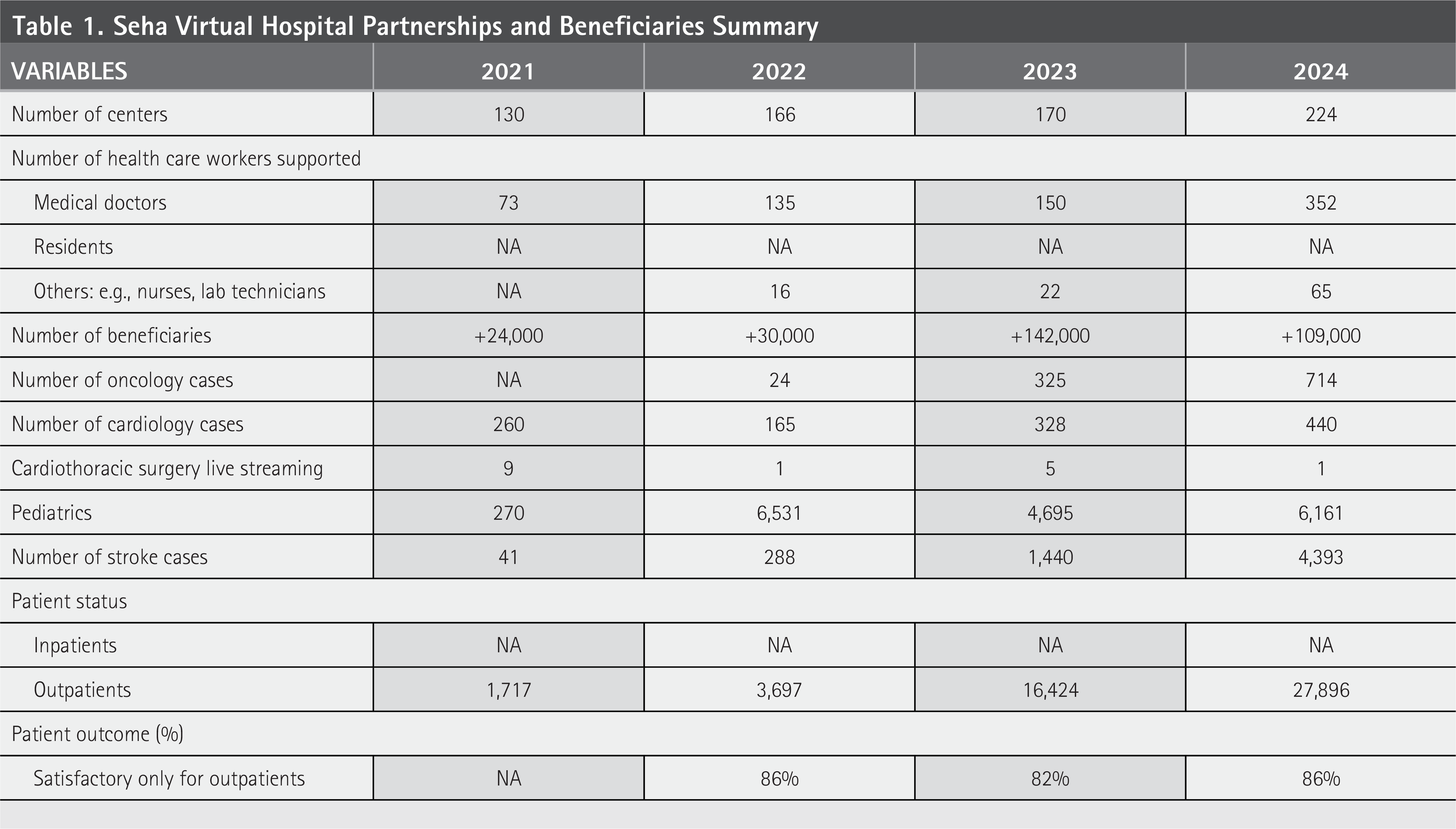
The data collected between 2020 and 2024 for SVH illustrate significant growth in the number of health care facilities, health care workers, beneficiaries, and the diversity of medical services provided. The following sections present the results, organized by key variables of interest: the number of centers, health care workforce, patient demographics, and medical case categories, and summarized in Table 1.
Seha Virtual Hospital Partnerships and Beneficiaries Summary
EXPANSION OF SVH NETWORK
The SVH witnessed remarkable growth from 2020 to 2024, significantly enhancing health care accessibility across Saudi Arabia. In 2020, the hospital had no active centers, but by 2021, it had established 130 centers, rapidly expanding to 224 centers by 2024. This substantial increase in the number of virtual health care facilities underscores SVH’s commitment to providing nationwide health care coverage. Additionally, the hospital’s integration with 65 health care institutions has reinforced its role as a key player in telemedicine, facilitating the delivery of specialized medical services to patients regardless of their geographic location. This expansion has played a crucial role in bridging health care gaps, particularly in remote and underserved regions, where access to specialized care was previously limited.
GROWTH IN HEALTH CARE WORKFORCE
The development of SVH has been accompanied by a substantial increase in its health care workforce, reflecting the hospital’s commitment to strengthening its service capacity. The number of medical doctors providing virtual consultations and specialized care increased significantly from 73 in 2021 to 352 in 2024. This growth aligns with the hospital’s expansion and the increasing number of patients requiring specialized services. Furthermore, the number of other health care professionals, such as nurses and laboratory technicians, saw steady growth, rising from 16 in 2022 to 65 in 2024. This increase highlights the hospital’s dedication to supporting nonphysician health care roles, ensuring comprehensive patient care in the virtual health care setting. These professionals play a crucial role in delivering seamless telemedicine services, from diagnostic procedures to patient education and follow-up care.
INCREASE IN PATIENT BENEFICIARIES
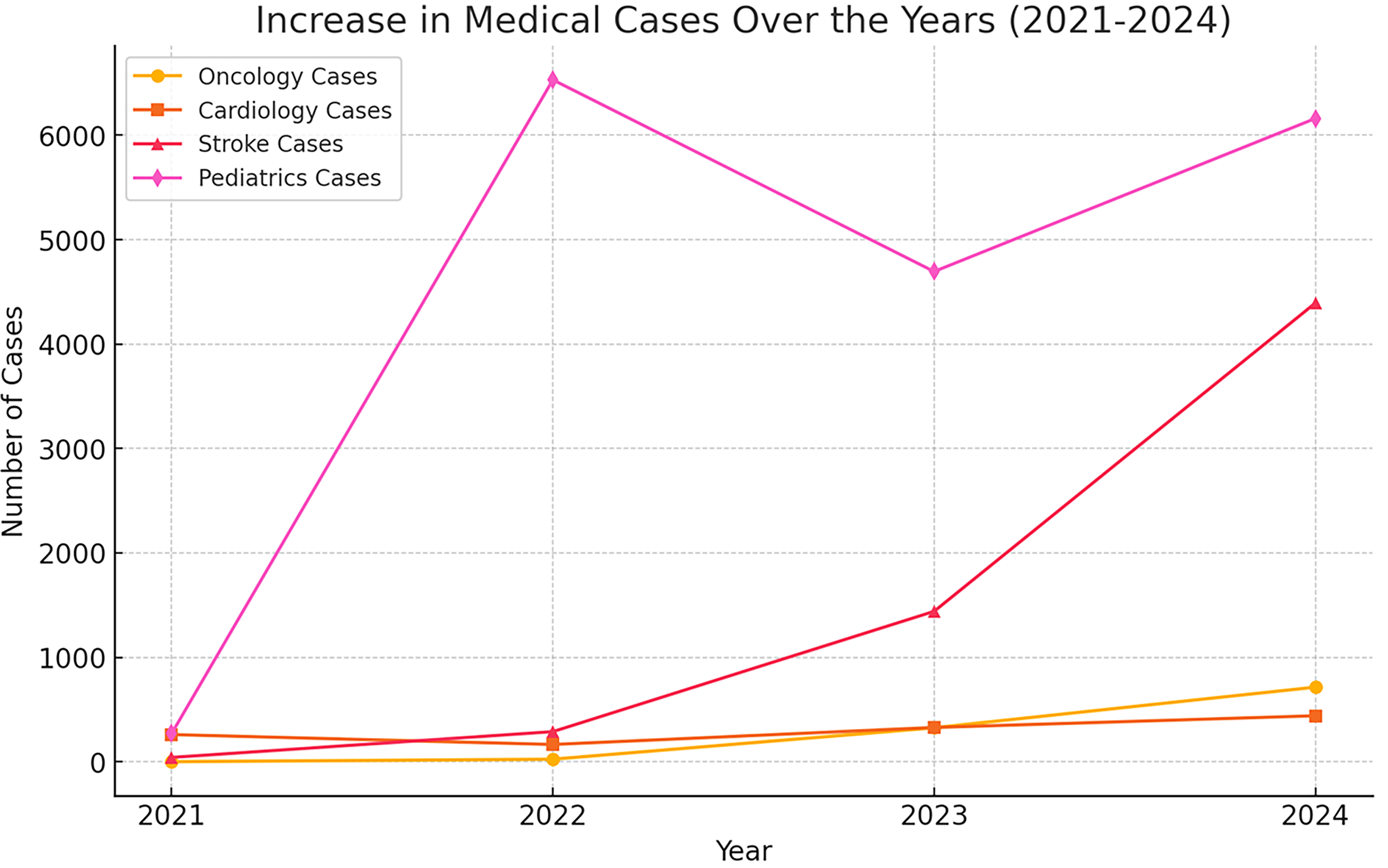
SVH has experienced a significant rise in the number of patients benefiting from its services (Fig. 1). In 2021, the hospital provided care to 24,000 patients, a number that increased to 30,000 in 2022. The most dramatic surge occurred in 2023, when over 142,000 patients received virtual medical services. In 2024, the number of beneficiaries slightly decreased to 109,000, potentially due to variations in health care demand and shifting patient needs. Additionally, during the Hajj season in 2024, SVH played a crucial role in managing health care services for pilgrims, handling an additional 12,308 virtual cases. This highlights the hospital’s ability to provide rapid and large-scale health care support during mass gatherings, reducing the burden on physical health care facilities and ensuring timely medical interventions for patients in need.
Indicators of specialized clinics of Seha hospital.
ADVANCEMENTS IN SPECIALIZED MEDICAL SERVICES
SVH has made significant strides in offering specialized medical services, with a notable increase in the number of cases treated across various disciplines. The National Virtual Cardiology Committee managed 111 adult cases and 174 pediatric cases, providing remote cardiac consultations to patients requiring expert cardiovascular care. Critical care services also saw substantial utilization, with adult intensive care units handling 4,486 cases across 12 hospitals, pediatric intensive care managing 1,060 cases across 5 hospitals, and neonatal intensive care providing support for 4,927 cases in 7 hospitals. This expansion of intensive care services through virtual platforms has enhanced the hospital’s capacity to manage complex medical conditions remotely, improving patient outcomes and reducing the need for in-person hospital visits.
RISE IN ONCOLOGY AND NEUROLOGY CASES
Oncology services at SVH have seen significant growth, with the number of cancer cases rising from 24 in 2022 to 714 in 2024. This sharp increase highlights the growing reliance on virtual consultations for cancer diagnosis, treatment planning, and follow-up care. Similarly, stroke management has emerged as a critical area of focus, with stroke cases increasing from 41 in 2021 to 4,293 in 2024. The rapid expansion of virtual stroke care services reflects improvements in remote diagnostics, early intervention strategies, and the overall effectiveness of telemedicine in managing critical neurological conditions. Additionally, neurology services such as electroencephalogram (EEG) assessments have grown substantially, with 5,746 cases recorded in 2024, demonstrating the increasing demand for virtual neurological evaluations and monitoring.
EXPANSION OF RADIOLOGY AND INPATIENT CONSULTATION SERVICES
Radiology has been one of the most utilized services within SVH, with an impressive 99,264 cases recorded in 2024. This reflects the widespread adoption of remote imaging analysis and virtual radiology consultations, allowing patients to receive accurate and timely diagnostic reports without the need for physical hospital visits. Additionally, inpatient virtual consultations have also been integrated into the hospital’s services, with 329 consultations conducted in 2024. These remote inpatient evaluations enable specialists to assess hospitalized patients’ conditions without requiring their physical presence, improving hospital efficiency and patient care coordination.
OUTPATIENT GROWTH AND PATIENT OUTCOMES
The majority of SVH’s services have been outpatient-based, with a steady increase in the number of virtual consultations over the years. The number of outpatients increased significantly from 1,717 in 2021 to 27,896 in 2024, demonstrating the growing trust in telemedicine and its effectiveness in delivering quality health care. The hospital’s focus on outpatient care has allowed for the efficient management of chronic diseases, follow-up appointments, and second opinions from specialists, reducing the burden on in-person medical facilities. Patient outcome data indicate consistently high satisfaction rates, with 86% of outpatient cases reported as having successful outcomes in both 2022 and 2024, despite a slight drop to 82% in 2023. These variations may be attributed to case complexity, evolving health care delivery models, and patient expectations. Nonetheless, the consistently high success rates underscore SVH’s commitment to maintaining high-quality virtual health care services.
The continuous expansion and technological advancements of SVH have positioned it as a leader in telemedicine, significantly improving patient access to specialized health care services. The hospital’s ability to integrate with 65 health care institutions, manage a growing number of complex medical cases, and provide real-time virtual consultations highlights its effectiveness in bridging health care gaps across Saudi Arabia. With the increasing adoption of artificial intelligence, expanded telehealth infrastructure, and continuous policy improvements, SVH is set to play an even more pivotal role in shaping the future of digital health care in the country. Moving forward, further enhancements in virtual health care capabilities and continued investments in medical technology will be essential in sustaining and optimizing telemedicine services nationwide.
Discussion and Conclusions
The KSA SVH initiative represents a transformative milestone in Saudi Arabia’s health care system, aligning closely with the strategic objectives of Vision 2030. 5 By expanding health care access through digital technologies, KSA SVH has significantly enhanced service delivery, ensuring that specialized medical care reaches underserved populations across the Kingdom. The substantial growth in the number of health care centers, health care workers, and beneficiaries underscores Saudi Arabia’s commitment to integrating digital health solutions as a cornerstone of its national health care strategy. 6 The initiative has enabled patients to receive high-quality medical care regardless of geographical barriers, reflecting a broader effort to modernize and optimize health care services in line with global standards.
One of the most notable achievements of the KSA SVH program has been its impact on specialized medical care. The significant increase in oncology, cardiology, and stroke cases treated through the virtual hospital highlights the effectiveness of telemedicine in addressing critical health care needs. The dramatic rise in stroke cases from 41 in 2021 to 4,393 in 2024 underscores the role of virtual consultations in reducing response time and improving patient outcomes, particularly in emergency situations where timely intervention is crucial.10,11 Telemedicine has facilitated rapid neurology consultations, allowing for earlier diagnosis and better management of stroke patients, ultimately improving survival rates and reducing long-term disability. Similarly, the increase in oncology cases from 24 in 2022 to 714 in 2024 reflects the expanding role of virtual oncology services, enabling remote consultations for early cancer diagnosis, multidisciplinary treatment planning, and continuous patient monitoring, which are all essential in improving long-term prognoses.
The integration of live-streamed cardiothoracic surgeries within the virtual hospital framework further demonstrates its role in advancing medical education and professional development. 12 While the number of live-streamed surgeries has fluctuated, this initiative has provided an invaluable resource for surgical training, offering real-time access to specialized expertise without the need for physical relocation. This aligns with Saudi Vision 2030’s emphasis on knowledge transfer and capacity building, ensuring that health care professionals in various regions have the opportunity to learn from experienced specialists and improve their clinical skills. 13 The ability to access expert surgical guidance remotely is particularly beneficial in areas with limited specialized surgical expertise, thereby enhancing the overall quality of surgical care in the Kingdom.
The continuous rise in outpatient visits, increasing from 1,717 in 2021 to 27,896 in 2024, along with stable patient satisfaction rates, further reinforces the success of the virtual hospital model. The steady satisfaction levels, ranging from 82% to 86%, highlight the trust and reliability patients place in telemedicine services. 14 This success is in line with the findings of Alasiri (2022), who emphasized that Vision 2030 prioritizes the modernization of health care through digital transformation, with telemedicine serving as a key tool for expanding access to quality care, particularly in remote and underserved regions. 5 The success of outpatient teleconsultations, particularly in pediatrics, cardiology, and general medicine, has played a crucial role in reducing hospital overcrowding, improving follow-up care, and enhancing patient convenience, further demonstrating the efficiency of this model.
Despite its success, the long-term sustainability of the KSA SVH will depend on addressing several key challenges. 15 One major concern is digital literacy and accessibility, as ensuring equitable access to telemedicine services requires bridging the digital divide, particularly in rural and lower-income communities.16,17 Government initiatives to improve digital health literacy and expand internet connectivity will be essential to ensuring that all patients can effectively use telehealth services.18,19 The widespread availability of high-speed broadband and extensive 5G coverage ensures that virtual health care solutions can be effectively implemented across the country without significant technological barriers, minimizing concerns about connectivity issues for telemedicine services. 20 Moreover, maintaining consistent service quality across diverse geographic areas requires ongoing investment in digital health infrastructure, including edge computing and scalable 5G networks, which help reduce latency and improve real-time responsiveness in remote diagnostics and consultations. 4 Privacy and cybersecurity also remain critical concerns, as telemedicine involves the transmission of sensitive health data across digital platforms. Addressing these challenges will be vital to ensuring equitable access and sustained adoption of telemedicine services nationwide. 21
Beyond technological readiness, regulatory and ethical considerations remain critical to the sustainable expansion of virtual health care. Ensuring robust data security, protecting patient confidentiality, and maintaining compliance with international health care standards are essential for fostering patient trust and adherence to best practices. As telemedicine continues to evolve, continuous refinement of legal frameworks and ethical guidelines will be necessary to address emerging challenges and optimize the efficiency and reliability of digital health care services in the Kingdom.22,23 Overall, the KSA SVH initiative is a groundbreaking success, demonstrating the power of digital health care in transforming service delivery. The exponential growth in health care centers, workforce, beneficiaries, and key medical cases highlights the initiative’s impact on national health care accessibility and efficiency. By improving specialized medical care, advancing medical education through live-streamed surgical training, and increasing access to outpatient consultations, KSA SVH has set a new standard for digital health care in Saudi Arabia. The program serves as a model for other nations looking to integrate telemedicine into their health care systems. Moving forward, sustained investment in digital health infrastructure, AI-driven patient management systems, and telemedicine regulations will be essential to maintaining and expanding KSA SVH’s success, ensuring that Vision 2030’s health care transformation goals continue to be realized. 24
Limitations and Future Directions
Despite its success, SVH faces key challenges that must be addressed for sustainable growth and long-term efficiency. Fragmentation in workflows, billing complexities, and inefficiencies in hybrid health care models pose operational hurdles that require standardized systems for seamless interoperability, reimbursement structures, and coordinated care delivery. The lack of comprehensive economic studies assessing cost-effectiveness and the overall impact of virtual health care limits strategic decision-making. Without robust financial insights, justifying investments and scaling virtual health care services may face resistance from policymakers, health care providers, and insurers. 24
A well-defined long-term strategy is crucial to overcoming these scalability challenges while ensuring service quality, cybersecurity, and equitable access. While centralization has been a driving force behind Seha’s early success, future expansion requires a balanced approach that maintains centralized coordination while allowing decentralized adaptability to meet regional health care needs. Additionally, integrating AI-driven diagnostics, enhancing real-time remote monitoring, and refining patient engagement strategies will be essential to strengthening telemedicine adoption. Addressing these limitations through data-driven policy development and infrastructure investments will be vital in aligning digital health care with national priorities. By refining its operational framework and expanding its technological capabilities, SVH can continue advancing Saudi Arabia’s Vision 2030 goals and serve as a global model for virtual health care transformation.
Footnotes
Acknowledgments
The authors would like to thank CTI medical writing team for the support in the medical write-up, editorial support, and submission.
Author Disclosure Statement
All the authors declare no conflict of interest.
Funding Information
This research received no specific grant from any funding agency in the public, commercial, or not-for-profit sectors.
Availability of Data and Materials
The datasets used and/or analyzed during the current study are available from the corresponding author on reasonable request.