




Abstract
The advancement of wearable technology has driven research into shape memory alloy (SMA) textiles for diverse applications, enhancing comfort, functionality, and adaptability. This review systematically analyzes 30 studies published up to November 2024, examining SMA textile structures, actuation mechanisms, applications, and user evaluations. SMA textiles are categorized into knitted, woven, and knot structures, each with distinct advantages and limitations. Contraction actuation is widely studied, particularly in rehabilitation and compression wear, while bending actuation is gaining attention for localized motion assistance. However, challenges related to energy consumption, durability, and response time continue to hinder practical implementation. Standardized usability assessments are lacking, as most studies rely on laboratory-based testing rather than real-world evaluations. Hybrid actuation mechanisms that integrate contraction and bending remain underexplored, limiting their multifunctional potential. Future research should prioritize energy-efficient activation strategies, improved material durability, and standardized testing protocols to enhance real-world applicability. This review provides a critical analysis of SMA textile technologies, highlighting key research gaps and future directions to improve functionality, wearability, and commercialization potential.
Introduction
Shape Memory Alloy (SMA) textiles have emerged as a significant area of research due to their potential to revolutionize wearable technology. SMAs are materials capable of recovering their original shape after deformation when exposed to specific stimuli, such as thermomechanical or magnetic changes. 1 This unique property makes them ideal candidates for integration into textiles, enabling dynamic and responsive functionalities previously unattainable with traditional materials. In particular, SMA textiles can be applied in wearable technology to create garments that adapt to body movements,2,3 provide therapeutic support,4,5 thermal protection,6,7 or even store energy for later use. 8
As SMA textiles continue to evolve, their potential applications in wearable products become increasingly diverse and transformative. The term “wearable products” broadly encompasses accessories, clothing, devices, and robots designed for the human body. 9 Over the past decade, these wearable products have grown rapidly across fields such as healthcare, sports, rehabilitation, and personal assistance.10,11 A major advancement has been the integration of multiple technologies, such as soft exoskeletons, compression garments, and haptic feedback devices.12,13 These innovations enhance functionality, creating more seamless interactions between users and their environments while offering personalized experiences. At the core of these innovations are responsive materials like SMA, which enable wearable products to adapt to movements and external stimuli. SMA textiles, in particular, provide customized solutions to improve mobility and comfort, making them ideal for continuous use in applications such as rehabilitation and personal assistance.5,14
In fact, SMA textiles have demonstrated practical applications across various industries, moving beyond theoretical research. In healthcare, SMA-integrated garments assist in rehabilitation by providing muscle support and improving joint mobility for patients with physical impairments.2,5,18 In functional clothing, SMA textiles are used in compression wear to reduce injury risk by adapting to athletes’ movements and in protective clothing to shield the body from thermal hazards.15,19,20 These applications highlight the potential of SMA textiles to improve quality of life and expand wearable technology. However, challenges remain in integrating SMA into wearable products, particularly regarding actuation control, durability, and user comfort.2,15 Addressing these issues is essential to unlocking the full potential of SMA textiles. While previous studies have explored the mechanical and actuation behavior of SMA textiles,16,17 much of the research focuses on isolated aspects rather than taking a holistic approach to functionality and wearability. Moreover, there is no consensus on best practices for integrating SMA into textiles to optimize performance and user experience, emphasizing the need for a comprehensive review to address these gaps.
Therefore, this review aims to bridge these gaps in the integration of SMA textiles into wearable applications, focusing on their structural variations, actuation mechanisms, and user-centered evaluation methods. By analyzing recent advancements, this review provides insights into optimizing SMA textiles for practical use. The key research questions are: (1) What are the predominant structures and actuation mechanisms used in SMA textiles? (2) How do SMA textiles enhance wearable applications in terms of functionality and user comfort? (3) What are the key limitations and opportunities for future advancements in SMA textile research? By addressing these research questions, this review seeks to provide actionable insights for optimizing SMA textiles in practical and user-centered wearable applications.
Review methodology
A systematic approach was applied to data collection to conduct a literature review on SMA textiles for wearable applications. We first selected the following three keyword sets: (1) “Shape Memory Alloy”, (2) “Textile”, “Fabric”, and “Knit”, and (3) “Cloth”, “Garment”, and “Wearable”. All three sets of keywords were combined using Boolean operators (AND/OR). The electronic databases searched included PubMed and Web of Science, and only original articles published in English before November 2024 were included in this review. Conference proceedings, patents, and presentation materials were excluded from this review. A systematic search identified 114 articles, including 87 from Web of Science and 27 from PubMed (Figure 1). After removing 23 duplicates using Mendeley, 91 abstracts were reviewed to identify studies focused on SMA materials in textile forms. Studies utilizing materials other than SMA wires—such as shape memory polymers, 3D-printed materials, composite structures, or films—were excluded, narrowing the dataset to 47 articles. The inclusion criteria focused on studies that developed SMA textiles through processes like weaving, knitting, stitching, or sewing, including those with thin SMA springs in fabric bundles. A further eligibility assessment excluded 10 articles based on predefined criteria, and 7 more for using SMA wires between fabric layers rather than within the textile structure. Ultimately, 30 articles met the criteria for comprehensive analysis. These 30 articles were categorized into SMA textile structures, actuation mechanisms, wearable applications, and user-centered evaluation methods, forming the state of the art in SMA textiles (refer to Appendix). We then compared SMA textile structures, discussed challenges in actuation control and durability, and identified gaps in user evaluation methods, providing a critical analysis of existing research. Finally, we explored real-world applications and proposed future research directions. Flowchart of database filtering.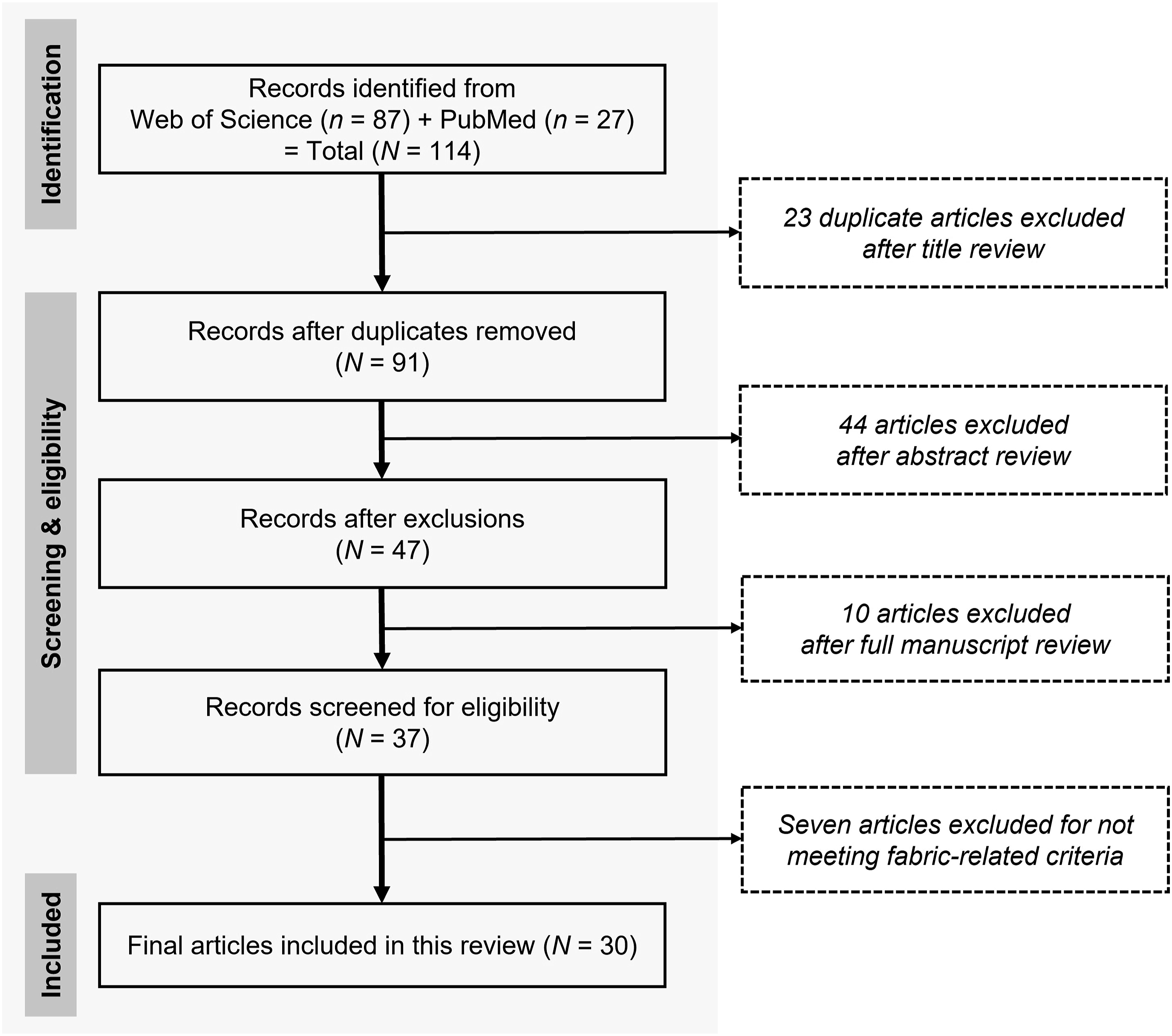
State of the art in SMA textiles
SMA textile structures and fabrication methods
Knitted SMA textiles were the most widely studied, with weft knitting as the dominant technique (Figure 2(a)). This preference stems from the intrinsic flexibility of knitted structures, which allow SMA wires to expand and contract without significant mechanical resistance. Garter and plain knits16,22,25,27,29–31,37,38,40 were particularly favored due to their high elasticity and comfort, making them ideal for wearable applications requiring close skin contact (e.g., compression and rehabilitation garments) (Figure 2(b)). However, their lower structural stability compared to woven textiles poses a limitation in applications requiring precise force output or sustained mechanical support (e.g., exosuits, orthopedic braces). Lah et al.
6
and Granberry et al.
30
demonstrated the potential for enhancing mechanical resilience and actuation force using less commonly utilized knit structures, such as rib knit and garter-stockinette weft knit. However, further research is needed to assess their long-term durability and user comfort. Lee & Han
34
and Lee et al.
5
proposed experimental structures such as crochet and warp knit; however, despite their potential for customizable stretch and localized actuation control, these structures remain insufficiently explored. SMA textile types and actuation in wearable applications: (a) distribution of textile type, (b) knit and woven structures, (c) actuation motions, and (d) aims.
Woven textiles were the second most common structure, valued for their high structural integrity and predictable actuation response. Among the 12 studies that explored woven SMA textiles, weaving7,19,20,24,28,32 was the most frequently employed method. The key advantage of woven textiles lies in their ability to maintain wire alignment and consistent tension, leading to more uniform and controllable actuation motions. However, woven SMA textiles typically exhibit limited stretch and flexibility, which can restrict movement when applied to dynamic wearable products. To address this, Shi et al. 8 and Kim & Kim 31 have investigated hybrid integration methods, which enables localized actuation but has the drawback of uneven force distribution across the fabric.
Other studies have explored spring bundle integration,14,32,36 which has proven effective in high-stress applications requiring significant force output (e.g., soft exosuits, industrial wearable robots). Meanwhile, Shin et al. 39 demonstrated that zigzag structures have the potential to facilitate multi-directional actuation, making them promise for adaptive robotic wearables and haptic feedback interfaces. Oh et al. 3 proposed the applicability of knot structures for arm wear. However, this remains an underexplored area due to manufacturing challenges and scalability issues. However, early studies suggest that auxetic knot structures may provide exceptional contraction rates and adaptability, enabling applications in soft robotics, advanced haptics, and biomechanical assistance. The primary research gap in this area lies in ensuring consistent actuation performance over repeated cycles and improving textile integration techniques to enhance real-world usability.
Actuation mechanisms
Among SMA textiles, contraction-based actuation was the most extensively studied (Figure 2(c)(d)). This preference is primarily attributed to SMA textiles’ ability to replicate muscle movements, making them particularly suitable for power-assisted exosuits and rehabilitation devices. Contraction mechanisms provide a direct force output, allowing for controlled compression and mobility support in wearable applications. 5 The strong emphasis on contraction highlights its biomechanical relevance, as it enables efficient energy transfer and force distribution across wearable structures. Granberry et al. 23 designed a structure that dynamically adapt to calf size, and Granberry et al. 30 expended on these findings to develop space compression pants. These results further demonstrate the adaptability of contraction-based actuation in wearable applications, where precise force modulation and dynamic fit are essential. Such advancements underscore the potential of SMA textiles in environments requiring real-time mechanical adjustments, such as medical rehabilitation and aerospace applications.
Unlike contraction, which focuses on linear displacement and force generation, bending enables localized motion, making it well-suited for wearable joints, soft robotics, and flexible actuators.2,8,29,33,35,37–39 Specifically, Lee et al. 29 developed a gripping aid, proposing that plain knitted SMA textiles can mimic the bending motion of fingers. Lee et al. 35 and Lee & Park 2 applied bending actuation to facilitate localized movement, demonstrating its effectiveness in rehabilitation gloves for patients. Among textile structures, contraction and bending actuation have been particularly validated for specialized environments, with contraction proving effective in aerospace compression wear and bending demonstrating its benefits in rehabilitation technologies. These findings highlight the potential for SMA textiles to be further optimized for environment-specific applications, where controlled movement and adaptability are essential. Hybrid actuation mechanisms, which integrate contraction and bending, have been significantly underexplored, with only one study investigating this approach. Jung et al. 15 developed a dual-structured weft knit incorporating plain and rib to create an elbow brace, demonstrating the potential for providing compression through bending and contraction deformations. This dual structure may present challenges such as reduced actuation efficiency due to interlayer friction and thermal transfer issues during SMA activation. Therefore, further analysis is needed to determine the optimal driving force and improve the performance of hybrid SMA textiles.
Material and structural influence on actuation performance
SMA materials and actuation characteristics.

Note: # = Not specified; Af = Austenite finish temperature; EMG = electromyography, ROM = range of motion.
Another critical factor is the austenite finish temperature (Af), which dictates the thermal response of SMA textiles. Shi et al. 8 and Granberry et al. 23 utilized low Af values (35–37°C) to ensure compatibility with direct skin contact, enhancing wearability and user comfort. Conversely, Jung et al. 15 integrated SMA wires with higher Af values (70°C) and incorporated additional materials to mitigate excessive heat exposure. However, balancing actuation temperature and user safety remains a key consideration in SMA textile development, as improper thermal management can hinder practical applications. The prolonged actuation of SMA textiles in wearable products may lead to excessive heat generation and potential risks of low-temperature burns. To address this, Lee et al. 5 implemented a pre-programmed actuation cycle with an automatic on-off function within a glove, minimizing heat-related injuries, particularly for paralyzed patients. However, as these findings were based on a single case study, broader user evaluations are needed to validate safety and effectiveness across a wider population.
Textile architecture plays a crucial role in determining the contraction efficiency and mechanical behavior of SMA textiles. Lee et al. 35 proposed plain and rib structures, which achieved contraction rates between 4% and 19%, making them suitable for adaptive wearables with moderate actuation requirements. Meanwhile, Lee et al. 5 demonstrated that warp knits exhibited the highest contraction efficiency relative to a given SMA wire length, though their limited stretchability may restrict their use in highly dynamic applications. In contrast, alternative SMA textile structures such as spring bundles14,28,32 and auxetic knots 3 have been developed, achieving significantly higher contraction rates of 50% and 200%, respectively. These advancements expand the possibilities for more responsive and adaptable wearable systems. Park & Park 14 utilized relatively thick 500 µm SMA wires to develop an exosuit, whereas Choi et al. 28 and Park et al. 32 engineered spring bundles with ultrathin SMA wires, achieving comparable actuation forces of approximately 50 N. While most SMA textile structures have been optimized for unidirectional actuation, some studies have explored novel designs to achieve multidirectional and rotational motion. Oh et al. 3 demonstrated the feasibility of auxetic structures, which enabled omnidirectional contraction and expansion deformations, enhancing flexibility. Meanwhile, Lee & Han 34 implemented a crochet chain structure, showcasing its potential for rotational actuation. Although these configurations offer high actuation performance, integrating them into practical wearable designs remains challenging due to concerns about long-term durability, power consumption, and adaptability to human movement.
Wearable applications
Wearable applications can be broadly categorized as compression garments, gloves, grippers, arm-worn devices (braces, sleeves), soft exosuits, and energy storage clothing (Figure 3(a)). Each category serves a distinct functional purpose, ranging from providing mechanical assistance and haptic feedback to enhancing thermal protection or controlled compression. Notably, compression garments15,23,26,30 and SMA-powered gloves2,5,33,35 were the most extensively studied applications. This trend highlights a strong research focus on medical and rehabilitation applications, particularly for patients requiring controlled pressure therapy or improved hand dexterity. The widespread use of compression wear aligns with SMA’s ability to apply dynamic pressure, making it valuable for circulatory support and post-injury recovery. Similarly, SMA textiles-based gloves have been extensively researched. Kim et al.
33
developed a tactile feedback glove by stitching SMA wires at the fingertips, while other studies primarily focused on enhancing motor function, targeting stroke patients and individuals with reduced hand mobility. Despite their potential, current studies lack long-term durability assessments, which remains a barrier to commercialization. Overview of wearable products using SMA textiles and their target users: (a) wearable products, (b) body regions, (c) target users, and (d) user evaluation.
Actuation motions, advantages, and applications of SMA textiles.

Target users and usability assessment
Studies that have specified body sites have mostly focused on arm and hand applications, demonstrating that SMA fibers can provide local mechanical support (Figure 3(b)). This applications include gloves and sleeves, where contraction-based actuation enhances mobility or provides compression therapy. Lee et al. 29 and Lee & Han 34 developed grippers, while Lee et al. 35 designed rehabilitation gloves, demonstrating that SMA textiles can support fine motor tasks. They developed knit structures considering the wearer’s skin surface changes and adjusted the knit gauge and ratio to optimize functional performance for rehabilitation gloves. However, challenges remain in integrating flexible yet powerful actuation for precise hand movements. Granberry et al.23,26,30 developed compression wear, demonstrating its potential for circulatory health and space applications. Despite their promise, current SMA textiles lack sufficient durability for continuous wear, highlighting the need for further material optimization. Notably, many studies did not specify a body region, suggesting that they focus on fundamental SMA textile mechanics rather than user-specific applications. This underscores the need for more application-driven research that considers ergonomic factors, long-term comfort, and real-world usability.
User evaluations reveal that SMA wearable applications primarily address medical, industrial, and assistive needs (Figure 3(c)). Lee et al.5,35 provided muscle support for hemiplegic patients, while Jung et al. 15 focused on osteoarthritis patients. This aligns with SMA’s ability to provide adaptive support while remaining lightweight compared to traditional mechanical actuators. Thermal protection was particularly important for individuals exposed to firefighting and hazardous environments,6,7,19,20 while patients requiring compression therapy3,15 and astronauts23,25,26,30 were also key users. Although these studies demonstrate SMA’s potential in thermal protection and pressure modulation, real-world validation remains limited, as few studies include clinical or physiological assessments. Despite their promising applications, a major limitation across studies is the lack of comprehensive user evaluations (Figure 3(d)). Although some studies2,5,15,30 incorporate basic user feedback or mannequin-based assessments, there is a clear lack of clinical trials, physiological testing, and long-term studies. These inconsistencies in evaluation methods makes it difficult to compare usability outcomes across studies, hindering standardization and broader adoption.
Discussion and future direction
The research on SMA textiles has made significant progress, yet several critical limitations remain that hinder their transition from laboratory research to practical applications. This review has identified gaps in material performance, actuation efficiency, durability, and real-world usability assessments that must be addressed to further the development of SMA-based wearable products.
Critical review of existing research
One of the most significant limitations of existing studies is the lack of standardized methodologies for evaluating SMA textile performance. While contraction-based actuation has been extensively studied, bending-based actuation remains underexplored despite its potential for localized movement assistance. Furthermore, hybrid actuation mechanisms, which could provide more multifunctional and adaptable wearable solutions, have been largely overlooked. Current studies predominantly focus on laboratory-based testing, with limited real-world applications or long-term user trials. Consequently, while SMA textiles exhibit promising mechanical behaviors in controlled environments, their effectiveness in daily wearable applications remains uncertain. Material durability is another key challenge, as many studies have highlighted the fatigue issues of SMA wires.16,27 Frequent cycling can degrade actuation performance, reducing the long-term reliability of SMA textiles. This issue is exacerbated in applications requiring continuous or repeated actuation, such as rehabilitation garments or soft exosuits. Moreover, heat dissipation during actuation remains a challenge for practical wearability. 15 While some studies have investigated low-temperature SMA alloys,8,23 most research still relies on materials with activation temperatures that could cause thermal discomfort or even injury for users. Another major gap is the inconsistency in user evaluation methods. Most studies evaluate SMA textiles based on mechanical characterization rather than human-centered testing. Although some research has begun incorporating joint range of motion (ROM)2,3,5,28,32,35,36 or pressure measurements,5,16,23,25–27,30 clinical validation is still lacking. Without standardized usability assessments, comparing results across studies and ensuring the practical effectiveness of SMA textiles for end users remain challenging.41,42
Future research directions
Development of hybrid actuation mechanisms
Current studies on SMA textiles predominantly focus on either contraction-based actuation, which mimics muscle-like movement, or bending-based actuation, which facilitates localized motion. However, integrating both actuation types within a single structure could enable more dynamic and multifunctional applications. Hybrid actuation mechanisms, which integrate multiple movement modes within a single SMA textile structure, represent a promising yet underexplored research area. Future research should investigate innovative fabric structures that facilitate both contraction and bending actuation within a single garment. For instance, weft-knitted SMA textiles with varying stitch densities could incorporate rib sections for contraction while maintaining a flexible plain-knit region for bending motions. Layered and composite structures could be investigated, where one textile layer drives contraction while another controls bending. For example, a warp-knitted overlay on a weft-knitted base could enable simultaneous force generation and flexibility.
Enhancing material durability and performance
The durability and long-term performance of SMA textiles remain major challenges for wearable applications. SMA fibers and wires experience mechanical fatigue, thermal degradation, and performance inconsistencies over repeated cycles, limiting their real-world effectiveness. Enhancing longevity and reliability requires advancements in material composition, structural design, and testing methodologies. Future research should focus on enhancing SMA textile durability and performance. Coating methods incorporating materials like graphene could enhance durability while preserving flexibility, mechanical resilience, and electrical conductivity. 43 Encapsulation techniques with polyurethane or silicone may also help preserve flexibility and prevent degradation. 44 Integrating lightweight, high-strength fibers such as carbon fiber or Kevlar with SMA wires could improve mechanical elasticity. As demonstrated by Oh et al., 3 multi-directional actuation layouts can minimize localized stress accumulation. Standardized fatigue testing protocols replicating real-world conditions should be established. Additionally, AI-driven predictive models could be employed to forecast long-term performance degradation and support product lifecycle assessment.
Optimization of energy efficiency and thermal management
High energy consumption and heat generation remain significant challenges for the commercialization of SMA textiles. While these materials offer promising applications, their reliance on external heat sources or electrical input for phase transformation results in substantial energy demands. This not only limits their feasibility for continuous wear applications but also raises concerns regarding heat dissipation, user safety, and power supply constraints. To address these issues, future research should focus on developing SMA alloys with lower Af temperatures, enabling activation at reduced power levels. For example, NiTi-based SMA alloys modified with copper have been shown to lower activation temperatures and improve actuation efficiency. 45 Additionally, optimizing traditional resistive heating methods is essential for minimizing energy loss. One potential approach involves developing printed or flexible conductive coatings that enable precise and efficient heat delivery. Furthermore, integrating adaptive control systems that dynamically adjust actuation based on real-time user activity could significantly improve power efficiency and extend battery life, enhancing the viability of SMA textiles for wearable applications.
User-centered evaluation and standardized testing protocols
While SMA textiles show promising mechanical performance, their real-world usability remains largely unexplored. Most studies focus on material characterization and laboratory-controlled tests, with limited research on long-term wearability, comfort, and biomechanical compatibility. A major challenge is integrating SMA textiles into functional garments without compromising wearability. Evaluations should assess how SMA textile conform to body movement, distribute pressure, and maintain flexibility during dynamic activities. Without standardized usability testing, their benefits in medical, athletic, and industrial applications remain unclear. Future research should prioritize user trials, physiological assessments, and long-term wearability studies to develop guidelines for comfort, safety, and functionality. Wear duration studies could evaluste responses to movement, perspiration, and environmental exposure, while biomechanical assessments could ensure actuation forces do not cause strain or discomfort. By focusing on user-centered evaluation and standardization, research can bridge the gap between laboratory performance and real-world usability, accelerating the adoption of SMA textiles.
Exploration of emerging applications
The majority of SMA textile studies have focused on rehabilitation gloves, compression garments, and exosuits. However, SMA textiles hold potential in other domains such as adaptive fashion, interactive haptic feedback, and space applications. Future research should investigate new design possibilities, such as garments that autonomously adapt to environmental conditions, smart textiles that enhance human-computer interactions, and lightweight actuators for microgravity environments.
Conclusions
This review evaluated the development and application of SMA textiles in wearable products, highlighting dominant trends in textile structures, actuation mechanisms, and user evaluations. Knitted textiles were widely used for their flexibility, while woven structures provided stability for structured applications. Contraction was the primary actuation motion, supporting power assistance and compression as key functional aims. Despite advancements, several challenges remain, including durability limitations, inconsistent real-world validation, and the need for more efficient actuation mechanisms. Future research should focus on hybrid actuation mechanisms, improved material formulations, and standardized testing protocols to enable the transition of SMA textiles from experimental research to practical, market-ready wearable products. By addressing these challenges, SMA textiles can evolve into scalable, high-performance materials for assistive, medical, and performance-enhancing wearables, paving the way for next-generation smart textiles.
Footnotes
Declaration of conflicting interests
The author(s) declared no potential conflicts of interest with respect to the research, authorship, and/or publication of this article.
Funding
The author(s) received no financial support for the research, authorship, and/or publication of this article.

A list of articles reviewed
Note: # = Not specified; EMG = electromyography, ROM = range of motion.
No
Author
Textile type
Wearable product (Target)
Target user
User evaluation
1
Choi et al.
28
Woven (weaving, sewing & spring bundle)
(Soft exosuit)
People who need strength assistance
#
2
Eschen & Abel
16
Weft knit
#
#
#
3
Eschen & Abel
24
Woven (weaving)
(Wearable device)
People who need strength assistance
#
4
Eschen et al.
25
Weft knit
(Compression garment)
Astronauts
#
5
Eschen et al.
27
Weft knit
#
#
#
6
Granberry et al.
23
Weft knit
Compression garment
#
3D tracking, compact sensing
7
Granberry et al.
26
Weft knit
Compression garment
Astronauts
#
8
Granberry et al.
30
Weft knit
Compression garment
Astronaut, people who need compression therapy
Skin temperature, pressure
9
Jung et al.
15
Weft knit
Elbow brace
Osteoarthritis patients
Skin temperature, pressure & blood flow
10
Kim et al.
33
Woven (stitch)
Glove/sensing actuator
People who use wearable haptic interfaces
#
11
Kim & Kim
31
Weft knit
#
#
#
12
Lah et al.
6
Weft knit
(Thermal protective clothing)
People who need thermal protective clothing
#
13
Lee & Han
34
Crochet knit (chain)
Gripper
#
#
14
Lee et al.
29
Weft knit
Gripper
People who need strength assistance
#
15
Lee et al.
35
Weft knit
Glove
Hemiplegic patients
Skin temperature, pressure & joint ROM
16
Lee et al.
5
Warp knit (closed)
Glove
Hemiplegic patients
Skin temperature, pressure & joint ROM
17
Lee & Park
2
Weft knit
Glove
Hemiplegic patients
Skin temperature, pressure & joint ROM
18
Oh et al.
3
Knot (auxetic)
Elbow brace & arm wear
People who use wearable haptic interfaces
Elbow angle
19
Pan et al.
20
Woven (weaving)
(Thermal protective clothing)
People who use thermal protective clothing
#
20
Pan et al.
19
Woven (weaving)
(Thermal protective clothing)
People who use thermal protective clothing
#
21
Park et al.
32
Woven (spring bundle)
Soft exosuit
People who need strength assistance
Repeated actuation, EMG
22
Park et al.
36
Woven (spring bundle)
Soft exosuit
People who need strength assistance
EMG, ROM
23
Park & Park
14
Woven (spring bundle)
Suit-type wearable robot
People who need strength assistance
#
24
Pettys-Baker et al.
38
Weft knit
Compression garment
Astronaut, people who need compression therapy
25
Salej et al.
22
Weft knit
(Shirt with air gap)
#
#
26
Shi et al.
8
Woven (stitch)
Energy storage clothing
People who need wearable electronics
#
27
Shin et al.
37
Weft knit
Gripper
#
#
28
Shin et al.
39
Woven (zigzag structure)
Arm wear
People who need strength assistance
Actuation force
29
Vasile et al.
21
Woven (weaving)
#
#
#
30
Wang et al.
7
Woven (weaving)
(Thermal protective clothing)
People who use thermal protective clothing
#