



Abstract
The use of textile science and innovative approaches in the development and manufacturing of multifunctional fabrics for sports bras has continuously grown in the last decades, contributing to female well-being and health. The fabrics used for sports bras must be lightweight and have good heat and moisture management properties. A sports bra must provide appropriate stabilization, as the most important and original functionality, while providing optimal thermal comfort. In this work, we examined basic fabric properties influencing the key functionalities, stabilization, and drying. Besides properties such as mass, thickness, water vapor permeability, air permeability, and relative porosity, thermal comfort (water uptake and drying) and mechanical properties (stabilization and support) were investigated. Multiple-linear regression statistical analysis was conducted to identify the most relevant variables and fabric characteristics for stabilization and drying. In addition, a “five-point” benchmarking and ranking system was established for performance assessment of the investigated knitted fabrics. With the proposed approach, we were able to identify the most suitable fabric from a set of benchmarking materials. This fabric exhibited a quick drying time of 16 minutes, along with high air permeability (312 mm/s), excellent moisture management, and very good dynamic elastic recovery (89%) and support. We successfully identified key fabric properties that define fabric drying and stabilization performance by applying models based on Multiple-linear regression. This provides the basis for the informed selection of fabrics for the systematic development of sports bras.
Keywords
Introduction
The systematic use of materials science and textile technology for the development and manufacturing of innovative, multifunctional fabrics for sports bras has been steadily increasing over the past two decades, aiming to enhance female well-being and health. 1 Several textile-related research fields’ areas are crucial for their development, such as polymer science, fiber science, production techniques, and finishing treatments. 2
Stabilization and thermal comfort/moisture management are two main requirements for a sports bra to be considered for high-activity physical performance. A better understanding of breast motion during sports activities 3 can contribute to the development of a sports bra with specific local functionalities. Fabrics for sportswear, such as sports bras, are required to stretch in accordance with the body movements and to retain the original shape after stretching, providing good support. 4 However, good stabilizing fabrics are more bulky and, therefore, usually show less good moisture management properties. On the other hand, fabrics with excellent moisture management properties, including related drying performance, usually do not provide high stability. It is challenging to find multifunctional fabrics for sports bras that are lightweight, provide good stability in dry and wet conditions, and have excellent heat and moisture management properties. 2 Therefore, in this paper, we conducted a methodological approach and scientific analysis to find an optimal balance between these two properties.5–20
Knitted fabrics have the potential to fulfill both requirements and, therefore, appear to be ideal for active sportswear, 5 providing better elasticity and stretchability compared to woven fabrics.2,4 This is important, particularly in active sportswear and outdoor activities where body flexing and stretching occur.6–9
Air permeability may have an impact on the drying characteristics of textile materials.7,9 The porosity of knitted fabric structures is a dominant factor regarding air permeability.5,14 Besides, hydrophilicity also has to be considered in fabric selection for sports bra development. 15 Moisture management properties of knit fabrics play an essential role not only in the comfort but also in the performance of functional clothing such as sportswear. 16
In daily life, the front side of the fabric interacts with the outer environment, and the backside of the fabric gets in touch with the skin.17,18 For active sportswear, liquid water transport properties of the textile fabrics are critical in keeping the skin dry and promoting thermal comfort.19,20 In this research, we investigated various basic parameters that mainly influence the drying performance and support of fabrics for sports bras 21 and how these parameters affect the properties of interest and their interaction.
Commercial sports bras commonly contain elastane, polyamide, and polyester fibers that are lightweight, easy to wash, dimensionally stable, and dry quickly.22,23 In recent studies also polypropylene fibers were investigated. 24
Ten knitted fabrics, polypropylene- and polyamide-based, were studied and benchmarked as the basis for developing an innovative seamless sports bra that may provide breast movement reduction and support simultaneously. Polypropylene-based fabric was selected due to better drying performance compared to polyester-based fabrics. 24 For commercial products, polyamide blends are the most popular fabric choice for sports bras and swimwear.25,26 The fabrics selected in this study were from several European textile companies that manufacture sports and leisure fabrics.
Polypropylene-based fabrics are hydrophobic and have limited wicking properties. Moisture can be transported through this fabric type by capillary effect (textile structure), temperature gradient (body heat), and evaporation. Polypropylene (PP) is recognized for its effective moisture management and good thermal properties, helping to keep the wearer warm in cold conditions and cool in warm conditions. 20
Polyamide-based fabrics (PA6 or PA 6.6) are widely employed in the textile and clothing industry with increasing use of bio-based variants (PA 4.10, PA 6.10, PA 10.10, PA 10.12, PA 11) made from renewable sources (such as castor oil plant seeds). Due to the inherent hydrophobic nature, some surface treatments are necessary before dyeing, printing, and finishing.27–29
Traditional elastic fibers for knitting are polyurethane-based fibers like Spandex or Lycra (EA). Other known brands are Roica and Dorlastanor olefin-based fibers like XLANCE (XLA). Polyurethane-based fibers have better elasticity, elastic recovery, and elongation at the break, while olefin-based fibers perform better in terms of thermal stability, ultraviolet resistance, and acid and alkali resistance to harsh chemicals.30–32
Finally, this work focuses on investigating the following hypothesis: Fabrics for sports bras require combined drying and support characteristics that adjust to body movement and provide good moisture management properties.
Therefore, this work aimed at identifying relevant fabric parameters for a better understanding of the drying and support properties of sports bras.
Materials and methods
Materials
Characteristics of fabrics.

(PA - polyamide, PP - polypropylene, EA - lycra, XLA – XLANCE, Ret: water vapor resistance).
Seven investigated fabrics were warp knits, tricot, and modified tricot, three weft knits, two single jersey fabrics, and one double jersey fabric, each with different percentages of elastic fiber content.
Figure 1 presents microscopic images of fabric surfaces from both sides, taken with a digital microscope KEYENCE VHX1000 (magnification 100x). Microscopic images of fabric structure.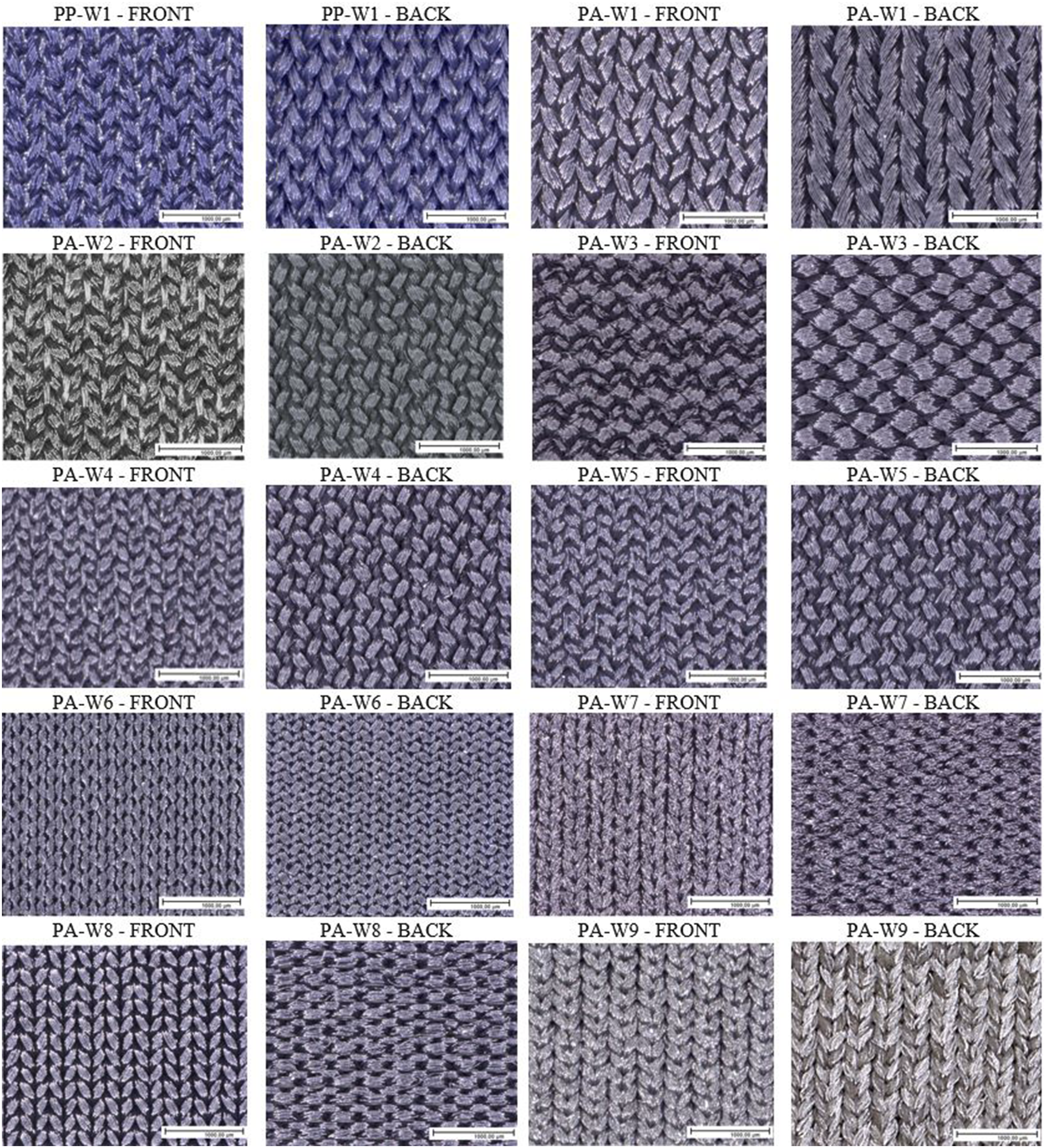
Methods
Evaluation of physical properties
Physical properties of fabrics, such as mass per unit area and thickness, were determined according to the ISO 3801:1977 34 and ISO 5084:1996. 35 The thickness tests were conducted using a thickness tester (Thickness Gauge D-2000-T, Hans Schmidt Co GmbH, Germany). The air permeability tests were conducted according to ISO 9237:1995 using an air permeability tester built in-house (test surface area of 20 cm2 and a pressure drop of 100 Pa). 36 The relative porosity was calculated according to a study by Vasile et al. 37 Water vapor resistance (Ret) was assessed according to ISO 11,092:2014.
Washing procedure for textile testing
All fabrics were washed together in an automatic washing machine (V-Zug Adora L, Zug, Switzerland) one time according to the ISO 6330:2021 33 at 40°C washing temperature (use of 100 % polyester ballast, 20 g of reference non-phosphate powder detergent without optical brightener and enzymes, 800 rpm of drum rotation and a washing duration of 75 min). Afterward, they were conditioned at 20 ± 2°C and 65 ± 2% relative humidity (RH) for 24 h before testing.
Contact angle
Contact angle measurements were carried out using a contact angle instrument (Krüss GmbH, Germany). The fabric specimen (20 mm × 60 mm) was placed on the sample stage. Afterward, a drop of water for HPLC (High-Performance Liquid Chromatography), 2 µL, was deposited on the fabric surface (front side) by lowering the needle top to the surface and then removing it (static measurement, sessile drop; distance of needle tip to droplet was larger than 1 mm during measurement). Images of the captured drop deposited on the fabric surface were analyzed by software (Krüss, Advance). The measurements were repeated five times for each sample in a lab. environment of 20 ± 2°C and 65 ± 2% RH.
Moisture management properties
According to AATCC 195-2017,38,39 the moisture management properties of all fabric specimens in this study were tested using the Moisture Management Tester (MMT) (SDL ATLAS M290, USA). Moisture usually spreads on both fabric surfaces and transfers from one surface to the opposite. The measurements were repeated five times for each sample in a lab. environment of 20 ± 2°C and 65 ± 2% RH. Each fabric specimen was cut as a circle with a diameter of 8 cm. The measured results were used to grade the MMT properties of a fabric by predetermined indices, while three of them were selected for this study.16,17,18,38,39,40
The Maximum Wetted Radius (MWR) reflects the moisture-spreading ability of a fabric. Liquid spreading over a larger area can indicate faster evaporation of liquid from a fabric. A larger area wetted by the same amount of water is associated with a higher drying rate.16,39 The Accumulative One-Way Transport Index (AOTI) is a measure of the moisture transport of the tested fabric from one surface to the other. AOTI shows the cumulative moisture difference between the two sides of a fabric. 41
Overall Moisture Management Capability (OMMC) is an index of a fabric’s ability to transport liquid moisture. 41
Water vapor resistance
Water vapor resistance was tested with a device built according to the definitions of ISO 11,092:2014. 42 Measurements are done in isothermal conditions with the samples (26 × 26 cm) placed onto an electrically heated porous plate at 35°C. The measurement system is placed in a climatic chamber where a fan blows air with defined temperature, humidity, and velocity tangentially onto the sample’s surface. Water vapor resistance is assessed using the heating power supplied to the surface in steady-state conditions (as a measure of the amount of vaporized water), the water vapor pressure difference between the atmosphere and the plate, and the size of the plate.
Measurement of drying performance of stretched fabrics on the heated cylinder
Drying performance, water uptake, drying time, and drying rate of stretched fabrics were determined based on the heated cylinder methodology (with a stretching ratio of 20%)
43
developed at Empa. Methodology details include fabric dimensions of 28 cm × 25.6 cm (including 2 × 0.5 cm seam allowance), folded and sewn alongside the 28 cm side, as a sleeve to be put on the cylinder, with ambient air access on the outer side of the fabric (Figure 2). Scheme of the experimental setup for the test with a heated cylinder.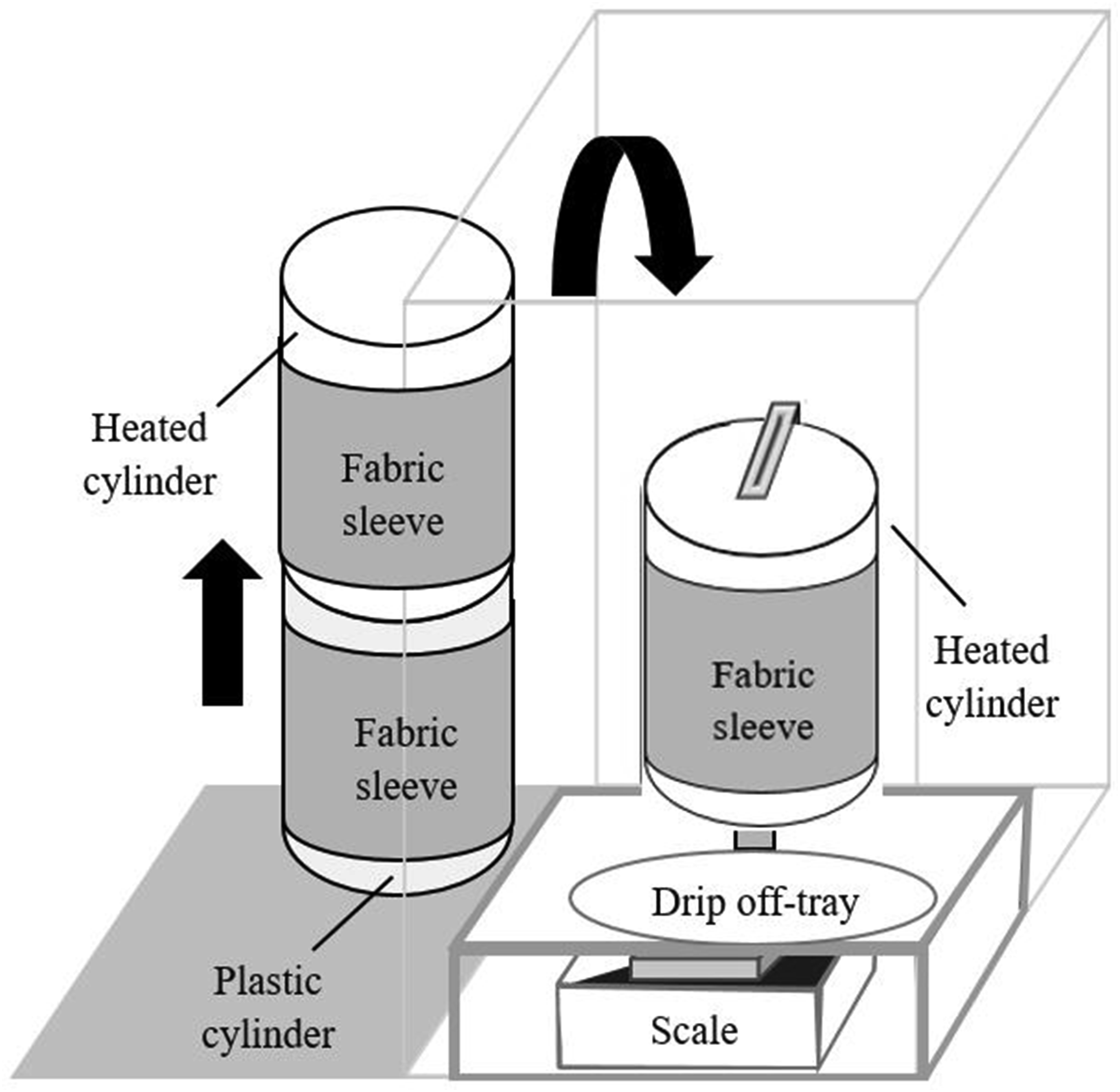
A constant surface temperature of 35°C (corresponding to human skin temperature) was set for testing in an acclimatized room (20 ± 2°C and 65 ± 2% RH). The sample was immersed in deionized water for wetting, placed in a large laboratory bath (dimensions of Ø 36 cm and height of 38 cm) for 1 h, and then transferred to the heated cylinder. The excess surface water was not removed for testing. After aligning the bases of both cylinders, the wetted fabric specimen was moved from the plastic cylinder onto the heated cylinder. The heated cylinder with the wetted fabric is located on an analytical balance (Mettler SM 1220, Mettler-Toledo, Switzerland, maximum weighing capacity 12 kg, resolution 0.1 g) using a suspension system to prevent dripping water from falling on the balance. A plate between the test set-up and the balance ensured that dripped-off water did not affect the drying measurement. The mass change of the fabric specimen was recorded every minute for 150 min, defined as testing time. The measurements were repeated at three different samples per fabric, from which the average values for the water uptake, drying time, and drying rate were calculated.
The water uptake capability (g/m2) was calculated using the equation (1) below
44
:
The drying time, t (min), was considered from the wet state to when 95% of the taken-up moisture was evaporated.
The drying rate in this work represents the average capacity of moisture evaporation of the wetted fabric 45 determined as mass loss per surface area of the sample and minute (g/(m2·min)). A high drying rate indicates that a fabric may provide fast drying. 46
The drying rate was calculated using the general equation (2) below:
Mechanical test: Dynamic tensile loading-unloading test
Fabric elastic recovery is important as a measure for the stretching of a fabric, and it can be categorized into two types: static elastic recovery and dynamic elastic recovery (DER). Static elastic recovery of the fabrics mainly helps to analyze the fabric’s dimensional stability, while DER of a fabric helps to analyze the garment’s response to repeated stretching, as it is common in body movement. 12
Dynamic tensile loading-unloading tests of each fabric presented in this study were performed based on the test according to ASTM D 4964-96
47
with slight modifications. A tensile testing machine (Zwick Roell Retroline, Ulm, Germany) was used for testing the knitted structures, both in wale and course direction. The testing was performed at the speed of 600 mm/min with a load cell of 100 N. At the beginning of tensile testing, 20% static stretch was applied. Afterward, ten loading-unloading cycles were carried out, 15% upwards for loading (to 30% extension) and 15% downwards for unloading (from 30% to 15% extension). The result of the first loading-unloading cycle was not considered for data analysis due to the static stretch applied at the beginning of the test. The distance between the clamps was 40 mm. Each sample was tested ten times with dimensions of 100 mm × 160 mm (80 mm folded, in the direction of testing) (Figure 3). Representation of dynamic tensile loading-unloading test.
DER of fabrics was considered at an extension of 30% to mimic the conditions of wearing sports bras at the extension of normal use. The Dynamic Elastic Recovery (DER) of the fabrics (%) was calculated using the equation (3) below
12
:
Besides, the stress values of fabrics were also examined, considering the mean values of forces measured from nine loading-unloading cycles (starting from the 2nd to 10th cycles) at 30% extension and the cross-sectional area of each fabric sample.21,48
Data analysis
Data standardization
After calculating mean values and standard deviations, the fabric measurement data was standardized using z-transformation. 49
Multiple linear regression analysis
Multiple linear regression analysis (MLR) was conducted with the free and open-source statistical software JAMOVI version 2.3.28. This statistical software is built on the R statistical language and offers a desktop application for the Microsoft Windows environment.
MLR enables the assessment of individual predictors in the model separately, and their collective impact on the outcome of interest. The model created assumes that there is no direct correlation between the dependent variable and independent variables 50 and calculates the line of best fit. Furthermore, MLR is used to assess whether the dependent variables can be explained by a combination of independent parameters. Preliminary combinations in model development for four dependent variables selected (drying time, drying rate, DER, and stress) included nine predictor variables (mass, thickness, air permeability, relative porosity, water vapor resistance, water uptake, OMMC, AOTI, and contact angle). For each model, independent variables that did not contribute or not significantly strengthen the model fit were identified and gradually excluded. Finally, four models based on the dependent variables (drying time, drying rate, DER, stress) and selected predictor variables for each model were developed and studied. The aim was to determine the most relevant parameters for the fabric benchmarking. The model fit created with the statistical software JAMOVI gives insight into model fit statistics considering R, R-squared, adjusted R-squared, and F-statistics taken as the overall model test (including p-value, with a level of significance <0.05). Commonly, higher R-squared indicates a better fit for the model. The adjusted R-squared adjusts the R-squared values based on the number of predictors in the models and can provide a precise view of the correlations. It is useful for comparing the fit of different regression models to one another. Statistical tests were applied to check the validity of the MLR analysis, such as tests for outliers and normal distribution of the data. Therefore, for checking the multivariate outliers, Cook’s distance was used, which examined whether any one line of data is an outlier, not just one data point. With regression, variables can be non-normal as long as the residuals (i.e., error) are normally distributed. The Shapiro-Wilk’s test was used to check multivariate normality, with the null hypothesis that “the data set is normally distributed” (p-value >.05).
Benchmarking and performance assessment
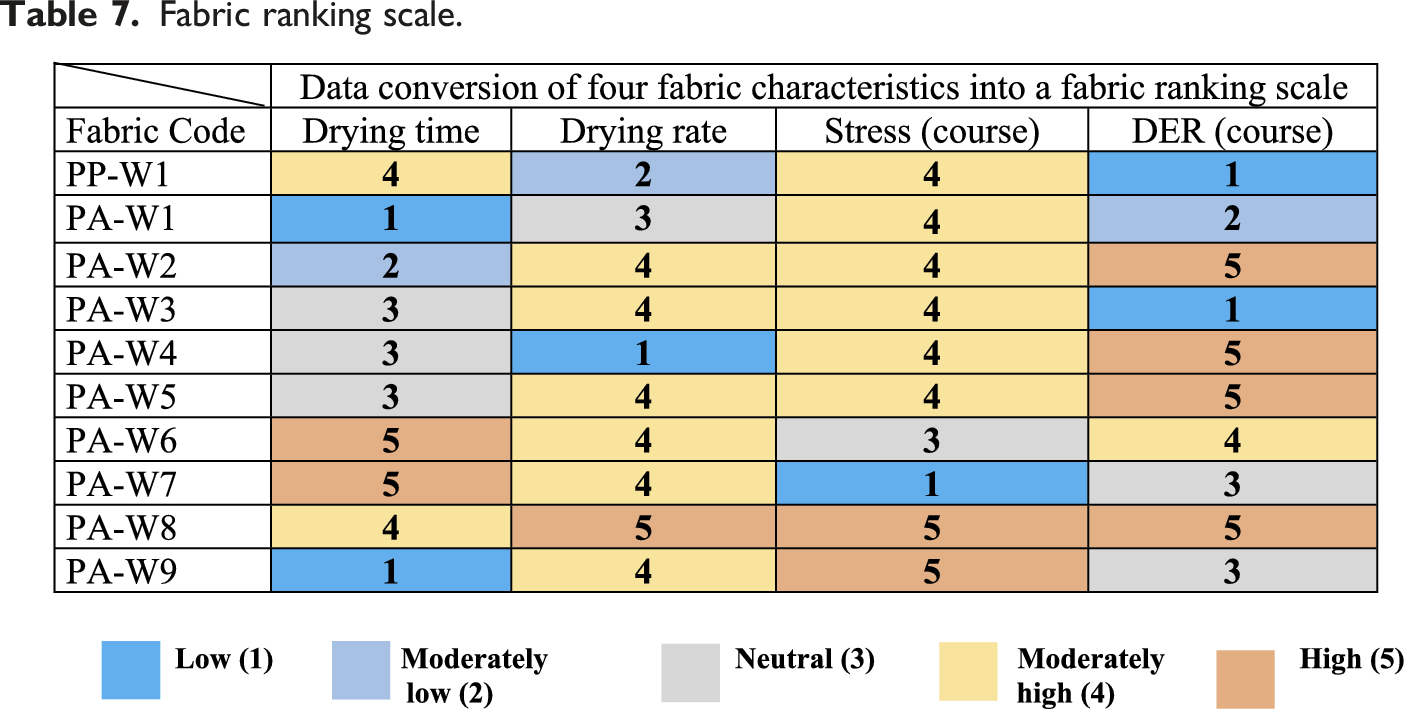
For fabric selection and performance assessment, a “five-point” benchmarking system has been defined where 1.0 indicates the lowest performance, and 5.0 indicates the highest performance 51 adjusted for this study based on the dependent variables of the MLR analysis. The minimum and maximum values were defined considering the results from the representative fabrics of this study and literature data. The benchmarking results were converted into an overall fabric ranking scale. The results of the fabrics’ performance, two regarding drying and two regarding mechanical performance, were plotted as spider charts. A high area covered indicates a good overall performance of the fabric.
Results
Multiple linear regression analysis
Multiple linear regression model fit investigated.
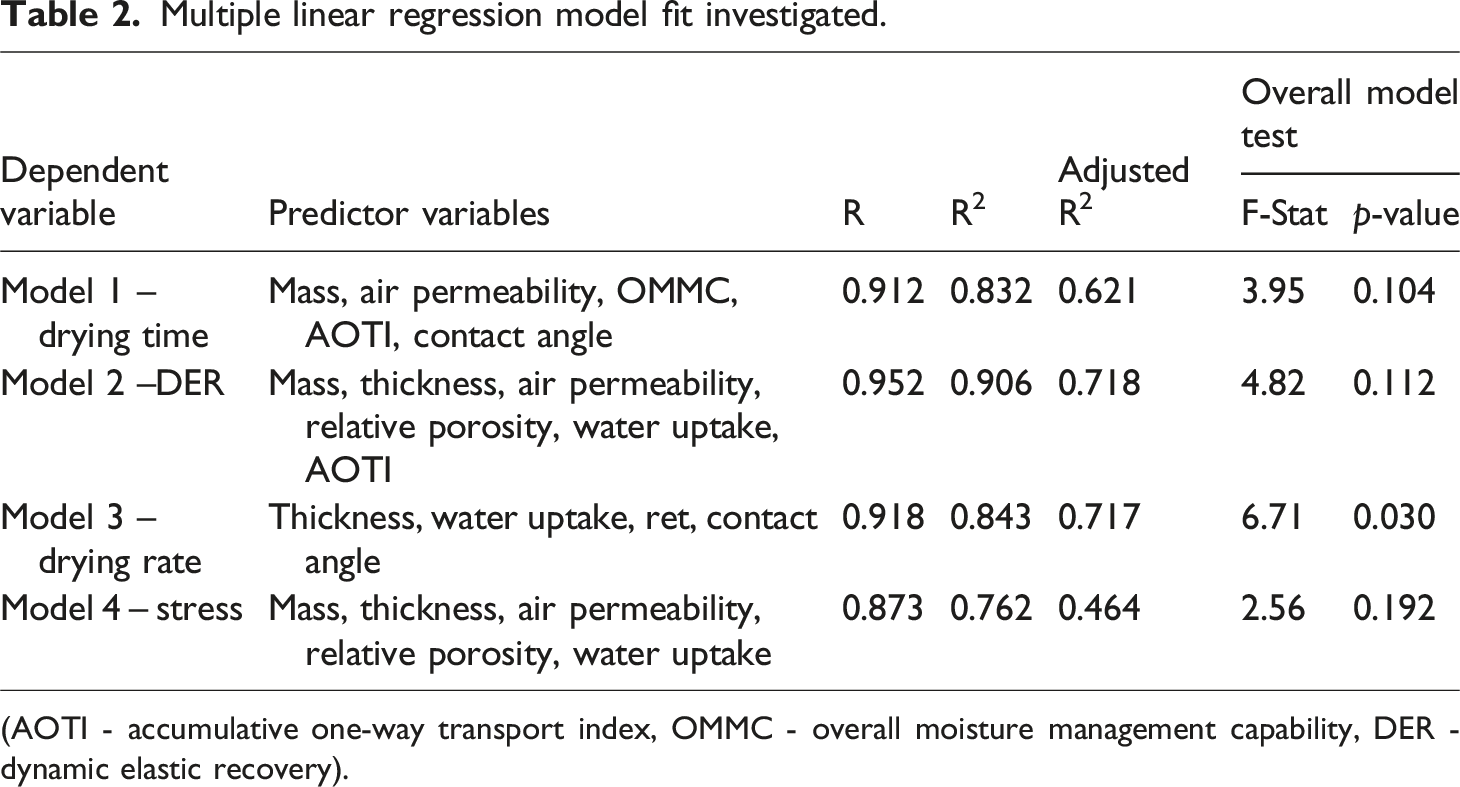
(AOTI - accumulative one-way transport index, OMMC - overall moisture management capability, DER - dynamic elastic recovery).
Cook’s distance.
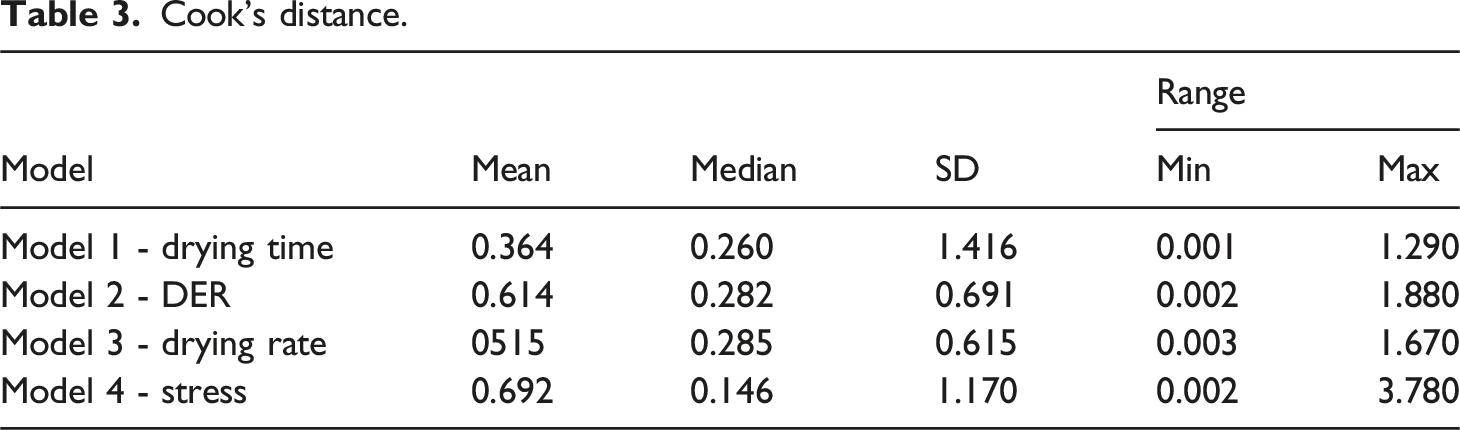
Normality test (Shapiro–Wilk).

Parameters of the MLR models.

(AOTI - accumulative one-way transport index, OMMC - overall moisture management capability, DER - dynamic elastic recovery, Ret – water vapor resistance).
Benchmarking and performance assessment
Five-point benchmarking system for performance assessment.


Overview of performance area covered by the selected fabrics.
Fabric ranking scale.

Fabric ranking overview.
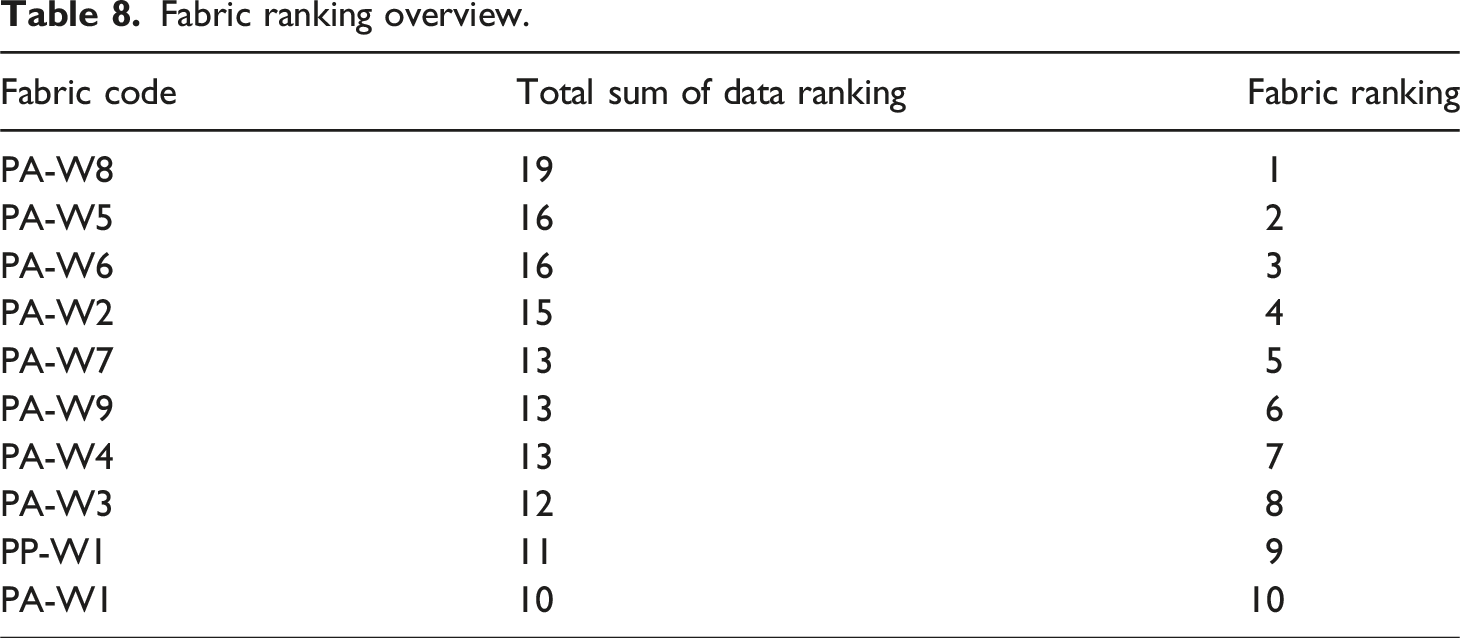
The fabric ranking plays a crucial role in determining the final order, with drying rate and DER being the most important factors based on the results of the MLR analysis. This is especially important when several fabrics have the same data ranking. In such cases, the fabric with higher values in these two characteristics is given priority, with drying time serving as an additional factor. The performance-based covered area content of the fabrics (Figure 4) serves as an indicator for the final ranking, as shown in Table 8.
Discussion
Hydrophobicity and moisture management properties
Almost all fabrics are hydrophobic (Table A1), while only single jersey fabric, PA-W8, is rated hydrophilic (contact angle was zero). Generally, the contact angle may be affected by interfacial tension, surface roughness, chemical heterogeneity, polar groups, porosity, swelling, molecular orientation, and yarn tension. 52
Modified tricot fabric, PA-W2, and single jersey fabric, PA-W8, show moderate values for three MMT indices studied (Table A2), large or very large maximum wetted radius (≥20 mm), fair (80%) to good (114%) one-way transport capability and good overall capability to transport liquid moisture (0.54). Weft knitted fabrics, single jersey, PA-W7, and double jersey, PA-W9, produced from the same manufacturer, show very good AOTI (521% and 645%) and good OMMC capabilities (0.53 and 0.56) but relatively low maximum wetted radius range (≤5 mm). The highest liquid moisture management capability (0.63) is scored by tricot fabric, PA-W1, representing the capability of moisture to be transferred from the skin to the outer surface to keep the skin dry. However, very poor OMMC (0.00) and negative AOTI (≥-993%) demonstrated by the modified tricot fabrics, PP-W1, PA-W4, and tricot, PA-W6, indicate that the liquid cannot diffuse easily from the next-to-skin surface to the opposite side which will lead to moisture accumulation. 41
Measurement of drying performance of stretched fabrics on the heated cylinder
There are not many studies concerning the effect of the elastic component in fabrics on water uptake and drying properties. 53 Two main groups of fabrics, (modified) tricot and single jersey, demonstrate shorter drying time, between 11 min and 22 min, with different water uptake capabilities (Table A3). It is evident from the results that water uptake can be crucial for the drying characteristics, 54 particularly regarding the drying time of jersey fabrics (single and double jersey). In general, the lower the water uptake, the shorter the drying time, and the higher the drying rate. 55 However, this is not always the case since drying can be affected by multiple factors. This is especially evident in this study through the example of the modified tricot fabric, PA-W4 (with 41% EA), which scored low water uptake (94 g/m2), moderate drying time (19 min), low drying rate (<3 g/m2·min)55,56 and poor MMT properties. 38 On the other hand, modified tricot fabrics, PA-W3 and PA-W5 show moderate drying time (18 min and 20 min), high drying rate (>15 g/m2·min), and high water uptake capabilities (>309 g/m2). Fourt et al. 55 showed that when drying fabrics on a line, the drying rate was almost the same for all fabrics, and drying time was defined mainly by the taken-up water and water vapor pressure difference as the main driving force. In the case of the more realistic test scenario with the heated cylinder, 43 a temperature gradient from the skin to the ambient and an average stretch of 20% was considered.
Mechanical test: Dynamic tensile loading-unloading test
A high dynamic elastic recovery (DER) value provides a more intense fabric response to body movements. 48 In the case of two types of elastic fabrics with the same DER value at a specific extension level, the energy loss for the wearer is lower for the one with a lower stress value. 48 This is why both DER and stress were considered in this study. Most of the resulting stress values are in the range of 0.052 N/mm2 to 0.137 N/mm2 (Table A4), which corresponds to other studies.12,48
For warp-knitted (modified) tricots, the resulting stress values are between 0.057 N/mm2 and 0.137 N/mm2 in the wale direction and between 0.056 N/mm2 and 0.091 N/mm2 in the course direction. In the case of weft-knitted single and double jersey fabrics, the results of stresses are almost in the same range in both directions, between 0.052 N/mm2 and 0.116 N/mm2.
The most promising fabrics in terms of mechanical properties, high DER (81-89 %), and low stress values (0.052-0.077 N/mm2) were the three modified tricot fabrics, PA-W2, PA-W4, and PA-W5, and one single jersey fabric, PA-W8. These fabrics have a high percentage of elastic polyurethane fibers (39% or 41% EA), which is essential to score high DER values.30–32
Multiple linear regression analysis
The fabric measurement data standardized using the z-transformation were taken for MLR analysis (Table A5). Good predictive results were achieved for all models with R-squared values ranging from 0.762 to 0.906. The adjusted R-squared values differed between models compared to R-squared. The highest adjusted R-square was obtained by models 2 and 3 (adjusted R-squared = 0.718 and 0.717, respectively). Generally, the F-values obtained were not significant, and the p-values were above the threshold (>0.05) for all models except for model 3 (p = 0.03). One of the reasons could be the small set of samples for analysis (ten knitted fabrics) and the limited range of measurement values due to the specific target use of the fabrics.
Only for model 3 a statistically significant impact of predictor (independent) variables has been found regarding the dependent variable (p = 0.03). Model 3 shows a very good fit of the data set and demonstrates the lowest p-value (0.03). For the other models, p-values were above the 0.05 significance threshold.
The predictive power of the four models is rather high, though, with R-square values of around 0.8. The number of independent variables for each model was selected based on their individual contribution to the model’s performance (Table 5). Variables with the highest p-value were excluded first.
We found that three independent variables, mass, thickness, and water uptake, have a crucial impact on the dependent variables. Air permeability is also part of three models, but the attributed p-values are not significant.
Mass has a significant effect on model 2 (t test = 3.938, p = 0.029) and influence on model 1 (t test = 2.608, p = 0.060) and model 4 (t test = −2.376, p = 0.076).
Thickness has a significant effect on model 2 (t test = −5.195, p = 0.014) and influence on model 3 (t test = −1.755, p = 0.154), respectively.
Water uptake has a significant effect on model 2 (t test = 3.811, p = 0.032), and model 3 (t test = 4.47, p = 0.007), respectively.
Model 2 shows the highest predictive performance (R2 > 0.9), whereas model 3 has the lowest p-value (highest significance). In model 2, only one independent variable, air permeability, does not have a significant effect on DER as the dependent variable (t test = 2.137, p = 0.122). In addition to the previously mentioned independent variables, relative porosity (t test = 4.745, p = 0.018) and AOTI (t test = −4.329, p = 0.023) have significant effects as well on this model.
The results of the MLR analysis show that all four dependent variables can be used for fabric ranking (R2 > 0.75). The remaining parameters for each linear regression model are plausible regarding their physical characteristics and are in line with the findings of the cited literature.
Benchmarking and performance assessment
The area covered in the spider charts was used as a measure of the fabric performance (Figure 4). According to the total sum of data ranking (Table 8), a single jersey, PA-W8, shows the highest performance, followed by two (modified) tricot fabrics, PA-W5, and PA-W6.
The weft knit fabric, single jersey, PA-W8, provides the best fit of performance in terms of short drying time (16 min), very good recovery and support values (89% DER, 0.052 N/mm2 stress, in course direction), good air permeability (312 mm/s)56,57 and moderate water uptake (292 g/m2).
The warp-knitted modified tricot, PA-W5, shows balance in terms of drying and mechanical performance and moderate values of MMT indices previously discussed. It has low air permeability (33 mm/s), however.
The warp-knitted lightweight tricot fabric, PA-W6, demonstrates high drying and mechanical performance. The main drawback is the low air permeability (9 mm/s).
The warp-knitted modified tricot, PA-W2, shows the highest mechanical performance and moderate values of MMT indices 38 previously discussed but a long drying time (22 min) and moderate drying rate (<14 g/m2·min). The drawback is also the low air permeability (22 mm/s).
From a marketing perspective, the very lightweight, single jersey, PA-W7 fabric could be an interesting option, although it is in the middle of the ranking list (Table 8) due to the eco-friendly and sustainable fiber composition (80% PA bio-based with 20% EA) and good hand-feel (based on subjective analysis). The major drawback is the low mechanical performance (75%, DER and 0.116 N/mm2, stress, in course direction) compared to most fabrics. However, one possibility to overcome this drawback could be to use local reinforcements, e.g., using innovative printed bonding technologies57,58 in zones where mechanical properties are crucial for relative breast movement reduction and support.
There are one double jersey fabric, PA-W9, and two modified tricots, PA-W3 and PA-W4, on the lower side of the ranking scale. They demonstrate a drying time between 18 min and 25 min. Double jersey fabric, PA-W9, shows low drying time (25 min), modified tricot fabric, PA-W3, shows low DER in course direction (68%), while another modified tricot fabric, PA-W4, demonstrates a low drying rate (<3 g/m2·min) in our fabrics dataset studied.
Finally, the two (modified) tricot fabrics, PP-W1 and PA-W1, exhibit the lowest results of performance (drying and mechanical) in the set of the ten fabrics. These two fabrics have XLA in their composition and demonstrate moderate to long drying time (17 and 24 min), moderate drying rate (<12 g/m2·min), and lower DER value in course direction (<75%) compared to most fabrics.
Conclusions and future outlook
The development of sports bras is challenging, and a balance between mechanical performance and thermal comfort has to be found. Our paper provides a method to be able to find the best compromise between these two main requirements for fabrics used in sports bra development, considering several relevant base parameters. We showed that statistical models based on basic fabric properties can be used to predict fabric performance. The model predicting drying rate showed the best fit of the data set as a predictor of the overall performance.
Four dependent variables were considered for the fabric benchmarking and ranking: drying time, drying rate, stress, and DER. By applying the findings of this paper, the development of sports bras may be simplified, and the performance regarding thermal comfort and mechanical (support) may be improved.
Supplemental Material
Supplemental Material - Relevant fabric parameters to be considered for optimizing combined drying and support properties of sports bras
Supplemental Material for Relevant fabric parameters to be considered for optimizing combined drying and support properties of sports bras by Ivona Jerkovic, Sahar Ebrahimi, Joyce Baumann, Rolf Stämpfli, Martin Camenzind, Simon Annaheim and René M Rossi in Environment and Planning B: Urban Analytics and City Science.
Footnotes
Acknowledgments
The authors would like to thank Innosuisse for funding the project. They also want to express their special thanks to Leonie El Issawi-Frischknecht, Pierrine Zeller, and Markus Hilber, technicians at Empa, for their support in fabric testing.
Author contributions
I.J. participated in performing the experiments, data analysis, interpretation of the results, visualization/data presentation, and writing the original draft. S.E. participated in the conceptualization and review of the manuscript. J.B. participated in the performing the experiments, interpretation of the results, and the review of the manuscript. R.S. participated in the data analysis and interpretation of the results. M.C. participated in funding acquisition, project administration, conceptualization, supervision of the research, methodology (particularly in the drying method), and the review of the manuscript. S.A. and R.M.R. participated in the conceptualization, the interpretation of the results, the supervision of the research, and the review of the manuscript.
Declaration of conflicting interests
The author(s) declared no potential conflicts of interest with respect to the research, authorship, and/or publication of this article.
Funding
The author(s) disclosed receipt of the following financial support for the research, authorship, and/or publication of this article: This work was supported by the Innosuisse [grant number 57359.1] and funding project entitled: “HybridSwimRunBra.”

Supplemental Material
Supplemental material for this article is available online.
Notes
References
Supplementary Material
Please find the following supplemental material available below.
For Open Access articles published under a Creative Commons License, all supplemental material carries the same license as the article it is associated with.
For non-Open Access articles published, all supplemental material carries a non-exclusive license, and permission requests for re-use of supplemental material or any part of supplemental material shall be sent directly to the copyright owner as specified in the copyright notice associated with the article.
