



Abstract
Sandwich structures have gained significant industry interest due to their excellent specific strength, stiffness, and energy absorption. Recent studies paid a lot of attention to sandwich composite structures and to how the addition of thermoplastic particles to cores of these sandwiches can enhance their performances. In this study, glass fabrics laminates manufactured via vacuum bagging process as skins for the sandwiches, while the cores made from epoxy without and with different concentrations of high density polyethylene. Flexural strength tests were conducted for all samples to investigate their capability for carrying-load and investigate their damage failures. Further, the finite element analysis (FEA) with commercial software, adopted to predict the damage failure modes for samples under flexural strength tests. Results illustrated that flexural strength decreased 11%, 12% and 13% after having 8%, 12%, and 16% HDPE in the cores of samples compare the sample without HDPE particles, meanwhile the flexural strain increased 80%, 87%, and 82% after adding 8%, 12%, and 16% HDPE in the cores of sandwich samples compare to the sample without HDPE particles. Results also reveal that the specific absorbed energy in the sandwich samples that have 8%, 12%, and 16% HDPE in their cores increased with 413%, 701%, and 363% in comparison with un-filled cores due to cores with thermoplastic particles have higher load-carrying and more plastic deformation with lower cracks propagation. Numerical simulation results for damage failure modes are in accordance with experimental results both qualitatively and quantitatively for all sandwich samples under flexural loading.
Keywords
Introduction
Sandwich composite structures are widely used in various engineering applications such as aerospace, automotive, marine, and wind energy, and these applications are requiring a high structural rigidity, lightweights, and high strength, and stiffness.1–7 Generally, sandwich composite structures are consisting of a low-density core, a thin skin, or a face-sheet layer, which bonded to each side of the core.7–13 Many studies confirmed that the structural behavior of a sandwich composite structure depends on several parameters such as construction materials and core topology design.14,15 Further, the mechanical, the impact resistance properties, and absorb energy of sandwich can significantly increase by including woven composite fabrics as the skins of these sandwich. These capacities to capture and dissipate a great amount of energy make them particularly suitable for load bearing capacity and dynamic loadings such as low-velocity. 16 Most of core materials of sandwich structures are made from polymeric foams due to their low cost and ease of manufacture compared to the metallic foam cores.17–19 Further, polymer foams offered low-velocity impact, blast mitigation, crashworthiness, and shock wave absorption capabilities for sandwich composite structures. 20 The important polymeric foams are epoxy-based foams composites, which have attractive properties such as high adhesion, good chemical properties, heat resistance, low shrinkage, corrosion resistance, and excellent electrical properties.21–23 However, their poor stiffness and toughness properties are considered a main drawbacks which reduced their applications.24–26 Thus, many studied have been done to improve the properties of epoxy-based composite materials, and these investigations have been reported that the adding a fillers at different particle sizes and volumes proved to have different effects on the properties of sandwich composites.27–30 Syntactic foams are composite materials, which are made by filling a metal, polymer, or ceramic matrix with hollow and non-hollow particles; leading to lower density, higher specific strength and stiffness, and lower coefficient of thermal expansion.31–33 G.Tagliavia et al. 34 showed that the mechanical performances of vinyl ester matrix syntactic foam was improved by including micro-balloon particles. Daniel Paul et al 35 studied the effect of including of glass micro-balloon in the flexural properties of epoxy syntactic foams as a sandwich core material. Their results confirmed that the load carrying of these structure is considerably improved. Olusegun A. Afolabi et al 36 confirmed that the mechanical properties of epoxy syntactic foam made from epoxy as core for sandwich composites improved by including hollow glass microsphere in the epoxy resin. An analytical and numerical approaches have been examined the mechanical performances of sandwich composite structures that have cores based epoxy hybrid with a range of nano-fillers. 37 Xu et al. 38 investigated the experimental study and compared with simulations to optimize the mechanical properties of a foam-filled re-entrant aluminum honeycomb composite structure. Further, Z. Ahmed et al 39 optimized the electromagnetic (EM) and mechanical performance of using a combination of hybrid foam core and hybrid face sheets (Kevlar & S Glass) sandwich composite structures by using experimental and simulations investigations. Olusegun et al 40 manufactured sandwich composite structure consist of four different sequences of face-sheet reinforcement (e.g., kenaf-kenaf; glass-glass; glass-kenaf, and kenaf-glass). While the mixing of epoxy resin and hollow glass microballoons (HGM) are adopted to create the syntactic foam core. These sandwiches were subjected to by compressive, tensile, and flexural strength tests. Their results showed that the compressive strength was highest at the kenaf-glass skin, tensile strength was highest at glass-glass skins, and flexural at “glass-glass” skins with 52%, 68%, and 74% increase compared to “kenaf-kenaf” face-sheets, respectively.
Although, an extensive research have been focused on the behavior of glass fibre laminates as skin and epoxy based as core under different loading types, the response of these sandwich composite with hybridization core under quasi-static loading has not been properly explored. Besides, research works on the damage mechanism of these sandwich composites under flexural loading is rarely reported. This work tries to explore the performance and damage mechanism of sandwich composites with glass fibre laminates skins and hybrid core under quasi-static loading to fill the mentioned research gap.
Thus, this research work focuses on the study the effect of including thermoplastic particles in the millimeter size on the core of sandwich composites and evaluation their mechanical performances and damage mechanisms under quasi-static flexural strength tests. Towards this goal, the sandwich composites structure are made from laminates with glass fber/epoxy are as skins, while the cores are made from epoxy hybrid with different percentage of high density of polyethylene particles (HDPE). The sandwich structures are subjected to flexural loading to investigate their resistance and damage failures with adding these particles. Further, to simulate the flexural strength and damage failures that happen in these sandwich composites, this investigation was carried out utilizing 2D continuum shell elements through Abaqus software.
Experimental works
Materials
Specification of glass fabric.

Properties of epoxy and HDPE.

Manufacturing of skin and sandwich composite structure
The skin of sandwich composite made from composite laminates, which was done by infusing epoxy resin by using a vacuum bagging technique in which four layers of fabrics were laid over one another in warp direction to manufacture glass fabric composite laminates. The vacuum was done by using vacuum pump with capacity equal to −2 bar. Then the samples were left for 24 hours at 30°C for curing. The volume fraction of glass fibre in this laminate equal to 50%. The core of sandwich composite laminate manufactured from epoxy and thermoplastic particles of High-Density of Polyethylene ( HDPE) produced by RTP company/USA. The specification of these particles are presented in the Table 2.
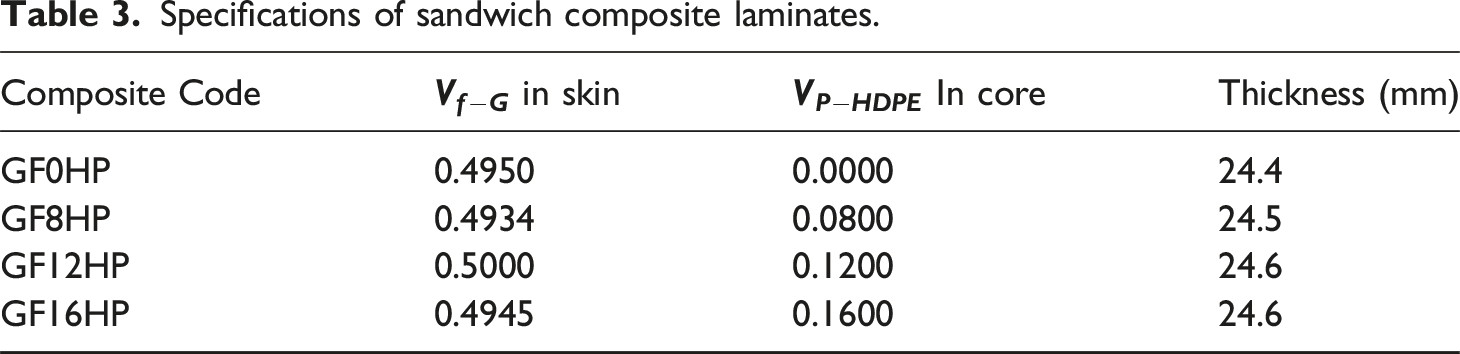
In order to achieve uniform distribution of HDPE particles in the epoxy resin, the resin wa heated to 60°C for half hour and then the dry powder was added into resin and they mixed together by using electrical stir. Four percentage of HDPE particles are chosen (0%, 8%, 12% and 16%) and mixed with epoxy and its hardener , and then this mixture poured into a mold, which have dimensions equal to ( 200 mm × 100 mm × 20 mm) and left for 24 hours for curing as shown in Figure 1. Core of sandwich composite laminate.
The skins in both top and bottom are glued with the core by using same epoxy resin of core to made sandwich composite structures as shown in Figure 2. Each skin has thickness equal to around 2 mm, while the thickness of core around 20 mm. Thus, the total thickness of sandwich composite structure approximately equal to 24 mm. The specification of all sandwich composite laminates are illustrated in Table 3, where Sandwich composite laminate. Specifications of sandwich composite laminates.
Density of sandwich composite materials

The densities of skins, cores and sandwich composites samples.

Experimental tests methods
Flexural strength tests
Three-points bending test has been adopted in this study to investigate the flexural strength of sandwich composite structures and this test was performed on an Instron testing machine (as shown in Figure 3) using a 5 kN load cell at a constant cross-head speed of 1.0 mm/min. at room temperature. The dimensions of samples are 200 mm × 20 mm × 24 mm as length, width and height respectively according to the ASTM D790-17 standard.
42
The flexural strength and flexural modulus are calculated from the following equations: Set-up of Flexural strength test.


Numerical modelling
In order to understand mechanical characteristics, the numerical simulation of Sandwich composite structure under flexural strength tests was also conducted using the commercial finite element (FE) code, with aiding Abaqus software in this study. According to the dimension are given in the experimental, applied material solution, and observed failure mechanism, the model variants are considered. The following sections will discuss the FEM models.
Materials and modeling
The composite sandwich structure has been simulated in this study. The composite sandwich consists of top and bottom skins made from glass composite laminates, while core manufactured from epoxy with different concentration form thermoplastic particles (i.e. High density of polyethylene HDPE) as shown in Figure 4. The FEM model for sandwich composites structure.


Mechanical properties of glass/epoxy lamina.
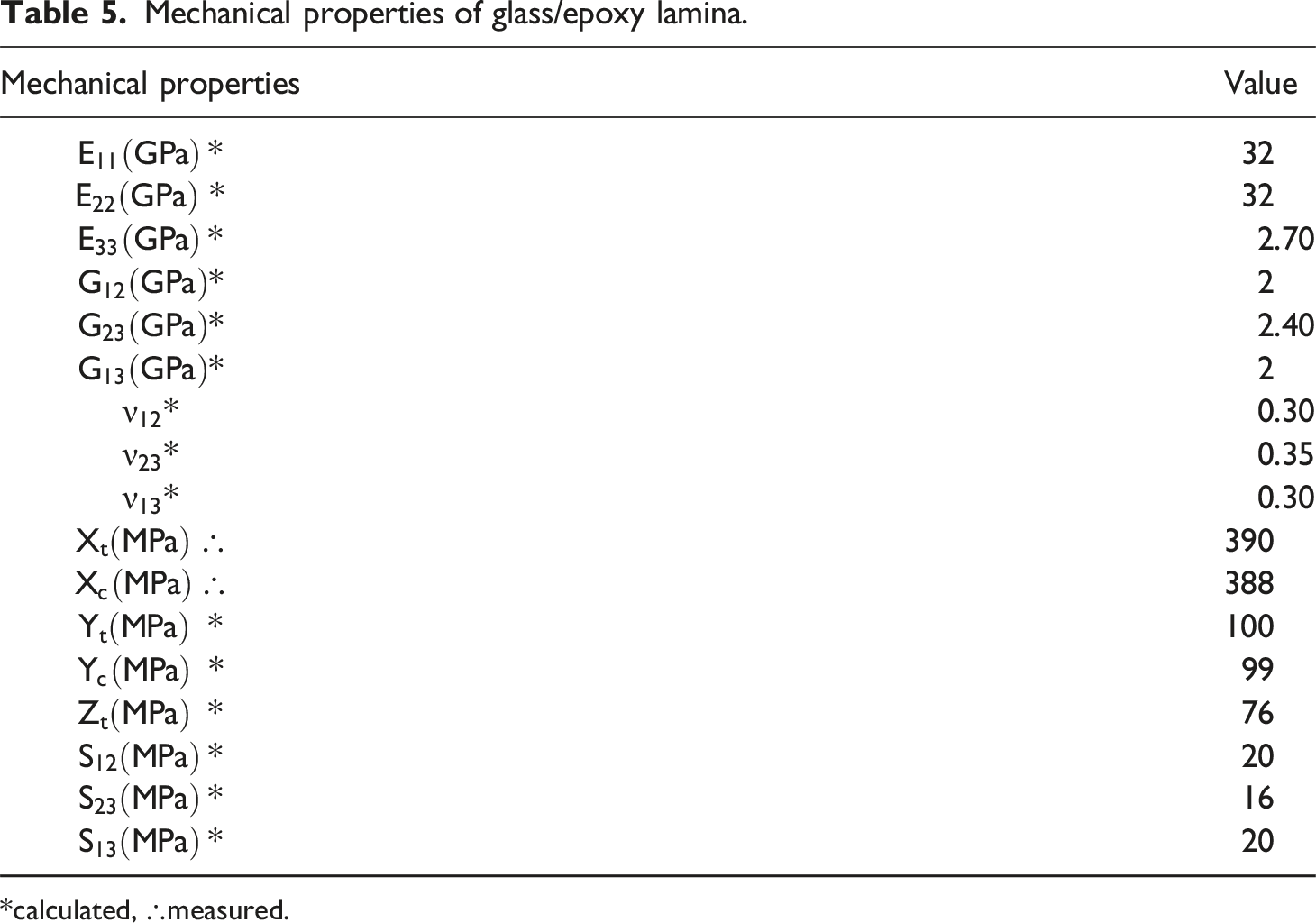
*calculated, ∴measured.
The model of core assumed distribution of HDPE particles in the epoxy and the mean radius of particle is 3 mm and the volume fraction of these particles in epoxy are varied according to the experimental work. The bulk modulus of HDPE particles is about 2 GPa and Poisson’s ratio close to 0.5. The bulk modulus formula is calculated as follow:
The interface properties of the HDPE particle and epoxy are simulated by adopting the separation initiation and separation expansion conditions of the cohesive element. Thus, the criterion of maximum principal stress is used; that is, when the von Mises stress on the cohesive element reaches the maximum value, the element begins to separate. The BK rule in the energy criterion is selected as the separation and expansion conditions, and the energy release rate should be set during the separation and expansion. The principle is elaborated in the following part. The initial stress of separation was set to
The skins and core are bonded together using tie interaction in order to ensure their rigid bonding. This means that the slave surface makes the exact same movement as the master surface at each mode. Because of the load presses from the top, it is decided that the upper skin is the master surface and the core underneath is the slave surface, while for the bottom portion, the bottom fixture is the master surface and the skin is the slave surface.
Mesh type
The mesh of the skins are standard type with continuum shell elements (SC8R) with linear geometric order as shown in Figure 5. Moreover, the element type that is used is structural hex, which stacked from the top plane. In the other hand, the mesh of the core are standard type (3D stress) elements (C3D20) with linear geometric order and the element type that is used is structural hex stacked from the top plane. Mesh of sandwich composite model.
Mesh independence was used for sandwich composite structure before choosing a final size mesh in the current study. The maximum flexural stress in this simulation was conducted with different mesh size such as 10000, 30000, 50000, 70000 and 90000 cells but in different period of time (i.e minutes). Then, these values were compared and it was showed that the max. flexural stress become uniform at mesh size of 90000 cells. This size of mesh is adopted for sandwich composite structure in this investigation and final results were used to achieve reliability.
Loading and boundary conditions
According to the FE analysis, the applied flexural loading was positioned at the top of the composite laminate from the middle support and the value of this load was extracted from the experimental tests. Further, the Load Module in Abaqus/Explicit has been used to define the boundary conditions of the models; assuming that the two supports at the end of samples are fully constrained (U1=U2=U3=0). Both apply load and the boundary conditions of this simulation are presented in Figure 6. Loading and boundary condition of the FEM models of sandwich composites structure.
Results and discussion
Results of flexural strength tests
The results of flexural strength test for all sandwich composite samples are presented in Figure 7 and Table 6. Basically, the sandwich composite samples in the current study can fail under flexural loading with different mechanisms and damage modes. Thus, the damage mechanisms of the sandwich composite can be classified into three stages as seen in Figure 7(a). The flexural stress- strain curves for (a) Mechanical properties of sandwich composite samples under flexural strength test.

When the flexural stress applied the sandwich composite behaved linearly and the main flexural stress was carried out by the top skin and the stage one of damage occurred. During this stage, all sandwich composite samples are deformed considered elastically and the sample without high density polyethylene in core showed highest flexural modulus compared to other samples as seen in Figure 7(a). As the flexural stress increased and reached to first peak point, the core of sandwich composite sample started to carry load and the second stage of damage started with cracks propagation. Further, the width of this stage is varied according to the thermoplastic particles concentration in the core. For example, the second stage in the sandwich sample without thermoplastic particle ( as seen in Figure 7(a)) has narrow width, while the wide of this stage increase with increasing of thermoplastic particle concentration ( as shown in Figure 7(b)–7(d)). This indicates that the poor plastic behaviour and extremely brittle characteristics of core without thermoplastic making the cracks for propagation quickly. In contrast, the cores with thermoplastic particles have higher load-carrying and more plastic deformation with lower cracks propagation. Ayodele et al 4 manufactured sandwich composite structure consisted of skins made from banana fiber composite laminates and core made from epoxy resin mixed with (1 wt.% to 3 wt.%) from hollow glass microspheres (HGM). Their results showed that the banana fiber composite as skin with epoxy resin has a limited amount of strength when used without a hybrid core but delivers better performance when HGM are mixed with epoxy as the hybrid core because of excellent ultimate strain and strong interfacial adhesion between the microsphere and the matrix.
In order to assess the carrying-load capability of sandwich composite samples, the total energy absorption (EA) and specific energy absorption (SEA) have been adopted in this study. Thus, (EA) is calculated from the following equation:

The total energy absorption (EA) and specific energy absorption (SEA) of all samples.

Numerical model validation
Damage failures of sandwich composite structures
The damaged regions in the tested sandwich composite samples are presented in Figure 8 and compared with damage failures that extracted from the simulation results. Figure 8(a) depicts the main damage failure in the sample that has core without thermoplastic particles are debonding between top skin and core and fast propagation of cracks in the core because of the brittle behaviour. Further, the fibres in the bottom skin started to split and bend under flexural loading. This can be interrupted the lower dissipated energy that occurred in this sample. Figure 8(b) presents the damage failures of sandwich sample that have different concentration of HDPE particles in their cores. It can observed that debonding between top skin and core are happened and the crack propagation in the core are pinned in the core because of thermoplastic particles which are working as restriction for these cracks Comparison of damage failures experimentally and numerically for (a) 
In addition, the increasing of the concentration of HDPE in the cores of sandwich sample can reduce the fibre fracture in the top and bottom skins and changed the paths of cracks; leading to absorb more energy during the flexural loading as seen in Table 7.
Conclusion
This current study paper aims to investigate the effect of adding high density polyethylene on the core of sandwich composite structure that have skins made from glass composite laminates and subjected to flexural loading. The flexural strength performances and damage failures of the sandwich composite samples have been also simulated by using the finite element analysis. The following concluding remarks can be drawn from this study: • The sandwich composite without HDPE in the cores appeared higher flexural strength and flexural modulus than the other samples; nevertheless, the inclusion of HDPE in core resulted in a fail in flexural strength, which increased with the increasing of HDPE in the cores of sandwich samples • Experimental results implied on 413%, 701%, and 363% increasing in the specific absorbed energy in the sandwich composite samples that have 8%, 12%, and 16% HDPE in their cores in comparison with un-filled core one • This investigation adopted a simulation model along with the addition of Abaqus software, and it also embraced several criteria. The current findings of simulation are dependable for predicting damage failure modes in sandwich composite samples and there appears to be a small discrepancy in the accuracy between the simulation and testing results.
As noticed in this study, the approach of including thermoplastic particles in the core of sandwich composite structures can effectively produce light weight and higher energy absorption members with less catastrophic failures .This leads to use these structures in applications in automotive, naval, and construction applications.
For future work and to improve the performance of sandwiched structure, it suggest to build sandwich composite structure with the composite laminates skins and axuetics core structure and then discussing failure mode and studying the fracture of failed specimens using a scanning electron microscope device.
Footnotes
Declaration of conflicting interests
The author(s) declared no potential conflicts of interest with respect to the research, authorship, and/or publication of this article.
Funding
The author(s) received no financial support for the research, authorship, and/or publication of this article.
