



Abstract
Last decade a lot of research was done in the development and investigation of textile-based shielding materials against electromagnetic radiation. Still, there is a gap in understanding the effect of knitted structure (i.e., stitch type and shape) on shielding effectiveness by different shielding mechanisms: reflection and absorption. Seven knitted fabrics were produced on 8-gauge flat knitting machines, using 0.12 mm diameter stainless steel (SS) wire and 30 x 2 tex cotton yarn. The fabrics differ by the method of incorporation of conductive element (SS wire) into the knitted structure: separately and simultaneously with cotton yarn and used interloopings. The effect of stitch type (loop, float, or tuck) was studied as well. It was found that both the method of SS wire incorporation and the shape of its positioning in the knitted structure affect the EMR shielding effectiveness while only the method of SS wire incorporation determines the shielding mechanism: absorption or reflection. The half Milano rib knitted structures demonstrate the best shielding efficiency due to the additional floats behind held loops.
Keywords
Introduction
With the advances in technique and 4.0 industry emerging technologies as well as an improving quality of lifestyle electronic devices are becoming necessary in both professional work and daily routine. The rapidly increasing number of electronics around us transmit huge amounts of electromagnetic waves in different ranges 1 that negatively affect human beings and the environment. 2 Over the last decades, researchers around the world3,4,5 have been working in the field of electromagnetic interference (EMI) to create new and improve existing shielding methods 6 and materials.7,8
Textile due to its flexibility 9 and low weight 10 is a widespread material for high-tech screens and interactive structures manufacturing that protects against electromagnetic radiation (EMR). In addition to protection against radio frequency interference, 11 textile advantages are in high comfort characteristics 12 such as coordination of thermal expansion and permeability, 13 stretchability, 14 and so on.
The biggest part of the publications in the field covers the development of EMI textile screens by various chemical treatments,15,16,17 but an introduction of conductive elements such as fiber, yarn, and even wire into the textile structure during the weaving or knitting can be a more sustainable solution. The knitted fabrics are not widely used in EMI shielding screens for technical applications but they have a high potential for protection products where permeability and elasticity are important. 18 The both warp19,20,21 and weft22,23 knitting technology is used. The screening performance of textiles for protection against EMR for general use requires a smaller value of shielding effectiveness (SE) compared to those for professional use. The SE value between 10 and 20 dB grades as “good”, between 20 and 30 dB as “very good” and over 30 dB as “excellent” 24 : for protection textiles used in casual wear, office uniforms, aprons, consumptive electronic products, and communication-related products.
Tesel et al. 25 studied single jersey fabrics for T-shirts produced from metal/cotton conductive composite yarns and found that all investigated structures had more than 7 dB SE for cellular phone communication bands. It was found that, despite 100% cotton fabric did not have EMR shielding ability, the cotton yarn count is highly significant on the shielding effectiveness. Fabrics with two-ply yarns have higher SE values than fabrics with one-ply cotton yarn of the same count. Palanisamy et al. 14 investigated the single jersey and double jersey (1 × 1 rib) fabrics knitted using silver-coated yarn and found that all studied fabrics had a SE range of 42 – 65 dB for 1.5 GHz frequency, while the double jersey structures showed higher shielding ability compared to the single jersey.
The different alternations of reverse and face loops in repeat 26 lead to changes in the mechanical 27 and shielding 28 properties of the fabric. He with the team 29 while comparing plain, 1 × 1 rib, and 2 × 2 rib knitted fabrics contained a stainless-steel yarn concluded that the loop arrangement significantly affects the shielding effectiveness. The plain and 2 × 2 knitted fabrics showed similar SE in all frequency bands with peaks of 13.35 dB (450 MHz) and 12.5 dB (240 MHz) correspondently. The slightly less shielding effectiveness in ‘1 × 1’ rib knitted fabric (about 3 dB) was stated compared to ‘2 × 2’ rib structure.
The knitted structure and its properties can be changed by using tuck 30 and/or float (miss) 31 stitches. The investigation 32 of the influence of plain, tuck, and miss loops on the EMR SE of the single knitted fabrics from cotton yarn and metal wire showed that single pique knitted fabrics involving stainless steel wire combine a high shielding effectiveness with a lower production cost. The latest development in the topic was in a study of the impact of different combinations of knit, tuck, miss, and transfer stitches on the shielding effectiveness of single and double knitted fabrics from composite yarn comprising stainless steel wire in the core and polyester fibers wrapped as a sheath. 18 A novel single-jersey derivative with a unique loop structure and optimum hole size demonstrated the highest overall shielding effectiveness (up to 17 dB).
The investigations of double knitted fabrics for EMR shields showed a similar effect of tuck and miss stitches on shielding ability. Abdulla et al 33 studied knitted fabrics from composite plated yarns containing a metal fiber and a cotton yarn. It was found that fabric structure had a significant effect on the EMR SE. The best values (above 20 dB) were obtained for the Milano rib structure. Tunakova et al 34 developed the hybrid knitted fabrics for electromagnetic radiation shielding and found that the shielding efficiency at low frequencies was higher than 10 dB and depended on the arrangement of SS filaments in the knitted structure: the half Milano rib knitted structure demonstrates the best SE. 35 Such hybrid knitted fabrics had good thermo-physiological 12 and sensory comfort 33 along with satisfactory electromagnetic properties. This idea was followed by Li et al 36 in an investigation of double knitted fabrics from the cotton/SS blended yarn. It was found that the EMR SE of weft inlay stitch was most prominent among the five structures, followed by plain, Milano rib, Cardigan, and half Cardigan stitch.
To summarize the above-mentioned analyses, the existing studies of conductive knitted fabrics show that fabric interloping repeat, density, and stitch length as well as wire type, positioning in the structure, and number of layers affect the shielding effectiveness against EMR.
EMR shielding effectiveness is usually investigated using different methods37,38 and characterized by general SE defined as the logarithm of the ratio of the total input to transmitted power (electric or magnetic field) as follows
1
:

On the other side, the shielding principle is based on three interaction mechanisms of electromagnetic waves and materials: attenuation by reflection, absorbent attenuation, and attenuation caused by multiplied reflection.
39
The reflection is recognized as the primary one. It is based on the relative impedance mismatch between the shield’s surface and the propagating wave.40,41 The reflection magnitude under a plane wave (far field conditions) can be presented as follows
6
:

The absorption as the secondary mechanism of EMI shielding occurs due to currents induced in the medium producing ohmic losses and material heating.
4
The absorption loss can be expressed as follows
42
:


The multiple reflections refer to the reflections at a surface`s variety or in the shield interfaces. This mechanism mostly depends on the structure of the textile material, 43 that is its macro level. In this case, the relationship between electric and magnetic fields can be described by Maxwell`s equations. 5 At a micro level, for shields with thickness lesser than the skin depth, the EM waves are reflected from multiple boundaries present in the shield. 44
Jianjun Yin et al 45 proposed to divide the textile materials into three types regarding the interaction between waves and textiles that is, their shielding properties: electromagnetic shielding fabric, wave-absorbing fabric and wave transparent fabric. As the main purpose for EMR shielding materials is to limit the transmission of EM energy from one side of the material to the other side it is very important to know which type of materials is developing: absorbents or reflectors. Conductive fibers,46,47 yarn,48,49,50 and even wire 34 , 51 are used for the development of EMR shielding fabrics with a reflection mechanism. In the design of wave-absorbing materials, most researchers are focused on absorbing fiber materials 21 only, but the introduction of the metal wire as part of composite yarn 52 or along with conventional yarn 34 can be successfully used as well.
Despite many publications regarding EMR shielding materials, still there is a lack of reports on their absorption or reflection ability. The knitted fabrics because of structure variety will affect the EMR waves differently, and it is urgent to study the influence separately. The main task of this research is the study of new knitted materials for shielding against EMR and an investigation of their shielding effectiveness according to both reflection and absorption properties. The effect of stitch type and steel yarn configuration in the knitted structure on each shielding mechanism will be analyzed.
Materials and methods
Yarn
Cotton combed yarn of 30 tex nominal linear density and Z twist with 13.9 turns per inch was used in thi study. This yarn is available on the market and commonly used in knitwear manufacturing. The yarns were stored at standard atmospheres according to ISO 139:2005 53 : a temperature of 20 ± 2°C and a relative humidity of 65 ± 4 %.
Metal wire was used to provide shielding properties. The stainless steel wire (SS) was chosen based on the conclusion by Tezel et al. 32 that the fabrics with SS wire have higher EMSE values than those with copper wire of the same interlooping. The 0.12 diameter SS wire was used as the most suitable for existing knitting machines in the university lab.
Trial manufacturing was performed on 8 and 14 gauge knitting machines (Figure 1). Based on the results the eight gauge V-bed knitting machine PVRK (Figure 2(a)) was chosen to avoid high stress in the needle`s hook and prevent it breakage. The thickness of needle hook is few times more than wire diameter (Figure 2(b)) that ensures the normalization of the knitting process. Unraveled SS wire from knitted structure produced on machine gauge: (a) 8E; (b) 14E. V-bed knitting machine PVRK: (a) general view, (b) correlation between SS wire diameter and hook size.

Knitted fabrics
The positioning wire in the knitted structure depends on stitchers formed from it. There are three main stitches in knitting
26
: knit loop, float stitch, and tuck stitch (Figure 3) which differ by yarn amount used, shapes of a skeleton, the presence of additional yarn float behind the skeleton, or additional open tuck. The three most spread interlooping were chosen for wire incorporation: 1 × 1 rib, half Milano rib, and half cardigan. For all of them, the loops were formed on front needle bed at every course and fabrics are differ by stitches on back needle bed: knit loop - for 1 × 1 rib, float stitch - for half Milano rib and tuck stitch - for half cardigan. Used stitches: (a) knit loop; (b) float stitch; (c) tuck stitch.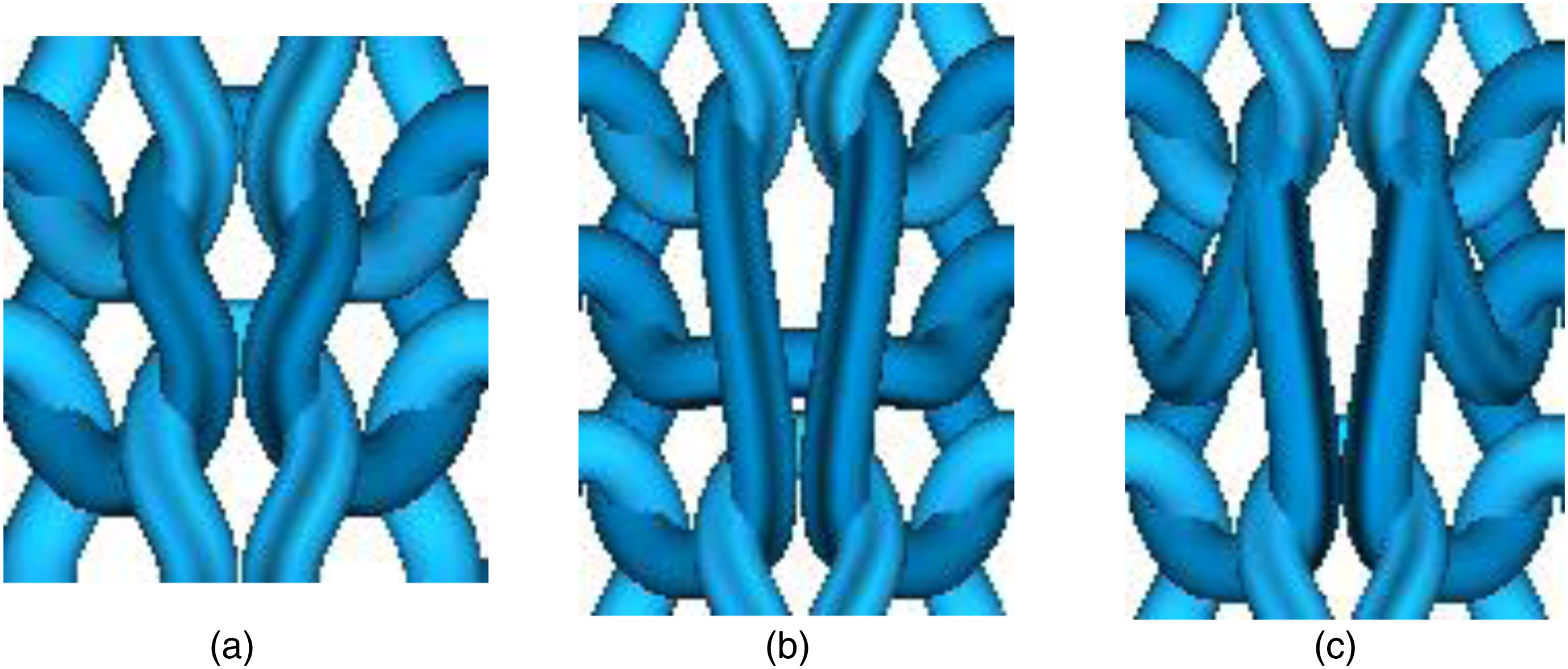
The SS wire was introduced into the structures in two different ways.
In the first case, SS wire and cotton yarn were fed separately and feeders were changed after every two courses. This option was proposed for the next reason. The knitted metal meshes are widely used as antennas and flexible EMR screens, but not in special clothes and smart textiles. The alternation of courses from cotton yarn and metal wire improves the fabric’s appearance and comfort. From another point, the materials in the clothes are usually positioned in different directions thus the proposed material can create a good circuit. The float and tuck stitches are formed in two knitting cycles thus two courses from each yarn were chosen for alternation. As a result, two courses of Rib 1 + 1 were knitted from cotton yarn and two courses were knitted from SS wire (RIB 1, HM 1, HC 1).
In the second case, both the SS wire and cotton yarn were used simultaneously and all stitches were formed from both components (RIB 2, HM 2, HC 2). It allows to create dense fabric with expected connections between metal loops. Additionally, a 1 × 1 rib structure from only 0.12 mm diameter stainless steel (SS) wire was produced and used as control (RIB SS).
Graphical representation and photos of hybrid knitted fabrics.

Structural parameters of hybrid knitted fabrics.

Method for measurement of EMI shielding effectiveness
The ASTM D 4935-18 method for planar materials 58 using a far-field electromagnetic plane wave was used for EMR shielding effectiveness (SE) testing over a frequency range of 30 MHz to 3 GHz, which corresponds to the wavelength of 10 m to 0.1 m.
The setup (Figure 4) at the Technical University of Liberec consisted of a sample holder SE test fixture (model EM-2107A, Electro-Metrics, Inc.) and a Rohde & Schwarz ZN3 network analyzer to generate and receive the electromagnetic signals. The measured sample is a circle of 13.31 cm in diameter. The samples were air-conditioned before testing (T = 22°C ± 3, RH = 50% ± 10 %), and the measurements were performed three times (n = 3) at three different sample locations chosen randomly to facilitate subsequent statistical analysis. The mean values were used for calculation and analyses. Installation set up for measuring the EMR shielding efficiency of textile.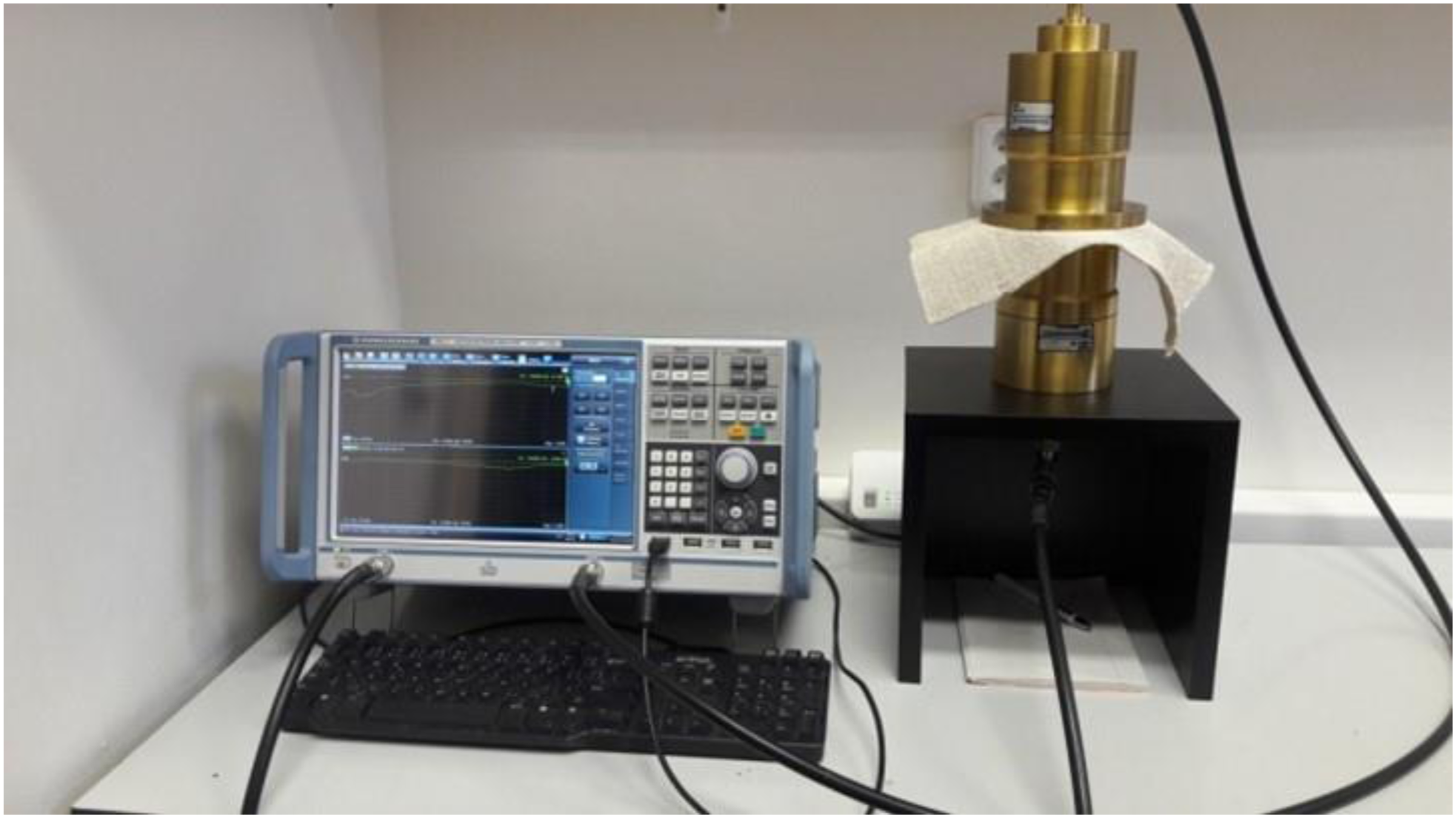
The insertion–loss method was used to determine the SE of the fabric. Scattering parameters S11 (or S22) and S21 (or S12) which are obtained through the measurement of a two-port network analyzer, give the reflection (R), transmission (T), and absorption (A) components, where R = |S11|2 and T = |S21|2 and A = 1 - |S11|2 - |S21|2. Further to describe the value of SER and SEA more convenient in decibels (dB), the values can be calculated as follows
59
:

For comparative analyses of SE at 900 MHz and 1800 MHz frequencies, the ranges of 870-930 MHz and 1770-1830 MHz were used correspondently. These gave us 50 measurements for each parameter. The SE mean values for these ranges, as well as standard deviation (σ) and coefficient of variation in percentages (CV%) were calculated.
Results and discussion
SE of the control fabric
The results of the study of the shielding effectiveness of control fabric RIB SS in the frequency range from 0 GHz to 3 GHz are presented in the graphs of Figure 5 a in terms of the two main mechanisms of EMR attenuation: absorption and reflection. It can be noted that the total shielding effectiveness at low frequencies (up to 0.3 GHz) is higher than 20 dB and corresponds to the “very good” level.
24
This fabric demonstrates better shielding performance than 1 × 1 rib structure investigated by He et al.
29
The value of total shielding efficiency at 0.9 GHz frequency, which is most used by 4G mobile operators in Ukraine, is 7 dB and characterizes the SE screen as “moderate”. In the range from one to 3 GHz, the total shielding efficiency of the control fabric is 5-2.5 dB. Shielding effectiveness over a frequency range of RIB SS fabric: (a) SE value; (b) absorption and reflection percentages.
The percentages of absorption and reflection in total SE for 100 % stainless steel fabric were calculated and presented in Figure 5. The results show that the reflection-based shielding mechanism is predominated in lower frequencies (up to 1000 MHz) and it is determinate for this fabric.
SE of fabrics from SS wire and cotton yarn fed separately
The results of the study of the shielding effectiveness of fabrics produced by changing feeders with cotton yarn and SS wire after each second courses are presented in Figure 6. The general trend for all hybrid knitting fabrics was observed. The shielding effectiveness decreased with increasing incident frequency, which can be thought of as the result of smaller wavelengths in higher frequencies. With the increase in the frequency, the electromagnetic wavelength became shorter and the incident waves were able to penetrate through the gaps of the structure at the area from SS wire. Such behavior is similar to the RIB SS fabric (Figure 5(a)). Shielding effectiveness of hybrid knitted fabrics from SS wire and cotton yarn fed separately: (a) RIB 1 SE value; (b) HM 1 SE value; (c) HC 1 SE value; (d) total SE; (e) reflection SE; (f) absorption SE.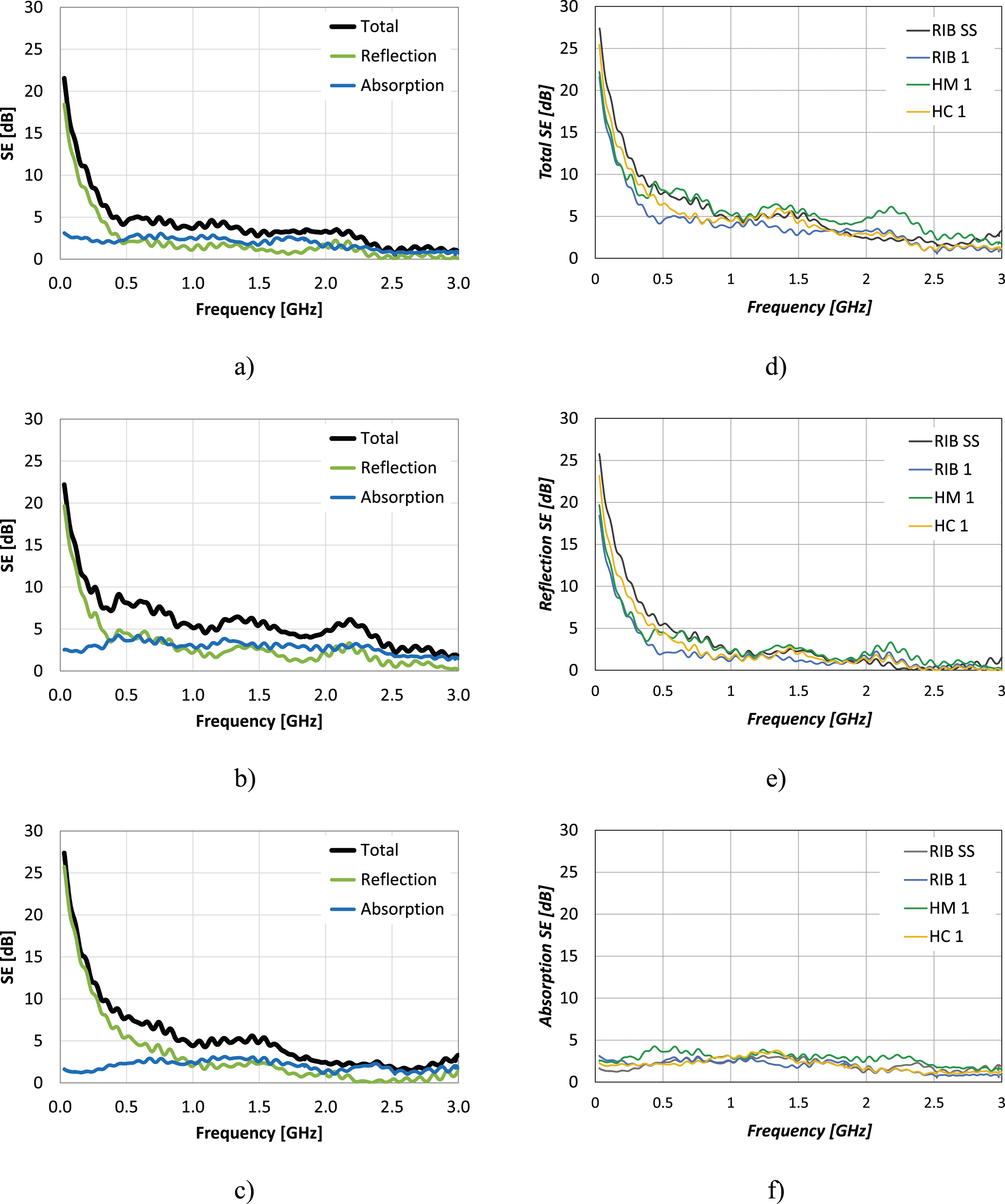
Comparative analysis (Figure 6(d)) of the fabrics’ shielding properties shows the following. The shielding effectiveness of fabric of this set is smaller than for the RIB SS. This is due to the presence of the zones from cotton yarn that don`t have any shielding properties. But it should be noted that the difference in SE between this set and RIB_SS fabrics is not big and hybrid fabric is more applicable in special clothes production.
The stitch type for SS wire has an impact on the electromagnetic shielding effectiveness. The using tuck stitches in the structure leads to increasing SE, especially in the range from 1 GHz to 2 GHz thus hybrid fabric HC 1 (Figure 6(c)) has got SE similar to RIB SS (Figure 5(a)). This corresponds to the previous studies,18,25 and can be explained by differences in the shape of ordinary loops and tuck stitches. The float (miss) stitches in the structure have a greater impact on the shielding properties of the fabrics which is similar to the conclusions in.33,34,36 The hybrid knitted fabric HM 1 (Figure 6(b)) has the greatest SE in the 1.2-2.5 GHz range compared to others in this set and even to RIB SS fabric from stainless steel wire only.
The absorption and reflection SE for hybrid knitted fabrics produced from the stainless-steel wire and cotton yarn in different courses were calculated and presented in Figure 5 as well. The results analyses show that the studied hybrid knitted fabrics have a reflection-absorption behavior similar to RIB SS fabric (Figure 6(e) and (f)). The reflection-based mechanism is predominated in lower frequencies (up to 600 MHz) (Figure 6(e)); whereas, a higher contribution of absorption-based shielding was observed with increasing frequency. The HM one fabric has the highest potential for EMR reflection (Figure 6(e)) in higher frequencies (more than 600 MHz) compared to others in this set and to RIB SS even. This can be explained by the structure of float stitch: there is a float behind the held loop which creates an additional point for wave reflection.
The absorption of CE for hybrid knitted fabrics produced from the stainless steel wire and cotton yarn in different courses has a low values in studied frequency range (Figure 6(f)). A higher contribution of absorption-based shielding was observed with increasing frequency due to the general tendency for shielding effectiveness to decrease. The results are consistent with the literature, 3 where it has been stated that absorption increases with increasing frequency, whereas reflection tends to decrease with an increase in frequency.
SE of fabrics from SS wire and cotton yarn fed simultaneously
The results of the study of the shielding effectiveness of hybrid knitted fabrics produced by simultaneously knitting the cotton yarn and SS wire are presented in Figure 7. These fabrics exhibit better shielding properties compared to the hybrid knitted fabrics from SS wire and cotton yarn fed separately. For HM 2 (Figure 7(b)) and HC 2 (Figure 7(c)) fabrics as a general trend the shielding effectiveness has peak values of 20 ÷ 50 dB in the interval between 200 and 700 MHz. This indicates the “very good” and “excellent” level of EMR shielding for general use
24
of the developed structures in the indicated frequency range. Shielding effectiveness of hybrid knitted fabrics from SS wire and cotton yarn fed simultaneously: (a) RIB 1 SE value; (b) HM 1 SE value; (c) HC 1 SE value; (d) total SE; (e) reflection SE; (f) absorption SE.
The stitch type has a great impact as well on the electromagnetic shielding effectiveness for hybrid knitted fabric from cotton yarn and SS wire used together (Figure 7(d)). The using float (HM (2) or tuck (HC (2) stitches in the structure leads to increasing SE (Figure 7(b)) compared to RIB 2 (Figure 7(a)) and to RIB SS fabric (Figure 5(a)) as well. The best SE values for half Milano rib structure (HM (2) with float (miss) stitches are in the 550-700 MHz range (Figure 7(b)) with the 47.2 dB peak at the 677 MHz point. The best SE values for half cardigan structure (HC (2) with tuck stitches are in the 350-450 MHz range (Figure 7(c)) with the 49.5 dB peak at the 400 MHz point. This result gives the possibility for choosing the right structure for shielding screens in certain electromagnetic wave ranges.
The absorption and reflection SE for hybrid knitted fabrics produced from the stainless-steel wire along with cotton yarn were calculated and presented in Figure 7 as well. The results analyses show that the hybrid knitted fabrics of this set have completely different behavior compared to hybrid fabrics of the previous set (Figure 6) and the RIB SS fabric (Figure 5(b)). They have low reflection SE (Figure 7(e)) and high absorption SE (Figure 7(f)) in the entire range of frequencies. It is due to higher fabric bulk density and less porosity 13 because of the cotton yarn in each stitch.
Effect of metal wire incorporation method on SE
To clarify the effect of method used for metal wire incorporation into knitted structure on shielding performance of hybrid knitted fabric the fabrics were grouped according interlooping used for SS wire. Based on above obtained results the low frequincy range was used for comparision (Figure 8). The simultaneous incorporation of SS wire with cotton yarn leads to increasing fabrics total EMSE compared to fabrics with alternation courses from metal wire and cotton yarn. But these fabrics have lower reflection part that can be explain by decreasing in contacts between wire loops because there is a cotton yarn in each loop as well that positioned between wires. From the other side the cotton yarn affects the fabric bulk density. The fabrics became dense with less porosity
13
that leads to increase in EMR absoption. Shielding effectiveness of hybrid knitted fabrics with different interloping for SS wire: (a) 1 × 1 rib; (b) half Milano rib; (c) half cardigan.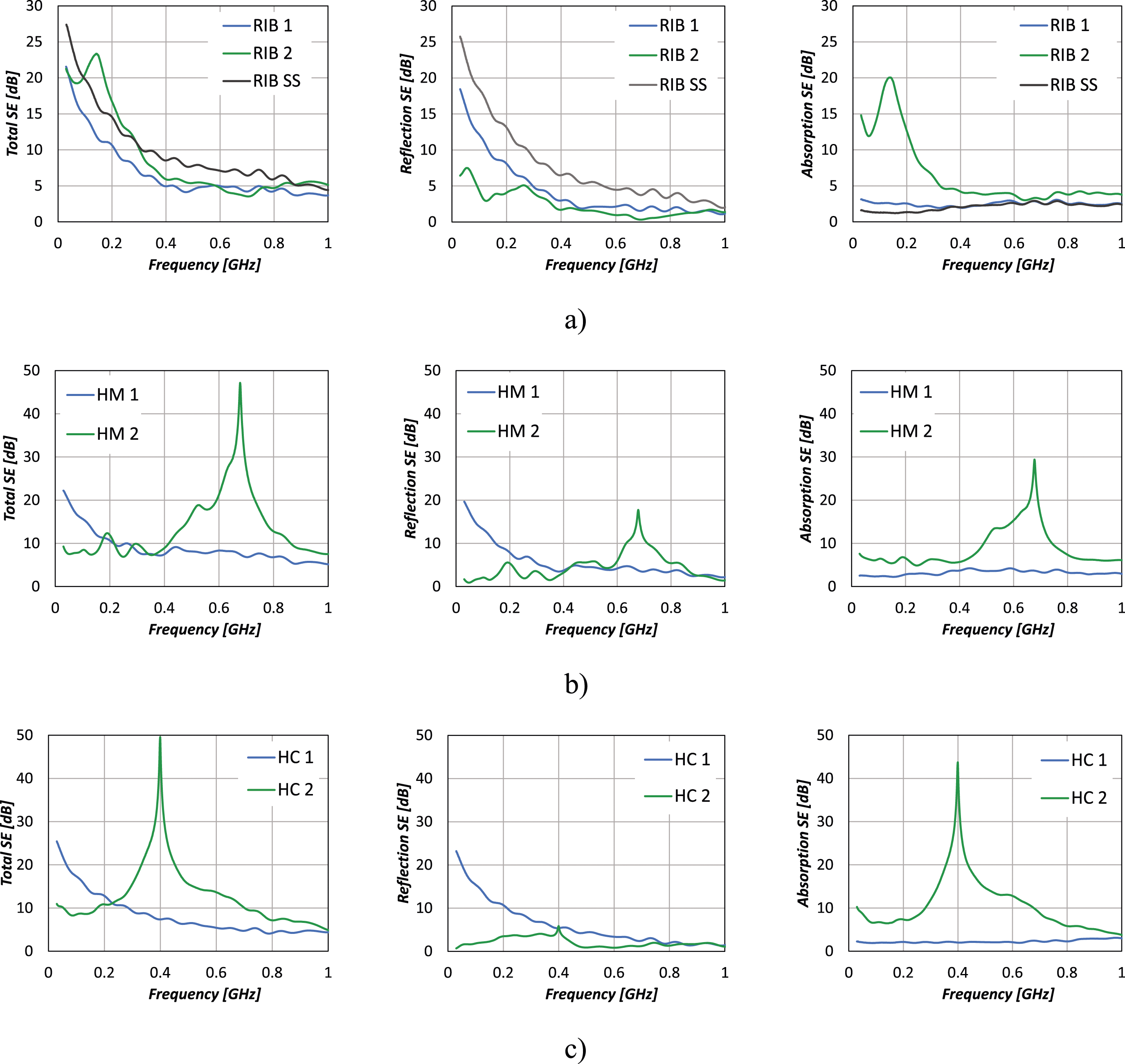
Within a relatively low frequency range (i.e. up to 600 MHz), the developed hybrid knitted fabrics with an alternation of cotton and SS courses can be used as electromagnetic wave reflectors. The difference in the frequency range below 600 MHz may be important for the end uses of such kind of conductive fabrics. The hybrid knitted fabrics produced from the stainless-steel wire along the cotton yarn can be used as electromagnetic wave absorbents.
Comparative analyses
Shielding effectiveness of hybrid knitted fabrics at 900 Hz and 1800 Hz frequency.

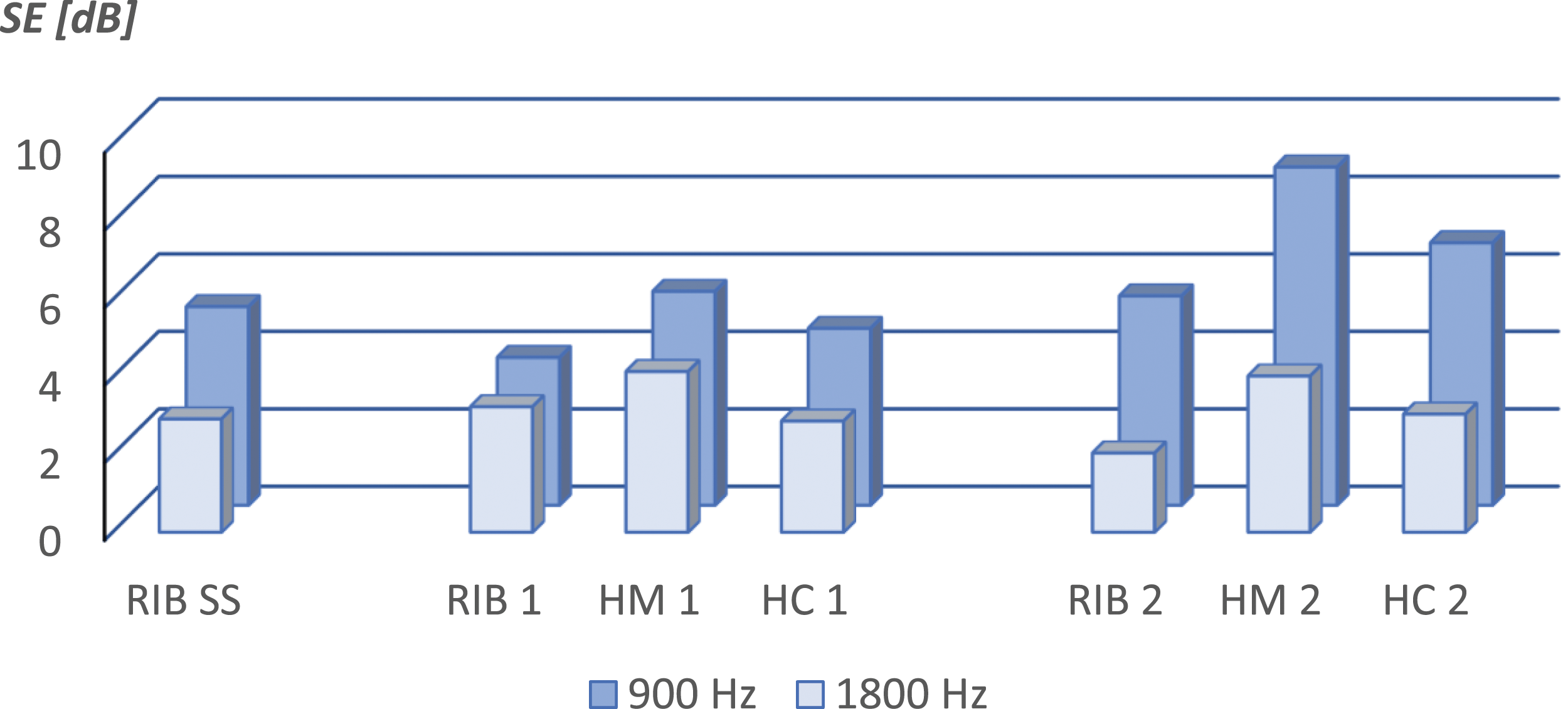
Shielding effectiveness of hybrid knitted fabrics in frequency bands used by mobile operators most.
Conclusion
Within this work hybrid knitted fabrics with incorporated stainless steel wire were studied in terms of ability for electromagnetic radiation shielding. Two variants of 0.12 mm diameter stainless steel wire incorporation into knitted structure were chosen: together with cotton yarn and separetly when two courses from cotton yarn alternate two courses from wire. Three type of interlooping (1z1 rib, half Milano rib, half cardigan) were used for SS wire incorporation to cover tree main types of ctitches: loop, float and tuck.
The developed hybrid knitted fabrics with incorporated stainless steel wire have the ability to shield EMR. The study results show that the method of SS wire incorporation into the knitting structure (separately or simultaneously with cotton yarn) affected both the shielding effectiveness and the basic mechanism of shielding.
The fabrics produced by alternation of two courses from cotton yarn and two courses from wire have shielding properties similar to 1 × 1 rib fabric produced from stainless steel wire only. Despite the fact that cotton is no effective barier for EMR , the EMR SE of such hybrid fabrics is only 10-15 % less in studied fraquince range from 30 MHz to 3 GHz. The cotton yarn usage can allow to use hybride knitted fabric in special clothes production.
The fabrics produced by using SS wire along with the cotton yarn have better shielding performance compared to fabrics with SS wire and cotton yarn in different courses.
From the other point, the developed fabrics from SS wire and cotton yarn fed separately have predominated the reflection-based mechanism whereas the hybrid knitted fabrics from SS wire and cotton yarn fed simultaneously have predominated the absorption-based mechanism. This understanding helps in choosing materials and technology for certain products. The hybrid knitted fabrics with alternation of cotton and SS courses can be used as electromagnetic wave reflectors while the hybrid knitted fabrics produced from SS wire along with the cotton yarn are good as electromagnetic wave absorbents.
It is evident from research results that the stitch type used for SS wire is the main factor that determines the shielding properties of knitted materials. The highest values of shielding effectiveness can be achieved by using float stitches. The half Milano rib knitted structures demonstrate the best shielding efficiency due to the arrangement of the structural elements namely additional floats behind held loops.
To summarize the results, it should be stated that both the method of SS wire incorporation and the shape of its positioning in the knitted structure affect the EMR shielding effectiveness while only the method of SS wire incorporation determines the shielding mechanism: absorption or reflection.
Footnotes
Declaration of conflicting interests
The author(s) declared no potential conflicts of interest with respect to the research, authorship, and/or publication of this article.
Funding
The author(s) disclosed receipt of the following financial support for the research, authorship, and/or publication of this article: This work was supported by the International Visegrad Fund (62410015).
