




Abstract
Liquid transport across the thickness of a fabric, also termed as ‘transplanar wicking’, is one of the crucial properties affecting the moisture management capability of textiles. Although many test methods for this property have been proposed in the past, a simple and direct measurement of wetness on both sides of the fabric is still missing. This paper reports on the development of a simple directional liquid transport fabric tester (DLTFT) which can measure the liquid content on both faces of the fabric after exposed to a defined volume of liquid droplets. DLTFT used two filter papers to absorb liquid moisture from both sides of the wetted fabric under controlled pressure, and the gravimetric analysis technique was used to calculate the parameters of liquid transport. A new indicator called normalized transplanar ratio is proposed. The results showed that DLTFT was highly sensitive and reproducible in measuring the transplanar liquid transport properties of fabrics. Analysis further showed that, measurements from DLTFT can accurately differentiate fabrics that cannot be differentiated using existing test methods. This instrument is useful for fabric evaluation in textile product development and quality control.
Keywords
Introduction
Directional liquid transport property, sometimes also known as ‘transplanar wicking’, refers to the ability of a fabric to allow preferential liquid transport across its thickness in one direction, but not vice visa.1–3 Because it is one of the critical characteristics related to thermal comfort of functional clothing, 4 development of directional liquid transport fabrics has mushroomed in recent years.5–9 In clothing applications, such fabrics can improve evaporative cooling and keep the microclimate between the wearer’s skin and the garment as dry as possible.10,11 Such fabrics can also be applied for collecting fresh water from the fog in the air and sea water12,13 as well as for wound dressing in health care as it promotes the discharge of liquid secretion to keep the wounds dry.14–16
There are generally two main design principles for creating the asymmetric wicking across the fabric thickness: (1) adjusting porous structure of both sides of the fabric to control water flow direction, (2) creating wettability gradient across the thickness of the fabric by different yarns or chemical treatment and so on. 17 Many different types of fabrics varying in construction, surface texture and finishing are possible under these two design principles.
Existing instruments for the measurement of directional liquid transport property of fabrics have many limitations. Image analysis was used by some18–22 to determine the wicking pattern of both sides of the fabric surface. However, these apparatuses do not provide a direct quantitative measurement of surface water content and poses difficulties in detecting the wicking area in dark-colored or matt finishing fabrics. Others made indirect measurement through detecting electrical signals from the wet part of the fabric (e.g. electrical conductivity, 23 capacitance, 24 electrical current 25 ). Take the Moisture Management Tester (MMT) as an example23,26, which is widely used commercially to test the liquid moisture management properties of the fabrics. MMT has a number of drawbacks that contribute to the inaccuracy of its results. On the one hand, the sensor pins of MMT are distributed in concentric circles, whereas the wicking pattern on the fabric surface is usually anisotropic, leading to inaccuracy in test results. Besides, the sensor pins may have a poor contact with uneven fabric surface designed to reduce the stickiness discomfort. Furthermore, the liquid supply pin pushes the fabric, causing extrusion and deformation, which is different from the real wearing condition. It has also been shown that these limitations can lead to incorrect wetting time results in MMT tests. 27
Filter paper is a good material for absorbing liquid on fabric surface for characterizing fabric surface wetness. Several tools 28 based on this principle have been developed to measure the water transport property of fabrics. However, these tests have problems caused by supplying water upwards, as the ability of liquids to penetrate Janus membranes/fabrics is the result of capillary forces competing with gravity in the vertical direction.11,29,30 Supplying water upwards may affect the wicking of water across the fabric thickness and can lead to unrealistic results. Other researchers31,32 developed a gravimetric analysis technique that included a wetted fabric sandwiched between two filter papers with pressure applied, but the testing procedure was quite complicated, leading to measurement inaccuracy. Therefore, a simple, direct and accurate method of detecting the directional liquid transport across the fabric remains to be a challenge.
In this work, we report on our recent development of a simple and accurate technique for the measurement of directional liquid transport property-Directional Liquid Transport Fabric Tester (DLTFT). This instrument is a semi-automated apparatus and easy to operate. In this study, through testing a range of typical moisture management fabrics, the effect of two key external factors that influence the directional transport (viz., the amount of water supplied and pressure applied on the fabric layers 32 ) are examined. Furthermore, the test results of 18 typical moisture management fabrics from DLTFT are also compared with those from various liquid transport tests (horizontal wicking test, vertical wicking test and MMT), and the correlation and differences between these instruments are discussed.
Methods
Design principle of DLTFT
When sweating, liquid and moisture transport through the fabric mainly in two modes.33,34 One mode is the evaporation of sweat into vapor in-between the skin surface and the inner surface of the fabric, following by vapor transport through the fabric or condensation on the inner side of the fabric and then liquid transport through the fabric.35–37 In the other mode, liquid sweat directly contacting the fabric is abosrbed and transported in three dimensions by in-plane water transport and transplanar wicking.
As shown in Figure 1, DLTFT is designed to simulate sweating by supplying water droplets in a controlled volume and measuring liquid accumulation on both sides of the fabric to characterize the directional liquid transport property. During the water supply phase, a water injection device was used to simulate sweating and the distance between the injection outlet and the fabric was adjustable to simulate the varying fitting of clothing. After that, a filter paper was attached to each side of the fabric and weighted to determine its moisture absorption from the wetted fabric surfaces. The difference in the moisture content of the filter paper on both side of the fabric was used to characterize the directional liquid transport. Schematic diagram of DLTFT, including water supply phase and testing phase.
The instrument is illustrated in Figure 2(a). It can be divided into four parts from bottom to top: a power supply module, a testing module, a water injection device, and a compression loading. In the power supply module, the gear structure (9, 10) efficiently regulates the opening and closing of sample blade (11) and upper filter paper blade (18) to eliminate operator-induced variability by its automatic placement process. In testing module, sample blade (11) and filter paper holders (13, 18) were made by polished metal to eliminate wicking of the liquid between the blade surface and the fabric as well as ensuring these surfaces are smooth. The rest of the module was 3D printed with Polylactic acid (PLA). Through this module, the sample was placed in-between two layers of standard material (Whatman® medium speed filter paper) for examining the fabric surface wetness (Figure 2(b)). By considering the varying fitting of clothing and real wearing condition, the water injection device in this work consisted of a 10 Experimental set up of DLTFT. 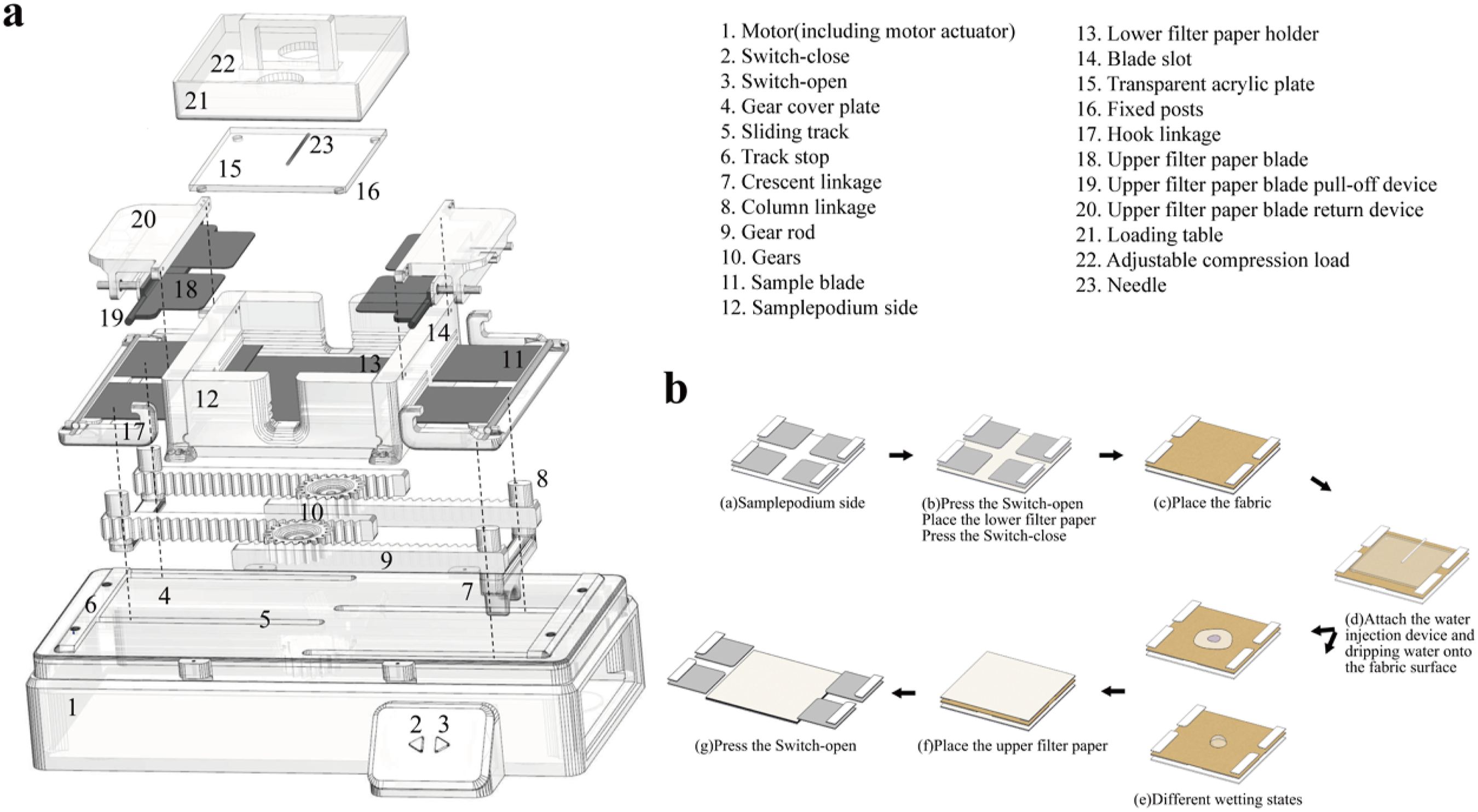
The operational testing procedures are listed below: 1. Prepare the specimen for testing. Cut the filter papers and test samples to fit the stage (square: 12 cm 2. Prepare the instrument for testing. Turn on the syringe pump and adjust the water flow rate and water supplied of injection, then turn on the electronic balance with a readability of 0.0001 g. 3. Note the dry weight of the upper filter paper, fabric, and lower filter paper. 4. Check the position of the sample podium side, press the switch-open and make sure the sample blade and the upper filter paper blade are located at the end point of the test. 5. Mount the lower filter paper on the lower filter paper holder. 6. Press the switch-close to bring back the sample blade and the upper filter paper blade to their starting position. 7. Place the test fabric on the sample blade with the back side facing up. 8. Attach the transparent acrylic plate over the test sample, and make sure the needle connected with the plate is between the plate and the test sample. 9. Start the syringe pump and it will stop the injection automatically when the preset amount of water is reached. 10. Wait for water droplets to diffuse on the fabric for a certain time (60s). This is necessary for reproducibility. 11. Remove the transparent acrylic plate, and mount the upper filter paper at the upper filter paper blade. 12. Cover the upper filter paper with the loading table. 13. Press the switch-open, and make sure the stack of paper-sample-paper and loading table drop and touch for 60s. During this time, the compression load gives a certain pressure to it to help the filter paper evenly absorb the water remaining on the surface of the fabric, while avoiding the water already absorbed from the inner layer of the fabric to the outer layer of the fabric being squeezed back to the inner layer. 14. Take away the loading table, note the wet weight of the upper filter paper, fabric, and lower filter paper with the balance. 15. The apparatus is now ready for next setting of specimen.
Summary of various instruments for testing transplanar wicking of textiles.
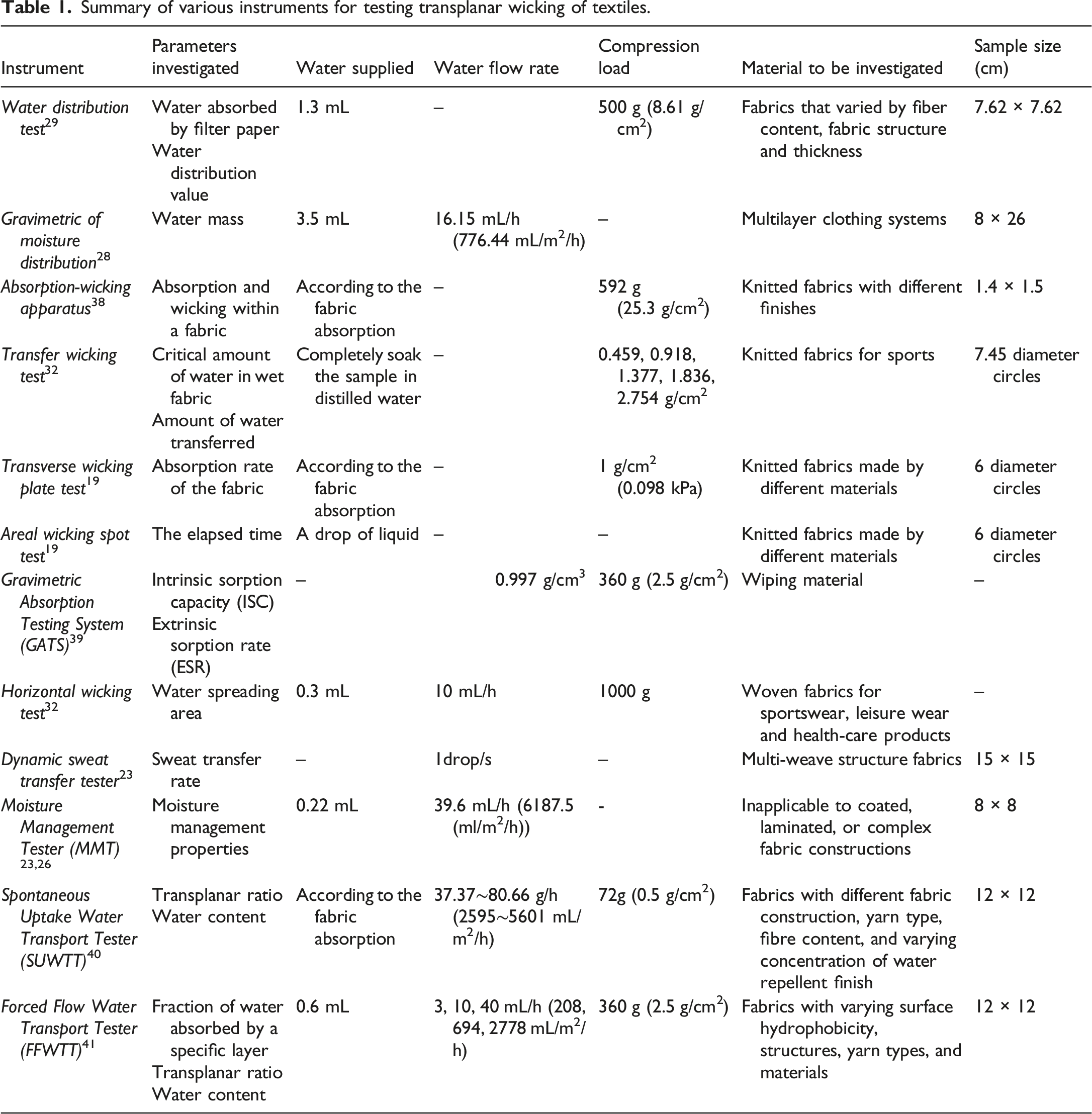
In this work, the water injection device simulates sweating by controlling the flow rate constant, while the water volume varies considering the primary response to heating a local skin area is to increase the output of individual glands.35,36 The flow rate was 20 mL/h (equivalent to 1388 mL/m2/h for a sample size of 12 Test results of standard sample by DLTFT. (a) Bubble chart describing the measurement accuracy of DLTFT. (b) Standard sample and its information. (c–f) Measurement results of standard sample by DLTFT under different water supplied and compression load.
We also investigated the influence of various compression loads, specifically 0.139, 0.694, 2.083, 3.472, 4.861 g/cm2, on the outcome of the experiments and choose the most appropriate one for further testing. By systematically exploring different compression load levels, we evaluated their impact on the absorption and distribution of moisture over different layers. This would provide valuable insights into the relationship between compression load and transplanar wicking, enabling us to identify the most suitable compression load for accurate characterization of fabric performance.
Analytical balance accurate to four decimal places was used for the measurement of the liquid absorbed by the stack of paper-fabric-paper on the DLTFT. From the relationship between the weight components of the liquid distribution, the total amount of liquid in the stack of paper-sample-paper can be determined by equation (1).


Where, m
i
indicates wetted mass of a specific layer. An index called transplanar ratio (TR) can be calculated from dividing the amount of water absorption in the upper filter paper by that of lower one using equation (4), providing a measurement of the ability of the fabric to facilitate the transport of liquid from one side of the fabric to the other. The higher the ratio, the better the fabric in facilitating the transport of liquid sweat from the skin surface to the outer layer of clothing, and preventing the accumulation of sweat on the skin surface.
Experimental investigations on 18 types of fabrics with varying water transfer mechanisms were carried out to systematically evaluate the test system. As it is more challenging to achieve one-way transport in thin and lightweight fabrics, we further defined the transplanar ratio per unit thickness and per areal density named normalized transplanar ratio (NTR) by the following equation (5):
Results and discussions
The effect of volume of water supplied and compression load
The measurement accuracy of the standard sample under 20 experimental conditions is plotted in Figure 3(a). Five tests were performed for each test condition to calculate the mean and standard variation. The bubble chart displays the three dimensions of the data effectively with the color of the bubble representing the accuracy of the corresponding fabric. It clearly demonstrates that the Error % in all of the tests was less than 5%.
From the results plotted in Figure 3(c)–(f), it can be seen that, compression load has a significant effect on the DLTFT test results. The bars show that with increasing compression, the water absorption in fabric decreases significantly, while that in filter papers continues to grow. Additionally, the measured TR decreased with the increase of compression load. It was found that TR is least affected by the compression load when the volume of water supplied was 1 mL.
ANOVA table-effect of volume of water supplied on fraction of water absorption by different layers and TR.

ANOVA table-effect of compression load on fraction of water absorption by different layers and TR.

Fabric samples
Details and specifications of 18 types of fabrics.

These 18 fabrics are grouped by detail. The design method of K1-K5, K9 and K15 is to have gradient loop density at different sides of the fabric. The characteristic of K6-K8, K10, K11, and K16 is double knitted with no significant structural differences between two sides of the fabrics. K12 and K18 are fabrics with finishing, and K13, K14 and K17 are single knitted fabrics.
In terms of areal density and thickness, as shown in Figure 4(a) and (b), there is no significant correlation between TR and fabric specifications for these 18 fabrics. Fabrics with similar specifications may have vastly different TR values, such as K15 and K6. This may be related to the characteristics of K6 is knitting the hydrophobic and hydrophilic yarns on opposite sides of the fabric, it leads to wettability gradient in the direction of the fabric thickness. Furthermore, all fabrics except K8 have TR greater than 1, and they can be classified as fabrics with one-way liquid transport property. It means the mass of liquid moisture absorbed by upper filter paper is lower than that of lower filter paper. Specifically, around 30% of these fabrics have a TR value greater than 7, over 65% of them have a TR value greater than 2. (a–b) Relationship between TR by DLTFT and fabric specifications. (c) Relationship between TR and NTR.
The new indicator NTR not only characterize the transplanar wicking of fabrics, but also take thickness and area density into account. Considering the NTR value of these 18 fabrics in Figure 4(c), K6 and K10 shows outstanding performance as both fabrics not only have good directional liquid moisture transport properties, but also relatively lightweight and thin. Technologies to achieve one-way liquid transport across fabric thickness are emerging, but achieving this performance in thinner and lighter fabrics remains difficult. From a practical point of view, NTR can help researchers to select fabrics that are thin, lightweight, and also highly transplanar wicking, which is suitable for sportswear with performance requirements, and can provide a useful tool for manufacturing.
Comparisons of various liquid transport tests
Summary of various measurement methods and existing difficulties.
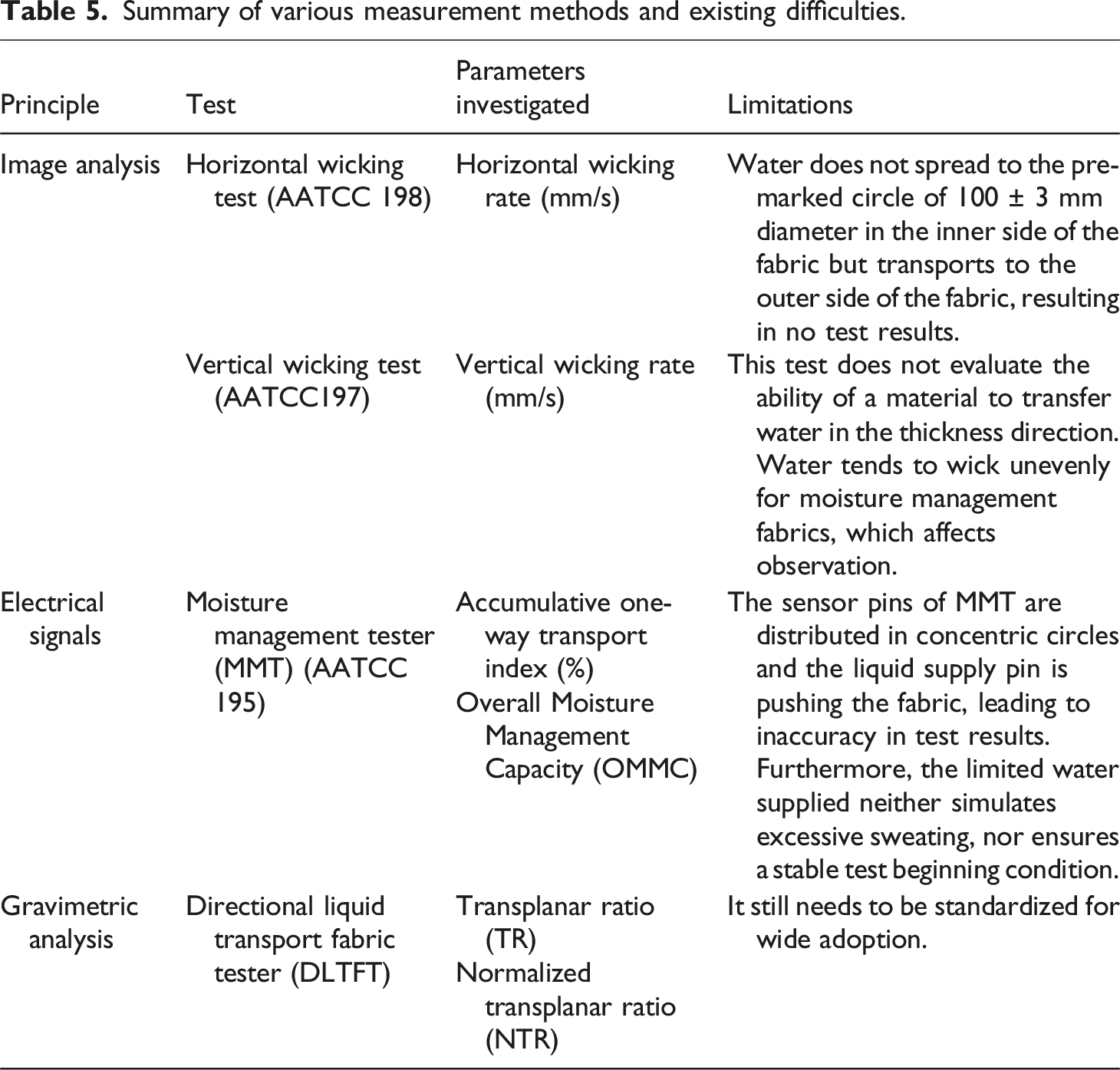
Figure 5(a) shows the test results of various liquid transport tests with the size of the bubble representing the test value and the color representing the coefficient of variation (CV). For horizontal wicking test, the asymmetric wicking across the fabric thickness poses difficulties in detecting the wicking distance by observation from the inner side of the fabric, as the water does not spread to the pre-marked 10 cm diameter circle in the inner side of the fabric but transports to the outer side, resulting in no test results. Furthermore, there were significant wicking differences between two sides of the textile, which were not mentioned in the test standard. (a) Bubble chart describing the test results of 18 types of fabrics, consisting of horizontal wicking rate (mm/s) by horizontal wicking test (AATCC198), vertical wicking rate (mm/s) by vertical wicking test (AATCC 197), accumulative one-way index (%) and OMMC by MMT, TR and NTR by DLTFT. (b–c) Relationship between DLTFT and vertical wicking test (d–g) Relationship between DLTFT and MMT.
Figure 5(b) and (c) present the relationship of vertical wicking rate and two parameters from DLTFT for 18 typical moisture management fabrics. Vertical wicking rate evaluates the ability of a material to transport water through or along itself in the length or width direction. It can be seen that there is no significant correlation between in-plane wicking (characterized by vertical wicking rate) and transplanar wicking (characterized by TR and NTR). If we analyze the differences between groups, it can be seen that samples with gradient loop density, in our case, possess a higher vertical wicking rate, while the double knitted fabrics have higher TR and NTR.
Overall moisture management capacity (OMMC) and accumulative one-way transport index are two parameters from MMT to provide quantitative measures of transplanar water transport. Positive and high values of them mean that liquid sweat can be transferred from the skin to the outer surface easily and quickly. The values of these two parameters from MMT are compared with TR and NTR in Figure 5(d)–(g) for 18 typical moisture management fabrics.
It can be seen that the two transplanar liquid transport parameters from MMT and DLTFT are linearly correlated in general except for a few outliers. In particular, K6 and K16 behave very differently on MMT and on DLTFT. We believe this is caused by the improper contact formed between the liquid supply pin as well as sensors pins of MMT and fabric surfaces, especially for fabrics with irregular surface structures, variations in finishing treatments, and resulting hydrophilic properties. 8 Consequently, large variations in the test results of some fabrics can be expected on MMT. For example, the CV of OMMC and accumulative one-way transport index values for K6 were 1.7321 and 2.1639, respectively, which were much higher than its CV of TR (0.2800). The simulation of the thickness of the air layer under the garment by the water injection device in DLTFT ensures controlled and reproducible beginning conditions. Besides, the very different test results of K16 on MMT and on DLTFT could be possible owing to its asymmetric wetting behavior, whereas MMT is designed with the assumption that wetting is symmetrical. Additionally, fabric K10 also behaves differently between NTR of DLTFT with two parameters of MMT. The high NTR value of K10 indicates that it has excellent directional liquid transport property at extremely low thicknesses and areal density, which was not taken into account in the parameters provided by MMT.
For the rest, linear fitting was computed between the DLTFT and MMT measurements excluding the distinct outliers, and all p-values were below 0.05, which were considered statistically significant. TR had a moderately positive correlation with accumulative one-way transport index and OMMC (Adj. R2 = 0.5557 and 0.4932 respectively). The relationship between NTR and two parameters of MMT is relatively weaker (Adj. R2 = 0.3354 and 0.3111 respectively). This is due to the wicking of moisture on the surface of the fabric detected with the metal pins does not exactly match the transfer of mass.
Conclusion
To conclude, by applying gravimetric analysis, a novel Directional Liquid Transport Fabric Tester (DLTFT) was developed to provide simple, accurate and reproducible measurement of one-way liquid transport through fabric thickness. Our experiments showed that liquid transport properties of fabrics are pressure-dependent. With a predetermined pressure, measurements from DLTFT were highly sensitive and reproducible in differentiating different fabrics. Correlation analysis showed that the transplanar ratio (TR) and normalized transplanar ratio (NTR) have positive correlation with overall moisture management capacity (OMMC) and accumulative one-way transport index and are able to test directional liquid transport fabrics that cannot be accurately characterized by MMT. Due to its high accuracy, our DLTFT is useful for fabric evaluation in textile product development and quality control.
Footnotes
Acknowledgments
The authors would like to acknowledge the funding support of Research Grant Council of HKSAR (Grant Ref #15216722) and Wuyi University (Project No: ZGGK).
Declaration of conflicting interests
The author(s) declared no potential conflicts of interest with respect to the research, authorship, and/or publication of this article.
Funding
The author(s) disclosed receipt of the following financial support for the research, authorship, and/or publication of this article: This work was supported by Research Grant Council of HKSAR (Grant Ref #15216722) and Wuyi University (Project No: ZGGK). This work was further supported by a Hong Kong Polytechnic University research studentship granted to Ms. Luning Yuan.
