




Abstract
Artificial ligaments transplanted into the human body are subject to ligament rupture and ligament fatigue injury during exercise. The three-section structure of artificial ligaments has a tight structure which can improve the breaking strength at the two ends, and a looser structure which can keep the flexibility in the middle. At present, scholars have studied braided artificial ligaments with high elasticity and creep resistance, and three-section artificial ligaments have other advantages on this basis. In this study, the three-section artificial ligaments were braided with UHMWPE, and a core-shell structure was used at both ends of the ligament as a way to strengthen the tightness and strength, facilitate the fixation of the ligament, and improve the fatigue resistance of artificial ligaments. In addition, the mechanical properties of artificial ligaments were investigated with different numbers of cores. This study proved that the three-section artificial ligament, which is made of UHMWPE has high strength, excellent elastic recovery rate, and fatigue resistance, which can provide mechanical support for the daily activities of the knee joint and help maintain the stability of the knee joint.
Introduction
The anterior cruciate ligament (ACL) has an excellent auxiliary value for the stability of the knee joint in human beings. ACL begins at the upper end of the tibia at the anterior horn of the meniscus and ends at the medial posterior aspect of the human lateral femoral ankle. 1 ACL is rope-like dense connective tissue that connects the femur to the tibia and plays a vital role in stabilizing the knee joint and normal movement. 2 ACL injury will reduce the stability of the patient’s knee joint and lead to knee dysfunction. 3 If left untreated, it is prone to osteoarthritic inflammation, such as synovitis, intra-articular cartilage and meniscus injuries, leading to meniscus avulsion in severe cases. 4 ACL injury repair methods mainly include autologous ligament reconstruction, allograft ligament reconstruction and artificial ligament reconstruction. Autogenous ligaments have problems such as insufficient source of supply, insufficient early strength, complications at the extraction site and uncertainty of healing with the bone tunnel. 5 Although allogeneic ligaments avoid donor-area complications, they require cold-chain transportation which is difficult to ensure quality. What’s more, allograft ligament reconstruction has problems such as disease transmission, immune rejection, delayed graft insertion and fewer sources. 6 Among them, the artificial ligament has the advantages of comprehensive source, high strength, fast recovery, no supply area complications and the risk of disease transmission. Moreover, the artificial ligament has the appropriate mechanical strength, which can play a mechanical effect after implantation and ensure that the patients can be rehabilitated in the early postoperative period.
At present, various polymer materials have been used to produce artificial ligaments and show good physicochemical and biological properties.7–10 The commonly used raw materials for artificial ligaments are polyethylene terephthalate (PET), polyglycolide acid (PGA), ultra-high molecular weight polyethylene (UHMWPE), and so on. 11 PET has excellent biomechanical properties and is easy to manufacture. However, it is prone to side effects such as synovitis, 12 and it can be subject to abrasion, affecting the treatment’s long-term efficacy. PGA has high strength and hydrophilicity but loses its mechanical strength due to rapid degradation and is a biologically inert and acidic degradation product. 13 UHMWPE is characterized by high tensile strength, high abrasion resistance, high impact strength, resistance to corrosive chemicals, low cost, low water absorption and low coefficient of friction.14–16 These properties have determined the use of UHMWPE in many developmental areas as well as medical and biological applications, including joint materials, tissue scaffolds, blood transfusion pumps, packaging bags, and so on.17,18 At the same time, the biocompatibility and extremely high tensile strength of UHMWPE make it an ideal candidate for ACL grafts. 19
Artificial ligaments are predominantly knitted, woven and braided. Warp knitting is commonly used in knitting; however, warp-knitted ligaments do not maintain excellent tensile properties. Woven technology can provide more choices in the design of material structures to ensure the strength of the artificial ligament and make the structure more stable. It can also be customized according to the patient’s situation to adapt to the needs of different patients, so that the artificial ligament can play a better role. However, the woven products have slightly poorer breathability, rugged feel, less elasticity and other problems. Braided artificial ligaments are dimensionally stable, with good flexibility, strength and fatigue resistance. These enhanced mechanical properties promote their wide application in tendon and ligament scaffolds with bionic properties. 20 In addition, braided fabrics exhibit good porosity and core absorption capacity while maintaining the production parameters and structure. 21 Thus, braided structures have the advantages of being loose, soft, elastic and favorable to bending and twisting compared to knitted structures. Compared to woven structures, braided structures have flatter surfaces and more appropriate pore sizes, which generally meet the mechanical properties and structural requirements of artificial ligaments. 22
With the increase of exercise, the existing artificial ligament graft is prone to loosening the bone channel, leading to slippage of the artificial ligament. However, the three-section artificial ligament can solve this problem. The three-section structure of the artificial ligament is tight at both ends and loose in the middle. Since the two ends need to be implanted into the bone canal and fixed with extruded screws, this tight structure can increase the friction between the fibers and the screws to improve the fastness of fixation. In the meantime, since the middle portion will be located in the articular cavity, the loose structure is conducive to preserving the flexibility of joint movement. To better address the issue of ligament slippage, the three-section artificial ligament can be designed with UHMWPE, which not only enhances the tensile strength, abrasion resistance and corrosion resistance of the ligament but also improves the fastness of the ends of the ligament and reduces slippage.
At present, various artificial ligaments have been produced and they all exhibit excellent characteristics. However, compared with the requirements of clinical applications, there are still significant gaps, such as easy to wear, poor fatigue resistance, easy to induce the expansion of bone tunnels and other problems. Regarding this issue, the fatigue resistance and characteristics of the three-stage ligament can effectively solve it. In this study, the three-section artificial ligament was developed based on a braided structure, which reduces ligament slippage and has excellent strength, elasticity, and fatigue resistance.
Materials and methods
Materials
400D UHMWPE (Zhejiang Qianxilong Special Fiber Co., LTD, Zhejiang, Chin) was used as the inner core. 800D UHMWPE (Zhejiang Qianxilong Special Fiber Co., LTD, Zhejiang, Chin) was used as the outer shell.
Preparation of artificial ligaments
The artificial ligaments were prepared with a 16-bobbin braiding machine (Engineering Research Center of Knitting Technology, Jiangnan University, Wuxi, China). Three types of artificial ligaments were braided with different numbers of cores to investigate the effect of the number of cores on the performance of artificial ligaments by comparing their mechanical properties.
23
As shown in Figure 1, the inner core and outer shell of the artificial ligament are both braided by the 16-bobbin braiding machine, but we only used eight bobbins from it. We achieve the loose part by not weaving the outer shell (the outer shells at both ends will be connected by yarn), and the weaving angle of the loose part is within 40°. Since the artificial ligament in this paper was a three-section structure, the length of the two ends of the ligament was designed to be 50-70 mm and the middle length was 20-30 mm. To compare the effects of different numbers of cores on the artificial ligament, we set the number of cores at 10, 14, and 18 (expressed as TAL-10, TAL-14, TAL-18). Design and preparation schematic of three-section artificial ligaments.
Tensile testing of artificial ligaments
The tensile properties of artificial ligaments were determined using the Electronic Universal Testing Machine (MTS Systems Co., Ltd, Guangzhou, Guangdong, China). To avoid sliding during tensile test, both ends of the samples were soaked in glue and dried, while the edges of the grippers were marked on the samples. With the movement of any mark away from the edges, the test results were considered invalid due to sliding. The inner core and outer shell are tightly attached to each other due to the enormous pressure exerted by the clamp, resulting in significant frictional force. To determine the stress and strain of the artificial ligaments, the tensile testing was conducted with a gauge length of 15 mm at a loading speed of 50 mm/min (Figure 3(c)).
24
Sample stress is calculated according to equation (1) (n = 3 per group).

Elastic recovery testing of artificial ligaments
A certain number of cyclic tensile preconditioning can increase the modulus of the sample, reduce the residual deformation and stabilize the stress-strain curve.
25
Therefore, all samples needed to be preconditioned before the elastic recovery test under a 30 N loading force, with a 60 mm initial length and at a loading speed of 120 mm/min for 10 cycles. After preconditioning, loading-unloading testing was conducted under a 46.8 MPa ultimate load, which is close but does not exceed the human ACL breaking strength, with a loading-unloading speed of 120 mm/min and a dwell time of 1 s.
26
The elastic recovery of the sample is calculated according to equation (2) (n = 3 per group).

Cyclic tensile testing of scaffolds
Cyclic testing was conducted with a 5% constant elongation at 120 mm/min stretch and return speeds for 500 cycles. A 5% constant strain level was selected because more than 6% strain levels had been suggested to cause the failure of a single collagen bundle, resulting in permanent changes in the tensile behavior of ligaments.27,28 After cyclic tensile, the samples were stretched at a constant rate of 50 mm/min until rupture.
29
The sample stress decay rate is calculated according to the formula (3) (n = 3 per group).

Results and discussion
Structural parameters of artificial ligaments
The artificial ligaments produced are white in color, soft to the touch, with a certain degree of stiffness, and the strips are even and the surface is smooth. In addition, their middle part can be flexibly bent. Figure 2 shows the length and diameter of the inner core, the diameter of a single core is 0.85 mm. The length of the artificial ligament was 50-70 mm at both ends and 20-30 mm in the middle. The braid angles of the three types of ligaments were 82.89°, 84.61°, and 105.13°. The diameters of the three types of ligaments were 3.6 mm, 4.06 mm, and 4.55 mm, respectively. In the available studies, the diameter of braided artificial ligaments ranged from 3 to 10 mm.24,30,31 Although the diameter of the ligaments fabricated in this study was on the thin side, it was within the range of diameters of braided artificial ligaments. Microstructure and morphology characterization of three types of artificial ligaments.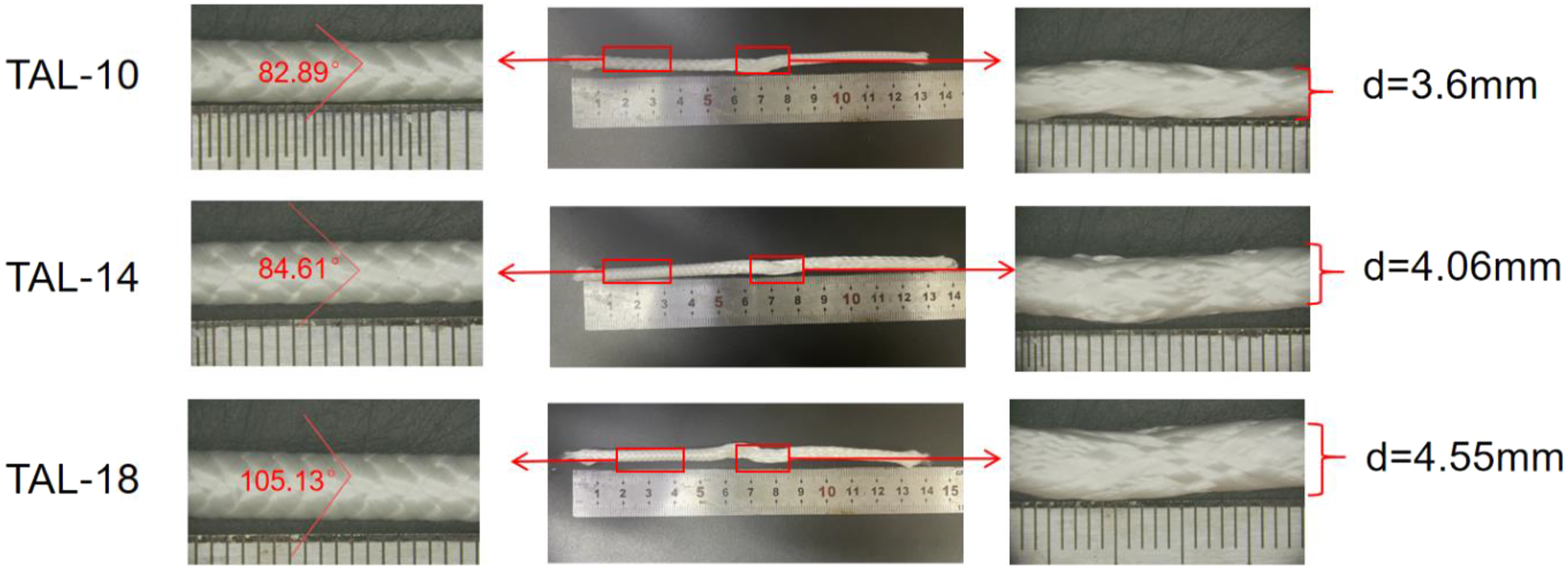
Tensile properties
Mismatch of mechanical properties causes most failures of synthetic grafts, so the mechanical properties of the scaffolds are crucial for ACL reconstruction, and sufficient tensile strength and appropriate stiffness are necessary to maintain the stability of the joint.32,33 The mechanical properties of the prepared cores and the three types of artificial ligaments are shown in Figure 3. As seen in Figure 3(a), the behavior of the inner core during external stretching can be divided into non-linear and linear regions. At the early stage of stretching, the inner core increases in elongation and shrinks in cross-section under tensile force. At the same time, the fibers in its outer layer break, this process exhibits non-linear characteristics. As the stretching proceeds, the inner fibers bear the main tensile force due to the massive breakage of the outer fibers. At this point, the inner core exhibits linear characteristics. With the increase in the number of cores, the breaking strength of the ligaments gradually increases, the strain gradually decreases, and the elongation gradually decreases. (a) Average stress-strain curves of single cores. (b) Average stress-strain curves of TAL-10, TAL-14 and TAL-18. (c) Tensile testing graph. (d) Comparison of the strength between the human ligament, TAL-10, TAL-14 and TAL-18. (e) Comparison of the stress between the human ligament, TAL-10, TAL-14 and TAL-18. (f) Comparison of the strain between the human ligament, TAL-10, TAL-14 and TAL-18.
Average, standard deviation and coefficient of variance of strength, stress and strain of TAL-10, TAL-14 and TAL-18.

Elastic recovery properties
Failure of ligament reconstruction is often due to a lack of elasticity of the prosthesis.
37
The role of artificial ligaments is to maintain the stability of the knee joint, which requires ligament material with an excellent elastic recovery rate.
38
So that after elongation due to knee flexion, the ligament graft can return to its original length instead of elongating. Ligament grafts with poor elastic recovery can lead to knee instability after irretrievable elongation, which can interfere with daily motion.
39
Figure 4(a) and (b) show cyclic stretching of the artificial ligaments and their electron micrographs after 10 cycles of stretching. Comparing the electron micrographs after cyclic stretching with those obtained without stretching, it can be seen that the knitting angle of the ligaments did not change much, which demonstrated that the ligaments had good elastic recovery. (a) Photos of cyclic stretching. (b) Electron microscopy of TAL-10, TAL-14 and TAL-18 after 10 stretching cycles. (c) Single loading-unloading cycle curve of TAL-10, TAL-14 and TAL-18 after 10 stretching cycles. (d) Comparison of the elastic recovery between TAL-10, TAL-14 and TAL-18.
Figure 4(c) shows the single loading-unloading cycle curves for TAL-10, TAL-14 and TAL-18, and the elastic recovery rates of the ligaments are shown in Figure 4(d) as 84.17%, 76.56% and 73.44%, respectively. Studies have shown40–42 that the elastic recovery rate of braided artificial ligaments close to the human ACL strain (48.24 MPa) is 50% to 70%. The elastic recovery rates of the three types of artificial ligaments were higher than those described above, indicating that these artificial ligaments have excellent retraction and deformation capabilities, and can recover their original lengths quickly after physiological activities, thus maintaining the relative positions of the femur and tibia. The better elastic recovery of these artificial ligaments is due to their three-section structure with two tight ends and a loose center. The loose center allows the whole ligament to be cushioned when a force is applied, reducing direct force’s effect on them. As the number of cores increases, the elastic recovery performance of artificial ligaments gradually decreases, probably because the core of the artificial ligament is subjected to the main forces, and these forces cause the core to undergo denaturation. Therefore, artificial ligaments with more cores produce more total deformation under the same stress, which decreases the elastic recovery performance of artificial ligaments.
Cyclic tensile properties
Ligaments are flexible and stiff tissues around joints to support body movements.
42
Current research suggests that the length of time that artificial ligaments bear primary mechanical support is about 30 weeks. Thus, artificial ligaments implanted in the human body must withstand cyclic loading and allow the knee joint to move within a specific range without injury. Figure 5(a) shows the strength-displacement graphs of the first cycle of TAL-10, TAL-14 and TAL-18, which show that the curves of the three ligaments are similar in the first cycle but different from those of the subsequent cycles, and the reason for this phenomenon may be because the internal stresses in the artificial ligaments are not eliminated. The internal stresses are eliminated after the first cycle. Figure 5(b) shows the strength-displacement graphs of the three ligaments for 100, 200, 300, 400 and 500 cycles, which shows that the curves of the three ligaments for five cycles are overlapped, and we can conclude that the change of the force with the displacement is almost unchanged after many cycles. Therefore, those artificial ligaments have good fatigue resistance performance. (a) 1st cycle of TAL-10, TAL-14 and TAL-18. (b) 100th, 200th, 300th, 400th and 500th cycles of TAL-10, TAL-14 and TAL-18. (c) Photos of tensile test after cycling. (d) Comparison of the stress between the artificial ligaments before and after cyclic stretching. (e) Comparison of the stress decay rate between TAL-10, TAL-14 and TAL-18.
Moreover, the excellent fatigue resistance of the three-section ligaments could be demonstrated by calculating the stress decay rate of the stretched artificial ligaments. After 500 stretching cycles, the tensile test results of the samples are shown in Figure 5(d) and (e). The stress decay rate of the three types of ligaments decreased with the increase in the number of cores, and the stress decay rates were 9.09%, 7.50%, and 6.31%. In previous studies, the stress decay rates of braided artificial ligaments with different structures and materials ranged from 2.89% to 10.21% after 500 stretching cycles. The stress decay rate of the artificial ligaments prepared in this study is within this range, and it can be concluded that the three-stage artificial ligaments have good fatigue resistance. It can be seen that as the number of cores increases, the cyclic stretching has less of an effect on the tensile properties of the samples. This may be because when stretching artificial ligaments under the same force, as the number of cores increases, the force equally divided by each core gradually decreases, and in the process of cyclic stretching 500 times, the total force received by a single core is less than that of the core of artificial ligaments with a small number of cores. Thus, TAL-18 has the lowest rate of breaking strength attenuation.
Conclusion
In summary, three types of three-section artificial ligaments were designed and prepared with different numbers of cores, and the effects of the number of cores were investigated on the breaking strength, elastic recovery, and tensile cycling of the artificial ligaments in this study. With the increase in the number of cores, the fracture strength of the artificial ligaments increased gradually, and the fracture stress, tensile rate, elastic recovery force and stress decay rate decreased gradually, but its indexes compare favorably with those of the general braided artificial ligament. Overall, the three-section artificial ligament has a high breaking strength, excellent elastic recovery and fatigue resistance. In this study, only the mechanical properties of the three-stage artificial ligament were investigated. So in future research, further exploration of artificial ligaments can be conducted. In short, the three-section artificial ligament shows excellent potential for application and may serve as an alternative to conventional ACL reconstruction techniques.
Footnotes
Declaration of conflicting interests
The author(s) declared no potential conflicts of interest with respect to the research, authorship, and/or publication of this article.
Funding
The author(s) disclosed receipt of the following financial support for the research, authorship, and/or publication of this article: This work was supported by the National Science Funds of China (52373058, 11972172), the Postgraduate Research & Practice Innovation Program of Jiangsu Province (KYCX23_2475).
