




Abstract
Due to the numerous and growing programs and applications of braid structures, understanding and predicting the mechanical behaviors of these structures is essential for engineers. In this paper, 12 tubular biaxial hybrid braids with different combinations and braiding angles were produced. They are made of two different yarns that one of them is a high-performance yarn and the other is an ordinary yarn. The tensile modulus as a mechanical property of a braided structure was compared in the different braiding angles and hybridization under the uniaxial tensile test. In addition to the experimental and statistical study presented in this research, a theoretical equation was also proposed to predict the tensile modulus of biaxial hybrid braided structures. The theoretical and experimental values are close. Also, statistical analysis of the proposed model showed the same results as statistical analysis of experimental results. So, it seems that the modified equation can be valuable and helpful. Also, several peaks in the second part of the load-extension diagram of hybrid braid observed that by increasing the amount of yarn with higher tensile properties in the hybrid braid structure, the number of peaks decreases. This is due to the fundamental difference in the type of yarn used in the production of hybrid braids. It could be said that this research may be a good start for future research on braid structures as advanced engineering materials.
Introduction
In the late 20th century, the increasing requirement and application of materials with unique properties in industry, such as high-strength, high-modulus, and stiffness, led to the beginning of research on advanced engineering materials and high-performance structures. A biaxial braided structure is among the high-performance structures which can provide unique mechanical properties compared to other woven structures. Biaxial braided structure consists of two sets of yarns intertwined. 1 A biaxial braid is a braided structure formed by two yarn systems running in opposite directions. 2
A biaxial braid is one of the ideal and critical structures which is also used as reinforcement in composite materials with different cross-sectional shapes due to its high adaptation level, torsional stability, and damage resistance. 3 Therefore, there are some studies on the properties of braids and braided composites in different years. The study on braided structures was started by Branchweiler. He studied the tensile and structural properties of biaxial braids. The results showed that the ability to increase the length of a braid structure is at least 50% more than a normal yarn. Also, the force required to rupture a braid structure is four times more than a normal yarn. Moreover, it was showed that the braiding angle (θ) is a critical parameter that describes the geometry of a braided structure and determines its mechanical properties. 4 The braiding angle is the angle between the longitudinal direction of the braid and the deposited fibers. The acute angle measured from the axis of fabric or rope to a braiding yarn is called the braiding angle.2,4 The effect of this parameter on the tensile properties and some methods for predicting the braiding angle in different years were investigated.4–9 Omeroglu studied biaxial braids from polypropylene yarns. He stated that an increase in the braiding angle leads to a delay in the plastic deformation (proportional to the increase in angle), and following that a decrease in plastic elongation. 5 Rawal mathematically predicted the paths of yarns in a braided structure and its relation to the braiding angle. 6 Also, he proposed a simple model using tensile analysis which was based on braid geometry, braid kinematics, and monofilament properties. The results showed that under tensile load, geometric deformation occurred in the braided structure first. 7
An improvement in tensile strength of reinforcing fabrics in composites because of the yarns’ combination leads to the use of this technique, which is called hybridization, in braiding structures. 10 Hybrid braid structures, consisting of at least two different yarn types, are used when the desired mechanical behavior is not available from a single type of yarn in a braided structure.11,12 Today, hybrid braided structures are widely used as reinforcement in composite structures.13–15 In 2019, Wu et al. investigated the impact of carbon–aramid hybrid three-dimensional five-directional (3D5d) braided composites and found that the initial damage and its progress in these structures were significantly reduced. 15 In addition, if a hybrid braid structure is designed optimally, the use of hybrid braids can reduce costs and increase efficiency.16–18 It is obvious with an increase in the percentage of yarn with higher tensile properties in a hybrid braided structure, leads to an increase in the braid’s tensile strength.19,20
Tensile properties are one of the most important mechanical properties in describing materials and structures and the study of the tensile properties is one of the essential parts in the structure’s production. The investigation of the mechanical behavior of the braided structures and braided composite structures under tensile load was studied in different years.21–32 Saber Ben Abdessalem studied the tensile behavior of knotted and non-knotted braids produced by polyester yarns and found that breaking tensile load and elongation are decreased and increased, respectively. He also stated that this occurred due to an increase in braiding angle. Moreover, he stated that a knotted braid has a lower breaking tensile load and elongation than a non-knotted braid. 23 Ahmadi investigated the mechanical properties of GFRP braid-pultruded composite rods made from glass roving with different linear densities. He observed that braid-pultruded rods have a lower tensile modulus than unidirectional pultruded rods, and also an increase in braiding angle decreased the tensile modulus of rods. 24 Kalebek investigated the tensile performance of sutures made from polyester, silk, polypropylene, and polydioxanone. This study suggested that polyester and polypropylene sutures use for cardiovascular surgery and prosthesis because these sutures especially PP have enough high-strength and elongation. 29 Debbabi studied the effect of yarn count in a polyamide braid on mechanical properties. He used PA 6-6 (Polyamide 6-6) multifilament with different yarn counts (44, 88, and 110 dtex) and the 8, 12, and 16 HERZOG circular braiding machines to produce structures and found that the yarn count, and the number of carriers, are important parameters. 31 Czichos experimentally studied the influence that different machine settings on biaxial carbon braids. He stated that machine speeds and yarn tension effects braid’s properties. He also stated that the speed of the braiding process to produce a carbon braid should be low to reduce fiber damage. 32 Nevertheless, the tensile behavior of several hybrid braid structures were studied mainly in the composite state and related to composite rods.33–37 Pereira et al. investigated the influence of braiding angle and fiber’s type as core reinforcement on the tensile behavior of braided composite rods. They used polyester fibers to produce the biaxial braids at braiding angles of 10–27°, and E-glass, carbon, HT polyethylene, and sisal fibers as a core reinforcement. The braided structures were impregnated with vinyl ester resin to obtain the braided composite rods. The results of this study showed an increase in strain and bearing force by the structure from a braid angle of 10–24° and a decrease in these values from a braid angle of 24–27°. Therefore, there is an optimal braiding angle of about 24° that guarantee the desired properties of the researchers in this study. Moreover, carbon and sisal core braids showed the highest and lowest tensile properties, respectively. The reason for this is due to the properties of the fibers. In addition, the results of this study showed that the volume fraction of reinforcing fibers in the composite should not be less than 40% so that the reinforcement can show its effect. 33 Rana et al. investigated the mechanical behavior of hybrid braided composite rods made from the polyester braid and different combinations of carbon and glass fibers in the cores. The hybrid braided specimens were produced in three levels of combination the ratio of carbon fiber/glass fiber included 77/23, 53/47, and 0/100 percentage in the cores. The results showed that the specimen which was contained the highest amount of glass fiber showed good mechanical properties. This was due to the higher tensile strength of rupture in glass fiber than carbon fiber. 36 Afzali and Johari studied the effect of fiber type and their ratio on the tensile properties of 2D tubular braided composites. They produced 15 different samples with different combinations of three types of yarns (PET, PP, and PA). The experimental and statistical analysis results showed that the specimen contained 75% PA yarn, 12.5% PP yarn, and 12.5% PET yarn had the best performance among the hybrid braided composites. 37
The modulus is a criterion to describe the stiffness and rigidity of solid materials and shows the relationship between stress (force per unit area) and strain (relative deformation) of a substance. Therefore, it seems that this property is the most crucial parameter and describes the tensile behavior of a structure better than other tensile properties.2,38 But for complex structures such as yarn and braid, it is not a proper parameter and it is better to examine true stress which is defined as an applied load to linear density. According to the definition of modulus and linear density and how to calculate them, these two parameters can be considered equivalent. Therefore, the computational complexities relate to the geometry of a braid and its variations can be ignored during the tensile test.
In this current study, basalt and polyester yarns, which are completely different in terms of mechanical properties, are used to produce hybrid braids to evaluate the tensile performance of a hybrid braid structure. Therefore, the possibility of using a braided structure as an alternative in various applications (such as yarn and fabric) can be considered if higher properties are needed to reduce costs and increase applications' efficiency. Hence, this study aims to analyze the tensile modulus of the hybrid braided structure at different braiding angles and various yarn compositions. Twelve different tubular biaxial hybrid braided specimens were fabricated and their tensile behavior was monitored during the tensile test. Then, the tensile modulus (true stress) of these structures was examined by a statistical analysis of variance. In the next step, a model was modified based on the equations presented in various papers to predict the tensile modulus of the hybrid braid structures. The excellent fit of the analytical and experimental results showed the usefulness of the model. Therefore, the novelty of this research can be considered in the type of yarns used in the braid production, the type of biaxial braids produced, and the simplifications made to present the model. Therefore, not only the familiarity with the role of yarns used in the production of hybrid braids but also a good start for future research on hybrid braid structures are the applications of this work.
Experimental
Materials
In the present work, polyester and basalt yarns are used to produce the samples. These yarns have a polymer base. Therefore, the braids which are studied in this study can be related to polymeric materials.
To determine the most critical tensile property of these yarns, namely the tensile modulus, their maximum tensile load was specified on an Instron 5566. The measurement had carried on according to the ASTM D 578 and the ASTM D 2256.39,40 Not only the yarns but also the braid structures are complex structures. Therefore, The tensile modulus is the result of dividing the tensile force applied to the structure (yarn or braid) to the moment of rupture by the linear density of that structure with unit centinewton per Tex. This parameter can also be introduced as true stress.
7
The linear density of a braid or yarn in terms of tex is the structure’s mass in 1000 m and this value is calculated using equation (1).

Properties of the yarns used.

It should be noted that in this study, the tensile modulus is expressed in units of tensile load applied to the linear density of the structure known as the true stress. But for simplicity, the word modulus was used.
Fabrication of braided structures
The experimental plan.

As can be seen in Figure 1, the movement of all parts in this machine was provided by two motors. A motor moved the carriers, and the other caused take-up of the braided structure. Therefore, the ratio of velocities made by these two motors determined the braiding angle according to the location of the braiding point. All samples were produced at a constant braiding point by four different ratios of the take-up velocity to the carriers, namely, 11:10, 13:10, 15:10, and 17:10, to achieve four different braiding angles. (a) The thirty-two-carrier vertical braiding machine and (b) a closer look at braiding.
Characterizations of properties
There are different methods to calculate the braiding angle that are used according to the available facilities. The braiding angle in the current work was measured by an optical technique which is named image processing. The single high-resolution camera was installed on a microscope ophthalmic lens. Then images were taken from the specimen’s surface, similar to shown in Figure 2, and their information was saved into a file on a computer system that was connected to a microscope. Finally, the obtained data were analyzed by ImageJ software.
41
The braiding angle was measured in 10 different points on each of the samples, and the average of these points was calculated and shown in Table 3. The microscopic image of braid surface (magnification, 25x). The braiding angle of the samples.

According to a few researchers, image processing may not be a suitable tool for measuring braid angle. But there are some articles on calculating braid angles to image processing methods. On the other hand, the design of the used braiding machine was such that it was not possible to calculate the braiding angle in another way. Therefore, in this study, the image processing was used to determine the braiding angle.
As can be seen, a code was assigned to each of the braid samples to facilitate the samples' use. Letters H and A refer to combination and braiding angle, respectively. The number after the letter H included 1, 2, and 3 represented the combination of the fibers in the braid structure. Combination 1 included 28 carriers of polyester yarn and four carriers of basalt yarn. Combination 2 included 16 carriers of polyester yarn and 16 carriers of basalt yarn. Combination 3 included four carriers of polyester yarn and twenty-eight carriers of basalt yarn. The number after the letter A included 1, 2, 3, and 4 represented the braiding angle’s value, and it means 28°, 33°, 37°, and 40°, respectively. For example, the code H1A1 meant a braid specimen produced in combination number 1 and the value of braiding angle is 28°.
The tensile modulus measurement of the braided structures was carried out according to the ASTM D 6775-13 by SANTAM tensile tester with a capacity of 15 ton shown in Figure 3(a)
42
Also, how specimens were clamped to do the tensile test is according to Figure 3(b). (a) SANTAM tensile testing machine and (b) how a specimen is clamped in the jaws for a tensile test.
The appearance of this jaw and how a specimen cross it, had two advantages
43
: 1. Elimination of the human factor in controlling the intensity of pressure between the jaws. 2. Prevention sample frustration at the jaws.
As mentioned before, the basalt yarns and polyester yarns were used to make the braids. The combination of these yarns with different properties in the production of braid was a novelty of this work and the error rate should be reduced as much as possible. Therefore, to reduce the measurement error, each of the braid samples was tested five times instead of three.
All relaxed specimens were tested at 25 ± 2°C temperature and 65 ± 5% relative humidity. The test speed and the gauge length are 75 mm/min and 250 mm, respectively.
Finally, A statistical analysis at a 95% confidence level and a Post-Hoc test were performed using SPSS software. 44 In this way, not only the effect of the braiding angle and the hybridization on the tensile modulus of biaxial braided structures determined, but also it can be determined to what extent each of these factors will affected the tensile modulus.
Results and discussion
Experimental and statistical study of the braiding angle and hybridization
The effect of braiding angle and yarns combination parameters had studied as follows:
The calculating the tensile modulus of a braid is very complicated. In order to avoid computational complexity in this complex structure, the true stress was used (tensile load per centinewton applied to the linear density per tex) to investigate the tensile behavior of this structure.
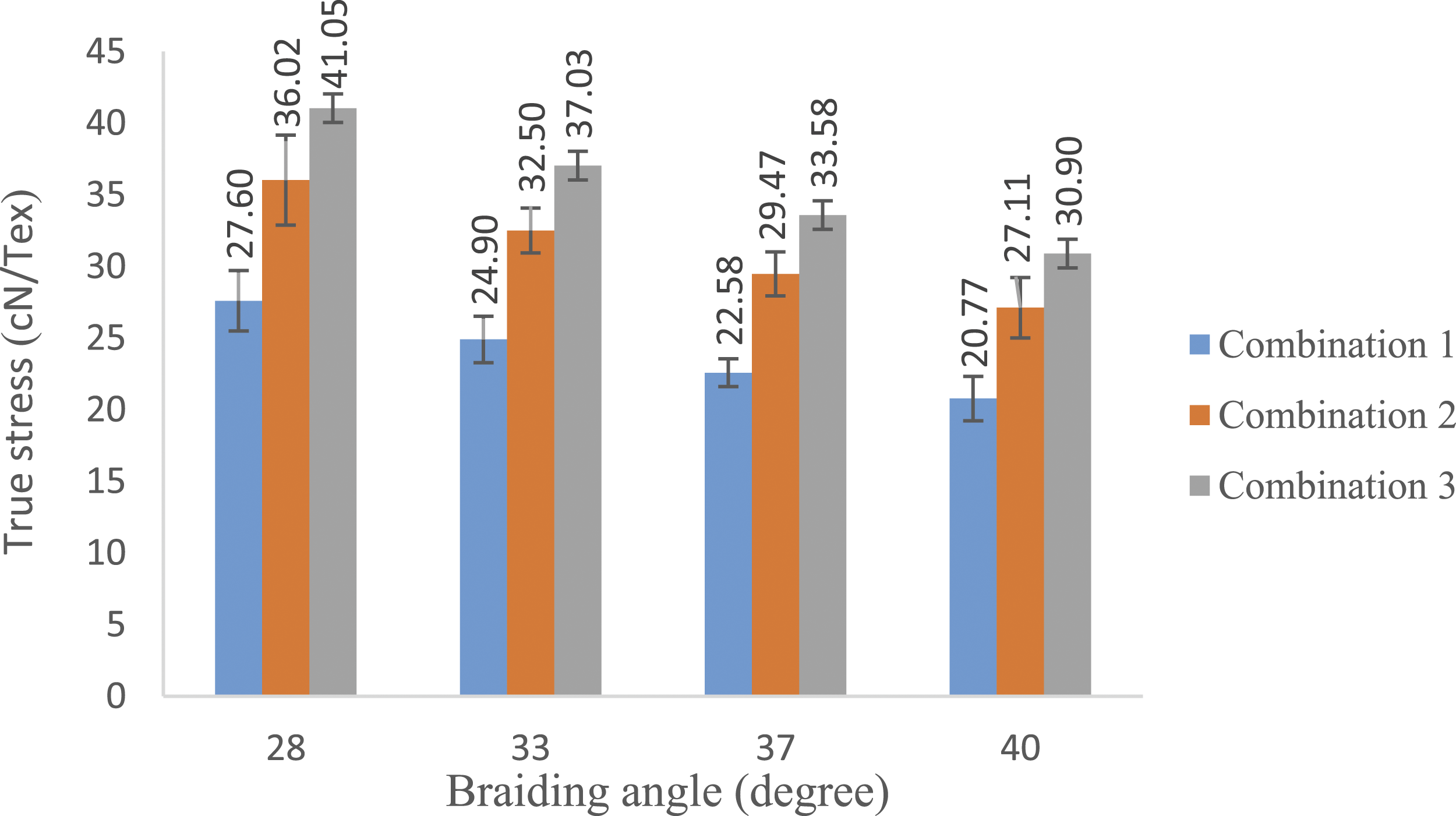
The tensile modulus of the braid samples.

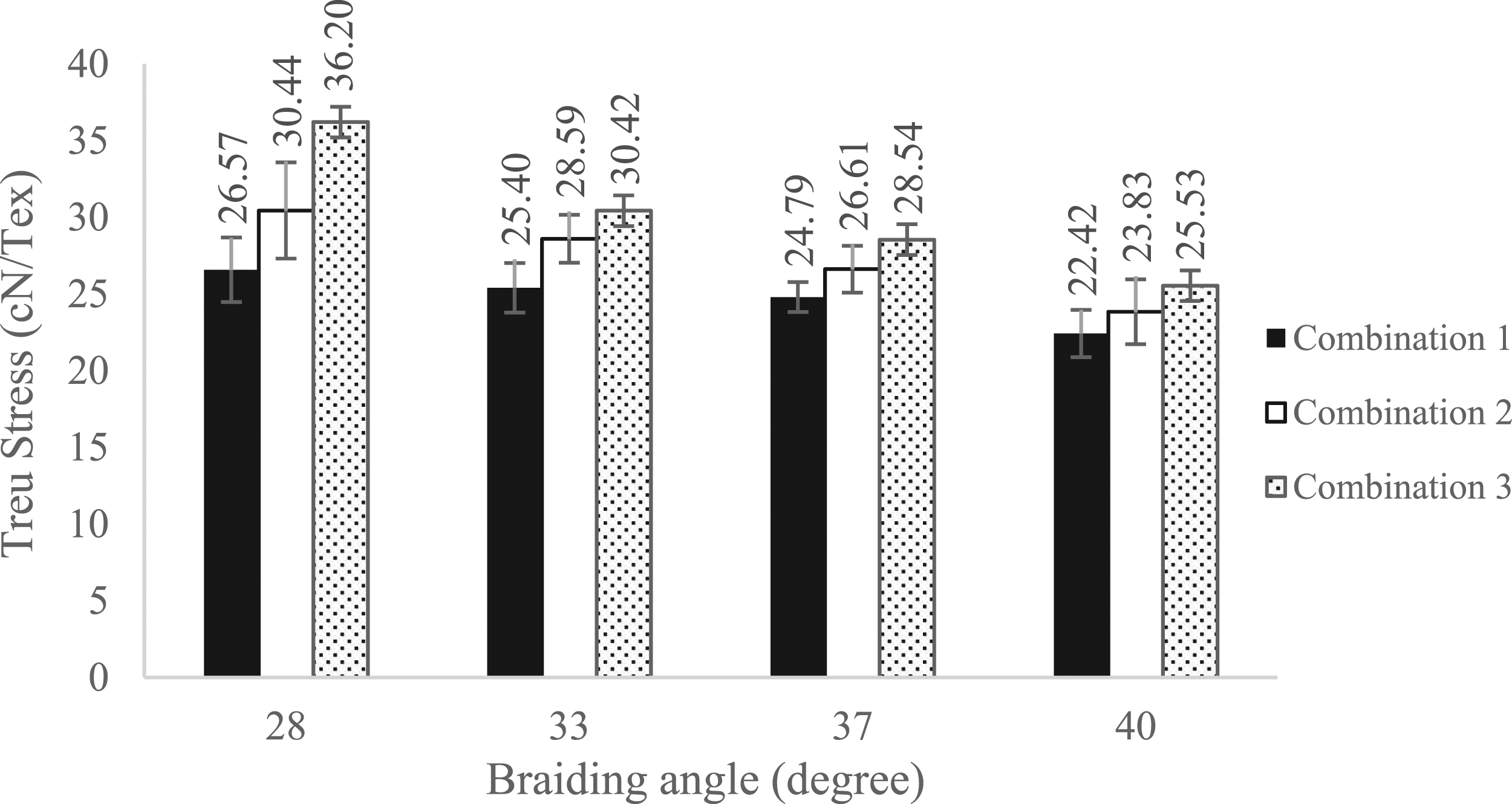
The effect of braiding angle and hybridization on the tensile Modulus (True stress).
Paying close attention to Figure 4 and Table 4 is clear that E-H3A1 and E-H1A4, which are bolded in Table 4, have the highest and the lowest experimental tensile modulus, respectively. Also, the effects of braiding angle and hybridization on the tensile modulus can be seen clearly in the results. As can be seen, by increase the braid angle, the braid modulus (true stress) is decreasing. Because with increasing braiding angle, the distance from the braiding axis increases and requires less tensile force for failure. This finding was in agreement with the other research.10,31,45–51 More investigation also showed that the increase in the number of basalt yarn in the hybrid braided structures increases the modulus. It is due to the more tensile properties of basalt yarn than polyester yarn. The tensile properties of the braid structure will increase as the number of yarns forming the braid structure with higher tensile properties in the hybrid braid structure increase. This finding had also confirmed by other researchers in this field.8,52 E-H1A1 has a lower number of basalt yarns than E-H3A4, while the braiding angle of E-H3A4 is higher than E-H1A1. The results showed that E-H1A1 had a higher tensile modulus than E-H3A4. So, the braid angle is the more important parameter than the composition or hybridization.
One-way analysis of variance table with 95% confidence.
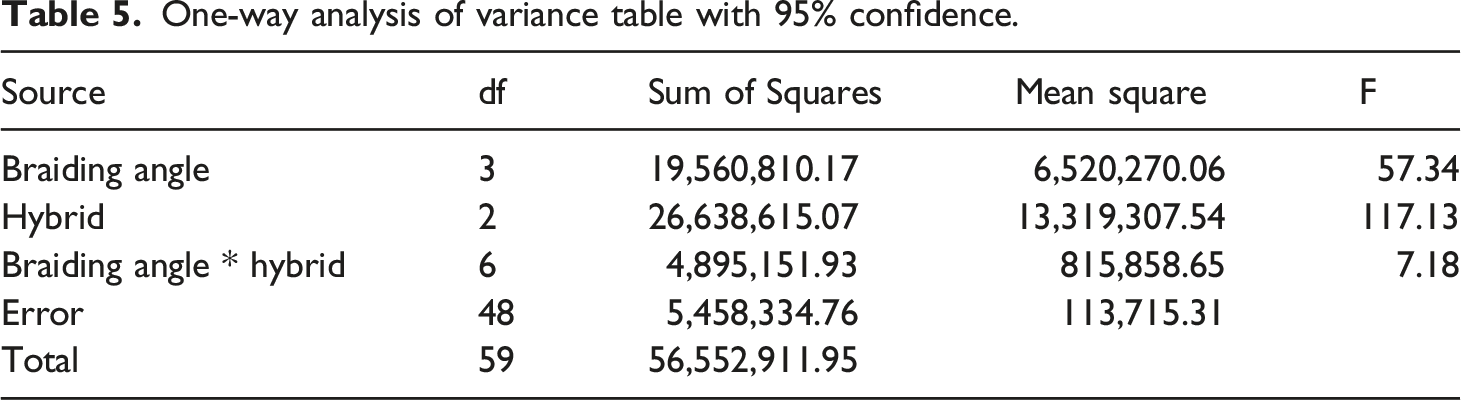
The results tabulated in Table 5 indicate that the braiding angle and the hybridization have a significant difference in the tensile modulus.
Grouping the tensile Modulus based on the braiding angle for the experimental tensile Modulus.

Grouping the tensile modulus based on the hybridization for the experimental tensile modulus.

To better understand the tensile behavior, the load-extension curve had investigated. According to studies conducted by various researchers, the load-extension diagram for a biaxial braid produced from one type of yarn is as follow30,38,52:
In the first section, which is nonlinear, a small and low amount increase in load leads to an increase in the extension until occurred jamming condition. The jamming condition is a state in which the yarns in a braided structure contact each other, and there is no more space for them to move in the braid structure. So, in this section that has a low slope, the braid undergoes the maximum geometrical deformation. Then the changes continue linearly. In this section, the yarns forming the braid show their role, and their mechanical properties determine the most tensile force.
In the hybrid braids, the amount of yarn composition seems to play a role in the second part of the diagram. Figure 5 shows the load-extension curve for each biaxial hybrid braid specimen. The load-extension diagram of samples. (a) Combination 1 (b) combination 2 (c) combination 3.
As can be seen in the curves shown in Figure 5, the slope of this curve is low at the beginning of the test and then it increases suddenly. This behavior was also observed and interpreted in a study conducted around 2016 on tubular braids.
38
Generally, the tensile behavior of a tubular biaxial hybrid braid structure is not significantly different from the tensile behavior of tubular braids which are made from one type of yarn. The images which are taken from the tensile test also show that the braid under tensile load first undergoes geometric deformation to reach the jamming state and then they are ruptured by further stretching. Figures 6 and 7(a) show two different braiding specimens with the same braiding angle and different hybrids at the moment before rupture. A hybrid braid specimen produced with 28 polyester yarns and 4 basalt yarns before rupture. A hybrid braid specimen produced with 4 polyester yarns and 28 basalt yarns. (a) Before rupture, (b) At the moment of rupture.
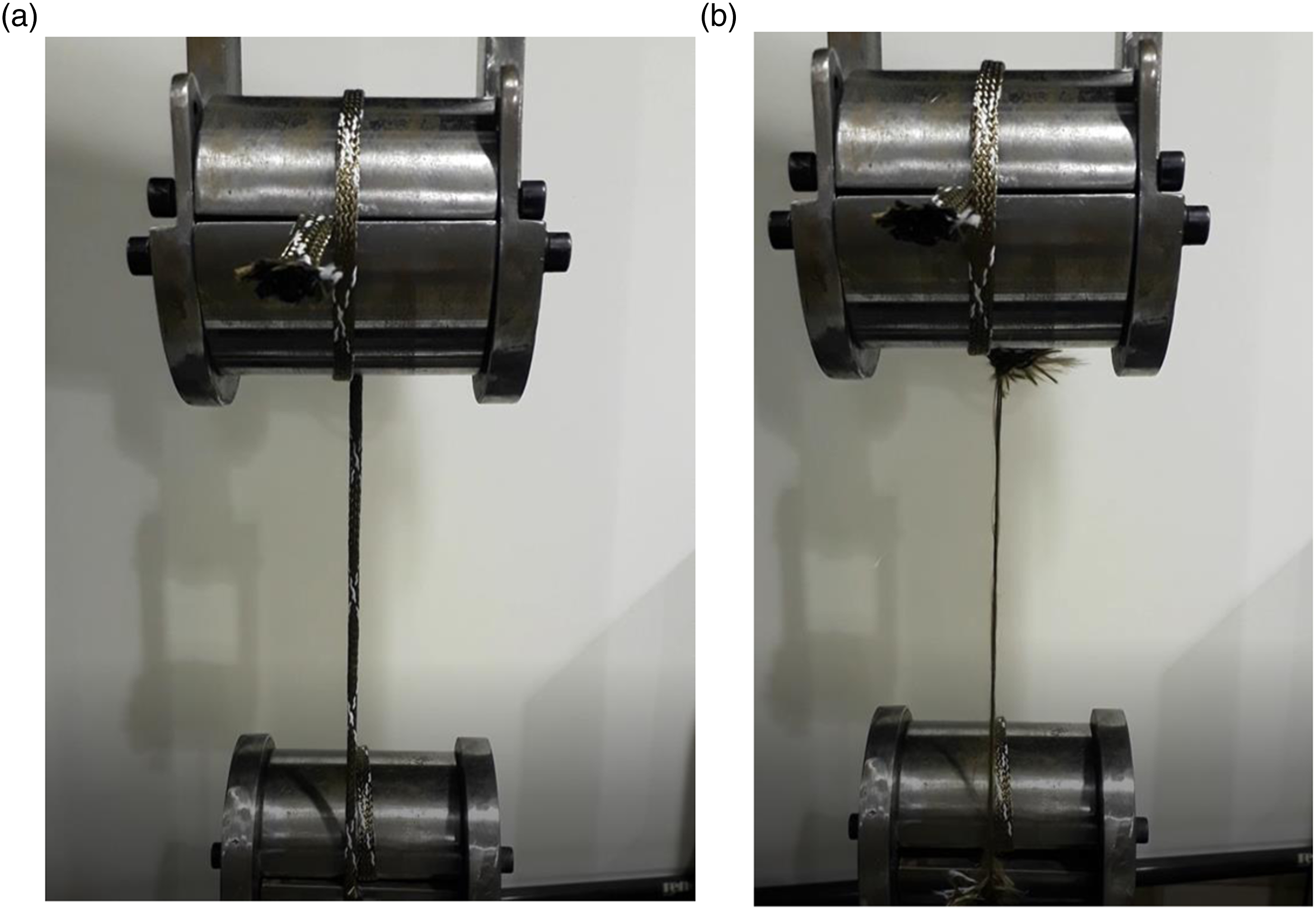
The load-extension diagrams of tubular hybrid braided structures show several peaks in the second part of the curve. This phenomenon is related to the hybrid structure. The reason is that by applying tensile load, some filaments of yarns failed, and a sharp drop in load occurred. But there are yarns with higher tensile properties, and they are still able to withstand the load. Therefore, the load increase occurs again. As shown in Figure 5, by increasing the amount of yarn with higher tensile properties in the hybrid braid structure, the number of peaks decreases. Consequently, the shape of the diagram resembles conventional diagrams. Figure 7(b) shows a specimen with 4 polyester yarns and 28 basalt yarns at the ruptured moment. As can be seen, if the amount of basalt yarn in the hybrid structure is high, the structure does not necessarily split in two pieces.
Moreover, As shown in Figure 5, The maximum tensile load that a hybrid braid can withstand before rupture increases and decreases with increasing the amount of yarn with higher tensile properties and increasing braiding angle in the hybrid braid structure, respectively.
The prediction of the tensile modulus for the biaxial hybrid braids
Many models proposed to predict the mechanical behavior of braided composites. While published articles on predicting the mechanical behavior of braids seem to be limited.8,30,53 One of these articles is the Boris study, which provides an analytical model for predicting the tensile modulus of triaxial braided reinforcements. Changes in a braided structure are huge and great before failure occurs, and the braiding angle changes during the tensile test. Therefore, to predict the tensile modulus of the biaxial hybrid braid structures, equation (2) provided by Boris is used, which is already shown own efficiency to predict the tensile modulus of triaxial braid structures
30

Equation (2) modified with the following points and assumptions: 1. According to the definition of composite, all existing rules in the composite field applied to hybrid braided structures. 2. There are two different types of bias yarns 3. Lack of axial yarns in the structure 4. Each of the bias yarns has a specific tensile Modulus 5. The braiding angle in all hybrid braid structures equal to α 6. Tex is equal to the weight in grams of one km of yarn. 7. The unit of the modulus is in centinewton per tex.
Considering Hypotheses 2 to 5, equation (2) will be writing as follows
E1 is the tensile modulus of the first bias yarn and E2 is the tensile modulus of the second bias yarn in a hybrid braided structure. N1 and N2 also refer to the first and second type yarns, respectively.
Generally, the word composite refers to a structure consisting of two or more distinct and recognizable parts. Therefore, the hybrid braids which were produced in the current work can be considered as composite structures, and to determine the amount of each type of yarn in the hybrid braided structure can be used to the concept of volume fraction. Therefore, according to Hypothesis 1, can be written
54

V1 and V2 are the volume fraction of the first and second components of the composite, respectively. This equation is known as one of the most practical equations in the role of mixture for composite. On the other hand, the amount of each type of yarn in the hybrid braided structure depends on the number of carriers on the braiding machine and the braiding angle during produce. Therefore, equations (3) and (4) do not contradict each other.
Then, according to the Classical Lamination Theory, hypotheses 6 and 7, a coefficient of the linear density in the braid structures is used to modify the equation
Tex1 is the linear density of the first type of yarn, Tex2 is the linear density of the second type of yarn, and Texbraid is the linear density of the biaxial hybrid braid structure that it is obtained by measuring the weight and length of the braid, and calculating through equation (1) before the tensile test. All of the linear densities are in terms of tex.
Equation (2) is presented for the triaxial braid structures with a low braiding angle (less than 20°). On the other hand, many studies are shown that the properties of the braids are related to the power of 2 cosine braid angle. So instead of number 4 in equation (5), number 2 is replaced. Also, the experimental results showed that it is better to introduce equation (6) as a modified equation. Because there is a much better agreement between the experimental results and the theoretical results obtained from it
The tensile modulus of the samples by using equation (6).
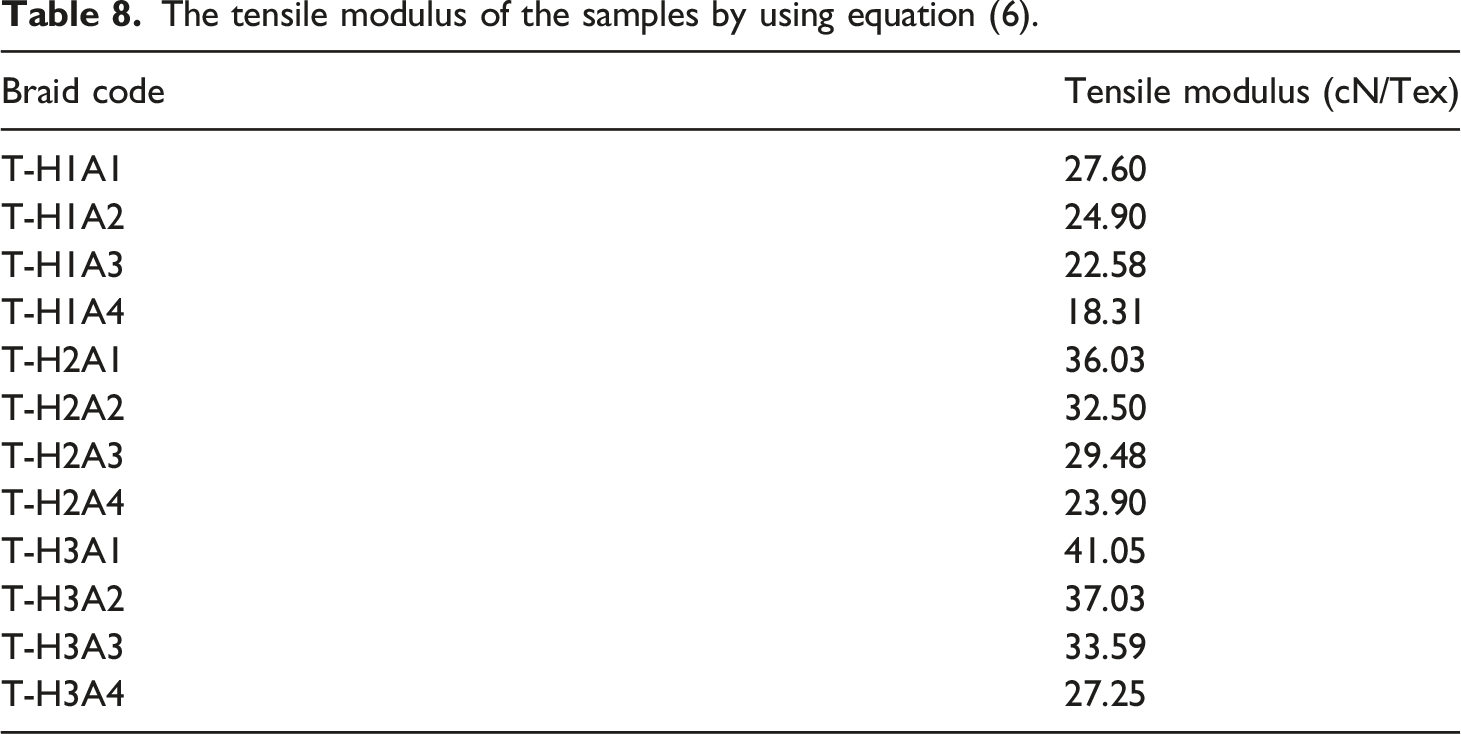
The theoretical average tensile Modulus (True Stress) of hybrid braided structures.
A close investigation of the results shown in Table 4 and Table 8 indicates that the braid tensile modulus’ values calculated by equation (6) are in good agreement with experimental values.
One-way analysis of variance table with 95% confidence level for the theoretical tensile modulus.

Grouping the tensile modulus based on the braiding angle for the theoretical tensile modulus.

Grouping the tensile modulus based on the hybridization for the theoretical tensile modulus.

The statistical analysis for the experimental and the analytical model is the same (Tables 5–7 and 9–11). Moreover, the theoretical results were in good agreement with experimental results. It means that the proposed model has been successful. Also, the results showed that the braid tensile modulus values obtained from equation (6) are very close to the experimental values. Therefore, it seems that equation (6) provides an appropriate estimation from the tensile modulus of tubular biaxial hybrid braids.
Conclusions
In this work, the effect of braiding angle and hybridization on the tensile modulus (True Stress) of biaxial hybrid braids were investigated. Twelve exclusive biaxial hybrid braided structures product of yarn types (one high-overall performance and the opposite normal-overall performance) were produced and evaluated on this look. Figured out that the braiding angle and the hybridization play critical roles in tensile modulus (true stress). A lower withinside the braiding angle results in a growth in tensile modulus (true stress). An increase in the quantity of high-overall performance yarn in a hybrid braided structure, additionally, resulted in a growing tensile modulus. Since the high-overall performance yarns have a higher modulus than normal-overall performance yarns, the mentioned increase in the braid's tensile modulus is logical. In addition, according to the load-extension diagram, a hybrid braided structure could nevertheless resist even extra load with the lack of normal-overall performance yarns' filaments because of rupture in a tensile check till high-overall performance yarns were entirely ruptured. It was critical to say that there were numerous peaks in the second part of the load-extension diagram of the hybrid braid structure with the lowest amount of high-overall performance yarn. The number of peaks was relied upon the number of yarns' filament on which the tensile applied force. Therefore, the number of peaks was decreased with an increase in the quantity of high-overall performance yarn. An exciting finding was that the braiding angle was a more critical parameter than hybridization. In addition, a modified equation was introduced to predict the biaxial hybrid braided modulus made of two different yarns. The look at this theoretical method is entirely consistent with the experimental outcomes. Experimental and theoretical results were close, and this indicated the usefulness and effectiveness of this equation.
Footnotes
Declaration of conflicting interests
The author(s) declared no potential conflicts of interest with respect to the research, authorship, and/or publication of this article.
Funding
The author(s) received no financial support for the research, authorship, and/or publication of this article.
