




Abstract
Commercial facemasks have become a common tool during the COVID-19 pandemic. They are cheap, simple to use and some are capable of filtering out most particles in the air, protecting the user. These qualities are usually employed in relation to hurtful viruses or contaminants, but they could also be used to prevent the radioactive dose due to radon, which is the second leading cause of lung cancer worldwide. For that reason, the main goal of this study is to verify if facemasks could prevent radon decay products from entering the potential user’s lungs. Since these decay products are the main source of radioactive dose, several commercial facemasks were tested by exposing them to radon and then measuring the presence of radon daughters by gamma spectroscopy. Reusable facemasks made from materials such as cotton, polyester or neoprene appeared to be inefficient with only 40% filtering efficiency, Polypropylene woven masks being the only exception, with 80% efficiency. Surgical masks presented filtering efficiencies between 90 and 98%. FFP3 and FFP2 proved to be the most reliable, almost completely filtering out radon daughters with filtering efficiencies up to 98%. Results prove that the use of FFP3 and FFP2 facemasks could be a useful tool to reduce the radioactive dose due to radon in places where other techniques cannot be used or are not advisable.
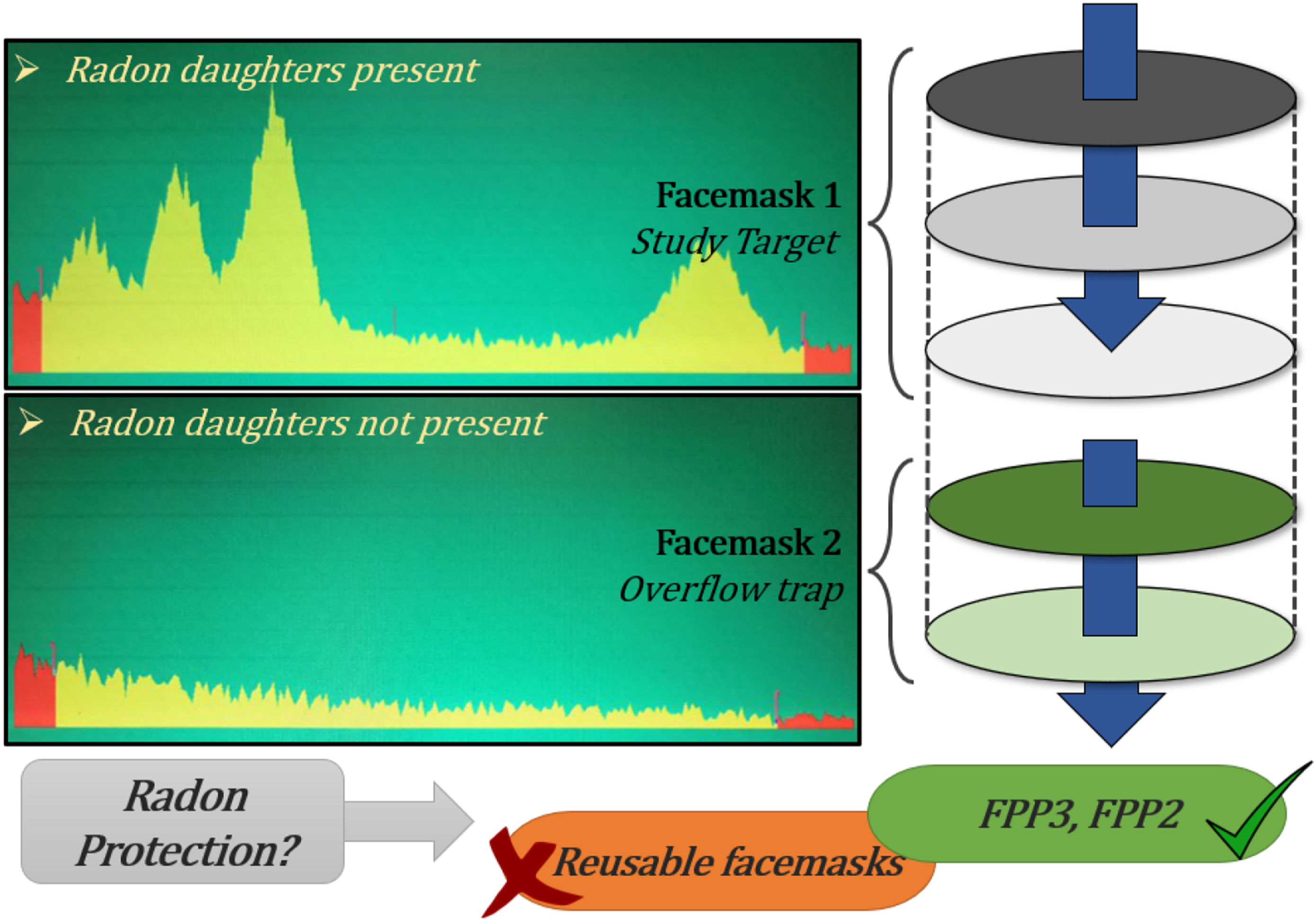
Highlights
• Commercial facemasks were tested for filtering out radon daughters. • FFP2 and FFP3 were 98% effective in removing radon progeny. • Surgical-type facemasks were 90% to 98 % effective. • Polypropylene woven reusable facial mask had 80% filtering efficiency. • Most reusable facemasks lack radon progeny filtering capabilities.
Background
It is well known that radon and its daughters are the second leading cause of lung cancer, just after smoking, being the largest natural source of radiation to the general public.1–6 Radon gas is generated in rocks containing radium, which is present naturally in small quantities in rocks and sediments, thus being ubiquitous in the air, especially over continental air masses.7–10 In the last decade, a large number of measurements of this gas have been carried out throughout the European Union, which have made it possible to establish a Radiation Atlas. 11 In addition, the 2013 European Directive established reference levels not only for the general public but also for jobs. 12
Once in the air, radon decays into radioactive isotopes of heavy metals like polonium, bismuth and lead. Since radon is a noble gas it has limited interaction with the lungs while breathing, being mostly exhaled back to ambient air. 13 However, radon daughters may be deposited inside the lungs. Due to the small half-life of the immediate isotopes in the radon progeny chain, between the 164 µs of 214Po to the 27 min of 214Pb, the radon daughters deposited on the respiratory system cannot be purged by the clearance processes of the body and will deposit their decay energy within the human respiratory tract.14,15 For these reasons, the short-lived radon daughters are considered to be the main source of radiation dose from radon.9,16–19
Within the first second of being formed, radon progeny interacts with trace gases and air vapors and either becomes small clusters of particles of the order of nanometers (unattached fraction)5,20 or attach to existing aerosol particles in the air (attached fraction).7,21 The attached fraction present three distinct range sizes: nucleation mode, formed by sizes from 10 to 100 nm; accumulation mode from 100 to 450 nm; and coarse mode for particles larger than 1 µm.5,22 Within the attached fraction, the most significant dose risk is due to radon progeny adhered to the accumulation mode.23,24 Previous studies have shown that the unattached fraction is responsible for approximately 10 % of the total activity of radon progeny in the air, however, it might be responsible for a significant part of the dose of radon and its daughters thanks to its smaller size.16,22,25
This implies that, in order to reduce the dose due to radon, it would be more effective to reduce the concentration of radon daughters than the radon concentration itself. Some studies have shown that filtration of aerosols in the air with air cleaners or HEPA filters are viable options.26,27 In most cases a filtering device implies pumps and complex machinery, but the recent COVID-19 pandemic has extended the usage of facemasks as a passive filtration device. Because the virus size is similar to the attached fraction magnitude, commercial facemasks could be a cost-effective solution to reduce the concentration of radon daughters that reach the lungs. A recent work showed that FFP2 and surgical facemasks can significantly reduce the dose of radon. 28 This is especially important in places where other alternatives are less suitable such as mines, basements, radon therapy spas or touristic caves.22,29,30
Firstly, this work aims to evaluate which facemasks are capable of filtering out radon daughters and henceforth reduce the radioactive dose due to its presence. A complementary objective of this work is to propose a methodology based on gamma spectroscopy of radon daughters. Secondly, it is important to identify the materials that are most effective, especially in relation to reusable facemasks, as their reusable nature would represent a significant improvement for workers in areas with high levels of radon, where regulations to reduce its concentration cannot be implemented effectively. To achieve this, the Methods section will describe the measurement process, the rationale behind the facemask’s measurement setup and an inventory of the studied facemasks. The results will show the main outcomes of the study, identifying the types of commercial facemasks that have been found to reduce the radon daughter’s presence.
Methods
Methodology description
To achieve the goals of the study it was necessary to verify if radon daughters were able to pass through any of the aforementioned facemasks. This would mean that radon progeny would be able to reach the respiratory tract of the potential user. Taking this into account, the rationale behind the methodology is straightforward: radon-rich air was forced through two facemasks at a constant flow, hence exposing them to radon-rich air, with the particularity that the air was forced to go through one of the facemasks before being able to reach the other. The facemask that the radon-rich air reached first was called the ‘primary facemask’ and the second facemask was consequently named ‘secondary facemask’ (Figure 1). In general, every facemask is made out of different layers, which were also studied independently. Idealized scheme of the placement of the primary and secondary facemaks during the samplings.
With this setup, if the primary facemask was effective in filtering out radon progeny, all the radioactivity due to the radon daughters would be contained in the first facemask while the secondary facemask would not show any signs of radon daughters’ radioactivity. On the contrary, if the primary facemask was not able to effectively filter out radon daughters, the secondary facemask would show radioactivity from radon progeny, therefore concluding that its unfortunate effects would also reach its potential user.
The primary facemask was the actual focus of the test, while the secondary facemask’s only role was to catch and trap any excess radon progeny not caught by the primary mask. This secondary facemask effectively worked as a proxy to estimate the quantity of radon daughters that would enter the lungs if the user had worn any of the facemask tested during this study.
To actually measure the exposure of any of the facemasks to radon progeny, the radioactivity present in them was measured using gamma spectroscopy. The specifics of the gamma measurement process will be detailed in the measurement process section. The key point introduced by this methodology is to study the relative measurements provided by gamma spectroscopy instead of the gross measurements. This means that every measurement was then divided by what was obtained on the first layer of the primary facemask. Hence, the first layer will always have a value of 1, while the subsequent layers will have values above 1 if their radioactivity was higher than the first layer, or below 1 if their radioactivity was less that the first layer.
This type of analysis simplifies the measurement process and allows to study the performance of any facemask even if the conditions changed slightly. Since any change in environmental conditions would affect all facemasks at the same time, but not the relative measurements between them, this setup would make the results more robust. It also provides an easy way to calculate the efficiency of the facemask as a quotient of what reached the secondary facemask and what stayed within the primary facemask.
Measurement process
Summary of the characteristics of non reusable facemasks.

aBoth Surgical facemasks were type IIR.
bNot disclosed by manufacturer.
Summary of the characteristics of reusable facemasks. PP refers to Polypropilene.

The measurements process started by cutting a circular section of the facemask that would be tested, i.e., the primary facemask. Each circular section was cut using a template of approximately 6 cm in diameter. The radioactive background of the sample was then measured by a NaI gamma spectroscopy detector. Afterwards the sample was placed in a filter holder and air was forced through it using a pump with a calibrated flow of 10 L/min for 1 h (Figure 2). Pump and filter used during the experiment.
The filtering stage was done in a basement room used for storage next to a 150 L container with soil collected from a nearby old uranium mine. 31 This setup was chosen for several reasons. Firstly, access to this room was very limited, preventing the amount of personnel that would be exposed to high radon concentrations. Secondly, previous experiences with smaller measurement volumes showed that the air pumped through the filter would return to the volume cleaned, altering the concentration of particles that radon progeny could attach to and, consequently, changing the radon progeny concentration. To prevent this, it was necessary to use a large room where the employed pumping rate could be considered negligible in comparison to the overall volume of air.
This setup was repeated between 3 and 5 times for each primary facemask. Different secondary facemasks were used to ensure that there was no cross contamination between samplings.
Gamma spectroscopy
To measure the presence of radon (222Rn) daughters in each layer of the facemasks a NaI gamma spectroscopy detector (Canberra, USA) was used. The activity of radon daughters was measured by two counting windows, the first one using the triplet of 214Pb (242, 295 and 352 keV) and the second one the 214Bi (609 keV). A spectrum example is shown in Figure 3. Example of a measurement of a layer of a facemask with (a) presence of radon daughters and (b) absence of radon daughers.
For each combination of primary and secondary facemask, the background was measured at least five times and after the exposure to radon-rich air each layer of each facemask was measured again. As stated in the introduction, the immediate radon progeny in the decay chain have short half-lives, 27 min of the 214Pb being the longest of them. Because of this, it is necessary to take into account the amount of radon daughters that will decay during the measurement process. For this reason, the total counts of each layer was computed following the typical inverse decay equation:
It is important to note that equation (1) is an approximation. The actual decay behavior of the three radon daughters will follow a complicate behavior that would depend on the initial activity of each radioisotope in relation to the rest. Theoretically, the activity in the filter could be estimated by using the Batemans Equations, however, the concentrations of each specific radionuclide are hard to measure or predict due to its complex interaction with the particles in the air.
To account for this, the decay constant was measured experimentally by exposing a facemask to radon-rich air and measuring its natural decay using the same NaI detector. The experimental value of 
Results and discussion
Decay constant measurement
As stated in the measurement process section, due to the radioactive nature of radon daughters it is necessary to account for the loss of activity between the exposure to radon-rich air and the gamma measurement. Experimental decay after exposure was measured explicitly five times and its average was found to be Example of an experimental decay measurement.
Facemask measurements
Each facemask was measured at least 3 times to verify the consistency of the results. Counts for each layer were normalized by the number of counts on the first layer to account the stochastic variability due to the radioactive nature of radon daughters. This allowed to evaluate the relative capacity to filter out radon daughters across all measurements without the distortion that a higher or lower number of counts between different experiments would have. It also allowed to calculate the standard deviation using all the data for each facemask, providing a way to evaluate the accuracy of the measurements.
It is also important to note that layers whose were measurements compatible with the background before applying the decay correction were assigned a net count value of zero. The uncertainty of the gross counts, Relative counts with respect to the first layer for each filter and layer. Error bars are defined by the standard deviation (1σ).
Measurements show that facemask FFP3 and FFP2 are the most effective at filtering out radon daughters. The top and bottom layer of FPP3 captured most of the radon daughters, while the middle layer also filtered out around 15 % of the initial concentration. The two FFP2 facemasks showed that the first layer was the one that captured most of radon daughters. Even though FFP2-2 had some counts in the secondary facemask, it is statistically compatible with zero even with only 1σ.
On the other hand, surgical facemasks appear to depend more on the individual brand. While Surgical-1 did prevent radon daughters from reaching the last layers, Surgical-2 allowed around 30% of the original concentration to pass through. In any case, these types of facemasks would be less effective overall due to their lack of a tight seal around the mouth, which would hinder their usefulness to reduce the dose of radon into the lungs.
Lastly, the reusable facemasks’ (R-1 to R-4) capacity to filter out the radon daughters present in the air depended on the employed material. R-1 facemask, made from three layers of polypropylene, i.e., first woven, second blown and third woven again, was effective to an extent. The first two layers retained mostly the same amount of radon daughters, while the third layer only retained around 10% in relation to the two first. However, the secondary facemask presented some radioactivity, 42% in comparison to the first layer of the primary facemask, showing that some radon daughters were not filtered out by the reusable facemask.
In relation to the other reusable facemasks (R-2, R-3 and R-4), all showed more radon daughters activity in the secondary than in the primary facemask. This means that most of the radon progeny present in the air was not successfully filtered and would have reached the potential user. It seemed that R-2 facemask allowed more radon progeny to pass through, almost 160% more reached the secondary facemask when compared with the first layer of the primary mask. These numbers are lower for R-3 and R-4, being around 125%, but with higher uncertainties, especially in the case of R-4.
The measurements performed on the reusable facemasks seem to clearly point out the materials that could be used to filter out radon daughters effectively. The first and middle layer of R-1, made out of woven and blown PP, respectively, managed to filter out a significant portion of the particles. This is probably related to the size of their internal structure, which were made to follow the guidelines of the technical specifications UNE-EN14683:2019 and AC:2019 in relation to their filtration efficiency.
In the case of R-2, which is composed of two layers made out of polyester and cotton, the desired filtering effect is not achieved by any of the layers, whose surface structure does not seem to be small enough to prevent radon daughters from passing through. The single layer of R-3 and R-4, made out of polyester and neoprene, respectively, had the same issue. It is worth mentioning the lack of any technical specification for R-2 and R-3, which likely had an effect in the process employed to manufacture these masks. Furthermore, it seems the technical specification of R-4, CWA 17553:2020, was not enough to filter radon daughters.
Finally, an average filtration efficiency was calculated as the percentage of the radioactivity that reached the secondary facemask in comparison with the total counts in both the primary and secondary facemask. To clarify, a 100% efficiency means that all radioactivity was retained within the primary facemask and a 0% efficiency represent a case where all radioactivity was detected in the secondary facemask, with no radioactivity present in the primary. The results are shown in Figure 6. Average radon daughters filtration efficiency for each facemask. Error bars are defined by the standard deviation (1σ).
The average efficiencies confirm what was seen in more detail in Figure 4. FFP3 and FFP2 facemasks have the highest filtration efficiency overall, with all of them being above 97% and compatible with 100% within 1σ of the uncertainties. These results are similar to those obtained in other work where FFP2 masks proved to retain 98.77 ± 0.64% of the unattached fraction of radon progeny. 28
On the other hand, surgical facemasks have shown good filtration efficiency overall, but with significant differences in the two samples measured in our study. Surgical-1 presented a 98.9 ± 1.4% efficiency while Surgical-2 had 90.3 ± 2.9%. It would seem that the materials used in the first facemask, which were not disclosed by the manufacturer, worked better than the three layers of Spunbound, Meltblown and non-woven Spunbound present in the second surgical facemask. Our measurement results are partly in agreement with the work performed by Hinrichs et al. (2023), 28 where the surgical facemask showed a 98.36 ± 0.69% efficiency.
Regarding, the reusable facemasks, there is a significant different between R-1 and R-2, R-3 and R-4. R-1 performs more closely to the FFP3, FFP2 and surgical facemasks, with an average filtration efficiency of 82.24 ± 0.32%. This facemask is made up of three layers made with polypropylene, showing that this material is a good candidate to make reusable facemask that protects the user from radon progeny.
On the contrary, the polyester facemasks, R-2 and R-3, and the neoprene facemask, R-4, have lower average efficiencies, only being able to filter out, 43.53 ± 0.20%, 42.8 ± 3.3% and 44.9 ± 7.3% of the radon progeny, respectively. This indicates that these facemasks are not the best choice to protect the user from radon progeny, even though they do retain a significant portion (∼40%) of radon daughters present in the air.
This study is not without limitations. For consistency, the secondary facemask was always a type FFP2 which, according to the norms EN 149:2001 and A1:2009 ensure a 95% filtration for particles above 300 nm. 33 This means that no conclusions can be drawn for the unattached particle and those modes from the attached fraction up to 300 nm. Additionally, it is important to note that the facemask fit to the filter holder was airtight during our experiments, which might not be the case in a real scenario.
Conclusions
In this study a range of commercial facemasks were tested to evaluate their capacity to filter out radon daughters. This is relevant information for those cases where radon mitigation techniques are not available or might not be sufficient, such as mines, touristic caves or radon therapy spas. Results showed that FFP3 and FFP2 are capable of preventing around 98 % of radon daughters from reaching the lungs, being an effective tool to reduce the radioactive dose of radon in these cases. Surgical masks show similar percentages, 98 and 90%. These results are consistent with the only other work that studied the radon progeny filtration capacity of facial masks. 28
Additionally, reusable facemasks made with a range of materials were also studied in this work. These measurements showed that facial masks made out of polypropylene were able to filter out about 82% of the radon progeny, which is close to those values of FFP3, FFP2 and surgical facemasks. Masks did not perform as well when made out of polyester, cotton or neoprene, only being able to filter out around 40% of radon daughters. These results provide clear information about which materials to use and, to our understanding, have not been shown elsewhere.
This work confirms that the use of individual facemasks can provide important protection to the user, up to 98% in some cases, reducing the lungs exposure to radon progeny and, consequently, reducing the risk of lung cancer.
Footnotes
Acknowledgements
Authors want to acknowledge the support and materials provided by the pharmacies and other stores that donated the facemask for the study.
Authors’ contributions
LQ and CS developed the original concept. All authors participated in the design of the work. IG performed the measurements and the initial analysis of the data. IG and SC made the first draft of the paper. SC and IF calibrated and maintained the gamma spectroscopy detector used for the measurements. All authors participated in the interpretation of the results. All authors read and approved the final manuscript.
Declaration of conflicting interests
The author(s) declared no potential conflicts of interest with respect to the research, authorship, and/or publication of this article.
Funding
The author(s) disclosed receipt of the following financial support for the research, authorship, and/or publication of this article: This research was supported by the Spanish Ministry of Science, Innovation and Universities, by means of the ‘Plan de Recuperación, Transformación y Resiliencia’, funded by Next Generation European funds (NextGenerationEU) and managed by the University of Huelva through the Requalification of the Spanish University System for 2021–2023.
