




Abstract
This article is giving an introduction to JSET’s special section on mechanical models. It explains why mechanical models represent essential tools in sports engineering, defines their potential application fields and proposes a possible categorization. Further two short examples of mechanical models with corresponding literature and an overview of the manuscripts included in this special section are given.
The role of mechanical models for knowledge gain
One of the finest scientists in the field of (sports) biomechanics, Professor Herbert Hatze who died in 2002 much too young at the of age 65, was a mathematician. In his famous manuscript “Myocybernetic Control Models of Skeletal Muscle,” 1 he developed a mathematical description of human muscle contraction, building-up a well-reflected system of side-long equations, which not only described the biochemical process of bridge-building in the muscle cells, but also considered the specific anatomical structures of different muscle types. He was very familiar with mathematics and certainly convinced of its power to increase our knowledge and understanding of the real world. Therefore, it is hard to believe that in their research to understand the tennis stroke, he and his team developed, manufactured, and used a mechanical replicate of the human arm. This device is shown in Figure 1.
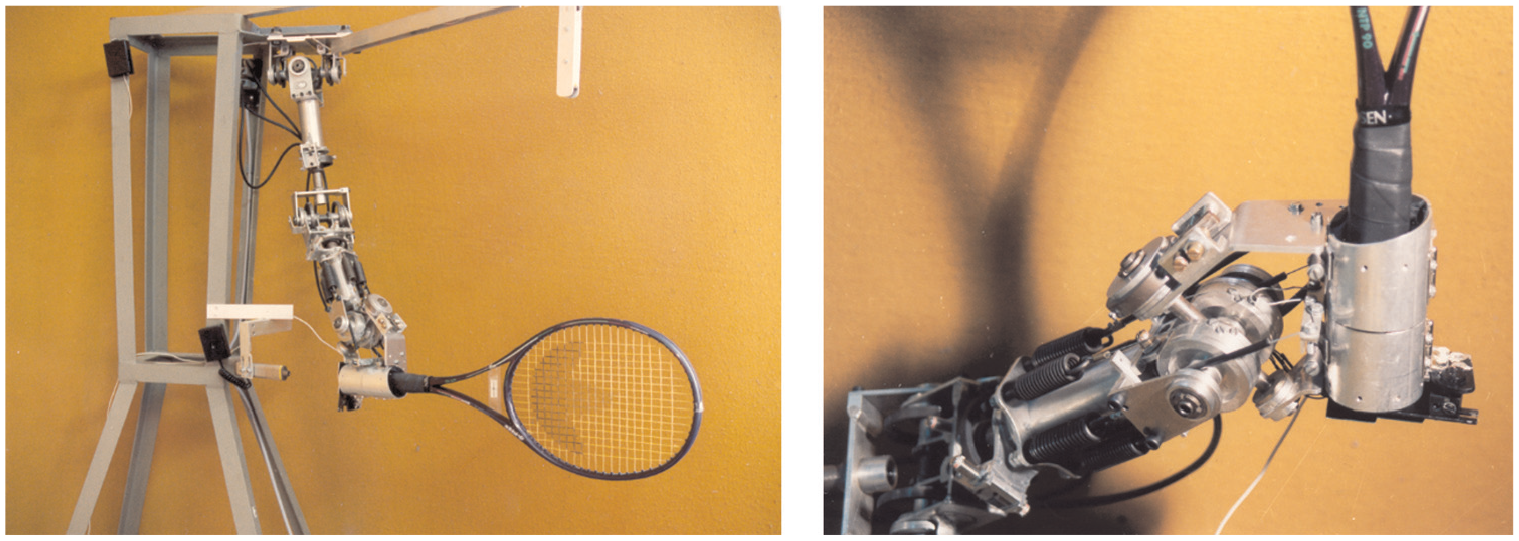
Mechanical model of the human arm and hand for testing tennis rackets.
Hatze called this artificial arm for testing tennis rackets “Manu-Simulator,” and I was lucky to talk to him in person, discussing the advantages of this device. For him, the major benefit was not only the possibility to standardize boundary conditions, but even more so, the option to systematically redefine the boundary conditions, both accurately and precisely. He dismissed counter arguments of limited external validity of his mechanical model and passionately criticized tennis racket tests, even with experienced tennis players, because of their inherent high variability and unidentified confounding variables raised by human material.
In his journey to identify the best approach, he finally used both mathematical and mechanical models, combining them with athlete experiments in the field and in the lab. As a result, he was able to derive valuable insight into the few milliseconds prior to and after ball impact, showing the relationship between grip strength, transferred vibration to the hand-arm-system, and oscillation-damping characteristics of tennis rackets.2,3
The motives for a special section on mechanical models
Despite the power of combining mathematical and mechanical models, this special section concentrates only on mechanical (physical) models. Why? One reason is that the application of mechanical models is so widespread. They are present in sport, exercise, and training science, as well as in the daily practice of many sports. The second motivation for focusing on mechanical models is the wide variety between simplicity and amazing complexity, raising the exciting question of how much complexity is needed and where simple models meet their limits. Lastly, a little bit of a secret reason is that mechanical/physical models for the application in sport is a wonderful playground for people who call themselves engineers. Designing and realizing these models bares enough challenge and requires all the knowledge we have learned in mechanics, thermodynamics, aerodynamics, material science, and product design. We no longer need to limit our engineering skills for designing transmissions, turbines or tooling machines. Instead, we are allowed to apply these models to one of the most passionate areas – the field of sports. Thus, developing mechanical models for the application in sport could be one major reason why we call ourselves “sports engineers.”
Categories of mechanical models
The importance of mechanical models in sports, sports engineering and sports injury prevention becomes more clear, when trying to categorize them based on their purpose and application. The following open list should be seen as a proposal for such kind of categorization – other structuring however might also be appropriate:
Mechanical models (MechM) for the validation of mathematical models (MathM) and vice versa,
MechM for development and testing of personal protection equipment (PPE) like helmets, wrist or ankle protectors, joint stabilizers, shoulder pads, shin-guards, etc.,
MechM for highly standardized product testing, including fatigue tests (sweating mannequins, biofidelic crash test dummies, equipment specific abrasion tester, kicking-leg, etc.),
MechM serving as training devices to build-up force, endurance, motor skills under most possible real-life conditions (i.e. ball throwing machines, sailing/skiing/kayaking simulator, high performance cycling or rowing ergometers, etc.),
MechM to improve the existing knowledge regarding the human’s musculoskeletal system (by using a lower leg surrogate with instrumented ligaments for instance), 4
MechM to better understand the principle mechanics of certain movements in sports (Figure 2),
MechM to replace missing limbs (prosthetic devices).
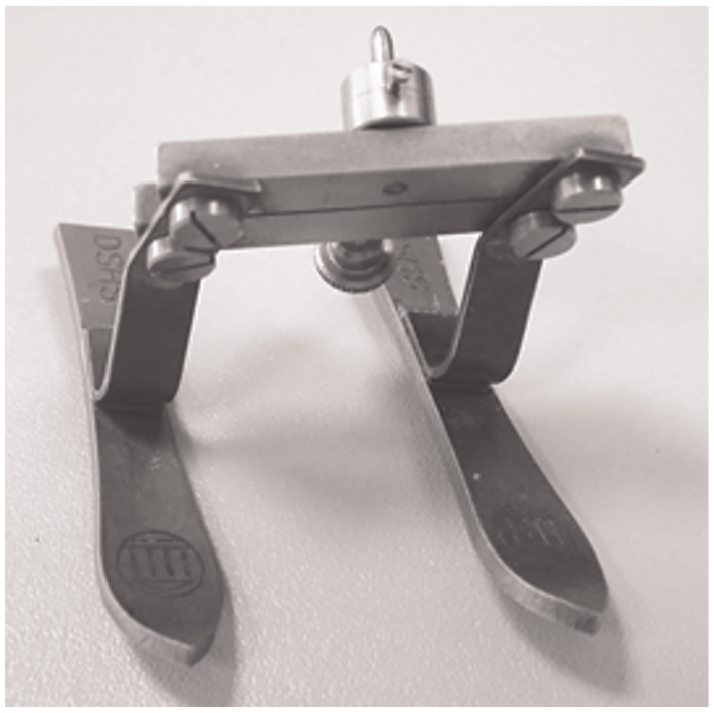
Passive mechanical model of a skier, able to “automatically” carve down an inclined plane. This model helped to explain skiing physics and how the shaped ski initiates and controls turns.
What is the scope of this special section?
The idea behind this special section is to focus on the methodological aspects in the development and use of MechM, intended to gain knowledge in the field of sports, sports science, and engineering. This objective goes further than just describing the design or function of a certain apparatus. Instead, we want to illustrate how researchers have solved the challenge of finding the best compromise between needed complexity and necessary simplification. By this, the reader should be able to make better decisions (e.g. when having to select the appropriate material to best replicate certain human tissue behavior) or identify the advantages and disadvantages of MechM by understanding their major limitations. Finally, they should be aware of the challenges to conduct an acceptable validation process, which sometimes is impossible to achieve fully.
Two examples
MechM to replace missing limbs (prosthetic devices)
The major challenge in the development of prosthetic devices is to achieve minimal asymmetries between the artificial and existing limb with respect to motion pattern and resulting bone contact forces in the joint(s). Needless to say, this task requires biomechanical methods, especially in sports when human motion is based on high energy transfer. The high level of energy transmission is a demanding aspect for sports engineers who are developing prosthetic devices for Paralympic athletes. Moreover, they must achieve the necessary structural durability and system reliability for those typically lightweight structures. Proper service strength tests require knowing both the typical loading pattern the product will experience in service, as well as the loading cycles it has to withstand throughout its lifespan. Therefore, on the systematic approach to find the optimal design, fatigue testing is essential. Thus, valid loading apparatuses are needed. For those who are working in this challenging field, the publication of Smith and Gordon 5 is worth reading.
MechM for testing safety gear
Two major difficulties are connected with personal protection equipment (PPE) used in sport, as well as with safety gear for other fields like work and production). First, for ethical reasons, such gear cannot be developed and tested with living subjects, at least not under those conditions for which they are intended. Second, it is essential to establish test procedures for PPE, which allow both manufacturers and test houses to quantify, classify and certify the efficacy of PPE before these products are certified to enter the market. One major reason for the latter are legal issues, such as the Product Liability Law in Europe or the U.S. Consumer Product Safety Act.
The process of testing and approving PPE and safety gear is a long, tedious process that requires (i) describing a safety problem based on profound epidemiology, then to (ii) formulating it as a concrete research problem, (iii) deriving adequate working hypothesis, (iv) observing and conducting experiments (if possible), establishing (biomechanical) models and executing simulations to verify or falsify them against the existing theories, (v) designing and realizing technical solutions which are based on the acquired knowledge, and finally (vi) publishing all these steps and derived solutions in acknowledged scientific journals. All these steps may take years to complete.
A good example of a long-term development is the device for testing snowboard wrist protectors. Even though the basic biomechanics of wrist protection was known since the late 1990s,6–8 and epidemiology clearly confirmed the need for prevention measures,9,10 this standardizing process was initiated in 2013. It started with the publication of a white paper, 11 Greenwald et al.’s 12 summary on wrist biomechanics in snowboarding and an in-vivo study determining sub-threshold loading parameters. 13 From that point, it took 7 years until the corresponding standard 14 was finally published in 2020. On the way to its launch, modeling and simulation approaches15,16 and several versions of MechM17–19 were needed. This example also demonstrates the advantages of shared research and common international efforts to develop validated MechM.
Overview of papers included
We are fortunate to have a distinguished list of contributing authors, each an expert in a specific area of physical models.
Two papers address the challenging task of developing a valid representation of the human head, which is suitable for conducting realistic impact tests. These papers include Stone et al.’s Development of a representative headform for the assessment of potentially destructive head impacts and Gilchrist et al.’s Physical Properties of Biofidelic Headforms for Accurately Simulating Oblique Impacts.
Even though sport surfaces at first sight may not be considered a MechM, artificial turf definitely is. Replacing the natural grass, completely or to a certain extent, by some types of polymers while still having to provide similar mechanical properties as the original material is difficult. As players and clubs expect the perfect playing surface over longer periods of time, the contribution of Fleming et al. titled A New Model of Third Generation Artificial Turf Degradation, Maintenance Interventions and Benefits looks at the aspect of maintenance.
Coming from the playing surface to footwear, the work by Havenith et al. deals with the thermo-physics inside the shoe. Their contribution A thermal foot manikin as a tool for footwear evaluation and development will certainly be helpful to footwear developers to study and improve foot climate, and thus, reduce discomfort.
The study by Mocera et al. titled Nordic Walking Multibody analysis and experimental identification presents a methodology for the analysis of body motion during Nordic Walking by designing a numerical tool to replace human body behavior. This approach allows for studying several biomechanical aspects, including the kinematics of each body segment, while estimating the loads applied to joints for given tasks.
In the study by Love and Shannon titled A Comparison Study of Athletic Kinesio-tapes and Structural Cloth Tapes Applied to Address Biomechanical Injuries and Muscle Stabilization, the authors acknowledge the widespread use of tapes and wanted to assess distinctions between them from a material perspective. Their study focuses on measuring mechanical properties and modeling their mechanical response.
We hope this collection will motivate some of the readers to enter this exciting field of sports engineering. For those who are already working in this field, this Special Section hopefully delivers some valuable inspiration for ongoing work.
I want to thank Michael Caine for helping to guest edit this Special Section. I would also like to express my deepest thanks to all contributing authors and especially to all the involved reviewers. Special thanks to Susan Pryputniewicz and km. Ranjana for continuing to follow-up on manuscripts and James Sherwood, JSET Associate Editor, for allowing this Special Section to become a reality.
Footnotes
Declaration of conflicting interests
The author declared no potential conflicts of interest with respect to the research, authorship, and/or publication of this article.
Funding
The author received no financial support for the research, authorship, and/or publication of this article.
