




Abstract
To expand the application of C/C composites in the field of 5G satellite, this paper explores the influence of different preform structures on the mechanical properties, EMI shielding properties, and thermal conductivity of C/C composites. Three common 3D fabric preform structures with different weaving parameters are designed. The pore evolution process of different samples was analyzed by image recognition processing method and pore partition method. The findings indicate that the 3D Fine weave pierced structure leads to higher graphitization degree. 3D orthogonal woven structure results in a higher compression strength of up to 240 MPa. Furthermore, the molding method of 3D orthogonal woven structure exhibits superior EMI SE and thermal conductivity. The EMI shielding mode of C/C composites is the coexistence of absorption and reflection. And excellent texture and a high fiber volume fraction are beneficial to improve thermal conductivity. In conclusion, 3D orthogonal woven structure is more suitable for producing C/C composites with high strength, superior EMI shielding, and enhanced thermal conductivity compared to 3D Fine weave pierced structure. This study reveals a new control method of high-performance materials for 5G satellites.
Keywords
Introduction
Scientific exploration satellites are increasingly affected by electromagnetic pulses, especially when detecting low-energy laser particles or low-energy plasma satellites.1,2 An effective electromagnetic interference (EMI) shielding material requires a balanced combination of conductivity and magnetism, 3 while ensuring dimensional stability during long-term operation. Currently, commonly used EMI shielding materials include aluminum alloy, foam steel, nickel, and copper. 4 However, metals limit the need for light weight while improving the conductivity and thermal conductivity of composites. In the satellite manufacturing process, some researchers in the field of EMI have turned their attention to carbon fiber (CF) reinforced composite materials.5–7 An increasing number of metal materials are replaced by high-performance composites to reduce weight. 8 Resin-based CF composites have been utilized in shell of satellite electronic components,9,10 while still facing high temperature stability issues. A common approach to mitigate interface thermal resistance is the use of high thermal conductivity composites between the equipment and radiator.11–13 Compared to other CF composite materials, carbon/carbon(C/C) composites have the advantages of excellent dimensional stability, high thermal conductivity, and corrosion resistance.14–16 It is believed that C/C composites are trending towards becoming a structural integrated material with both high EMI shielding and high thermal conductivity for satellites.
At present, C/C composite materials have been widely used in multiple fields such as aerospace, automotive, medical devices, etc. C/C composites are crafted from carbon fiber preforms through a densification process and high-temperature heat treatment. 17 Consequently, the structures and properties of the composites can be manipulated by altering the preforms structures and process type. Currently, some scholars have tried to investigate the thermal conductivity of C/C composites at the process stage. Zhang et al. 18 densified one-dimensional C/C composites by the pure chemical vapor infiltration (CVI) process and CVI-polymer infiltration and pyrolysis (PIP) mixed process respectively, and analyzed the influence of matrix carbon on the thermal conductivity and electrical conductivity. Li and co-authors 19 prepared high thermal conductivity C/C composites by the 3CVI process and 3CVI-4PIP mixed process on 3D carbon fiber preforms. The effects of fiber and matrix carbon on the thermal conductivity and mechanical properties of the materials were studied. Yuan et al. 20 prepared C/C composites by hot pressing ribbon carbon fibers arranged in parallel and high temperature treatment at different temperatures. The microstructure and thermal conductivity of the C/C composites were studied. At the same time, there are also relevant studies on EMI shielding performance of C/C composites. Zhang and co-workers 21 in situ grew SiC nanowires on C/C composites through a sintering process, and explored the microstructure and EMI shielding performance of the composites. Tian et al. 22 prepared HfCnw reinforced C/C (HfCnw-C/C) composites by in situ growth of HfC nanowires in 2.5D needled carbon felt by chemical vapor deposition (CVD). The effects of HfCnw on the conductivity, EMI shielding, and oxidation resistance of the C/C composites were studied. In our previous work, 23 3D C/C composites were heat treated at different temperatures. The texture changes and EMI shielding properties of the composites were also studied. In addition to the treatment process, the preform structures also affected the microstructure and properties of the C/C composites. Luo et al. 24 controlled the structure of mat-based preforms by changing the type of pavement. The influence of the preform structure on the microstructure and flexural properties of C/C composites was also investigated. Wan et al. 25 prepared carbon fiber preforms with three different structures, and observed the microstructure through X-ray computed tomography (XCT) technology. However, to date, there are few reports on EMI shielding properties and thermal conductivity of C/C composite preforms. The preform structure can fundamentally alter the properties of C/C composites, and it is innovative to explore the influence of microstructure on the macroscopic performance of C/C composites by designing different preforms.
In this work, we designed three 3D orthogonal carbon fiber preforms with different structures by controlling the molding process and Z-direction interlaminar density. A systematic analysis was conducted on the mapping relationship between the preform structure, pore evolution process, and macroscopic properties of C/C composite materials. This study offers a control method for materials with high strength, high thermal conductivity, and high EMI shielding performance. Furthermore, it introduces a new concept for designing high-performance materials for 5G satellites.
Experimental
Raw materials
Structural information.


Preform diagrams and the corresponding SEM images (a,d 1#, b,e 2#, c,f 3#).
Preparation of C/C composites
CVI and PIP were used to densify carbon fiber preforms. At a deposition temperature of 950°C, the single deposition time was set to 120 h, and the propylene flow rate was set to 2 L/min. Pyrolytic carbon (PyC) was continuously deposited on the sample until the density reached 1.35 g/cm3 after opening the partially closed pores of the sample through high-temperature heat treatment. Subsequently, resin was introduced by the PIP process to further densify the sample to a density of 1.75 g/cm3. The resulting samples are named PIP-1 to PIP-4, indicating the number of PIP cycles. The impregnation temperature and curing temperature were 30∼40°C and 180°C, respectively. Following the carbonization process, high-temperature graphitization treatment was carried out at 2700°C for 1 h. Three types of C/C composites with different structures were prepared, as illustrated in Figure 2. Preparation process of C/C composites.
Pore characterization
The porosity of the samples was determined by The Archimedes drainage method based on the reference standard GB/T 25,995-2010. After the sample was completely immersed in deionized boiling water, the porosity could be calculated by the mass of the dry state, wet state, and suspended state of the sample based on the following equation:
To quantitatively analyze the porous structure of C/C composites, we have developed a new method for characterizing pore structure, combining microscopic images with the image processing software ImageJ. The work applying this method has been published.
26
The method divides the micro morphology of C/C composites into different regions, as shown in Figure 3. Furthermore, quantitative analysis was conducted on the pores in regions A, B, and C in this work. Regional distribution.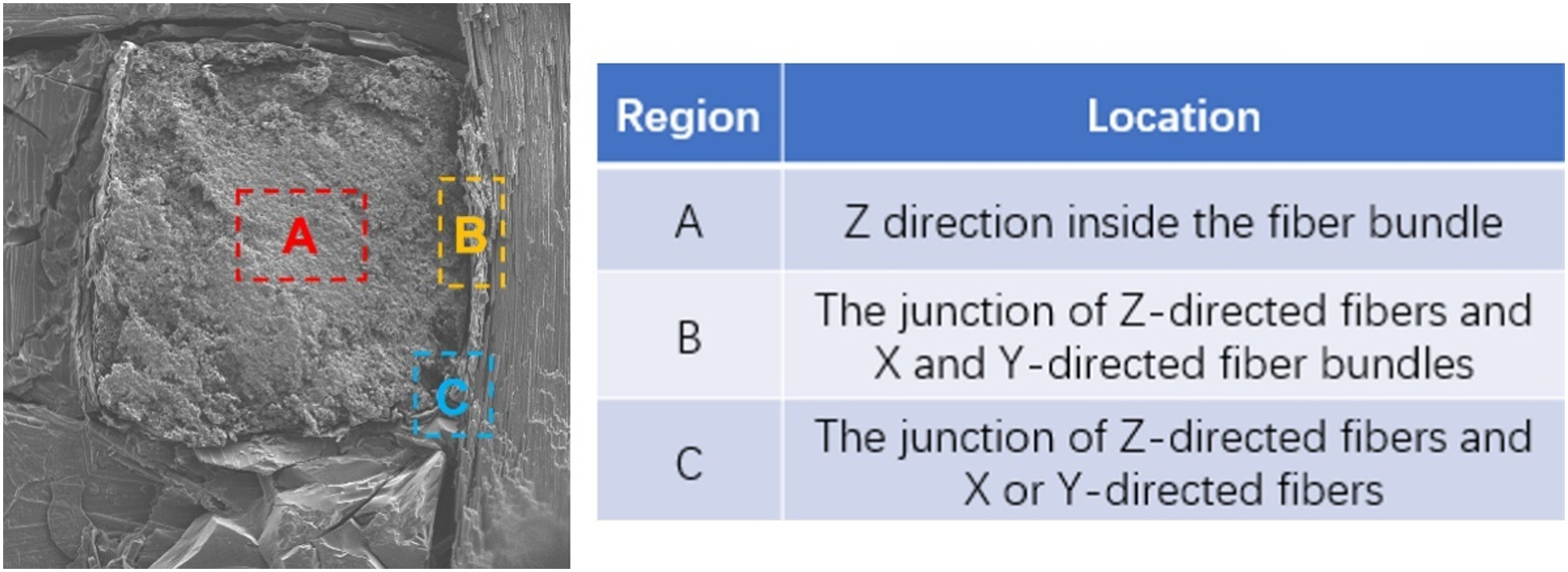
Compression test
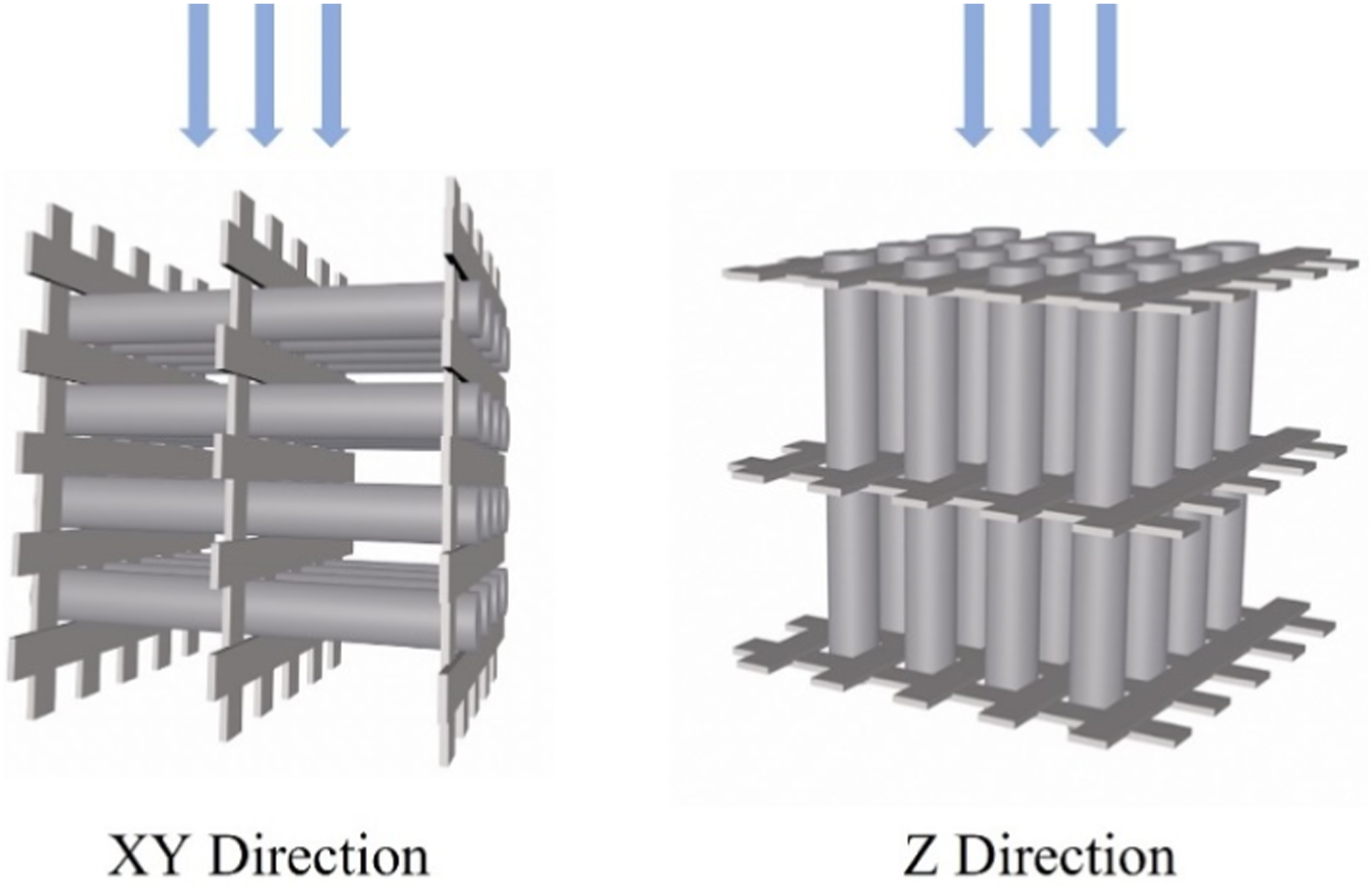
The compression properties of the C/C composites were tested using a Zwickroell Z100 mechanical testing machine. The sample size was processed to 10 mm × 10 mm×10 mm. The testing machine accurately expressed the relationship between load and displacement at a constant rate of 1 mm/min at room temperature. Compression properties were tested from the XY and Z directions, that is, perpendicular to the axial (Z) fiber and parallel to the axial (Z) fiber, as shown in Figure 4. Five tests were performed in each direction. Absorption energy and specific absorption energy of the C/C composites were calculated to evaluate the compression performance. The calculations were carried out based on the following equations
27
: C/C composite direction diagram.

EMI shielding test
The EMI shielding performance of the C/C composites was measured using an AGILENT E5071 C microwave vector network analyzer. The test was conducted at room temperature using the waveguide method, with a test frequency range of 8.2-12.4 GHz. The sample size was processed to 22 mm × 10 mm×4 mm. The EMI shielding performance of materials is typically expressed by shielding effectiveness (SE). The total SE (SEt) is defined as the ratio of the power of the emitted electromagnetic wave to the power of the incident electromagnetic wave (expressed on a logarithmic scale). The expression is shown as equation (4).
28

In addition, SEt consists of absorption (SEa), reflection (SEr), and multiple reflection (SEm), according to the shielding theory of Schelkunnoff.
29
The calculation method can be expressed as equation (5).



Thermal conductivity test
The thermal diffusion coefficient of the C/C composites was measured by a Netzsh LFA427 ultra-high temperature thermal conductivity meter. The sample size was processed to 10 mm × 10 mm×4 mm. Graphite was sprayed on the sample surface to ensure the heat distribution on the surface uniform before testing. Thermal conductivity tests were conducted in both the XY and Z directions. Three tests were performed in each direction to minimize errors. The specific heat capacity (CP) of the C/C composite sample, with a density of 1.75 g/cm3, was measured with a laser thermal conductivity meter. The thermal conductivity is calculated from the measured thermal diffusion coefficient, specific heat capacity and the density of the sample using the following equation
32
:
Results and discussion
Effect of preform structure on pore structure
Porosity of different samples.

The evolution of pores during densification is a process of varying the number and area of pores in different regions. Pore size during densification exhibits a broad distribution, ranging up to several hundred micrometers. In this work, pores ranging from 4 to 30 μm, 30-100 μm, and above are defined as micropores, mesopores, and macropores, respectively. The number distribution (Figure 5(a)–(c)) and area proportion (Figure 5(d)–(f)) of pores, as determined by software statistical analysis in the three C/C composites during the PIP process stage, are illustrated. Obviously, both pore number and area proportion gradually decrease with increasing sample density. From a quantitative perspective, C/C composites exhibit the highest proportion of micropores and an extremely low proportion of macropores. Analyzing the area proportion, it becomes evident that the limited number of macropores (1%) significantly influences the overall pore structure. Thus, the densification of C/C composites is a dynamic process in which macropores are filled into mesopores, and mesopores are filled again. The area proportion of macropores decreases rapidly, while the area proportion of micropores remains relatively stable during the PIP process. After densification, the number of micropores approaches 100%. The analysis of the pore structure in different regions (Figure 5(g)–(i)) reveals that region C has the largest pore area, followed by region B, aligning with SEM images. This observation indicates that mesopores and macropores are primarily concentrated between fiber bundles in the early stage of densification. With successive densification cycles, the area proportions in the three regions gradually converge. After densification, the pores within the bundles are predominantly filled. The porosity of the final product is mainly consists of closed pores between bundles, especially at the intersection of multidirectional fiber bundles. This trend aligns with the variation in pore area (Figure 5(d)–(f)). Pore characterization (a, b, c quantity distribution, d, e, f area variation, g, h, i region area variation, j,k,l).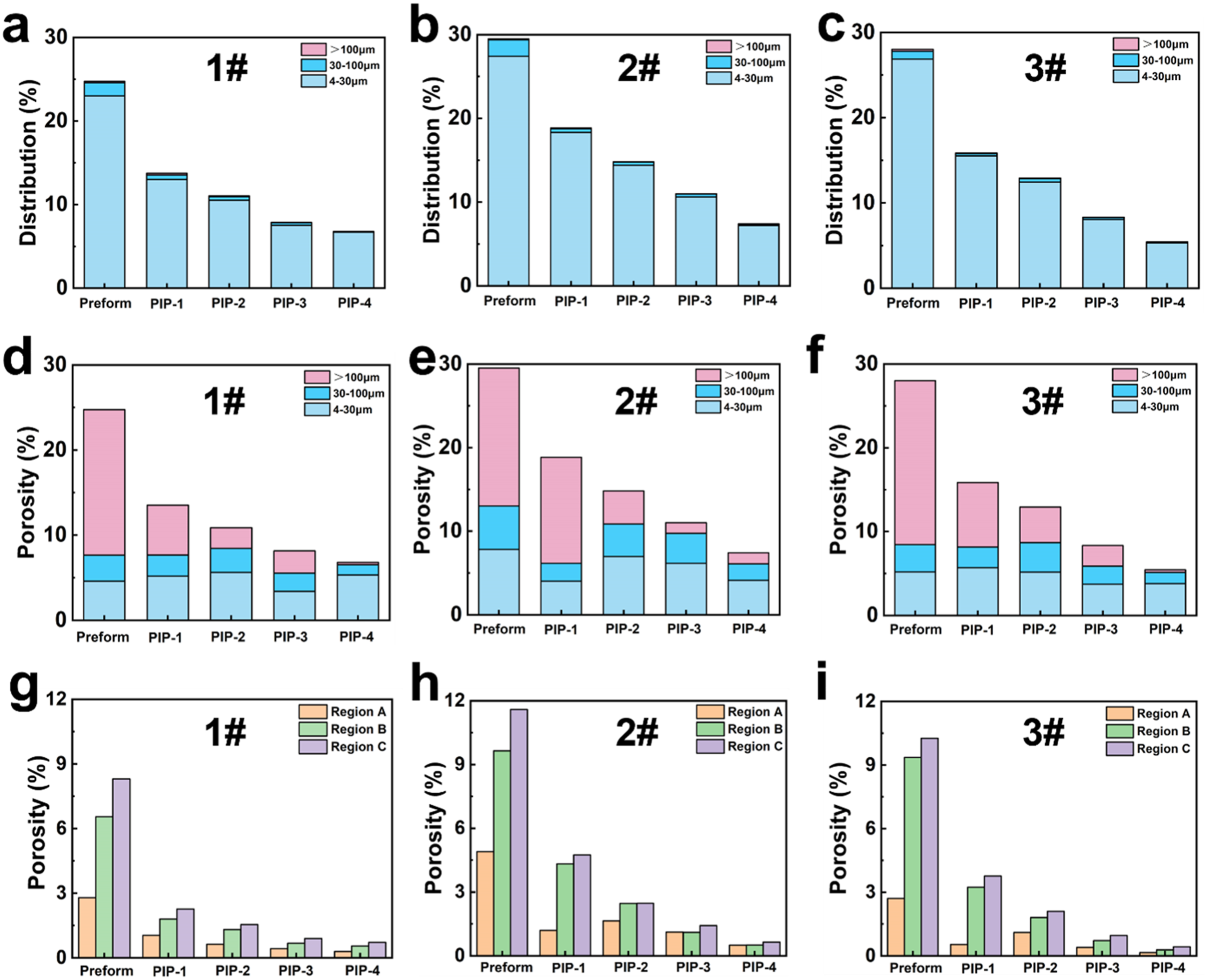
From the SEM images (Figure 6), it is evident that pores inevitably form at the fiber interlaces (region B) in the 3DOW structure. Macropores. That PyC cannot fill successfully, are observed in the right-angle area (region C) formed by orthogonal knitting of the XY direction fibers around the axial (Z) fibers(Figure 6(a) and (b)). In sample 3#, the area C formed by puncture appears as a circular arc (Figure 6(c)). This type of damage penetrates fiber layers of different directions, resulting in the formation of large holes in region C. In addition, sample 3# exhibits more pores than sample 1# at the initial stage of densification, indicating that the compact structure affects the deposition of carbon source gas (Figure 5(c) and 5(f)). After the PIP process, region C is rapidly filled (Figure 5(d)–(f)). In the 3DOW structure, The pores remain concentrated near the axial (Z) fibers (Figure 5(d) and 5(e)), whereas in the 3DFWP structure, the pores are more evenly distributed (Figure 5(f)). It is observed that the 3DFWP structure is more compact than 3DOW structure, but the needle damage to the XY fiber layer results in more interlaminar pores. A smaller interlayer density provides more space for resin shrinkage. Sample 2# still has 1.33% macropores and 1.96% mesopores distributed in three regions due to the large layer spacing (Figure 5(e)). SEM image of pore characterization (a, b, c SEM image before PIP, d, e, f SEM image after PIP).
Effect of microstructure on mechanical properties
The excellent mechanical properties contribute to expanding the range of use of materials. As observed from the stress-strain curve (Figure 7(a) and 7(b)), the compression properties of the C/C composites in the Z direction are significantly higher than those in the XY direction due to the simultaneous stress on the axial (Z) fibers and carbon fiber layers. Sample 1# exhibits the maximum compression strength in the XY direction (88 MPa) and Z direction (240 MPa) owing to its woven structure and higher finished product density. Notably, samples 1# and 3# have obvious failure strength peaks, indicating brittle failure. In contrast, sample 2# maintains certain mechanical properties after reaching the compression strength, showcasing characteristics of plastic failure. The increase in compression distance resulting from plastic deformation also leads to a reduction in the compression modulus of sample 2# in the XY(894 MPa) and Z directions(1042 MPa) (Figure 7(c)). Analyzing the absorption energy distribution (Figure 7(d)), the compression strength (124 MPa) and absorption energy (8.30 kJ) of sample 2# in the Z direction are lower than those of sample 3# (170 MPa and 10.80 kJ), but the compression strength (79 MPa) and absorption energy (0.84 kJ) in the XY direction are higher than those of sample 3# (59 MPa and 722 J). Compression performance (a,b stress-strain curve in XY direction and Z direction, c compression modulus, d absorption energy, e,f Pictures of the compressed samples in the XY direction and Z direction, g,h compression model in XY direction and Z direction).
Figure 8(a) and (b) present the physical images of C/C composite compression failure specimens in different directions. The compression failure of C/C composites in the XY direction appears more severe than that in the Z direction, indicating superior mechanical properties in the Z direction. Specifically, samples 1# and 3# showed obvious delamination, maintaining the integrity of the fiber bundle. This suggests inter bundle porosity is a crucial factor leading to compression failure. Sample 2# still retains some macropores with a pore diameter greater than 100 μm after densification. Consequently, the top or bottom of sample 2# was crushed, accompanied by some fiber bundles being peeled off. Notely, the fiber layer of sample 3# displays significant brittle fracture, in addition to evident delamination. This differs from the sample 1# with complete separation of the fiber layer. The fiber damage caused by the puncture process significantly reduced the strength of the XY fiber layer of sample 3 #, resulting in the rapid destruction of the XY fiber layer under stress. This is the reason why sample 3 has a lower absorption energy in the XY direction. Compression mechanism (a,b Pictures of the compressed samples in the XY direction and Z direction, c,d compression model in XY direction and Z direction).
Based on the compression strength and failure diagram, compression models for different structures are established, as shown in Figure 8(c) and (d). The brittle failure of samples 1 # and 3 # is attributed to their high CF volume fraction in the XY direction. The strong adhesion between PyC and CF does not easily lead to fiber pullout, and the fiber and matrix almost break simultaneously when the stress reaches the maximum. Therefore, the layering phenomenon caused by shear failure occurs primarily between the fiber layers of samples 1# and 3# after compression. Sample 2# has a lower CF and PyC content in XY direction, and the binding force between resin carbon and PyC and carbon fiber is weak. Under compression, the resin carbon of sample 2# is crushed as a whole, resulting in large-scale failure. The spherical resin carbon accumulated after failure exhibits plastic deformation under continuous stress. The defect with low interlaminar density of sample 2# is more noticeable in Z-direction compression. The reduced strength of sample 3# in the XY direction depends on the damage to the CF layer and the structural integrity compromised by the two-way puncture process. When sample 3# is compressed from XY direction, the failure caused by the stress concentration at the fiber layer damage reduces the compression strength. This is also the reason why its absorption energy (0.57 kJ) is the lowest.
In summary, the 3DOW structure proves effective in minimizing fiber damage and enhancing compression performance. The 3DFWP structure leads to a reduction in compression strength due to fiber damage and structural integrity disruption. Moreover, an increase in interlayer spacing results in elevated porosity between bundles, making the material more susceptible to plastic failure.
Effect of microstructure on EMI shielding performance
In the context of electromagnetic interference (EMI) shielding, which holds crucial significance in the electromagnetic protection of 5G satellites, the shielding mechanism of C/C composites is explored. The electromagnetic losses of different samples are illustrated in Figure 9, shedding light on the shielding mechanism primarily comprising reflection, absorption, and multiple reflections.
33
It is notably observed that The EMI loss in the XY direction of all C/C samples is markedly higher than that in the Z direction. In both directions, shielding effectiveness of absorption (SEA) surpasses that of reflection (SER), indicating that microwave absorption significantly contributes to electromagnetic interference shielding effectiveness (EMI SE). However, this advantage is less apparent in the Z direction. Particularly for sample 3# using a 3DFWP structure (Figure 9(b)), the absorption loss is 16.32 dB and the reflection loss is 14.58 dB. While determining the shielding mechanism of C/C composites solely based on SER and SEA studies might not be appropriate, as SER represents electromagnetic wave attenuation within the material. Accordingly, reflected power (R), absorbed power (A) and transmitted power (T) were calculated from S parameters (Figure 9(c) and (d)). The reflected power (0.9 mW) significantly outweighs the absorbed power (0.02 mW), signifying that reflection dominates EMI SE. This is attributed to a considerable portion of electromagnetic waves being preferentially reflected due to the substantial impedance mismatch between free space and the surface of the C/C composite material. Notably, the absorption power of samples 1# and 3# both in XY (0.023 mW) and Z (0.024 mW) directions is greater than that of sample 2# (0.017 mW and 0.023 mW). This is a result of the high content of PyC coated around the CF. Combining the results of electromagnetic loss and shielding power, it can be concluded that C/C composites possess an excellent inherent electromagnetic absorption capacity, but a substantial portion of incident electromagnetic waves is reflected on the surface of C/C composites. EMI shielding mechanism (a XY EMI loss, b Z EMI loss, c XY shield power, d z shield power).
It is generally accepted that the structure of materials is critical to EMI SE. Furthermore, EMI SE is closely tied to electrical conductivity, with materials exhibiting high electrical conductivity demonstrating excellent EMI SE.
34
To investigate the effect of preform structure on EMI SE, the EMI SE and electrical conductivity of three different C/C composites in different directions were tested, as shown in Figure 10(a) and (b).The trend of electrical conductivity is basically the same as that of EMI SE. The electrical conductivity of the composite is as high as 6 × 10⁴ S/m. Affected by the structural integrity of the conductive network, the number of migrating and hopping electrons in the textured carbon fiber and the matrix carbon containing pores is also different. The complex conductive network in C/C composites is simplified into carbon fiber series and parallel bonding circuits. The equivalent circuit model (Equation (12))
35
is used for description and analysis. (a) EMI SE, (b) electrical conductivity, (c) Conductivity model in XY direction, (d) Conductivity model in Z direction.

The conductive path is established by XY fiber layers and axial (Z) fibers. Due to low porosity, sample 1# has the best electrical conductivity in both XY (6.78
On balance, the forming method has an important contribution to the EMI shielding performance and conductivity property. The 3DOW structure, in comparison to the 3DFWP structure, exhibits superior EMI SE and electrical conductivity. Conversely, the puncture structure and large layer spacing reduce jumping electrons, thereby weakening EMI shielding performance.
Effect of microstructure on thermal conductivity
Toward the practical application as the thermal management material for 5G satellites, the influence of different preform structures on the thermal conductivity of C/C composites was studied. Figure 11(a) shows the thermal conductivity of the C/C composites in different directions. The total thermal conductivity Thermal conductivity (a thermal conductivity, b thermal conduction model of preform, c influence of carbon texture of matrix, d Phonon interface scattering, e influence of porosity, f Heat conduction model in Z direction).



The mechanism diagram illustrating the influence of structure on phonon heat transfer in C/C composites is presented in Figure 11(c)–11(e). Due to its excellent conductivity and unique structure between disordered layer structure and graphite crystal,
To explain the thermal conductivity of different preform structures, the thermal conductivity model of C/C composites is proposed in Figure 11. Influenced by phonon vibration, the thermal conductivity of sample 3# (86 Wm−1K−1 at 300°C) is optimal when conducting heat in XY direction, whereas the thermal conductivity of sample 2# (52 Wm−1K−1 at 300°C) is superior when conducting heat in Z direction (Figure 11(a)), This contrasts with the trend observed in electrical conductivity, indicating that phonon heat transfer predominantly shapes the thermal conductivity of C/C composites. To study the thermal conductivity of different prefabricated structures, 
Overall, the overall thermal conductivity of the 3DOW structure is more excellent. When the direction of heat conduction is determined, it can be attempted to use a bidirectional puncture structure and increase the interlayer spacing to improve the thermal conductivity.
Comparison and selection of properties of materials
Compressive strength, thermal conductivity, and EMI SE of different related materials.

Conclusion
C/C composites were prepared using CVI and PIP processes with three types of preforms featuring distinct molding methods and interlaminar densities. The microstructure was characterized through image recognition. In the pore evolution of C/C composites, the limited number of macropores significantly influences the pore structure, with mesopores and macropores primarily concentrated in areas B and C. Compared with the 3DOW structures, the 3DFWP structures are more compact, making pyrolytic carbon deposition challenging in the initial stage. The influence of microstructure, influenced by preform structure, on compression performance, electromagnetic shielding performance, and thermal conductivity was investigated. Inter-bundle porosity emerged as a crucial factor in compression failure, and the puncture process diminished structural integrity while PyC content influenced material failure modes. The 3DOW structure and high-density sample 1# demonstrated superior compression resistance. In addition, EMI shielding performance and thermal conductivity of C/C composites in the XY direction surpassed those in the Z direction. The change trends of EMI SE and electrical conductivity are basically the same. The 3DOW structure has better EMI shielding performance, and the molding method makes up for some defects caused by large layer spacing. Finally, the influence of the preform structures on thermal conductivity performance was discussed. Both phonon and electron jointly affect the thermal conductivity of C/C composites, while phonon heat transfer plays a predominant role. The puncture process, causing pathway incompleteness and altering carbon species, leads to significant phonon scattering. Overall, the thermal conductivity of the 3DOW structure proved to be superior. In summary, the 3DOW structure with high layer density is deemed more suitable for crafting C/C composites with high strength, EMI shielding, and thermal conductivity. C/C composites hold promise as high-performance materials for 5G satellites.
Footnotes
Declaration of conflicting interests
The author(s) declared no potential conflicts of interest with respect to the research, authorship, and/or publication of this article.
Funding
The author(s) disclosed receipt of the following financial support for the research, authorship, and/or publication of this article: This work was supported by the National Science Funds of China (11972172).
