




Abstract
The paper deals with the fire technical characteristics of insulation panels made of recycled technical textiles from the automotive industry. The introductory part focuse an of the use of recycled textiles, a description and division of technical textiles, a description of the examined material and its composition, combustion processes, and the method of handling waste textiles. The monitored characteristics were the determination of the ignitability of the material, the gross calorific value as well as the radiant heat resistance. The measurements were carried out on samples from recycled technical textiles before and after their treatment with flame retardants (Isonem Anti-fire Solution, Ecogard B45, HR Prof, woven carbon foil, non-woven carbon foil). The best results in the ignitability test after treatment with liquid flame retardants were obtained after treatment with Ecogard B45. The results show that when flame retardants are used, the released heat during the combustion of the monitored materials treated through the dipping method is significantly lower from 13.7 MJ/kg to 23.7 MJ/kg. The lowest gross calorific values were achieved when using liquid flame retardant HR Prof when applied by dipping. The proportion of material that did not burn was very low (4.61 to 5.63%). After exposure to radiant heat for 10 min, the highest mass loss was 13.6% (dipping in Ecogard B45) and the smallest 1.8% (non-woven carbon foil). Based on results, it shows that flame retardant ECOGARD® B45 for the insulation material Senizol AT XX2 TL60 made from recycled technical textiles is the most suitable fire protection.
Keywords
Introduction
In connection with the changes in geopolitical developments over the past year, increased emphasis is placed on the energy-efficient use of materials and the extension of their life cycle. Recycling materials is also gaining importance in products and constructions that have a long-term character of use. From this point of view, there has been a dynamic development in recent years, especially in the branch of wooden constructions and the insulating materials used in them.1–5 With the increase in the prices of building materials, including wood, new building components are being developed, the main component of which is recycled and natural materials.6–11
Bio-materials made from renewable resources have recently been developed based on the concepts of bio-economy and low-carbon economy. Renewable raw materials such as pulp and recycled textile fibers are used to produce value-added products such as environmentally friendly thermal insulation materials.12,13
Most works compare recycled materials from the point of view of the life cycle (LCA analysis) and carbon footprint.14–18 Some are devoted to the specific properties of recycled materials, which are important in terms of energy, operational, and utility characteristics in building construction. Other works are devoted to the evaluation of other groups of characteristics of recycled materials, especially acoustic and thermophysical ones.19–26 The existing studies rather focus on the evaluation of the physical properties of materials after their treatment with a retarding agent,27–29 only some also evaluate the fire characteristics. 30
In the past decades, flame retardants were mainly used to increase fire resistance or limit its spread. They were mainly used in textiles to reduce flammability, for example in structural elements, car seats, strollers, children's clothing, etc.31,32 In 2019, the global consumption of flame retardants was 2.39 million Tons. In the last 4 years, this consumption has been constantly growing, and a continuous growth of 2.7% is expected until 2025. The largest share of consumption was achieved by the Asian continent (51%, of which China 27%). 33
Scientific studies have shown that Flame retardant products are a source of various environmental burdens and pollution, such as air pollution,34,35 dust, 36 surface water, 37 drinking water, 38 and wastewater. 39 Adequate amounts of Flame retardants have also been found in some fish species.40,41
Several studies have shown that recycling textile fibers treated with different types of flame retardants overall improve their durability and usability. In this way, fully biological, fire-resistant, and more ecological products are created, suitable as fire-resistant structural filling and insulation materials for textile products in the home or as building materials.42,43 Flame retardants have become promising treatment options to improve the fire resistance of materials due to their efficiency and economic benefits. Recent research into flame retardant applications has shown that the substances protect underlying materials from fire damage and improve their mechanical properties.
Several substances have been investigated as flame retardants for textiles. For example, halogen-based flame retardants, boron-based flame retardants, phosphorus-based flame retardants, nanocoatings, nitrogen-based flame retardants, and mineral-based flame retardants (e.g., aluminum, etc.). 44 The use of nanoparticles for flame retardancy is relatively recent. 45 Graphene is a nanomaterial that functions as a flame retardant for textiles through carbon formation. 46 The use of TiO2 and ZnO nanoparticles for textiles along with flame retardancy also improves mechanical properties and hydrophobicity. 47 Nanoparticles can even be used in combination with other flame retardants, for example, silica nanoparticles in combination with borate have been used to improve flame retardancy. 48 Flame retardant application techniques also play an important role. 44
Thus, most of the published works investigated the effect of flame retardants on textiles, which are commonly used as recyclates for the clothing industry, or the production of textile products in the home. 49 In addition to thermal insulation and acoustic properties, fire protection is also very important. It is important to minimize the spread of fire in buildings because it fundamentally damages property and increases the risk of endangering human life. 50 If the building envelope is insulated with flammable organic insulations, the fire spreads more easily and is more difficult to fight. 51
In our previous works, we dealt with the acoustic, thermophysical, and fire technical characteristics of materials from modified recycled technical textiles. 52 The aim was to determine the influence of selected flame retardants on sound absorption (sound absorption coefficient) and thermophysical characteristics (coefficient of thermal conductivity, thermal diffusivity, and specific heat capacity) of insulating materials made from recycled technical textiles. 53 These materials demonstrate the potential of use for various purposes (e.g., interior decoration, construction purposes, especially in wooden constructions). 54
This work aimed to determine the effect of selected flame retardants on the physical properties (surface tension, viscosity) and fire technical characteristic properties (flame propagation, gross calorific value, and mass loss) of Senizol AT XX2 TL60 material. Liquid retardants (Ecogard B45, Isonem Anti-Fire Solution, HR Prof), as well as solid retardants made of woven and non-woven carbon fiber, were selected as flame retardants for this work.
Materials and methods
Material and flame retardants
The research was carried out on a material called Senizol AT XX2 TL60 (Stered PR Krajné s.r.o., Krajné, Slovakia), which consists of a synthetic and natural fiber mixture originating from the automotive technical textiles (car seats, ceiling upholstery, anti-noise upholstery, foot pads, etc.) from cars interconnected by polyurethane adhesive and water. Technical textiles used for the manufacture of automotive parts, which have good acoustic and thermal insulation properties, are made from synthetic fabrics consisting of polypropylene (PP), polyamide (PA), polyester (PES), and additional materials such as polyethylene (PE) and polyurethane foams (PUR). For our experiments, we made use of material from recycled technical textiles of above mention composition including an admixture of cotton, wool, and other natural or inert materials (talc). The studied material from technical textiles with a mass density of 60 kg.m−3 consisted of several layers combined by felting.55,56 Due to the fact that the examined material consists of synthetic combustible materials, it can be classified in the fire reaction class E according to the test protocol according to EN 13501-1+A1. 57
To achieve the required fire safety, the products are modified with chemical substances that prevent not only flare-ups or ignition but also the spread of flames at various stages of the burning process.
The selected flame retardants were selected based on the following criteria: Availability, safety, liquid state, suitability for application to textiles. The selected flame retardants meet these criteria. Three flame retardants were used to achieve the required fire safety of the investigated insulation panels: ECOGARD® B45 (TÜCHLER Bühnen-& Textiltechnik GmbH, Wien, Austria), 58 ISONEM® ANTI-FIRE SOLUTION (ISONEM BOYA VE YALITIM TEKNOLOJILERI INS. SAN. TIC. A.S., Izmir, Turkey) 59 and HR Prof (Holz Prof, Tallinn, Estonia). 60 The flame retardants were applied by spraying (coating mass HR Prof was 60 g·m−2, ECOGARD® B45 was 66 g·m−2 and ISONEM® ANTI-FIRE SOLUTION was 77 g·m−2) and dipping in flame retardant. Flame retardant consumption of ISONEM® ANTI-FIRE SOLUTION was 430 g·m−2, HR Prof was 532 g·m−2 and ECOGARD® B45 was 542 g·m−2. Dipping of the test specimens (with a larger area) took 5 s in the liquid retarder, which was in a polypropylene container. After each application of the retarder to the test specimen, the solution in the container was topped up to the original level to maintain the same conditions for all test specimens. After this application of flame retardants, the test bodies were placed so that the excess liquid dripped off. They were then placed in the dryer with the ventilation turned on.
The second treatment method was spray application. In this case, the consumption of retarding substances was lower, and the test specimens did not need to be drained. After spraying with a retarder, the test bodies were placed on a dryer. Subsequently, the samples were conditioned at an air temperature of 20°C and a relative humidity of 50% for 30 days.
Commercially available retardants ISONEM® ANTI-FIRE SOLUTION, ECOGARD® B45, HR Prof were used to modify material. Their composition is the know-how of manufacturers, which cannot be published.
The solution for fire protection ECOGARD® B45 (TÜCHLER Bühnen-& Textiltechnik GmbH, Wien, Austria) is a universally applicable impregnating agent designed for all absorbent natural materials and many synthetic materials that protect against common ignition sources. It is characterised as a colourless, odourless aqueous solution that contains phosphorus and halides. ECOGARD® B45 is not self-ignitable and is not explosive. This flame retardant provides physical protection against flames and prevents the formation of salt. 58
ISONEM® ANTI-FIRE SOLUTION (ISONEM BOYA VE YALITIM TEKNOLOJILERI INS. SAN. TIC. A.S., Izmir, Turkey) is characterised by the manufacturer as a substance that provides absolute resistance to fire. This transparent soaking solution can be applied to wood, textiles, wool, cotton, polystyrene and other combustible materials. ISONEM® ANTI-FIRE SOLUTION, the non-flammability solution, encapsulates the applied surface as molecules and prevents its contact with oxygen. Thanks to its active ingredients, it prevents it from reaching the temperature that will initiate the combustion reaction. In this way, the substance to which it is applied never catches fire. ISONEM® ANTI-FIRE non-flammability solution is a product that is produced from 100% natural materials, has no harm to human health and is anti-bacterial. 59
HR Prof (Holz Prof, Tallin, Estonia) is designed for modification of wooden structures, stairs, coffered ceilings, wooden floors and other wood and cellulose products in order to ensure their resistance to ignition under direct flame. It is a light brown, odourless liquid. Active substance in this agent is ferric phosphate (30%). HR Prof, which possesses high diffusion properties, quickly penetrates the structure of the substrate. Once absorbed into the surface of the material, HR Prof combines chemically within the cell structure but does not form a surface finish. Materials treated with HR Prof when exposed to temperatures of up to 1700°C are subject to charcoal forming, severely restricting the spread of flame. 60
Woven and non-woven carbon fibers (Kordcarbon, as, Strážnice, CR) were also applied to the surface of the textile panels. Carbon fiber is defined as a continuous fiber containing the vast majority of carbon atoms in various modifications with a diameter between 5 µm and 8 µm. Its task is to improve the mechanical and thermal insulation properties as well as to reduce the total mass. However, their price is currently relatively high. 61 These are polyacrylonitrile fibers (PAN) characterized by a modulus of elasticity of approx. 230 GPa and tensile strength of approx. 4.4 GPa. The density of carbon fibers is approx. 1750 kg.m−3. The material is characterized by a low thermal conductivity of 5.5 W.m−1.K−1. It withstands temperatures up to 750°C and has a self-extinguishing feature. 62 Carbon fibers were mechanically attached to technical textiles using steel connecting material. In the next part, the methodology of the individual tests performed is described.
Physical properties
The amount and speed of absorption of the liquid flame retardant by the material depend on several factors, namely the viscosity of the liquid, its surface tension, as well as the properties of the material. Therefore, for the purposes of our research, the mentioned physical properties were investigated.
Surface tension is created when the surface of a liquid is in contact with another phase (e.g., solid) that causes the surface of the liquid to act as an elastic sheet. Surface tension σ (N·m−1) is expressed as a ratio of the surface force to the length of the acting force. The surface tension was measured using the drop-weight method. If we know the surface tension of one liquid (e.g., distilled water), then the surface tension of the other liquid (flame retardant) can be calculated from the equation:

Dynamic viscosity evaluates the internal resistance of a fluid to flow. It gives more information about the force required to make the liquid flow (into the material) at a specific rate. The dynamic viscosity of flame retardant was measured in a Thermo Scientific HAAKE RS100 rotary viscometer. The measurement is based on the resistance of the measured liquid in which the spindle rotates at a precisely defined speed. The type of geometry for measurement is selected according to the preliminary estimate of viscosity, in this case, the cylinder-cylinder type was chosen. In terms of the type of geometry used, the volume of the tested liquid was determined – at 13 mL. Using a syringe, the appropriate amount was taken and poured into the stationary part of the rheometer. After closing the non-stationary cylinder, the solutions were allowed to be tempered each time for 2 min, and then the measurement was performed. 63
Fire technical characteristics – Ignitability test
As mentioned above, the investigated material consists of combustible materials. According to the classification protocol, the material has been assigned to fire reaction class E, which means that it can significantly contribute to the development of a fire. Therefore, the relevant fire technical properties – mass loss and gross calorific value – were determined.
Ignitability of the product is an evaluation criterion of one of the current test methods of reaction to the fire according to ISO 11925-2:2020. 64 The test determines the ignitability of vertically oriented samples when exposed to a small flame, either at the edge or the surface of the samples. The burning behavior of the samples is observed for flame spread and the occurrence of burning particles and droplets. The test result is the fulfillment/failure of the classification criterion, i.e., whether the flame tip reaches and/or passes the 150 mm mark above the flame application point in 20 s (or 60 s) after the start of the test if the exposure time of flame was 15 s or 30 s (depending on the classification class according to STN EN 13501-1:2019 65 ). The test makes it possible to determine an additional classification from the point of view of observing the formation of burning particles and droplets. It is used for classification into reaction to fire class B, C, D, and E. The test can be terminated earlier if no ignition is observed after the removal of the flame source, or the samples cease to burn (or glow), the flame tip reaches the upper edge of the samples.
Test samples with a height of (250 ± 1) mm and a width of (90 ± 1) mm were used for the test. Building products with a thickness of 60 mm and less must be tested at this thickness and products over 60 mm thick must be adjusted to a thickness of 60 mm on the unexposed side. The test took place in a testing chamber.
Gross calorific value
The gross calorific value is the property of materials that is determined to classify them in terms of reaction to fire. The gross calorific value is defined as the total amount of heat released by the perfect combustion of the substance and the complete condensation of all the water formed. It is determined using a test according to ISO-1716:2019 in a calorimetric bomb. 66
The gross calorific value of the material (gross calorific value in MJ/kg) was determined by the bomb calorimeter IKA C200 using the standard ignition method EN ISO 1716: 2019. 40 The ash content was determined using the standard ignition method ISO 1171: 2019. In addition to the basic sample, a reference sample was also evaluated in the laboratory for analysis.
Radiant heat resistance test using the radiant heat source
This non-standardized method is used in the model burning tests. This test method evaluates a material's heat resistance when exposed to a continuous and constant radiant heat source on the base of relative mass loss over the duration of an experiment. The mass loss rate is often used to characterize the burning behavior of a material. 67
A ceramic infra-red heater with a power of 1000 W emits infrared radiation with wavelengths (3–6) μm and operates in the temperature range from 300°C to 750°C. The samples were exposed to a radiant heat source for 10 min, at a distance of 30 mm from the surface of the infra-red heater. During the test, the mass loss was recorded at regular 10-s intervals, and possible ignition of the samples was visually monitored. 68
The evaluation criterion of the experiment is the relative mass loss according to the equation:

Based on the test results, a scoring system was created to evaluate the effectiveness of individual kinds of flame retardants and the method of their application to insulating material. Fire-technical characteristics, which are important indicators from the point of view of fire safety of construction products, were included in the evaluation. A scale from 1 (the worst) to 9 (the best) points was chosen for the evaluation depending on the test result. A higher point rating of the individual fire-technical characteristics of the material before and after the flame retardant treatments means, the higher material fire performance. Evaluation of resistance to radiant heat was performed based on a visual assessment of the residual of the material (sensory characteristics). The last line shows the order (from 1st to 9th), which is an expression of the effectiveness of the used fire protection of the insulating material made of the technical textiles.
Results
Physical properties
Figure 1 shows the average mass of samples with dimensions (100 × 100) mm before and after treatment with flame retardants. As can be seen (Figure 1), the sample mass after treatment increase varies depending on the treatment method as well as the properties (surface tension as well as viscosity) of the flame retardant used. Materials mass before and after treatment with flame retardants.
The highest increase in mass of the material was recorded after the application of Ecogard B45 by dipping, up to 26.52 g on average. The smallest increase in the mass of material was recorded after the application of HR Prof by spraying, only 3.19 g. The test samples after the experiment are shown in Appendix 1 and 2.
Surface tension and kinematic viscosities of selected flame retardants.

Based on the results shown in Table 1 and shown in Figure 1, it can be concluded that the amount of flame retardant absorbed by the material during dipping depends inversely proportional to its surface tension and viscosity. This means that the lower the surface tension and viscosity of the flame retardant, the better the impregnation of the material, i.e., the material will withstand high temperatures for a longer time. Based on the sensory evaluation of the surface of the examined material of the insulation panels, it can be concluded that after treatment with the retarder Isonem Anti-fire Solution, the surface of the material hardened slightly. When using the Ecogard B45 retarder, the surface of the material is almost present to the touch, while with HR Prof, the surface of the examined technical textile material was sticky even after drying. The odor of the material remained the same even after the use of retardants.
Ignitability test
Results of the ignitability test of the material Senizol AT XX2 TL60 before and after flame retardants application (application the flame at the edge of samples).

Results of the ignitability test of the material Senizol AT XX2 TL60 before and after flame retardants application (application the flame at the surface of samples).
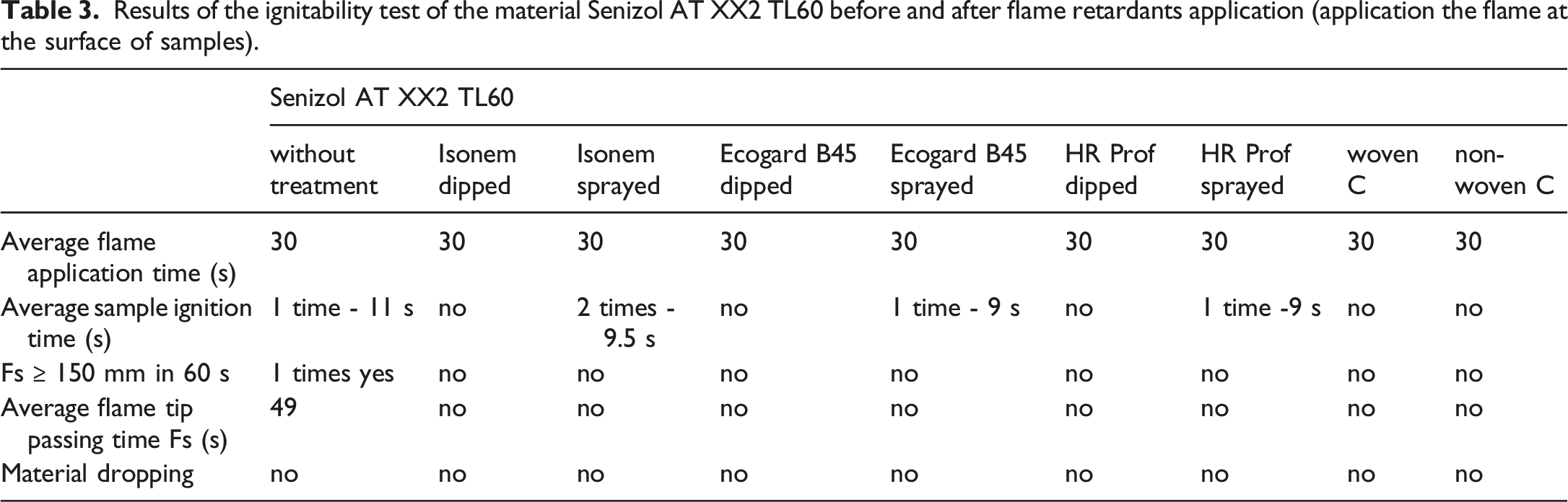
The ignitability test of insulation material made from recycled textiles was performed by the authors in. 52 The results of the ignitability test showed that the product Senizol AT XX2 TL 60 without flame retardant treatment can be classified in class E of reaction to fire.
It is clear from the results that the 150 mm limit from the application of the flame on the material Senizol AT XX2 TL60 without treatment was not exceeded in only one tested sample number 6. Thus, Senizol AT XX2 TL60 without treatment cannot be classified in a lower class of reaction to fire. The best results after treatment with liquid flame retardants were obtained after treatment with Ecogard B45, after both methods of application (dipping and spraying).
After treating the tested material with a carbon foil coating, the samples did not burn and there was no flame spread. Only local charred due to the high temperature on the opposite side of the carbon layer was observed and slight dripping from one sample was observed after modification with woven carbon foil. The material treated with carbon fiber coating showed an improvement in material fire-technical properties. The test samples after the experiment are shown in Appendix 3.
Thus, it can be concluded that after all modifications made by us to the material Senizol AT XX2 TL60 made from recycled technical textiles, its fire performance was improved. This means that it would be possible to classify it in the reaction to fire class B, C, or D. However, the result of the ignitability test still needs to be confirmed by the SBI (Single Burning Item) test, which precisely determines the classification of the fire reaction class.
Gross calorific value
The gross calorific value determines the amount of energy released when the sample is completely burned in the calorimeter. From this characteristic, it is subsequently possible to derive the calorific value of the given material. 69
Determination of gross calorific value and ash content of Senizol AT XX2 TL60 material with various flame retardants.
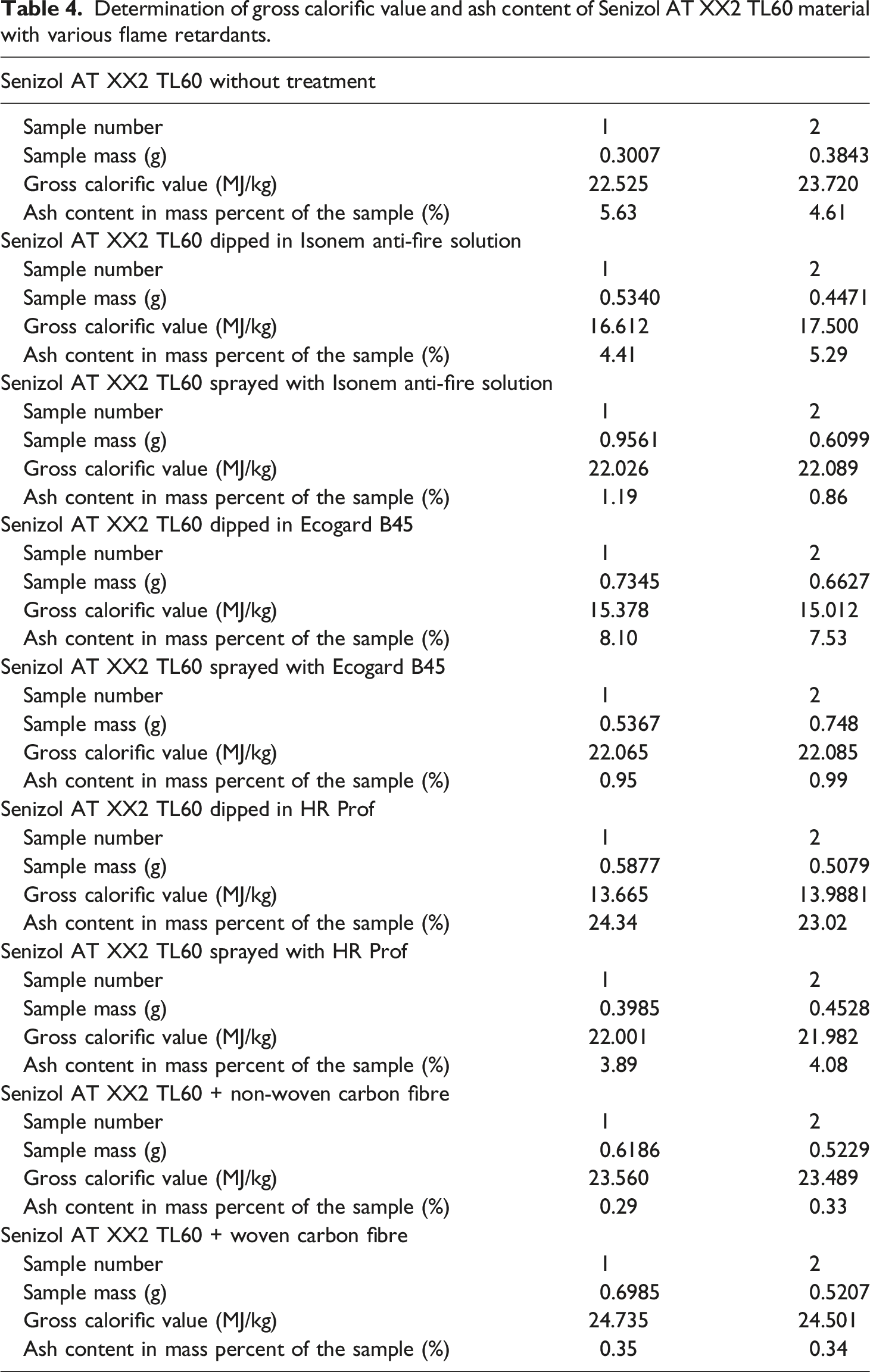
Our long-term experience with measuring different types of materials confirms that if the difference in the value of gross calorific value between several samples is less than 5%, then it is a homogeneous material and the measurement of other samples will not confirm fundamentally different results. Therefore, only two samples were measured. The differences in the values of gross calorific value varied for individual pairs of samples from 0.092% to 5%. If the difference in values was close to 5%, a third reference sample was also measured, which, however, always confirmed the homogeneity of the material.
The results show that when flame retardants are used, the released heat during the combustion of the monitored materials is significantly lower. The lowest values were achieved when using liquid flame retardant HR Prof when applied by dipping. The method of application of the liquid flame retardants (by dipping or spraying) proved to be decisive for the value of the gross calorific value (GCV). When the liquid flame retardants were applied by spraying, the gross caloric values were significantly higher than when applied by dipping. This result is also important from the point of view of planning fire prevention standards. The results of the determination of GCV also correspond to the results of the ash content in mass percent of the sample, which indicates the percentage of material that does not burn. The largest amount of sample burned was for materials that were treated with woven and non-woven carbon fibers. Ash content in mass percent of the samples of the insulating material before treatment with the flame retardant was very low (0.29 to 0.35%). However, after treatment of Senizol AT XX2 TL60 insulation material with Ecogard B45 and HR Prof flame retardants, the mass fraction of ash increased significantly after dipping treatment. In the case of using the HR Prof flame retardant, even the ash content in weight percent was almost five times higher than in the material test before treatment. This is probably related to the chemical specification of this retarder, which directly increases the proportion of the non-combustible component of the treated material.
The application of retarders by spraying turned out to be an inappropriate solution, since in all cases the ash content was considerably lower than when applied Ecogard B45 and HR Prof by dipping. When sprayed with Ecogarde B45 retardant, even the ash content in mass percent of the sample was significantly lower than after the test of untreated material. The ash content in the case of Ecogarde B45 spraying on the insulating material was less than 1%, so more than 99% of the material was burned.
The method used to determine the gross calorific value is relatively accurate, so it is not necessary to perform a large number of measurements. On the other hand, the material Senizol AT XX2 TL60 is made of approximately ten different materials, so the composition of each sample may vary.
Radiant heat resistance test using the radiant heat source
During the exposure of the samples to a radiant heat source, the formation of a flame, the formation of smoke, the loss of mass, and other physical manifestations of the material were monitored. Figure 2 presents the course of mass loss of Senizol AT XX2 TL60 material without and after treatment with various flame retardants during exposure to a radiant heat source for 10 min. The course of mass loss of insulating material without and after treatment with various flame retardants during exposure to a radiant heat source for 10 min.
The tested material showed a higher mass loss after treatment with liquid flame retardants than after the application of carbon fiber foil. After exposure to radiant heat for 10 min, the highest mass loss of insulation material treated by dipping in Ecogard B45 was recorded, up to 13.6%. The smallest average mass loss of the insulating material after exposure to radiant heat was recorded after treatment with non-woven carbon foil, i.e., 1.8%.
The results of the radiant heat resistance test are conditioned by the composition of the Senizol AT XX2 TL60 material, which consists mainly of polymers (i.e., polyester, polypropylene, and polyurethane). The material started to melt after being exposed to radiant heat but not a single sample caught fire. During exposure of untreated insulating material to radiant heat, smoke generation was minimal and increased with the amount of flame retardant bound in the material. In addition to the formation of smoke, volatile substances (Volatile Organic Compounds - VOC) are released when the material is subjected to thermal stress. Danihelová et al. found that volatile products start to be released from the insulation panel made of technical textiles at 80°C (toluene and benzaldehyde). At temperatures above 100°C, xylenes, styrene, phenol, acetophenone, naphthalene, caprolactam, and other carbonyl compounds were also formed. 70
Discussion and conclusion
The work presented a wide range of fire technical characteristics of the material Senizol AT XX2 TL60, which was treated with various flame retardants. In addition to these characteristics, the surface tension and viscosity of liquid flame retardants were also determined.
The results showed that the more suitable fire protection treatment was the treatment of the insulating material with liquid flame retardants. The most effective was the treatment of material with Ecogard B45 which was applied by spraying.
This treatment will ensure sufficient fire protection with a minimal increase in the mass of the material, and after its application, all monitored characteristics show only minimal changes. From the point of view of the fire protection of the insulating material, dipping in the HR Prof retardant appears to be the worst treatment method. Among the cladding materials used, treatment with woven carbon fibers is more suitable, which increased the fire resistance of the material but at a significant increase in mass.
When the insulation material was exposed to radiant heat, it was shown that none of the flame retardant treatments we used prevented significant degradation of the material. Even after the fire protection treatments were used, it began to melt almost immediately. However, the average percentage mass loss does not correspond to the overall consequences of the thermal degradation of the material. The difference was mainly caused by the evaporation of the retardant from the sample, which was the cause of the greater difference in masses.
The flammability test confirmed the assumption 52 that the untreated material belongs to the fire reaction class E, but with the correct selection and application of the flame retardant, the material Senizol AT XX2 TL60 can be classified in a lower fire reaction class. However, to confirm this classification of the material, it is necessary to perform an additional SBI test, which is used for construction products. The treatment of insulation material with liquid flame retardants as well as the application of carbon fiber proved to be effective. The only exception was the treatment of the insulating material by spraying with HR Prof retardant when the flame tip passed the mark 150 mm from the point of application of the flame in two tested samples of insulating material.
The article presents a wide range of fire-technical characteristics of the insulating material Senizol AT XX2 TL60 before and after the application of various flame retardants. In order to clarify the behavior of flame retardants when they are applied to insulating material, their physical properties, namely surface tension, and viscosity, were also determined.
Evaluation of flame retardant effectiveness.

It is clear from the evaluation results (Table 5) that the most effective fire protection of the insulation material Senizol AT XX2 TL60 can be achieved by treating it with the liquid flame retardants Ecogard B45 and HR Prof and by short-term dipping. After the application of flame retardants by spraying, an increase in the fire resistance of the material was achieved after treatment with Ecogard B45 and Isonem Anti-fire Solution. Also, the addition of woven carbon fiber foil appears to be a suitable fireproofing treatment of the insulating material, but the addition of nonwoven carbon foil is ineffective.
The results of previous research 53 on the insulation material Senizol AT XX2 TL60 showed that the flame retardant treatments we used did not cause a deterioration in the sound absorption of this material made from recycled technical textiles. Even after treatments, this material achieves high and almost constant sound absorption in the interval of 600 Hz to 2000 Hz, and according to the ISO 11654:1997 standard, it can be classified in sound absorption class A. 71
From the point of view of thermophysical characteristics, this material has very good thermal insulation properties. Fire protection treatment with liquid flame retardants applied by spraying has an almost negligible effect on the thermophysical characteristics of the insulation material. However, after the application of flame retardants by dipping, the thermal conductivity of the insulating material significantly deteriorates. The exception is the treatment of the material with ECOGARD® B45 flame retardant, as the insulating material retained very good thermal insulation characteristics after both methods of application. 53
Based on a comprehensive evaluation of the fire technical, acoustic, and thermophysical characteristics of the Senizol AT XX2 TL60 material, it turns out to be the best treatment by dipping in the ECOGARD® B45 retardant. This method of fire protection increased the fire resistance of the insulating material without worsening its thermal insulation and acoustic characteristics.
Supplemental Material
Supplemental Material - The effect of flame retardants on the fire technical characteristics of recycled textiles
Supplemental Material for The effect of flame retardants on the fire technical characteristics of recycled textiles by Anna Danihelová, Miroslav Němec, Tomáš Gergeľ, Miloš Gejdoš, Martin Lieskovský, Iveta Mitterová, Patrik Sčensný and Rastislav Igaz in Journal of Industrial Textiles
Footnotes
Declaration of conflicting interests
The author(s) declared no potential conflicts of interest with respect to the research, authorship, and/or publication of this article.
Funding
The author(s) disclosed receipt of the following financial support for the research, authorship, and/or publication of this article: This research was funded by projects Scientific grant agency (VEGA 1/0714/21); and Cultural and education grant agency The Ministry of Education, Science, Research and Sport of the Slovak Republic (KEGA 023ŽU-4/2021); and Slovak research and development agency (APVV 22-0001).

Supplemental Material
Supplemental material for this article is available online.
References
Supplementary Material
Please find the following supplemental material available below.
For Open Access articles published under a Creative Commons License, all supplemental material carries the same license as the article it is associated with.
For non-Open Access articles published, all supplemental material carries a non-exclusive license, and permission requests for re-use of supplemental material or any part of supplemental material shall be sent directly to the copyright owner as specified in the copyright notice associated with the article.
