




Abstract
This paper reports the compressive behavior and low-velocity impact behavior of warp-knitted spacer fabrics (WKSFs) filled with shear thickening fluid (STF) when subjected to quasi-static compression and low-velocity impact loadings, respectively. In the steady rheological test, the STF experiences a shear thickening transition at a critical shear rate. Besides, the critical shear rate decreases with the increase of silica mass fraction. The compression curves of WKSFs filled with STF composites were consistent with those of WKSFs, including initial, elastic and compaction stage. As the compression speed increases, the overall compression load values of WKSF and WKSFs filled with STF composite increase. Moreover, the compression load of composite increases with the increase of silica mass fraction. Compared with WKSFs, WKSFs filled with STF composite composites need more work to deform under the same strain. The impact result reveals that STF-filled WKSF would absorb more energy and keep the peak load at a lower level than WKSF under the same impact loadings. In a certain range, the energy absorption of composites becomes more excellent with the increasing silica mass fraction. However, over a certain range, the energy absorption of the composite decreases with the increase of the mass fraction of silica. It was concluded that the STF-filled WKSF composite could be expected as a damping or energy-absorptive material for human body protection.
Introduction
Warp-knitted spacer fabric (WKSF) is a kind of three-dimensional fabric consisting of two separate fabric layers connected vertically by pile yarns. Due to their unique structure, WKSFs have excellent compression resilience, damping energy absorption, moisture transmission features and higher air permeability. 1 Combinations of high productivity, low cost and weight make WKSF suitable for various applications, such as automobile industries, geotextiles, aerospace, sports, marine, ship building and production.2,3 Especially, the application of WKSF as cushioning material in the field of personnel protective clothing and equipment has attracted great attention in recent years due to their special sandwich structure and flexible property, which can provide products with good press comfort performance.4,5
Many researchers have studied the mechanical properties of spacer fabric. Liu et al. 4 studied the impact compressive behavior of WKSFs developed for human body protection. They found that the WKSFs can be used as a type of effective material for human body protection due to their high energy absorption capacity and reduction of the contact peak force. Du et al. 6 selected five spherical indenters to conduct a spherical compression test on WKSF and then simulated the spherical compression behavior by the finite element method. The results show that it is effective to simulate the spherical compression performance to achieve an optimizing design of spacer fabric with good compressive pressure comfort by relieving the pressure concentration effect. Also, in the same year, Du et al. 7 published a paper studying of the decompression properties of spacer fabrics. This paper points out that the pressure concentration effect could be well improved by increasing surface stitch density, spacer filament arrangement density and thickness of WKSF.
However, the spacer yarns in WKSF are easily buckled when subjected to external forces and the energy absorbed by spacer fabric as well as the compressive protection capability of WKSF are limited. 1 Currently, researchers try to fill the spacer or coat the surfaces with shear thickening fluids (STFs).1,2,8,9 STF is a non-Newtonian fluid, which exhibits a drastic viscosity jump under shear loading while diminishing its viscosity to the initial levels upon removal of the shear loading.10,11 In recent years, the applications of STF impregnated fabric have drawn extensive attention because of its excellent energy absorption capability.12–14 Mawkhlieng and Majumdar 15 prepared three monodispersed STFs and nine bi-dispersed STFs from three different particle sizes of silica (100, 300 and 500 nm) and their binary mixtures keeping the mass fraction of silica constant (65%). Results showed that yarn pull-out force increased almost uniformly after the STF treatment, irrespective of whether monodispersed or bi-dispersed silica had been used. The superior impact resistance performance of fabrics treated with STFs prepared using monodispersed silica, could be attributed to the shear thickening behavior. Zhang et al. 16 used STF and Thermoplastic polyurethanes (TPU) to compound the sandwich structure stab-resistant composite in different combinations. And then studied the stab resistance performance, bursting performance and flexibility of stab-resistant composites. Results showed that STF improved the stab resistance and bursting performance of stab-resistant composites better than TPU coating. The sandwich structure stab-resistant composite was impregnated with STF and then coated with TPU has the best stab-resistant performance of the stab-resistant composite improvement in bursting performance. Caglayan et al. 10 carried out the drop-weight impact test on STF-filled Polyurethane (PU) foam cores, and results showed that STF-filled PU foam cores exhibit a higher energy absorption rate compared to its neat counterpart. In addition, STF-filled PU foam core sandwich composites were found to respond with lower damage width compared to neat PU foams.
At present, there are few studies on the mechanical properties of the WKSF impregnated with STF. 2 Lu et al.1,2 investigated the response of WKSF impregnated with STF when subjected to quasi-static compression and low-velocity impact loading. Results showed the compressive behavior of the STF impregnated WKSF has a significant strain rate effect under compression. The STF impregnated WKSF also shows a higher stiffness, a lower peak load and higher energy absorption than the WKSF under the same impact loadings. Jing et al. 8 reported a study of difference in the dynamic impact compression response between the pure WKSF and the WKSF composite reinforced with STF. Wardiningsih and Troynikov 17 dipped the WKSF into STF and coated it with room-temperature vulcanized (RVT) silicone. Then they measured the effect on force attenuation of the volume of STF applied to the fabric by varying the amount of STF applied to the fabric. Conclusion showed that the force attenuation capacities of the treated knitted spacer fabrics were significantly higher than those of untreated fabric. Impregnation with larger volumes of STF progressively increased the force attenuation capacity of the knitted spacer fabric. Impact forces on the treated knitted spacer fabric decreased as the number of layers increased. Layering the fabric also exponentially increased the force attenuation capacity. Xu et al. 18 impregnated the auxetic WKSF with STF and studied its impact behavior under low-velocity impact loading. They found spacer fabric with better auxetic performance endows composite with better impact resistance.
By filling WKSF with STF instead of impregnating, a novel STF/WKSF (warp-knitted spacer fabrics filled with shear thickening fluid) composite with high impact resistance and energy absorption characteristics was manufactured in this paper. This study first investigated the rheological properties of STF. For this objective, rheological experiments were conducted on the STF to identify its shear thickening behavior at various temperatures or with various mass concentration. Then, the compressive behavior and low-velocity impact behavior of WKSF filled with STF were investigated. This study provides insight into the design of STF-treated fabric structures. It is expected that this study could provide a deep understanding of the mechanical properties of STF/WKSF and could help us to optimize their structural design for human body protection.
Experiment
Warp-knitted spacer fabric
Specifications of warp-knitted spacer fabrics.

Fabrication of shear thickening fluid
The STFs consist of nanoparticles and carriers: amorphous silica nanoparticles (SiO2, A200) (Guangzhou Lihou Ltd. Co., China) with a particle size of 12 nm and a specific surface area of approximately 200 m2/g. The polyethylene glycol (PEG) with an average molecular weight of 200 g/mol (Sinopharm Group Ltd. Co., China) was chosen as a carrier since it had a higher viscosity and promised a sharper thickening behavior due to the long chains in its structure. Each suspension was prepared by adding the silica into the PEG 200 in a blender and mixed for 2 hours, after which the mixture was processed with ultrasonic vibration to be fully dispersed. Then, the samples were placed in a vacuum chamber at 65°C for about 1 hour to remove the bubbles. The STFs with four different mass fractions (9%, 14%, 19% and 24%) were prepared for the rheological test. Since PEG 200 was a polar solvent, when silica nanoparticles were dissolved in PEG 200, the as-prepared suspense viscosity was increased and became like a paste. Therefore, the maximum mass fraction of the dispersed silica was studied up to 24%.
Rheological test
The rheological property of STF was conducted using a rotational rheometer ARES-RFS (TA Instruments-Waters LLC, US) at 20°C and 65% humidity as well as 30°C and 65% humidity, respectively. The diameter of plate was 25 mm, and the gap between the two plates was set to 1 mm. The steady shearing rate was set between 0.1 s−1 and 1000 s−1. The steady-state strain rate sweeps were conducted to study the rheological properties of STF.
Composite preparation
As shown in Figure 1(a), the surface of WKSF had various meshes of different sizes and shapes, which makes the spacer fabric easy to fill with STF, but also easy to cause liquid outflow. Therefore, a layer of plastic film was used to cover the sample’s surface before filling STF. Firstly, a mold with internal dimensions of 66.00 × 66.00 × 12.38 mm3 was prepared as shown in Figure 1(d). Secondly, plastic film and spacer fabric were laid in the mold successively. Thirdly, STF liquid was slowly poured into the WKSF until the liquid and the top surface of the WKSF were in a horizontal plane. After that, the WKSF was sealed with plastic film. Due to the protective effect of plastic film, the liquid would be stored in the interval layer of the fabric, as shown in Figure 1(b). Then, injected RVT silicone rubber (Shanghai Jingdong Chemical Raw materials Co., LTD, China) into the mold to coat and fix the precast. Finally, the final composite (Figure 1(c)) was obtained by placing the sample for 2 hours at room temperature. The dimension of the composite samples is 66.00 × 66.00 × 12.38 mm3. After adding suspension with mass fractions of 9%, 14%, 19% and 24%, the weight gain of spacer fabric was 83.72, 88.59, 94.06 and 100.24 g, respectively. After treatment, the mass of composite material is 32.34, 34.22, 36.33 and 38.72 times of the previous spacer fabric. WKSF images at different stages during the composite process and mold picture. (a) photo of WKSF, (b) precast of STF/WKSF composite, (c) STF/WKSF composite, (d) mold of STF/WKSF.
The reason for choosing RTV silicone rubber to seal STF in the WKSF is that RTV silicone rubber has poor mechanical properties. The experimental data of composite materials will not be affected if choose RVT silicone rubber to seal the STF into the WKSF.
Compression test
The quasi-static compression tests of the STF/WKSF were conducted by the HD026G servo-hydraulic materials tester, as shown in Figure 2. Studies have shown that some parts of the body contacting with spacer fabrics were almost arc-shaped19,20 while other contacting parts were almost flat-shaped. So, in this test, a spherical indenter with a diameter of 16 cm was selected to simulate the shoulder region, buttock and human plantar as much as possible. The plane plate was circular with a diameter 20 cm. The sample was compressed at “constant compression rate” mode and the compression rate was up to 30% in an environment of 20°C and 65% relative humidity. Five compression speeds (i.e., 200, 400, 600, 800, 1000 mm/min) were set for the test. At least three composite samples were tested under each testing condition and an average compression Stress-Strain curve was obtained. Compression test. (a) Compression instrument, (b) Experimental photo of the compression method.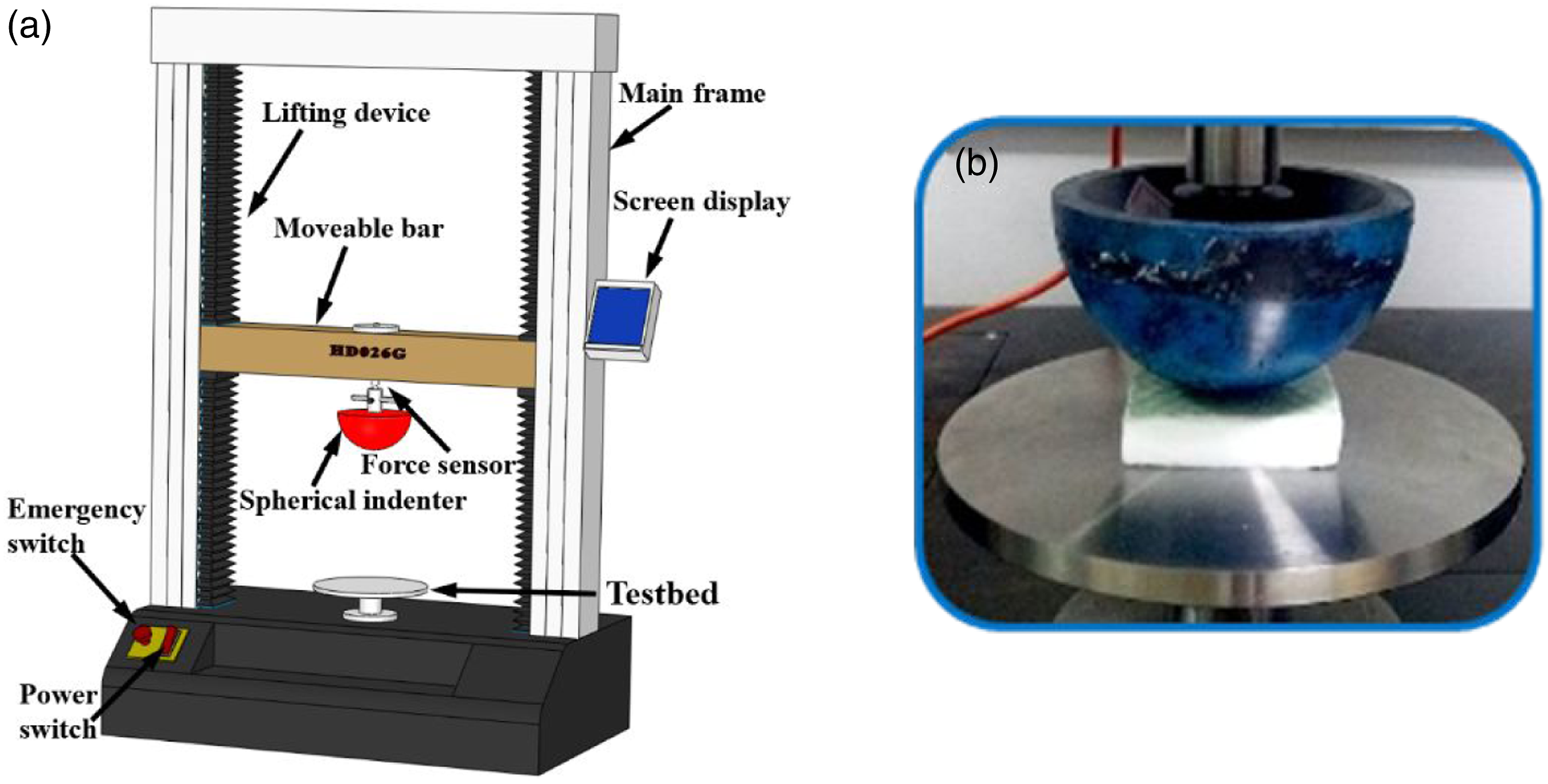
Low-speed impact test
The low-velocity impact tests for WKSF and STF/WKSF composites were conducted using the independently designed and manufactured drop hammer test device which was refitted with reference to the falling hammer system in GB/T 30907-2014. As shown in Figure 3, the impact indenter is a cylinder with a diameter of 45 mm and a mass of 198 g. The total weight of the falling hammer system, including impact indenter, acceleration sensor, force sensor, clump weight, was 8.5 kg. h is the distance between the bottom surface of the impact indenter and the upper surface of the sample, m. In the experiment, the falling hammer system was released free from three different heights of 8, 12 and 16 cm to the center of the specimen, respectively, in an environment of 20°C and 65% relative humidity. The cross-head is assumed to fall without any friction. Five samples for each specification were tested, and the data were processed with variance analysis. There was no significant difference, the data were averaged for each specification. Impact test. (a) Impact instrument, (b) Experimental photo of the impact method.
Results and discussion
Rheological properties of shear thickening fluid
The steady shear responses of the STF at 9%, 14%, 19% and 24% silica mass fractions are shown in Figure 4. It can be observed that the steady shear viscosity is a function of the steady shear rate. The STF has both shear thinning and shear thickening behavior. At low shear rates, the viscosity of STF decreases with the increasing of its shear rate, no matter what the mass fraction of silica is. Then, a sharp increase occurs in viscosity at a critical shear rate, which indicates the presence of a shear thickening effect. The reason for this phenomenon is SiO2 particles tend to agglomerate under fluidic forces to form particle clusters when the shear rate reaches to the critical point. These phenomena validated the hydro-clusters theory discussed in early studies.21–24 At the equilibrium state, silica particles were randomly suspended in the liquid medium PEG. As the shear rate increased, the disorder of the particles increased until they formed a layer structure, which resulted in shear thinning with reduced viscosity. When the shear rate reached a certain critical shear rate that marked the onset of shear thickening, disordered layer structures and particle groups, namely hydro-clusters were formed, causing a dramatic soar in viscosity. The viscosity remained at a plateau phase with high values with the increase shear rate. By increasing the shear rate continuously, the viscosity declined significantly, indicating the end of shear thickening. Shear thickening behavior of STF. (a) Shear thickening behavior of STF with different mass fractions for steady shear flow, (b) Temperature dependent flow behavior of STF with a mass fraction 24%.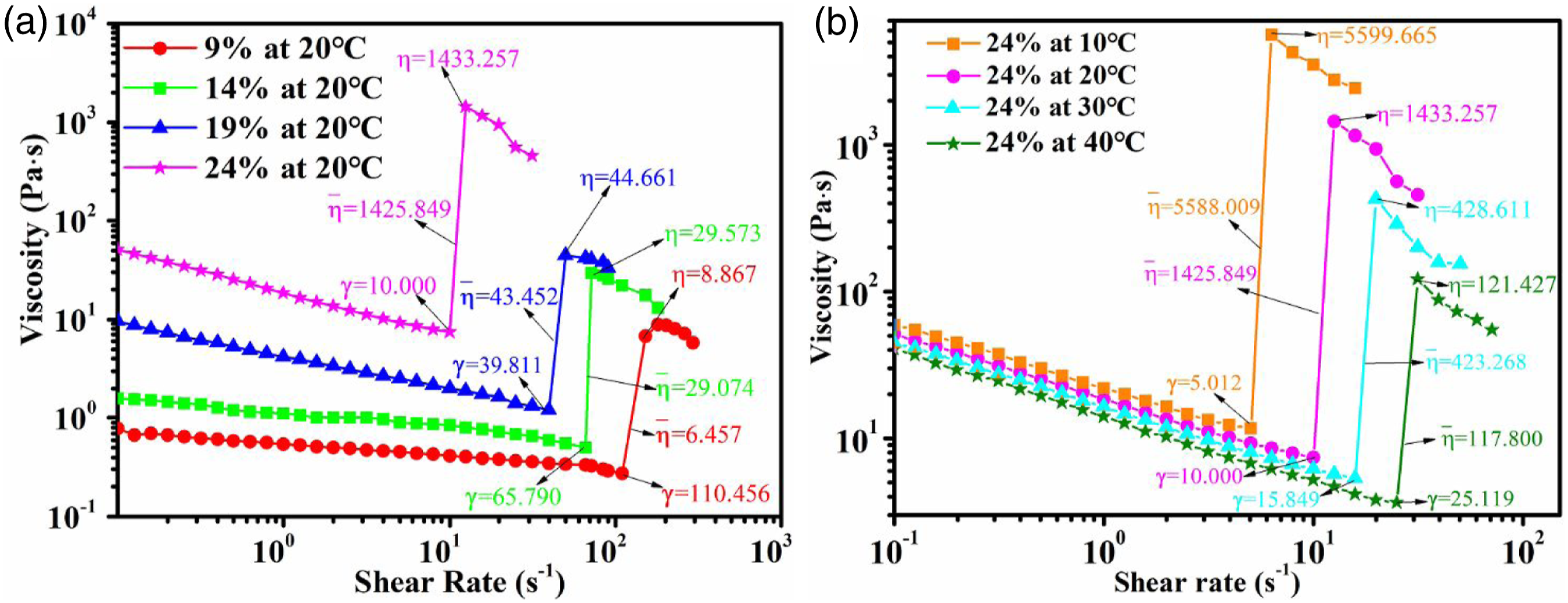
Another notable phenomenon in Figure 4 is that the critical shear rate decreased with increasing particle mass fraction. For example, the shear thickening transition was observed to occur at a shear rate 𝛾 of 110.456 s−1 for the STF having a particle mass fraction of 9% and 10 s−1 for the STF with a particle mass fraction of 24% when the temperature is 20°C. Moreover, the mass fraction of the dispersed phase displayed a great influence on the viscosity η of the dense suspensions. The initial viscosity and the maximum viscosity of the suspensions increased as the mass fraction of silica nanoparticles increased. And suspensions with higher mass fractions of silica nanoparticles exhibited a greater increase in viscosity. For example, the four suspensions are listed as suspension with a mass fraction of 24%, suspension with a mass fraction of 19%, suspension with a mass fraction of 14% and suspension with a mass fraction of 9% in descending order of initial viscosity value. Meanwhile, the viscosity gap
By comparing the shear thickening curves of STF with mass concentration of 24% at different temperature, it can be obtained that the thickening intensity exhibits a loss of performance at higher temperatures. For example, the peak viscosities of STF at 10 (lowest temperature) and 40°C (highest temperature) are found to be 5599.665 and 121.427 Pa·s, respectively, portraying a sharp reduction of ∼98%. The reason is that in a certain range, the higher energy input into the mixtures leads to an increase in the particle motions. Therefore, higher forces are required to collect the silica particles into a group. In addition, the thinning of suspension due to high temperatures reduces the hydrodynamic forces acting on the particles and thus, repulsive forces between the particles cannot be easily overcome for hydro-clustering. 25 Therefore, the viscosity of the STF decreased while the critical shear rate increased.
Compression property
Figure 5 shows typical compression Stress-Strain curves of the spacer fabric sample and STF/WKSF composites at various compression speeds. Figure 5(a) shows that the compression curves of WKSFs are different from those of traditional WKSFs, which do not show typical nonlinear features with a platform stage2,20,26 in the middle segment. This is because the spacer fabric in this experiment is normally compressed. Some compression curves of spacer fabrics have the platform stage because the spacer fabrics are crushed and collapse.2,19,26 These Stress-Strain curves show comparable tendency, which exhibits a mild increase stage and then a sharp increase stage of stress. To facilitate the analysis of the compression behavior of these samples, the compression process is divided into three different stages, i.e., the initial stage (stage I), elastic stage (stage II) and densification stage (stage III), according to the changes in the slope of the curve. Compressive Stress-Strain curves of WKSFs and STF/WKSF composites. (a) Stress-Strain curves of WKSF at various compression speeds, (b) Stress-Strain curves of STF/WKSF composite with mass concentration of 19% at various compression speeds, (c) Stress-Strain curves of WKSF and STF/WKSF composite with a mass concentration of 24% at various compression speeds.
For the WKSF samples, at the initial stage where ε ≤0.1, the stress increases slowly, which is caused by the loose outer layers and ineffective constrained monofilaments. As each loose multifilament stitch around a monofilament cannot tightly constrain the monofilament at this stage, slight slipping of the monofilaments in the outer layers occurs. However, when the fabric is further compressed into stage II, all the compressed multifilament stitches are changed to a fastened microstructure. In this stage, the monofilaments buckle at a larger scale stitch. Consequently, a rapid increase of the compression stress, i.e., a stiffer mechanical behavior of the fabric, is observed. With the increasing compression force, monofilaments and fabrics are squeezed to the maximum extent, and little space is left for them to deform. By this time, the curves enter the sharp increase stage (ε >0.275), and the stress drastically increases, corresponding to a greater strain.
Obviously, the quasi-static compression curve of the STF/WKSF is similar to that of the WKSF as shown in Figure 5(b)–(e). Moreover, Due to the existence of silicon nanoparticles, the compression curves of the STF/WKSF composite are higher than that of the pure WKSF. Besides, STF/WKSF composites with higher mass fractions of silica has higher compressive forces. The main reason for these phenomena is that the strain rate corresponding to the compress speed (
Take the compression behavior of STF/WKSF at the compression speed of 1000 mm/min as an example. The strain rate can be approximated by the equation (1).
In the equations,
When the sample thickness is 12.38 mm, and the compression speed is 1000 mm/min, the compression strain rate is about 1.346 s−1. At this strain rate, STF does not reach its critical shear rate. Therefore, STF does not undergo shear thickening and is only in the shear thinning stage. At this point, STF viscosity tends to a constant value. Therefore, in quasi-static compression, the compressive load of composite material increases mainly because of the reaction force generated by the extruded flow of STF.
Figure 5 also reveals the variation of the Stress-Strain curves of spacer fabrics and STF-impregnated spacer fabrics at different compression rates: as compression rates increase, loads also increase, but the overall trend of the curves does not change. In addition, Figure 5 also shows that regardless of pure WKSF or STF/WKSF composite, the compression Stress-Strain curves increase with the increase of compression speed under the same strain condition. This is mainly because the spacer fabric was squeezed together faster and had no enough time to deform and absorb energy when it was compressed at a higher speed. So, the reaction force was higher. On the contrary, when the spacer fabric was compressed by a slowing force, it can slowly deform and absorb energy. Therefore, the reaction force was small.
Figure 6 shows the Energy-Strain absorption curve of WKSF and STF/WKSF composite materials at the compression speed of 1000 mm/min. It can be seen from Figure 6 that the trends of their compression curves are consistent with those compression curves of WKSFs. What is more, the composite materials absorb more energy with the same strain after the addition of STF and the Energy-Strain absorption curve of composites with more silicon nanoparticles is greater than that of composites with fewer concentrations of shear thickener. However, the increase in STF concentration does not significantly improve the energy absorption performance of composites. This is because the compressive strain rate did not reach the critical shear rate of STF, which could not make STF play the role of energy absorption. While, composites with more silicon nanoparticles need more energy to squeeze STF out. So, the Energy-Strain absorption curve of composites with more silicon nanoparticles is greater than that of composites with fewer concentrations of shear thickener. Quasi-static compression Energy-Strain absorption curve.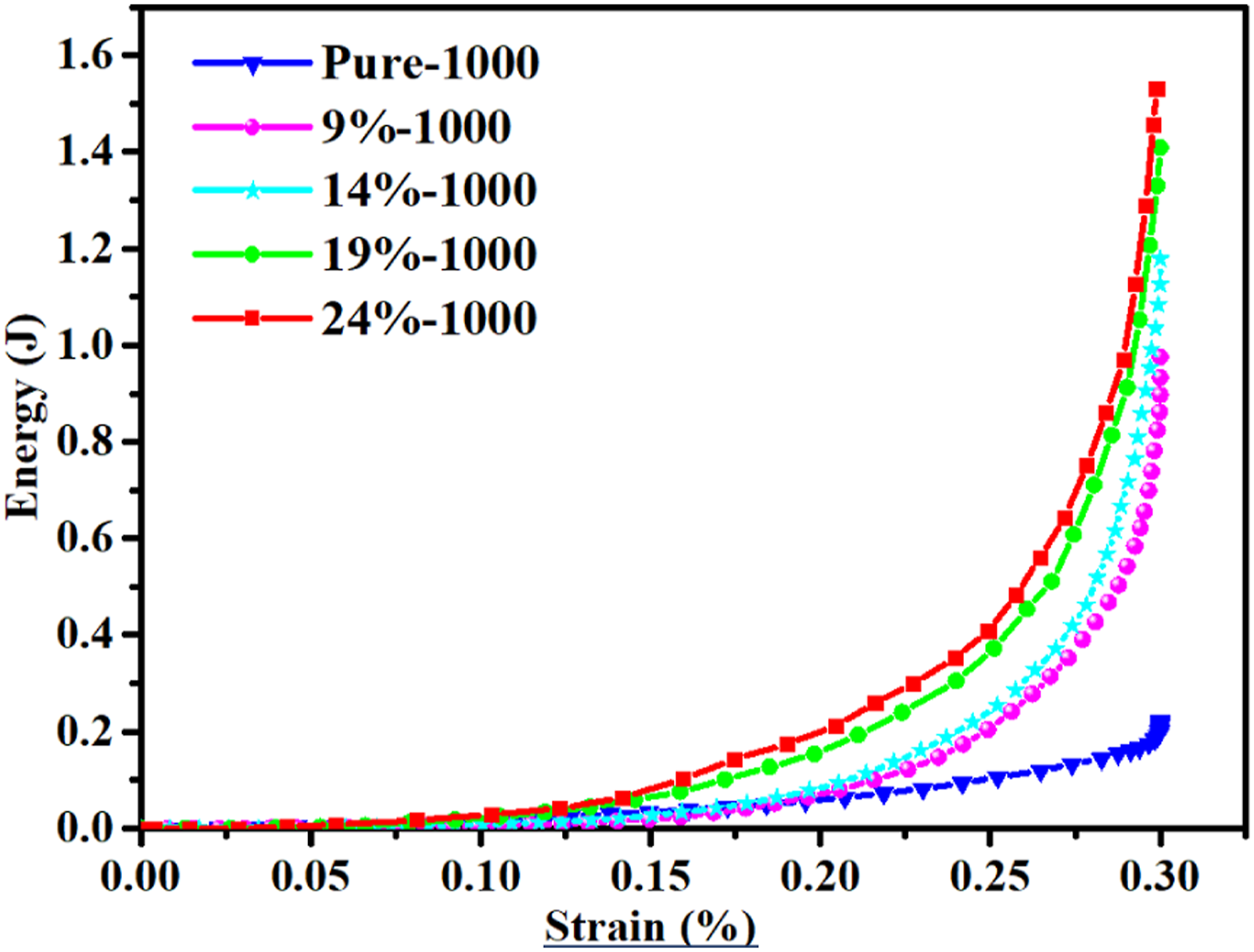
Impact performance
Impact properties of STF/WKSF composite materials
Figure 7 shows Force-Time curve of WKSF and STF/WKSF composites with an impact height of 8 cm. It can be seen from the figure that the impact curve of the STF/WKSF composite material has a great change compared with that of WKSF: (1) The slopes of the composites’ curves become significantly slower, which means the impact modulus indexes of the composites become smaller. (2) The peak load value has a large decrease under the same energy, which means the buffering effect is enhanced. Force-Time curve of WKSF and STF/WKSF composites when the height of the drop hammer is 8 cm.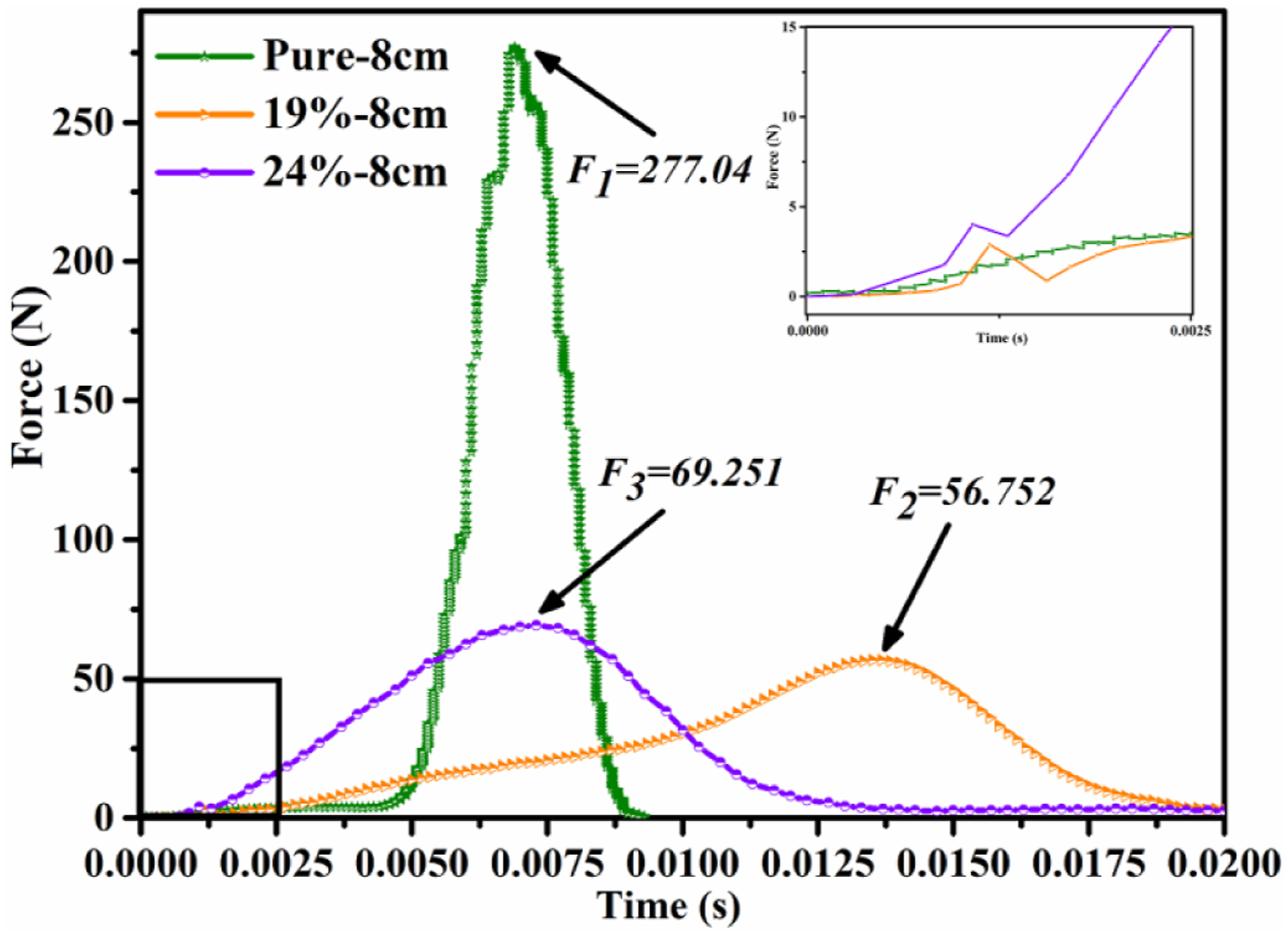
The velocity of the impact head when it just touches the upper surface of the sample was 1.25 m/s when the impact height was 8 cm according to equation (2).
Since the thickness of the STF/WKSF is 12.38 mm, so the characteristic shear rate can be calculated by equation (3).
In the equations,
The velocities of the impact head when it just touches the upper surface of the sample was 1.5 and 1.8 m/s, respectively, when the impact height was 12 and 16 cm, according to equation (2). The corresponding characteristic shear rate of the STF/WKSF composite was 121.16 and 145.40 s−1, respectively.
According to Figure 4, the shear thickening rates of STF/WKSF with mass fractions of 19% and 24% are 39.81 s−1 and 10.00 s−1 at 20°C, respectively. Because the characteristic shear rates of the STF/WKSF composites greatly exceed the critical shear rates of STF, STF thickens. When the composite undergoes impact, all the original gaps in the WKSF are filled by STF, which has a strong binding effect on the movement and buckling of spacer wire. So, the spacer wire is not prone to bend, and the deformation of the sample is significantly reduced. At the same time, STF is an incompressible material, which is not easy to shear flow after being thickened by impact. Therefore, the overall displacement is greatly reduced. Due to the existence of STF and its binding to spacer wire, the bearing capacity of STF/WKSF composites is stronger than that of pure spacer fabric. Under the same displacement, the load values of the STF/WKSF composites are higher than that of the pure WKSF. Since the composite materials absorb a lot of energy in the first stage, their peak load is reduced.
Influence of the impact properties of STF/WKSF composites
Figure 8 shows the Force-Time curves of STF/WKSF composites with the mass fraction of 19% and 24% when the impact height is 8, 12 and 16 cm, respectively. The gravitational potential energy of the free-falling system from these three heights is 6.664, 9.996, 13.328J, respectively. As seen from the figure, the peak load values of the composites’ curves increase with increasing gravitational potential energy. Compared with static compression, there is no transition period of low modulus in the low-velocity impact process. This is because the STF become hard after being impacted. What’s more, the greater the velocity acting on the fluid, the easier it is for the particles in the system to aggregate in large quantities. At the same time, Figure 8 also reveals that the higher the mass fraction of silica in the STF by no means is the better the energy absorption and buffering performance of the composite material. To be exact, in a certain range, the energy absorption of composites becomes more excellent with the increasing silica mass fraction. However, over a certain range, the energy absorption of the composite decreases with the increasing of the mass fraction of silica. That’s because too much silica makes the composite too hard. When the composite material with higher mass fraction is impacted, its reaction force is greater. Force-Time curve of STF composite at different impact heights.
By comparing Figure 7 with Figure 8, it can be seen that, in the beginning, the impact curve of composite material will fluctuate to some extent with the increasing impact velocity. In the subsequent stage, the stiffness of the material also increases with the increase impact velocity. That is, STF/WKSF has an obvious strain rate effect and is a strain rate sensitive material.
Since STFs having mass fractions of 9% and 14% own smaller viscosity and bigger critical shear rate compared with another two kinds of STFs, it can be predicted that the impact curves of STF/WKSFs with mass fractions of 9% and 14% at various velocities should be in the middle of those of WKSFs and composites with a mass fraction of 19% and impact curve of STF/WKSFs with a mass fraction of 14% is higher than the curves of STF/WKSFs with a mass fraction of 9%. Besides, the trends of their impact curves are consistent with those impact curves of WKSFs. Moreover, the impact Force-Time curves increase with the increase of impact higher under the same strain condition.
Conclusion
Compression test and low-velocity impact behavior of WKSF and STF-filled WKSF composites were tested to investigate the relieving pressure property of STF-filled WKSF composites as a protective material for the human body. The rheological properties of the STF were also tested to reveal the shear thickening effect under compression force and impact loading. The compression Stress-Strain curves and impact Force-Time curves of WKSF and the STF-filled WKSF were obtained. It was found that: 1. In the steady rheological test, the STF experiences a shear thickening transition at a critical shear rate. The critical shear rate decreases with the increase of silica mass fraction. The thickening intensity of STF exhibits a loss of performance at higher temperatures. 2. The compression curves of STF/WKSF composites were basically consistent with those of WKSFs, which include initial stage, elastic stage and compaction stage. In the low-speed compression test, as the compression speed increases, the overall compression stress values of WKSF and STF/WKSF increase. Moreover, the compression stress of composite increases with the increase of silica mass fraction. Compared with WKSFs, STF/WKSF composites need more work to deform under the same strain. All the compression Stress-Strain curves of WKSFs and STF/WKSFs increase with the increase of compression speed under the same strain condition. 3. STF/WKSF composites show different buffering performances when impacted by a different energy. The impact elastic modulus index of the STF/WKSF composites increases with the increase of impact energy. The energy absorbed by the STF/WKSFs were greater than those absorbed by the WKSFs. Especially in the impact test, STF/WKSF can absorb more energy and keep the peak load at a low level. In a certain range, the energy absorption of composites becomes more excellent with the increasing silica mass fraction. However, over a certain range, the energy absorption of the composite decreases with the increasing of the mass fraction of silica. Thus, STF/WKSF can be a damping material for personnel protection. And the mass fraction of silica in the composite should not exceed 19%.
Although STF filled spacer fabrics would provide improved protective performance against low impact velocity or compression load, the superiority of the STF treatment was not evident considering the resulted weight gain. Besides, the time effect of hardening of STF was not studied. In our following study, the composition and weight of suspensions will be optimized and the time effect of STF hardening will be discussed deeply.
Footnotes
Declaration of conflicting interests
The author(s) declared no potential conflicts of interest with respect to the research, authorship, and/or publication of this article.
Funding
This work is jointly supported by Natural Science Foundation Project of Shanghai “science and technology innovation action plan” (22ZR1400500, 20ZR1400200), “the Fundamental Research Funds for the Central Universities (2232021G-06, CUSF-DH-D-2018036),” and supported by Project (Grant 52173218) supported by National Natural Science Foundation of China, by Fujian Provincial Key Laboratory of Textiles Inspection Technology (Fujian Fiber Inspection Center) of China (2021-MXJ-01), Shanghai Frontier Science Research Center for Modern Textiles, Donghua University (2022).
