




Abstract
This paper reports the preparation of auxetic warp-knitted spacer fabric impregnated with shear thickening fluid and studied its impact behavior under low-velocity impact loading. The shear thickening fluids have been prepared by mechanically dispersing 12 nm silica particles with weight fraction of 10, 15, 20, and 25% in various carriers (PEG200, PEG400, and PEG600). Rheological results indicate that shear thickening fluid experiences shear thickening transition at a specific shear rate. The critical shear rate reduces, and initial viscosity and maximum viscosity increase with the increase of silica weight fraction. The higher molecular weight of polyethylene glycols can lead to lower critical shear rate. The impact process of composite under impact loading can be divided into three stages. The warp-knitted spacer fabric with different negative Poisson’s ratio has a significant effect on the impact behavior. The warp-knitted spacer fabric with better auxetic performance endows composite better impact resistance, the specific performance is the deformation depth, and energy absorption and peak load increase with the increase of auxetic effect of fabric. The silica weight fraction of shear thickening fluid can increase the energy absorption of composite due to the shear thickening transition of shear thickening fluid. Shear thickening fluid has a synergistic effect with the auxetic warp-knitted spacer fabric on impact resistance of composite. The various carriers have no obvious influence on the overall energy absorption and impact load of composites.
Keywords
Introduction
Materials with negative Poisson’s ratio (NPR) effect are called auxetic materials. They shrink in the transverse when subjected to compression in a perpendicular direction and expand in the crosswise when tensile is stretched in the longitudinal direction; these materials also can generate concentrate when subjected to impact [1]. These features endowed this material with excellent mechanical properties, such as shear resistance [2,3], indentation resistance [4,5], and hyperbolicity [6,7]. Auxetic materials are widely applied in the manufacture of protective equipment, aerospace field, automotive industry, national defense industry, and so on. Knitted structures occupy a special position in composite preforming due to their inimitable characteristics [8]. Warp-knitted spacer fabrics (WKSF) were knitted on double-needle Raschel machine, which consisted of two separate fabric layers connected with vertically pile yarns. Combination of its unique structure, WKSFs are endowed with good air and moisture permeability, sound absorption, acoustical insulation, compression elasticity, structural integrity, and formability, which make WKSF widely applied in shaped shoe materials [9], garment fabrics, automotive, safety, and protection materials [10–12]. Auxetic WKSF is made up of WKSF and auxetic rotational hexagonal structure. This fabric was first fabricated by Ma et al. [13,14]. Then, they studied the tensile and impact resistance properties of this sample, and they found that the auxetic structure can enhance sample’s tensile and impact resistance [15,16].
Shear thickening fluid (STF) is a non-Newtonian fluid, whose viscosity reduces with the increase of shear rate at low shear rate and increases abruptly after achieving a critical shear rate. Several researchers have attached more attention on STF, because it can increase the stab resistance [17,18], the yarn pull-out force [19–21], and impact resistance [22,23] of high-performance fabrics. Composites made by STF and reinforcements have attached considerable attention in several years. Fu et al. [24] study the low-velocity impact behavior of an STF and STF-filled sandwich composite panels. They found that STF-filled sandwich composite panels exhibited much higher energy absorption capacity than neat sandwich composite panels. Lu et al. [25] focused on the compressive behavior of WKSFs impregnated with STF under quasi-static compression. They found that the STF-impregnated WKSF can be used as damping material for personal protection due to its higher energy absorption. Xu et al. [26] explored the stabbing resistance of body armor panels impregnated with STF. They found that the STF can be used to improve stabbing resistance of soft ballistic body armor, because STF can improve the fraction coefficient of yarns and the energy absorption properties of composite. Gürgen et al. [27] studied the ballistic performance of aramid-based fabrics impregnated with multi-phase STFs. They found that multi-phase STFs can improve the ballistic performance of high performance fabrics in comparison to single-phase STFs. However, the mass efficiency of fabrics has a loss of performance for high velocity impact conditions. Majumdar et al. [28] studied the high velocity impact properties of 3D-woven aramid fabrics reinforced with STF. They found that soft body armor panels can be developed by tuning the structure of 3D-woven orthogonal aramid fabrics and reinforcing them with STF. Also, synergistic effect of 3D-woven fabric structure and reinforcement of STF was found to be the key for successful design of soft body armor.
It seems to be clear that STF is able to enhance the low-velocity impact resistance, compression, and stabbing resistance of composites. However, composite prepared by shearing thickening fluid and auxetic warp-knitted spacer fabric is still beyond our attention. The research described in this paper aimed to investigate the low-velocity impact behavior of composite. This composite can be used for soft protective materials. In addition, the effects of rheological behavior of STF and NPR of WKSF on the impact resistance of the composite were also studied.
Materials and experimental
Auxetic WKSF
The auxetic WKSFs based on rotational hexagonal structure [13], as shown in Figure 1, were produced on RD7/2-12EN type of double-needle bar Raschel warp-knitting machine (German Karl Mayer, supplied by Huayu Knitting Co. Ltd. in Jingjing, China). The machine gauge was E22. The 200D/96F polyester multifilament was used to create hexagonal mesh structure in the knitting process through guide bar 1 and guide bar 2 (GB1, GB2) for the top outer layer and guide bar 6 and guide bar 7 (GB6, GB7) for the bottom outer layer. The 100 D/96F polyester multifilament was used to form rotating hexagonal meshes through guide bar 3 and guide bar 5 (GB3 and GB5). The polyester monofilament of 0.09 mm in diameter was used to connect the two outer layers together through guide bar 4 (GB4). In the knitting process, the chain notations for yarn movements are shown in Table 1. The chain notation is the number of pattern chain block, such as 2-3-3-3 in GB1. The first and second values 2-3 are the overlap of the front needle bar, the third and fourth values 3-3 are the overlap of the back needle bar, and the second and third values 3-3 are the underlap of the guide bar. “2-3-3-3” is a complete horizontal knitting. The thickness of fabric was 5 mm, wale stitch density was 12 courses/cm, and course stitch density was 10 wales/cm. Then, set the heat setting parameters (R-3 baking machine, 150°C, 120 s) for heat setting to make fabric shrink, deflect regularly, and to make fabrics with different auxetic effect. The fabric structure before and after heat setting was shown in Figure 2. It can be concluded that samples would have a smaller angle between two ribs and with much compactness after heat setting.
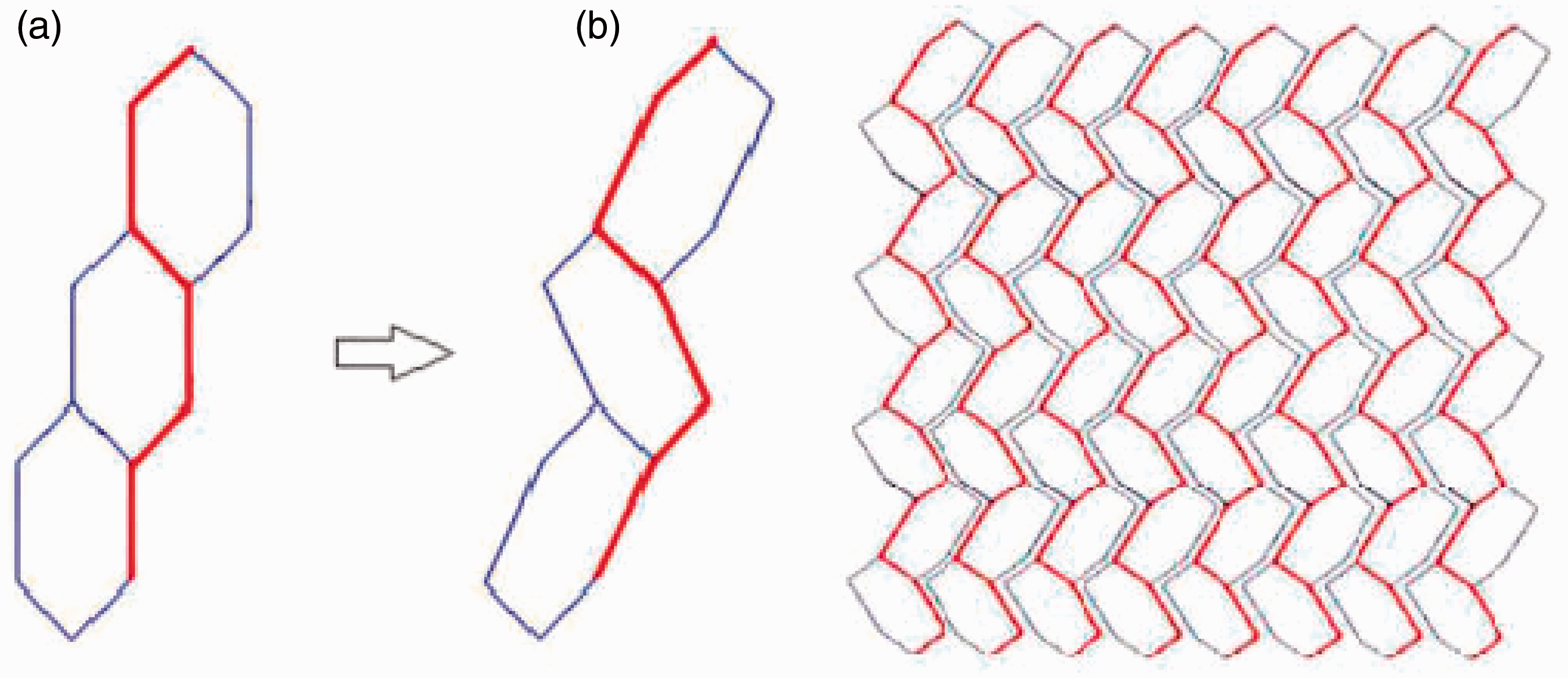
(a) Rotate hexagonal structure unit; (b) hexagonal mesh rotation structure [14].
Chain notation of auxetic warp-knitted spacer fabric.


Comparison of top and lateral views of fabric structure [16].
Poisson’s ratio value test
Poisson’s ratio is defined as the negative value of the ratio of the strain perpendicular to the load direction and the strain along the load direction. Samples were used for Poisson’s ratio value test with width of 100 mm and height of 150 mm. The measurement method was shown in Figure 3(a). The samples were first marked two points in the wale direction and course direction. The initial distance between two marks in the horizontal direction is x0 and in the vertical direction y0. In order to minimize the edge effect of the clamps, the measuring points were taken from the middle part of the sample. Then, we fixed the sample’s one side and tensile another side, ensuring the increment in the tensile direction by 1 mm, recording the length yn, xn and calculating the wale and course strains, following the formulation
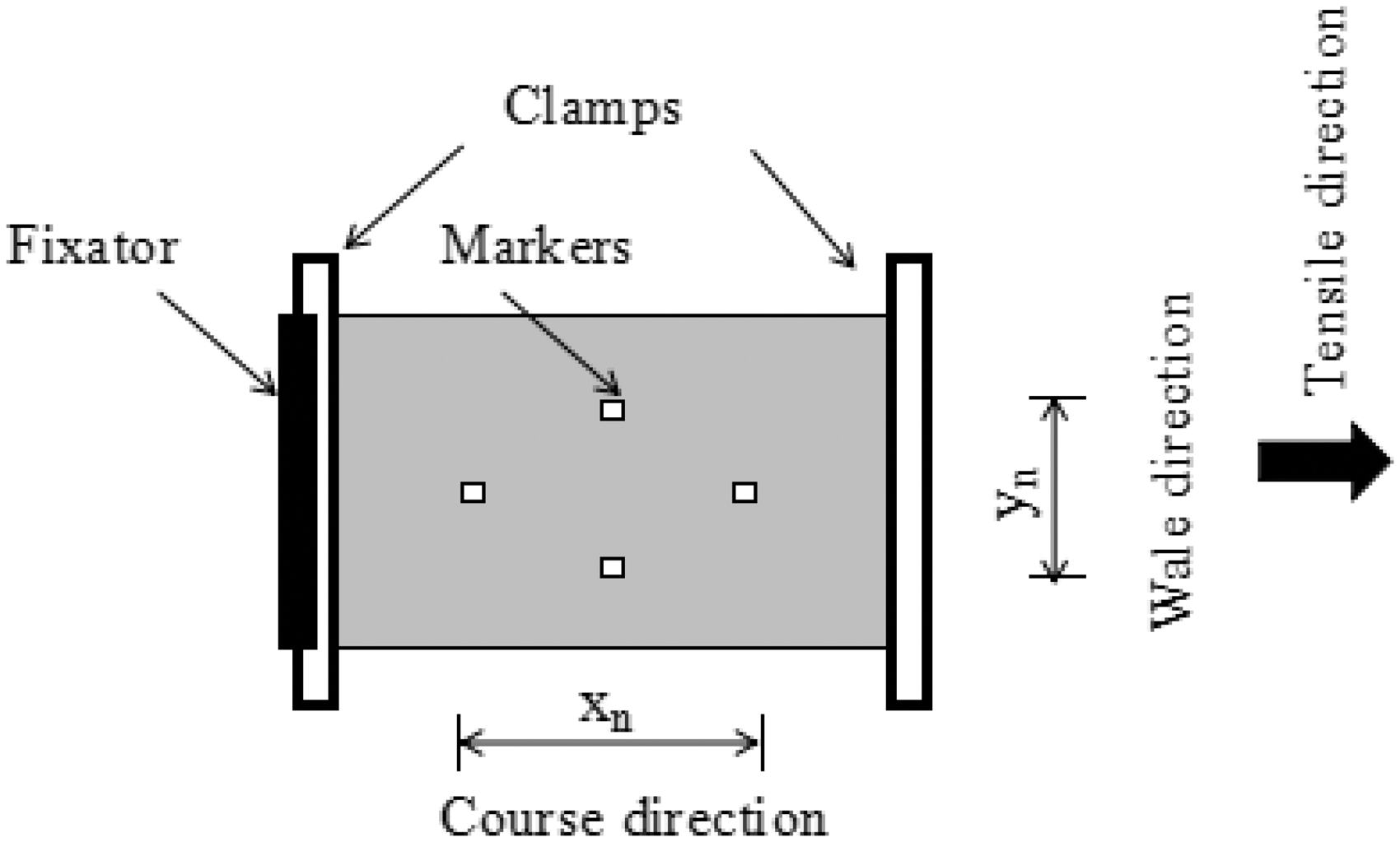
Scheme of the testing method.
Average Poison’s ratio value.

STF preparation and rheological test
The STFs consist of nanoparticles and carrier: the fumed silica (Degussa Corporation, Akron, OH) with particle size of 12 nm and a specific surface area of approximately 200 m2/g. The polyethylene glycol (PEG) (Sino pharm Chemical Reagent Co., Ltd) was chosen as a carrier with molecular weights (PEG200, PEG400, and PEG600). Each STF sample was manufactured by adding the nano-particles into the PEG in a blender and mixed until needed STF was obtained. The prepared STFs were first placed in an ultrasonic seismograph at room temperature for 2 h and then placed in a vacuum chamber for 12 h to remove the bubbles. The STFs with four different weight fractions were prepared for rheological test.
Rheological test was conducted on rheometer DISCOVERY HR3 (TA Instruments-Waters LLC), as shown in Figure 4, with the diameter of 20 mm in parallel-plate, the environment of 20°C, and the relative humidity of 65%. The dynamic oscillation strain sweeps and the steady-state strain rate sweeps of STFs were measured.

Photographs of rheological tester.
Composite preparation and low-velocity impact test
The auxetic WKSF could be cut into different sizes with length × width = 150 mm × 100 mm and then immersed in STF for 5 min. Later, remove the excess STF outside auxetic spacer fabric. Figure 5 shows the composite prepared by STF and auxetic WKSF. Table 3 shows the composite samples. Low-velocity impact tests are conducted on a drop-weight impact tester Instron Dynatup 9250HV device (Instron Corporation, USA), as shown in Figure 6(a), in an environment of 20°C and a relative humidity of 65%. The pounding head of the device is hemispheric with 12.8 mm in diameter, and the weight of the striker is 6.234 kg. All impact velocity is 1.5 m/s, and corresponding impact energy is 7.013 J. As shown in Figure 6(b), the composite was fixed on the fixture. The pounding head was released and dropped along a vertically guided path into the composite during the test process.

Top view of STF-impregnated auxetic WKSF.
Composite samples.

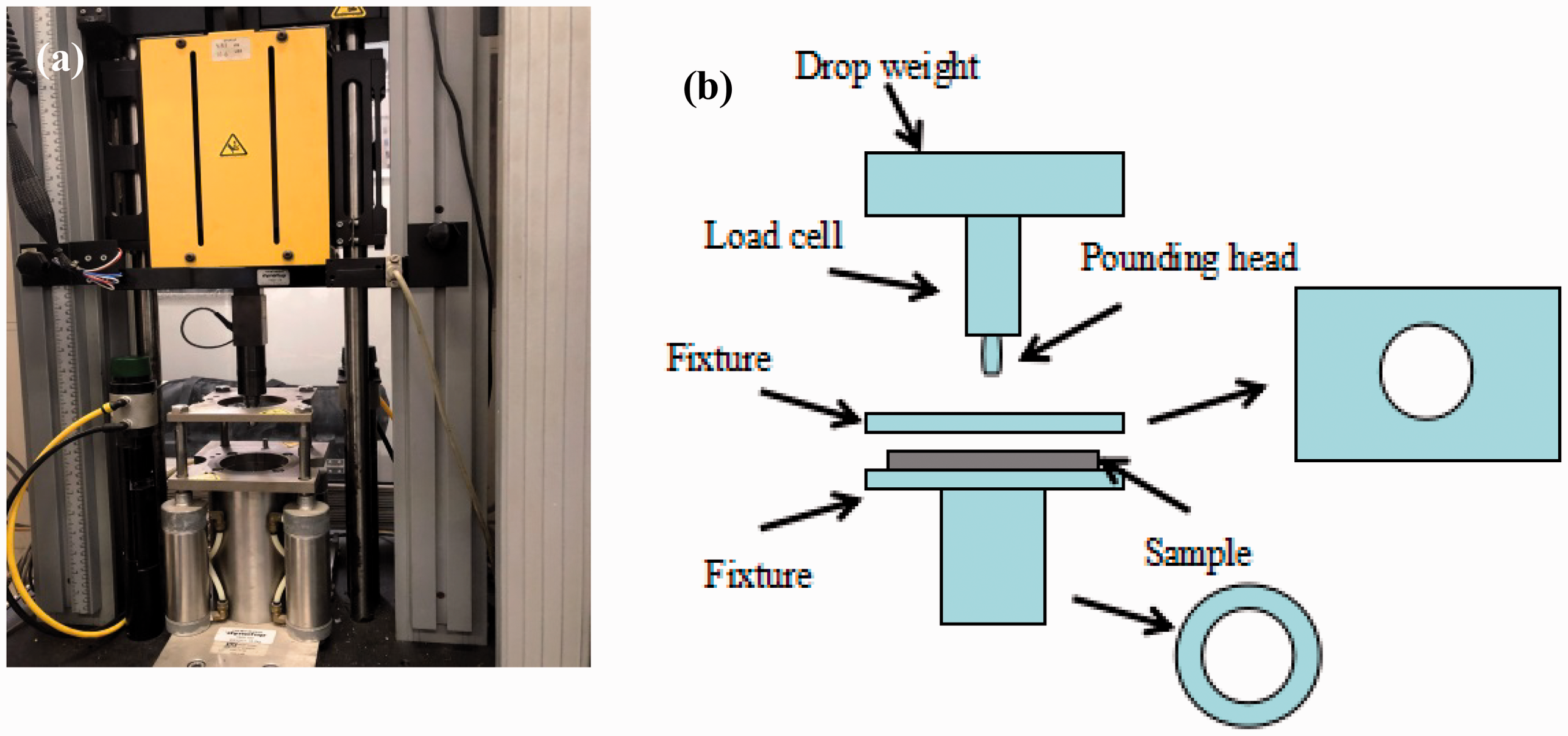
Photographs of INSTRON 9250 tester.
Results and discussion
Poisson’s ratio of WKSF
Poisson’s ratio of WKSF is shown in Table 2. Table 2 shows that the Poisson’s ratio of the warp knitted spacer fabric is related to GB4. Fabric 4# has best auxetic effect compared to fabrics 1#–3#. This is because the inlay direction of yarn has an impact on the rotation deformation of fabric surface structure. From the chain notation of GB4, the spacer yarn of fabric 4# is continuously synthetic laying in the first six rows and reverse laying in the last six rows, which is more conducive to the rotation deformation of the hexagonal mesh on the surface fabric. That is to say, it is more favorable to obtain the NPR effect.
Rheological properties of STF
The steady-state shear behavior of the STF at 10, 15, 20, and 25 wt% is shown in Figure 7(a)-1. It can be concluded that all plots consist of three zones from Figure 7(a)-2. Take mass fraction 25% STF as an example. The zone I is shear thinning zone, where viscosity reduces with the increase of the shear rate. The zone II is shear thickening zone, where viscosity increases abruptly after shear rate reached critical shear rate. The zone III is shear thinning zone, where viscosity reduces again moderately with the increase of the shear rate. It is suggested that the viscosity decreases first before the shear rate reached the critical shear rate and then increases abruptly at the critical shear rate. Finally, the viscosity decreases again moderately with the increase of the shear rate. The rheological behavior is also observed to be silica weight fraction-dependent. The critical shear rate reduces, and initial viscosity and maximum viscosity increase with the increase of silica weight fraction [25], as shown in Figure 7(b). This implies that jamming of silica particles becomes easier at higher silica weight fraction, and thus lower shear rate is needed to induce jamming of silica particles [29]. The rheological behavior of STF with different carrier is shown in Figure 7(c)-1. Take the STF (mass fraction 20%, PEG 200) as an example, the critical shear rate (γc) and maximum viscosity (ηmax) have been marked in Figure 7(c)-2. The critical shear rate reduces, and the maximum viscosity increases with the increase of molecular weight of PEG. This concludes that larger molecular weight of PEG makes jamming of silica particles easily.

(a)-1 shear thickening behavior of STF with different weight fraction for steady shear rate; (a)-2 shear thickening behavior of STF with weight fraction 25%; (b) shear rate and viscosity versus mass fraction; (c)-1 shear thickening behavior of STF with different carrier for steady shear rate; (c)-2 shear thickening behavior of STF with PEG 200; (d) modulus versus oscillation strain of STF.
The dynamic oscillation strain sweep of STF was preformed from low to high strain at the constant angular frequency of 45 rad/s. Dynamic oscillation strain sweep shows the viscoelasticity of STF. When the loss modulus of the system is greater than the storage modulus, the system behaves as viscosity; otherwise, it behaves as elasticity. The dynamic properties in terms of storage modulus G′ and loss modulus G″ are shown in Figure 7(d). It can be concluded that the storage modulus first decreases and then increases abruptly after reaching critical oscillation strain (critical oscillation strain (γCos) marked in Figure 7(d)), but the loss modulus increases slowly before oscillation strain unreached critical oscillation strain. Additionally, loss modulus was observed to be higher than storage modulus after oscillation strain reached 10%, which indicated that STF exhibits both different stiffness and damping characteristic [30]. This implies that STF can be used to manufacture energy absorption materials.
Low-velocity impact behavior of composite
The low-velocity impact test of the NPR WKSF impregnated with STF composite material is carried out. The whole impact process includes three stages: the first stage, a certain mass of drop hammer moves freely at a specified height to convert the gravitational potential energy into kinetic energy; the second stage, with the drop hammer dropping freely, the drop hammer’s speed reaches the maximum value when it just contacts the composite material. In the process of the drop hammer contacting the composite, the drop hammer speed decreases gradually. When the drop hammer speed is zero, the drop hammer falls to the lowest point and completes the impact; in the second stage of the drop hammer impacting the composite, the composite unfolds gradually with absorbing energy. In the third stage, the falling hammer is blocked by the secondary impact protection device.
The low-velocity impact behavior of composites prepared by STF (20 wt%, PEG200) and different auxetic fabric under same impact velocity is shown in Figure 8(a) and (b). It can be seen from Figure 8(a) that the deflection–load curve of the composite shows great fluctuation in the initial stage of impact, which is mainly because STF is strain rate-sensitive material, and STF has shear thickening phenomenon under the impact load. The particle clusters in STF dispersion system gather in a short time, which makes the stiffness of the composite larger. As the impact process continues, the impact resistance of the composite mainly depends on the performance of the reinforced fabric, that is, the NPR effect of the fabric. Combining the measured values of NPR, conclusions can be drawn from Figure 8(a) that samples with higher NPR value can undergo larger impact load. This is because the samples with better auxetic performance would have denser face structure [31]; therefore, it could have better impact resistance. Energy absorption–deflection curve of composite (1#–4#) is shown in Figure 8(b). It is obvious that slopes of energy absorption–deflection curve increase gradually, suggesting that impact energy is absorbed by composites faster and faster, and it can also be seen with the composite 4# with highest energy absorption. Fabric with higher NPR would have smaller θ (shows in Figure 2); therefore, the fabric would have denser structure and more structure units per square meter. When the pounding head impact the composite, the soft composite would expend the deflective hexagonal structure to ordinary hexagonal structure. Therefore, composite with higher NPR would resist higher impact load and have longer deflection. Meanwhile, the energy absorption is mainly resulted from the deformation of auxetic structure [32], so it can be concluded that samples with higher NPR can absorb more energy under impact.
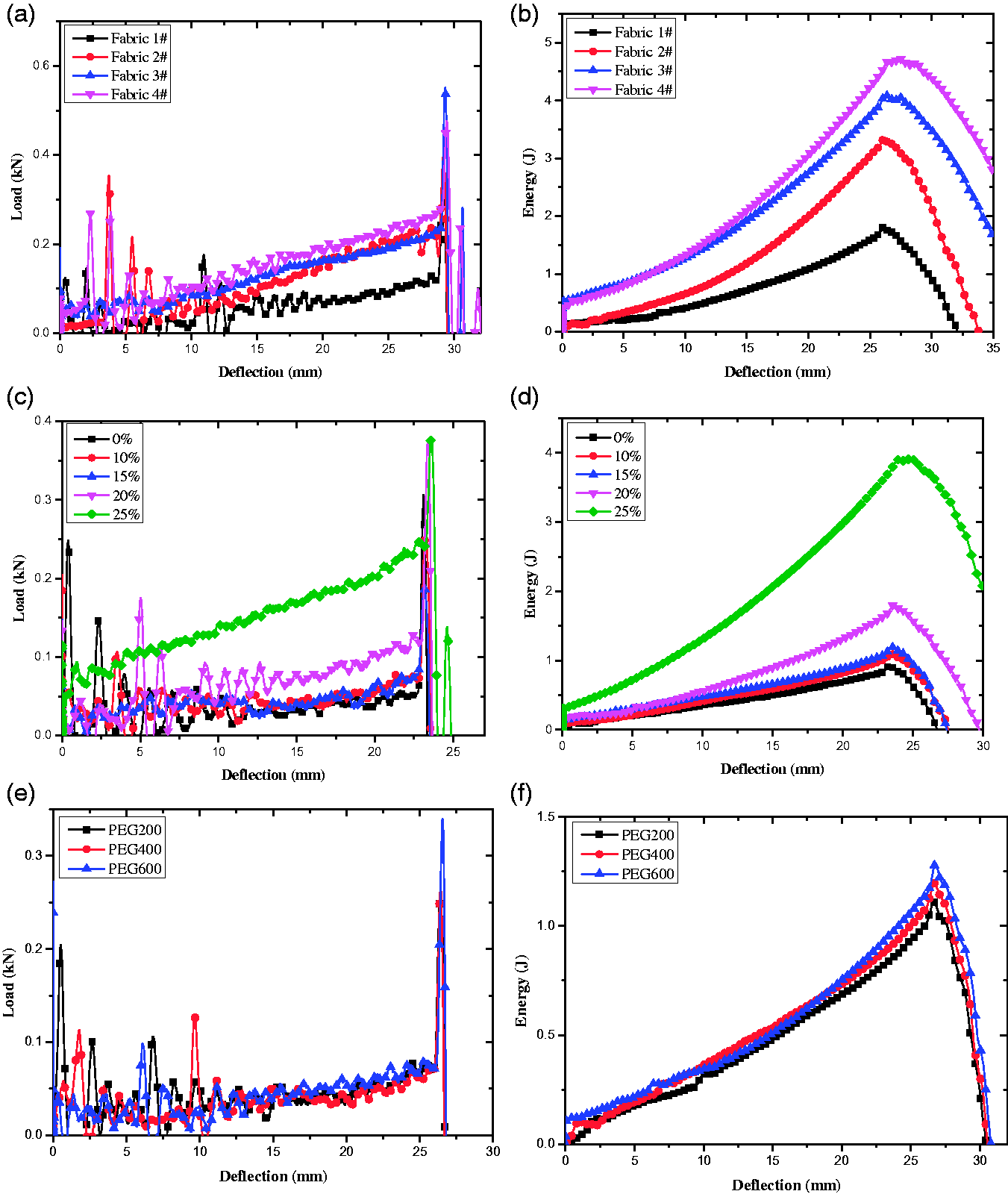
(a) Impact load–deflection curves for STF-impregnated WKSF with various auxetic performances; (b) energy absorption–deflection curves for STF-impregnated WKSF with various auxetic performances; (c) impact load–deflection curves for WKSF impregnated with STF with various weight fractions; (d) energy absorption–deflection curves for WKSF impregnated with STF with various weight fractions; (e) impact load–deflection curves for WKSF impregnated with STF with various disperse systems; (f) energy absorption–deflection curves for WKSF impregnated with STF with various carriers.
The STF made by 12 nm silica nanoparticles and PEG200 were created with particle weight fraction of 10, 15, 20, and 25%. For a given particle size, it was found that the viscosity of STF increases abruptly with the increase of the particle weight fraction when a shear rate equal to or above the critical shear rate. The auxetic fabrics with same NPR impregnated with STFs (10, 15, 20, and 25 wt%), and neat fabrics were conducted on same condition to study their low-velocity impact properties. Figure 8(c) and (d) shows the impact of load–deflection curve and energy absorption–deflection curve; it can be drawn that the STF can enhance the impact load and energy absorption when compared to the composite and neat fabric. Meanwhile, the impact load values and energy absorption also increase with the increase of silica weight fraction. The main reason is that STF with more silicon nanoparticles would be easier to occur shear thickening and could result in more thickening. This confirms that higher weight fraction of STF can result in better impact resistance in terms of maximum impact load and energy absorption [33].
Figure 8(e) and (f) shows the deflection–load and deflection–energy absorption curves of soft composite (WKSF impregnated with STF (20 wt %, PEG200, PEG400, PEG600)). It can be found from the deflection–load curve and deflection–energy absorption curve that impact load and energy absorption are close, which means that various disperse systems have no obvious effect on the impact load and energy absorption of composites under impact.
Deformation behavior of composite
As shown in Figure 9, the deformation process of sample during the impact process can be easily detected from the views of sample’s top morphology. When the impact head hits auxetic WKSF impregnated with STF, the deformation of the auxetic WKSF starts from the contact point, as shown in Figure 9(a), expanding gradually the rotating hexagonal mesh structure to honeycomb meshes, as shown in Figure 9(b) to (d). The impact energy is first absorbed through deformation of rotating hexagonal mesh and then absorbed through the STF and intrinsic deformation of WKSF. When the auxetic structure expanded absolutely, the STF existed in WKSF experience shear thickening transition under impact load. The WKSF with better auxetic effect has more rotational hexagonal structure in unit area and needs longer time to expend absolutely.
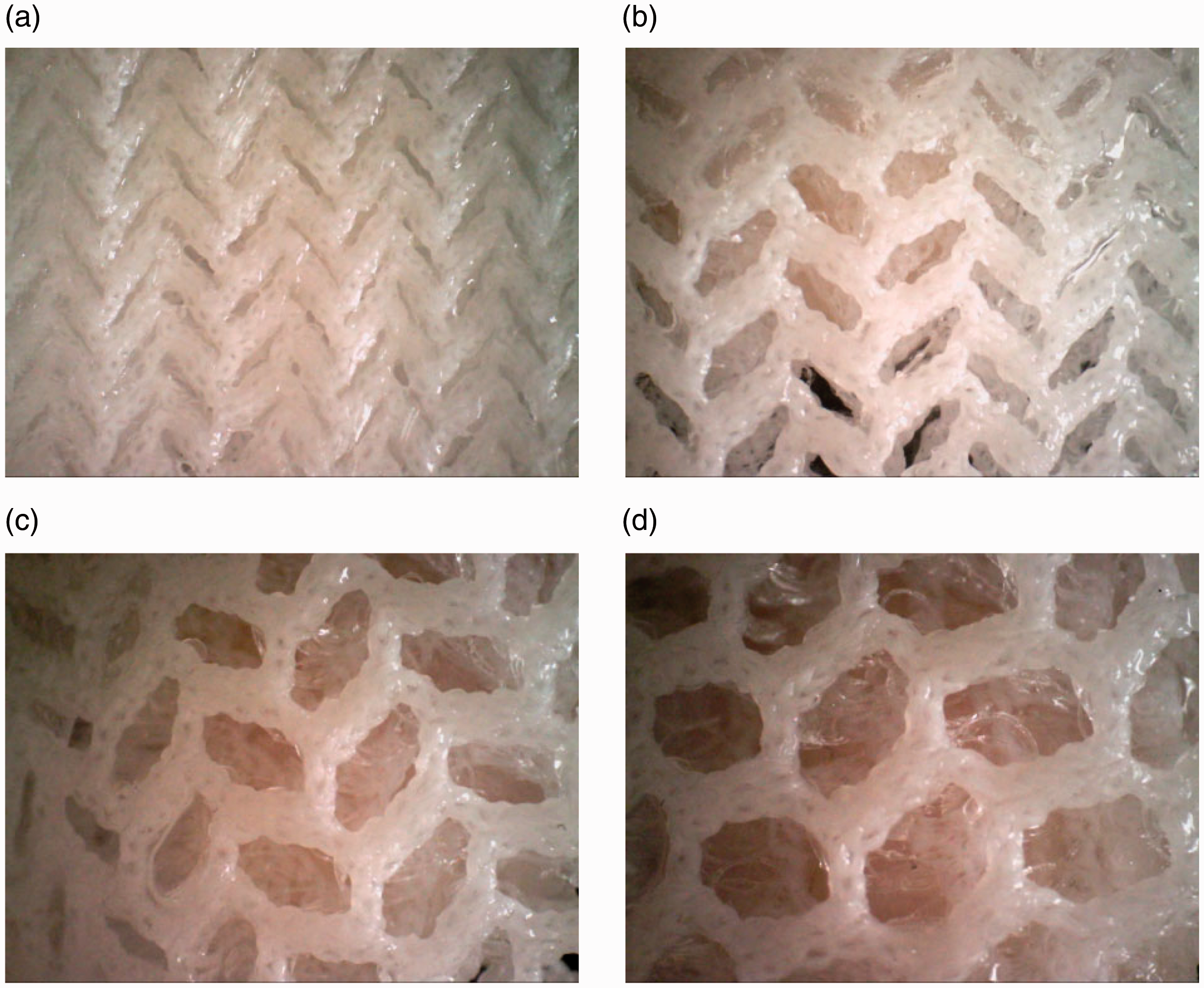
The deformation process of STF-impregnated WKSF/NPR under impact.
The top and bottom morphologies of composites after impacts are shown in Figure 10, and we can draw that the rotational hexagon structure of four composites has been expended, and the bottom morphologies of all samples have no obvious differences. As shown in Figure 11, deformation extent of four composites after same initial impact velocity can be easily detected from the profile morphologies of four composites. The maximum deformation depth with composite #1, composite #2, composite #3, and composite #4 has a maximum depth of 19, 21, 23, and 25 mm, respectively. That means that the maximum vertical depth of all composites increases with the increase of NPR.

The top and bottom morphologies of STF-impregnated WKSF/NPR after impact.

The profile morphology of STF-impregnated WKSF/NPR after impact.
Conclusions
The low-velocity impact behaviors of auxetic WKSF impregnated with STF were conducted to study the impact resistance and energy absorption properties. The rheological behaviors of STF were tested to prove the shear thickening effect under low-velocity impact. The impact load–deflection curves and energy absorption–deflection curves were obtained. It was found that: In the steady rheological test, the STF experiences shear thickening transition at critical shear rate. The critical shear rate reduces, and initial viscosity and maximum viscosity increase with the increase of silica weight fraction. And the molecular weight of PEGs can make critical shear rate smaller but have a slight influence on the maximum viscosity. The dynamic rheological test shows that STF exhibits both different stiffness and damping characteristic. The impact process of composite under impact loading can be divided into three stages. In the first stage, the deformation of the composite is completed, and the second stage is the main energy absorption stage of composite. The WKSF with better auxetic performance endows composite better impact resistance, and the specific performance is composite after impact with longer deformation depth, higher energy absorption, and peak load. The silica weight fraction of STF can increase the energy absorption of composite due to the shear thickening transition of STF. The main reason is that the shear thickener will absorb the impact energy after thickening effect, which has a synergistic effect with the auxetic warp-knitted spacer fabric. The various carriers have no obvious influence on the overall energy absorption and impact load of composites.
Footnotes
Declaration of conflicting interests
The author(s) declared no potential conflicts of interest with respect to the research, authorship, and/or publication of this article.
Funding
The author(s) disclosed receipt of the following financial support for the research, authorship, and/or publication of this article: the National Key R&D Program of China (2017YFB1103400), the National Science Funds of China (11972172), the Fundamental Research Funds for the Central Universities (JUSRP22026, JUSRP52013B), Postgraduate Research & Practice Innovation Program of Jiangsu Province (KYCX19_1875), and a Project Funded by the Priority Academic Program Development of Jiangsu Higher Education Institutions (PAP).
