




Abstract
Motorsports athletes compete at high speeds for, on average, three to four hours in a cockpit that can reach temperatures of 50°C. While engineers have worked to create a faster car and safer conditions, the comfort of the driver is often sacrificed. Motorsports governing bodies require that a driver’s racing suit meet at least one of several certification levels for thermal protection. While much research and testing go into certification, there continues to be a lack of information in the body of research regarding the impact of the racing suit on thermal comfort and heat stress. Therefore, the purpose of this research was to determine the impact of auto-racing personal protective clothing on the thermal comfort of race car drivers by utilizing a thermal manikin to observe the thermal insulation, evaporative resistance, and total heat loss (THL) of standard racing suits. Racing suit systems of varying SFI Foundation, Inc. (SFI) certification levels were purchased and analyzed using an ANDI sweating thermal manikin in an environmental chamber. Results from this research demonstrate that the average predicted THL for an SFI compliant racing ensemble is 172 W/m2. Findings indicate it is more beneficial for thermal comfort to wear a lower rated suit with base layers as opposed to a higher rated suit without undergarments. More research must be done to better understand how the predicted THL for racing ensembles effects the human body when performing under race day conditions, and to determine a minimum THL benchmark for racing ensembles.
Introduction
It was not long after the invention and commercialization of the automobile that the first organized automotive race took place. In 1895, the humble beginning of the motorsports racing industry took place as a race between a handful of cars from Paris to Bordeaux and back. The route took the drivers across rough roadways that were by no means designed to be used for a public arena for motorsports competition, much less for an automobile at all. 1 As the automobile continued to evolve and reach an increasing number of consumers, motorsports racing did as well.
Today, there are a multitude of different racing series in both professional and amateur ranks, such as Formula (1) and IndyCar racing, drag racing, rallying, and stock car racing, most commonly recognized as NASCAR (National Association for Stock Car Auto Racing). 2 Various governing bodies exist to organize and facilitate competitive events, publish, and enforce rules for the sport, and broadcast races for the entertainment of devoted racing fans. NASCAR, Sports Car Club of America (SCCA), International Motor Sports Association (IMSA), and the National Hot Rod Association (NHRA) make up a handful of automotive racing’s governing bodies.
As a testament to the popularity of motorsport racing in today’s society, NASCAR sanctions more than 1500 professional events at more than 100 designated motor speedways each year. 3 Organizations for amateur racing, such as SCCA, may boast even more activity, pulling in millions of dollars in profit each year. 4 Motorsport racing captures and intrigues its audience with the speed, risk, and long hours that its drivers must endure. Speeds in stock car/NASCAR races can reach an average maximum of 200 mph. 5 Drivers must compete at these high speeds for, on average, three to four hours in a cockpit that can reach temperatures of 50°C (122°F), depending on the design of the car. 6 Conditions inside the car can further elevate the danger of this sport, as drivers must work to overcome the physical demands of high speed movement such as high vibration, constant noise, gravitational loading, and the strain of controlling a racecar that may or may not have power steering, depending on the competition series. 7 A crash at top speed could be fatal, especially combined with the crushing weight of the car itself and spillage of flammable fuels. To better protect both the motorsport athletes and the spectators, a significant amount of research and innovation has been put into improving the safety of the car itself and the regulations governing motorsports safety.
Personal safety equipment regulations
Similar to other hazardous occupations and sports, motorsports drivers must wear personal safety equipment that is specific to the risks experienced within the sport. Racing organizations such as NASCAR, SCCA, and IMSA require that a racing suit meet at least one of several certification levels determined by The SFI Foundation, Inc. (SFI) or the Federation Internationale De L’Automobile (FIA). The SFI Foundation, Inc. provides industry-accepted specifications which establish test procedures and standards for determining the safety and performance capability of personal safety equipment. SFI specifications are used as minimum competitive requirements by sanctioning bodies internationally, as well as guidelines for construction by personal safety equipment manufacturers.8,9 FIA specifications are typically used more exclusively in European racing series, such as Formula (1).
Interviews with stock car drivers revealed that the number one fear experienced during motorsports racing is of fire and is followed by head and neck injury. 10 As such, auto-racing suit requirements specifically target fire protection. SCCA specifies that motorsport racing suits must have a SFI 3.2A/1 or higher certification label, or a FIA Standard 1986 or FIA Standard 8856-2000 homologation label. 11 These certification and homologation labels indicate a suit’s compliance with the corresponding specifications. SCCA also specifies that racing suits must cover the body from the neck to the wrists and ankles and must be worn in combination with a fire-resistant base layer. However, the base layer requirement is optional for suits with a SFI 3.2A/5 or higher certification label. 11
SFI Foundation Specification 3.2A for Driving Suits is the most common standard for racing suit safety and can be further broken down into varying ratings such as, SFI 3.2A/1, 3.2A/5, 3.2A/10, and 3.2A/30. SFI 3.2A tests a material or garment’s fire protection ability and assigns a rating based on the determination of the material’s thermal protective performance (TPP) and by testing the flammability of the material. 12
The SFI rating scale which is determined by a racing suit’s TPP rating and flammability test. 12

SFI 3.2A also requires flammability testing by determining the resistance of the material to flame, glow propagation, and tendency to char. The SFI Foundation, Inc. describes the procedure that they recommend to be similar, but not identical, to ASTM D6413-15 Standard Test Method for Flame Resistance Materials of Textiles (Vertical Test). 12 Single layers of fabric are evaluated for the amount of time it takes for the material to self-extinguish after a direct flame is applied. 9 The results of the TPP and flammability test methods determine the SFI rating that the garment is given.
In regards to the other components that make up the full systems ensemble for motorsports racing, such as gloves, socks, balaclavas, and shoes, SCCA requires that these items be made up of leather and/or accepted fire resistance materials. 11 SFI Foundation Specification 3.3 for Driver Accessories offers test methods and specifications for evaluating these items. 13 Crash helmets must be approved by one of three organizations, the Snell Foundation, FIA, or the SFI Foundation, and must bear the appropriate certification sticker for the corresponding organization. 11 In general, each component of the full systems ensemble must bear a tag or sticker with the corresponding certification label.
Heat stress
It is important for drivers to understand the risk of heat-related stress and illness when competing in motorsport competition. Heat-related illness can occur when the body is unable to dissipate heat at a rate that allows the body to maintain a normal, healthy temperature, and is most often seen in warm environments coupled with physical activity. 14 As skin temperature increases and the body can no longer dissipate heat in such a way to maintain a regulated core-to-skin temperature gradient, a driver may experience greater perceptions of discomfort, cognitive impairment, dehydration, 7 muscle cramps, heat exhaustion, or heat stroke. 15
In motorsports racing, heat loss is further impaired by the unique aspects of the sport. As in any sport, heat is a byproduct of physical exercise. 7 In addition to exercise, the emotional stress of the sport can increase activation of the nervous system, increasing perceived heat. 10 However, compared to other sports, heat loss in motorsport racing is uniquely inhibited by the artificially heated environment inside the closed racecar cockpit. Asphalt tracks absorb and accumulate heat, and the mechanisms of the racecar can cause some components to reach localized temperatures of 100°C (212°F). 7 As noted previously, cockpits can reach average temperatures of 50°C (122°F), 1 but in warmer regions, temperatures can reach 75°C (167°F). 16 Second, heat loss is impeded by the personal safety equipment that automobile racers must wear. The combination of a multilayer racing suit, socks, fire-resistant shoes and gloves, a helmet, and any other additional gear such as a balaclava or base layers eliminates skin exposure for sweat evaporation and reduces the body’s ability to properly thermoregulate in an already dangerously hot environment. 7 As Carlson et al. previously estimated, based on US military clothing ensembles, auto-racing suits are thought to have a clo, or thermal insulation value, of approximately 1.56.6,17 This estimation, however, is quite generalized when considering the broad range of racing suits on the market for various racing types with suits consisting of one to upwards of seven or more layers.
The impact of motorsports on the body has been studied through the use of portable metabolic measurement systems during competition, allowing for a body of knowledge that has examined the average and maximum heart rate, average VO2 values, 18 pre-and post-race core temperature, and blood pressure. 19 It is widely acknowledged that motorsports personal safety equipment is related to the heat stress that drivers experience.6,7,10 Despite the regular testing that auto-racing personal safety equipment must go through for thermal protection certification, the gear’s thermal comfort is rarely considered. Little to no research has been conducted on auto-racing PPC as compared to other types of sports such as sailing and cycling. 20 There continues to be a lack of information in the body of research regarding the impact of auto-racing PPC, specifically, on thermal comfort and heat stress. Therefore, the purpose of this research was to determine the impact of racing PPE on the thermal comfort of race car drivers by utilizing a sweating thermal manikin to observe the thermal insulation, evaporative resistance, and predicted manikin total heat loss (THL) of standard racing suits.
Materials and methods
Motorsports racing suits
Three racing suit systems of varying SFI certification levels were purchased through a leading racing suit manufacturer and were analyzed in combination with the full systems ensemble including: base layers, racing gloves, socks, and boots (Figure 1). All uniforms were purchased in a one-piece design in a size appropriate to fit an ANDI sweating thermal manikin. Table 2 details the suits and their certification levels, construction, fiber content, and average thickness. The base layers utilized in this study were a set of thermal underwear that included a long-sleeved shirt and long underpants. Both base layer garments met SFI Specification 3.3 for Driver Accessories and were composed of 100% meta-aramid fiber. From left to right: base layers, SFI-1 suit, SFI-5 suit, and SFI-20 suit. Each SFI suit was tested with and without base layers worn underneath; racing shoes, socks, and gloves were worn by the manikin for all test ensembles. Racing suit certification level, construction, fiber content, and thickness.
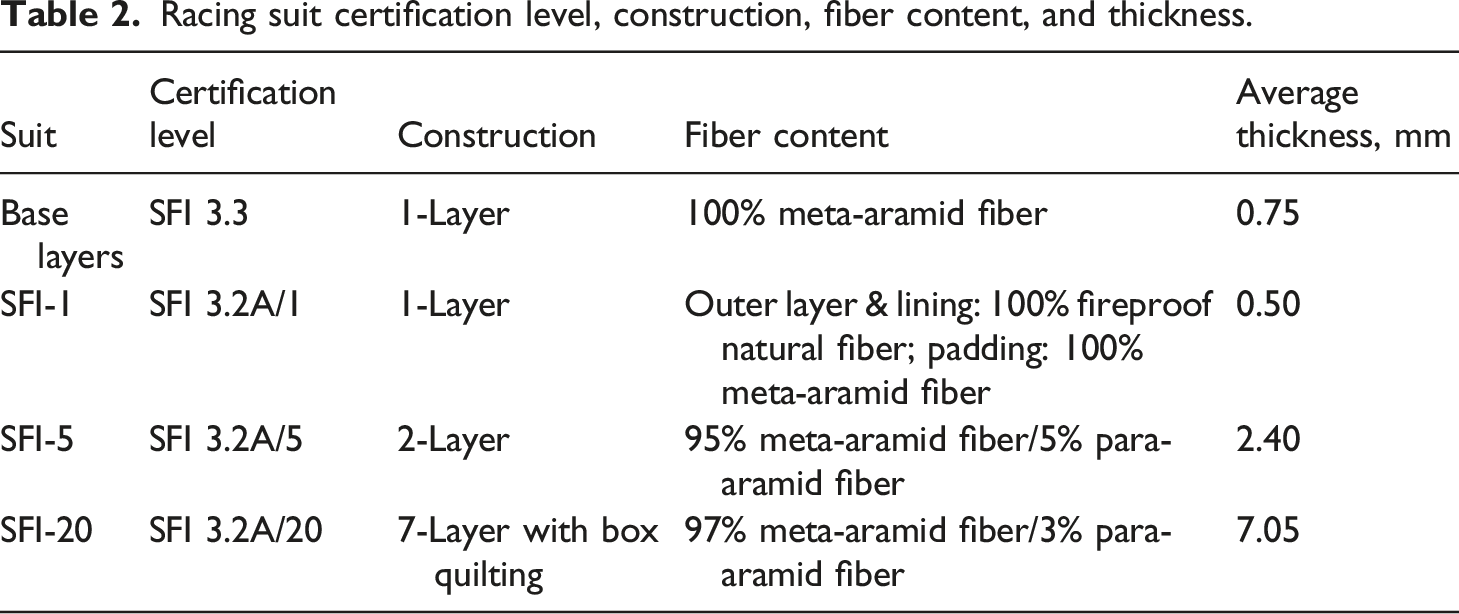
The SFI-1 suit met SFI Specification 3.2A/1, indicating that this suit has a TPP value of 6 cal/cm212 and when exposed to a heat source, would protect a wearer against second degree burns for 3 seconds 9 It should be noted that in a race setting, a suit meeting SFI Specification 3.2A/1 must be worn in combination with base layers. The SFI-5 suit met SFI Specification 3.2A/5, indicating a TPP value of 19 cal/cm2. 12 When exposed to a heat source, it would protect a wearer against second degree burns for 10 seconds 9 Lastly, the SFI-20 suit met SFI Specification 3.2A/20. A suit meeting this specification has a TPP value of 80 cal/cm212 and when exposed to a heat source, would protect a wearer against second degree burns for 40 seconds 9 This type of suit is commonly worn in open wheel racing series, such as drag racing.
Racing gloves, socks, and boots were also purchased through leading racing suit manufacturers and were in accordance with the appropriate certifications. The selected racing gloves were in accordance with FIA Standard 8856-2018 and were composed of 100% aramid fiber. The socks met SFI Specification 3.3 and were composed of an aramid and fire-retardant cotton blend. The racing boots were also manufactured in accordance with FIA Standard 8856-2018 and were composed of a suede upper, leather insole, and natural rubber sole. Each component of the full systems ensemble bore a tag with the corresponding certification label, as required for motorsport competition.
Air permeability
To determine the air flow capacity of each SFI rated auto-racing suit, ASTM D737-18 Standard Test Method for Air Permeability of Textile Fabrics was followed. A Textest FX 3300 Air Permeability Tester III with pressure set at 125 Pa was used to measure the cm3/s (cm3/s/cm2) of air flow at a constant pressure drop. Each auto-racing suit was measured in 10 separate locations across the surface of the coverall. Results were averaged to determine the overall air permeability for each SFI rated suit.
Sweating thermal manikin procedures
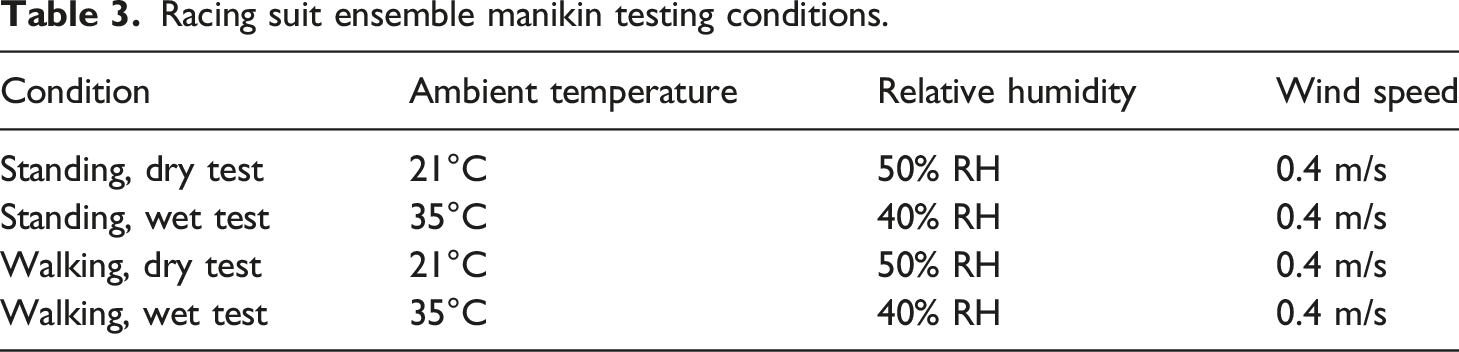
Racing suit ensemble manikin testing conditions.
The thermal insulation (R
t
) of each racing suit ensemble was measured on an ANDI 35-zone manikin according to ASTM F1291-16 Standard Test Method for Measuring the Thermal Insulation of Clothing Using a Heated Manikin which determines the insulation value of clothing ensembles through the measurement of dry insulation from a heated manikin in a calm, cool environment.
21
This method quantifies the dry heat loss from the manikin, through the clothing microclimate, and to the ambient environment. Three repetitions were completed for each auto-racing suit ensemble in each test condition (Table 3), at 21°C/50% relative humidity (RH). The total thermal resistance (R
t
) was calculated per equation (1) below. R
t
= total thermal resistance (insulation) of the clothing ensemble and surface air layer (°C·m2/W), A = area of the manikin’s surface (m2), T
s
= temperature at the manikin surface (°C), T
a
= temperature in the air flowing over the clothing (°C), and H = power required to heat manikin (W).
21

To determine the evaporative resistance (R
et
) and wet heat loss through the racing suit system, ASTM F2370-16 Standard Test Method for Measuring the Evaporative Resistance of Clothing Using a Sweating Manikin was followed.
22
For each racing suit ensemble three replicate wet tests were performed in each condition (Table 3) and total evaporative resistance was calculated using the following equation: R
et
= total evaporative resistance of the clothing ensemble and surface air layer (kPa·m2/W), P
s
= water vapor pressure at the manikin’s sweating surface (kPa), P
a
= water vapor pressure in the air flowing over the clothing (kPa), A = area of the manikin’s surface that is sweating (m2), H
e
= power required for sweating areas (W), T
s
= temperature at the manikin surface (°C), T
a
= temperature in the air flowing over the clothing (°C), and R
t
= total thermal resistance of the clothing ensemble and surface air layer (°C·m2/W).
23

After determining the thermal insulation and evaporative resistance of each racing suit ensemble, the R
t
and R
et
were used to calculate a predicted manikin total heat loss (THL) value. These calculations, per equation (3), are based on traditional fabric level THL measurements and have been previously validated.24,25 Manikin THL values are noted as predictive as the R
t
and R
et
measurements are collected in non-isothermal environments, unlike fabric level thermal insulation and evaporative resistance measures. For the purposes of this research, the same standard environmental conditions used to collect fabric level THL were utilized to predict manikin level THL (25°C/65% RH). Q
t
(predicted,T,RH) = predicted manikin THL for specified environmental conditions (W/m2), T = specified temperature condition (°C), RH = specified relative humidity (%), T
s
= specified temperature at the manikin surface (°C), T
a
= specified temperature of the local environment (°C), P
s
= calculated water vapor pressure at the surface of the manikin (kPa), P
a
= calculated water vapor pressure in the specified local environment (kPa), R
t
= thermal resistance of the clothing ensemble and surface air layer (°C·m2/W), R
et
= evaporative resistance of the test ensemble and surface air layer (kPa·m2/W).24,26
Statistical analysis
To determine the variance and statistical significance between auto-racing suit thermal comfort performance one-way ANOVAs were performed, followed by two-sample T-tests, assuming equal variance, if significant differences were identified between suit ensembles for thermal resistance, evaporative resistance, and predicted manikin THL. Pearson’s correlation coefficients were used to determine if significant relationships existed between predicted manikin THL and other factors including SFI protection rating, suit thickness, and air permeability. The statistical methods used in this study are in line with commonly used statistical analysis procedures for thermal manikin data published in similar previous studies.27–29 A p-value of 0.05 was chosen to indicate statistical significance.
Results
Air permeability
The base layers (shirt and pants) worn underneath the SFI rated suits had an average air permeability of 645.2 cm3/s/cm2. The auto-racing suits had average air permeability values of 35.2 cm3/s/cm2, 64.7 cm3/s/cm2, and 43.1 cm3/s/cm2 for the SFI-1, SFI-5, and SFI-20 protection levels, respectively. Air permeability results were significantly different (p <0.01) between all suits and base layers in the study. Pearson’s correlation analysis, however, indicated no correlation (r-value range of 0.2–0.4) between air permeability of the auto-racing suits and predicted manikin THL.
Thermal resistance
Average R t (°C·m2/W) value for all suit configurations.

When comparing identical racing configurations with and without the addition of base layers (BL), results indicate that wearing the racing suits without BL does significantly reduce the overall thermal resistance of the ensemble for some protection levels in static conditions (SFI-1 and SFI-20; p <0.05). For comparisons of configurations worn without the BL, the thermal resistance between the ensembles was still significantly different in both the static and dynamic conditions, with resistance increasing as the SFI protection rating of each suit increased. The static and dynamic results of suit configurations without BL were compared to each other as well, and Rt was found to be significantly reduced when walking for all three suits, regardless of protection level.
Evaporative resistance
Average R et (kPa·m2/W) value for all suit configurations.
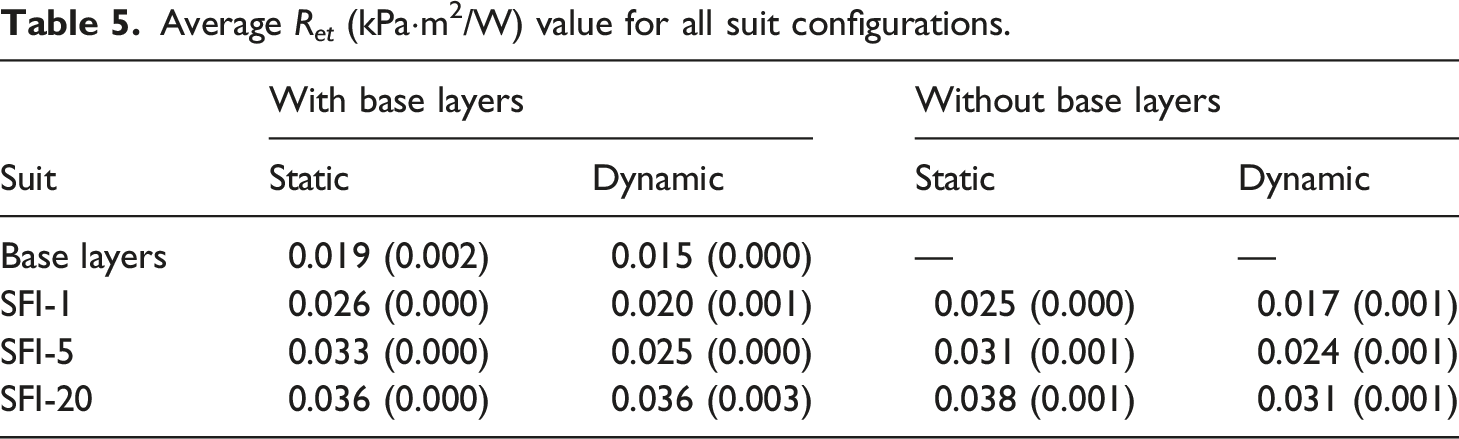
Garment configurations without BL were compared to their counterparts with BL, in both static and dynamic conditions, and results indicate there is a significant reduction (p <0.05) in evaporative resistance when wearing the racing suits without a base layer for most protection levels, except SFI-5 in the static condition and SFI-20 in the dynamic condition. When no BL were worn underneath the racing suits, evaporative resistance between the ensembles was still significantly different in both the static and dynamic (walking) conditions, with resistance increasing as the SFI protection rating of each suit increased. The static versus dynamic evaporative resistance of configurations without BL were compared to each other as well, and it was found that R et was significantly reduced when walking for all three suits, regardless of protection level.
Predicted manikin total heat loss
THL results ranged from 132 W/m2 for the SFI-20 suit worn without base layers in the static condition to 285 W/m2 for the SFI-1 suit worn without base layers in the dynamic walking condition. For all test conditions, significant differences were present between all suits for predicted manikin THL, as indicated by one-way ANOVAs. In all instances, all garment configurations had a greater amount of THL when walking compared to the same garment configuration tested in the static condition. When comparing each racing suit, the THL continued to decrease in all testing conditions (with and without base layers; in static versus dynamic conditions) as the protection level of each suit increased. This indicates an inverse relationship between the certification level of the racing suit and the average predicted THL (Figure 2). In comparison with Table 1, these findings illustrate that as the TPP of each SFI rated suit increases, average predicted THL decreases. Predicted THL by racing ensemble configuration and conditions.
When comparing BL suit configurations in static versus walking conditions, results indicate there is a significant increase in predicted manikin THL when pumping effects are introduced for all suits except the SFI-20 rated suit. The predicted average THL values of the SFI-1 suit with base layers and the SFI-1 suit without base layers were significantly different when in static conditions. When comparing the SFI-5 suit configurations and the SFI-20 suit configurations under static conditions in the same way, the differences in THL values were not statistically significant. In the dynamic walking condition, however, the predicted manikin THL was significantly greater for all suit protection levels when the base layer was removed from the garment ensemble.
When no BL were worn underneath the racing suits, predicted manikin THL between the ensembles was still significantly different in both the static and dynamic (walking) conditions, with manikin THL decreasing as the SFI protection rating of each suit increased. When comparing configurations with no base layers under static versus dynamic configurations, THL significantly increases when walking is introduced for all three suits, regardless of protection level. The same was found to be true when base layers were worn underneath each suit, except for the SFI-20 suit.
Discussion
This research was conducted to determine the impact of auto-racing PPE on the thermal comfort of race car drivers by utilizing a sweating thermal manikin to determine the THL of standard racing suits. As the SFI protection rating of each suit increased, the dry thermal resistance and wet evaporative resistance of each suit also significantly increased for both the static and dynamic (walking) conditions. These findings are in line with previously established relationships between TPP and THL in the area of structural firefighting PPE, as well as previous studies that support a direct relationship between an increase in garment thickness, clothing insulation, and thermal and evaporative resistance.25,30,31
Thermal resistance results indicate that when forced convection through body movement is introduced, wearing thicker, more protective auto-racing suits without a base layer significantly reduces the overall R t for all racing suit protection levels in this study. In practice, race car drivers are most often in a sitting position, without the possibility of body movements occurring (walking or similar actions), when they find themselves in the most stressful environments, such as the cockpit of the race car. However, drivers would still benefit from the lack of base layers being worn during pre-, and post-racing activities outside of the car, as well as when applying physical effort to control the racecar. As such, per the R t results in this study alone, it would be most beneficial for a motorsport athlete to wear a racing suit with an SFI rating of SFI 3.2A/5 or higher, as suits with a lower rating require the addition of base layers. As thermal resistance was significantly reduced when walking when base layers were not worn for all three suits, regardless of protection level, these results demonstrate the effectiveness of forced convection through pumping effects due to body movement.
Evaporative resistance findings demonstrated that wearing the racing suits without a base layer significantly reduced the overall evaporative resistance of the ensemble for some protection levels, except SFI-5 in the static condition and SFI-20 in the dynamic condition. Even though the results were not statistically significant in these two cases, the evaporative resistance was still reduced by removing the base layers for both test configurations. These results demonstrate the effectiveness of forced convection through pumping effects due to body movement. Evaporative resistance is significantly reduced when walking compared to static measurements for all three suits, regardless of protection level, when base layers were not worn.
As the SFI protection rating of each suit increased, the predicted manikin THL of each suit significantly decreased, for both the static and dynamic (walking) conditions. These findings are in line with previous studies which supports a direct relationship between an increase in garment thickness, clothing insulation, and a decrease in the body’s ability to lose heat through the portable clothing environment.27,29,31–34 Interestingly, however, when analyzing the SFI-1 suit worn with base layers versus the SFI-5 suit worn without base layers, predicted manikin THL was greater for the SFI-1 suit worn with base layers than the SFI-5 suit worn without base layers despite multiple garment layers being worn versus a single garment layer. This was true in both the static and dynamic test conditions, regardless of pumping effects. This indicates that for lower levels of SFI protection, between SFI-1 and SFI-5, the race car driver would benefit more from wearing the lowest level protection suit in conjunction with thermal underwear than wearing the SFI-5 suit without any base layers.
When considering fabric thickness, however, these results are not surprising. The SFI-5 suit had an average thickness of 2.4 mm whereas the base layers had a thickness of 0.75 mm and the SFI-1 suit a thickness of 0.5 mm. When worn together, the fabric thickness of the base layers plus the SFI-1 suit (1.25 mm) remains more than a millimeter less than wearing the SFI-5 suit without base layers. Given the established negative correlation between THL and fabric thickness, these results are in line with previous literature related to similar types of PPE.29,34 This example illustrates the need for end users to consider more than just the number of garment layers being worn but the importance of the thickness of those clothing layers, the air layers created between multiple clothing and fabric layers, and other material properties such as air permeability, moisture vapor transfer, and others. Considering the specific suits tested within this study, the thermal comfort of the driver would be improved when wearing the SFI-1 rated suit with base layers compared to the SFI-5 suit without thermal underwear.
Based on the overall comparisons between suits, with and without base layers, in both standing and walking conditions, drivers should wear the thinnest suit configurations, without base layers at SFI-5 or above, when possible, to improve their thermal comfort. Caution should be taken, however, to ensure a sacrifice in thermal protection does not occur and drivers should follow all recommendations for wearing base layers with lower SFI rated suits.
Conclusion
To the researchers’ knowledge, this study is the first of its kind to assess manikin total heat loss of auto-racing ensembles. A novel manikin heat loss model24,25 was used to determine the predicted manikin THL in order to quantify the direct ability of a race car driver to lose sufficient heat when wearing each suit of varying protection levels. It is worth noting that unlike firefighting PPE, racing suits do not have a minimum fabric level THL value ensuring wearer breathability and thermal comfort, nor has any previous research prior to this been conducted to establish such THL measures on the garment level. Results from this research, however, demonstrate that the average predicted THL for a compliant racing ensemble (SFI-1 with base layers, SFI-5 and SFI-20 with or without base layers) is 172 W/m2. More research should be done to better understand how the predicted manikin THL for racing ensembles effects the human body when performing under race day conditions, and to establish a minimum THL benchmark for auto-racing ensembles, as has been done for structural firefighting PPE. 32 Future research should measure the physiological responses of drivers when wearing suits of various SFI protection levels during different types of racing.
A limitation of this study was the inability to completely recreate the physical experience of a motorsport athlete controlling a car using a sweating thermal manikin. As previously noted, a driver must overcome the physical demands of high speed movement such as high vibration and gravitational loading. 7 Physical demands may also vary based on velocity and the type of track. 6 These unique circumstances would require a large-scale wear trial for accurate study for which the budget of this project did not allow. Another limitation was the inclusion of only one brand of racing suits, also due to project budget constraints. Additional suits should be studied to increase market representation. More research should be done to understand how the predicted THL for auto-racing ensembles effects the human body, and to determine a minimum THL for racing ensembles to prevent heat strain and potential fatality.
Footnotes
Declaration of conflicting interests
The authors declare that there is no conflict of interest.
Funding
The authors disclosed receipt of the following financial support for the research, authorship, and/or publication of this article: This work was supported by the American Association of Textile Chemists and Colorists (AATCC) Student Research Support Grant Program [2020].
