




Abstract
There is no perfect method to test and evaluate electromagnetic shielding (EMS) clothing up to now. The main reason is that the influence laws of the emission source parameters and the test position on the shielding effectiveness (SE) of the EMS clothing has not been clarified. In this paper, the SE of the EMS clothing is tested using a semi anechoic chamber in the frequency range of 1–18 GHz. The variation of the SE of the clothing is explored when the emission source parameters and the test positions are different. It is found that the SE of the EMS clothing decreases obviously with the increase of the testing distance, and the decline degrees are different with different frequencies. The decline trend slows down and approaches stability as the distance increases to a certain extent. The influence of the emission source angle on the SE is closely related to the frequency and positive or negative effects are produced at different frequency points. The SE are low when the test points are in the leakage areas with seams and openings, and the SE are high in the normal area. Under certain conditions, the measured SE of the clothing is close to zero or even less than zero. That is, a dangerous frequency point is formed. The mechanism of the above-mentioned laws is analyzed, and a new multi-index composite evaluation method is proposed to scientifically evaluate the EMS clothing based on the comprehensive consideration of the influencing factors. This research has great significance to promote the scientific test, evaluation and relevant standard formulation of the EMS clothing, and provides a reference role for the design and production of the EMS clothing.
Keywords
Introduction
Electromagnetic radiations exist in our living and working environment, which seriously endangers the human health. It has been listed as one of the pollution to be controlled in the world. 1 Electromagnetic shielding (EMS) clothing has become an ideal product to protect the human body from electromagnetic waves because it can be worn on the human body for a long time. 2 The EMS clothing has attracted more and more attention. It has developed rapidly in recent years, and has become an urgent demand in daily life and various industrial fields. However, the theoretical problems related to the test and evaluation of the shielding effectiveness (SE) of the EMS clothing are not clear at present. In particular, the influence laws of the main test factors on the test results is not clear. As a result, the market products are intermingled. It is difficult to judge whether they are good or bad, and even some inferior products become invisible killers, which has a harmful effect on the human body. Therefore, it is an urgent need to study the influencing factors and laws of the test and the evaluation of the EMS clothing. The research is the key to determine whether to correctly test and evaluate the EMS clothing, and is great significance to ensure the electromagnetic safety protection of human body.
There are four main test standards for the EMS clothing in the world at present. The first is the American standard: MIL-C-82296B. 3 It has been abolished because there are too many requirements for protective clothing itself, too many points to be tested, too few test frequency points and unreasonable test layout. The second is the German standard: DIN 32780-100-2002. 4 Although there are two sets of evaluation indexes: specific absorption rate (SAR) and SE, the applicable frequencies are narrow and cannot meet the current requirements of electromagnetic protection. The third is Chinese standard: GB/T 23463-2009. 5 Although the performance requirements and test methods of microwave protective clothing are included, the test details are not explained in detail, especially the performance grades are inconsistent with reality. The forth is Chinese standard: GB/T 33615-2017. 6 This standard is mainly for civil electromagnetic radiation protective clothing. However, the regulations on the manikin of key components are not rigorous, the scientificity of the test is not considered, and the SE of the clothing is not comprehensively considered. In the above standards, the influencing factors of distance, angle and test position on the test results are not considered, and the action mechanism of the clothing characteristics on the test results is not involved. Moreover, the existence of dangerous frequency points and the invisible damage brought by them are not found. Therefore, the test results cannot scientifically evaluate the EMS clothing, which has caused a lot of controversy in the industry. It was organized to discuss and modify them many years ago, but there has been no conclusion.
There are few research literature on the EMS clothing at present. It mainly includes three parts. The first part is the study of test methods. For example, Kurokawa and Sato 7 and Yoshimura et al. 8 studied the test method of the SE of the clothing by time domain analysis, and tested the chest area of the mannequin. Wang et al. 9 used the same EMS fabrics to manufacture and test the clothing with different structures and styles, and analyzed the laws of various factors on protection effect of the clothing. The second part is the research of numerical simulation and simulation methods. For example, the numerical simulation of EMS clothing was carried out in order to predict the SE of the clothing through the model. 10 Simulation and numerical calculation methods were adopted to analyze the basic laws of electromagnetic leakage through holes and its influence on the protective effectiveness of the clothing. 11 The performance of the EMS maternity clothes was tested and simulated to explore the relevant laws. 12 The third part is the research on the performance of the EMS clothing. In the research by the literature,2,13 the influence of the neckline and cuff on the SE of the clothing was analyzed. Meisinger et al. 14 pointed out that wearing EMS clothing could effectively prevent radiation by investigation and literature analysis. Researchers have also studied the comfort of the EMS clothing,15,16 and explored the properties of manufacturing materials and their influence on the overall protective performance of the clothing. 17
At present, the research on the shielding mechanism of the EMS clothing is rarely mentioned. The basic consensus is that the previous method of using the EMS fabrics to evaluate the overall SE of the clothing is wrong, and the factors such as curved surface structure, opening and seam of the clothing must be considered to correctly evaluate clothing. 18 However, the influence mechanism of the curved surface, hole and seam on the EMS clothing has not been revealed so far. Other researches on the EMS clothing mainly focus on the properties of the shielding fiber, 19 identification and analysis of the shielding fiber, 20 influencing factors of the SE, 21 the SE prediction, 22 and calculation model construction23,24 and so on. All these provide an important reference in the related research of the EMS clothing.
The above researchers have done a lot of work in the field of the EMS clothing. However, the research on the influence of emission source parameters and the test position on the SE has not been involved, resulting in the lack of mature test and evaluation methods of the EMS clothing. Related researches are carried out in this paper. Through experimental testing and data analysis, we explore the influence laws and mechanism of the emission source distance, angle, frequency and test position on the EMS clothing, and put forward a new evaluation method.
Experiment
Experimental material
The EMS clothing has many styles and types, which is widely applied in medical and health, electronic and electrical, aerospace and many other special industries. With the increasing emphasis on human comfort in these fields, the EMS clothing with openings, seams, brilliant colors and beautiful styles is gradually becoming the mainstream. Therefore, we select representative garment samples of different styles and fabrics of the EMS clothing with openings, seams and certain decorations for study. The research conclusion is more suitable to measure the comfortable clothing. The analyzed style are determined according to the popularity of the style, the dimension of the opening and the number of the seams, and the production of the clothing are determined according to the popularity of the fabric and the amount of the contain of the EMS materials in the fabric. Finally, four pieces of representative EMS clothing are selected. The style diagrams and pictures of the garment sample are shown in Figure 1 and the specifications are listed in Table 1. Style diagrams and pictures of garment samples. Specification parameters of experimental garment samples.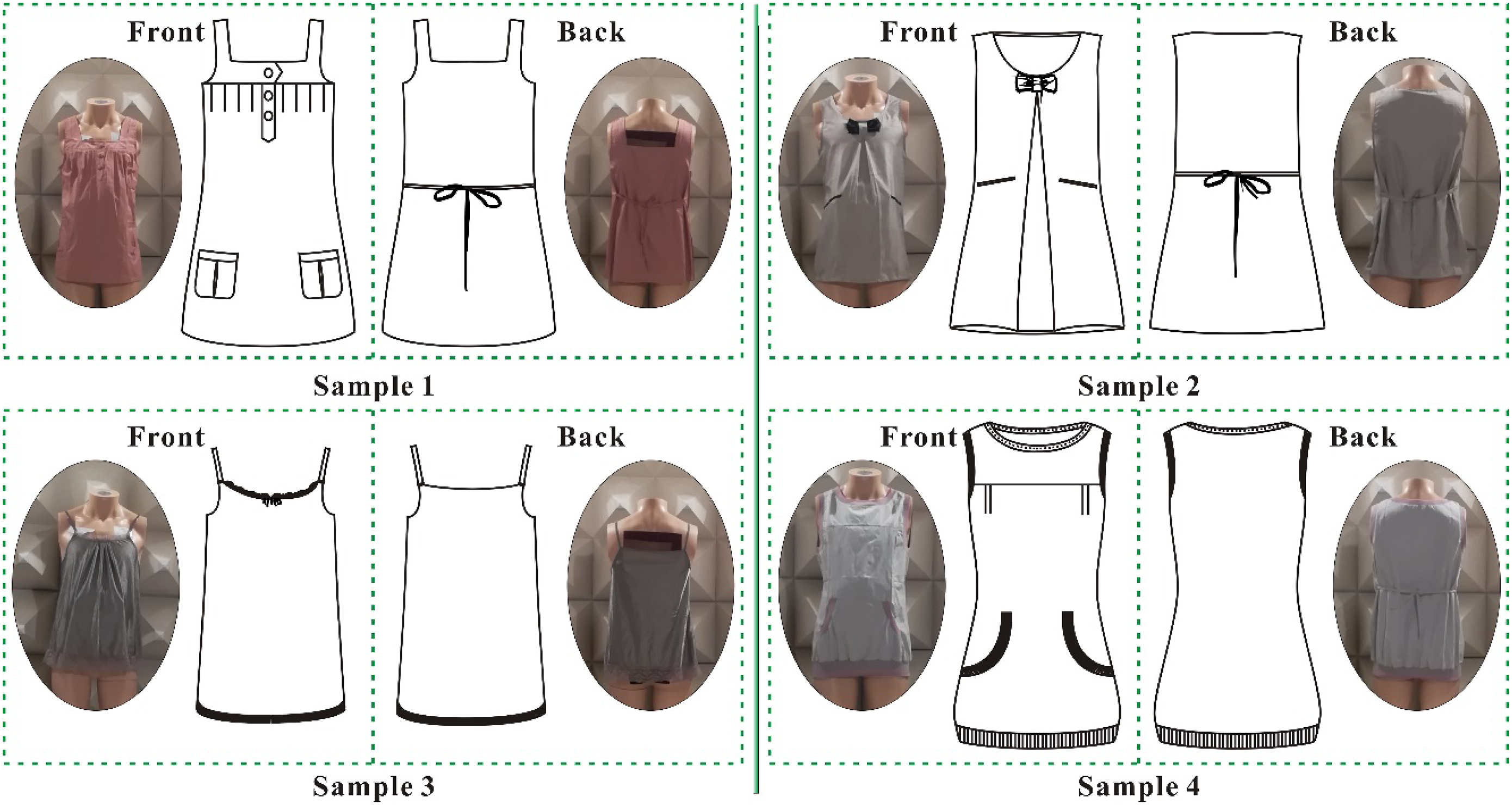

Test method
The semi anechoic chamber is used for testing. As shown in Figure 2, the electric field probe is placed on the sponge partition in the chest area or the abdominal area of the mannequin. The mannequin is made of high polymer material transparent to electromagnetic wave, and does not contain any metal material to prevent interference to electromagnetic wave signal. Under the condition of fixed power output, if E0 (V/m) represents the electric field intensity of the mannequin without clothing in the same test position and E1 (V/m) is the electric field intensity of the mannequin with clothing, the SE of this position can be calculated by the following formula
25
Diagram of test method.

The testing equipments include semi anechoic chamber, mannequin, DR6103 broadband double-ridge horn antenna, DR-P01 micro omnidirectional electric field signal receiver, DRA00818 power amplifier, AV3629D vector network analyzer of microwave, etc. The transmission frequency range is 1 GHz–18 GHz. The testing distances are 0.5 m, 1 m, 2 m, and 3 m. The abdomen and chest positions are selected as testing positions. During the test, the height of the transmitting antenna is consistent with that of the signal receiver. The test angles are selected around the mannequin as 0°, 45°, 90°, 135°, and 180°. The operation method is shown in Figure 3. Schematic diagram of the test distance and angle.
Results and analysis
Influence of test distance on SE of the EMS clothing
Various types of EMS clothing are tested, and it is found that the test distance has a significant impact on the SE of the clothing. As other conditions remain unchanged, the SE of the EMS clothing has a downward trend with the increase of test distance. Figure 4 shows the test results of different regions of the abdomen of garment samples 1–4. The SE of measured clothing is high when the test distance is 0.5 m. The SE decreases obviously when the testing distance is changed from 0.5 m to 1 m, and the SE decreases slightly when the testing distance is changed from 1 m to 2 m and 3 m. It is also observed that the SE increases slowly with the frequency for any test distance. Influence of test distance on SE of the fabric.
The maximum values of the measured SE of the garment samples 1–4 appear near the frequency of 16 GHz. The minimum values of the SE occur near the frequency of 8.8 GHz, and the values are close to zero or even negative. We call the frequency band as the dangerous frequency point, as shown in the red circle in Figure 4. There are dangerous points in garment sample 3 and sample 4 around the frequency of 8.8 GHz, and garment sample 3 has the dangerous points around the frequency of 1 GHz and 13 GHz. Although the dangerous point no longer appear in garment sample 4, the SE at multiple frequency points is close to the low level of zero.
The dangerous frequency point is represented by one frequency point, but it represents a range. That is, all the frequency bands attached to this point are dangerous frequencies. After repeated tests, it is found that there are one or multiple dangerous frequency points. The existence of dangerous frequency points will turn the clothing into an invisible killer. In some frequency points, it will unknowingly lose its protective effect on the human body and cause great harm to the human body. Therefore, it must be considered in the evaluation of the clothing.
SE order of four garment samples at different test distances.

Influence of test angle on SE of the EMS clothing
The experiments show that the test angle has an obvious influence on the SE of the EMS clothing. Figure 5 is the SE variation of abdominal areas of garment samples 3–4 at different angles, and the test distance is 3 m. It can be seen that the SE values are differ greatly from different angles for the same frequency points. For the garment sample 1, the difference of the SE test results between the testing angles of 180° and 45° near the frequency of 3 GHz is about 12 dB, and the difference between the testing angles 180° and 135° near the frequency of 18 GHz is about 14 dB. For the garment sample 2, the difference of the SE test results between the testing angles of 0° and 135° near the frequency of 8.8 GHz is about 15 dB, and the difference between the testing angles 45° and 135° near the frequency of 12.1 GHz is about 16 dB. The garment samples 3–4 are also consistent with the above situation. The maximum difference of the SE test results of garment sample three at different angles reaches about 12 dB, and that of garment sample four is about 15 dB. This difference is not a positive or negative difference in the whole frequency band. It is different according to the frequency change. Therefore, the test angle is closely related to the frequency. Influence of test angle on SE of the clothing.
When the angle changes, the SE maximum value does not appear significantly at a certain frequency point, but the dangerous frequency point is very clear. For example, the dangerous frequency points of the garment sample 1 appear near the frequency of 8.8 GHz and 15.2 GHz. The dangerous frequency points of the garment sample 2 and sample 4 occur near the frequency of 8.8 GHz, 12.1 GHz, and that of the garment sample 3 is near the frequency of 1 GHz, 8.8 GHz and 13 GHz. This phenomenon is consistent with the results shown in Figure 4. That is, the SE value is zero or even negative value at some frequency points when the SE is tested at a certain angle.
Characteristics of test results when the test angle of four garment samples changes.

Influence of test position on SE of the EMS clothing
The test position also has a great influence on the SE of the EMS clothing. Figure 6 shows the comparison of the test results of garment samples 1–4 in chest and abdominal area, and the test distance is 3 m. It is observed that the SE results of garment samples 1–3 in the abdominal area are higher than those in the chest area when other conditions remain unchanged. The SE results in the abdominal area of garment samples 1–2 are much higher than that of the chest area in the frequency band of 4–7 GHz and 15–18 GHz. For garment sample 3, the SE results in abdominal area are higher than the chest area in the frequency band of 4.5 GHz–7.5 GHz and 16.5 GHz–18 GHz. For garment sample 4, the difference between the abdominal area and chest area are not very large. Only the SE result of the abdomen is higher than that of the chest in the frequency band above 16 GHz, the SE of the abdomen is lower than that of the chest between the frequency of 5 GHz and 16 GHz, and the rest areas remain the same results. The SE maximum values of garment samples 1–4 measured in the abdomen arear are 12.8 dB, 11 dB, 14.9 dB and 10 dB respectively. The SE maximum values of chest area are 7.7 dB, 10.2 dB, 11.5 dB and 10.1 dB respectively. It confirms the variation laws of the test values in chest and abdomen area. Influence of test position on SE of the clothing.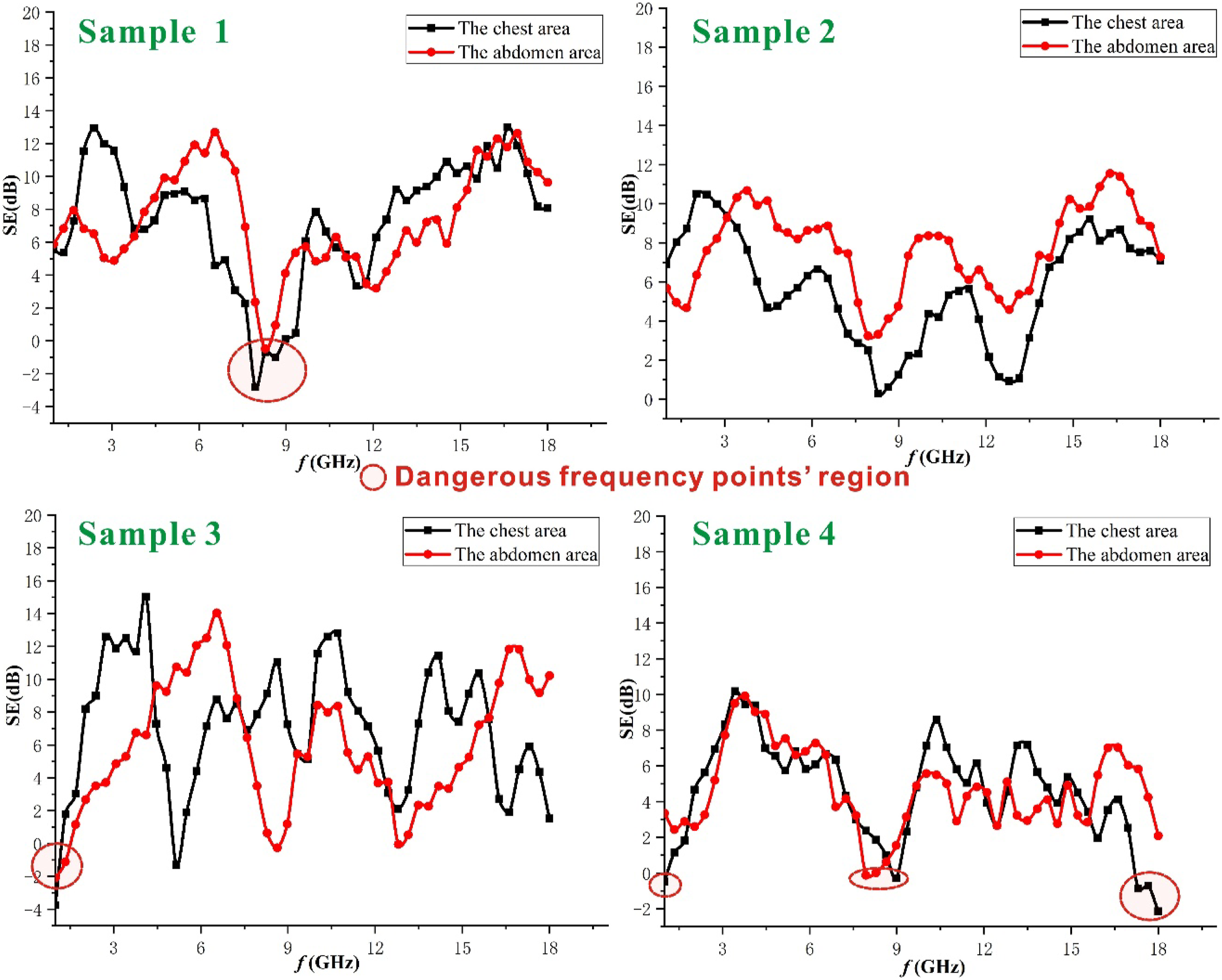
Test results comparison of different positions of four garment samples.

Influence of different styles on the SE of the EMS clothing
In order to further analyze and test the influencing factors of the EMS clothing, the same materials are selected to make different styles of the EMS clothing. The garment samples are compared to reveal the influence of the styles on the SE of the EMS clothing. Figure 7 shows another two styles of the garment samples made of the materials of the garment sample 1, the design idea of which is to gradually reduce the dimension of the openings in the chest and neck area. It is observed that the SE shows a trend of increasing as a whole with the decrease of the openings. In comparison of the garment style 1, the maximum value of the SE is more than 15 dB near the frequency of 5 GHz and 18 GHz, while the minimum value is more than 5 dB in the whole frequency band, and there is no danger point. In comparison of the garment style 2, most of the maximum value exceed 5 dB in the frequency band around 10 GHz and above 16 GHz, while the minimum value exceeds 7.5 dB in the whole frequency band. However, the SE of the garment sample 1 in many frequency bands is less than 5 dB, and the dangerous points may occur. The SE values of any frequency points in the whole frequency band do not exceed 15 dB. SE of the clothing with different styles made of the same materials.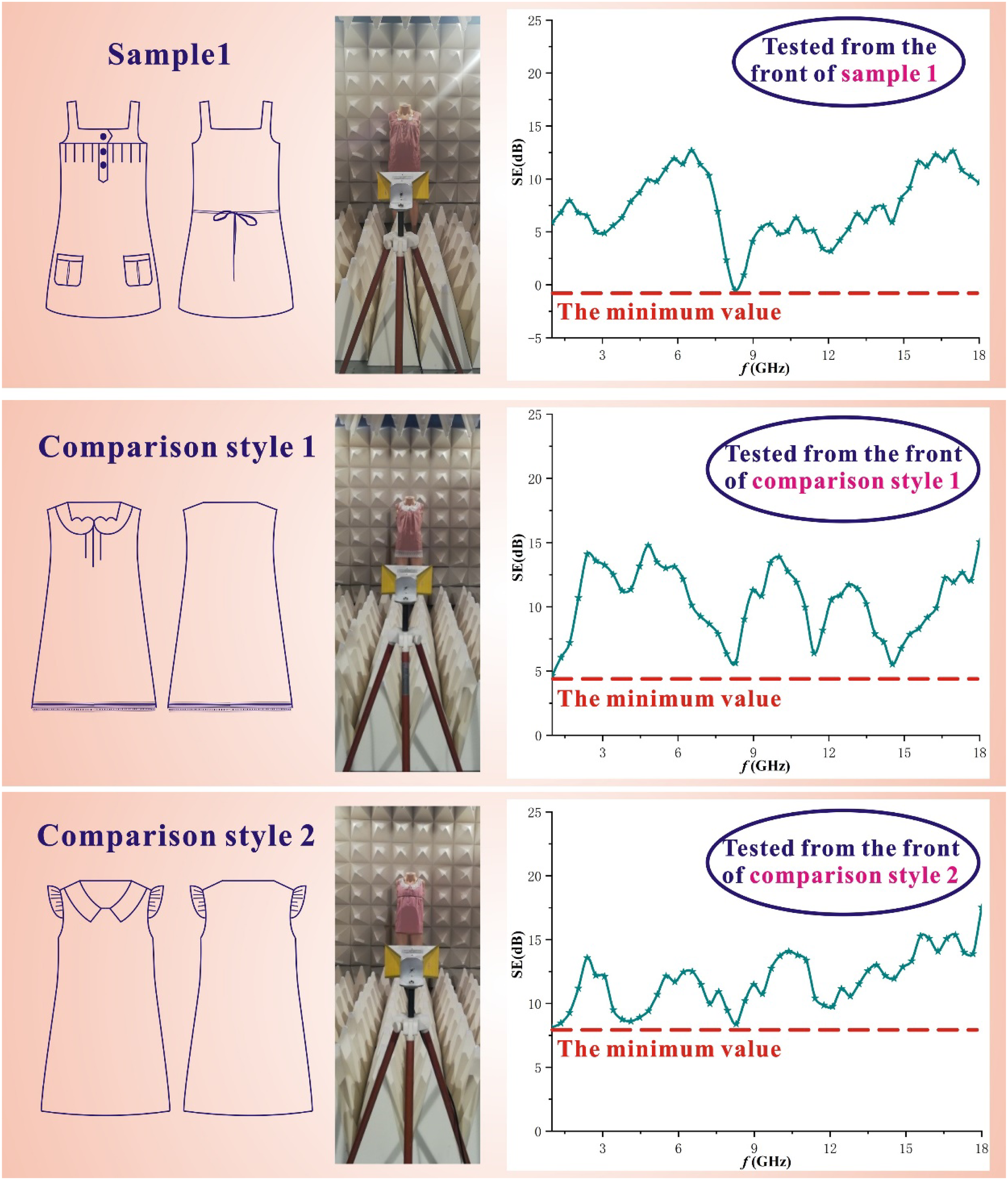
The comparison between the garment samples with different styles and materials also shows the above laws. With the increase of the opening area of the clothing, the SE also shows a downward trend. The opening increases to a certain extent, even the dangerous points appear. This law provides a basis for the factors to be considered in the testing and evaluation of the EMS clothing, and further suggests that attention must be paid to the angle, position and distance during the testing. The change of the angle and position causes the change of the opening dimension of the garment area where the electromagnetic wave is incident, resulting in a large difference in the test results. The change of distance leads to the change of the penetration intensity when the electromagnetic wave is incident on an open area, and affect the test results of the garment.
Influence of different materials on SE of the EMS clothing
The influence of the materials on the SE of the EMS clothing is obvious and must be considered in the test. However, the specific impact law of the clothing needs to be clarified. For this reason, we use different fabrics to make the same style as the garment sample 1 for comparison. The specifications of the selected comparison material 1 and the material 2 are shown in Table 5. The appearance of the comparison materials 1–2 and the material used in the garment sample 1 and the change of the SE are shown in Figure 8(a), the garment styles are shown in Figure 8(b), and the change of the SE of the garment is shown in Figure 8(c). SE of the garment with different materials and the same style. (a) Appearance of garment material and change of the SE. (b) Styles of garment sample 1. (c) SE of the garment with different materials and the same style. Fabric specifications used for comparison of different materials and the same style of the garment.
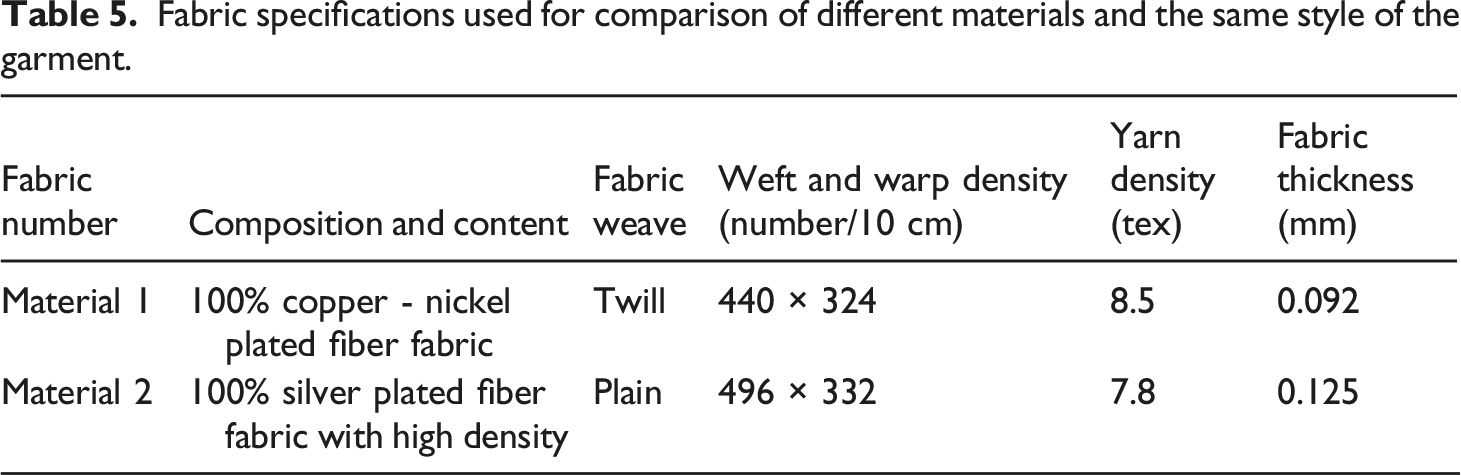
From Figure 8(c), it can be observed that the SE of the fabric has little influence on the overall SE of the garment. Among the three fabrics, the SE of 100% silver plated fiber fabric with high density is the best, and the values are from 50 dB to 80 dB. The SE of 100% copper - nickel plated fiber fabric is between 35 dB and 55 dB, and the SE of 30% stainless-steel fiber fabric used in garment sample 1 is the lowest, ranging from 23 dB to 44 dB. The difference of the highest value of the SE is 25 dB and 11 dB, and the difference of the lowest value of the SE is 15 dB and 12 dB. However, these three fabrics with large differences are made into the same style garment, and the SE difference of the garment is small. The SE of the garment made of 100% silver plated fiber fabric with high density is between 7 dB and 19 dB, the SE of the garment made of 100% copper - nickel plated fiber fabric is between 0 dB and 16 dB, and that made of 30% stainless - steel fiber fabric is between −1 dB and 13 dB. The difference of the highest value is 3 dB and 3 dB, and the difference of the lowest value is 7 dB and 1 dB respectively. It can be observed that the overall SE of the garment increases with the improvement of the SE of the fabric used, but the increase is not large. The maximum increase is only 12% and 27% of the increase of the fabric, and the minimum increase is 47% and 8% of the increase of the fabric.
The comparison of the clothing with different materials and other styles also shows a consistent rule. Although the quality of the fabric is a factor of the shielding performance of the garment, it is not a decisive factor in many cases. The substantial increase of the SE of the fabric does not dramatically improve the overall SE of the clothing, and other factors such as the style should be considered. This also shows that when testing and evaluating the EMS clothing, not only the performance of the fabrics but also the style should be considered. For the same clothing, it is necessary to bring different test results when the test angle, position and distance change. Therefore, if the clothing is tested and evaluated correctly, these factors must be considered at the same time.
Mechanism of distance, angle and position affecting SE test results of the EMS clothing
The essential reason for the change of the SE test results with distance is that the signal strength changes with the distance and the transmission coefficient of the clothing fabric changes with the incident intensity. As shown in Figure 9(a), when the mannequin is not dressed, according to the electromagnetic wave attenuation theory, the electric field intensity Influence mechanism of the distance on SE of the clothing. (a) No dressed, (b) after dressed.

After wearing clothing, as shown in Figure 9(b), the reflection loss R, absorption loss A and multiple reflection loss B of the reflective fabrics of the EMS clothing increase under high field strength,
26
resulting in the reduction of the transmission coefficient of the clothing fabric. That is
If the electric field intensities of the corresponding distances after dressing is 

Obviously, substituting equations (4) and (5) into equation (1), the relationship between short - distance SE (
From equation (6), under other conditions remain unchanged, although the electric field intensity is
The influence of the test angle and position on SE of the clothing is essentially determined by the characteristics of different areas of the clothing. As shown in Figure 10, comfortable clothing must has openings, seams, buttons, slide fasteners and other areas, which can form equivalent holes and narrow gaps, resulting in the leakage of electromagnetic waves. The larger the hole area and the longer the hole seam lead to more leakage of the electromagnetic waves.
28
We call the area with more seams, openings, buttons, slide fasteners and other accessories as the leakage area, and the area with less seams, openings, and accessories as the normal area. Let the overall area is A and the area of the hole is Schematic diagram of the leakage area and normal area.

Let the thickness and width of the equivalent long and narrow gap in an area is 
According to equations (7) and (8), the larger area of the hole of a leakage area and the wider gap lead to the lower SE and the clothing even loses the protection ability.
Obviously, when the angle of the emission source or the test position changes, the central area of the vertical incidence of the electromagnetic wave also changes. When the incident center area is the leakage area, according to equations (7) and (8), the equivalent holes and seams lead to a large amount of electromagnetic wave transmission, resulting in the SE of the clothing decline. The more holes and seams in the leakage area, the more serious the decline of the SE. When the incident center area is a normal area, the leakage generation of the electromagnetic wave is avoided, the SE of the clothing will not be significantly reduced, which is the reason why the test angle and position affect the SE test results of the clothing. For example, in Figure 5 and Table 3, we list the influence of different angles on the test results and the comparison of four garment samples. These results are formed by the influence of the leakage area and normal area. When there are many openings and seams in the incident area at a certain angle, the SE reduces, and dangerous frequency points easily appear. For the garment sample 3 in Table 3, the maximum and minimum values appear in the angle test of 0°. It not only related to the excessive opening at the front collar and the armhole of the clothing, but also related to the frequency. A certain frequency of the electromagnetic wave can produce multiple reflections at a specific opening or produce an antenna effect at the seam of a certain clothing style, resulting in the SE of the clothing has a sharp decline. 2
For garment samples 1–3 in Figure 6, because of the style structure, the opening and seam in the abdomen area are less than that of the chest area, which has a good protective effect on electromagnetic wave. There are many openings and seams in the chest area, such as armholes, necklines and placket, a number of electromagnetic wave penetrates the clothing in the chest area, and the measured SE results are low. For garment sample 4, the leakage area of the abdomen is the same as that of the chest, the test results of the abdomen are the same as those of the chest as a whole.
The essence of dangerous frequency points is also due to the existence of the leakage area. Because of the leakage area of electromagnetic wave during testing at a certain angle and position, a large amount of leakage occur at some frequency points, even produce multiple reflection or antenna effect. The SE of the clothing at this frequency point is 0 or even negative. The back of the clothing is generally integrated, which has few dangerous frequency points.
It is worth noting that the polarization direction of the electromagnetic wave also has a great impact on the SE test results of the clothing. In the experiments, we found that the SE is high when the polarization direction is perpendicular to many seams, and SE is low when it is parallel to many seams. The final SE depends on the number of vertical or parallel seams. However, the antenna effect occurs when the length and thickness of the seam match a certain frequency, which should be considered. Similarly, when the polarization direction is perpendicular to the long axis of the hole, the measured SE is high. When it is consistent with the long axis direction, the SE is low. The multiple reflection effect of abnormal increase of field strength at the opening in different polarization directions also need to be considered. The essence of these effects is determined by the characteristics of the leakage area and normal area of the clothing. The change of polarization direction is actually the change of the direction of the electromagnetic wave and the direction of the seams or holes. Both vertical and horizontal polarization follow the same mechanism. Therefore, we do not discuss it separately in this paper.
Proposal of testing and evaluation method for the EMS clothing
When the human body is wearing the EMS clothing, the SE of the clothing changes with the distance. The distribution of the leakage area and normal area leads to the SE change of the clothing when the test angle and test position change, and there is no fixed laws. Therefore, the test distance, test angle and test position are three important factors that must be considered. Different settings lead to different results of the SE. In addition, dangerous frequency points may lead to catastrophic protection failure of the clothing, which must be considered in the reasonable evaluation of the SE of the clothing. According to above reasons, for different styles of the clothing, we should fully consider their individual characteristics to conduct a comprehensive test and evaluation of the clothing.
It can also be seen from the experiments that there are some other factors affecting the SE test results of the EMS clothing, such as the composition parameters of the fabrics, the types of garment styles, the high and low positions of the signal transmitters and signal receivers. In fact, the influence of the composition parameters of the fabric is reflected in the SE of fabrics, which indirectly affects the shielding performance of the clothing. The influence of the clothing style is reflected in the position and number of the holes and seams, which is the essential reason why the distance and angle change of the transmission source and the position change of signal receiver affect the test results of the clothing. Therefore, these two factors have been taken into account in the test process, and belong to indirect factors. The changes of high and low positions of the signal transmitter and the signal receiver are similar to that in distance, angle and test position. The essence is also the effect of the holes and seams of the garment style, so it is unnecessary to consider again.
To establish a scientific evaluation method, the influencing factors of the distance, angle, position and frequency of the emission source on the test results of the clothing should be considered. Therefore, we propose a multi-index composite evaluation method. Considering multiple factors such as emission source distance, angle, frequency and test point location, multi-distance and multi-angle tests on the clothing in multiple-areas are conducted to establish a scientific evaluation method of the clothing through weighting method. The specific steps are shown in Figure 11. Test and new evaluation method of the EMS clothing.
According to Figure 11, a mathematical description of the evaluation method is given. Set the number of the test positions of clothing as 

In the actual testing and evaluation, the importance of each factor is different due to different application scenarios of the clothing. For example, the shielding effect on certain parts of some clothing is very important, and the weight ratio of this position can be added. Therefore, the weight index can be introduced into equation (9), and the formula is modified as
Dangerous frequency points 
Formulas (9) to (12) are the framework of proposed method of multi index composite evaluation of the EMS clothing according to the new findings in the testing process described in this paper. The method not only considers the distance, angle, frequency of the emission source affecting the test results, but also considers the location of the test points and the dangerous frequency points caused by the characteristics of holes and seams of the clothing, so that an overall evaluation of the clothing is accomplished.
Conclusion
The test and evaluation of the EMS clothing must comprehensively consider the factors of the distance, angle, test point position and frequency of emission source. Through experiments and analysis, the new laws of these influencing factors on the SE of the EMS clothing are found, and its occurrence mechanism is revealed in this paper. 1. The SE of the EMS clothing has an obvious downward trend with the increase of the testing distance. The degrees of decline are different with different frequencies. When the distance increases to a certain extent, the downward trend slows down and approaches stability. The essence of this phenomenon is due to the change of signal strength with the distance and the change of the transmission coefficient of the fabric with different field strength. 2. The influence of emitter angle on SE is closely related to the frequency. Different frequency points produce positive or negative effects. When the test angle changes, the incident area of the electromagnetic wave changes, resulting in the increase or decrease of the test results. The essential reason is that there are two characteristics of the leakage area or normal area in different areas of the clothing. When the incident area is leakage area, a large number of the electromagnetic waves pass through, resulting in the decline of the SE results. 3. The location of the test points also has a significant impact on the SE results of the clothing. When other conditions remain unchanged, the test results are different with different test locations. The essence of this phenomenon is caused by the leakage area and normal area of the clothing. When the test position is selected in the leakage area with many seams and openings, the measured SE of the clothing is low, otherwise it is high. 4. Under certain conditions, when the SE of the clothing is tested, the SE is close to zero or even less than zero, and the dangerous frequency points are formed. This means that at this time, the clothing loses its protective effect and even cause great harm to the human body. The essence of this phenomenon is that the incident area of the electromagnetic wave is a serious leakage area of the clothing. When the electromagnetic wave is at a certain frequency, it form multiple reflections at the opening or antenna effect at the seam of some styles of the clothing, resulting in serious shielding failure of the clothing. 5. The correct evaluation of the EMS clothing should comprehensively consider the factors of the distance, angle, frequency and test point location of the emission source. Therefore, we propose a new multi-index composite evaluation method to evaluate the EMS clothing scientifically and completely, which can promote the testing, evaluation and relevant standard formulation of the EMS clothing, and provide reference for the design and production of the clothing.
Footnotes
Declaration of conflicting interests
The author(s) declared no potential conflicts of interest with respect to the research, authorship, and/or publication of this article.
Funding
The author(s) disclosed receipt of the following financial support for the research, authorship, and/or publication of this article: This work was supported by the National Natural Science Foundation of China (Grant No. 61771500, 61671489), and was supported by Key Research and Development Plan Project of Shaanxi Province (No. 2021GY-258, 2022GY-277).
