




Abstract
Mesh-fabrics that enable flexible designability and structural mechanical load-bearing have been developing rapidly in the past several decades. Currently, there is an increasing demand for mesh-fabrics with lightweight and high strength in engineering fields. Nevertheless in practice, design, manufacture, and application of mesh-fabrics are often dealt with separately, which could lead to the performances of final products unable to meet the need of specific scenes. This article introduced the classifications and preparation processes of mesh-fabrics. The mechanical properties under various load conditions were described. Then different methods of structural and numerical simulations were reviewed. Current application status of mesh-fabrics were summarized; Finally, several suggestions have been provided to address challenges for the research, development, and application of mesh-fabrics. Look forward to the future, it is expected that mesh-fabrics will play a key role in innovative and high technology engineering fields.
Introduction
As early as in the primitive periods, people made tools by braiding with the roots and stems of plants, the earliest mesh or called net appeared. 1 With the development of textile and industry, mesh-fabrics gradually formed the various structural and functional products. 2 Nowadays, mesh-fabrics refer to the material that the yarns in the fabric are fused, wound or knotted at their crossing points, so that the fabric forms holes between the yarns. Because of the update of material preparation processes, the mesh-fabrics, characterized by lightweight, high strength, high protective performance, and strong designability, have been widely used in the field of construction, marine and aviation fields.3–5
However, there are still some common problems about the manufacture and researches of mesh-fabrics, mainly focus on the following points: producing for mass application but with low profits, taking inadequate effort on research and development, and conforming to the concept of recycling rarely.6,7 On the one hand, in conventional productions, researchers work independently to improve the performance based on their domain knowledge which does not give the optimum design considering the performance parameters of another domain. There exists a disconnection between production, research and application. On the other hand, The applications of high-performance fibers in mesh-fabrics are still in their infancy, and the fundamental researches on dynamic mechanical properties in different application environments are still less. As for the technical difficulties, lie in the structural design, post-processing procedures, and the performance testing methods of mesh-fabrics need to be supplemented and updated. 8
In this article, three kinds of common mesh-fabrics structures have been summarized and evaluated, and their fabrication methods were analyzed in detail, the research status of mechanical tests and simulation methods were described briefly, and the applications fields of mesh-fabrics were emphatically summarized. Finally, several suggestions were proposed to pave the way for further expanding the applications and selections of mesh-fabrics. This study provides ideas for further research on the properties of mesh-fabrics and the development and application of high-performance mesh materials. Look forward to the future, it is expected that mesh-fabrics will play a key role in innovative and high technology engineering fields.
Classifications of mesh-fabrics
Generally, the minimum unitary structures of mesh-fabrics consist of meshes, feet and knots. The range of mesh sizes is very large, after the diagonal of the mesh of different structural fabrics is straightened, the size units of two mesh knots can range from mm to m. The foot can be directly composed of single, multiple or twisted strand of yarns. The vertices of meshes are called knots, and their function is to prevent mesh deformation, which is of great significance to the performance of mesh-fabrics. The preparation process of mesh-fabrics is tying and string yarn or filament as a whole by twisting, knitting, and braiding. The typical representatives of mesh-fabrics are woven mesh, knitted mesh, braided knotted and knotless mesh (Figure 1). It can be simply divided into two categories knotted and knotless according to the manufacturing methods or the characteristics of the mesh knots. The advantage of knotted mesh is that is stable and suitable for the occasion where the mesh size is determined, but the yarn at the knot is bent, leading to large part loos of strength; the knots also increase the weight of meshes. Knotless meshes have a relatively smooth surface, but the yarn is prone to slip under stress. Mesh-fabrics can also be divided into a diamond mesh, square mesh, and hexagonal mesh according to the mesh shape; According to the type of material can be divided into nylon mesh, polyethylene mesh, etc. The preparation methods will be introduced below according to three classifications woven, knitted and braided mesh. The typical representatives of mesh-fabrics.
Woven mesh
Woven fabric refers to which is interwoven by two orthogonal yarns according to specific rules, namely warp and weft. Before weaving, the warp needs a series of processes, including coping, winding, warping, sizing and threading. Weft should go through two processes of coping and pirn winding, then be woven on a machine. 9 The structure of loom and weaving process of simple woven meshes are the same as ordinary woven fabrics. But loom gauge and fabric count are smaller, which causes meshes to occur between warp and weft yarns.
There are two common methods to make meshes by weaving. One is gauze and leno weave, only wefts parallel to each other; the warp is divided into two groups of crossing warp and ground warp, spaced regularly and twisted each other to form sheds, then interweave with weft to create mesh; Another is open work weave, using jacquard loom or change of reed drafting method, evenly distributed holes formed on the fabric surface. The woven mesh fabrics formed by warp and weft interweaving are generally 90° quadrilateral mesh. A projectile loom has large width, which can produce two or more fabrics with different widths simultaneously. However, due to the limitation of torsion bar picking motion and weft insertion on the projectile loom, the actual production of mesh-fabrics cannot reach the calculated maximum production. Vo et al. used the open reed weaving (ORW) technique to obtain woven fabrics with integral mesh edges, which could be cut out in the weaving process and achieve a firm edge. 10 ORW rapier looms PTS4/SOD from Lindauer Dornier GmbH (Germany) were used to weave two-dimensional woven fabrics with mesh edges. It not only reduced yarn damage during weaving but also eliminated the need for excessive cutting and trimming after molding to prevent fabric edge wear. It is helpful to reduce material waste, construction period time, and preform manufacturing costs.
Because the yarns of the same system in the woven mesh fabrics are kept parallel, which can always maintain a tensile state in the process of forming structure to reduce yarn damage, so the fabrics are firm, and products with high tensile breaking strength can be obtained. In addition, the structure of woven mesh is plain with two same sides, and the weaving is relatively simple; the tightness can be adjusted at any time. However, the simple interweaving of yarns at the mesh feet makes poor stability, and yarns are easy slip, so the woven mesh is prone to deformation once stressed.
Knitted mesh
Knitting is a technology bending the yarn into loops with knitting needles; and then setting the loops together to become knitted fabric. Firstly, it is necessary to prepare before knitting, such as doubling and warping, then choose the appropriate type and gauge of machine. The loop structure of knitted fabric has strong designability and formability. Compared with woven fabric, knitted has better ductility and flexibility. Besides, it has diversified shapes, strong artistic senses, and light textures.
Knitted mesh could be categorized into weft and warp knitting. Weft-knitted mesh usually according to particular combinations formed with the basic structural unit: knit, tuck, miss, and through loop transfer. Relatively high requirements of yarn and machine are needed to develop mesh by weft knitting, and it is difficult to form large and continuous meshes, so weft knitted mesh-fabrics often used only for clothing and decorative scenes to create pattern effect. In the production of mesh-fabrics, warp knitting mesh is composed of multiple yarns simultaneously along the longitudinal (warp) order into loops, based on the organizations such as tricot, pillar stitch, and weft insertion, etc. Warp knitting mesh feet are made up of loops; mesh holes are formed between loops. Warp knitting can form various mesh shapes, including square, diamond, hexagonal and column bar, etc. And mesh size, distribution and density could be changed on a larger scale according to needs. The earliest warp-knitted machines were developed by Karl Mayer and dominated the market. In the past 40 years, the updating of new raw materials, technological innovation, equipment numerical control technology breakthrough, and application of the expansion of the knitting industry has achieved rapid development.
Further, warp-knitted mesh can be divided into raschel and tricot. Raschel machine can produce a wide range of mesh-fabrics. Elastic mesh is most prominent product, such as hexagonal and diamond elastic mesh; Tricot is produced on the HKS series model machine, and its mesh structure is generally symmetrical. When knitting, the yarns between each pair of combs are threaded in the same way and carried out yarn laying symmetrically. Tricot mesh has certain extensibility and elasticity, and has the characteristics of relatively loose structure, it also shows favorable air permeability and light transmission property. There is also a special type of three-dimensional mesh-fabric, the sandwich warp-knitted spacer fabric, which consisting of two independent multifilament mesh layers and a spacer monofilament.11–13
The warp-knitted meshes with smooth and stable surfaces are not easy to detach and wear, and the stability and vertical and horizontal elasticity of the fabric can be controlled by process adjustment. It can be designed to increase the strength, change the mesh size and fabric thickness, and adapt to a variety of end uses. However, the mesh size would alter under the external forces, and the stability of the mesh still needs to be improved in some situations.
Braided mesh
The traditional braided knotted mesh is made by setting knots with warp and weft together; or using the knotting machine to twist several strands of rope together to form a net fabric. At present, various countries generally use turn hook type knotted equipment, also known as fishing net machine, to produce knotted meshes. During the braiding process, the knotting and horizontal movements of the net yarn are mainly realized by the coordination of three main parts: the upper hook, the lower hook, and the hole plate.14,15 The shapes of braided mesh are determined by the number of mesh knots. The four mesh feet are generally composed of a single yarn, and the four vertices are knotted nodules. Braided mesh can be divided into bidirectional and unidirectional based on the direction of the mesh knot. According to the type of knot, the braided mesh can be divided into single, double firm and loose knotted net. The most significant advantage of the knotted mesh is that the distance between the knot and the knot would not change, causing better stability, and it is suitable for the occasions where the mesh size is confirmed. However, the yarn is bending at the net knot, if the elongation of the fiber exceeds its extension at break, lead to many cracks occurring in the nodule of fiber, which ultimately shows the immense loss of fiber strength; the mesh would be damaged easily, and has a short service life. Moreover, the protruding part of knots would increase the fabric weight and the yarn consumption.
In order to solve the problem of the low strength utilization rate of yarn in knotted mesh, around the 1970s, Berger, Harry and Holm et al. invented a knotless braiding machine in Germany, and created braiding netting based on the traditional Maypole two-dimensional braiding principle.16,17 Braiding netting has high strength, the net formed by multiple strands of yarn is firm and stable, and the two sides of the net are not prominent, which is equivalent to integrating the advantages of knotted mesh and warp knitted knotless mesh. Another special type is the twisted knotless mesh, which is only twisted and braided by two yarns. Although the yarn is not bent and knotted, its strength utilization rate is high, but the stability of the knot is poor; the yarn is easy to slip around and pull out. At present, 2D braiding is also used as an automated composite preform manufacturing technique. 18 Most braided composites require a closed mesh structure to increase stiffness and strength. There are also techniques for 3D braiding by winding two or more braided yarns to form an integral structure.19,20 In addition, braided composites can be prepared in various ways, such as rectangular braiding, triaxial braiding, circular braiding, and other two/four-step techniques of displacement braiding.
Performances of mesh-fabrics
Mechanical properties
Mesh-fabrics are mainly used for protection and blocking. The whole process will be continuously affected by all kinds of static and dynamic forces. Researching the mechanical properties of mesh-fabrics has always been a hot issue in textile field. In addition, according to the specific usage scenarios of different materials, researchers will also design corresponding test methods and evaluation standards to determine mechanical properties of mesh-fabrics. Below, the static and dynamic mechanical properties of mesh-fabrics will be introduced, respectively.
Static mechanical properties
Generally, test and analysis the overall strength of the materials, contrast factors are set about raw material, organizational structure, mesh density and size, or focus on the mesh foot and knot, through comparison and calculation to illustrate the influence of each factor on strength.21,22 First, during the design and preparation process of mesh-fabrics, a tensile strength test is essential.
23
To determine the tensile properties of knotless netting fabrics, Moe et al. established a new method for testing, applied it to super-knot Raschel knitted Polyamide 6 netting, and developed stress-strain relations.
24
The stiffness was expressed as a constant value for relatively small strains, while for large strains, the stress-strain connection was defined by a cubic. But the proposed models are only valid for static analysis. The tensile properties can be divided into uniaxial (Figure 2(a)) and biaxial (Figure 2(b)) tensile. Uniaxial tensile test is used widely, usually the sample size and loading rate are slightly different.25,26 Yang et al. studied the mechanical properties of the protective nets with different polyethylene monofilament diameters and knitting densities, including tensile stress along with the fabric in three directions with 0°, 45°and 90°.
27
The results indicated that several kinds of protective mesh show good mechanical properties. The strength of the mesh is not only related to the thickness and density of the fabric but also affected by the direction of the placement of the mesh when used. In principle, biaxial stretching can reflect the tensile stress state of the material more than uniaxial, but it is difficult to measure the biaxial strength accurately during the process of implementation; the failure state is not easy to control; there are many limitations caused by the material itself. Yang et al. used warp-knitted metal mesh fabric as the object to research its mechanical loading behavior under uniaxial and biaxial stress loading states. The relationship and connection between the effective elastic modulus of its anisotropic structure were studied.
28

Secondly, among the mechanical properties of mesh, bursting strength (Figure 2(c)) have special significance. 29 Different investigations have been performed on the bursting properties. For example, when the hernia repair mesh is implanted into the human abdominal cavity, it will be subjected to pressure from all directions.30–32 To evaluate the ability of the mesh to resist such pressure, many scholars investigated the effect of the raw materials and fabric structure on the bursting characteristics of warp-knitted surgical mesh.33–36 Due to the difference in thickness and density of mesh structures, their bursting performances are different. Sometimes, tear-resistance (Figure 2(d)) is also worth noting because the material inevitably needs to be trimmed. Due to the presence of meshes, leading to incomplete edge of the fabric, so fabric is prone to tear. This problem usually be solved by heat setting or hot pressing.
For 3D mesh-fabrics, such as warp knitted mesh spacer fabric, its excellent compression resistance (Figure 2(e)) has also been concerned and studied by many scholars.37–39 When it is used as reinforcement to prepare foam40,41 or concrete composites, 42 the geometric structure of yarn and the mechanical behavior of fabric play a crucial role in the infiltration and reinforcement of composite matrix, which involves the study of its flexural and shear resistance.43–47
Different applied scenarios of mesh-fabrics mean that it will be affected by various environmental conditions, usually according to the external factors that may appear when using the design of processing conditions, to predict the strength stability, and durability of material under the influence of other factors, to carry out process optimization and put forward preventive measures.48–50 The impact of dry heat treatment on tensile length and shrinkage of polyester/spandex warp knitting mesh were studied by Lee, 51 and the effects of different temperature and treatment time were compared. When the temperature rises from 100°C to 140°C, the shrinkage rate increases by about 10%. The effect of treatment time was similar, and the longitudinal shrinkage rate increased more than the lateral shrinkage rate. ATAYETER et al. studied the impact of some pollutants such as heavy metals and temperature on the mesh breaking strength of knotless polyamide (PA) fishing nets. 52 According to the results, they advised that fishing nets should not be stored in metal containers or on metal surfaces, the net should be aerated and dried following their usage. Amane Miura and Masato Tanaka found that the metal mesh with single comb atlas stitch has isotropic elasticity by comparing three kinds of fabric structure: single comb atlas stitch, reverse locknit, and tricot-atlas stitch. 53 Because the metal mesh of the satellite antenna will be stretched at the same time by forces in different directions when working, the isotropy of the metal mesh elasticity is very important. In the test of incident waves with different directions, it is found that the isotropic single comb atlas stitch metal mesh fabric has better electrical properties.
Dynamic mechanical properties
In order to better evaluate the mechanical properties of mesh-fabrics, it is far from enough to test the strength through static experiments. Studying the dynamic mechanical properties and failure mechanism under various impact loads has significant reference value. 54 Researchers in various fields explored the performances of mesh-fabrics in the application process through simulations.
Yang,
55
Wang,
56
and Wales
57
et al. studied the failure mode of aramid mesh under medium-speed impact and stainless steel mesh under low-velocity impact successively. Yang placed the mesh with the most minor yarn diameter at the impact center; and used mesh with decreasing density at the fabric boundary. Evaluated the deformation, stress distribution, and wave propagation with the finite element method (Figure 3(a)). This method has a particular guiding significance for the performance research of steel and other high-performance fiber mesh. Boscariol et al. studied the whole process of liquid dropping on metal mesh with different pore sizes,
58
and Kumar et al. explored the impact of liquid droplets impacting the rebound of super hydrophobic copper mesh. A high-speed camera was used to film the process of water droplets impinging on the fabric of mesh structure.
59
They found that the wire diameter had a significant influence on the impact of the copper mesh. Even at a lower Weber number, there would be a slight rebound when impinging on the copper mesh, which reduced the contact time. At the same time, the volume loss caused by jet could also be reduced by using flexible mesh-fabrics. The combination of fluid mechanics with textiles helps develop and design woven mesh-fabrics under impact conditions. Higashide et al. investigated fragment clouds (Figure. 3(b)-(c)) generated by hypervelocity impacts (HVIs) on metallic weave mesh to estimate its protection capability.
60
The HVIs test was conducted with a two-stage light gas gun facility with a impact velocity of 3 km/s. The analysis shows that as the surface density of the metal mesh increases, the debris velocity decreases, proving that the metal mesh is an excellent protective material and can be developed as a new buffer to reduce the impact of space debris on the international space station.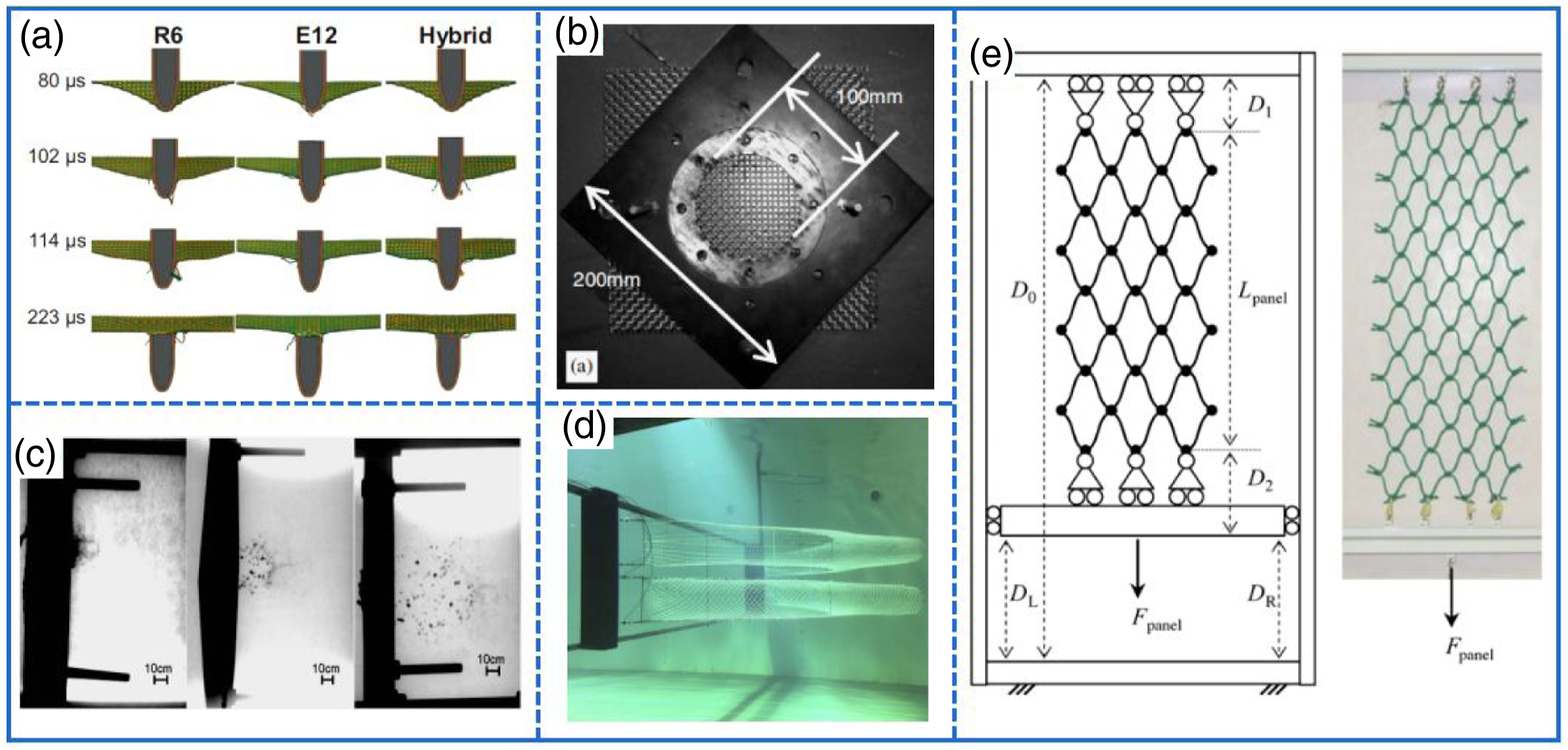
For the mesh-fabric which cannot be tested in practice, the corresponding dynamic research methods have been proposed. Zhang et al. presented a dynamic analysis approach for the composite structure of a deployable truss and cable-net system 61 They adopted an elastic catenary element to model the slack/tensioned cables; then derived the kinetic energy, elasticity-potential energy and geopotential energy of the cable-net structure and deployable truss. Thus, the flexible multi-body dynamic model was built based on the Lagrange equation; and the effect of the cable-net tension on the antenna truss was discussed. Both the simulation and experimental results verified the validity of the method presented.
The hydrodynamic performance and drag resistance of fishing nets are also the focus of research.62–65 Thierry et al. used four bottom trawl models to study the hydrodynamic performance of bottom trawls with different materials, mesh sizes, and twine thicknesses; revealed the effects of twine diameter, twine material, and mesh size on performances; also developed a drag prediction equation to provide the basis for predicting bottom trawl performance . 66 Balash et al. investigated a novel design concept for prawn trawls called the ‘W’ trawl (Figure 3(d)) and thoroughly researched into the effect of mesh orientation on netting drag and its application. 67 The opening resistance of the mesh is also one of the parameters to be quantified when the mesh material is used. Prada 68 based on the method of Sala et al. 65 described a simple but accurate experimental method (Figure 3(e)) to quantify the mesh resistance to the opening of netting panels. They also proposed a new uni-axial experimental set-up that simplifies the required measurement instrument.
Structure model
With the developments of science and technology in textile, from fabric organization design to process parameter calculation, and then to the appearance simulation tend to be intelligent and convenient. Computer software is widely used and constantly updated to simulate the composition and geometry of fibers, yarns and fabrics. Because mesh-fabrics are cyclical in structure, the smallest repeating unit is called a single cell, which is usually used to build a meso-scopic model. Yarn interlacing and fabric structure of woven and braided mesh are relatively easy to simulate, but structure modeling of knitted mesh is the most complex. The geometry of warp-knitted loops (Figure 4(a)) has been studied for more than 60 years. Allison, Peirce et al. first proposed various simplified models of loops.69–72 However, it is seen that the structure theory by using the geometric model method was too different from the actual situation because of over-simplified geometric assumptions, it can not directly applied to engineering. Due to the complex force and deformation of knitted fabric loops, the models of knitted mesh-fabrics are always difficultly to find the characteristic points and bending laws; combining with computer graphics is of great significance to the analysis of a 3D geometric model of fabric.
73
Non-uniform Basis-Spline (NURBS) curves and surfaces were used early. Later, Kurbak et al. tried to use the known curve in their research and obtained the closed pillar stitch model by changing the existing model of open pillar stitch
74
; studied the structural characteristics of square weft insertion mesh-fabrics; and constructed some 3D geometric models,
75
which provided a research basis for the simulation of mechanical deformation, moisture absorption, heat transfer, and electric radiation performance. (a) Raschel knitted netting. (b) Schematic configuration of 2D fabrics elements of holes, unit cell under the action of the course-wise forces, and the bending moment created as a result of tensile forces. (c) Schematic diagram of wire movement trajectory in the smallest units of the metal mesh, pillar stitch and inlay. (d) Microscopic image of the 3D-spacer fabrics and schematic representation of the topology. (e) Schematic diagram of the mass-spring model.24,28,76,79,92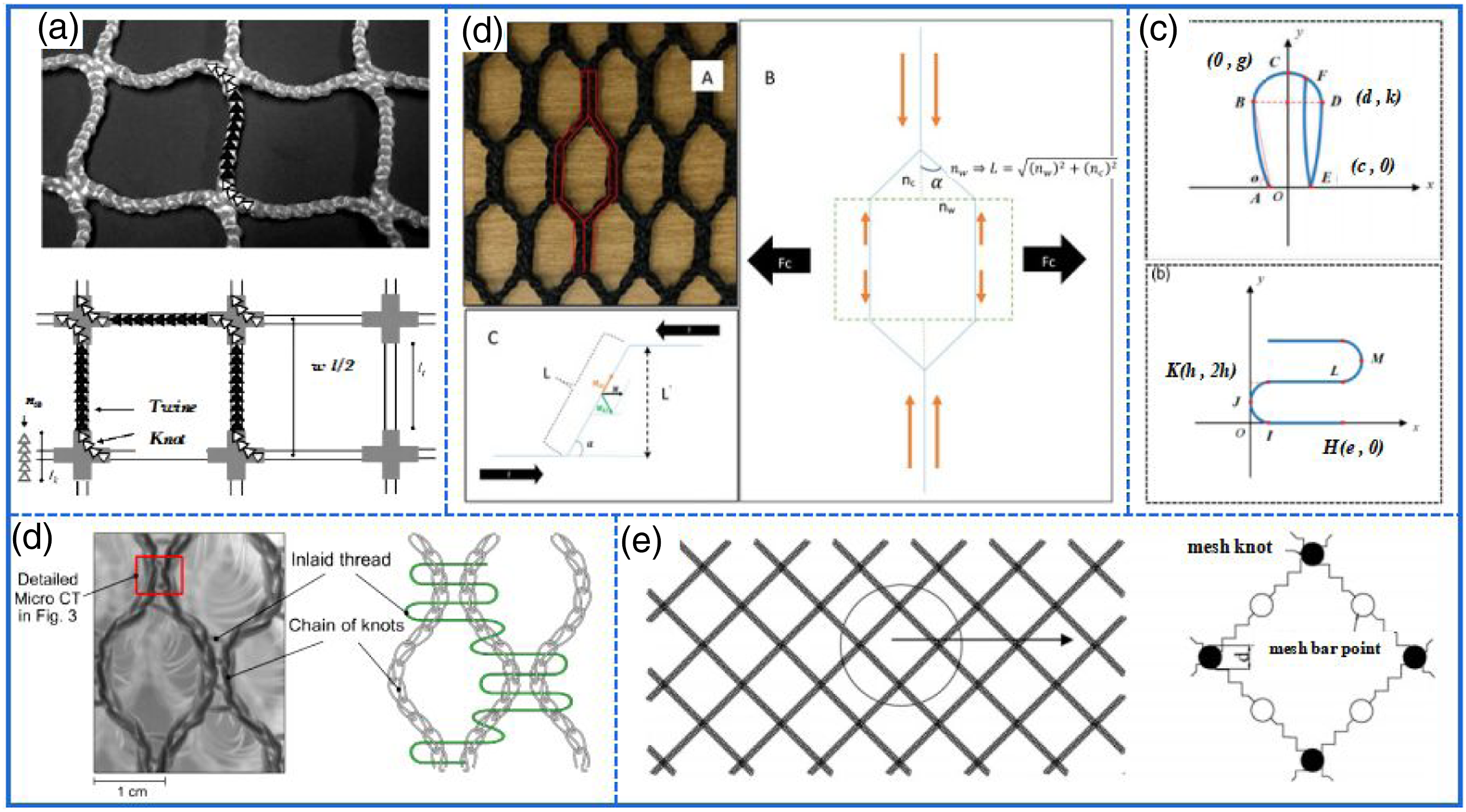
Yang modeled aramid mesh fabric and created a hybrid mesh fabric model. 55 The research results show that the macro model is suitable for large-scale simulation. Ghorbani et al. worked on the tensile modulus of net warp-knitted spacer fabrics using experimental and theoretical approaches. 76 A theoretical model (Figure 4(b)) was built using the energy method and the Castigliano theorem for the fabrics as a structure. Yang et al. regarded the structure of the fabric as a geometric shape with variable side lengths (Figure 4(c)), they assumed that the structure is linear, using the principle of superposition when applying strain and displacement to characterize the response of the fabric during stretching.28,77,78 Moreover, Aranda-Iglesias et al. proposed multiscale modeling (Figure 4(d)) of 3D multi‐axial knitted mesh structure spacer composites and had presented a preliminary experimental validation. 79 Zhao et al. thought fishing net could be modeled as a series of lumped point masses interconnected with springs without mass. 78 Lumped point masses are set at each knot and the center of the mesh bar (Figure 4(e)). Each knot point mass is assumed to be a spherical point at which the fluid force coefficient is constant in motion direction. With the rapid development of electronic technology today, we should make full use of the computer as a tool to describe the complex spatial coils. Thus different structures of mesh-fabrics could be established. Besides, geometrical and physical methods must be used together to build the foundation for performance testing of engineering applications.
Numerical simulation
Numerical modeling that relies on technology is favored by researchers.80–82 For example, the finite element is used to calculate the properties of materials,83–85 including meso-FE, and macro-FE simulations (Figure 5(a)), FE model of wire mesh cross-sectional view (Figure 5(b)), testing (Figure 5(c)), and braiding process (Figure 5(d)). Compared with experimental methods, it usually saves time and cost, and it is conducive to reduce the workload of practical tests.
86
Numerical simulation can reduce the error caused by the contingency of exploratory testing, but improving simulation accuracy is a difficulty. Vu et al. comprehensively analyzed the tensile strength and fatigue resistance of braided mesh yarn by finite element simulation and experimental testing, and the research results were highly persuasive.
87
(a) Residual shapes obtained from experimental tests, meso-FE, and macro-FE simulations. (b) Repeated feature of wire mesh structure, the cross-sectional views of real wire mesh, and FE model. (c) Spherical impact test simulation. (d) Simulation of the 3D braiding process. (e) Photo during experiment, 3D view of the simulation result, and simulated profile in a symmetry plane. (f) Finite element model of fishnet cage. (g) Net deflection comparison with two different size holes, the FEM and actual net panel.56,57,88,90,94
The assessment of mesh resistance to opening is a crucial factor when coming to design to study or optimize the selectivity process. Different authors proposed methods for twine flexural rigidity identification and mesh opening angle at rest. But most experiments could rely on complex instrumentation and dedicated models or software. Vincent et al. proposed a new methodology to determine mechanical and dimensional characteristics of common netting materials, including flexural rigidity, rest angle, knot length, and enables the simulation of large deformation of nettings constructions, even 3D flexural rigidity (Figure 5(e)). The method had been applied to previous experimental results to prove its reliability and practicability. 88 The authors also thought that future work should consider the plasticity in the modeling and a more realistic model for the netting knot. Prada et al. modeled a net twine as a double-clamped beam to accurately describe the mesh resistance to opening, and calculated its force–displacement response by finite element analysis. 89 They also used this fitting technique to develop three different dimensionless stiffness models: (1) polynomial fitting of the force, (2) spline fitting of the potential energy, and (3) spring-based model able to deal with large axial deformations. Their works showed that the presented models have outstanding accuracy and high computational efficiency.
In the marine field, researchers have tried to use numerical analysis methods to simulate the changes of fishing nets at different depths and flow speeds in the sea, even the force and deformation of the whole large cage (Figure 5(f)) 90 Matrixing network was an efficient data structure for simulating the fishing net. Distributed computing had notable advantages in solving massive calculations in modeling the dynamics of purse seine and trawl. Zhang et al. developed a matrixing network in the simulation of the fishing net. The results indicated that the use of the matrixing network and distributed computing in the simulation of a fishing net was effective and reasonable; and gave significant advantages in computations in computer. 91 Zhao et al. presented a numerical method for modeling the hydrodynamic behavior of a 3D gravity net cage in current; the effects of structure size ratio (RDH) and mesh type on the 3D net deformation of gravity cages are simulated and discussed in detail. 92 Sterling et al. conducted two comparative experiments with commercial prawn trawls made from five respective netting materials, including standard polyethylene (PE), high tenacity PE, and three examples of Ultra High Molecular Weight (UHMW) PE. 93 The first experiment is a sequence of paired comparisons of engineering performance. The second experiment is catching and selecting performances assessed by towing the five trawls simultaneously in a five-rig system. Fredriksson et al. studied the finite element modeling technology (Figure 5(g)) of the aquaculture network with a comparison of laboratory measurements. 94 As the randomness of complex deep-sea conditions varies greatly, the error between experimental values and theoretical values is significant, and there is still a great improvement in this direction; researchers still need to collect empirical data.
Space net reflects potential value in the aerospace field, and the research on its performance should be more rigorous. 95 Xu et al. simulated the uniaxial tensile test process of the warp-knitted metal satellite reflective mesh antenna by finite element method (FEM). 96 Zhai et al. proposed a new concept of using a flexible tether system for in-orbit capture, which is widely used in the in-orbit assembly, maintenance and debris mitigation, etc. 97 Compared with a rigid mechanical arm, using a flexible tether system is more promising. Zhang et al. present a dynamic analysis approach for the composite structure of a deployable truss and cable-net system. An elastic catenary element is adopted to model the slack/tensioned cables. 61 Then, from the energy standpoint, the kinetic energy, elasticity-potential energy, and geopotential energy of the cable-net structure and deployable truss are derived. However, the research on space net is limited mainly by the conditions and can only be predicted and improved through these simulations.
For some new structural materials, there may be no application benefit at present. Through theoretical research and structural optimization, we can broaden the application ideas and will realize tremendous value in the future. By designing the structure of warp-knitted mesh spacer fabric, Chang et al. made it have negative Poisson’s ratio performance. They provided some new ideas for industrial textiles through experiments and mathematical models.98,99 Most of the researchers’ studies on braided tubular structures explain the influencing factors by changing one or two parameters. 100 It is difficult to test the properties of micro-sized materials such as vascular scaffolds, and it is more convenient to further explore their mechanical properties by simulating. At the same time, according to the needed optimization of product quality, through the simulation of yarn movement and braided forming process, it becomes a feasible scheme.101,102
Applications
With the improvement of fiber performance and equipment technology, mesh-fabrics are no longer only used in daily necessities. They were widely used in industrial fabrics and have entered the high-tech fields such as bio-medical, national defense, military, aerospace and space science, etc.
Life field
In our daily life, mesh-fabrics are often used for mosquito mesh, fruit packaging bags, curtains and lace, etc. Firstly, because of the small density and evenly distributed yarn holes, gauze and leno weave are used as window and screen mesh. Knitted mesh cloth has sufficient clearance, good moisture conduction, air permeability, and temperature regulation function; Secondly, it has a wide range of adaptability to raw materials. Combined with the basic needs of fashion clothing, Raschel warp knitting machine elastic mesh is favored by consumers and is widely used in tights, vamps, bras, dance clothes, swimsuits and sportswear, etc. Hexagonal mesh spacer fabric on the basis of the 2D fabric has excellent compressibility and resilience, is suitable for car cushions, sofa cushions and mattresses. 103 In addition, mesh-fabrics also are used as the base cloth for coating or multi-layer composite material, such as the use of mesh base cloth and PVC foam coating technology developed by the airtight, waterproof fabric, often used in the production of lifeboats, lifebuoys, and some rescue equipment.
All types of mesh-fabrics are used in leisure sports scenes. The woven mesh can be used for racquets; The main applications of warp knitting mesh are: sports shoes, swimming suits, diving suits, sports protective clothing, etc. By increasing the lining yarn or adding additional loop weaving to improve the strength, used as the indoor protective mesh. Knotted and braided meshes are also often used for sports protection meshes, twist knotless mesh has lightweight, convenient installation, often shows as tennis courts, football fields, and other protective meshes, in sports venues can be used as a catch mesh, not only play a role in the separation of the area, but also to protect adjacent personnel from flying ball damage. (Figure 6) Mesh-fabrics in our daily life.
Marine and agricultural sector
Mesh-fabrics are widely used in the marine fields, from inshore fishing to heavy fishing in the ocean, as flow mesh, trawl (Figure 7(a)), fishing mesh (Figure 7(b)), purse seine (Figure 7(c)), cast mesh (Figure 7(d)) and so on, has made a outstanding contribution to marine fishing. Both knotted and knotless meshes are used, and the braided knotless meshes have the best performance among them. Due to the increasing shortage of offshore resources and the aquaculture cage developed rapidly, seawater cage aquaculture (Figure 7(e)) has been regarded as a new growth point in marine economy in the 21st century.
104
The mesh cage has higher requirements on the resistance to water flow and the smoothness of the surface. Another problem that should take into account is the anti-biological adhesion performance of mesh-fabrics, a variety of new anti-fouling treatment methods emerge in an endless stream.105–107 (a) Trawl. (b) Fishing mesh. (c) Purse seine. (d) Cast mesh. (e) and (f) Deep sea aquaculture cage
108
(g) Agricultural protection mesh.
Akva Group in Norway used PET monofilament to braid a twisted mesh called Econet, 108 which showed in Figure 7(f). On the one hand, because PET fiber with high crystallinity bring up Econet’s general hardness and structure stability like a stone cage mesh. Even if one thread break, the mesh structure would not have deformation, and mesh feet not be scattered; Econet can effectively buffer the impact of large Marine predators, like sharks, on the cages, protect the fry from attack. In addition, the PET monofilament surface is smooth, Econet with few surface crevices, seaweed, and other marine organisms are difficult to adhere to the surface of the mesh, which improves the exchange rate of water inside and outside the cage, increases the life of the product. These advantages make Econet used in high-end fish farming, but its cost is several times that of ordinary fishing meshes, so it has not been widely used. In Ningbo, China, Dacheng New Material has independently developed and produced three kinds of PET twisting meshes: DCFN-7, DCFN-8, and DCFN-9. The breaking strength of DCFN-9 is as high as 793 MPa, and the strength retention rate of the yarn is more than 70% higher than that of the warp-knitted mesh.
Mesh-fabrics are also widely used in agricultural protection (Figure 7(g)), such as plant sunshades and insect protection meshes. Mesh size is critical to protective meshes; it should adapt to protection objects and ensure permeability. Most the protective meshes are warp knitted mesh. The use of exclusion netting as an Integrated Pest Management technique is likely to become increasingly important as a means of increasing crop yields while lessening pesticide use. Despite this, With the centralization and mass production of agricultural products, excessive use of plastic products will also cause irreversible pollution to the environment. So the surface modification 109 and use of biopolymer and other degradable pollution-free raw materials to prepare agricultural network materials 110 are also significant problems to be studied and overcome.
Construction field
In the field of construction, mesh-fabrics can be used as a construction safety mesh (Figure 8(a)), slope protection mesh (Figure 8(b)), and so on.
111
The construction safety mesh refers to which used for lateral and scaffolding protection mesh, according to the different functions can be divided into the beam and set mesh. To prevent people and objects from falling from high.
27
The surface of the protective mesh is smooth without knots, and would not harm the falling thing, ensures the safety of life and property. Construction safety meshes using PVC polyester can also be made into flame retardant protective meshes (Figure 8(c)) through post-treatment to prevent fires caused by welding sparks. Reduce noise and dust pollution to achieve civilized and environmental construction. A slope protection mesh can avoid slope collapse and reduce the threat of dangerous rock falls. In the mining site, it can be used as a rockfall mesh to protect workers from falling rocks. Glass curtain wall cable mesh is a kind of flexible mesh with excellent performance of light, beautiful, mobile, and high strength, widely used in building curtain wall engineering.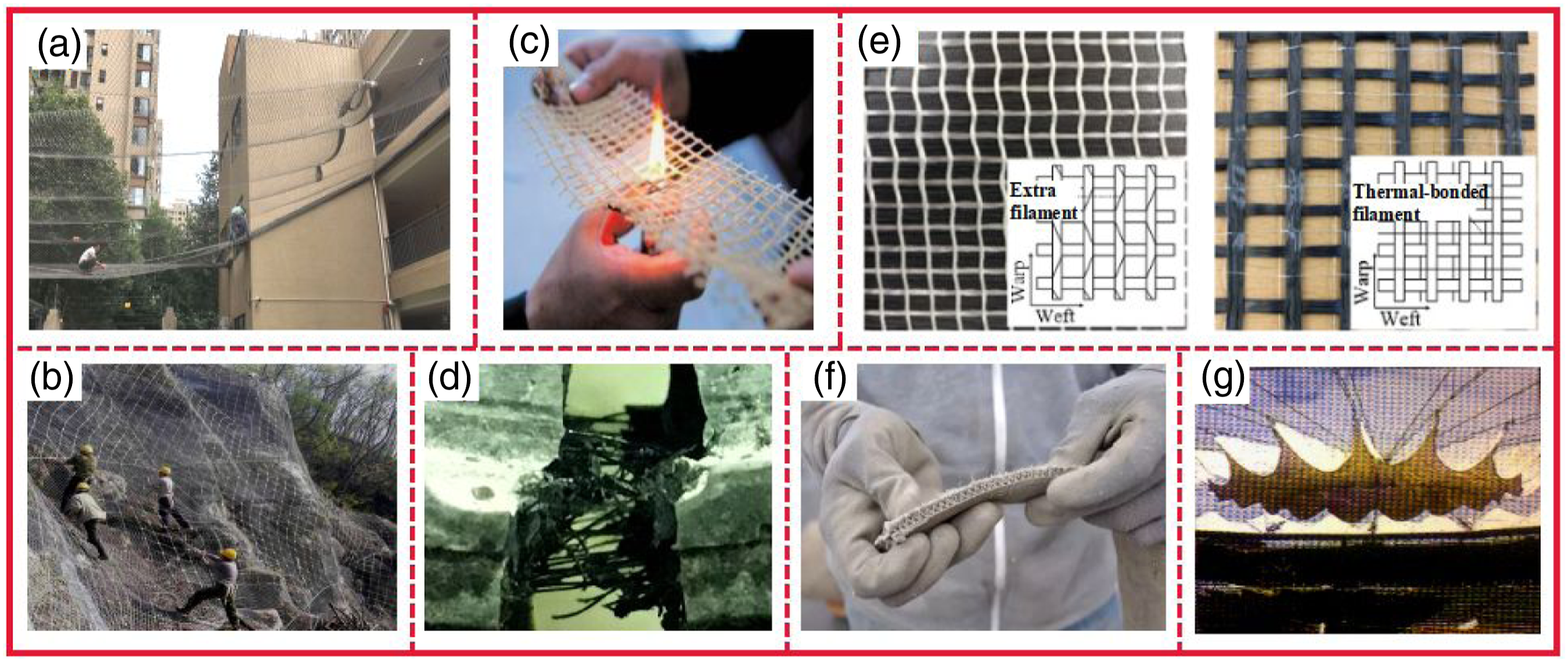
In the 1960s, it was found that short-cut fibers with high elastic modulus and high tensile strength, such as carbon (Figure 8(d)) and glass fiber, could improve the tensile strength of the matrix and inhibit the propagation of cracks, similar to steel bars. However, the disordered distribution of chopped fibers greatly limits its enhancement efficiency. Later, continuous fiber roving was woven into a plane or three-dimensional mesh-fabrics (Figure 8(e)), the fiber woven mesh was laid in the special concrete, and the meridional or latitudinal fiber bundle was arranged along the main direction of the tensile force in the concrete, thus forming textile reinforced concrete, TRC for short. Nowadays, the research on mesh spacer fabric reinforced concrete composite (Figure 8(f)) has not stopped. 112 Mesh structure can significantly reduce the quality of the structure; the weight of fabric or fabric-reinforced structure (Figure 8(g)) is only 1/30 of the conventional components such as brick, cement, and steel, which can greatly save the number and weight of supporting structure and strengthening materials. The mesh structure is stable, has strong ability to resist external damage, and repair after the damage is relatively easy. It can be designed in various shapes and appearances, with a wide range of regulations. And it can be installed flexibly and removed. Fabric production efficiency is high, and the daily output of a single machine can reach more than 1.5 t, which can greatly shorten the engineering cycle and reduce the cost.
Medical field
All the time, woven mesh fabrics have been commonly used as wound dressing gauze (Figure 9(a)), which is stable, breathable and soft. However, the bandaging cannot be done with one hand, and the tightness cannot be flexibly adjusted to promote wound recovery. Warp knitted meshes with high elasticity are used more frequently now
113
; they also could fit various shapes (Figure 9(b)). Due to the stiffness requirements, large-aperture braided mesh-fabrics are widely used in the medical field, such as braided tubes (Figure 9(c)), composite catheters, braided hoses, etc. can be used in cardio-cerebrovascular surgery.114–117 Warp knitted mesh-fabrics can be made into elastic bandages of various shapes, providing care products for women during pregnancy and postpartum repair (Figure 9(d)), such as abdominal braces, girdles, and so on.
118
The existing glass fiber light-cured bandage (Figure 9(e)) and polymer fixed bandage splint (Figure 9(f)) can replace the traditional gypsum material. Warp knitted mesh has unique advantages for human implanted mesh
119
hernia repair meshes with various shapes and fiber materials (Figure 9(g)) have been put into clinical use,120,121 and bladder mesh, female pelvic mesh, etc. have also been developed.
122
In addition, some mesh can be made into a specific shape by the three-dimensional molding method (Figure 9(h)) to conform to the formation of human body parts.123,124 It is expected to develop heart mesh to treat myocardial infarction in the future. For different kinds of material and specifications of the meshes, it’s hard to draw a conclusion about which is better or worse. (a) Woven dressing gauze. (b) Warp knitted fixed mesh. (c) Braided composite catheter. (d) 3D-shaped medical shorts. (e) Glass fiber light-cured bandage. (f) Polymer fixed splint. (g) Human organ repair mesh. (h) 3D model repair mesh.
Military industry
Warp knitting mesh with excellent surface performance, dimensional stability, and high fracture strength at the joint usually be used as linings and fabrics for special clothing (Figure 10(a)). Warp knitted mesh spacer fabric can also be produced for safety vests (Figure 10(b)). On the battlefield, a camouflage mesh (Figure 10(c)), as a vital shielding tool, provides protects for equipment, weapons, and military facilities, making the target difficult to be detected by the enemy. Camouflage mesh is generally made of high strength chemical fiber as the primary raw material, using the well type flat lattice or warp knitting cord lap for manufacturing base cloth (Figure 10(d)), then carried out chemical plating and spraying processes, forming an absorbing coating on the surface.125,126 Currently, reconnaissance technology has been dramatically improved; the camouflage and anti-reconnaissance stealth technology has become the focus of the modern war, among which the camouflage system, especially the camouflage mesh, has become one of the effective methods to prevent detection.
127
In addition, UAV interceptor meshes (Figure 10(e)) and apron skid meshes (Figure 10(f)) are also several new applications. Using high-performance fiber raw materials such as ultra-high molecular weight polyethylene and aramid to prepare flexible mesh materials, which are portable and easy to storage and transportation, will play an essential role. (a) Special combating clothing. (b) Safety vest. (c) Disguise clothing. (d) Camouflage mesh. (e) Drone capture mesh. (f) Apron skid mesh.
Aerospace
As early as the 1980s, the research on the metal mesh material of space deployable satellite antennas (Figure 11(a)) started.
53
Wade et al. adopt the woven mesh fabric with gauze and leno weave as the reflector material of satellite antennas.
128
Boan et al. used gold-plated tungsten metal wire to knit warp knitted mesh as reflector material for satellite antenna.
129
Dimensional stability is one of the vital performance indexes of large aperture reticulated reflector antenna. The combination of wire and warp knitted technology greatly improves the mechanical properties of fabrics, but this method is expensive and has been developed only in the aerospace field. Metal mesh is also an excellent protective material; a new buffer could be designed to reduce the International Space Station (ISS) from being affected by space debris. The power system of ISS and spacecraft tend to grow in semi-rigid batteries. The key institutions need to load the erosion of space environment and require a very lightweight, compact with a mesh structure and higher strength. Currently, the critical innovation prepared with high strength glass fiber warp knitting mesh material has been successfully applied in the Tiangong-1 spacecraft.
The mesh-fabrics serve the space rope mesh system (Figure 11(b)), and can be used for space target acquisition, garbage removal, etc. At present, relevant exploration work is being carried out in some countries.130,131 Space tug launches a string braided flexible mesh to capture the target direction by expanding mechanism; after the arrest target was wrapped in, recall and control the target spacecraft (Figure 11(c)). Its advantage is the small purchase and storage volume, high fault tolerance, far capture distance, low capturing accuracy requirement, and more negligible collision damage effect. But the rope mesh’s unique flexible features also bring a series of problems; large displacement motion and deformation coupling results in complex nonlinear characteristics of the mesh. At the same time, there are no explicit mechanism researches on the process of launch and collision during the rope mesh capturing the task, and the structure design also lacks consideration for mechanical performance based on its working stages.
With the more delicate design and development of light aircraft, research on the flexible structure of cargo blocking mesh (Figure 11(d)) has been paid more attention. For example, Boeing, Airbus, and other large aircraft block the mesh as level Ⅰ limited dynamic installation, so it is necessary to study the flexible block mesh weaving more than two kinds of nonlinear high-performance fiber yarns. Then establish the block mesh load strength calculation model through the non-static simulation study to provide strong support for determining the type of block mesh according to the requirements of load strength.
Conclusions and perspectives
Increasing use of mesh-fabrics in numerous applications has demonstrated its functional versatility as a high-tech material. New structures, sizes, materials, and properties of mesh-fabrics have been important factors for promoting the essential properties required in different industrial areas. In this paper, these recent advances are reviewed and summarized in terms of three aspects: the classifications of mesh-fabrics, the key performances, and research techniques, and the present situation of applications (Figure 12). Combining with the characteristics of mesh-fabrics and the developing directions of industrial technology, engineering mesh account for a large proportion of the current market. Particularly, warp knitting mesh fabric can achieve more practical performances in specific fields, due to its variety of changes in structures and produce forms, strong designability, excellent extensibility, and stable mesh shapes. In addition, given the shortcomings of the existing studies, challenges and further research directions for each aspect are given. The conclusion of mesh-fabrics development status and several suggestions for the future researches.
There are several suggestions presented as follows: 1) Improve the intensity and integrity of research
The problem of low technical level exists in the conventional textile industry, mainly reflected in the lag of equipment technology and insufficient investment in product research, which would seriously hinder the steps of innovation. Mesh-fabrics have a wide range of potential applications, which require stronger cooperation with several subjects, such as materials science, informatics, mechanical engineering, medicine, and industrial engineering, to form a complete industrial chain of research, production, promotion, and application in relevant industrial fields. 2) Strengthen the sustainable concept
Industrial mesh-fabrics have a large volume, consumption of resources, and emissions, so recycling and regeneration are essential. During product development, we should fully consider the recyclable and environmentally friendly characteristics of materials and make more efforts in the treatment and procedure of material recycling. 3) Promote the research of high-performance mesh-fabrics
Mesh-fabrics applied in the high technology and new field is in infancy; most materials are limited to the theoretical and laboratory stage, have not been widely used in engineering practice. However, with the upgrading of high-performance raw material preparation, refinement, and intelligence of textile technology, the future application, and development of mesh-fabrics would be broader.
Footnotes
Declaration of conflicting interests
The author(s) declared no potential conflicts of interest with respect to the research, authorship, and/or publication of this article.
Funding
The author(s) disclosed receipt of the following financial support for the research, authorship, and/or publication of this article: This work was supported by the National Science Foundation of China (11972172), the Fundamental Research Funds for the Central Universities (JUSRP622005), and a Project Funded by the Priority Academic Program Development of Jiangsu Higher Education Institutions (PAP), and the Postgraduate Research & Practice Innovation Program of Jiangsu Province (KYCX22-2428).
