




Abstract
The range and strength of Electromagnetic Wave loss are increasing with the development of electronic technology in intellectualization and diversification. Extensive research is focused on high-frequency microwave absorbersbut rarely on low-frequency ones. However, the shield of low-frequency microwave interference is bulky and complicated. It is necessary to adopt new structural composites with lightweight, porous, or multi-layer magneto-dielectric synergistic to obtain lighter, thinner, broader bandwidth, and strong absorption absorbers in the low-frequency range. The porous and multi-layer textiles would extend the Microwave (M. W.) transmitting pathway. The prepared M. W. textile-based composites possess broad bandwidth and strong absorption in the low-frequency range when magneto-dielectric synergistic functional particles have embedded in the textiles. This paper reviewed the modified graphene-based absorbers (GBAs), the hybrids combined GBAs with the low-frequency magnetic loss absorbers (LFMLAs), and the textile-based composites added by the complex combined GBAs with LFMLAs (GBAs/LFMLAs). The prepared GBAs/LFMLAs textile-based composites are broad bandwidth, lightweight, small thickness, and strong absorption materials in the low-frequency range. The prepared GBAs/LFMLAs textile-based microwave absorbers (MWAs) may expand the application scope of MWAs and promote their economic benefit. The GBAs/LFMLAs textile-based composites may propose a new strategy of broad bandwidth MWAs in the low-frequency range.
Keywords
Introduction
With the rapid development of information technology, electronics' high-speed calculation and transmitting rate are becoming increasingly important. The Electromagnetic Wave (EMW) interference and shielding frequency range expands constantly. With complicated modern battlefield conditions, radar detection systems are simultaneously exposed to EMW interference. Besides, the civilian and military applications suffer from the booming EMW interference as well, such as R.F., 1 radar stealth technology, 2 national defense security, 3 portable transmission, 4 and electronic devices. 5 Therefore, military and civilians suffer from the booming EMW interference due to upgrading continuous communication technology.
However, the absorbing frequency range appears to “blueshift” to the low-frequency range gradually, as shown in Figure 1.6–8 Therefore, the nature of the microwave absorbers should be broad bandwidth, as well as lightweight, small thickness, strong absorption, excellent stability, appropriate flexibility, and physical compatibility in the low-frequency range.
9
(a) Common definition of electromagnetic spectrum ranges of the corresponding frequency bands. (b) Various microwave and terahertz devices are widely applied in modern society.
8

The high-frequency (>8 GHz) absorbing technology has been relatively mature, while the low-frequency absorbing technology (<8 GHz) with long propagation distance, strong penetration ability, and poor shielding suffers from great difficulties and needs to be solved urgently.6,7 The microwave absorbing textile-based composites are widely used because of their excellent absorption and characteristics, such as lightweight, remarkable plasticity, flexibility, and low cost.8,9
Generally, the absorption of common textiles is not outstanding. Functional particles with magnetic loss and/or dielectric loss are introduced directly or through transparent materials to the textiles. The textile-based composites possess the function of magnetic loss and/or dielectric loss. When the hybrids that the magnetic loss particles are combined with the dielectric loss particles in optimized ratios, namely the magneto-dielectric synergistic composites, the electromagnetic wavelength absorption is remarkable.10–12
The traditional MLAs include ferrite, magnetic metal particles, and their alloys. However, using a single absorber (MLA) has many limitations, such as its considerable thickness, heavyweight, narrow Effective Absorption bandwidth(EAB), and weak absorption. The traditional Dielectric Loss absorbers(DLAs) include conductive polymers, ceramic-based materials, Mxene, and chiral materials,carbon-based materials such as carbon nanotube (CNT), Graphene (G.N.), ppy and polythiophene (PTh).13–16
Graphene (G.N.), an excellent dielectric loss material, has attracted much attention due to its high strength, good toughness, lightweight, medium dielectric constant, and electrical tunability with frequency.17–19 There are interactive phenomena between the reduced Graphene Oxide (rGO) and wool/nylon (W/N) fabric, as shown in Figure 2. In textile-based composites, the depositing of rGO can construct a three-dimensional electronic transmitting channel network within the W/N textile. Therefore, they can be excellent E. M. textile-based composites.
18
The preparation process of the GBAs-based wool/nylon (W/N) composite.
18

In MWA textile-based composites, textiles often have two roles. One of them is to be a reinforcement providing all the mechanical properties of the composite. The reinforcement textile is then coated 20 or printed 21 by MLAs or/and DLAs function particles that are diffused in the transparent resin22,23 in the formation process. In this role, the textile can not attenuate any EMW energy. The second role of the textile is to promote the absorption of the MWAM.24,25 For example, carbon fiber, 26 glass fiber, 27 and metal and metal alloy fiber, such as Ni, 28 can consume the electronic or magnetic component of the MWAM. The functional fiber of textiles would prolong the pathway of the M.W. Therefore, textiles can promote the absorption of the absorber.29,30
The absorbing mechanism of the Microwave Absorbing Materials (MWAMs)
The absorbing mechanism of MWAMs is not only related to their intrinsic performance, but also their structure, such as the electric resonance, 31 ferro-resonance, 32 and mono-layered, 33 double-layered, 34 multi-layered, 35 and meta-material.36,37
In the propagation process, the Microwave (M.W.) penetrates the front surface of the MWAMs, as shown in Figure 3.
7
The incident microwave can be divided into three parts: the absorption wave, the reflection wave, and the transmitting wave. When the absorption of MWAMs enhances, the reflection of M.W. and the transmitting M.W. to the spatial will be reduced, which may be an effective shielding method for EMW.
38
The propagation process of EMW.
6

Two points should be achieved to promote the absorption of the MWAM. Firstly, it is necessary to make an excellent impedance match between MWAM and M.W. When the M.W. propagates in the MWAM, creating a pathway long enough to transfer the M.W.’s energy is essential. Secondly, there should be an ability to dampen the M.W. and convert the energy of M.W. into thermal energy or other forms of energy.39,40
According to the propagation process of EMW, the possible schemes to achieve excellent absorption can be discussed as follows: (1) improving the impedance match between MWAM and M.W. so that M.W. enter the MWAM smoothly, (2) the porous or multi-layered structures are formed inside the MWAM, which make the transmitting pathway of M.W. curve and long, (3) the MWAM have powerful M.W. attenuation ability to consume the M.W. Thereby, the absorption of MWAM may be promoted.40–43
Two conditions must be met simultaneously to implement both broad bandwidth and strong absorption of the MWAM in the low-frequency range. The two conditions are the remarkable impedance match ability and the exceptional M.W. absorbing ability. 44
To meet the two conditions above, the constituent component of MWAM must have the capability of magnetic loss or/and dielectric loss in the low-frequency range. Among the MWAMs, the electrical loss material consumes the electric component of M.W., and the magnetic loss material consumes the magnetic component of M.W. in the low-frequency range. When the GBAs/MLAs hybrids have the magneto-dielectric synergistic resonance in some overlap frequency range, the absorbing ability of MWAMs should be enhanced in the corresponding frequency range. The combination of the magneto-dielectric synergistic hybrids with porous or multi-layered textiles will expand the application scope of textile-based MWAMs.45–48
Graphene-based absorbers (GBAs) with dielectric loss

Cao and co-workers 53 demonstrated that the M.W. reflection loss value(RLV) of rGO is −6.9 dB at 7 GHz, which was higher than that of carbon nanotube and graphite.
Rubric and co-workers 54 added G.N. to the epoxy resin to study their dielectric loss performance and absorption of their hybrid. The effects of particle size (3 μm, 6–8 μm, 15 μm) and mass ratio (5%–25%) were studied and discussed. The results demonstrated that the sample with the smallest G.N. particle size (3 μm) and the highest weight ratio (25 wt%) exhibited high loss tangent (tan δ = 0.36) and medium dielectric constant (ε' = 12–14) in the frequency range of 8–10 GHz.
In summary, pure graphene (G.N.), acting as an absorber, has a medium dielectric constant, which is suitable for the medium and/or high-frequency MWAM. Although the absorbing strength of G.N. is higher than that of carbon nanotube and graphite, the optimal RLV was just −6.9 dB. The RLV of pure G.N. is greater than −10 dB, which indicates that the pure G.N. fails to implement effective absorption(generally, the effective absorption reflection loss value is less than −10 dB). The reason may be that the G.N. molecule is a 2D crystal macro-molecule composed of a tightly packed carbon layer, as shown in Figure 4(a). There is almost no gap among G.N. molecules and small gaps between their valence and conduction bands in the molecule. In this way, it is easy to cause the pure G.N. to accumulate and poor impedance match with spatial. Thereby, the absorption of the pure G.N. is limited.55,56
To improve the absorption of G.N., researchers modified it to improve its natural resonance, heterogeneous structure interface, and electromagnetic coupling, which may improve the impedance match and enhance the absorption. The modification of pure G.N. is inevitable. The modified G.N. will represent for GBAs with lightweight, small thickness, and strong absorption. 57
Modification of the molecular structure of G.N
Introducing heteroatoms (such as N, B, F, S, P, I), transition metal ions and rare-earth atoms to the surface or the edge of G.N. molecules induces gaps between or among G.N. molecules. The process of introducing atoms to G.N. was named doping, which results in the gaps between the valence and conduction bands opening and the molecular structure flattening. The doping of G.N. reduces the constant effectively. Among the doping atoms, the N atom is the most appropriate dopant for the G.N. molecule. The doped product was named as nitrogen-doping graphene(NGN).58–61
The introduction of the N atom to the G.N. makes the C atom polarize and brings about the lattice changes, which prompts energy transition from the contiguous state to the Fermi level,62,63 and the electrons' transporting speeds up. Furthermore, the molecules are not accessible to self-agglomerate. In addition, introducing the N atom causes more structural defects and additional polarization relaxation in the G.N. molecule, which improves the impedance match between the MWAM and the spatial. Therefore, the nitrogen-doping Graphene (NGN) is more suitable as a dielectric loss absorber than pure G.N., as shown in Figure 4(b). There are four types of N atom existing in the NGN molecule: pyridinic N atom, amino N atom, pyrrolic N atom, and graphite N atom.64–69
Quan and co-workers 70 synthesized the NGN with precursors graphene oxide (G.O.) and urea by a facile hydrothermal method. The pyrrolic-N of NGN has been found to dominate the induced magnetic performance, which cooperates with the dielectric loss, and the NGN was conducive to absorption. The optimized RLV of NGN achieved −11.3 dB at 12.7 GHz, and the Effective Absorption Bandwidth (EAB) is 12.2–14.3 GHz with a thickness of 3 mm. Furthermore, the density of NGN is proved more favorable than other existing GBAs.
Zhou and co-workers 71 synthesized NGN nanosheets through the in-situ strategy. The NGN reduced the dielectric constant and solved the interface impedance mismatch problem. The results demonstrated that the NGN nanosheet with 4.6% nitrogen-doping showed an excellent absorption compared to the pure G.N. nanosheet. More than 99% of the M. W. could be quantitatively attenuated in 5–18 GHz by the NGN.
Chamoli and co-workers 72 synthesized the NGN sheet by solvothermal. The results demonstrated that the presence of the N atom generates defects in G.N. molecular, which enhance the overall electrical properties of NGN. The prepared nano-NGN/epoxy resin composites were used to study the M. W. response. The results proved that the minimal RLV is −40.8 dB when the mass fraction of NGN is 2%, and the EAB (R.L. <−10 dB) is 1.5 GHz.
In summary, the RLV of NGN is 5 times that of pure G.N., and both the EAB and impedance match are improved. It may benefit from the introduction of the N atom to the G.N. lattice. The N atom induces the G. N. lattice defects, which prompt the polarizations of the G. N. system, such as dipole polarization, dielectric polarization, interface polarization, and defect polarization. Furthermore, the crystallinity is reduced automatically. The parameter optimization of the lattice resulted in a decrease in conductivity and the reduction of the dielectric constant. A better balance between attenuation loss and impedance match is implemented with the N atom doping in the G. N. molecular. It can be seen that the nitrogen-doping in the G. N. may improve the absorption and the impedance match.
Modification of the morphology structure of G.N
Graphene can be used as a dielectric absorber due to its unique intrinsic properties, such as specific surface area conductivity, dielectric loss, and low density and molecular morphology, which significantly influence the absorption of G.N. 73 The flexible 2D structure of G.N. can be assembled among nanosheets to form a multi-level sandwich-like structure or a 3D porous network structure. The huge cross-linking network makes the M.W. interaction inside the G.N., such as multiple reflections and scattering capacitor, and the long and complicated M.W. transmitting pathway contribute to the attenuation of the incident M.W. 74 Besides, the 3D porous G.N. has low density, large specific surface area, high conductivity, and high intensity, as shown in Figure 4(c). 75
Chen and co-workers 76 prepared potent M.W. absorbing hybrids constituted by the multi-walled carbon nanotube (MWCNT) and porous graphene foam (G.F.). They analyzed the properties of the composites with C atom G.F.s (CGFs) and without C atom (C@GFs) under different conditions, such as different mass ratios and annealing temperatures. The results demonstrated that the EAB of C@GFs is narrower than that of CGFs in the low-frequency microwave range. When the annealing temperature is 200°C, the absorption of GCF-200 is better than that of other members. The minimal RLV of GCF-200 is −32.5 dB at 4.5 GHz with a thickness of 2 mm, and the EAB is 2–18 GHz.
Shu and co-workers 77 prepared a 3D network graphene (3DNG) by hydrothermal self-assembly and high-temperature calcination. The 3DNG was synthesized by precursors nitrogen-doping rGO and MWCNT. The results demonstrated that the absorption of 3DNG improved significantly with the increase in calcination temperature. When the calcination temperature was 600°C, and the mass content was 8 wt%, the minimal RLV of 3DNG600 was −69.6 dB at 12.5 GHz with a thickness of 1.5 mm, and the EAB was 4.3 GHz (13.2–17.5 GHz).
Zhang and co-workers 78 prepared a series of graphene foams (G.F.s) through solvothermal and annealing. In the analysis of the G.F.s, it appeared that with the increase of annealing temperature, the number of porous was up at first, then down, and the penetrating M.W. propagated along the porous wall, then the E.M. energy dissipated significantly. Among the G.F.s, the minimal RLV of the GF-T600 (the annealing temperature was 600°C) or C0.6(the initial concentration of G.N. was 0.6 mg/mL) was −34.0 dB, and the EAB was 14.3 GHz. Besides, the bulk density of GF-T600 was an ultralow value of 1.6 mg/cm3, close to ambient air density (1.2 mg/cm3).
In summary, the 3D networked structure improves the RLV and the EAB of G. N., which is conducive to both the absorption strength and bandwidth. The reason may be as follows:① the networked structure of 3DNG increases the specific surface area, which increases the absorbing capacity of M.W.; ② a long and complicated electronic transmitting pathway of M.W. is formed, which makes the M.W. penetrate the inside of the MWAM and transmit along the porous wall. Thereby, the porous 3DNG could prolong the transmitting distance of M.W. and enhance its attenuation; ③ the attenuation ability of M.W. is promoted by the characteristic multi-level structure. And there are a series of attenuation mechanisms inside the 3DNG, such as magnetic resonance, interface polarization, relaxation polarization, and dipole polarization. Therefore, modified 3D networked structures of G.N. are conducive to the high-quality and lightweight absorber.
Modification of the supramolecular structure of G.N.
The researchers developed two-layer G.N.s by tearing and stacking. A two-layer or tetra-layer G.N. structure was composed of one or two AB-stacked G.N. bilayers with a relative rotation angle.
79
Namely, there were one or two stacks in the G.N. lattice. Under the action of the E.M. field, the G.N. molecular layers could be twisted at a certain angle, which was defined as Magic Angle. So far, there have been two kinds of G.N. available: twisted double-layer Graphene (TBG) and twisted double bilayer graphene (TBG),80,81 as shown in Figure 5(a) and (b). (a) Schematic drawing of the twisted double bilayer graphene configuration investigated in our work. The intrinsic symmetric polarization is illustrated. (b) Reciprocal lattice (black dots) and the mini-Brillouin zone (gray hexagon) of θ = 21.8° (m = 1) TDBG. The blue and red hexagons are the Brillouin zones of the corresponding A. B. stacked BLG counterparts.
64
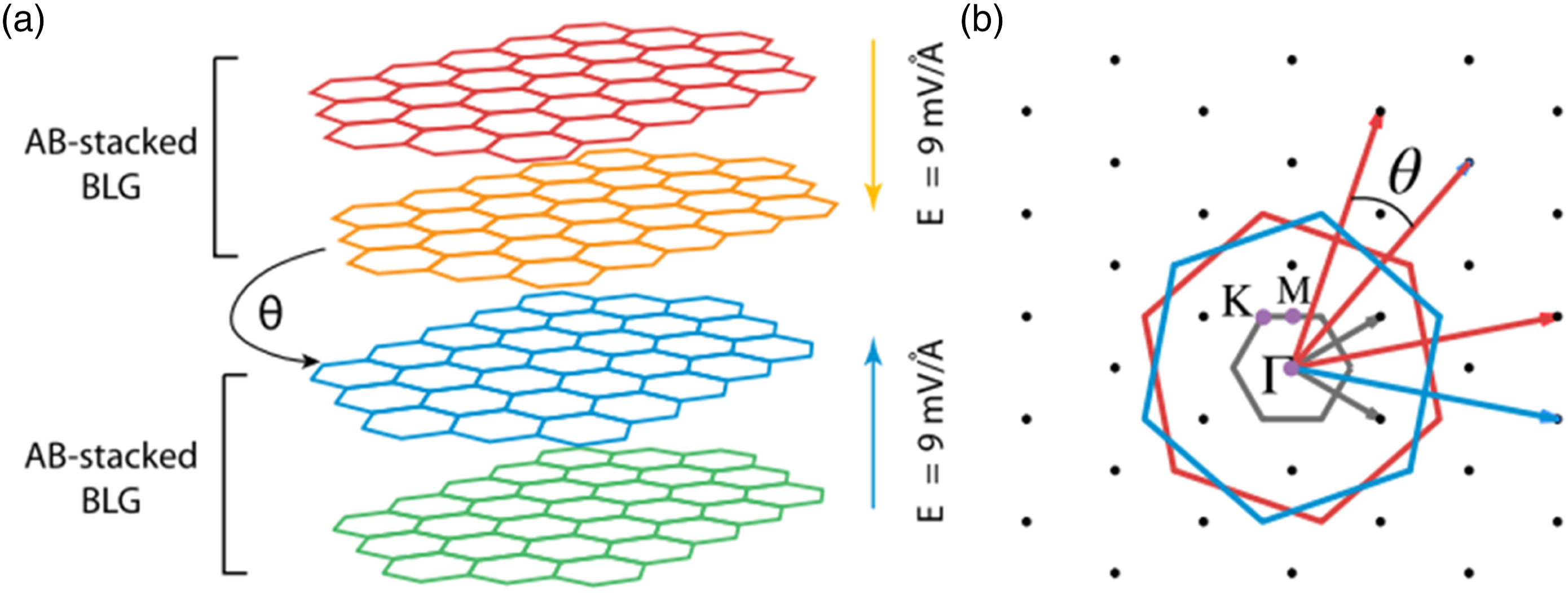
Zhang, 81 Shen, 82 and FateMeh 83 and their co-workers researched the TBG and TDBG. The results demonstrated that lattice modification made the G. N. amorphous to be flat conduction band at the Magic Angle θ = 21.8°. Therefore, separating the conduction bands among TBG or TDBG molecules was easy and conducive to inter-molecular filling and doping. Compared with pure G. N., the TBG and TDBG are easier to form structures with a large aspect ratio. However, these two materials are rarely used in actual production because of their novelty, low output, and high cost. However, they are used in theoretical research generally, such as modeling and simulation. Therefore, they are seldom used in the field of MWAM.
The hybrid of GBAs/MLAs functional particles in the low-frequency range
The modified GBAs can improve their frequency-tunable dielectric loss capacity, and the attenuation of the overall electrical component of the EMW is excellent. However, the attenuation ability of the magnetic component of the EMW is weak. To implement a broad bandwidth and strong absorption of GBA in the low-frequency range, the introduction of a complementary magnetic loss component is inevitable.7,84–86 The EMW loss capacity of MWAM decreases with an increasing frequency, especially in the low-frequency range. Hence, improving the EMW loss capacity of MWAM is imperative, especially the absorbing capacity. 87 However, higher dielectric loss is not conducive to impedance match in the low-frequency range. Therefore, the robust absorption in the low-frequency range mainly depends on the ability of magnetic loss.32,88
Traditional magnetic loss materials commonly include ferrite, metal, and metal alloys. 89 The ferrite can implement low-frequency absorption, but the bandwidth is narrow, the saturation magnetization intensity is poor, and the thickness is large also. Magnetic metals have excellent high-frequency magnetic resonance, which is suitable for high-frequency EMW absorption. However, the usage of magnetic metal and the metal alloy is limited in the low-frequency range because of their high density, poor chemical corrosion, and narrow EAB. The structure of micro-nano magnetic metal particles is relatively simple, and there are no magnetic moments between magnetic sub-grids canceling each other out. Their permeability and saturation magnetization are significant and can be modified to be micro-nano magnetic alloys to adjust their frequency response. The low-frequency absorption is improved when the micro-nano magnetic loss absorber and its alloys are combined with the dielectric loss GBAs. Therefore, the micro-nano magnetic loss absorbers are suitable for low-frequency MWAM.85,87,89
Ma and co-workers
90
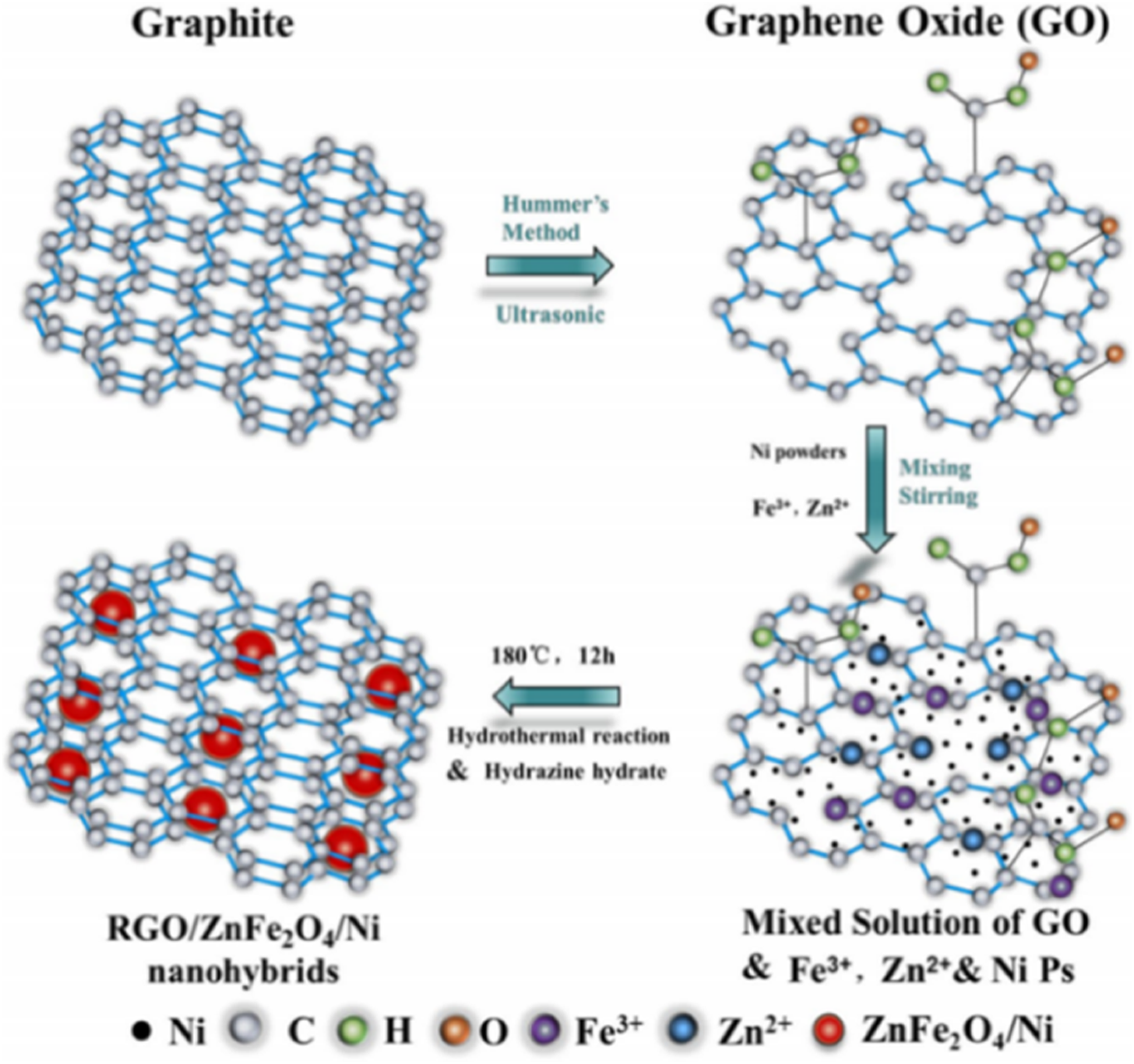
synthesized reduced Graphene oxide/ZnFe2O4/Ni (rGO/ZnFe2O4/Ni) spherical nano-hybrid composites by hydrothermal strategy. When the content of rGO/ZnFe2O4/Ni nano-hybrid increased to 40 wt%, the minimal RLV was −22.57 dB at 4.21 GHz with a thickness of 2.5 mm. The EAB range was 3.6 ∼ 10.22 GHz with a thickness of 1.5 ∼ 4.0 mm. The results demonstrated that the rGO/ZnFe2O4/Ni nano-hybrids were robust absorbers in the low-frequency range, which provided a new idea for the lightweight tailing of GAB, as shown in Figure 6. The schematic illustration of the fabrication process of rGO/ZnFe2O4/Ni nanohybrid.
90
Francisco and co-workers 91 synthesized a new type of M.W. absorber by Pechini sol-gel strategy. The reduced graphene oxide (rGO) acted as the based material in the system. The Fe @γ-Fe2O3 and Fe/Co/Ni alloy were protected by graphene-based nanoparticles (N.P.s), and the magnetic loss materials acted as the decorating material. The results demonstrated that the EBA range was 0.4 MHz–20 GHz, and the absorptivity of the MWAMs was between 60% and 100%, Sun and co-workers 92 assembled CoNi/G.N. nanocomposite (CoNi/G.N.) by the one-pot strategy. The results demonstrated that the M.W. absorption of CoNi/G.N. was excellent. The minimal RLV was −31.0 dB at 4.9 GHz with a thickness of 4 mm. The EAB was 7.3 GHz with a thickness of 2 mm.
Wan and co-workers 93 synthesized a novel γ-Fe2O3 nanoring (N.R.)/porous nitrogen-doped graphene (γ- Fe2O3 NR/PNG) hybrid with different mass ratios by a two-step solvothermal strategy. The results demonstrated that compared with pure γ-Fe2O3 N.R.s or PNG, the γ-Fe2O3 NRs/PNG hybrids showed robust M.W. absorption. When the mass ratio of γ- Fe2O3 NR: PNG hybrid was 4:1, the EAB (RLV<−10 dB) was most comprehensive. The minimal RLV (RLVmin) value was −40.18 dB at 7.80 GHz with a thickness of 2.5 mm, and the EAB was 3.41 GHz. In addition, the hybrid had excellent absorption in the low-frequency range. The RLVmin was −32.69 dB at 3.38 GHz with a thickness of 5.5 mm.
In summary, when the low-frequency magnetic loss absorbers (LFMLAs) combined with GBAs, the EAB of the hybrids was primary in the low-frequency range with a small thickness. The reasons may be that the LFMLAs play an essential role in the magnetic resonance of the low-frequency range, and the GBAs play the role of electrical frequency-tunable resonance at the corresponding frequency range. When LFMLAs are combined with the GBAs at an appropriate ratio and in a reasonable manner, the LFMLAs consume the low-frequency magnetic component of the M.W., and the GBAs consume the electrical component of the M.W. and improve the impedance match of the hybrids. The GBAs and LFMLAs hybrids resonate synergistically in the low-frequency range. Therefore, the GBAs/LFMLAs hybrids improve the absorption in the low-frequency range.
The GBM/MLA-added textile-based composites
The common textiles have little effect on M.W. absorption. 94 However, some novel textile-based MWAM impacts the absorption remarkably. 1 The basic unit of the textile-based MWAM, no matter what kind of structure it is. 95
Fibers can be molded into 1D deposited or coated fibers, 96 2D flat textiles, 97 and 3D cubic fabrics 98 due to their flexible structure. However, the textile-based composites in the low-frequency range mainly focus on the EMW interference shielding materials but few on the MWAs. For example, Ozen and co-workers 99 studied the EMI fibers, which blended stainless/polyester fiber with standard polyester fiber in a specified proportion. The results demonstrated that when the ratio of conductive stainless steel fiber was 25% in the nonwoven fabric, the optimal electromagnetic shielding efficiency (EMSE) was 18 dB in the frequency range of 1.2–3 GHz. Zkan and co-workers 100 studied the fibers by blending stainless steel with nylon 66 filament. The results demonstrated that the optimal EMSE was 78.70 dB in the frequency range of 0.8 ∼ 5.2 GHz.
A network with colossal 3D cross-linked and intricate magneton-dielectric synergistic loss is inevitable for obtaining low-frequency textile-based composite. The 3D textile-based composite formed by 1D fiber creates a very long and complex transmission channel for the incident M.W., which reduces the thickness caused by the strong absorption and broad bandwidth of low-frequency MWAM. 100
Song and co-workers
30
prepared the textile-based composite by in-situ synthetic. The results demonstrated that the carbonyl iron/reduced Graphene oxide/nonwoven (CI-rGO-NW) textile-based composite had strong M.W. absorption in the low-frequency range (2.91–5.1 GHz), and the EAB was 9.2 GHz, as shown in Figure 7. The M.W. loss in the CI-rGO-NW composite.
30

Li and co-workers
101
introduced 2D rGO into 1D carbon fiber (CF) to synthesize 3D carbon fiber/reduced graphene oxide (CF-rGO) textile-based composite. In the system, zero-dimensional Ni nanoparticles were deposited on the surface of rGO to prepare a lightweight, flexible carbon fiber/reduced graphene oxide/nickel (CF-rGO-Ni) composite. The results demonstrated that rGO and Ni significantly influenced the dielectric parameter and absorption. In addition, CF-rGO and CF-rGO-Ni nano-textile could be low-frequency absorbers by adjusting the proportion and dosage of rGO and Ni, as shown in Figure 8. M.W. loss in the CF-rGO-Ni textile-based composite.
79

In summary, when the low-frequency magneton-dielectric synergist functional particles are added to the textile. The textile-based composite would obtain the corresponding low-frequency loss function. Therefore, the functional particle would cause the textile-based composite to possess low-frequency absorption. In the system, the textile acts as the electronic carrier and constructs the pathway of M.W. transmission. In other words, the network and porous structure in the M.W. loss composite extends the transmitting pathway of the M.W., which attenuates the M.W. energy effectively. Therefore, the magneto-dielectric synergistic textile-based composite would enhance the M.W. absorbing strength and bandwidth.
Conclusions and perspectives
This paper summarizes the modified GBAs, the hybrid constituted by GBAs and LFMLAs, and the textile-based composite added by a hybrid of GBAs/LFMLAs functional particle. In textile-based composite, the GBAs/LFMLAs functional particle hybrid consumes the M.W. energy synergetically, and the textile promotes absorption. In the composite, the lightweight GBAs, which are electric frequency-tunable, undertake as an excellent M.W. absorber of the electric component. At the same time, the LFMLAs take place magnetic resonance in the low-frequency range, consuming the magnetic component of the M.W. . The absorption would be enhanced when the LFMLAs and GBAs resonate synergetically in a similar or overlapping frequency range. The textile added by the GBAs/LFMLAs synergistic functional particle hybrid may prolong the propagation pathway of the M.W., which would enhance the M.W. consumption in the low-frequency range. Finally, the prepared M.W. textile-based composite has excellent properties in the low-frequency range, such as broad bandwidth, lightweight, small thickness, flexibility, and strong absorption.
However, there are some perspectives on the GBAs/LFMLAs textile-based composite of the low-frequency range: (1) carbonyl iron and ferrite are traditional LFMLAs, but there are some deficiencies. More suitable LFMLAs should be developed to replace the defective ones, such as nano-magnetic metal alloys and amorphous/nanocrystalline soft magnetic absorbers. (2) it is difficult to control the amount of N atom in the NGN. The effective control of doping the N atom will be of great significance to the dielectric constant of NGN, which may be a great assistant to the accurate application of NGN; (3) the hybrid modes of magneto-dielectric synergetic functional particle influence the absorption significantly. An excellent solution to this problem will make a remarkable breakthrough in improving absorption. (4) the strategies of adding magneto-dielectric synergetic hybrid to textile influence the absorption and application scope of the composite remarkably. In the future, there should be more popular strategies developed. The low-frequency GBAs/LFMLAs textile-based composite may be widely used in the military and civil scope.
Footnotes
Declaration of conflicting interests
The author(s) declared no potential conflicts of interest with respect to the research, authorship, and/or publication of this article.
Funding
The author(s) received no financial support for the research, authorship, and/or publication of this article.
