




Abstract
The deformation on the carpet texture is generally caused by foot traffic, furniture loading and soiling. The resistance of the carpet to texture distortion depends on the pile yarn characteristic and morphology. In this study, the resilience and appearance retention of carpet samples produced with drawn textured polyester pile yarns which are widely used in the carpet industry, were investigated. In this context, 6 pile yarns were produced with 3 different filament finenesses (3.13, 2.08 and 1.56 dpf) and 2 different disc types (polyurethane and ceramic). The carpet specimens were applied to compression/recovery, dynamic loading, hexapod appearance retention and soiling tests. According to the results, the carpet sample with 2.08 dpf filament fineness and produced by polyurethane disc type showed less thickness loss and better compression recovery results. Hexapod test results showed that the carpet samples with the finest filament had the lowest appearance retention levels. For soiling performance, it was observed that carpet samples with coarser filaments had slightly less staining and disc type had a no significance effect.
Introduction
The fibers commonly used as pile yarn in machine-made carpets are acrylic, polypropylene, polyamide, wool, polyester fibers. Wool fiber is known as the most prestigious material due to its high quality, but its high price led the manufacturers to use acrylic fiber as an alternative in machine-made carpets.1,2 On the other hand, since the staple acrylic yarns cause to fuzz and loose fibers on the carpet surface, the polypropylene became widespread due to its low cost, low density and high durability. For this reasons, acrylic and polypropylene are the most widely used pile materials among all textile fibers, in the machine woven carpet industry.2,3 Polyester fiber which is commonly used for tufted carpet production has a rising popularity in wilton face-to-face carpet production in the last years due to its high strength, soft touch and brilliancy features. Different forms of polyester fiber such as textured and bulked continuous filament (BCF) yarn are used as pile yarns.1,4
The synthetic yarns are exposed to some mechanical and thermal processes to increase its elasticity, softness, bulkiness and crimp. These processes are called as texturing. The texture parameters affect the yarn characteristics and so the fabric performance. The increase in the number of filaments in the yarn cross-section is an important parameter that leads to improvement of yarn properties. The disc type for drawn texturing and false-twist texturing is another significant factor which affects the filament yarn and fabric features. In the production of textured yarn, the most preferred disc types are polyurethane and ceramic. Polyurethane friction discs provide some real advantages over hard friction disc systems. Softer material used for the disc ensures higher surface-to-yarn friction and higher yarn transport component. Polyurethane discs have no distorting effect on the yarn surface. Nevertheless, for high number of filament and high yarn count texturing process, their structure may be damaged and deteriorated by the high working tension. For this reason, polyurethane discs have short lifetime. Polyurethane disc type provides high bulkiness to the yarn and soft touch to the fabric whereas an opposite effect is obtained with ceramic disc type. Due to their higher-hardness characteristic, ceramic discs can damage the filament yarn and by the way cause decrease in yarn strength and breaking elongation.5–8
In the literature, there are several researches which investigated the relationship between texturing parameters and filament yarn properties. Çirkin studied the effect of the texturing parameters such as production speed, draw ratio (D/R), disc combination etc. on the yarn properties. 6 Özkan and Babaarslan investigated the effect of number of filaments in yarn cross-section on the textured yarns properties. In the study, it was stated that increasing number of filaments in the yarn cross-section had a statistically significant effect on the yarn strength, elongation, crimp contraction and shrinkage properties. 9 Özkan conducted a study on the effect of filament cross-section shape, number of filaments and filament linear density on POY (Partially Oriented Yarn) and textured yarn properties. 10 Stojanovic et al. studied the effect of false-twist texturing parameters on polyester yarn structure. In the study, texturing speed and temperature were found as the most significant parameters affecting the yarn structure and crimp properties. 11 Varshney et al. searched the yarn characteristic as a result of change in cross-sectional shape and fineness of polyester fiber. Polyester fibers with different cross-sections and fineness were spun in different twisting levels in the ring frame. It was deduced that bending rigidity of yarn increases with the increase in fibre linear density. 12 In literature, there are also some studies focused on the effects of texturing parameters on the mechanical behaviours of carpets. Javidpanah et al. studied the thickness loss of carpets samples after static loading. The carpet samples were produced with air-jet textured polyester yarns modified by different heat processes. It was concluded that the recovery of carpets after loading enhanced as the temperature in setting of pile yarns twist at the autoclave process increased. On the other hand, the friezing and heat-setting processes of pile yarns did not have a significant effect on the static compression recovery. 13 Javidpanah et al. examined the thickness loss of carpet samples that were produced with the same modified air-jet textured polyester pile yarns after dynamic loading. It was determined that friezing and heat setting processes did not have a significant effect on dynamic compression recovery similar to static compression recovery in the previous study. 13 Besides, decreasing temperature of twist heat setting did not change the thickness loss of the carpet samples. 14 Many researchers have examined the effect of fiber types such as wool, acrylic, polypropylene and also structural parameters of carpets such as pile height and pile density on carpet compression and recovery properties.3,15–22 Sarioglu et al. 23 analysed the effect of pile height and pile density on the compressibility and soiling properties of the carpets. They concluded that higher pile density provided lower thickness loss. It was also claimed that the pile height had a preventing effect for texture deformation after compression recovery and static loading tests. It was determined that there was no difference between the soiling performances of the carpet samples. 23 Since the textile floor coverings are also used for the purpose of sound insulation, some of the researchers investigated the effects of pile density, pile height and filament fineness on carpet sound absorption.24–26 In order to explain the mechanical behaviour of the pile yarn under traffic exposure, a simulation model was submitted by Jafari and Ghane. 27 Compression and recovery performance of the carpet piles under the effect of traffic exposure was analysed with viscoelastic models. The carpet samples were applied hexapod wear test. The least square method was used to find the best fit for experimental data and the theoretical model. It was concluded that the generated viscoelastic model fits with the experimental results with an acceptable level.
When the scope of the previous studies were investigated, it can be highlighted that most of the studies on carpet performance are related to effect of pile density, pile height and filament fineness parameters. The most important distinctive aim of this study from the previous studies was to investigate the effects of filament fineness and disc type on carpet performance. Moreover, polyester fiber was selected as pile material in this study, because polyester fiber has an increasing usage as pile yarn in the carpet industry whereas most of the research in the literature has been carried out with acrylic and polypropylene pile yarns.
Material and methods
Material
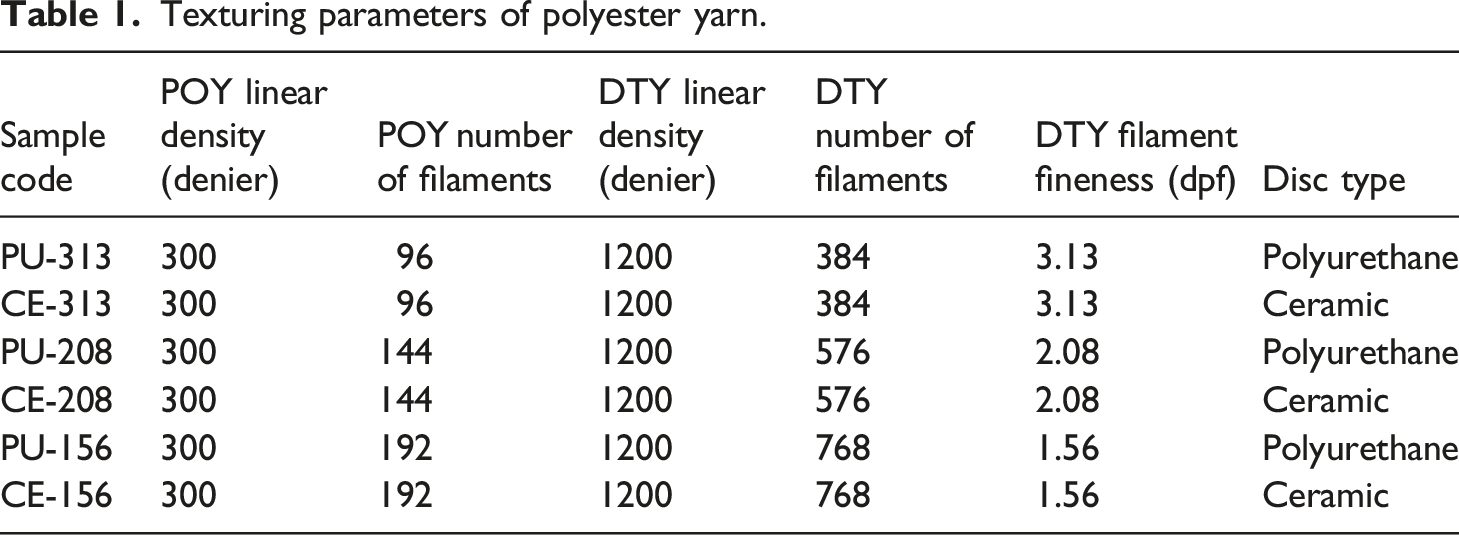
Texturing parameters of polyester yarn.
Tenacity, breaking elongation, crimp and shrinkage in dry-hot air test results of the yarn samples.

According to the yarn test results, yarn samples produced by polyurethane disc type have higher tenacity, breaking elongation and crimp contraction values than those of ceramic disc type. This was a probable result of damaging effect of ceramic disc to the yarn surface.
5
Tenacity results were evaluated according to filament fineness and it was determined that there was no significant difference. However, a significant decrease in breaking elongation and crimp contraction values were observed in finer filaments. This situation was attributed to the fact that as the number of filaments in the yarn cross section (that means finer filaments) increases, the filaments are exposed to more frictional forces.
9
Microscopic view of the yarn cross sections clearly demonstrates this situation (Figure 1). For both disc types, there was a decreasing trend with finer filaments in crimp contraction. This indicated that coarser filaments have bulkier structure. Although the shrinkage values of the pile yarn samples were similar, an increment was observed on 1.56 dpf filament fineness samples. Microscopic view (×10) of yarn samples with different filament fineness.
Properties of carpet samples.

Method
Carpet samples were conditioned for 24 hours at standard atmospheric conditions (20 ± 2° C and 65% ± 4% relative humidity) according to ISO 139:2005 standard, before the performance tests were conducted. 31
The resilience performance of carpet samples was investigated by compression/recovery and dynamic loading tests. Besides, the appearance retention of carpet samples was determined with hexapod tumbler test. The effects of filament fineness and texturing disc type on carpet resistance to soiling were determined with soiling test.
Two-way ANOVA and Duncan tests were applied to reveal the statistical significance of yarn properties on carpet performance. The statistical software package SPSS 21.0 was used to interpret the experimental data. All test results were assessed at 95% confidence interval.
Compression and recovery test
SDL Atlas Digital Thickness Gauge was used for compression and recovery test in accordance with the standard of BS 4098.
32
According to the standard, 5 specimens were prepared from each sample (PU-313, CE-313, PU-208, CE-208, PU-156, CE-156). After compression and recovery test, assessments were carried out depending on the average value of 5 experimental results for each sample. With the purpose of determining the compression behaviours of carpet samples, weights were loaded from 2 kPa to 200 kPa pressures; then the weights were removed from 200 kPa to 2 kPa pressures, in order to determine the resilience behaviour. In Figure 2, compression and recovery curve which shows the carpet thickness values obtained at the corresponding loading and unloading pressures at intervals of 30 s is shown. The compression and recovery graphic of PU-313.
According to the graph (Figure 2), 
Work of compression and recovery in j/m2 was determined by calculating the area under the loading and unloading curves. The work of compression in j/m2 estimated as the area under the loading curve (area ABD in Figure 2) and the work of recovery in j/m2 estimated as the area under the unloading curve (area BCE in Figure 2). The percentage of work recovery was calculated by the ratio of work recovery to work compression as seen on the equation (2).
Dynamic loading test
Dynamic loading test was carried out for determining the thickness loss of the carpet under dynamic forces. The WIRA dynamic loading machine gives information of the pile thickness loss by stimulating two of the main actions of walking, compression and the shearing effect at the edge of the shoe.
33
The thickness measurements were taken under 2 kPa pressure from A and B regions (Figure 3) of each specimen in accordance with TS 3374 ISO 1765 standard.
34
Periodic loading was made by dropping freely from 63 mm, every 4.3 seconds with a 1279 ± 13 g weight on the carpet sample. During the impact application, the sample moves front and backwards in horizontal axis alternately and the view of the carpet sample turns into as seen in Figure 3. Two samples prepared from each carpet set were applied to 50, 100, 200 and 1000 impacts in accordance with TS 3375 ISO 2094 standard.
35
Carpet sample after dynamic loading test.
The percentage of thickness loss was calculated by using equation (3), where 
Hexapod appearance retention test
For the hexapod appearance retention test, the carpet sample was placed into a tumbler and was exposed to hexapod rotation. The carpet surface was cleaned with vacuum cleaner after every 2000 revolution. Each carpet sample was applied in total 12,000 revolutions by using WIRA Hexapod Tumbler Carpet Tester device in accordance with TS ISO 10361 standard. 36 Hexapod test was used to determine the change in appearance on the carpet surface against mechanical effects in terms of crushing, pilling, yarn and loop loss, colour change, change in pattern clarity and visibility of carpet back. According to reference scales, the visual grading changes between 1 (the most distorted) and 5 (the least distorted) were evaluated by 3 people. 37
Soiling Test
With the aim of investigating the soiling properties of carpet samples, 3 g artificial dirt was added into 1000 g polyamide chips and the soiling material was prepared by rotating for 20 minutes in WIRA Hexapod test device. For each carpet sample, 2 specimens were prepared in compliance with TS 11378-2 standard. 38 The test was carried out by rotating the hexapod drum for 30 minutes in which the carpet samples, 250 g of soiling material and 1 kg of metal balls were placed. After the rotation completed, the specimens were cleaned by vacuum cleaner in order to remove excessive soiling material from the surface. Soiling degrees of the carpet samples were graded between 1 (the most stained) and 5 (the least stained) by 3 people in accordance with the standard of ISO 105-A02. 39
Results and discussion
Compression and recovery test results
Compression recovery is measure of tendency of pile yarns to return their initial shape after loading and unloading. Compression recovery results of carpet samples are illustrated in Figure 4. According to the figure, the best recovery results were observed in polyurethane disc type with 2.08 dpf filament fineness and ceramic disc type with 3.13 dpf filament fineness. The lowest recovery percentage was obtained in 3.13 dpf fineness with polyurethane disc. Sample CE-313, had higher recovery value than the others. As a general trend (except PU-313), the recovery performance decreased with increase in fiber fineness. The finer filaments had lower rigidity or in other words lower bending resistance due to the finer fiber diameter.
12
As seen from the results, coarser filaments showed better recovery performance. This was expected result since the coarser filaments had higher crimp contraction (see Table 2) and so higher bulkiness ensures higher recovery after compression. This result was in good correlation with Çelik’s findings, coarser fibers in staple acrylic pile yarns, provide better compression recovery percentage.
3
Compression recovery of carpet samples.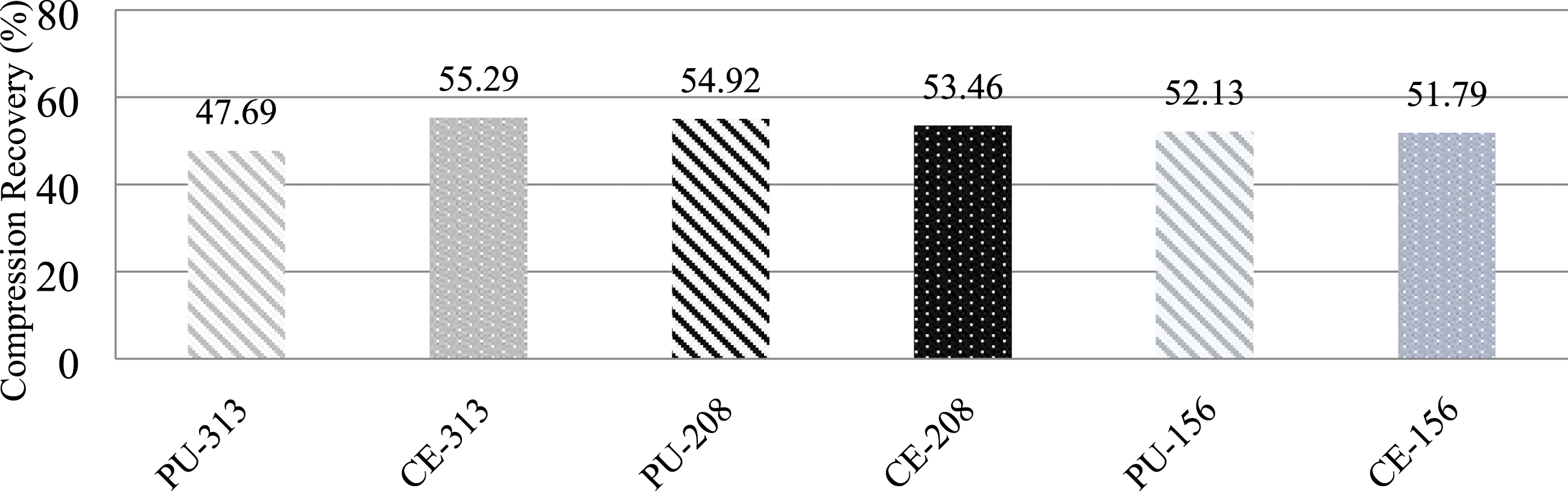
Two-way ANOVA results for compression recovery percentage.

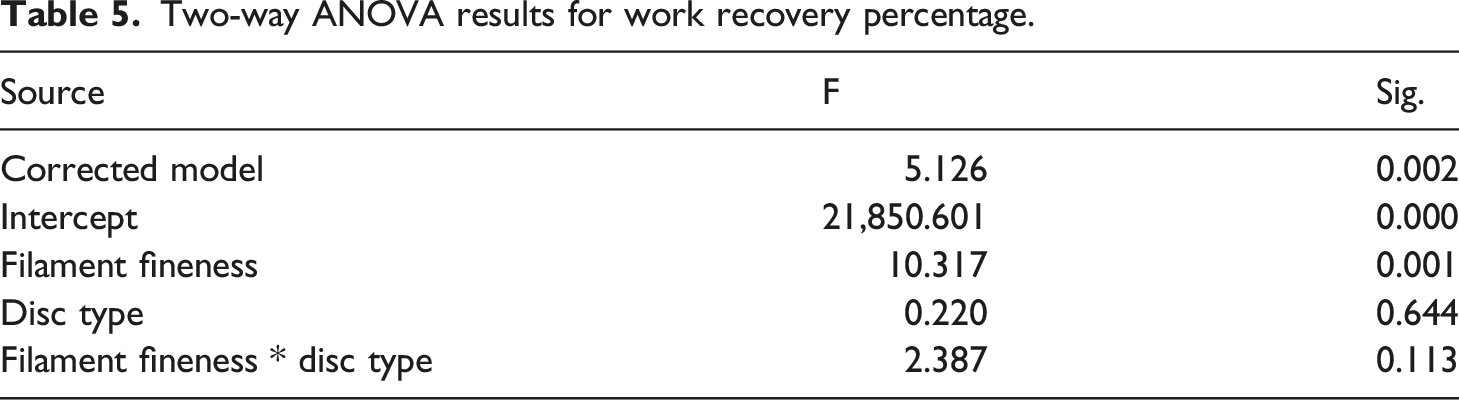
Work recovery percentage can be defined as the resistance of carpet pile yarns to compression. As seen in Figure 5, which show the work recovery percentage results of carpet samples, a similar trend was obtained with that of compression recovery, except 3.13 dpf filament fineness sample group. The samples with 2.08 dpf filament fineness performed higher work recovery than the other samples. In other respect, the samples produced by different disc types with same filament fineness had similar values. There wasn’t any significant difference in 3.13 dpf and 1.56 dpf filament fineness in terms of work recovery percentage results. Work recovery of carpet samples.
Two-way ANOVA results for work recovery percentage.
Duncan test results for work recovery percentage.

Dynamic loading test results
Carpet samples were exposed to different impact cycles in accordance with the relevant standard. Thickness loss of carpet samples under dynamic loading after 50, 100, 200 and 1000 impacts are shown in Figure 6. As seen from the figure, thickness loss of carpet samples increased as the number of impact increased. CE-156 had the highest thickness loss after all impacts among all carpet samples. When the samples with same filament fineness were considered, the samples produced by polyurethane disc type had generally lower thickness loss than that of ceramic disc type. Hard surface of ceramic discs may have damaged the filament yarn structure. As a result a reduction trend occurred on yarn tenacity and yarn breaking elongation [8]. In coincide with the literature, DTY polyester samples produced by polyurethane disc types had higher tenacity, breaking elongation and crimp contraction results (see Table 2) than samples produced by ceramic disc types. According to the results, samples produced with polyurethane discs had a bulkier yarn structure and lower thickness loss after dynamic loading. Thickness loss of carpet samples after 50, 100, 200 and 1000 impacts.
Carpet surface is exposed to heavy foot traffic during usage. Therefore, the thickness loss values obtained as a result of high impact (1000 impacts) would give more accurate results expressing heavy foot traffic. The lowest thickness loss in the dynamic loading test was measured in 2.08 dpf filament fineness sample produced with polyurethane discs. This result coincides with work recovery percentage (Figure 5). As it was stated in Çelik’s study, the thickness loss after dynamic loading was higher in carpet samples produced with finer filaments. 3 Besides, another study in the literature also showed that carpet samples produced with finer fibers have worse thickness loss than those of coarser fibers. 22 In this study, it was observed that the tendency of the pile yarns to return to their initial position was lower with the carpet samples produced by finer filaments (which have lower crimp values) such as CE-156 and PU-156.
Two-way ANOVA results for thickness loss of carpet samples after 1000 impacts.

Duncan test results for thickness loss of carpet samples after 1000 impacts.

Hexapod appearance retention test results
Hexapod appearance retention levels of carpet samples.
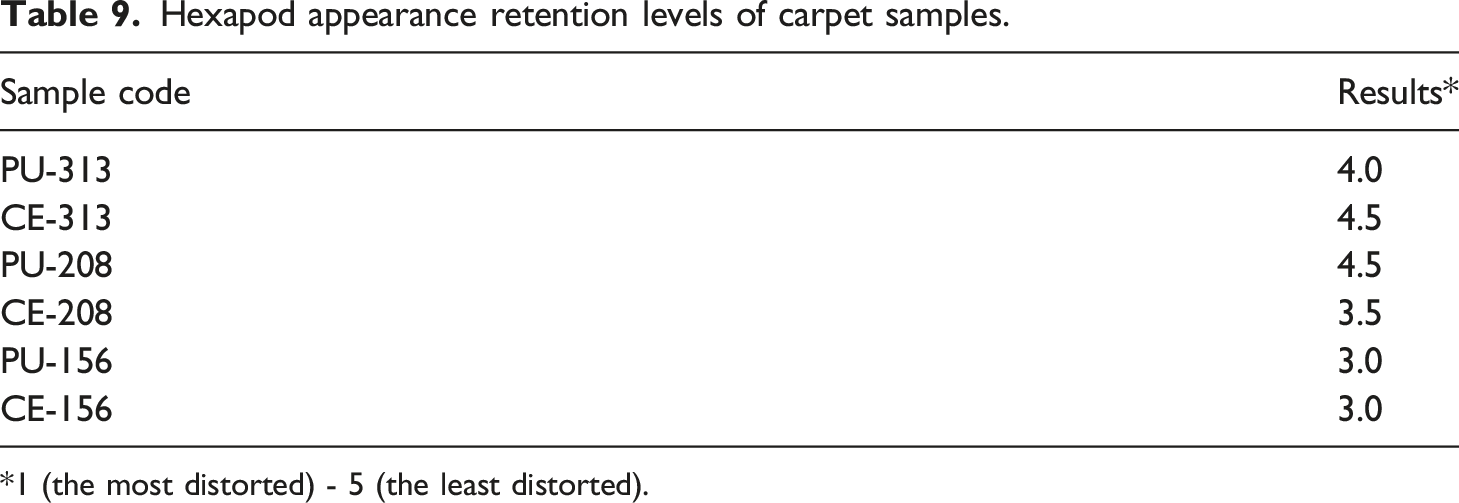
*1 (the most distorted) - 5 (the least distorted).
Soiling test results
Staining after soiling test.

*1 (the most stained) and 5 (the least stained).

Photographic view and microscopic (×1000) view of carpet samples before and after soiling test.
Conclusion
According to the results of carpet performance tests, it was determined that carpet samples with finer filaments (1.56 dpf filament fineness) performed the lowest resilience behaviour. This situation was attributed to the lower bending rigidity caused by lower diameter of finer filaments. Due to the higher crimp contraction and so bulkiness of yarns with coarser fibers (3.13 dpf and 2.08 dpf filament fineness) had better recovery performance.
In general, polyurethane disc type was detected to lead better recovery and lower thickness loss results than ceramic disc type. This situation was explained by the distorting effect of ceramic disc type on the yarns structure. Ceramic disc type damages the filament yarns and affects adversely the yarn crimp and elasticity. Higher bulkiness characteristics of the yarn samples produced with polyurethane discs caused to possess better recovery and thickness loss values of carpet samples produced from these yarns.
For these reasons, it was concluded in this study that the optimum carpet performance properties were obtained from the samples with 2.08 dpf filament fineness produced by polyurethane disc type.
In order to determine the appearance retention of carpet samples, the specimens were subjected to hexapod and soiling tests. According to hexapod test results, disc type was not composed a significant effect, nevertheless the lowest appearance retention levels were detected on the carpet samples with the finest filament. It was observed that higher number of filaments in the yarn cross section led lower bending rigidity. As mentioned before, due to the fact that the pile yarns with finer filaments had lower bending rigidity and so higher tendency to laying, the samples performed lower appearance retention. Depending on soiling test results, the samples with 3.13 dpf filament fineness were deduced to be less stained. Finer filaments were evaluated as having more contact area with artificial dirt due to the increased number of filaments in the yarn cross section. Besides, disc type did not have a significant effect on soiling.
Consequently, according to the findings of this study, it will be appropriate the usage of pile yarns produced with polyurethane disc type and coarser filaments for the outdoor carpets that will be exposed to heavy foot traffic and soiling.
Footnotes
Acknowledgements
The authors would like to thank for the company of KORTEKS A.Ş., Bursa, Turkey and Gizem İplik, Gaziantep, Turkey and their employees.
Declaration of conflicting interests
The author(s) declared no potential conflicts of interest with respect to the research, authorship, and/or publication of this article.
Funding
The author(s) disclosed receipt of the following financial support for the research, authorship, and/or publication of this article: This study was supported by Kahramanmaras Sutcu Imam University, Division of Scientific Research Projects [grant number 2019/1-18 D [D6]].
