




Abstract
Depleting non-renewable resources and global warming motivated researchers to focus on passive cooling solutions to minimize the internal temperature of buildings. The benefits of using stacked coir mat and perlite in wet and dry conditions are tested for their cooling capacity compared to green roofs are explored in this research work. The benefits are quantified in terms of heat flow and temperature variations in a field experiment, and they are compared to a conventional bare roof in a tropical region in the Indian subcontinent (8.9142oN, 76.632oE). The heat transfer to the inside of the roof for dry coir mat paved, stacked coir mat and perlite bed, stacked wet coir mat and wet perlite bed, and extensive green roof system with coir mat as retaining layer are reduced by 38.43%, 63.21%, 55.3% and 56.97% respectively. This study evaluated the evaporative cooling capacity of wet coir mat and wet perlite, which have given almost near cooling capacity of green roof for 24 h. Considering its low maintenance and low initial cost, the usage of the stacked coir fibre mat with perlite shows a compatible reduction in heat transfer through the roof slab as that of the green roof. The coir insulation with perlite will undoubtedly reduce the energy requirement for heating ventilation and air conditioning (HVAC) systems to a greater extent.
Introduction
Sustainable building technology has been gaining importance due to its wide range of benefits like less energy, low maintenance, higher design flexibility and improved air quality. Sustainable buildings can be achieved using natural materials to absorb less heat and low reflectivity. With the expansion of urban areas, plants and surrounding flora will ultimately be replaced with materials with high thermal conductivity and low reflection ratios. These materials absorb solar radiation tremendously during the daytime and release stored heat during the evening. In large cities, the temperature in the city’s heart is higher in the late evening than in its outskirts (the suburbs). This phenomenon is called Urban Heat Island (UHI) effect. 1 Green plants can reduce the carbon dioxide level in the atmosphere and alter the temperature around them (micro climate) by their ability of evapotranspiration. Studies proved that the green roof could reduce the urban heat island effect (UHI), increase the roof’s life, reduce noise and air pollution, increase the aesthetic impact, and mitigate stormwater runoff.2–6 The green roofs are specific and unique to climatic conditions since the vegetation must tolerate extreme weather fluctuations, drought tolerance, and high winds.7,8 In previous studies, the thermal performance of the green roof varies by several parameters like plant species, substrate and local climatic zones. 9 It is reported that during a life cycle analysis of a green roof, a 10–15% loss will be incurred due to the maintenance, watering, caring by weed killing and nutrient addition to the green roof. 10
Aditya et al. 11 reviewed the effect of various insulation materials on energy conservation in buildings. Increasing the building skin’s thermal resistance can reduce energy consumption for heating or cooling. Certain materials, such as Vacuum insulated panels, Phase change materials with appreciable thermal characteristics, can be used as building envelopes in different parts of the building to enhance thermal comfort. 12
Coconut fibre composites have gained popularity as a thermal insulator over concrete due to their effectiveness in reducing heat transfer into the room, low density and abundance in tropical regions. India and Srilanka together meet 90% 0f the coir product requirement all over the world. Since they are natural, coir mats are promising, imparting evaporation and insulation compared to conventional roof insulations and play a vital role in the total roof energy balance.13–17 Due to their porosity and hygroscopic nature,18,19 the coir mats have significant potential to act as a building envelope for decreasing the temperature fluctuation, cooling and heating requirements. It effectively reduced inside room temperature from 2.8°C to 3.1°C. 20 It is theoretically proved that the layering position of coconut fibre over the roof slab is the best position to reduce the heat transfer into the room. 21 A thermal lag of three and half hours and a reduction in temperature fluctuations of 40% were observed when coconut fibre is incorporated in precast ferrocement roofing channel components. 22 Reflective paints, roof gardens, light-coloured outer surfaces, and window treatments are some preferred solutions to minimize the heat load of the building; Portland cement, coarse aggregate, fine aggregate, coconut fibres and water can be used as a composite concrete to appreciably improve the properties such as hardness, tensile strength and torsion. 10
Coir mat has many heat-mitigating characteristics and can be used as a building skin capable of blocking the heat during daytime and liberating heat during nighttime. The heat blocking during daytime and heat liberation during wee hours are separately studied for the cases of coir mat and its combinations. The results are compared with the green roof case to check whether it is an alternative for the weight of the green roof, watering, maintenance and heat liberation in the wee hours. This experimental research compares green roofs, stacked coir mats, and perlite for their heat mitigation capacity. In the case of green roofs, evapotranspiration is the main reason for its cooling effect. This study tries to impart the vapourization technique to coir mat by wetting with highly hygroscopic perlite, which is very lightweight and eco-friendly.
Materials and method
Details of roof slab IS: 456-2000. 23

Instruments used and data obtained.

The top of the cubicle roof is taken as the test section having a dimension of 1.4 m × 1.14 m,24,25 and is kept exposed to maximum solar radiation. The interference of shade is eliminated since the experimental set-up (Figure 1(a)) is at the top of a 4-story building. A plastic skin sheet of 40 microns is kept over the roof slab to act as a waterproof membrane under all configurations. Perlite is selected due to its low thermal conductivity, water holding capacity, and eco-friendly nature. The properties of coir mat and perlite are given in Tables 3 and 4, respectively. (a) Two identical cubicles for the experiment (b) Experiment with dry coir mat (c) Experiment with coir mat and perlite (d) Experiment with Green roof. Properties of coir mat (IS: 12,503 (parts 1-6) 1988).
26
Properties of perlite.
27


The heat gain through the four sidewalls is prevented by insulating them with 50 mm thick extruded polystyrene panels (k =0.027 W/mK). Doors are provided at the northern side of the cubicle to have accessibility to sensors, temperature probes, and inspection.
In solid parts (coconut fibre mat and RCC slab), the primary mode of heat transfer is conduction. Above the coconut fibre mat, the solar radiation, radiation exchange between surroundings and convection with ambient air has to be considered (25)
In the equation (1) first term on the right-hand side gives heat transfer by convection, the second term gives the heat transfer by radiation, the third term gives heat transmitted through solar radiation, and the last one gives latent heat of vaporization. The heat exchange through the green roof is more complicated, however is estimated that around 60% of the cooling effect during solar hours is due to evapotranspiration and approximately 20% by convection (29).
The four types of insulation selected to study the heat mitigation capacity are shown in Figure 1. For each insulation skin, the experiment is conducted for 3 days, and readings are taken at an interval of 1 h. The parameters measured are i) Heat flux through the bare roof, ii) Heat flux through the insulated roof, iii) Internal surface temperature of the bare roof, iv) Internal surface temperature of the insulated roof, and also the mentioned weather data.
Details of different insulation
The different insulation and the combinations used for the experimental studies are discussed in the following sections.
Case – I: Dry coir mat versus Bare roof
The thermal conductivity of dry coir fibre is determined using the thermal property analyzer KD2 Pro (ASTM-D 5930-09). A coir mat in the dry condition is laid over the roof of one of the cubicles, as shown in Figure 1(a). Thermocouples are placed at the coir mat, roof interfaces, and over the coir mat for temperature measurements. Since the coir mat has porosity, the effective thermal conductivity (ke) is calculated by equation (2).
Were ka and kc are the thermal conductivity of air and coir. Void space in the coir mat for finding the porosity is calculated by taking the ratio of the difference between dry mass and wet mass of the coir mat (mass t of water in wet coir mat) to the density of water (1000 kg/m3). Then the porosity of the coir mat is found by the equation (3).
Case – II: Dry coir mat with dry Perlite versus Bare roof
A dry coir mat with perlite is tested for its heat mitigation capacity, in this case, Figure 1(b). Since dry perlite is very light in weight, it will fly off even in a small breeze and it is installed beneath the coir mat. It is very beneficial as a roof insulator since the slab’s weight will not increase too much by the weight of perlite. The thickness of the perlite layer is approximately 30 mm, and the thermal conductivity is determined by the thermal property analyzer KD2 Pro (ASTM-D 5930-09). The properties of the perlite are given in Table 4. Thermocouples are placed over the coir mat, and heat flux sensors are fixed on the lower surface of the roof slab. All the readings are taken as mentioned above.
Case- III: Wet coir mat with wet perlite versus Bare roof
The effect of evaporative cooling on heat propagation to the roof is investigated in this case. Since coir mat alone cannot retain much water, perlite is selected by virtue of its light weight, hygroscopic and eco friendly nature. A polyethylene skin of 40 microns thick is placed between the perlite bed and the outer surface of the roof to avoid moisture absorption by the roof. During the peak solar hours, i.e. 1 p.m., coir mat and perlite is wetted with 2.5 L of water. The evaporation of the water absorbed by perlite is possible through the pores of the coir mat. The thermal conductivity of perlite in wet and dry conditions is found according to ASTM-D 5930-09. Thermal conductivity will be increased due to the wetting of perlite (Table 4).
Case – IV: Coir mat with green roof versus Bare roof
The combined effect of the green layer over the coir mat (retaining layer) is investigated in this case. The parameters measured for this case are the same as those of previous cases. A layer of coir mat is placed in the green roof layer (Zoysiamatrella) as a retaining membrane to study the significance of additional insulation to mitigate heat flow through the roof (Figure 1(d)). In the green roof, the root barrier acts as a membrane to resist moisture absorption, decreasing the roof’s life. The drainage layer is the barrier to sieve out the excess water. A retention medium helps to retain the soil without going with water; here coir mat is used as a retention medium. The growing medium (Soil) allows for growing the green layer supplying all the nutrients for the green layer. Watering is done every evening at 6 p.m. with 2.5 L of water to avoid the wilting of plants. Green layer (with soil) is a commercial product which cost around rupees 900/m2. Including other layers the cost of green roof amounts $26/m2.
Results and discussions
4. The solar radiation, ambient temperature and the inside roof temperature for 4 cases of insulations along with the bare roof are plotted. One of the significant observations that can be made from these graphs is the time lag in building inner roof temperature. When peak hot hours outside is from 10:00 a.m. to 4:00 p.m., it shifts from 3:00 p.m. to 10:00 p.m. when measured on the lower surface of the roof slab.
Changes in room inner roof temperature with solar radiation under different insulating conditions
It is found that solar radiation is prominent from 10:00 a.m. to 5:00 p.m. in the tropical warmth and humid region in the state of Kerala, South India. The ambient temperature of the region went up to a maximum of about 35°C due to solar radiation. The solar radiation is reaching a maximum of up to 850 W/m2.
Temperature variations of the experiments conducted for four insulation cases are depicted in Figure 2. It is exciting to note that even though the maximum ambient temperature is about 35°C, the roof slab surface temperature of the room has gone more than 40°C for the case plotted for the bare roof. The maximum ambient temperature is at 1:00 p.m., whereas the maximum temperature observed within the inner roof is at 7:00 p.m. This lag is due to the roof’s heat capacity, creating a substantial thermal mass that stores and accumulates the heat. Effect of solar radiation on inner roof temperature of room under different insulating conditions.
Effect of insulation on the maximum inner roof temperature.

The maximum inner roof surface temperature value is compared with the maximum ambient temperature experienced during the day. It is found that, except for the bare roof and dry coir mat case, the inner roof is cooler than the ambient temperature for all the selected insulations. The difference in ambient air temperature and bare roof for the maximum possible conditions is about -4.51°C (a negative sign indicates that the inner surface of the roof is hotter than the ambient). Upon insulating with dry coir mat, stacked dry coir mat and dry perlite, stacked wet coir mat and wet perlite and green roof, the roof becomes cooler, and the difference with ambient temperature decreases to -1.37°C, 1.93°C3.17°C and 3.04°C respectively.
The percentage reduction, which is the ratio of the difference between maxima of ambient temperature & inner roof temperature to the maximum ambient temperature, is high for the wet perlite with a coir mat. The bare roof has a negative value indicating that the temperature inside the roof slab will be higher than the ambient temperature. The green roof and wet perlite with coir mat have given about 8.63% and 8.98% reduction in maximum temperature experienced inside the inner roof surface compared to the ambient temperature. For the case of dry coir mat alone, it is 5.47%.
Heat flux to the room due to solar radiation for different insulations
Heat saving for different roof Insulations.

Though the peak temperature of the ambient air reaches its maximum around 1:00 p.m., the inner roof temperature for the bare roof, dry coir mat, stacked dry coir mat and dry perlite, stacked wet coir mat and wet perlite, and green roof reaches its maxima at 7:00 p.m. Solar radiation data and the heat flux reaching into the room under different insulating conditions are plotted in Figure 3. It may be noted that the positive value of heat flux indicates that heat is transferred from the outside to the inside of the room, and the period for which the value is negative shows heat losses from room to outside. Effect of solar radiation on heat flux into the room for different insulations.
Cumulative heat gain on the inner side of the roof in all four cases is plotted in Figure 4. The average of heat mitigation potential, which is given in equation (4) along with their bare roof cases, is given by Cumulative heat flux for a day (24 h) into the room for different insulating conditions.

The heat mitigation potential of wet perlite with coir mat is less than that of dry perlite with coir mat owing to the increased heat capacity of moist perlite, which prevents heat dissipation from the room to outside during the night. This is equivalent to the film of water retained over the roof in a hot and humid condition. During the nighttime, the heat dissipation to the ambient air by evaporative cooling is blocked by water’s increased relative humidity and heat capacity. 28 This effect is getting more prominent with the green roof during the late-night and early morning hours.29,30
While observing the data for 24 hours, the heat transfer is bidirectional. When the ambient temperature exceeds the room’s inner roof temperature, heat will be transferred from outside through the roof to the room, and the flux is positive. However, due to the large thermal mass, the room inner roof temperature will become more than the ambient temperature, especially during the peak solar hours of the days, as understood from Figure 2. However, it is observed that heat is transferred from the room to the ambient air; therefore, the heat flux is negative.
The flux reversal time from positive to the negative direction and vice versa.
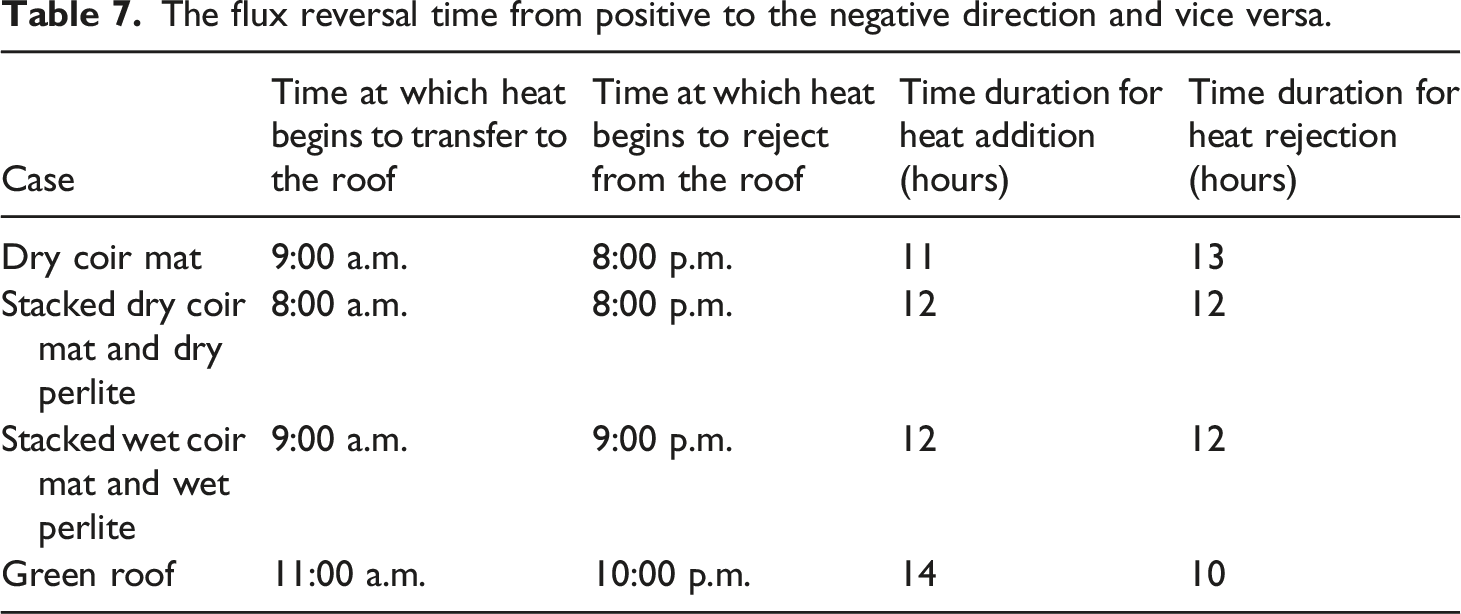
Therefore, for a particular case, the period for which heat is added to the room is the time duration for which the room is “cooler” than the outside, and the insulation system that helps to keep the room “cooler” for a more extended period will be a better one. For the case of dry perlite with coir mat insulation, the “cooler” period is for 12 h, and the “hotter” period is for 12 h. The hotter and cooler times for wet perlite with coir mat cases are 12 h and 12 h, respectively. The “cooler” time is 14 h for the Green roof, and the “hotter” time is 10 h. Therefore, experiments show that out of the different insulation options considered, a green roof is better with a favourable period of 14 h.
The flux reversal time happens differently for different cases of insulation over the roof. After the wee hours, the heat flows to the room side. Based on the experiments conducted, it has been found that for the case of dry coir mat roof and the combination of wet perlite with coir mat, flux changes from negative to positive at 8:00 a.m. For the case of dry coir mat, flux reverses from negative to positive from 9:00 a.m. onwards. The same thing happens for the green roof at 7:00 a.m. The flux reversal time from positive to negative happens from 10:00 p.m. onwards for all the cases. The individual peak flux has a typical hike pattern at 6:00 p.m. The minimum heat flux, i.e., the negative direction, occurs during the morning around 6:00 a.m.
The heat flux reduction capability for a green roof is 52.43% during the solar hours, as shown in Figure 5. Dry coir mats have a heat mitigation potential of about 20.47% only. In the case of dry perlite and coir mat, the heat mitigation potential during solar hours is 41.9% owing to its double layer insulation of coir mat, perlite and porosity of both. Coir mat with wet perlite has heat mitigation of 42.55% during solar hours. For the green roof, evapotranspiration brings the cooling effect, but evaporation gives for cooling in the case of wet coir mats. Heat mitigation potential during solar hours.
The time duration of the room’s inner roof temperature is less than 29°C, is shown in Figure 6. In the case of dry coir mats, 6 h duration is below 29°C, and for the possibility of dry coir mat with dry perlite insulation, it is 5 h duration. Green roofs have inner roof temperatures below 29°C for 7 h. Time duration of room inner roof temperature less than 29°C.
The temperature has to be lower than the bare roof for any insulation case during the entire solar time. In that sense, taking a datum as 29°C, the green roof is leading by 1 h, i.e. from 5 a.m. to 12 noon during solar radiation, as mentioned in Figure 6. However, wet perlite with a coir mat keeps the inner roof temperature below 29°C from 3:00 a.m. onwards for 8 h.
The heat-retaining capability is studied by the capacity of the additional insulation to reject heat from the ambient air compared to the heat added to the room. It is found by the equation (5). Heat rejection will happen during the late-night and early morning hours, i.e. from 10:00 p.m. to 7:00 a.m. It is clear from th figure that the heat retaining the ability for a green roof is 78.22% which means that heat absorbed by the green roof contains it during the wee hours. This is due to the emission of longwave radiation of vegetative parts during nighttime.31,32 Forth case of wet perlite and wet coir mat, the heat retaining is 63.23% due to th high heat capacity of water. (Figure 7) Heat retaining compared to the bare roof for different insulation.

Consolidated table for the heat saving capacity for 72 h.
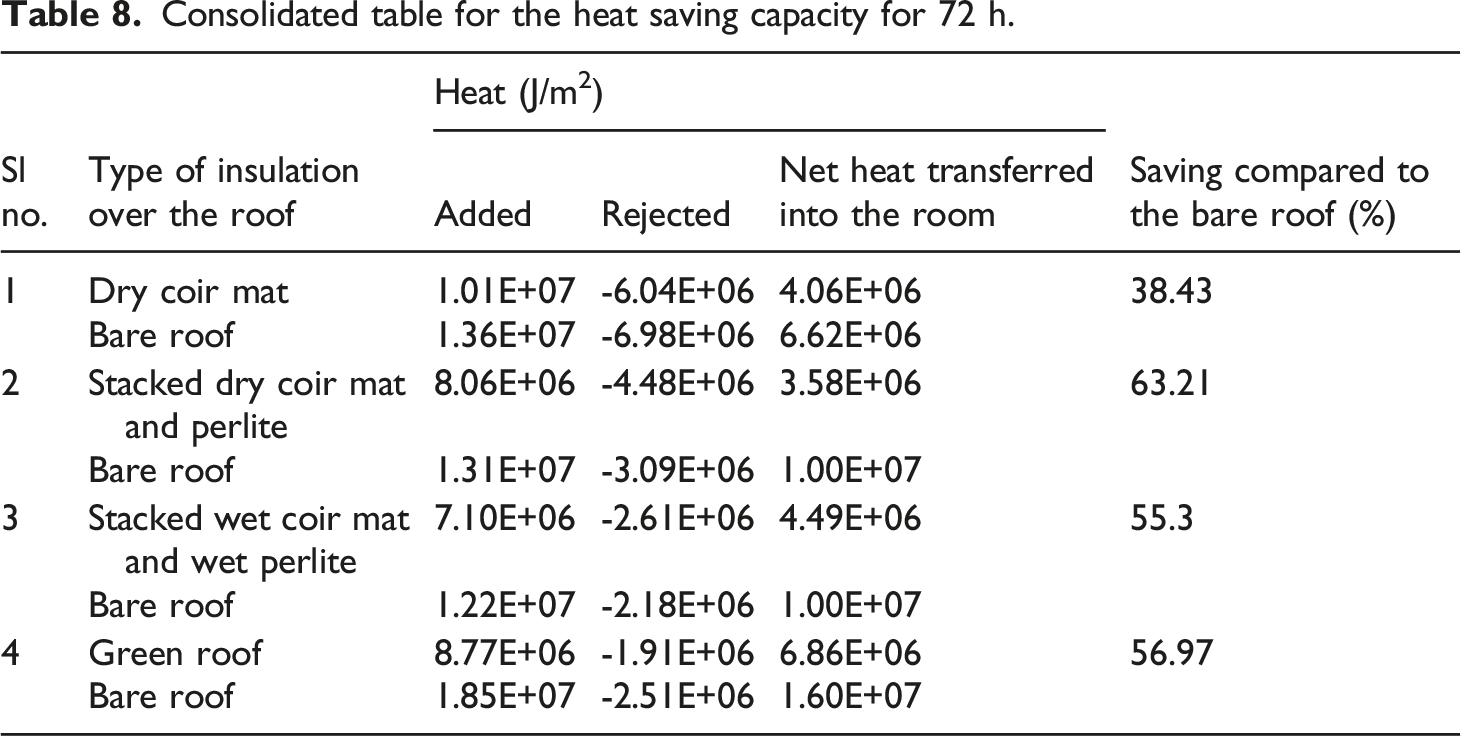
The experimental results at a glance.

Considering the cost for installing the green roof, the green layer is commercially available at a cost of rupees 900/m2. Other layers need to be installed as per the standard established for green roof i. e retaining layer, drainage layer, root barrier etc. The cost of installing the green roof as shown in Figure 1(d) is $26/m2 (approximately). For the case of stacked perlite and coir mat the cost of installation is $19/m2 (approximately). In the green roof, continuous monitoring of watering, weed killing and nutrient addition is required for the entire life time that is not required for coir mat and perlite insulation.
Since the study is conducted in a hot and humid climate, response of the stacked coir mat and perlite need to be explored in other climates. The humidity highly influences the heat transfer characteristics of coir mat and perlite, especially in the wee hours. Other textiles of natural origin can replace the coir mat.
Conclusions
An experimental study for the heat mitigation potential of stacked coir mat and perlite in wet and dry conditions is done, and its results are compared with that of an extensive green roof in a hot and humid climate. On evaluating an average heat flux coming through the roof for 24 h, it is found that the heat mitigation capacity of a dry coir mat with dry perlite (63.21%) is higher than that of a green roof (56.97%). When the experimental results are analyzed in two phases, i.e. non-solar hours and solar hours, the heat flux reduction capability for a green roof during solar hours is 52.43%. The wet coir mat with wet perlite has heat mitigation of 42.55% during solar hours. During wee hours, the heat-retaining capacity of a green roof is 78.22%, but for dry perlite with coir mat, it is only 44.1%, and for stacked wet coir mat and perlite, it is 63.24%. In a wet condition of perlite and coir mat, the slab’s temperature sustained below 29oC for 8 h and leads green roof by 1 h. More over cost of installing the green roof and its maintenance is very costlier than stacked coir mat and perlite. When the whole day is concerned, stacked coir mat and perlite have appreciable heat reduction capability than the green roof or almost equal to it in the wet case and can be indisputably recommended considering its low cost and easy maintenance and eco-friendly nature.
Footnotes
Declaration of conflicting interests
The author(s) declared no potential conflicts of interest with respect to the research, authorship, and/or publication of this article.
Funding
The author(s) received no financial support for the research, authorship, and/or publication of this article.
