




Abstract
Although flexible wearable conductive textiles for various applications have attracted a lot of attention from researchers in recent years, their fabrication with simple processes, excellent flexibility, environmental friendliness and superior performance remains a great challenge. Polypyrrole is gradually emerging in the field of flexible electronics due to its low cost, excellent conductivity and biocompatibility. Cotton fabrics were modified using dopamine, and then PPy was grown in situ on dopamine-coated cotton fabrics to prepare polypyrrole/dopamine/cotton fabrics with excellent electrothermal and pressure-sensing properties. The polypyrrole/dopamine/cotton fabric has good electrical conductivity, electrical heating temperature rise performance and heating stability. The surface temperature of polypyrrole/dopamine/cotton fabric can reach 115.5°C in 100 s at 5 v. And the flexible pressure sensor prepared based on polypyrrole/dopamine/cotton fabric exhibits the combined advantages of wide operating range (0–16 kPa) and high sensitivity (60.23 kPa−1). In addition, real-time monitoring of human motion and wrist pulses is possible. Compared with existing studies, polypyrrole/dopamine/cotton fabric shows better performance in both heating and sensing and achieves simultaneous access. These results demonstrate the potential application value and broad prospect of polypyrrole/dopamine/cotton fabric in flexible wearable electronics.
Introduction
With the development of flexible wearable electronics, flexible heating elements and pressure sensors are ideal as essential components of wearable devices in applications such as cold protection [1], thermal therapy [2], physiological and motion monitoring [3], and electronic skin [4], which are gradually improving people’s quality of life. Due to their softness, comfort, and common use in textiles and clothing, cotton fabrics have become one of the most promising flexible substrates for wearable electronics.[5] Cotton fibers are porous and have many hydrophilic groups (−OH) on their cellulose macromolecules, which facilitates the development of conductive fabrics for applications such as electric heating elements [6], pressure/strain sensors [7], and nanogenerators [8], etc.
To achieve electrical heating and sensing functions, researchers use different kinds of conductive materials to create flexible conductive textiles. Currently, typical conductive materials include carbon materials (graphene, carbon nanotubes, carbon black, etc.) [9–11], metal nanomaterials (silver nanowires, copper nanowires, etc.) [12–14], and conductive polymers (polypyrrole, polythiophene, polyaniline).[15–17] Compared with other conductive materials, conductive polymers have good electrical and thermal conductivity, superior chemical stability, thermal stability, and low density, making them ideal candidates for the development of flexible conductive textiles. Currently, there are two main methods for the preparation of conductive polymers, one is electrochemical [18], commonly used methods are constant potential [19], constant current [20] and cyclic voltammetry [21], etc.; the other is chemical oxidation [22], commonly used oxidants are ferric chloride [23], persulfate [24], etc. Although the manufacturing methods of conductive polymer-coated textiles are diverse, there are problems that limit the scope of their applications and development prospects. For example, polythiophene is expensive. The complex manufacturing process and equipment increase the difficulty of manufacturing. Therefore, it is important to develop flexible and safe conductive polymer-coated textiles with simple manufacturing process, low cost, and excellent performance by using suitable raw materials and methods.
Pyrrole undergoes a polymerization reaction based on an oxidative coupling mechanism to produce polypyrrole, which relies on liquid/solid interfacial adsorption on the surface of cotton fabrics. The oxidation potential of pyrrole is only 0.8 eV, which is lower than that of other heterocyclic compound monomers and also lower than that of water [25]. The best polypyrrole properties and highest electrical conductivity were obtained by chemical oxidation method for the preparation of polypyrrole with Fe3+ as oxidant and sulfonic acid-based organic compounds as dopants [26,27]. Due to the low cost, flexibility, good biocompatibility [28–31] and superior electrical conductivity, polypyrrole-coated cotton fabrics have gradually become useful in flexible wearable electronics. Lin et al.[32] developed a flexible pressure sensor by depositing polypyrrole on cotton mat cellulose fibers using an in situ steam growth method. Wang et al.[33] developed a flexible all-solid-state supercapacitor by depositing PPy nanoparticles by in situ polymerization and preparing high-performance yarn electrodes. Hence, PPy/PDA/Cotton fabric may also exhibit its research value in flexible electric heating elements and flexible pressure sensors.
This paper presents a simple and low-cost strategy for the preparation of flexible polypyrrole/dopamine/cotton (PPy/PDA/cotton) fabrics with excellent electrical heating and pressure sensing properties. The cotton fabrics were modified using dopamine, and then PPy was grown in situ on dopamine-coated cotton (PDA/cotton) fabrics. A series of characterization and measurements of PPy/PDA/cotton fabrics were performed to analyze the surface morphology, electrical conductivity, heating performance, and sensing performance. The results show that the PPy/PDA/cotton fabric exhibits excellent electrical heating performance and sensing performance. In addition, the application of the sensor in real-time monitoring was demonstrated. This study improves the experimental basis for further exploring the application value of polypyrrole-coated conductive textiles in wearable electronic devices.
Experimental
Materials
Acetone was purchased from Tianjin Yuanli Chemical Co., Ltd. Anhydrous ethanol and ferric chloride were purchased from Tianjin Fengchuan Chemical Technology Co., Ltd. Dopamine hydrochloride was purchased from Shanghai Aladdin Biochemical Technology Co., Ltd. Tris (hydroxymethyl)aminomethane was purchased from Tianjin Yuyuan Technology Co., Ltd. The pyrrole monomer was purchased from Shanghai Kewang Industrial Co., Ltd. (Shanghai, China). P-toluenesulfonic acid was purchased from Tianjin Komiou Chemical Reagent Co., Ltd. All chemical reagents used in this work are of analytical grade (AR) and can be used without further purification.
Preparation of dopamine-coated fabrics (PDA/cotton fabrics)
Commercially available fabrics were cut into 5 cm × 5 cm sizes and cleaned and dried. The fabric was first placed in a beaker and ultrasonicated for 20 min with an amount of acetone that did not cover the fabric to remove greasy impurities from the fabric. The fabric is then sonicated for 20 min with anhydrous ethanol to remove the acetone solution. The fabric is then washed several times with deionized water. Finally, the cleaned cotton fabrics are dried in an oven at 60°C. A 500 mL beaker was taken, 350 mL distilled water and 150 mL anhydrous ethanol were added and mixed well, then 0.4235 g tris(hydroxymethyl) aminomethane (Tris) was added for pH adjustment to obtain a slow release solution with a pH value of about 8.5, then 1.4 g dopamine hydrochloride (4 g/L) was added to the beaker, and then the pretreated cotton fabric was put into the beaker to make the dopamine After the reaction was completed, the polydopamine-coated fabric was removed from the solution, cleaned with deionized water and left to dry at room temperature (Figure 1). Preparation process of PPy/PDA/cotton fabric.
Preparation of PPy/PDA/cotton fabrics
After the PDA/Cotton fabric was completely wetted with distilled water, the fabric was placed in an aqueous solution of pyrrole monomer and magnetically stirred at 4°C for 30 min. Then, the mixed solution of p-toluenesulfonic acid and an oxidizing agent of ferric chloride (1.5 times the concentration of pyrrole solution) was added to the pyrrole solution three times, and stirring was continued for 90 min. Finally, the obtained PPy/PDA/Cotton fabric was rinsed with water and dried in a vacuum oven at 50°C to constant weight. The concentration of pyrrole is 0.1 mol/L–0.6 mol/L, and the concentration gradient is 0.1 mol/L (Figure 1).
Testing and characterization
Observe the surface morphology of the sample by scanning electron microscope (Phenom XL, Netherlands) at 10.0 kV. The composition and structure of the samples were analyzed by Fourier transform infrared spectroscopy (FTIR, Nicolet iS50, USA) and X-ray photoelectron spectroscopy (XPS, K-Aepna, USA). Conductivity measurement with a four-probe tester (ST2263). The surface resistance were measured by U3402A digital multimeters (Agilent Technologies, USA).
Electrical heating performance
An infrared camera (TP-8, Wuhan Hi-Tech Infrared Co., Ltd., China) was used for the electrical heating test, and the surface temperature of the specimen was recorded in real time during the heating process. Temperature image processing and analysis software written in Matlab tool was used to obtain the temperature-time curve and surface temperature distribution of the heated fabric.
Sensing performance
The measurement sensitivity of the fabric is the sensitivity of the prepared sensor, which refers to the ratio of the output variation to the input variation in a stable operating condition.
Sensitivity is the core index of the sensor, and the formula for calculating the sensitivity of a piezoresistive sensor can be expressed as follows:


Repeatability of the sensor refers to the inconsistency of the input and output characteristic curves obtained when the input quantity is measured several times in the same direction at full scale.
Repeatability can be defined as


Mechanical properties
Fabric tensile performance
Test with electronic fabric strength tester according to the national standard GB/T 3923.1-2009 method. The cotton fabric is cut into five warp fabric strips and five weft fabric strips according to 20 cm × 5 cm respectively, stretching speed 100 mm/min, stretching until the cloth breaks.
Fabric tearing performance
Electronic fabric strength tester according to the national standard GB/T 3917.2-2009 method test, the cotton fabric is cut into five warp fabric strips and five weft fabric strips according to 20 cm × 5 cm respectively, stretching speed 100 mm/min, stretching tear to the mark.
Friction test
The friction resistance of PPy/PDA/cotton fabric was analyzed by Y(B)571B tribometer produced by Daiei Textile Instruments. The sample was fixed on the chassis for friction test, and then the resistance value was measured after every 10 friction experiments with 100 times of friction.
Sweat test
Soak PPy/PDA/cotton fabric in physiological saline for 60 min each time, dry and test the resistance value. The PPy/PDA/cotton fabric resistance values were recorded after each sweat test and soaked 10 times.
Water washing test
The PPy/PDA/cotton fabric was immersed in distilled water with magnetic stirring at 600 r/min/min. Each washing time was 60 min, and the resistance value was tested after drying. The resistance value of PPy/PDA/cotton fabric was recorded after each washing test and washed 10 times.
Results and discussion
Structural and compositional analyses
Figure 2(a) shows the base cotton fabric. The fabric specifications and mechanical properties are shown in Tables 1 and 2. Figure 2(b) shows a polypyrrole coated dopamine fabric (PPy/PDA/Cotton). Figure 2(c) shows the dopamine layer on the surface of the cotton fabric, the thickness of the PDA layer is 0.9 μm. Figure 2(d)–(i) shows the SEM images of the PPy/PDA/Cotton at different pyrrole concentrations (0.1 mol/L, 0.2 mol/L, 0.3 mol/L, 0.4 mol/L, 0.5 mol/L, 0.6 mol/L). As shown in Figure 2(d)–(f), the PPy/PDA/Cotton prepared in pyrrole solutions with concentrations of 0.1 mol/L, 0.2 mol/L and 0.3 mol/L showed three states of polypyrrole growth on the surface of the yarns, namely, dotted flakes, branching and large uniform growth. At a pyrrole concentration of 0.4 mol/L, the outermost layer of the yarn was clearly covered with polypyrrole, but the polypyrrole did not completely penetrate into the yarn, as shown in Figure 2(g). In Figure 2(h), at a pyrrole solution concentration of 0.5 mol/L, the polypyrrole is uniformly coated throughout the yarn. As in Figure 2(i), at a pyrrole concentration of 0.6 mol/L, the polypyrrole on the yarn appears to come off in large pieces, resulting in an uneven polypyrrole coating on the fabric. The concentration is too high, the reaction rate is too fast, and the polypyrrole molecules accumulate rapidly, resulting in poor bonding between the polypyrrole and the substrate, easy to produce peeling and stripping, resulting in a decrease in sensitivity. (a) Cotton fabric (b) PPy/PDA/Cotton fabric (c) Dopamine layer on Cotton fabric; SEM images of PPy/PDA/cotton under different pyrrole concentrations (d) 0.1 mol/L (e) 0.2 mol/L (f) 0.3 mol/L (g) 0.4 mol/L (h) 0.5 mol/L (i) 0.6 mol/L. Cotton fabric specifications. Mechanical properties of cotton fabrics.


During the preparation process, the PPy/PDA/Cotton fabric prepared with varying pyrrole concentration showed different properties. The polypyrrole coated cotton fabrics prepared at a pyrrole concentration of 0.5 mol/L showed the lowest resistance and the highest loading, while showing the highest surface conductivity. (Figure 3(a)) (a) The relationship between the load and resistance of PPy/PDA/cotton fabric under different pyrrole concentrations; (b) FTIR spectra of cotton fabric, PDA/cotton fabric and PPy/PDA/Cotton fabric; XPS spectrum of (c) PPy/PDA/cotton fabric; (d) C1 s; (e) N1 s.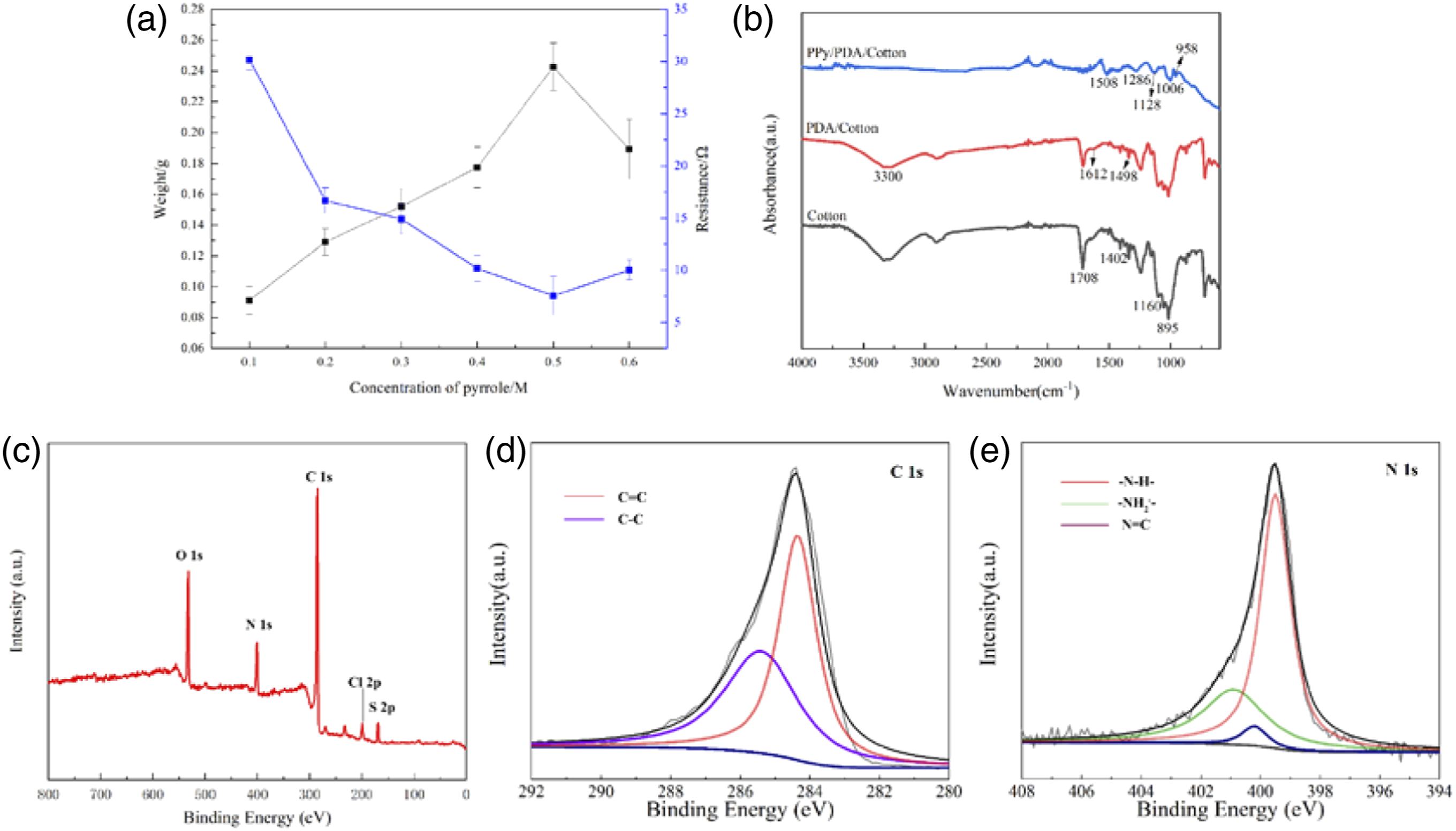
ATR-FTIR spectroscopy was used to characterize the surface composition of the samples. Figure 3(b) shows the FTIR spectra of the PPy/PDA/Cotton fabric [34–36]. The peak at 1508 cm−1 is attributed to the C=C stretching vibration in pyrrole ring. The broad peak at 1286 cm−1 is assigned to the C–H and C–N in plane deformation modes. The in-plane deformation vibration of NH2+ groups derived from the protonated PPy chains is located at 1128 cm−1. The band at 1006 cm−1 and 958 cm−1 is assigned to the C–H out-of-plane ring deformation mode. The curve of the pristine cotton fabric shows the characteristic peaks of cellulose a 1708, 1402,1160 and 895 cm−1, which can be assigned to the overlapping bands of the functional groups (C–O, C–C and C–O–C) [43]. The polydopamine-coated fabrics showed new characteristic peaks at 3300 cm−1, 1612 cm−1, and 1498 cm−1 corresponding to the stretching vibration of -OH in polydopamine, C=C vibration in aromatic ring, and N-N shear vibration, respectively. It indicates that polydopamine is successfully encapsulated on the fabric surface [44]. The main characteristic peaks of cotton fabric and PDA/cotton fabric were not observed after in-situ polymerization of PPy, indicating that PPy has been successfully deposited onto the fabric.
XPS is a useful tool for obtaining information on the doping level of conductive polymers. Figure 3(c) shows an XPS measurement spectrum of the PPy/cotton fabric. The presence of C, N, O, Cl and S can be observed from the figure. The elements Cl and S are attributed to the negative ions doped in PPy, which are probably derived from ferric chloride and p-toluenesulphonic acid. Figure 3(d) shows the C1s spectrum with two peaks centered at 285.5 and 283.35 eV, corresponding to the C-C and C=C bonds, respectively. The N1s spectrum is shown in Figure 3(e) with three peaks at 401, 400.3 and 399 eV, associated with N=C, -NH2+ and -NH-, respectively. These results indicate the successful deposition of PPy on the surface of the cotton fabric.
Sensing performance
The sensitivity versus PPy content is shown in Figure 4(a), where the slope of the curve represents the sensitivity of the device. When the PPy content is in the range of 0.1–0.5 mol/L, the sensitivity of the device increases with increasing PPy content. As the PPy content exceeds 0.5 mol/L, the sensitivity of the device decreases as the PPy content increases further. The sensitivity increased with the increase of PPy content. When the concentration of pyrrole is low, the polymerization reaction rate is slow, less polypyrrole is generated, and the sensitivity is low; as the concentration of pyrrole increases, the reaction rate is accelerated and polypyrrole accumulates on the surface of the base cloth; when the concentration increases to a certain degree, the same reaction time is polymerized into a film of suitable thickness and dense uniformity, and the sensing performance is optimal. If the concentration is too high, the reaction rate is too fast, and the polypyrrole molecules accumulate rapidly, resulting in poor bonding between the polypyrrole and the substrate, easy to produce peeling and stripping, resulting in a decrease in sensitivity (Table 3). (a) The change curve of the resistance change rate of PPy/PDA/Cotton fabric with time under different pyrrole concentrations; the PPy/PDA/Cotton fabric (b) the relative change rate of resistance at 0–16 kPa; (c) the lowest detection limit; (d) Response curve and (e) Recovery curve; (f) Continuous change of resistance change rate under different pressures; (g) Change of resistance change rate with time at different rates (h) PPy/PDA/Cotton fabric intermittent response of resistance change rate under pressure; (i) Relative resistance change rate-time curve under 3000 s cycle. Surface conductivity of PPy/PDA/cotton fabric.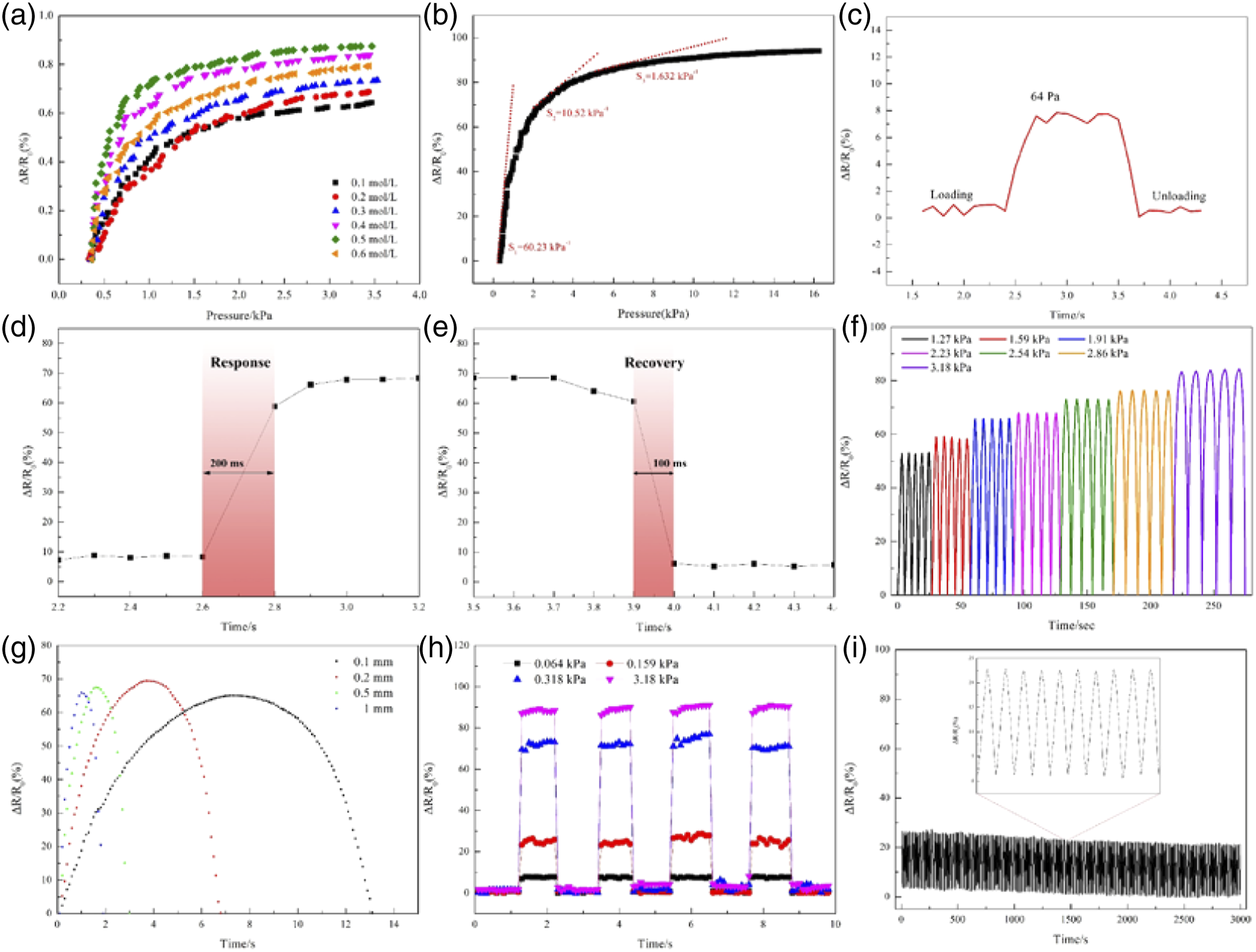

Comparison of performance parameters of literature and this work.

Wearable sensors ought to be adjustable to different pressure and speed conditions. Figure 4(f) shows the cyclic response behavior of PPy/PDA/cotton fabric under different compressive strains, and a stable and reproducible shadow pattern is observed in a wide strain range. Figure 4(g) shows the variation in response time due to different rates of applied pressure at the same stress. Good performance of the PPy/PDA/cotton fabric was found by dynamically loading and unloading for four cycles over a pressure range of 0.064 kPa–3.18 kPa. As shown in Figure 4(h), there is a large difference in the rate of change of resistance between 0.159 kPa and 0.318 kPa, which is due to the higher sensitivity at 0.159 kPa–0.318 kPa. It can accommodate pressure measurement in different conditions.
Pressure sensors for wearable should have certain stability and durability. A durability test of the compression resistance behaviour of the PPy/PDA/cotton fabric was carried out at a strain rate of 0.1 mm/s for 3000 s cycles at a pressure of 3.18 kPa. From Figure 4(i), it can be found that δR/R0 exhibits excellent recoverability due to the good elasticity and compressibility of the PPy/PDA/cotton fabric. All of the above demonstrates the high repeatability, stability and durability of the piezoresistive sensing performance.
Electric heating performance
The electric heating performance of the developed samples (heating area 5 cm
To investigate the influence of Pyrrole concentration on the electric heating performance of PPy/PDA/Cotton fabric, the heating performance of PPy/PDA/Cotton fabric with 0.1–0.5 pyrrole concentration was analyzed. Figure 5(a) shows the surface temperature change of the fabric monitored by the infrared camera when 5 V was applied to the PPy/PDA/Cotton fabric with different pyrrole concentrations. The surface temperature of 0.1 mol/L, 0.2 mol/L, 0.3 mol/L, 0.4 mol/L, 0.5 mol/L and 0.6 mol/L, could reach 56.9°C, 71°C, 79.9°C, 101.8°C, 115.5°C and 92.6°C, respectively. The difference in heating behavior can be attributed to the difference in electrical conductivity. As shown in Figure 5(b), the surface temperature curve of PPy/PDA/Cotton fabric under a load voltage of 1–5 V with time. It can be seen that higher load voltages result in higher surface temperatures and a faster heating rate during the first 50 s. It can be observed that the surface temperature of PPy/PDA/cotton fabric can reach 115.5°C in 100 s at 5 v at a pyrrole concentration of 0.5 mol/L. The fast thermal response and excellent electrical heating performance of PPy/PDA/cotton fabric is further demonstrated. (a) The temperature of the PPy/PDA/Cotton fabric under different concentrations of pyrrole under a constant voltage of 5 V versus time; (b) The electric heating temperature of PPy/PDA/Cotton fabric under the optimal preparation conditions as a function of time; (c) Temperature cycle stability for 120 repeated cycles (300 s at 5 V, 300 s at 0 V); (d) Temperature-time curve at a constant voltage of 5 V. (e–i) Two-dimensional thermal infrared image and three-dimensional thermal image of PPy/PDA/Cotton fabric when an external voltage is applied.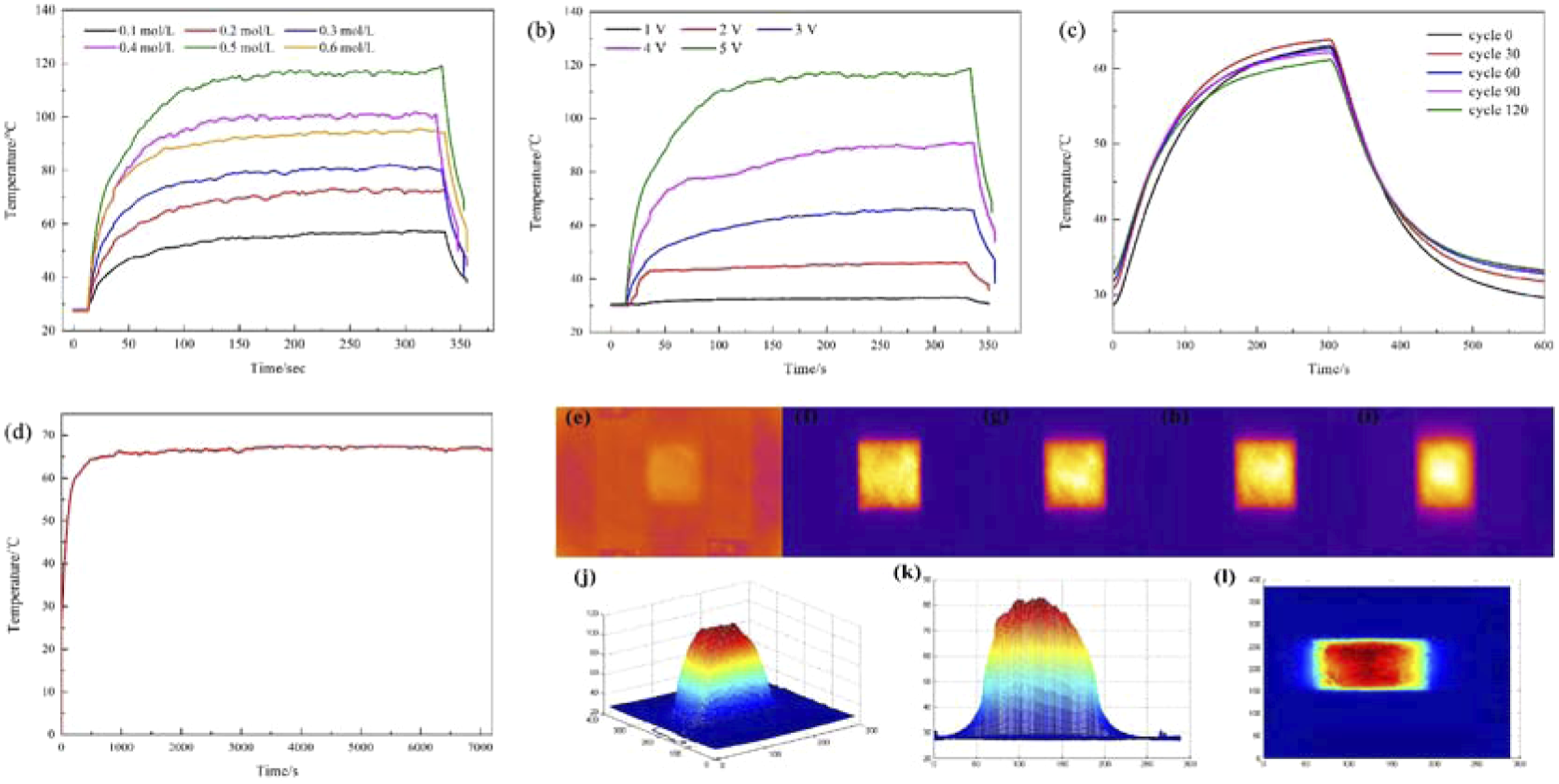
Flexible wearable electric heating elements not only need to reach the appropriate temperature under low voltage (<12 V), but also should have good heating stability, thus meeting the demands of repeated use and continuous use in practical applications. The stability of the PPy/PDA/Cotton fabric was tested by cyclic heating/cooling as in Figure 5(c) and the temperature change of the PPy/PDA/Cotton fabric was recorded for 600 s (5 v heating for 300 s and 0 v cooling for 300 s). After 120 cycles, the heating/cooling profile remained essentially constant, with good stability and repeatability. During each 300 s heating process, the temperature could be increased from room temperature to above 50°C within 100 s, indicating that the PPy conductive coated fabric has a high heating rate. Due to the insulation function of the cotton fibers, the fabric dissipates heat relatively slowly during the 0 V cooling power-off process. It satisfies the need for reusability of wearable flexible heating elements. The temperature dependence of the PPy/PDA/cotton fabric was investigated as shown in Figure 5(d). The PPy/PDA/cotton fabric was heated continuously at a constant voltage of 5 V for 7200 s. The results show that the surface temperature of the fabric increased rapidly throughout the heating process and then stabilized in a narrow temperature interval (68 ± 3°C). The temperature fluctuation may be due to the fact that the electron flow at the fiber junctions under goes several separations/reorganizations, thus reaching dynamic equilibrium at each point of the fabric. This demonstrates the remarkable resistance heating properties and thermal stability of the PPy/PDA/cotton fabric. It satisfies the need for stability of wearable flexible heating elements.
An operating voltage of 5 V was applied to the PPy/PDA/Cotton fabric and the thermal infrared map recorded by the infrared camera was observed. As can be seen in Figure 5(e)–(i), the temperature of the fabric is increasing during the 0–100 s time period. At the 100 s the imaging is no longer different from that at the 200 s and 300 s, and the maximum equilibrium temperature is reached and remains stable during this time period. After 300 s, the temperature starts to cool down and there is a significant decrease in the imaging temperature in Figure 5(i). The 3D temperature distribution trends processed by Matlab are shown in Figure 5(j)–(l). The heat distribution in the 3D, side and top views shows that the sample is heated uniformly and steadily within the effective heating region. It satisfies the need for temperature uniformity of wearable flexible heating elements.
In order to facilitate comparison, Table 4 shows the piezoresistive sensing parameters and electric heating performance parameters of some recent documents. In the work of this article, the PPy/PDA/Cotton fabric shows excellent performance in terms of operating range, sensitivity and maximum equilibrium temperature, proving that the PPy/PDA/Cotton fabric is a promising high performance products both as flexible piezoresistive sensors and as electrically heated elements.
As an intelligent wearable textile, it should be durable and should be washed or waterproof to keep it clean. The PPy/PDA/cotton textile was rubbed 100 times, and the resistivity changed 50% after 100 times of rubbing (Figure 6(a)). It was soaked in saline 10 times, and the resistivity changed 50% after seven times of soaking (Figure 6(b)). This demonstrates that the PPy/PDA/cotton fabric has good wear endurance and can withstand a certain number of rubbing and sweat soaking. The PPy/PDA/cotton fabric was washed 10 times, and the change of resistivity was maintained at 50% after one wash, which means the influences of washing on PPy/PDA/cotton fabric are considerable (Figure 6(c)). The relative resistance after (a) friction (b) soaking (c) washing.
Application
The high sensitivity and low pressure detection limit of PPy/PDA/Cotton fabric pressure sensors can provide many applications from monitoring the tiny signals of human pulse beats to recording the hard mechanical movements of human organs. Figure 6(a) shows a pulse wave detected by the PPy/PDA/Cotton pressure sensor. As shown in Figure 6(a), the device was fixed to the wrist of a 25 year old adult for a one-to-one test with the aid of medical tape. According to the test data, the heart rate is about 67 bpm (beats per minute), which is consistent with the beat-to-beat rhythm measured from a commercial blood pressure monitor. In addition, the inset of Figure 7(a) clearly distinguishes three waves from a single response cycle: percussive wave (P wave), tidal wave (T wave) and diastolic wave (D wave), which are related to heart rate, ventricular Blood pressure, systolic blood pressure and diastolic blood pressure [46]. The results can reflect the state of the circulation and monitor physiological indicators such as blood pressure and heart rate. Therefore, the flexible piezoresistive sensor made from PPy/PDA/Cotton fabric is suitable for pulse monitoring applications, which would be a simple and cost-effective way to observe the state of the heart. (a) Monitoring curve of pulse signal; (b) Curve for detecting finger movement state; (c) Curve for detecting wrist movement state; (d) Curve for detecting knee movement state; (e) The temperature-time curve of the heating element under different voltages; (f) the temperature-time curve under three voltages.
Pressure sensors with high sensitivity, a large working stress range and high stability are able to monitor the full range of human movement. As shown in Figure 7(b)–(d), PPy/PDA/Cotton fabric sensors are fixed on the joints (insets of Figure 7(b)–(d)) to test their response to the bending of fingers, wrists, and knees. The δR/R0 of the sensor is zero when the joint is kept straight at the joint. The δR/R0 value of the sensor increases in real time as the joint is bent. When the joint returns to extension, the sensor relaxes to its original state and δR/R0 drops to its original value. The periodic bending and straightening of the joint cause a periodic increase and decrease in δR/R0 and produces the curve shown in Figure 7(b).
As a practical application demonstration, an electric heating element made from PPy/PDA/Cotton fabric is fixed on a knee brace in the position of the human knee position as shown in Figure 7(f). The temperature of the electric heating element varies uniformly with the voltage change (Figure 7(e)). The electric heating element in the knee brace can be controlled by the voltage in three steps with uniform heating effect (Figure 7(f)). The stable electrical conductivity ensures that the heated fabric for joint thermotherapy can be operated effectively even when the wearer is in motion, for example when the knee is naturally flexed and extended. Joint thermotherapy involves frequent mechanical deformations during human movement and keeps the body warm and protected from the cold, especially for those with mobility problems such as infants, the elderly and the disabled. Electric heaters therefore have great potential for use in joint thermotherapy.
Conclusions
In summary, flexible, low-cost and biocompatible PPy/PDA/Cotton fabric was successfully prepared by wrapping a conductive polypyrrole layer on the surface of cotton fiber through a simple dopamine modification and chemical in situ polymerization method. The prepared PPy/PDA/Cotton fabric has excellent electrical heating temperature rise performance, heating stability and uniform temperature. The surface temperature of PPy/PDA/Cotton can reach 115.5°C at 5 V within 100 s. Meanwhile, the flexible pressure sensor based on PPy/PDA/Cotton fabric shows satisfactory pressure sensing performance. The PPy/PDA/Cotton pressure sensor exhibits the best performance with high sensitivity (60.23 kPa−1) and wide operating range (0–16 kPa). In addition, we demonstrate its ability to detect human motion (finger, wrist and knee flexion) and physiological signals (wrist pulses) in real time. The superior electrical heating performance and pressure sensing performance of PPy/PDA/Cotton fabrics show its research value and potential application in the field of wearable electronic devices.
Footnotes
Author contributions
The manuscript was written through contributions of all authors. All authors have given approval to the final version of the manuscript.
Declaration of conflicting interests
The author(s) declared no potential conflicts of interest with respect to the research, authorship, and/or publication of this article.
Funding
The author(s) disclosed receipt of the following financial support for the research, authorship, and/or publication of this article: The study was supported by Ministry of Science and Technology National Key R&D Program "Technology Winter Olympics" Key Special Project (Grant No. 2019YFF0302100); the Natural Science Foundation of Tianjin City (Grant No. 18JCYBJC18500).
Data availability statement
All data included in this study are available upon request by contact with the corresponding author.
