




Abstract
The stable performance of ultra-high frequency radio frequency identification (UHF RFID) tag thread with normal mode helical dipole antenna (NMHDA) was required for industrialized application. The ununiform helical pitches and helical radiuses caused by the unstable tension in the preparation process and material properties of carrying yarn probably deteriorate the performance of UHF RFID tag thread with NMHDA, while previous work focused on the properties of UHF RFID tag thread with uniform structure by finite element simulation. This work conducted numerical experiments with the actual statistical distribution of helical pitch and helical radius, i.e. normal distribution, and discussed the influence of the distributed parameters on resonant frequency. And then, the relationship between structure uniformity and resonant frequency was explored. Furthermore, the relationship was put into practice of the design of UHF RFID tag thread with stable properties. The results show that the fluctuation of resonant frequency first decreases and then increases with the increase of the mean helical pitch (S me ), and the resonant frequency decreases with the increase of the standard deviation of helical pitch (S st ) and that of helical radius (r st ). When the reactance of helical coil linearly changes with helical radius, the mean helical radius (r me ) has a negligible effect on the fluctuation of resonant frequency. The importance of the factors for the resonant frequency conforms to the following order: r me >S st >S me >r st . Additionally, the stable reading range of prototype (14.13 ± 0.06 m) demonstrated the practice of these results in the design of UHF RFID tag thread with NMHDA.
Keywords
Introduction
To upgrade to industry 4.0, ultra-high frequency radio frequency identification (UHF RFID) technology is one of the key technologies of intelligent manufacturing, and is widely used in logistics management of textiles and wireless sensor.
1
The UHF RFID tag, especially the UHF RFID tag thread with normal mode helical dipole antenna (NMHDA),
2
has the advantages of good flexibility, concealment, stretchability and reading range, and is a good way to integrate UHF RFID technology into textiles. The geometric structure of UHF RFID tag thread with NMHDA is shown in Figure 1. In the figure, r is the ideal helical radius; S is the ideal helical pitch; l is the single arm length; a is the conductor radius; C is the length of each helical coil; n is the number of helical coils; r1, r2, r3, ..., rn-1, r
n
, and rn+1 are the actual helical radiuses; S1, S2, S3, …, Sn-2, Sn-1, and S
n
are the actual helical pitches. UHF RFID tag thread with NMHDA: (a) Ideal NMHDA; (b) Actual NMHDA; (c) Geometric structure of UHF RFID tag thread with NMHDA; (d) Equivalent circuit of UHF RFID tag thread with NMHDA.
The stable and excellent reading range of UHF RFID tag thread with NMHDA is required for industrial application. The theoretical reading range of UHF RFID tag thread with NMHDA can be obtained by the Friis free-space transmission formulas,
3
i.e.

In order to improve impedance matching, Zhang et al.4,5 optimized the structural parameters by simulation and prototype preparation, and the reading range of optimized UHF RFID tag thread with NMHDA was over 10 m. The stability of antenna impedance depends on the stability and uniformity of antenna geometric structure. The UHF RFID tag thread with NMHDA deforms with the motion of fabric, and probably causes the change of geometric structure, antenna impedance, resonant frequency and reading range. Benouakta found that the resonant frequency decreased with the elongation of UHF RFID tag thread with constant number of helical coils by simulation. 5 When the UHF RFID tag thread with the carrying yarn radius of 0.5 mm, the helical pitch of 1.2 mm, and the single arm length of 47.5 mm was elongated by 11.5%, the reading range at 865 MHz lost 18%. 6 With the elongation of UHF RFID tag thread with NMHDA and the change of the working frequency, the reading range increased rapidly and then decreased rapidly, and the largest reading range, i.e. the reading range at resonant frequency, was always close to 10 m. In order to improve the reading range, the common UHF RFID tag thread with NMHDA must work near the resonant frequency. In other words, ensuring that the resonant frequency is within the working frequency band is the key to obtain stable reading range.
In terms of uniformity of antenna geometric structure, the carrying yarn of UHF RFID tag thread with NMHDA, i.e. a common textile yarn, is an irregular and compressible geometry. Yan 7 reported that the number of fibers in the yarn cross section obeyed normal distribution by Monte Carlo method. In addition, Wang 8 reported that the yarn diameter also obeyed normal distribution by autoregressive moving average model. The NMHDA was manufactured by helically and conformally wrapping the metal wire around the carrying yarn, herewith its helical radiuses and helical pitches were uneven in industrial manufacturing. Furthermore, the unstable tension in the wrapping process also worsens the unevenness of NMHDA for UHF RFID tag thread. Unfortunately, the influence of the structure uniformity due to manufacturing process on the resonant frequency has not yet been explored. For the NMHDA with uniform structure, the influence of structure parameters on the resonant frequency has been systematically discussed. According to previous results, 9 for the NMHDA with the helical pitch of 0.7 mm and the single arm length of 42.0 mm, when the helical radius increased from 0.55 mm to 0.65 mm, the resonant frequency decreased by 127 MHz. For the NMHDA with the helical radius of 0.6 mm and the number of helical coils being 120, when the helical pitch increased from 0.3 mm to 0.7 mm, the resonant frequency decreased by 400 MHz. For the NMHDA with the helical radius of 0.55 mm and the single arm length of 63.0 mm, when the helical pitch increased from 1.0 mm to 2.0 mm, the resonant frequency increased more than 150 MHz. 10 Obviously, the change of resonant frequency in the above cases were greater than the Chinese UHF RFID band (920–925 MHz). These results demonstrates that the structure uniformity from manufacturing process has a significant impact on the resonant frequency of UHF RFID tag thread with NMHDA.
Generally, the UHF RFID tag thread with NMHDA with large reading range has been obtained. However, it is unknown of the influence of structure uniformity due to manufacturing process on the resonant frequency and reading range, which is critical for the parameter control of production process. This study will make a finite element model (FEM) of UHF RFID tag thread with NMHDA, conduct a parametric analysis in terms of the statistical distribution parameters of structure features of manufactured prototypes, and explore the influence of structural uniformity on the properties of UHF RFID tag thread with NMHDA.
Modeling and simulation
This work will discuss the relationship between structure uniformity from manufacturing process and resonant frequency by prototype characterization and numerical simulation. The unevenness of helical pitch and helical radius cannot be eliminated due to the limitation of manufacturing process. Relatively, the UHF RFID tag thread with uniform helical pitch and helical radius can be obtained by modeling.
Modeling
The manufacturing structure uniformity is characterized by the statistical distribution parameters, and then the distribution parameters are used to build the geometrical model of the UHF RFID tag thread with NMHDA.
Prototype preparation and characterization
The repeated UHF RFID tag thread with the single arm length of 43.0 mm, the helical radius of 0.615 mm, the helical pitch of 1.0 mm, the conductor radius of 0.045 mm11 was prepared. The geometric sizes of prototype were characterized by image processing technology as shown in Figure 2. Taking the characterization of helical pitches as an example, the intersection coordinates of the central axis and each helical coil were measured, and then the helical pitches were obtained by scale conversion. Measurement of the geometric sizes. (a) Grayscale image; (b) Main body of NMHDA; (c) Trace extraction of NMHDA; (d) Sampling of helical pitches.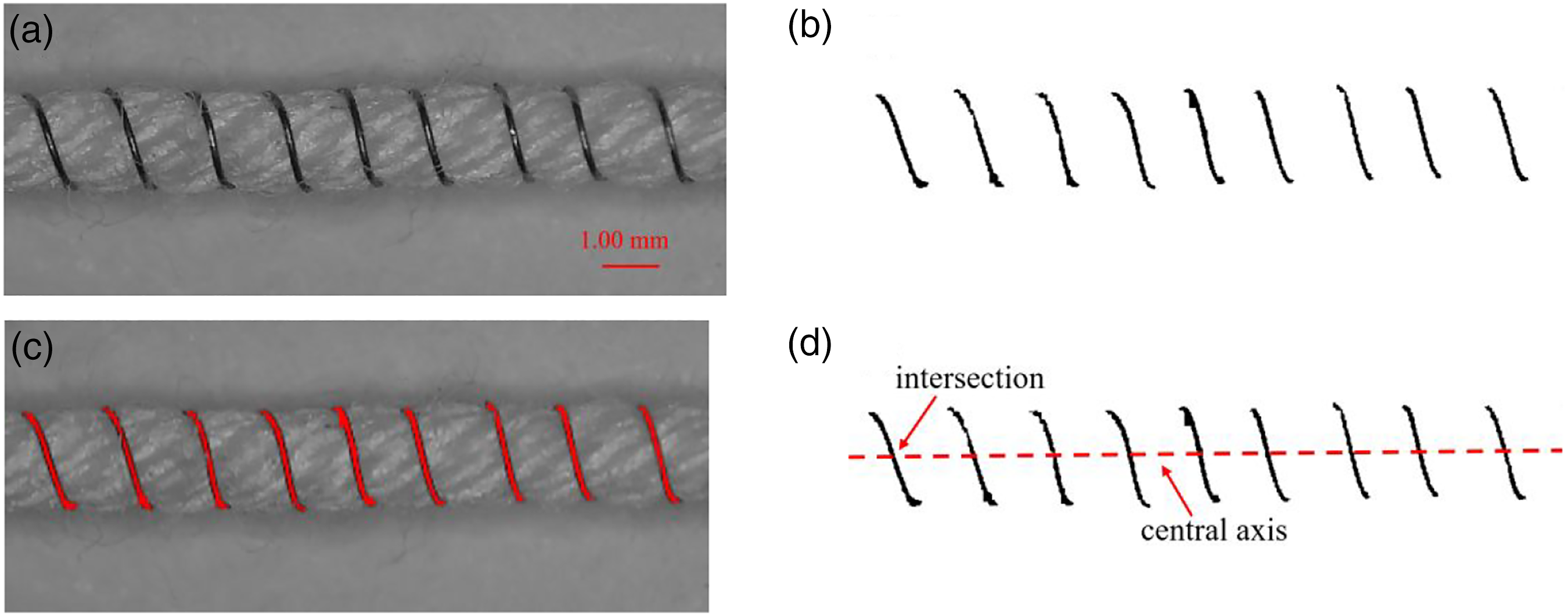
The measured values of many of yarn properties statistically obey normal distribution.12,13 In order to determine the statistical distribution of structure dimensions, the Kolmogorov-Smirnov test was performed on the measured helical pitches and helical radiuses, respectively. According to the Kolmogorov-Smirnov test of helical pitches, p = 0.729 > 0.05, and the helical pitches obeyed the normal distribution, i.e. S i ∼N(1.032, 0.216). In the same way, the helical radiuses also obeyed the normal distribution, i.e. r i ∼N(0.625, 0.051), and p = 0.761 > 0.05. After that, the normal distribution of the helical pitches and helical radiuses are used to generate the geometry size of the model of UHF RFID tag thread with NMHDA.
Finite element model
Theoretically, the dielectric properties of carrying yarn have an effect on resonant frequency. However, compared with the influence of structural parameters on the resonant frequency, the dielectric properties of the carrying yarn have a negligible influence on the resonant frequency in previous work.5,9,14,15 Thus, the carrying yarn was not considered to simplify the model of UHF RFID tag thread with NMHDA and reduce computing cost in this work. And then, the tag antenna was simplified as NMHDA. The relative permittivity of carrying yarn in FEM is reduced to that of air, i.e. 1. Furthermore, based on the geometric dimensions of prototype,
11
the NMHDA with the conductor radius of 0.045 mm, the single arm length of 43.0 mm, the helical radius of 0.615 mm, and the helical pitch of 1.0 mm was constructed as shown in Figure 3. Geometric model: (a) Front view; (b) Left view; (c) Top view.
The geometric size of chip was much smaller than the operating wavelength, so the chip was regarded as a lumped port with the size of 0.1 mm × 0.8 mm. And according to the impedance of Alien Higgs-3 chip at 915 MHz, the full port impedance was set to 27.38+j200.76 Ω. In view of the material of the NMHDA, the helical conductor was made of copper wire with conductivity of 5.8 × 10⁷ S/m.
The radiation boundary was created by cylindrical air box with the radius of 83.0 mm and the height of 151.8 mm. According to the ANSYS HFSS manual, the delta S was initially set to 0.02. An interpolating sweep setup was set from 0.6 GHz to 1.4 GHz. According to the accuracy of the general testing equipment in laboratory, the frequency step was set to 0.001 GHz.
The resonant frequency, the change of resonant frequency, θ, and the percentage change of resonant frequency, δ, were used as characteristic parameter. And they were expressed as

Numerical simulation and analysis methods of geometry structures
Validation of the model
Firstly, the accuracy of the model was validated. According to the geometric size of prototype, the UHF RFID tag thread with ununiform helical pitches and helical radiuses were constructed and simulated. As shown in Figure 4, the S-parameter was measured by Qing’s method.
16
And then, the simulated resonant frequency was compared with the measured one. Test of S-parameter of tag antenna. (a) Testing platform and fixtures; (b) Testing method.
Helical pitch
According to the geometric size of the common UHF RFID tag thread with NMHDA,10,11 the helical radius was set to 0.615 mm. The helical pitches were randomly generated by the normal distribution. Specifically, the standard deviation of helical pitch, S st , was set to 0.216 mm, i.e. the standard deviation of helical pitch of prototype. The mean helical pitch, S me , was set to 0.700 mm, 0.775 mm, 0.850 mm, 0.925 mm and 1.000 mm, respectively. For each case of S me , one set of value obeyed normal distribution, i.e. {S1, S2, …, S n }, was randomly generated. To note, the {S1, S2, …, S n } expresses the helical pitches of helical coils from one end to the other end of a bipolar NMHDA in sequence as shown in Figure 1. And the n was an integer, which minimized the value of |nSme −86|.
The influence of S st on the resonant frequency was also explored. The S me was set as 1.000 mm. The helical pitch of the prototype was greater than 0.090 mm, i.e. the conductor diameter. To make the probability of the actual helical pitches greater than 0.090 mm at the level of 0.005, the high threshold of S st was 0.35 mm. And then, the S st was set to 0, 0.07 mm, 0.14 mm, 0.21 mm, 0.28 mm, and 0.35 mm, respectively. And then, for each case of S st , one set of value obeyed normal distribution, i.e. {S1, S2, …, S86}, was randomly generated, respectively.
Helical radius
According to the geometric size of the common UHF RFID tag thread with NMHDA, the helical pitch was set to 1.000 mm. The helical radius was randomly generated by the normal distribution. Specifically, the mean helical radius, r me , was set to 0.550 mm, 0.600 mm, 0.650 mm, 0.700 mm, and 0.750 mm, respectively. For each case of mean helical radius, one set of values, i.e. {r1, r2, …, r87}, was randomly generated by normal distribution. To note, the {r1, r2, …, r87} expresses the helical radius of helical coils from one end to the other end of a bipolar NMHDA in sequence as shown in Figure 1.
The standard deviation of helical radius, r st , was also explored. The r me was set as 0.615 mm. The low threshold of r st is 0.045 mm, i.e. the conductor radius of NMHDA. To make the actual helical radiuses over 0.450 mm at the level of 0.005, the high threshold of r st is 0.22 mm. And then, the r st was set to 0, 0.044 mm, 0.088 mm, 0.132 mm, 0.0176 mm, and 0.22 mm, and then for each case of r st , one set of values, i.e. {r1, r2, …, r87}, was randomly generated by normal distribution, respectively.
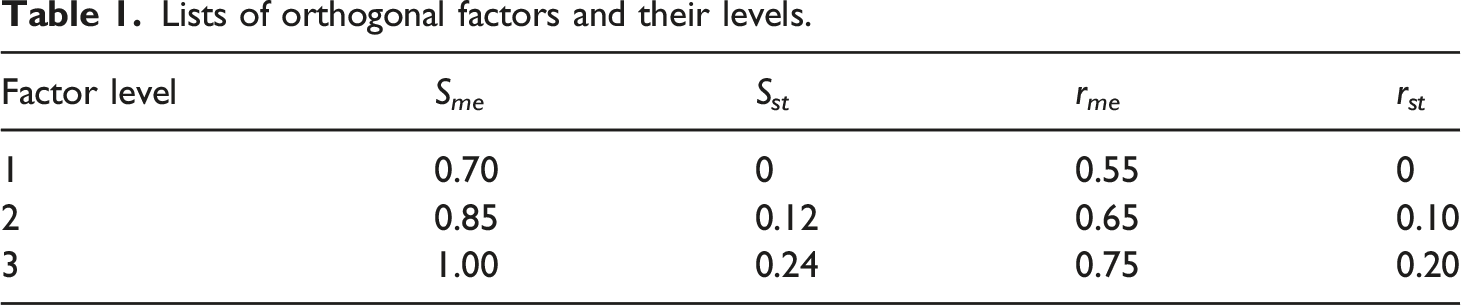
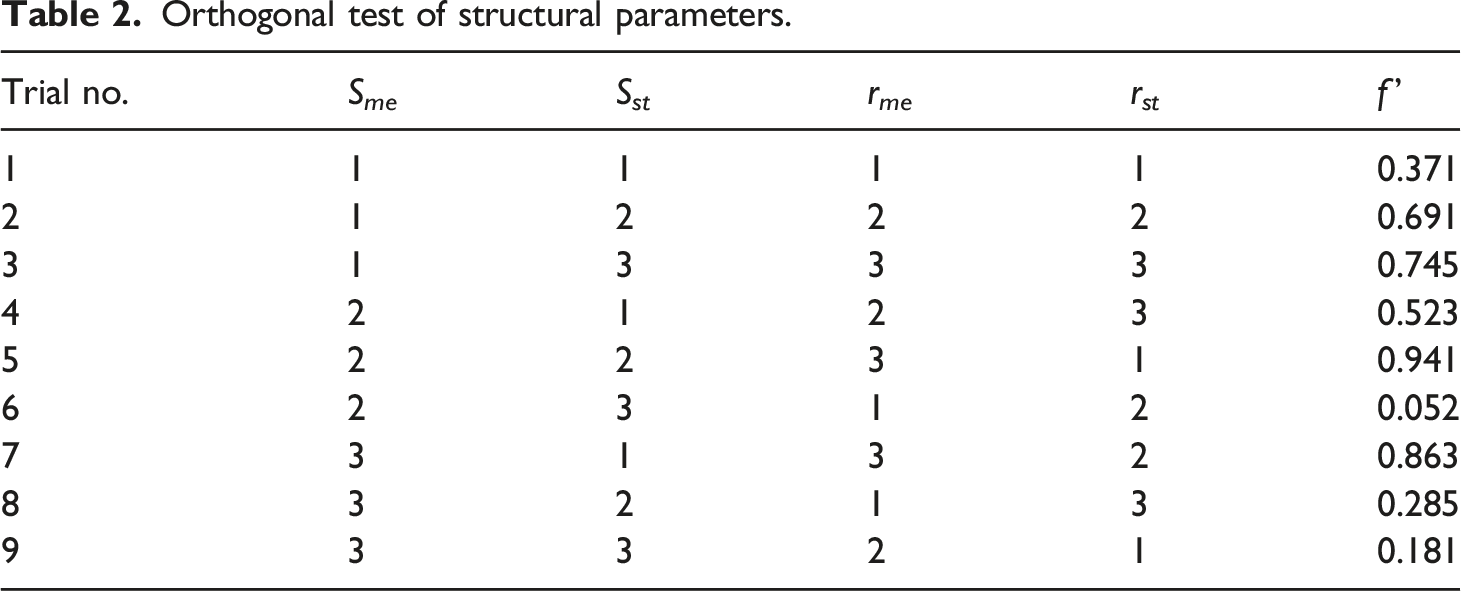
Factor analysis
Lists of orthogonal factors and their levels.
Orthogonal test of structural parameters.
Simulated result and discussion
Validation of the model
As shown in Figure 5, the simulated resonant frequency was close to the measured one, the deviation of simulated resonant frequency from measured one is only 0.22%. That is say, the method of simplifying the tag antenna geometry structure as NMHDA in this work is feasible. Additionally, according to Benouakta’s work,5,15 the resonant frequency decrease with an increase of relative permittivity of carrying yarn. Therefore, the simulated resonant frequency is little more than the measured one. All in all, the simulation method can be used to accurately characterize the electrical behavior of the actual UHF RFID tag thread with NMHDA. Comparison of the simulated and measured resonant frequency.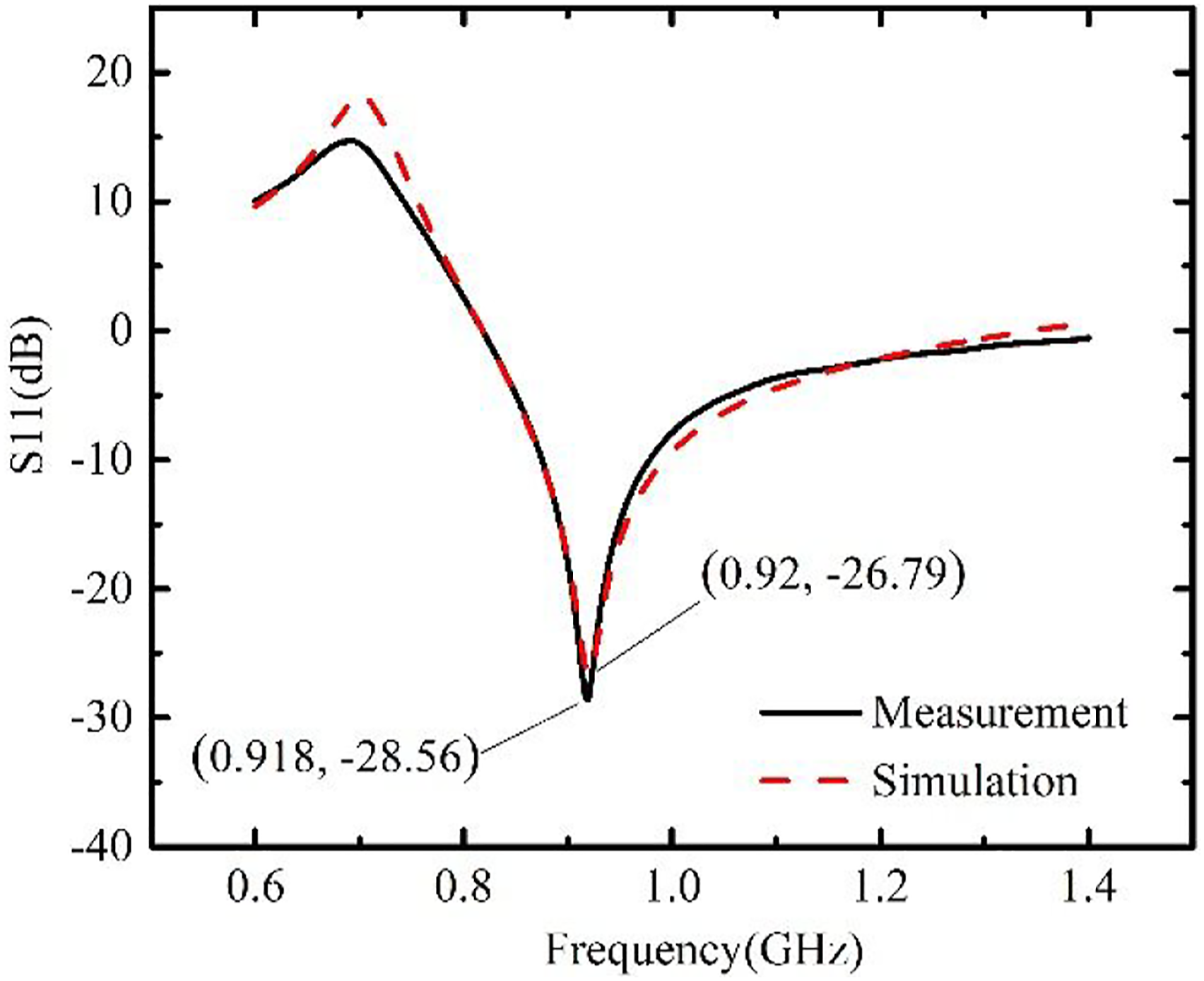
Influence of uniformity of helical pitch on resonant frequency
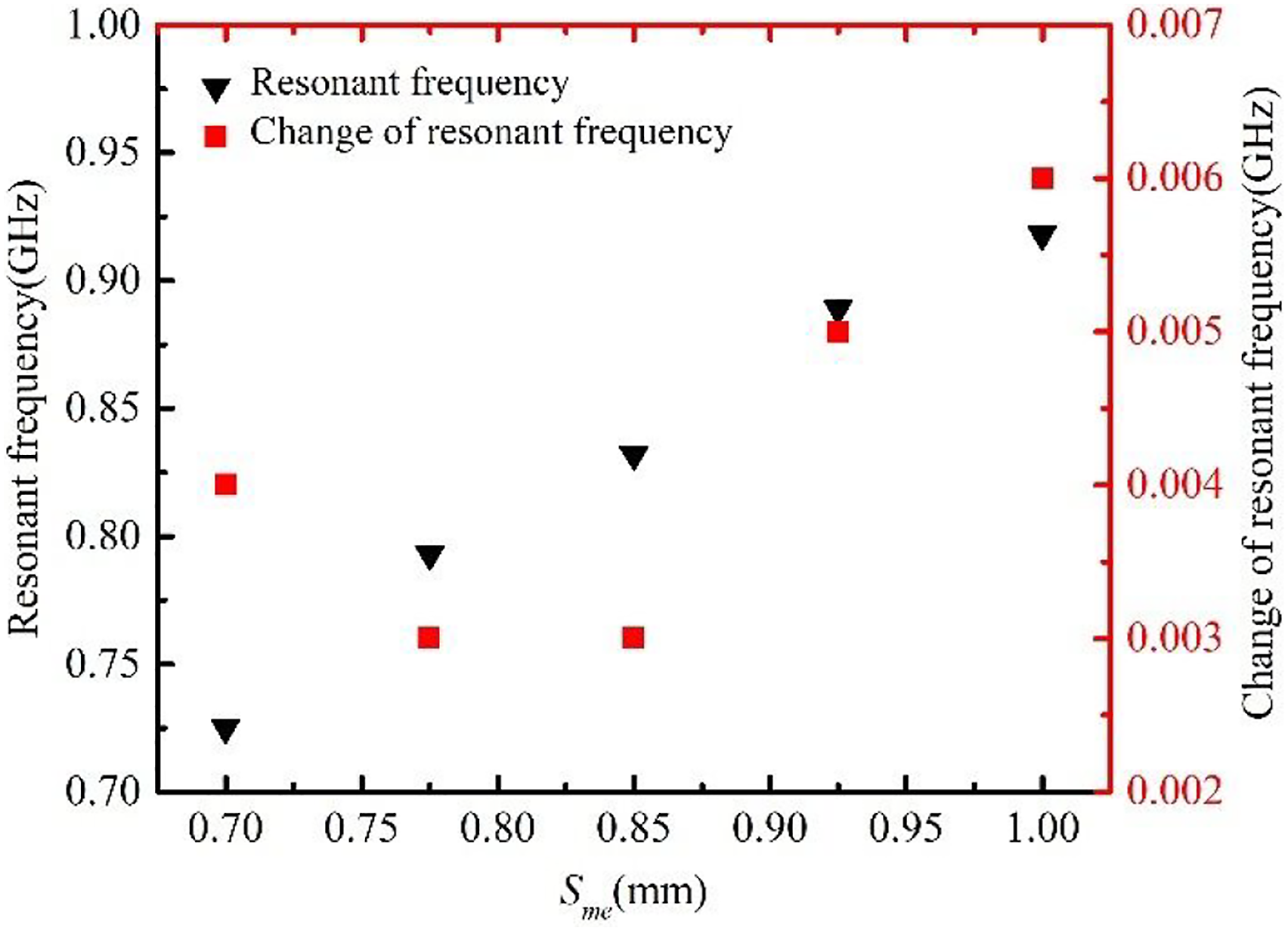
On the one hand, the resonant frequency increases by 193 MHz as the S
me
from 0.7 mm up to 1.0 mm in Figure 6. The inductance and reactance of NMHDA decrease with an increase of S
me
, which leads to an increase of resonant frequency. Obviously, 193 MHz far exceeds the Chinese UHF RFID bandwidth, as is same to previous work.
9
The influence of mean helical pitch on resonant frequency in the case of constant S
st
.
As the S
me
increases, the change of resonant frequency calculated by (2) first decreases and then increases. The reasons are as follow. The change of resonant frequency is related to the number of helical coil and the change rate of inductance with respect to helical pitch. On the one hand, the smaller S
me
is, the greater the number of helical coils is in the case of constant single arm length of NMHDA. Meanwhile, according to Wiener-khinchin law of large numbers, the greater the number of helical coils is, the more the average inductance of all helical coils tends to a constant. Finally, the smaller the mean helical pitch is, the smaller inductance fluctuation, impedance fluctuation and resonant frequency fluctuation. Therefore, increasing the number of helical coils is conducive to reducing the change of resonant frequency. On the other hand, the effect of the change rate of inductance with respect to helical pitch on the change of resonant frequency is discussed. Specifically, the inductance of any helical coil in NMHDA with uniform structure is expressed as
17

When the S
me
is from 0.700 mm up to 1.000 mm and the S
st
is 0.216 mm, the actual helical pitches are in the range of 0.144 mm–1.556 mm at the level of 0.005. As shown in Figure 7, the change rate of inductance gradually decreases when the actual helical pitch is from 0.144 mm to 0.310 mm, i.e. L(r,a,S) is a convex function. And the change rate of inductance gradually increases when the actual helical pitch is in the range of 0.310 mm–1.556 mm, i.e. L(r,a,S) is a concave function. Furthermore, from the probability density function of the normal distribution, the probability of the helical pitch in the range of 0.310 mm–1.556 mm is much greater than that in the range of 0.144 mm–0.310 mm. Therefore, this work only discussed the influence of the change rate of inductance on the change of resonant frequency when the helical pitches is from 0.310 mm to 1.556 mm. In this case, the change rate of inductance tends to 0 with the increase of helical pitch. Hence, when the number of helical coils is a constant, the change of impedance and that of resonant frequency decrease with the increase of helical pitch. The inductance of helical coil with the change of helical pitch predicted by equation (3).
In this work, as the S me increases, the number of helical coils decreases and the change rate of inductance trends to 0. When the S me is less than 0.75 mm, the change rate of inductance has a dominant influence on the change of resonant frequency. Hence the change of resonant frequency decreases with the increase of S me . And when the S me is more than 0.75 mm, the number of helical coils has a dominant influence on the change of resonant frequency. Hence, the change of resonant frequency increases with the S me .
As the S
st
increases, the resonant frequency decreases and the percentage change of resonant frequency increases in Figure 8. According to Chinese UHF RFID band, the S
st
should be less than 0.21 mm. Principally, this change can be seen from (3). According to the generation method of helical pitch with the mean value of 1.0 mm and low threshold of 0.09 mm, i.e. the conductor diameter, the helical pitch range is from 0.09 mm to 1.91 mm. (0.31, 3.80) is the inflection point of L(r,a,S), and the probability of the helical pitch in the range of 0.31 mm–1.91 mm is much greater than that in the range of 0.09 mm–0.31 mm. Therefore, this work only discussed the inductance of helical coil with the helical pitches in the range of 0.31 mm–1.91 mm. According to the characteristics of concave function, in this case the inductance satisfies The influence of standard deviation of helical pitch on resonant frequency.

The difference between the values on two sides of the inequality increases with the ΔS2. And ΔS2 increases with the S st . Obviously, the reactance of NMHDA increases with the S st , so that resonant frequency deceases.
Influence of uniformity of helical radius on resonant frequency
On the one hand, the resonant frequency decrease by 227 MHz with the r
me
from 0.55 mm to 0.75 mm in Figure 9. The inductance and reactance of NMHDA increase with the helical radius, resulting in a decrease in the resonant frequency. Obviously, the change of resonant frequency also far exceeds the Chinese UHF bandwidth, as is same to previous work.
9
As the r
me
increases, the change of resonant frequency calculated by (2) fluctuates around 0.001 GHz. Furthermore, the r
me
has no significant effect on the percentage change of resonant frequency by the one-way ANOVA at the level of 0.05. The influence of mean helical radius on resonant frequency.
This is due to the fact that the inductance of helical coil linearly changes with the helical radius. As shown in Figure 10, there is a good linear relationship between the helical radius and inductance (L(r) = 6.721r-1.710, R2 = 0.998) when the helical radius is from 0.421 mm to 0.879 mm. In this work, when the mean helical radius increases from 0.55 mm to 0.75 mm, and the standard deviation of helical radius is 0.051 mm, the range of helical radius generated by normal distribution is from 0.421 mm to 0.879 mm at the level of 0.005. For the any set of helical radiuses generated by the normal distribution, R1={r(1),r(2),…,r(87)}, its mean values, r1-me, is (r(1)+r(2)+…+r(87))/87. And then, when the inductance of helical coil (L(r)) linearly changes with the helical radius, L(r)=br+c, where b and c are constants and related to helical pitch and conductor radius. And then, The inductance of helical coil with the change of helical radius.
On the other hand, as the r
st
increases, the resonant frequency decreases and the percentage change of resonant frequency increases in Figure 11. According to Chinese UHF RFID band, the r
st
should be less 0.132 mm. This phenomenon also can be explained by (3). Specifically, the L(r,a,S) is a monotonically concave function in the case of constant conductor radius and helical pitch as shown in Figure 10. And then, the inductance of helical coil satisfies The influence of standard deviation of helical radius on resonant frequency.
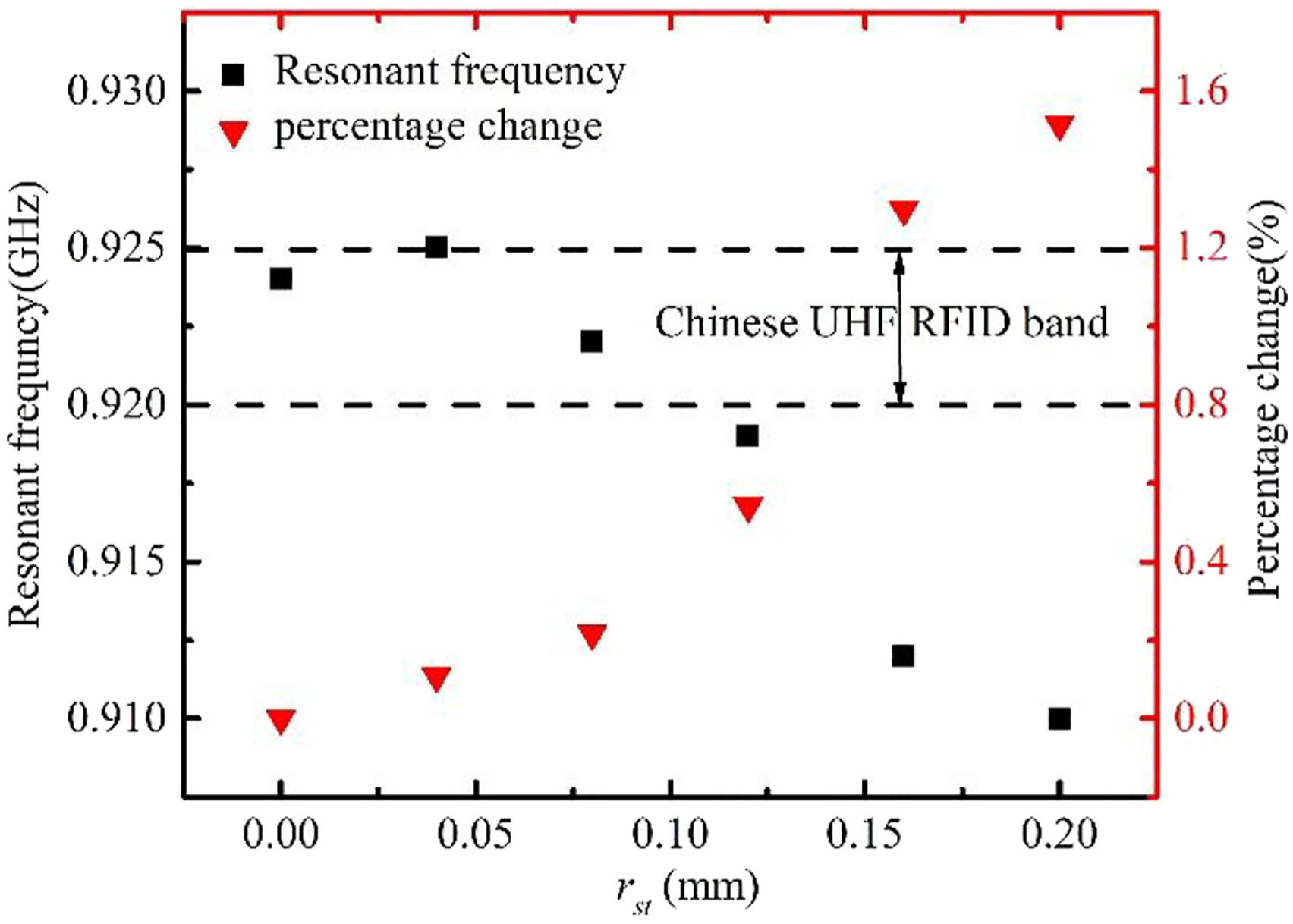
The difference between the values on two sides of the inequality increases with the Δr1. And Δr1 increases with the r st . Therefore, the resonant frequency decreases with the increase of r st .
Discussion
The range analysis of different influencing factors on resonant frequency.
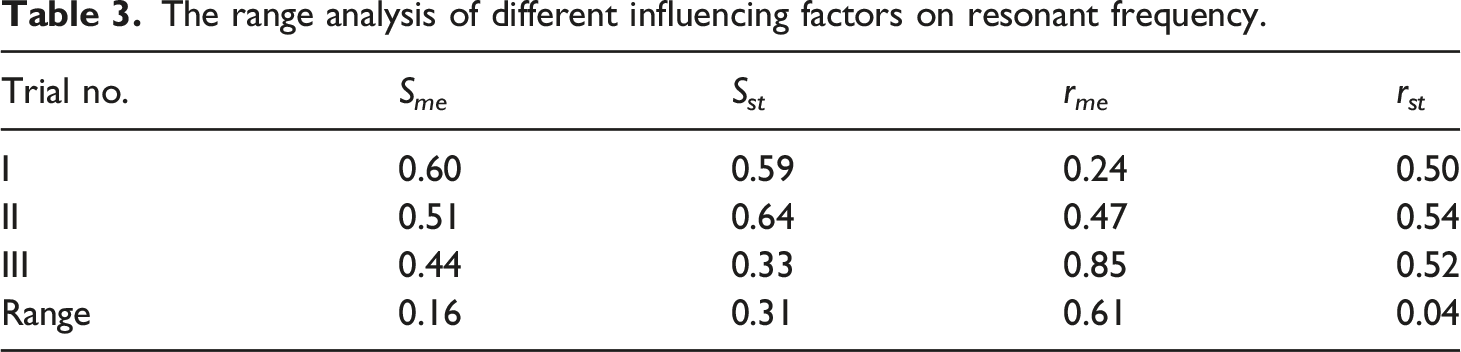
According to the range analysis, the influence of the S st on the resonant frequency is much greater than the influence of the r st on the resonant frequency. In addition, due to the supporting effect of the carrying yarn, the r st is smaller than the S st . Taking an example of the prototype in this work, the r st (0.051 mm) is smaller than the r st (0.216 mm). Therefore, the influence of r st on the resonant frequency is ignored, and the influence of S st on resonant frequency can be regarded as the influence of structural uniformity on resonant frequency. And then, the UHF RFID tag thread with stable resonant frequency and reading range can be obtained by controlling the standard deviation of helical pitch. The range of S st can be determined by simulating NMHDAs with different standard deviations of helical pitches and limiting the resonant frequency to the working frequency band.
To verify the practice of the above result into design, the resonant frequencies and reading range of five common UHF RFID tag thread with NMHDA characterized. On the one hand, as shown in Figure 12, the resonant frequencies of prototypes were accurately characterized by calibration curve, i.e. the simulated results in Figure 8. Test of the reading range of UHF RFID tag thread with NMHDA.
On the other hand, the reading ranges of prototypes were measured by UHF RFID reader (E9012PLNF). The measurement setup was illustrated in Figure 13. The reading ranges of prototype A, B, C, D and E are 14.1 m, 14.2 m, 14.2 m, 13.5 m and13.4 m, respectively. To note, the reading range of prototype is the distance between the tag and the reader when the tag is away from the reader and cannot be recognized by the reader for the first time. Taking the process of testing the reading range of prototype A as an example, the prototype A can be recognized when the distance between the reader and the prototype A is 18.6 m. However, when the distance is 14.1 m, the prototype A cannot be recognized. Hence, the reading distance of prototype A is 14.1 m rather than 18.6 m. The actual reading ranges of prototypes are all less than the theoretical reading range of UHF RFID tag thread with uniform structure by (1), i.e. 20.7 m, due to the radiation pattern of the UHF RFID reader and the influence of measured environment. It is worth noting that the variation of measured reading range is highly consistent with the variation of the measured resonant frequency of UHF RFID tag thread with NMHDA. Because the resonant frequencies of prototype A, B and C are both in the Chinese UHF RFID band, the reading range of prototype A is close to that of prototype B and C. The mean, standard deviation, and coefficient of variation of reading range among prototype A, B and C are 14.13 m, 0.06 m and 0.4%, respectively. And because the resonant frequency of prototype E is not in the Chinese UHF RFID band, the reading range of prototype E is 6.3% smaller than that of prototype B. The coefficient of variation of reading range between prototype B and E is up to 4%, which is much bigger than coefficient of variation of reading range among prototype A, B and C, i.e. 0.4%. That is to say that the UHF RFID tag thread with excellent and stable performance can be obtained by building calibration curve and controlling resonant frequency in the Chinese UHF RFID band. Comparison of the calibration curve and measured resonant frequency. (The measured prototype and its resonant frequency are: A:(0.124, 0.922); B:(0.179, 0.921); C:(0.197, 0.920) D:(0.223, 0.916) E:(0.276, 0.909).
Conclusion
This work explored the influence of manufacturing uniformity on the resonant frequency of UHF RFID tag thread with NMHDA by numerical simulation. The effect of the normal statistical distribution of both helical pitches and helical radiuses of prototype on resonant frequency are discussed, and the determinant relationship between the resonant frequency and these statistical features were built and applied into the design of NMNDA for UHF RFID tag thread. Specifically, as the mean helical pitch (S me ) increases, the fluctuation of resonant frequency first decreases and then increases, and the increase of the standard deviation of helical pitches (S sd ) makes a decrease of the resonant frequency. However, when the reactance of helical coil linearly changes with the helical radius, the mean helical radius (r me ) has no significant effect on the fluctuation of resonant frequency. The stable and superior reading performance of the designed UHF RFID tag thread with NMHDA demonstrated the practice of the relationship. In practical applications, the UHF RFID tag thread with NMHDA will be inserted into fabric and bent. The influence of bending deformation on the reading range needs a further investigation. Generally, these results are helpful to control manufacturing quality and engineering design of the UHF RFID tag thread with NMHDA with stable and superior reading performance.
Footnotes
Declaration of conflicting interests
The author(s) declared no potential conflicts of interest with respect to the research, authorship, and/or publication of this article.
Funding
The author(s) disclosed receipt of the following financial support for the research, authorship, and/or publication of this article: This work was supported by the Fundamental Research Funds for the Central Universities (2232021G-01), the Fundamental Research Funds for the Central Universities and Graduate Student Innovation Fund of Donghua University (CUSF-DH-D-2021021) and the Natural Science Foundation of Shanghai (22ZR1400800).
