




Abstract
Noise pollution is rapidly increasing, posing a health risk, particularly in the low frequency range. Therefore, the development of cost-effective, environmentally friendly and efficient audible sound absorbing materials is a necessary and crucial process. To this end, smart multilayer sound absorber has been developed based on micro-perforated panels and Jute fabrics as renewable and eco-friendly sound-absorbing material. Different perforation shapes have been fabricated and used for micro-perforated panels and optimized. The sound absorption properties for the new developed sound-absorbing system were evaluated inside a two-microphone impedance tube achieving outstanding results. The developed sound-absorbing system achieved higher sound absorption properties recording more 70% at low frequencies range (<500 Hz), also achieved excellent sound absorption coefficient with broad bandwidth. Furthermore, the flammability properties of the used Jute fabrics were evaluated achieving flame retardancy property of 44 mm/min rate of burning and 20% LOI value. Additionally, the Jute fabrics mechanical and surface morphology properties were investigated. Hence, this study presents a smart, cost-effective, flame retardant and efficient absorption system suitable for noise control for a wide applications range.
Keywords
Introduction
The negative human health effects of noise pollution force the scientists to find convenient sound-absorbing materials to mitigate noise hazards. Hence, sound-absorbing materials have to be used to reduce noise negative effect. However, sound-absorbing materials design is the key factor in this process. This is because numerous factors must be considered, including environmental stability, cost, efficiency, and reliability. The porous materials such as glass wool, mineral wool, and urethane foam have been reported previously for acoustic absorption applications, however, due to their negative environmental and health effect, they are restricted for some applications. 1 Natural fiber was undergoing intense research due to their unique property. In contrast to synthetic reinforced composites, natural fiber such as jute, has been subjected to extensive research due to low cost of application. Because of their acoustical and mechanical qualities, these materials have the ability to compensate for future difficulties and needs. Gowda et al. 2 show how renewable natural fiber sources can be used to make a variety of consumer item. The sound-absorbing systems are classified into two types; resonant sound absorbers and porous sound absorbing materials. From the engineering point of view, for any material to be applicable the tensile strength is very important property of textile materials which represents the ratio between force required to break a specimen and cross-sectional area of that specimen. The resonant sound absorbers, such as the Helmholtz resonator and the perforated panel, are primarily used to absorb low frequency noise, whereas porous materials are primarily utilized to absorb middle and high frequency noise . 3 Recently, textile based natural textile fibers have been exploited for fabricated of sound absorbing system.4–5 On the other hand, micro-perforated panel (MPP) has been introduced as alternative sound absorbing materials to conventional porous materials. MPP sound absorbing panel resonance system is a substitution tool composed of a large number of micros to sub milli-sized Helmholtz resonator holes in the front of an acoustically hard backing material of the testing tube. Additionally, MPP consists of a sheet panel with a lattice of sub-millimeter size perforations disseminate over its surface. Hence, tuning the perforations sizes to sub-millimeter scale or micrometer range leads to the required acoustic resistance and low acoustic mass reactance which is necessary for absorption process without the use of any porous material. 6 While, incident frequency is close to the resonator’s inherent frequency, air columns in the hole vibrate strongly and rub against the hole walls, then the acoustic energy is transformed into thermal energy due to inertial and viscous effects and finally attenuated . 7 Therefore, based on the merits of MPP as efficient and sound-absorbing material, it is interesting for various applications sectors such as building acoustics8,9 environmental noise abatement 10 and duct control. 11 Nevertheless, the MPP has a naturally narrow range of absorption bandwidth, 1 it is still restricted that one single MPP is still not able to meet some engineering demands to achieve sound-absorption properties in low frequency and wide absorption bandwidth. 12 Hence, there are various trials have been reported to overcome this deficiency such as theoretical model of MPP-porous composite as sound absorber, 3 micro-perforated panel backed by a porous material 13 and bionic multi-layer sound absorber composed from porous material, micro-slit panel and micro-perforated membrane. 10 Despite the fact that the porous absorbing layer behind the MPP improves low-frequency sound absorption, the total sound absorption bandwidth remains limited. As a result, there has yet many trials to be established an effective and accurate model for perforated panels with porous material as multilayer system of absorption. Additionally, there is a confusion and difficult to provide the guidance to adjust all the parameters of this complex system in their models and some of them failed to complete it or assume constant cavity length.14,15 It was found that when the perforation size is less than 1 mm, the acoustic impedance of the structure matches well with air and the absorption properties were greatly enhanced. 16 Hence, Crandall developed useful equations in which applied Rayleigh’s acoustic analysis theory can be used to micro holes. 11 It was also reported that the characteristics of the materials such as design parameters, thickness of perforation and geometry influence the absorption properties of the perforated panels, especially the profile of the material can affect strongly on the absorption properties. 17 It is worth to mention, when sound waves propagate onto the surface of the panels, they are excited to vibrate especially for flexible cases and hence sound-induced vibration of the panel itself can also cause acoustic dissipation. 18 Hence, the relationship between panel-type absorption and Helmholtz resonation in MPP with an electro-acoustic analogy model that cause the acoustic dissipation was studied.15,18–20 The electro-acoustic analogy of the panel-type absorption due to mass-spring resonance is correlated to Helmholtz-resonance in the same resonance system. The sound absorption of perforated closed-cell foamed aluminum was similar to that of a perforated solid with the same perforation parameters.20–21 Perforation diameter and pore size played a significant role in the absorption properties, as the absorption frequency became more significant as perforation diameter and pore size increased. The absorption coefficient of a multilayer structure in the form of coir fiber, air-gap, and MPP using acoustic transfer matrix analysis were previously studied using impedance tube.22–24 The sound absorption performance of a multilayer sound absorber consisting of layers of coir and kenaf fiber was also experimentally studied. Interestingly, this multilayer sound absorber system improved the low-frequency sound absorption of the coir fiber. 26 Thus, MPP with porous material in the design of an enclosure and its absorption performance using the transfer matrix method was previously evaluated. 27 Hence, the design of efficient, cost-effective and eco-friendly MPP based sound-absorption systems is crucial for safe mitigation of lower-frequency range of noise. Hence, in this study new and smart sound absorption system was developed for low frequencies range of 200 Hz–1600 Hz based on two types of Jute and different designs and perforation ratio from MPP achieving outstanding performance than reported sound absorbing system.28–30 Natural and synthetic textile fabrics for sound and environmental applications.31–33 The sound absorption properties for the developed multilayer system based on MPP of five different shapes (circle-spiral-hexagonal-slits- four combined shapes together) with renewable Jute fabrics in two configurations by replacing positions of MPP and Jute was studied using the impedance tube. Because, it’s intriguing since it provides a more versatile technique to determining absorption. Additionally, the effect of presence of air cavity of 2.5 and 5 cm after layers inside the tube was investigated. Our group has long been involved in the study of sustainable system for environmental applications.34–36 The paper results can provide some helpful references for the design of wideband sound absorbers. The flammability and mechanical properties of the used Jute fabrics was evaluated. Furthermore, surface morphology of the used Jute fibers was investigated and correlated with sound absorption performance.
Materials, methods and theory
Materials and methods
Jute fabrics as natural textile porous cloths were obtained from Egyptian market. Two different forms of jute cloths (I and II) were used for acoustical application. The jute fabrics were cut into circular shape with a diameter of 100 mm and 10 and 20 mm for thickness for the acoustical test (Figure 1(a) MPPs used in this study made from aluminum plate cut into circular pattern with a diameter of 100 mm which is same as the internal diameter of the B and K impedance tube as shown in Table 1. The thickness of the aluminum plate used is 2 mm, and the MPPs were prepared in different shapes at Radwan steel Company-Egypt. The cutting process was performed by using laser technique whereas all the MPP holes are uniformly distributed (Table 1 and Figure 1(b)). Moreover, before the cutting process the samples were draw using AUTOCAD software. Photographs for (a) Jute type I and II, (b) different shapes of MPPs. Structural parameters for MPPs test specimens in the study.

Characterization and measurements
Jute fabric specification.

The airflow resistivity, r0 (Pa. s/m2) is calculated by the relation 
Measurement of the sound absorption of multilayer sound absorber
The normal incidence sound absorption coefficient of multilayer sound absorber is measured with B and K 4206 impedance tube using the transfer function method. The measurements were performed according the ISO standard 10,534 27 using the transfer function between two B and K 4187 microphones. Samples of jute cloths and MPP are prepared with a diameter of 100 mm which are same as the internal diameter of the tube. The multilayer sound absorber is arranged in the required configuration (I and II). Then the normal incidence sound absorption coefficient is measured in the frequency range from 50 Hz to 1600 Hz. The sample is placed in the sample holder and the specific end condition is maintained as per the test condition. The random noise signal generated is connected to the loudspeaker in the tube through a power amplifier B&K 2706. B and K 3550 acoustic material testing software is used for processing of the measured data.
Acoustical theory for multilayer sound absorber structure
The purpose of presenting this part is to realize the concept of work and the physics behind in order to predict the sound absorption of the system as presented for the multilayers system. In terms of transfer matrix method, the loss of sound energy during propagation can be attained by solving the propagation relationship of sound waves in different media to obtain SAC of materials. The plane waves normally incident on the materials surface reach the rigid backing through three layers of different media. Three transfer matrices
For MPP
For porous material
The transfer matrix for air cavity
The total transfer matrix of the compound absorber (MPP and the porous sound absorbing material)
For the compound sound absorber type, a, the total matrix
Normalized specific acoustic impedance of MPP+porous+air cavity sound absorber can be determined by

Further information was found in supporting information section.
Results and discussions
Jute textile fabrics characterization
The jute samples used for the developed sound absorption system were characterized using different tools. The average air permeability of Jute samples I and II were found to be 72.4 and 52.5 cm3/cm2/S, respectively. On the other hand, the mechanical properties of the Jute fabrics were evaluated based on the maximum break loading which reflect the tensile strength and elongation at break. The maximum loading for Jute I was found to be 1792 N and elongation % at break was recorded 5%. However, for Jute II the loading at break was found to be 739 N and elongation was recorded 8%. This reflects the higher tensile strength of both samples in general and higher tensile strength of Jute I compared to Jute II. Furthermore, the flammability properties of the Jute I and II were evaluated using UL and LOI. While, Jute I achieved higher flame retardancy compared to Jute II which record rate of burning of 44 mm/min and 20% LOI value compared to 49 mm/min and 19% LOI for Jute II. This reflects the self-flame retardancy and good mechanical properties of Jute fabrics samples due to their composition compared to other reported natural textile fabrics28,29 which provide a good merit for preference of Jute fabrics for sound absorption system. It is reported that the number of pores and their sizes are considered as one of the important parameter for the absorption of sound waves.3,30 Then, the SEM images of Jute I and II indicated their pores and typical microscopic arrangements, where this may have an implication on their application as sound absorber material. Hence, when a porous material is exposed to incident sound waves, the air molecules at the surface of the material and within the pores of the material are forced to vibrate and in doing so, lose some of their original energy. This phenomenon is explained by the fact that some of the energy of the air molecules is transformed into heat due to thermal and viscous losses at the material’s internal pores and tunnels. 10 At low frequencies range these changes are isothermal, while at high frequencies, they are adiabatic. 31
The surface morphology of Jute I and its porous structure was visualized as seen in Figures 2(a) to (c). Hence, the pore size of an average diameter of 514 μm and the size of its bundle which consists of some small-scale yarns with size lies within the order of 1.3 mm. However, the diameter of the single yarn is of 40 μm. Pore, bundle, and yarn sizes for Jute II (Figures 2(d) to (f)) are approximately 1.0 mm, 2.5 mm, and 47.0 mm, respectively. Therefore, Jute I have smaller pore, bundle and yarn sizes compared to Jute II. As a result, Jute I (514 μm) should be preferred for high sound absorption because the pore size was less than Jute II (1000 μm), as shown below. SEM images of Jute fabrics (a–c) type I and (d–f) for type II.
The acoustic performances for the combination of micro perforated plates with absorbent acoustic materials and air cavities
Two different types of Jute cloths I and II in conjunction with MPP of different structures (Table 1) were used to develop smart and promising sound absorbing systems. Then, the two types of Jute cloths deliver different sound absorption performance as their density is different. Additionally, the five MPP (different shapes) with Jute (type I and II) in two configurations exhibit various sound absorption coefficient within the frequency range of interest as reflected in Figure 3. Please note, the sound absorption mechanism of porous material and MPP is different. As, in porous material the sound absorbs by viscous and thermal losses whereas the mechanism of sound absorption of MPP is of resonant type. However, when MPP is backed with the porous material layer, it gives sound absorption over broader frequency range at low frequency region, but still it remains resonant type.
30
Increasing the thickness of the material generally improve the low frequency sound absorption characteristics. The particle velocity of sound wave is zero at rigid interfaces such as backing wall for a sound absorbing material. Thus, for effective absorption of sound energy, the sound wave has to be passing through the absorbing material during a particle velocity maximum.
32
Hence, maximum absorption of low frequency sound can be achieved with resonant absorbers which involve volumes of air. The resonant absorber principles are commonly used for low frequency sound absorption. The Helmholtz (or cavity) resonators which are consists of a neck and a cavity.
32
The air in the neck oscillates as a mass while the static air in the cavity undergoes compression and expansion as a spring. Including energy dissipations, such as the sound radiation from neck opening and the friction between air and walls, the Helmholtz resonator can be modeled as a mass-spring-damper system. The cavity volume and the neck can be tuned to a specific low frequency. Its sound absorption characteristics can be broadened over the frequency range by lining the cavity with sound absorbing material. Thus, the mechanism of sound absorption is the resonant mass-spring behavior of the system which dissipates sound energy.
33
Representation diagram representing the fabricated system and the system working mechanism.
Figure 4 represents the sound absorption coefficient (SAC) curves for Jute cloths of 1 and 2 cm thickness samples with rigid backing. It is clear from the curve that the average SAC for 1 cm thickness Jute type I is in the order of magnitude of 0.85–0.97 in the frequency range of 1000–1600 Hz. The peak (maximum) of its absorption appears at frequency 1250 Hz. However, the average SAC for Jute type II (1 cm thickness) sample was found to be in the order of magnitude of 0.75–0.87 in the frequency range of 1250–1600 Hz, and the peak of sound absorption recorded at the frequency of 1600 Hz. On the other hand, for Jute type I (2 cm thickness), the highest value of SAC (∼0.83) appears at the frequency of 1000 Hz compared to 1250 Hz for thickness of 1 cm. Adhering to the same trend for Jute type II (2 cm thickness) the highest value of SAC (∼0.88) appears at the frequency of 1250 Hz compared to1600 Hz for thickness of 1 cm. Therefore, this conclude that increasing the thickness of the absorbing material attributed to slight shift of SAC toward lower frequency range with good performance of SAC value (Figure 3). Summarization of highest SAC values with their frequencies for all materials and combination given in Supplemental Table S1. The sound absorption performance for jute I and II below 200 Hz (Figure 4), reflects that increasing the SAC with increasing frequency (50–200 Hz) and the thickness of jute is the major cause for increasing SAC. This indicates that jute I and jute II of thickness 2 cm have higher SAC than samples of 1 cm thickness. Although, the SAC below 200 Hz is noticed to lie within ≤0.1 and this may be attributed to the higher wavelength of sound at this range that made the penetration ability of sounds is higher. Comparison of sound absorption coefficient for Jute (J) type I and II (1 cm& 2 cm thickness) within the frequency range of 50–1600 Hz.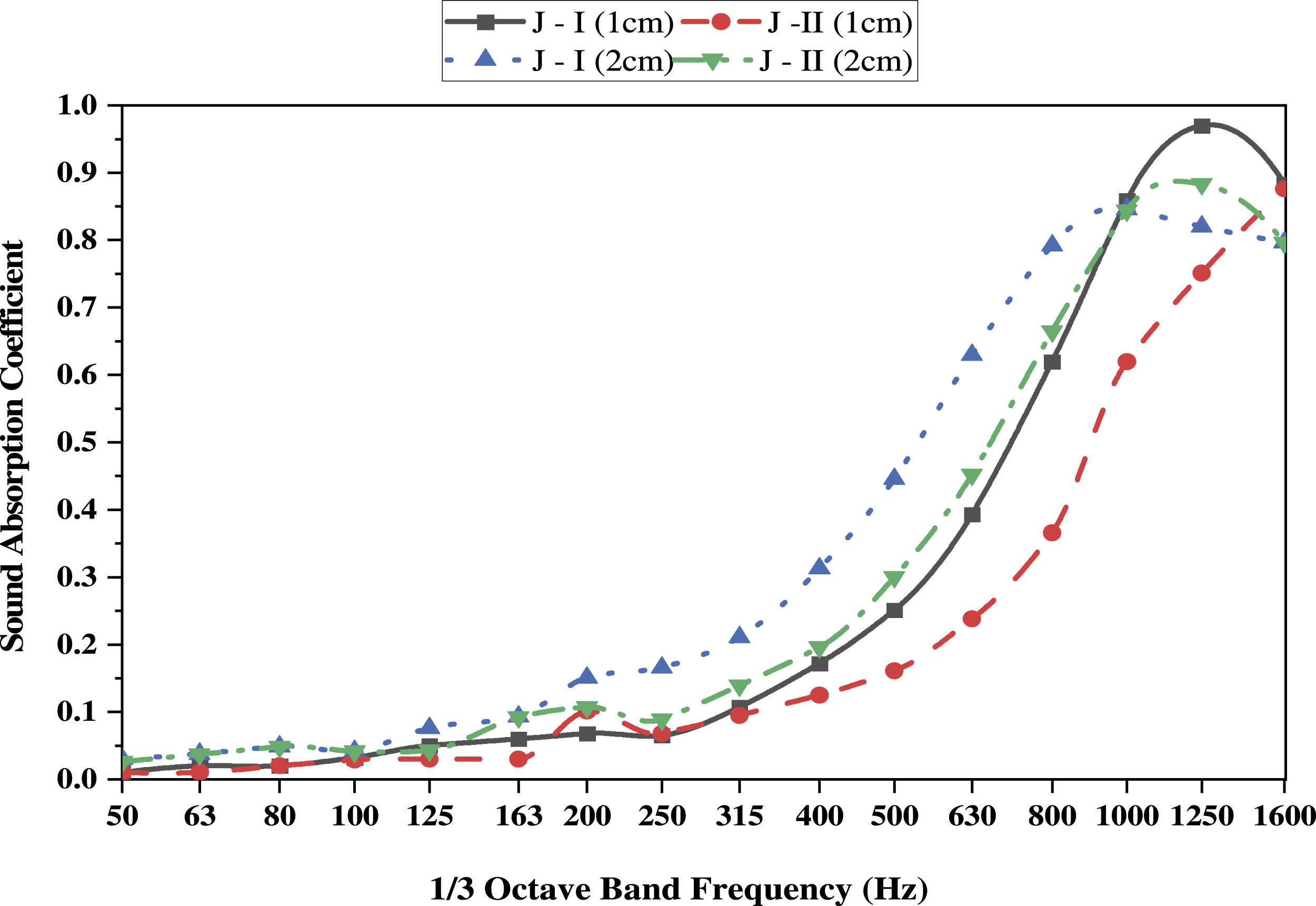
Sound absorption of multilayer sound absorber composed of Jute Type I (thickness 1 cm) - Configuration (1 and 2) and MPP- air cavity (2.5 and 5 cm)
The SAC curves for sound-absorbing system composed from Jute type I of 1 cm thickness sample with different five shapes of MPP in configuration one and two and air cavity of 2.5 and 5 cm were shown in Figure 5. Hence, Figure 5(a) represents the results of the sound absorbing system when the air cavity set at 2.5 cm (Configuration 1) and MPP shapes are varied to optimize and study the effect of combination of Jute with different MPPs designed shapes. For configuration I, the MPP is on the incident side of sound waves; therefore, the sound absorption was found to be in good performance especially towards the low-frequency region (Figure 5(a)). This is due to most of the sound energy is converted into heat due to the friction between the air and inner surface of the holes. It is observed that all the samples of combinations of (MPP-Jute I −2.5 cm air cavity) in configuration one show improvement in SAC with better order of magnitudes and broader bandwidth frequency in the low frequency regions (Figure 5(a)). Furthermore, for MPP circle shape-based sound-absorbing system the SAC enhanced with wide bandwidth of frequency absorption within the frequency range of 800–1000 Hz with the SAC peak values of 0.92 and 0.93 for 800 and 1000 Hz, respectively. In case of MPP spiral shape-based system the SAC also enhanced with bandwidth frequency absorption within the frequency range of 630–1000 Hz with the peak values of SAC of 0.90, 0.97 and 0.75 for the frequencies of 630, 800 and 1000 Hz, respectively. Thus, incorporation of MPP in the system enhances the SAC and also broadening the range of frequencies absorbed. Interestingly, for MPP hexagonal shape-based system the SAC enhanced with interesting wide bandwidth frequency absorption within the frequency range of 400–630 Hz with SAC values of 0.81, 0.98 and 0.88 for the frequencies of 400, 500 and 630 Hz, respectively, which considered the optimum condition for low frequency sound-absorbing system. Therefore, the developed combination of MPP-hexagonal shape and Jute achieved very good sound absorption performance in very low frequency regions. As stated, before that the presence of air cavity can cause shift in the frequency of absorption toward lower frequency. For MPP slits shape based system the SAC enhanced with bandwidth of frequency absorption in the frequency range of 1000–1600 Hz with the values of SAC of 0.85, 0.96 and 0.82 for the frequencies of 1000, 1250 and 1600 Hz respectively. Hence, it is considered to be the worse combination of MPP (slit shape)-Jute system in terms of SAC in low frequency region. Additionally, for MPP combined circle, spiral, hexganol, slits shapes-based system the SAC enhanced with wide band of frequency absorption within the frequency range of 630–1000 Hz with the values of SAC of 0.88, 0.97 and 0.89 for the frequencies of 630, 800 and 1000 Hz respectively. Thus, this corroborated that insertion of MPP improves the SAC and causes broadening in the range of frequencies absorbed. For configuration one when the air cavity set at 5 cm (MPP- Jute I-5 cm air cavity) the SAC values were enhanced in the low frequency regions, as increasing the air cavity has significant effect on the results as seen in Figure 5(b). Therefore, for MPP circle shape-based system, the SAC enhanced with wide bandwidth of absorption frequency within the frequency of 400, 500 and 630 Hz with the SAC values of 0.85, 0.96 and 0.94 respectively. Thus, increasing the air cavity to 5 cm shift the range of SAC to lower frequencies compared to air cavity 2.5 cm-based system for same MMP shape (Figure 5(a)). However, for MPP spiral shape-based system, the SAC enhanced within the frequency of 400, 500 and 630 Hz with the SAC values of 0.79, 0.95 and 0.94 respectively. Hence, inclusion of MPP in spiral shape attributed to better improvement in the SAC and also cause broadening and shifting toward lower frequencies especially with increasing the air cavity of 5 cm. Interestingly, outstanding SAC values were recorded when MMP hexagonal shape-based system was used achieving frequency absorption within the frequency of 315, 400 Hz of SAC values of 0.92 and 0.94 respectively. Thus, the sound-absorbing system of MPP-Jute I of air cavity of 5 cm triggers sound absorption in very low frequency regions (Figure 5(b)). Hence, this can be applicable for many industrial, building and environmental noise reductions. For MPP slits shape-based system, the SAC within the frequencies of 500, 630 and 800 Hz with the SAC peak values of 0.92, 0.94 and 0.87 respectively. Similarly, for the combined (circle, spiral, hexganol and slits) shapes-based system, the SAC within the frequencies of 400, 500 and 630 Hz with the SAC values of 0.85, 0.96 and 0.94 respectively. In conclusion, the incorporation of MPP with increasing the air cavity can significantly enhance the SAC in conjunction with broadening the range of frequencies absorbed and also shifting the frequency range of sound absorption toward lower frequencies. Sound absorption coefficient curves for Jute type I (1 cm) in Config.1–2.5 cm air cavity, (b) Config.1–5 cm air cavity, (c) Config. 2–2.5 cm air cavity and (d) Config.2–5 cm air cavity.
On the other hand, for configuration two the air cavity is fixed at 2.5 cm all the samples of system MPP-Jute I-2.5 cm air cavity reflect enhancement in SAC in the low frequency regions (Figure 5 (c)). In this configuration, the Jute is placed on the incident side of sound waves, so most of the frequencies of sound waves get absorbed by the Jute before it enters into the MPP. For MPP circle shape-based system the SAC enhanced with wide frequency absorption observed in the frequencies of 800, 1000 and 1250 Hz with SAC values of 0.85, 0.94 and 0.80 respectively. Thus, this is attributed to broadening the range of frequencies absorbed. Also, the presence of Jute in the front side made the sound absorption at higher frequencies than in case of MPP in the front. For MPP spiral shape based system similar SAC behavior was observed to circle shape based system as indicated in Figure 5 (c) (800, 1000 and 1250 Hz with SAC values of 0.82, 0.96 and 0.89 respectively). For MPP hexagonal shape-based system, the SAC performance was reduced, however, significant shift in frequency of absorption was noticed in the frequencies of 400,500 and 630 Hz with the values of SAC of 0.61, 0.83 and 0.81 respectively. It is noteworthy to note that the SAC values at low-frequency of virgin materials are very low. Therefore, multiple mechanisms and structures are combined and developed in this design to overcome this dilemma. Thus, we obtained a combination of MPP and Jute that can cause good sound absorption in very low frequency regions. For MPP slits shape-based system, the SAC enhanced and the resonance noticed at 1600 Hz with the value of SAC of 0.98 for the frequency of 1600 Hz. For MPP combined (circle, spiral, hexganol and slits) shapes-based system, the SAC enhanced with wide frequency bandwidth located in the frequencies of 500, 630 and 800 Hz with the values of SAC of 0.81, 0.95 and 0.90 respectively. When, the air cavity is fixed at 5 cm all the samples of system MPP-Jute-5 cm air cavity (Figure 5(d)) in configuration two reflect improvement in SAC values especially in the low frequency regions. Hence, for MPP circle shape-based system the SAC was enhanced and the frequency absorption was observed within the frequencies of 400, 500 and 630 Hz with the values of SAC of 0.82, 0.95 and 0.91 respectively. Thus, increasing the air cavity of 5 cm can shift the range of SAC to lower frequencies compared to air cavity of 2.5 cm (Figure 5 (c)). However, in MPP spiral shape-based system, the SAC improved and the frequency absorption in the frequencies of 500, 630 and 800 Hz were observed with the values of SAC of 0.93, 0.95 and 0.83 respectively. Interestingly in case of MPP hexagonal shape-based system, the SAC enhanced along with frequency absorption situated in the frequencies of 315 and 400 Hz with the values of SAC of 0.84 and 0.88 respectively. In contrast, for MPP slits shape-based system, the SAC and frequency absorption noticed in the frequencies of 630, 800 and 1000 Hz with the SAC values of 0.91, 0.97 and 0.88 respectively. However, in case of MPP combined (circle, spiral, hexganol and slits) shapes-based system, the SAC improved with wide frequency absorption appears in the frequencies of 400, 500 and 630 Hz with the SAC values of 0.82, 0.96 and 0.95 respectively. Thus, the inclusion of MPP in conjunction in the system with increases of the air cavity provide significant improvement in the SAC value with special broadening in the range of frequencies absorbed, hence shifting the frequency range of sound absorption toward lower frequency. Thus, our developed smart sound absorbing system achieved sound absorption in low frequency through tuning the air cavity and/or thickness of absorbing material. Figure 5 presents data within the very low frequency range from 50-200 Hz. It was observed that the SAC lies within 0.1–0.2. It is clear that as air cavity increases in case of configuration one the SAC increases. However, SAC record 0.2 at 125 Hz in case of 5 cm air cavity and continue increasing with frequency especially for hexagonal and combined MPP. Moreover, the sound absorption at 50 Hz begins at higher values (SAC= 0.1) when air cavity increases in comparison with those at lower air cavity depth (SAC <0.1).
Sound absorption of multilayer sound absorber composed of Jute Type I (thickness 2 cm) - configuration (1 and 2) and MPP- air cavity (2.5 and 5 cm)
Furthermore, the SAC curves for Jute type I of 2 cm thickness sample with various MPP shapes in configuration one and air cavity of 2.5 cm were studied and their SAC curves are presented in Figure 6. It is clearly observed from the results increasing the Jute thickness (2 cm) has positive effect on shifting the absorption toward lower frequency compared to lower thickness of Jute (1 cm). Therefore, in MPP circle shape-based system, the SAC was enhanced achieving sound absorption in the frequency of 400, 500 and 630 Hz and their SAC peak values of 0.82, 0.90 and 0.84 respectively (Figure 6(a)). Similar trend was observed in MPP spiral shape-based system, recording sound absorption in the frequency of 500, 630 and 800 Hz and SAC peak values of 0.80, 0.87 and 0.81 respectively, as indicated in Figure 6(a). Adhering to the same sound absorption trend, MPP slits, and combined shapes-based system have similar behavior and the SAC values significantly enhanced compared to lower thickness Jute fabrics sample. Interestingly, excellent improvement in SAC and sound absorption behavior was observed in MPP hexagonal shape-based system, recording sound absorption in the frequency of 315, 400 and 500 Hz and SAC values were 0.74, 0.88 and 0.85 respectively. Thus, the sound-absorbing system of MPP-Jute (2 cm) - air cavity triggers sound absorption in very low frequency regions. On the other hand, when the air cavity was changed to 5 cm in the same system configuration and Jute thickness (2 cm), the of SAC was significantly shifted to lower frequencies compared to air cavity 2.5 cm based system (Figure 6(a)) as indicated in all MPP shapes based sound absorption system as shown in Figure 6(b). This was clearly observed in the significant shift of sound absorption in the frequency of 200, 250 and 315 Hz with SAC peak values of 0.67, 0.84 and 0.81 respectively. Hence, the sound-absorbing system of MPP -Jute of air cavity of 5 cm triggers sound absorption in very low frequency regions (Figure 6(b)). Hence, it is pertinent to note in this study, the developed smart combined sound-absorbing system from MPP and Jute achieved outstanding and superior SAC values of sound absorption in very low frequency regions compared to reported sound absorbing systems.29,37 On contrast, in configuration two and air cavity is fixed at 2.5 cm (MPP-Jute I-2.5 cm air cavity) the sound absorption behavior was changed as depicted in Figure 6 c. This was obviously noticed in MPP hexagonal shape-based system, the sound absorption frequency was shifted to the frequency of 500, 630 and 800 Hz associated with SAC peak values of 0.82, 0.86 and 0.76 respectively (Figure 6 (c)). Interestingly, when the air cavity was increased to 5 cm in configuration 2 (MPP-Jute I-5 cm air cavity) significant shift of sound absorption was shifted in lower frequency regions as shown in Figure 6 (d) compared to 2.5 cm air cavity (Figure 5(c)). This positive shift was stemmed from the positive effect of air cavity increase. Interestingly, good sound absorption behavior in the very low frequency region between 50-200 Hz was noticed as shown in Figure 6. In case of both configuration 1 and 2, the SAC amplitude increases with increasing the air cavity depth. The values of SAC may reach 0.3–0.5 at frequencies from 125 Hz to higher especially in case of hexagonal and combined MPP used in the multilayer. Moreover, SAC value of 0.2 was noticed (air cavity 5 cm) even from 50 Hz, however, their SAC amplitude at same frequency of 50 Hz may below 0.2. SAC amplitude may reach 0.4 or higher from 125 Hz to higher especially when air cavity increases. The increasing of jute fabric thickness has a vital effect on the SAC at very low frequencies, as it increases with increasing jute thickness. Sound absorption coefficient curves for Jute type I (2 cm) in Config.1–2.5 cm air cavity, (b) Config.1–5 cm air cavity, (c) Config. 2–2.5 cm air cavity and (d) Config.2–5 cm air cavity.
Sound absorption of multilayer sound absorber composed of Jute Type II (thickness 1 cm) - Configuration (1 and 2) and MPP- air cavity (2.5 and 5 cm)
The performance of sound absorption system based on Jute type II of thickness 1 cm for configuration one and two using air cavity of 2.5 and 5 cm was investigated and SAC curves were presented in Figure 7. The SAC curves for configuration one and MPP- air cavity 2.5 based systems were presented in Figure 7(a). Hence, for MPP circle shape-based system, the SAC was improved and sound absorption frequency was shifted to lower frequency of 500, 630 and 800 Hz (Figure 7(a)) compared similar condition for using Jute type I (Figure 5(a)). However, in MPP spiral and hexagonal shapes-based system, similar sound absorption frequency range was observed as indicated in Jute type I (Figure 7(a)). While, for MPP slits shape-based system, the SAC values and sound absorption frequency was achieved almost lower frequency range (630, 800 and 1000 Hz) similar to what recorded in Jute type I as seen in Figure 7(a). Also, similar sound absorption frequency range and SAC behavior was observed in combined circle, spiral, hexganol and slits shapes-based system in Jute type I and II. Additionally, when the air cavity was changed to 5 cm (Config. I) and MPPs. Significant improvement in SAC and sound absorption frequency performance was recorded compared to same system but using Jute type I. This was obvious in MPP hexagonal shape-based system, as the SAC was observed in lower frequency of 250, 315 and 400 Hz (Figure 7 (b)). For configuration two when the air cavity is fixed at 2.5 cm (MPP- Jute-2.5 cm air cavity). The SAC was observed in higher frequency ranges and this clearly indicated in hexagonal shape-based system, the SAC observed within frequency of 500 and 630 Hz with the values of SAC of 0.80 and 0.78 (Figure 7 (c)). It is clear from Figure 7 (d) (Config. 2) when air cavity was increased to 5 cm, the SAC and sound absorption frequency for all MPP based shapes sound absorbing system was significantly improved to lower frequency compared to smaller air cavity (2.5 cm). This because of larger air cavity (5 cm) triggers sound absorption in very low frequency regions. Additionally, the very low frequency range below 200 Hz was seen in Figure 7. Thus, there is increase in the SAC amplitude at low frequencies. As, in case of air cavity 5 cm for both configurations 1 and 2, the SAC may lie within 0.2–0.4. Hence, SAC may record 0.4 at 125 Hz especially for hexagonal MPP and 5 cm air cavity depth in both configurations. Sound absorption coefficient for Jute (1 cm) type II in (a) Config.1–2.5 cm air cavity, (b) Config.1–5 cm air cavity, (c) Config. 2–2.5 cm air cavity and (d) Config.2–5 cm air cavity.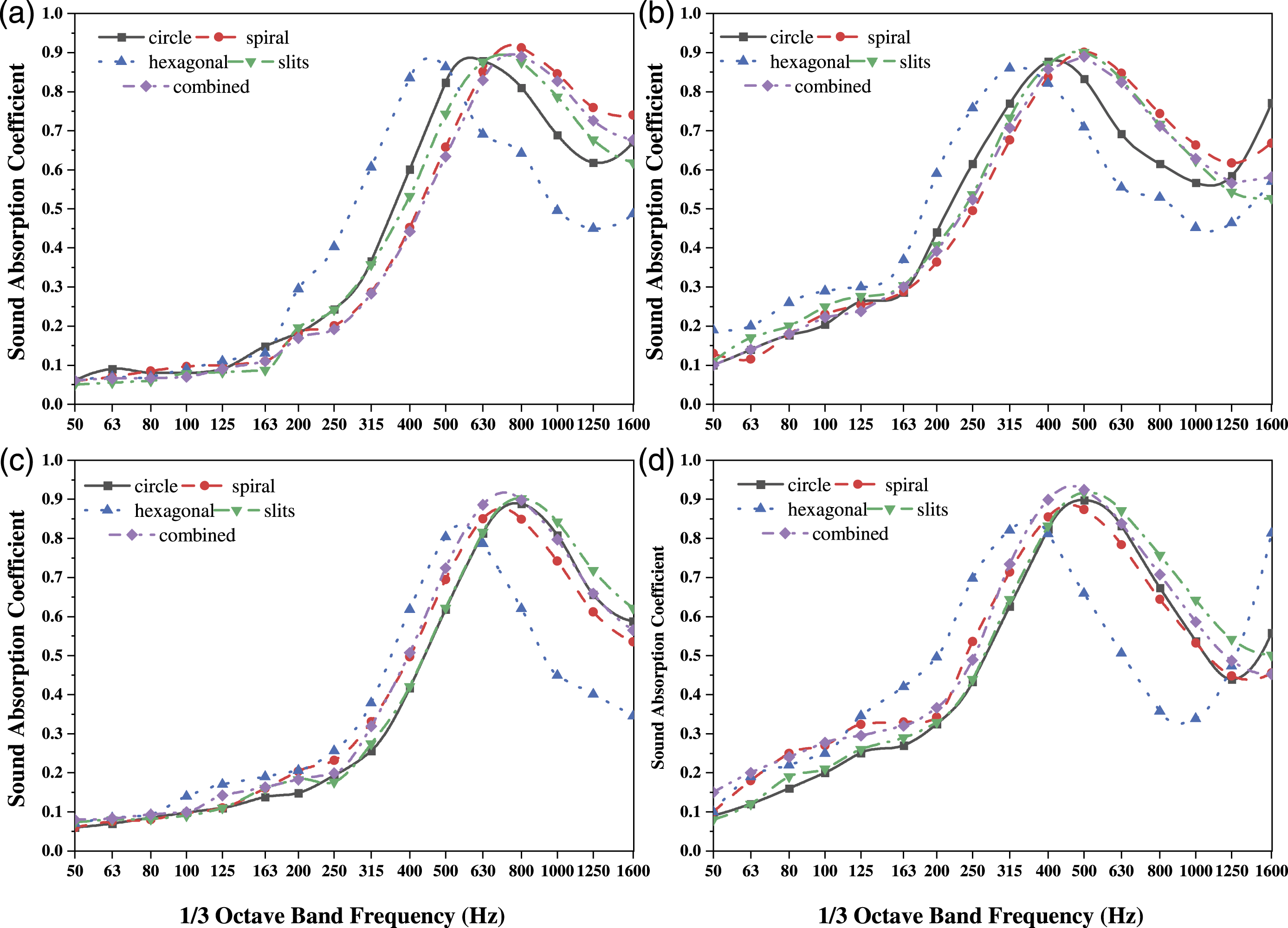
Sound absorption of multilayer sound absorber composed of Jute Type II (thickness 2 cm) - Configuration (1 and 2) and MPP- air cavity (2.5 and 5 cm)
The SAC curves for Jute type II of 2 cm thickness sample with various MPP shapes in Configuration one and air cavity of 2.5 cm were studied and their SAC curves are presented in Figure 7. It is clear from Figure 8(a) represents the SAC curves of sound absorption system based on air cavity of 2.5 cm (Config. I). Hence, similar sound absorption behavior was observed as indicated in similar system used in Jute type I. When the air cavity was changed to 5 cm in the same system configuration (1) and Jute thickness (2 cm), the of SAC was shifted to lower frequencies compared to air cavity 2.5 cm based system (Figures 8(a) and (b)) as indicated in all MPP shapes based sound absorption system as shown in Figure 8(b). This reflects the significant shift of sound absorption in the frequency of 250 Hz (Figure 8(b)). However, in configuration two and air cavity of 2.5 cm (MPP-Jute II-2.5 cm air cavity) the sound absorption behavior was shifted to higher frequency regions as depicted in Figure 8 (c). On contrast, when the air cavity was increased to 5 cm in configuration 2 (MPP-Jute II-5 cm air cavity) sound absorption and SAC peaks were shifted in lower frequency regions as shown in Figure 8 (d) compared to 2.5 cm air cavity (Figure 8 (c)). Sound absorption coefficient for Jute (2 cm) type II in (a) Config. I-2.5 cm air cavity, (b) Config. I-5 cm air cavity, (c) Config. II- 2.5 cm air cavity and (d) Config. II-5 cm air cavity.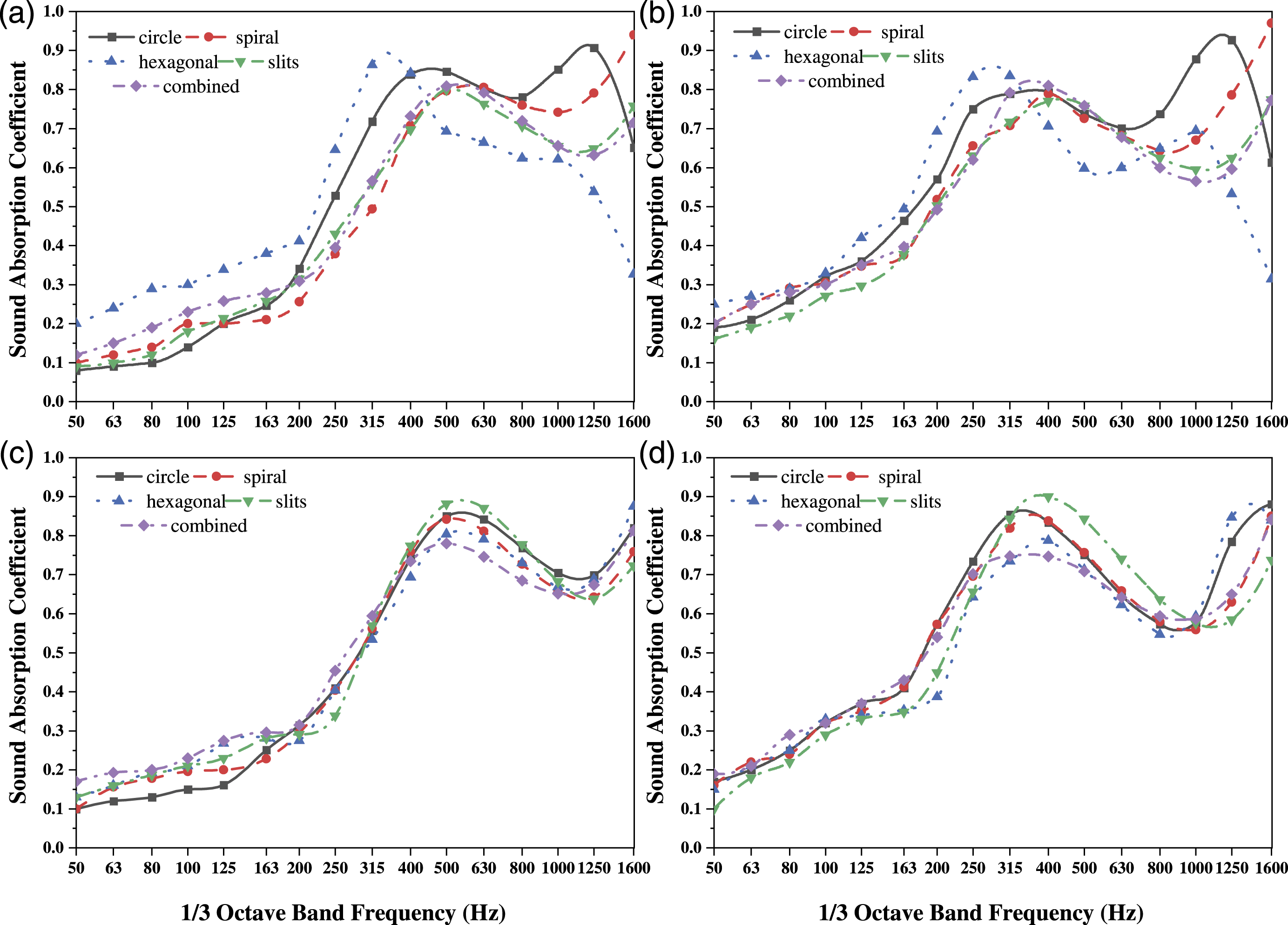
Figure 8 represents the increment in the SAC amplitude even at very low frequencies. As, it is clear that SAC begin at 0.2 or higher at 50 Hz especially when air cavity depth became 5 cm in both configurations one and 2. Also, we can observe that the SAC amplitude reaches 0.4 at 125 Hz especially for MPP of hexagonal shape in the multilayer. One of the important reasons for increasing the absorption amplitude is increasing the thickness of jute fabric in the multilayer system.
It is pertinent to note in this study, the new developed MPP-Jute I sound absorbing materials achieved superior SAC value at lower frequency region (≤200 Hz) compared to reported sound-absorbing materials.29,37 Additionally, the SAC recorded approximately 0.5 (50%) at very low frequencies at 125 and 160 Hz. However, lower frequencies such as 100 Hz may reach 0.3 to 0.4 especially when thickness of jute and depth of air cavity increased for multilayer based MPP of hexagonal shape. The highest SAC at different frequencies (Supplemental Table S1) indicates better performance of results observed when multilayer composite-based jute with MPP used compared to previous studies. Interestingly, it was found that the pore size of porous textile played a significant role for specifying the sound absorption range. Hence, in this study, the textile of lower pore size of 514 µm (Jute I) facilities the sound absorption in lower frequencies. Hence, our innovative sound absorbing material developed can be exploited for application in noisy house hold appliances like vacuum cleaner, dish washer, cloth dryer; in automobile like car door panel, engine partition, roofing and flooring; in architectural units such as ceiling, building partition and industrial use.
Conclusion
An innovative sound-absorbing system was developed as a solution for noise control problem over broader absorption bandwidth at very low frequencies. Hence, the influences of various parameters of MPP shape, the perforation ratio (∼≤ 1.05%), configuration, arrangement of two layers (MPP + porous), porous material thickness and air cavity thickness on the total sound absorption of the compound were studied. The results displayed low frequency sound absorption is primarily relied on MPP, but mid and high frequency sound absorption is primarily determined by porous materials, also, the MPP’s sound absorption bandwidth can be widened by adding the porous layer. Thus, excellent sound absorption coefficient results were achieved and jute thickness has a favorable influence on shifting absorption toward lower frequency with broad bandwidth, and SAC for jute was found to be the frequency range of 1000–1600 Hz. It was found that jute type I has better sound absorption especially at lower frequencies and has superior flame retardancy and tensile strength compared to jute II. Then, jute can be explored for various application presenting sustainable and safe sound absorbing material.
Supplemental Material
sj-pdf-1-jit-10.1177_15280837221098197 – Supplemental Material for Fabrication of cost-effective double layers composite for efficient sound-absorbing based on sustainable and flame-retardant jute fabrics
Supplemental Material, sj-pdf-1-jit-10.1177_15280837221098197 for Fabrication of cost-effective double layers composite for efficient sound-absorbing based on sustainable and flame-retardant jute fabrics by Tarek M El-Basheer, Amal A El Ebissy and Nour F Attia in Journal of Industrial Textiles
Footnotes
Declaration of conflicting interests
The author(s) declared no potential conflicts of interest with respect to the research, authorship, and/or publication of this article.
Funding
The author(s) received no financial support for the research, authorship, and/or publication of this article.

Supplemental Material
Supplemental material for this article is available online.
References
Supplementary Material
Please find the following supplemental material available below.
For Open Access articles published under a Creative Commons License, all supplemental material carries the same license as the article it is associated with.
For non-Open Access articles published, all supplemental material carries a non-exclusive license, and permission requests for re-use of supplemental material or any part of supplemental material shall be sent directly to the copyright owner as specified in the copyright notice associated with the article.
