




Abstract
The purpose of this study is to investigate the role of density and pile height on sound absorption coefficient in Double Base Persian (DBP) rug and possibility of prediction the acoustic behavior of DBP rug using the mathematical model. For this aim, in the first step, three double base rug samples were produced at different base densities (2, 4, and 6 warp yarn/cm) and the sound absorption coefficient of samples was measured with Impedance tube in two thicknesses (15 & 13 mm) to study the pile height effect. Moreover, the sound absorption of the double base zone was also measured by shaving off the pile from the double base rug samples. Three rug samples at different base densities were produced with very thin warp and weft yarns to avoid the base effect in this sample. Besides, the macroscopic empirical model (Johnson–Champoux–Allard (JCA)) was implemented on obtained data. The results showed that the sound absorption of the double base rug samples increases with increasing the pile height and base density. The role of the base zone in the sound absorption of the rug is bolder than the pile zone. What leads to improve the rug sound absorption by increasing density is increasing the sound absorption of base zone and the pile density changes do not play a major role in increasing the rug sound absorption. In addition, by assuming DBP rugs as a two-layer porous (pile + base zone) absorber, JCA model shows a good consistency with experimental data.
Keywords
Introduction
Noise pollution is an inevitable part of modern life due to the spread of urbanization and industry. Various methods for noise reduction are grouped into the passive and active mediums. The difference between these two methods is the necessity of applying external energy against sound waves for noise reduction process in the active mediums. Sound absorber and barriers are categorized in the passive mediums. Sound absorbers reduce noise by disseminating energy and turning it into heat. The ratio of absorbed sound energy to the incidence sound energy is called the sound absorption coefficient.1,2
Sound absorber materials include porous, panel, or resonant absorbers. In general, at high frequencies, the porous absorbers are more effective and at low frequencies panel and resonance absorbers.2–4 So far, various types of porous absorbers have been designed in different shapes such as textiles and composites with different materials including rock wool, recycled resources, foam, fibers and etc.5–7 It should be mentioned that the used fibers include synthetic, common and uncommon natural fibers such as Yucca Gloriosa, sugarcane bagasse and bamboo charcoal.8–10 In addition, the materials such as green olive leaves and lignocellulosic grape fiber can be used for this purpose ones.11–15
Generally, fibers are one of the most important porous materials in acoustic engineering. But they can only absorb sounds well at high frequencies. Many studies have been carried out to investigate the possibility of using fiber materials in low and medium frequencies, but because of need to increase in the weight and thickness of the common absorbers, these materials are usually not accepted in industry.
16
The rugs can be considered as good absorbers because of their high fiber contents and thicknesses. In this regard, rug has been considered as a desirable sound absorber for a long time. Among rugs, Persian ones shown in Figure 1 is one of the arts that shows the long history of Iranian art. Persian rug.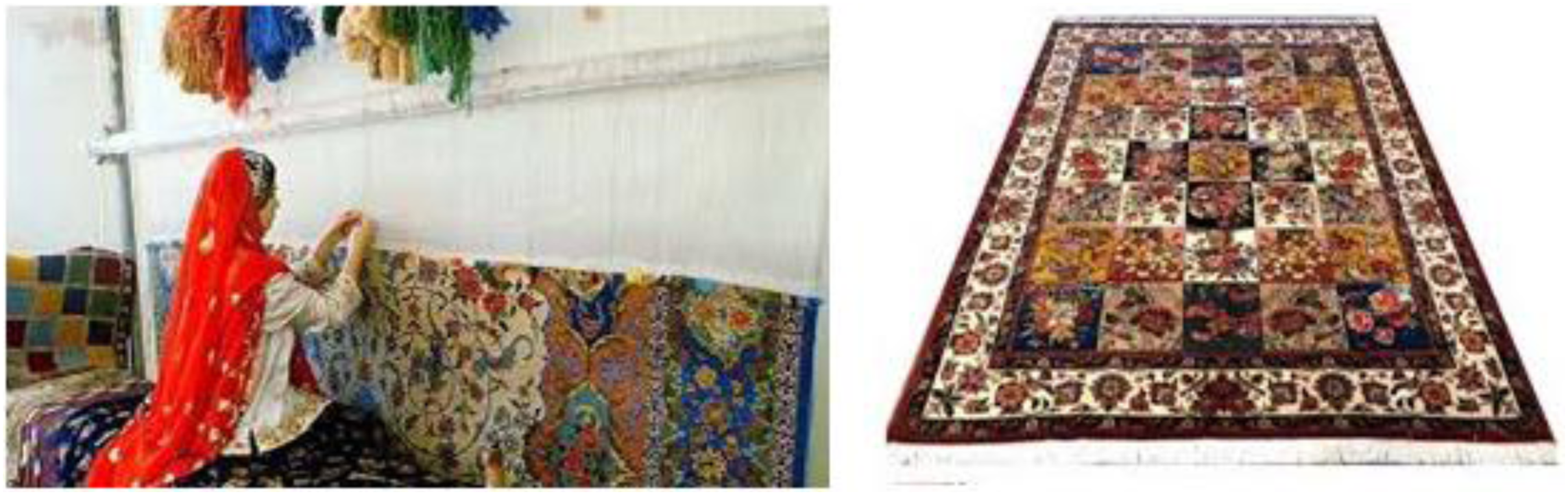
The oldest Persian rug samples found in the Sarab city in Iran shows the antiquity of Iranian rug weaving culture. 17 In additional, during excavations in 1949, the Persian hand-woven rug called Pazyryk was found in the mountains of Siberia. 18 Although historical documents of the presence of this art in 1524 are also available, this industry developed greatly with the growth of the global market by introducing Islamic Decorative Arts by holding the Crystal Pulse Exhibitions in London 1851 and the Vienna World’s Fair 1891. Of course, the increase in exports, designs, new patterns and colors introduced in response of global market demands helped to expand the rug industry. 19 After that, in the Safavi period (1722–1999), the remarkable creativity in rug making occurred in Iran, since then, there has been no significant change in the structure of Persian rugs. From this period, the most magnificent and prominent rugs of historical importance were created. In fact, about 1500 rugs from this period are kept in various museums and in private collections. Today, this valuable work of art is housed in the Victoria and Albert Museum in London. 18 Nowadays, the Persian rug remains a lasting and valuable symbol of cultural identity for all Iranians that represents a distinct and unique cultural product welcomed in a home décor universally. 19
The rug consists of two main parts, the base and the pile and most of the researches have been focused on the effect of the pile part. It is noteworthy that the rug base is a scaffold of warp and weft yarns, so that the pile yarns (generally made of wool or acrylic balks yarns) are tied to it which finally creates a three-dimensional plate. Since the base forms a large share of the rug body, it definitely has effects on the rug sound absorption. 20 Early studies on the rug sound absorption have been begun a few decades ago by Harris. 21 Since then, various rug factors have been studied to evaluate their effect on the sound absorption. The study of Nute and Slater 22 showed that the diameter and length of pile yarn in rug have some influences on sound transmission loss but pile density has no effect. According to the findings of the study by Shoshani and Wilding, 23 the sound absorption capacity of tufted rugs indicates different trends with increasing the pile height depending on frequency band, their study showed an increase in sound absorption with increasing pile density. In another research, Elkhateeb, Adas 24 investigated the effect of some factors on absorption characteristics of Masjid rugs. They demonstrated that increasing the density of the rug increases its absorption. The results of Küçük and Korkmaz 25 studies on the acrylic rugs sound absorption showed that density and length pile parameters affect the sound absorption properties at all frequency ranges. Recently, Celik 26 tested the effect of pile height on rugs, and their results showed that as the pile height increased, the sound absorption of the rug increased.
Based on these reviews, it can be concluded that the pile height and density are important factors in the rug sound absorption, although some studies have not showed the same results 23. Therefore, to study and find the effect of these two factors closely, it is necessary to examine them at the same time with a different approach.
On the other hand, in order to predict the sound propagation in a porous medium, several models based on Biot theory 27 have been proposed. The experimental and fast approximation models for obtaining the sound absorption coefficient using impedance characteristic and number of waves (related to airflow resistance of porous materials) are provided by authors such as Delany and Bazley, 28 Miki 29 and Garai and Pompoli. 30 Then phenomenological models such as Johnson–Champoux–Allard (JCA), 31 called JCA model, for more complex pore structures were proposed. Johnson–Champoux–Allard requires more non-acoustic elements and therefore has a higher accuracy, which makes it one of the most popular in acoustics field nowadays. It has been widely applied to various porous absorbers and indicates a very good agreement with experiment results.32–34 So far, to the best of authors’ knowledge no published scientific works have been conducted to addressing the effect of parameters in the rug sound absorption modeling.
The upper layer (pile part) exposed to the sound waves includes high porosity and the lower layer (base part) includes less porosity than pile part. The sound waves easily penetrate into the first layer and damping in the second layer with higher air flow resistivity. Therefore, the sound reflection from the rug is reduced. Furthermore, as mentioned earlier due to the rug covers a large area of the room and is a thick textile, it contains high weight and volume of fibers and can be considered as a potential sound absorber. The structure of Persian rug has not been changed for many years, but recently a new Persian rug with a double-base known as Double Base Persian (DBP) rug was introduced 35–37, and its mechanical properties such as feet feeling comfort, recovery, and compressibility were investigated. Obviously DBP rug due to new structure contains different properties in comparison with regular rugs which is needed to be investigated like acoustical properties.
Therefore, in this study, it has been tried to investigate the effect of base and pile density and pile height on the sound absorption of DBP rug with impedance tube and as well as modeling the sound absorption of samples using JCA model by obtaining acoustical parameters which explain later. It should be mentioned that modeling the rug sound absorption was accomplished by
Materials and methods
Materials and structure of rug samples
Specifications of the used yarns in the rug samples.

aFinal folded yarn count/ply number, Twist direction, T.P.M: twist per meter.
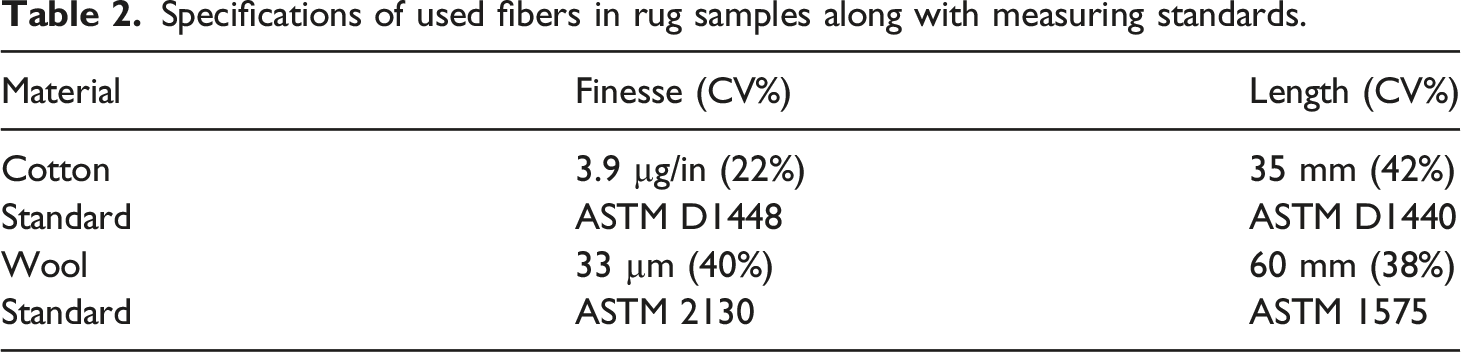
Specifications of used fibers in rug samples along with measuring standards.
Double Base Persian rug samples with different base structure were produced in such that the base warp yarns were divided into two groups and placed on two plates with a distance of 1 mm from each other as shown in Figure 2.
35
Spacer bar with 1 mm diameter is placed between two bases to ensure the distance of 1 mm between them (Figure 2). As a result, the thickness of the base in the new rug has been increased compared to the conventional one, which in turn it has increased the base specific volume and improved its mechanical properties. Schematic structure of DBP rug.
The difference between the new and conventional rug can be seen in Figure 3. As can be seen, generally, the body of rug is composed of two parts: Schematic structure of; a) conventional rug, b) DBP rug.
The base (back face of the rug) is placed on a hard surface (floor or wall) which made of woven yarns to create a scaffold for holding the pile yarns. The pile (the front face of the rug) is bulky yarns to give volume and thickness and creates a feeling of softness and comfort under the feet which is placed in front of the consumer.
To make a rug, a base is definitely needed, but to produce a rug in which only the role of pile can be evaluated, as much as possible the base was prepared with very fine yarns in different densities (6, 4, and 2 warp/cm) to hold the pile yarns as it can be seen in Figure 4. Rug sample with very thin yarns as the base on the production frame; front view (pile part).
Measurements
Airflow resistivity
One of the most important structural factors that characterize the sound absorption properties of porous absorbers is the airflow resistivity (σ in Ns/m4). It is the ratio of pressure gradient between the two sides of the porous sample that is created by passing a steady air stream of mean flow rate per unit area through a layer with specific thickness (in the airflow direction).
6
This parameter was measured using the direct airflow method according to ISO 9053 standard at the University of Bologna (Figure 5). Airflow resistivity meter (Acoustics laboratory of University of Bologna).
Porosity
Porosity (φ) is a dimensionless factor influencing the acoustic properties of porous materials. It is the volume ratio of a porous material occupied by the air phase.
6
It is measured in textile materials according to equation (1)


Tortuosity
Tortuosity (α ∞ ) is a dimensionless parameter that represents the ratio of the direct path (sample thickness) to the apparent way which the air has to pass to move from one side to another side of sample. 4
The tortuosity of samples was measured with the ultrasonic tortuosity meter (in the Acoustics laboratory at the University of Ferrara (Figure 6). In this device, an electrical pulse is sent to the emitter and it turns out to an ultrasonic wave that propagates in air. After it has passed through the sample another transducer receives this wave. The sample between transducer and receiver in the device causes changes in direction and magnitude of the fluid microscopic velocity. Finally, it is possible to calculate the amount of these changes and thus the amount of tortuosity by comparing the measurement results of the device in with and without the sample.
38
Ultrasonic tortuosity meter (in the Acoustics laboratory at the University of Ferrara).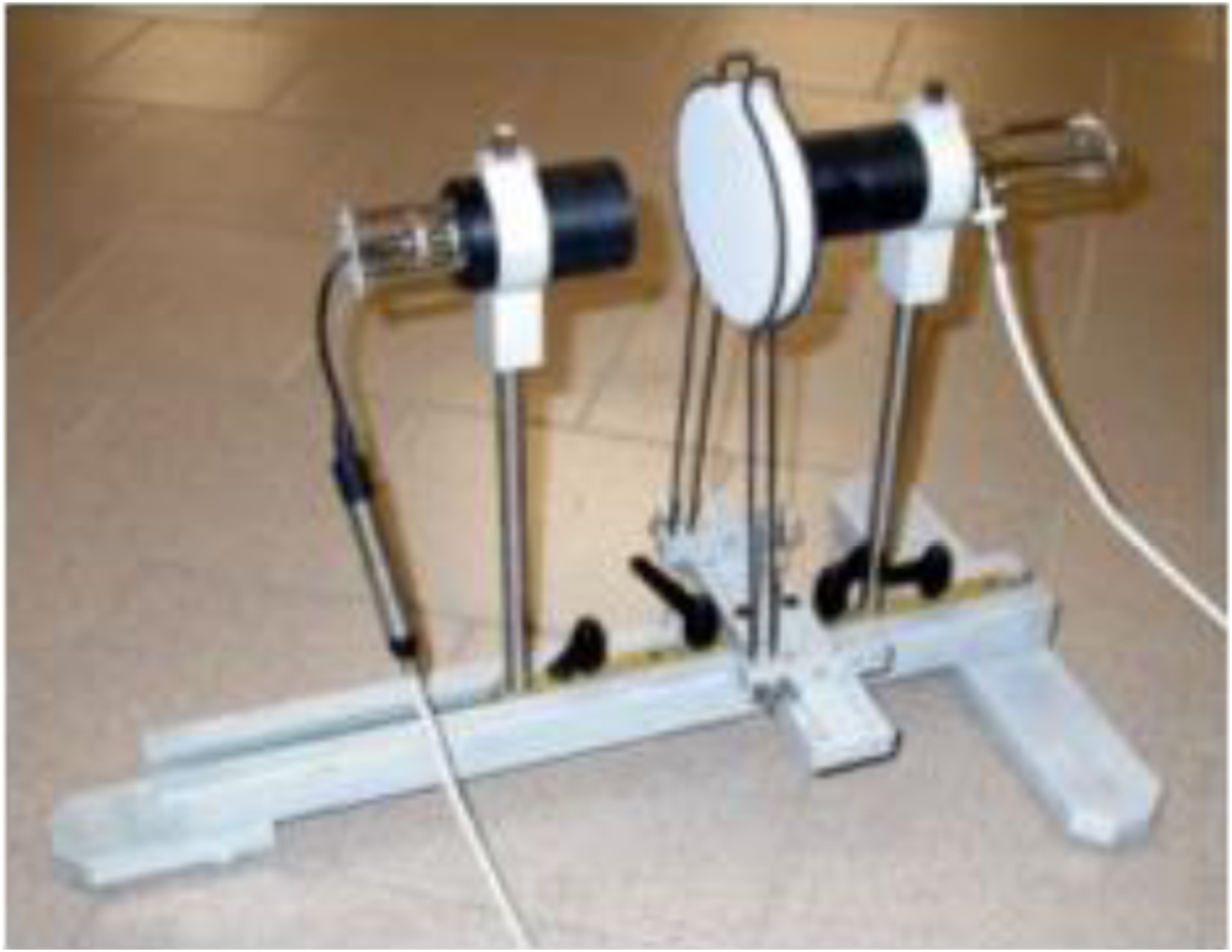
Viscous and thermal characteristic lengths
Other factors used for sound absorption modeling that describe the viscous and thermal effects in the pores of porous absorber are the viscous and thermal characteristic lengths (Λ and Λ' in µm). 32 These two factors are often evaluated with using an inversion approach for absorbers having a complex pore shape.31,39 In this study, these factors were calculated using inversion method by curve fitting of theoretical modeling on the experimental data.
Sound absorption coefficient
Normal sound absorption coefficient 100 mm impedance tube in the Acoustics laboratory at the University of Bologna; SA = 0.0700, SB = 0.1750, L = 0.775, m = 0.400 m and A for 245–1991 Hz and B for 98–883 Hz.
The thickness of rug samples were measured at the pressure of 5 g/cm2.
Acoustic absorption modeling
Johnson–Champoux–Allard model
Johnson–Champoux–Allard is phenomenological model which has five physical parameters as inputs for modeling sound absorption including φ, σ, α
∞
,
In this model with employing equations (4) and (5), the effective density (ρ(ω)) and bulk modulus (K(ω)) can be calculated

The surface acoustic impedance Z
s
can be calculated by equation (8) using the characteristic impedance (Z
c
(ω)) and the characteristic wave number Kc as follows


When an absorber is in two layers in order to model the surface impedance of this structure it is needed to evaluate the characteristic impedance of different layers separately according to Figure 8 and equation (11)
3
Schematic of two-layer system of DBP rug.
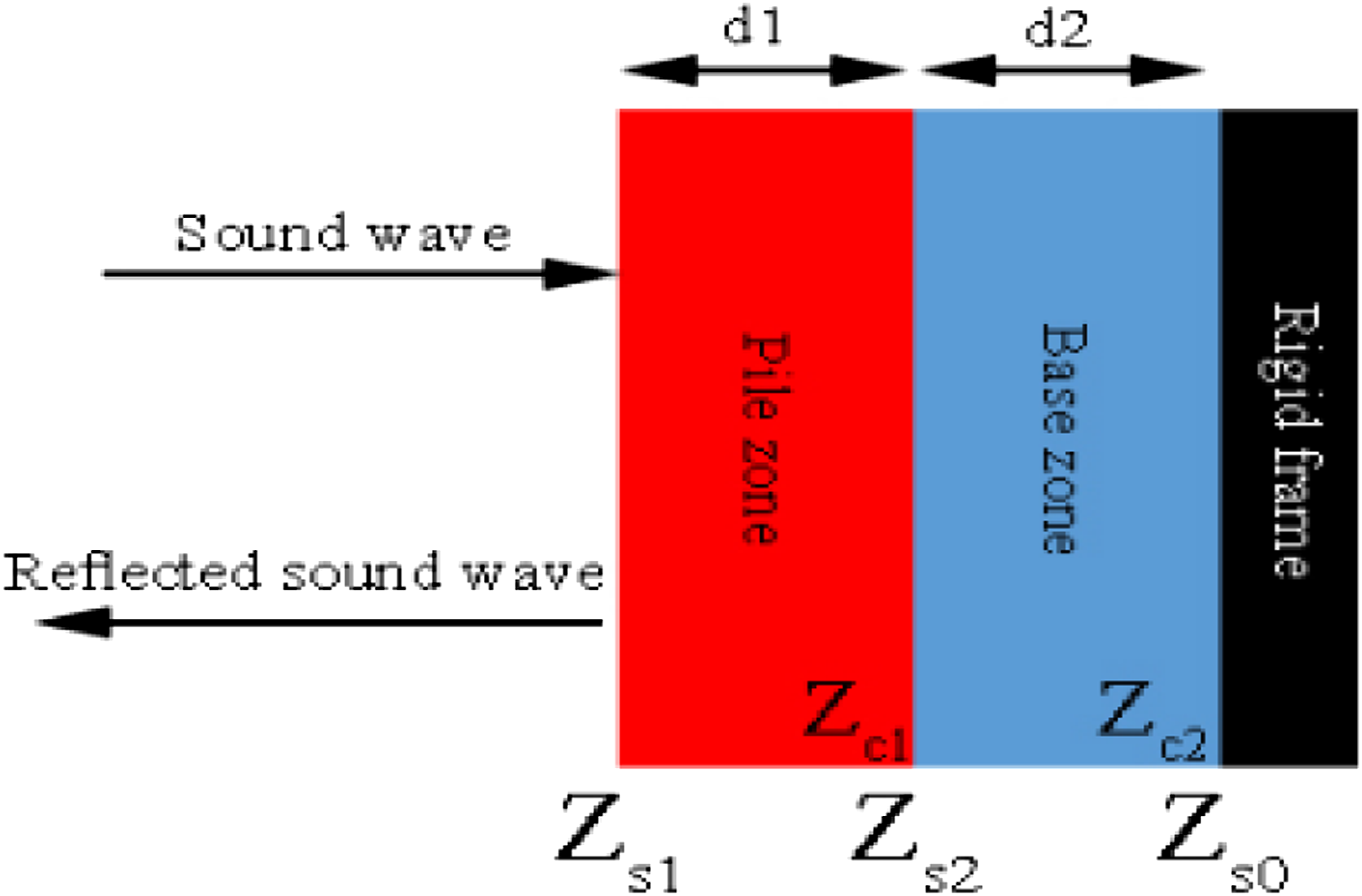
Initially, it is necessary to calculate the absorption coefficient of the second layer (sample with shaved pile or base layer) in order to find the surface acoustic impedance of base layer (Zs2). Then the characteristic impedance of first layer (Zc1 for pile zone) must be found to calculate the surface acoustic impedance of total sample (Zs,total) to finally obtain the total absorption of the rug according to equation (11).
Results and discussion
In this study, the sound absorption values of the DBP rug samples at different densities and pile heights were calculated using the impedance tube system. For better understanding the effect of mentioned factors on rug sound absorption, the pile and base parts have been investigated separately. In other words, by removing the pile from the samples, the effect of base density on the sound absorption of rug was tested and also by producing samples with negligible base (base with very thin yarns), the effect of pile density and pile length on the rug sound absorption has also been investigated. Additionally, the sound absorption of the samples were predicted using the JCA model and compared with the experimental data at different frequencies.
Effect of pile height and density on double base rug
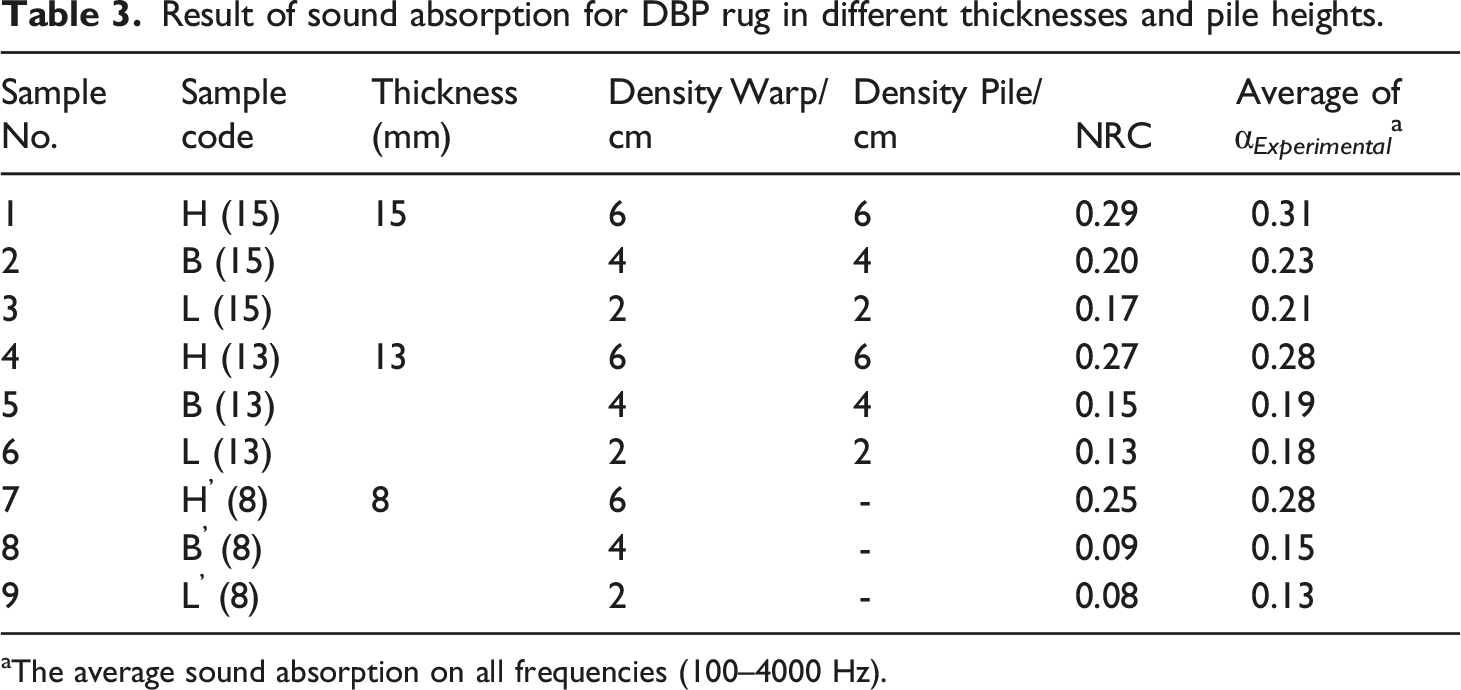
In this study, three double base rug samples in different densities (2, 4, & 6 warp/cm) with 15 mm thickness (pile thickness was 7 mm) were produced and their sound absorption coefficient was measured to investigate the pile height and density effects. In the next step, after shaving 2 mm of pile from the rug samples, the samples with 13 mm thickness (pile thickness was 5 mm) were tested again. It should be mentioned that 2 mm was selected regarding the available equipment and shortening all piles evenly. Then all piles were shaved from samples and the base with 8 mm thickness (pile thickness was 0 mm) were tested. Figure 9 and Table 3 show the test results for each sample in three thicknesses. In Table 3, The Noise Reduction Coefficient (NRC) is the average value of α in 250, 500, 1000, and 2000 Hz octave bands. The samples with pile are labeled H, B, and L corresponding to density of 6, 4, and 2 warp/cm, respectively. The same samples without pile (base only) are labeled as H’, B’, and L’. Effect of pile height on sound absorption coefficient of samples with different densities; a) 6 warp/cm, b) 4 warp/cm and c) 2 warp/cm. Result of sound absorption for DBP rug in different thicknesses and pile heights. aThe average sound absorption on all frequencies (100–4000 Hz).
Result of two-way analysis of variance for pile height and density factors on the DBP rug sound absorption.

aR-Squared = 1.00 (Adjusted R-Squared = 1.00).
The result of Tukey test for the density levels on the DBP rug sound absorption.

Means for groups in homogeneous subsets are displayed. Based on observed means. The error term is Mean Square (Error) = 5.83E-007.
The result of Tukey test for the thickness levels on the DBP rug sound absorption.

Means for groups in homogeneous subsets are displayed. Based on observed means. The error term is Mean Square (Error) = 5.83E-007.
Effect of pile height and density on sound absorption for samples with very thin base
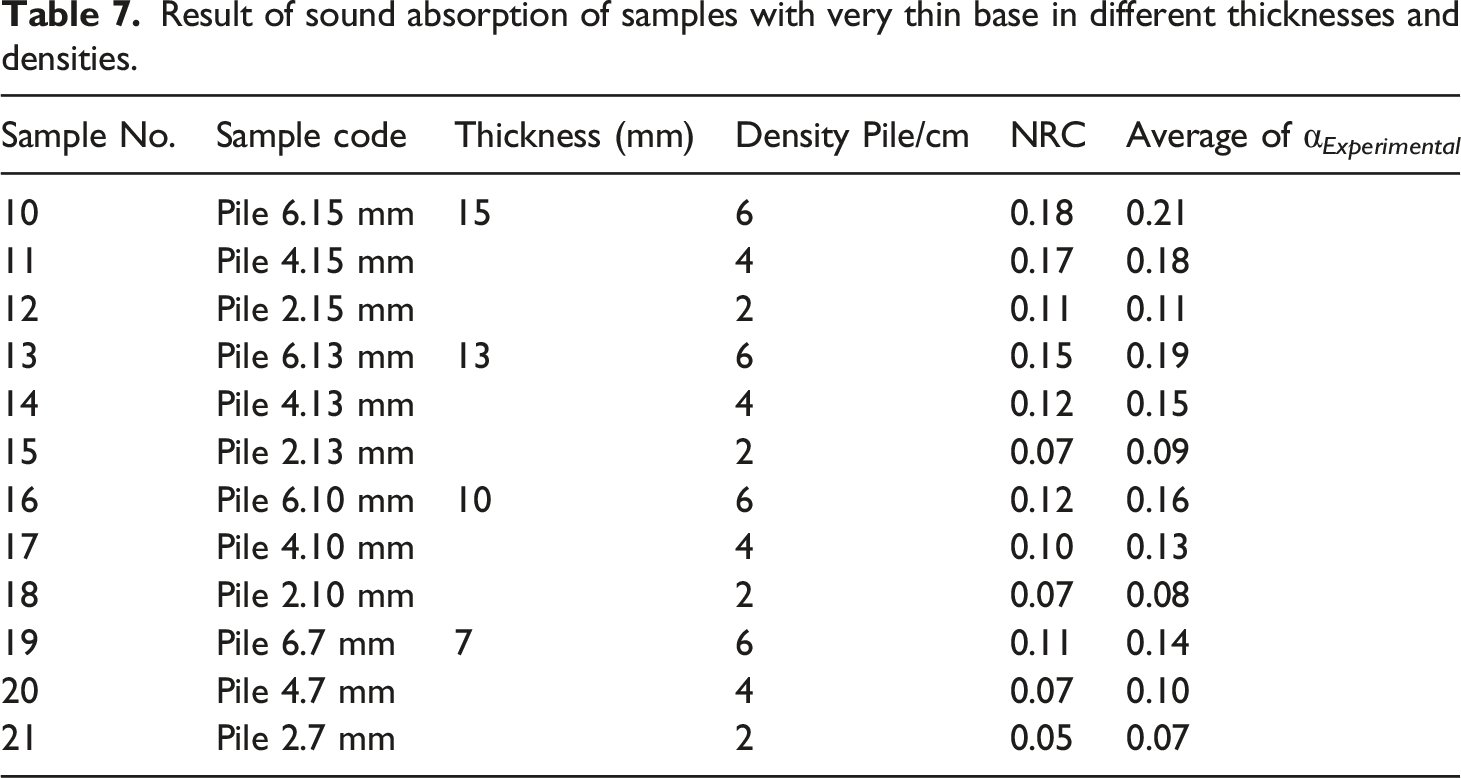
Due to the pile density changes with base density variations, it was necessary to examine the pile zone separately by removing the base. For this purpose, three samples in density of 2, 4, and 6 warp/cm were produced with a very thin yarns to create a scaffold in order to only hold the pile yarns. So, the acoustic influence of base zone in these samples was assumed to be negligible because. These samples were tested in four different thicknesses to investigate the effect of pile density and height on sound absorption and the results are shown in Figure 10 and Table 7. Effect of pile height and density on sound absorption coefficient of samples with very thin bases; a) thickness 15 mm, b) thickness 13 mm, c) thickness 10 mm, d) thickness 7 mm. Result of sound absorption of samples with very thin base in different thicknesses and densities.
Results of two-way variance analysis to investigate the effect of pile density and height factors on sound absorption of samples with very thin base.

a R-Squared = 1.00 (Adjusted R-Squared = 1.00).
The result of Tukey test for the density levels on sound absorption of samples with very thin bas.

Means for groups in homogeneous subsets are displayed. Based on observed means. The error term is Mean Square (Error) = 2.67E-007.
The result of Tukey test for the thickness levels on sound absorption of samples with very thin bas.

Means for groups in homogeneous subsets are displayed. Based on observed means. The error term is Mean Square (Error) = 2.67E-007.
As a matter of fact, the pile part has a more open structure than base and consequently shows less air flow resistance. Moreover, in all samples the volume in base part is more than pile, so pile part damps less energy of sound waves. However, with increasing pile density and height, the amount of fibers increases that are exposed to sound waves which leads to more conversion of sound energy into heat. Moreover, the effect of increasing pile height is revealed when the pile density presents a sufficient compact structure. This is due to the fact that in the low density, regardless of pile height there is extra space for sound waves to pass through the piles, but by increasing pile density a more compact structure is produced and consequently the sound waves have more contact with piles (Table 7).
Separating the density effect on the base and pile of double base rug
NRC of DBP rug.

*NRCbase + NRCpile.

In Table 11, comparing the NRC values of the DBP rug with the sum of the base and pile zones revealed that the equation (12) is almost acceptable. Another point that can be deduced from Table 11 is that the share of sound absorbed by the base is always greater than the sound absorbed by the pile. As a result, according to equation (12) and Figure 10(d), it is possible to display the sound absorption of the double base rug with a thickness of 15 mm along with the sound absorption of the base and pile at different frequencies in Figure 11. Separation of the base and pile shares from sound absorption coefficient of DBP rug in different densities according to equation (12); a) 6 warp/cm, b) 4 warp/cm, c) 2 warp/cm.
As can be seen in Figure 11, and what mentioned earlier, the new rug base has a significant share in sound absorption. This is because it contains a larger share of the rug and has a denser structure than the pile part, which leads to more air flow resistivity. Density is also an effective factor in the base sound absorption; the more open base structure, the more free air can transmit the sound. In the case of pile zone, with increasing density from 2 to 4, an increase in the sound absorption is observed, but more pile density does not play a major role in increasing the sound absorption. In other words, what improves the sound absorption of DBP rug by increasing density is an increase in the sound absorption of base zone and variations in the pile density does not play a major role.
Sound absorption modeling
The JCA model has five input parameters and high accuracy; therefore, this model has been used in this study. It was assumed that the DBP rug samples to be a two-layer absorber, while the pile zone has the different structure from base zone. In order to model the samples as a two-layer absorber according to the Figure 8 and equation (11), at first modeling was performed for the second layer (sample without pile). All modeling operations were done using MATLAB software R2016a.
Modeling of base layer (sample without pile)

Acoustical parameters of samples without pile (8 mm).


Experimental data (dotted line) and predicted values by JCA model (solid line) for samples with different densities and 8 mm thickness.
As can be seen in Table 12, airflow resistance and tortuosity are increased with increasing density. This means that in the face of a denser structure, sound waves must not only travel in a more tortuous path, but also collide with more fibers which convert the sound energy into heat.
As Figure 12 shows, the JCA model can be used to model the base zone of DBP rugs. As matter of fact, the JCA model substitutes the rug base with an “equivalent fluid,” but in the case of high-density sample which is very heterogeneous, the results do not show a very good agreement with experimental data. So. in order to better fit for this sample and as a solution, the amount of porosity is considered slightly higher than what was measured experimentally. In this study the value of 0.79 was considered in this case. This value is obtained by a set of trials in modeling to achieve the best model fit (the lowest RMSE) with experimental results. It is noteworthy to mention that without that assumption to predict sound absorption of high-density samples, a more complex model needs to be investigated. Thus, Zs2 (the surface acoustic impedance for base layer) was calculated for the second layer according to equations (4) to (8). Afterwards, to calculate the two factors K1 and Zc1 for another layer in equation (11), it is needed to model the pile zone.
Modeling of pile layer (sample with very thin base)
Acoustical parameters of pile samples (7 mm).

As Figure 13 shows, the JCA model adapts well to experimental data for all densities. Thus, by placing the values K1 and Zc1, obtained using equations (6) and (7), in equation (11) the sound absorption of the complete rug (pile + base) can be calculated. Experimental data (dotted line) and predicted values by JCA model (solid line) for pile sample with different densities and 7 mm thickness.
Modeling of DBP rug sample
A. DBP rug with 15 mm thickness (7 mm pile height)
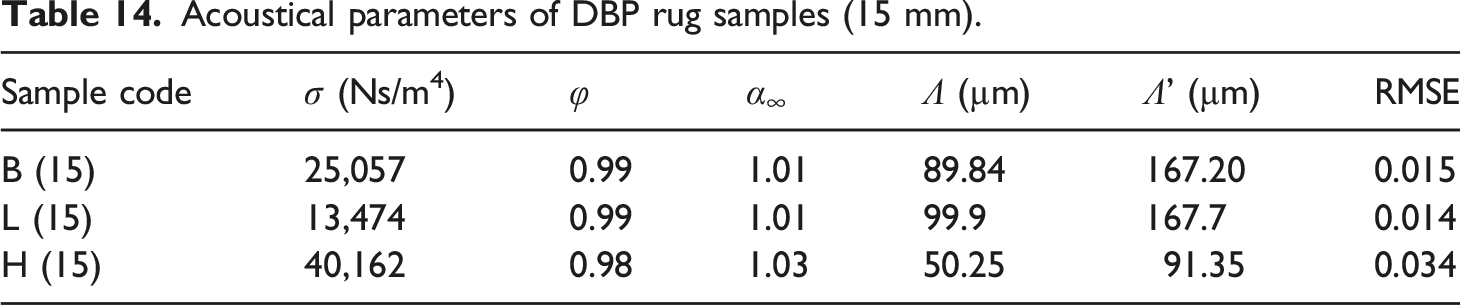
Acoustical parameters of DBP rug samples (15 mm).

Flowchart of modeling procedure for the sound absorption of two-layer rug samples.

Experimental data (dotted line) and predicted values by JCA model (solid line) for DBP sample with different densities and 15 mm thickness.
As Figure 15 shows the JCA model fits the experimental data of DBP rugs quite well.
Double Base Persian rug with 13 mm thickness (5 mm pile height)
In this section, those DBP rug samples were modeled with 5 mm of pile. The comparison of the results with the experimental values can be seen in Figure 16 and five factors of the pile zone were obtained using the inverse method, which is shown in Table 15. Experimental data (dotted line) and predicted values by JCA model (solid line) for DBP sample with different density and 13 mm thickness. Acoustical parameters of DBP rug samples (13 mm).
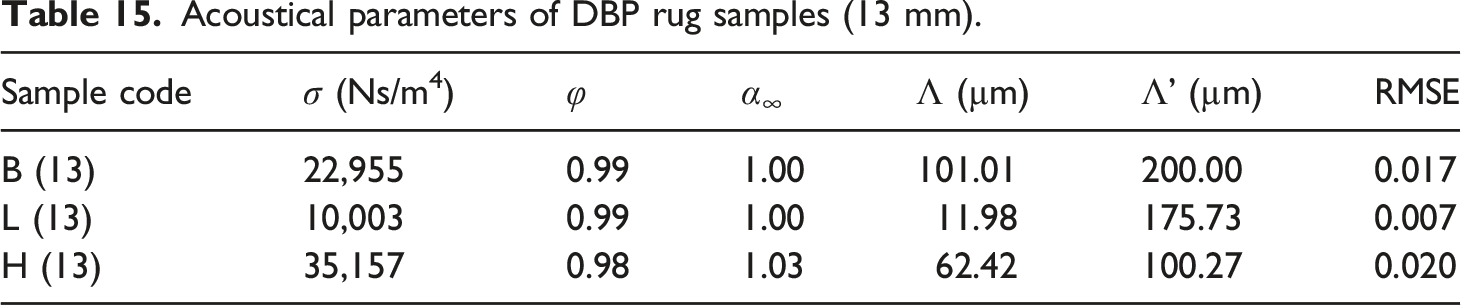
As can be seen from Figure 16, the model fits the experimental data quite well on the whole frequency range of the measured values. In addition, since the base factors are the same in both DBP rugs with 15 and 13 mm thickness (data in Table 12), a comparison of Tables 14 and 15 shows a decrease in airflow resistance with decrease in pile height (from 7 mm pile height (DBP rug with 15 mm thickness) to 5 mm pile height (DBP rug with 13 mm thickness)).
This increase in airflow resistance with increasing pile height indicates the effect of this factor on increasing sound absorption and it converts more sound energy into heat. Other points can be seen in Tables 14 and 15 are that for high density sample with very thin base, the tortuosity increases and porosity decreases. Therefore, the sound faces more obstacles to lose its energy when incidents with this sample, resulting in higher sound absorption.
Conclusion
In this study, three double base rug samples with different densities were prepared and their sound absorptions was measured in two different thicknesses in order to study the effect of pile height and density on sound absorption. Moreover, shaved and very thin base samples were studied. Finally, the JCA model was used to predict the sound absorption of the samples assuming that DBP rug is a two-layer absorber (pile + base). The results revealed that the sound absorption of all samples raises nonlinearly with increase in frequency and the sound absorption of DBP rug raises as the pile height and the base density increase, moreover there is an interaction effect between these two factors. Also, the sound absorption of samples with very thin base raises as the density and height of pile increase and there is an interaction effect between these two factors, too. The rug base has a greater share in the sound absorption of DBP rug and what improves the sound absorption is increasing the sound absorption in the base and changes in the pile density do not play a major role. Finally, the results of this study showed that the sound absorption coefficient of DBP rugs with different densities and thicknesses can be predicted with a quite good accuracy with a two-layer acoustical JCA model based on the five parameters. In order to obtain higher accuracy in predicting sound absorption in a high-density sample, a more complex model must be considered.
Footnotes
Acknowledgements
This work was done while one of the authors (T.A.) was visiting researcher at the Applied Acoustics Laboratory of the University of Bologna. She gratefully acknowledges the assistance of Luca Barbaresi, Paolo Guidorzi and Matteo Cingolani in performing the experimental work and also Paolo Bonfiglio and Cristina Marescotti of University of Ferrara for the tortuosity measurements.
Declaration of conflicting interests
The author(s) declared no potential conflicts of interest with respect to the research, authorship, and/or publication of this article.
Funding
The author(s) received no financial support for the research, authorship, and/or publication of this article.
