




Abstract
This paper investigates the influence of thread stitching on the ballistic performance of plain weaves made of ultra-high-molecular-weight polyethylene multi-filament yarns. The inter-yarn friction is increased due to the constraint imparted by the sewing thread. The yarn pull-out test shows that the peak-load force of the sample with one stitching line is almost 10 times greater than that of the unstitched plain weave, and the maximum pull-out force increases with the loading rate. Ball-bearing impact tests are performed to characterize the ballistic performance of the stitched and the unstitched samples, and finite element simulation is used to study the underlying mechanisms of energy absorption. The ballistic penetration tests show that the stitched fabrics outperform the plain weave in terms of energy absorption. The most significant improvement in ballistic performance is observed in stitched panels where sample SL2T (a triple-ply plain fabric system stitched on every two yarns) exhibits a specific energy absorption over two times greater than that of multi-ply systems consisting of plain weaves. It is also found from the high-speed photography that thread stitching constrains the yarn displacement and therefore eliminates the possibility of yarn pull-out, enabling the primary yarns to be well-engaged with the projectile at low impact velocities and to be stretched to fail at high impact velocities. Numerical predictions show that thread stitching enlarges the area of stress distribution and widens the transverse deflection, making the stitched systems absorb more energy than the unstitched system shortly after impact.
Introduction
Strong, low-density fibers have been favored materials for impact load-bearing applications.1–3 Among the limited choices, ultra-high-molecular-weight polyethylene (UHMWPE) is one of the most successfully commercialized and developed fibers for designing protective systems that are flexible and lightweight. For ballistic applications, these fibers are mainly used in the form of cross-plied continuous filaments laminated by a soft matrix. The filament reinforcement serves as the load-bearing constituent, and the matrix acts as a load transfer medium to constrain the filament mobility and improve dimensional stability. There is no shortage of publications studying the impact responses of cross-plied UHMWPE laminates. Most of these researches focused on commercially available products such as Dyneema®HB26, Dyneema®HB210, and Dyneema®HB80.4–8 Apart from the cross-plied laminates, the ballistic performance of needle-punched non-wovens was also investigated. Martínez-Hergueta et al. found that the ballistic limit of the needle-punched Dyneema®SK 75 non-woven fabric is dependent on the fiber orientation. A more isotropic structure led to a more significant increase in ballistic limit and energy absorption capability. The performance deteriorated when the fibers were more oriented in the system. 9
In comparison with non-woven laminates and needle-punched fabrics, flexible woven fabrics have attracted much less attention. Zhou et al. found that penetration is mainly accommodated by yarn pull-out and windowing due to the low yarn-yarn friction and projectile-fabric friction of UHMWPE woven fabrics.10,11 It follows that producing appreciable friction between the fabric-forming yarns might prove beneficial for the energy absorption capability. The simplest method of increasing inter-yarn friction is to weave tight fabrics. Nevertheless, the performance of tightly woven fabrics deteriorates due to the increased crimp ratio. This is because that the propagation of the transverse wave is slowed by yarn undulation and the direction of loading force is not normal to the fiber axis, leading to a lower ballistic limit 12 and reduced energy absorption capability. 13 Chu et al. attempted to use the plasma-enhanced chemical vapor deposition technique to increase the yarn–yarn friction. The results showed that the static friction was improved from 0.12 to 0.23, and kinetic friction rose from 0.11 to 0.19. 14 Hasanzadeh et al. impregnated the UHMWPE fabrics with shear-thickening fluids (STFs) composed of fumed silica nanoparticles suspended in polyethylene glycol. The ballistic results confirmed the improved impact resistance of the treated fabrics and the contribution of frictional properties induced by STF impregnation in restriction of the yarns within the fabric. 15 Wang et al. treated the fabrics with four different resin matrices and found that composites having flexible matrices performed much better in perforation resistance and energy absorption than those using rigid matrices. This is because that more rigid matrix restrained the laminate’s transverse deformation to a smaller area, resulting in a more localized strain area. 16 Zhou et al. incorporated leno structures into the plain weave. This combination demonstrated an increase in yarn pull-out force but was insufficient to provide a noticeable improvement in ballistic performance. 17 Some researchers used thread stitching to improve inter-ply reinforcement.18–21 Zhou et al. used thread stitching to increase the yarn-yarn friction of aramid fabrics, and the results suggested a significant improvement in energy absorption capability upon ballistic impact. 22 The main limitation of Zhou et al.’s work is that the experiments were performed in the vicinity of the ballistic limits only. In addition, the responses of the other types of stitched high-performance fiber assemblies upon ballistic impacts are still unknown. Since it has been demonstrated that thread stitching provides an appreciable increase in the energy absorption capability of the Kevlar plain weaves, it is interesting to put another commercially available material, UHMWPE fabric, as a subject of study over a range of impact velocities from the ballistic limits to 400 m/s. In this paper, the responses of stitched UHMWPE plain weave upon ballistic impact will be studied using a gas gun and high-speed photography. The finite element (FE) method will be used to investigate the underlying mechanism of the energy dissipation process. This work aims to improve the ballistic performance of UHMWPE plain weave and explore the possibility of using dry woven UHMWPE fabrics for the engineering design of flexible protective systems.
Material and methods
Materials
The plain fabrics were made of Tekmilon®multi-filament yarns, which were provided by Mitsui & Co. LTD. The UHMWPE mono-filament has a yield stress of 3.88 GPa, a longitudinal modulus of 135 GPa, and a transverse modulus of 1.34 GPa. The filament is 17.2 μm in diameter and 145°C in melting temperature. All of the fabrics have the same thread density and yarn linear density of 9 threads/cm and 1300 dtex, respectively. The plain weaves were flat-stitched on both of the warp and weft directions using a cotton sewing thread on an automatic embroidery machine (Figure 1(a) (a) Embroidery machine used to stitch the plain weaves; (b) plain weave with Stitching lines on every four yarns (SL4S). Yarn and sewing thread specifications. Fabric specifications.


Testing methods
The stiffness of fabric and yarn pull-out tests
Stiffness was tested to characterize the influence of thread stitching on fabric softness. This test was performed according to the standard of ASTM D1388-18 (cantilever method). Yarn pull-out tests were performed to characterize the influence of stitching on the frictional force between the fabric-forming yarns. Schematic diagrams of the yarn pull-out method are shown in Figure 2(a). Samples with zero, one, two, and three stitching lines 2 (b) were put into tests. Sample targets were cut into 6 × 12 cm. The length of the fabric zone is 6 cm. Yarn tails were left on the top (5 cm) and bottom (1 cm) sides. A slot was maintained for the very yarn to be pulled out on the bottom while the rest of the tails were clamped by a bottom jaw. Tests were performed at constant rates of 50 mm/min, 250 mm/min, and 500 mm/min, respectively. (a) A schematic diagram of the yarn pull-out test (b) Samples with a different number of stitching lines.
Ballistic test
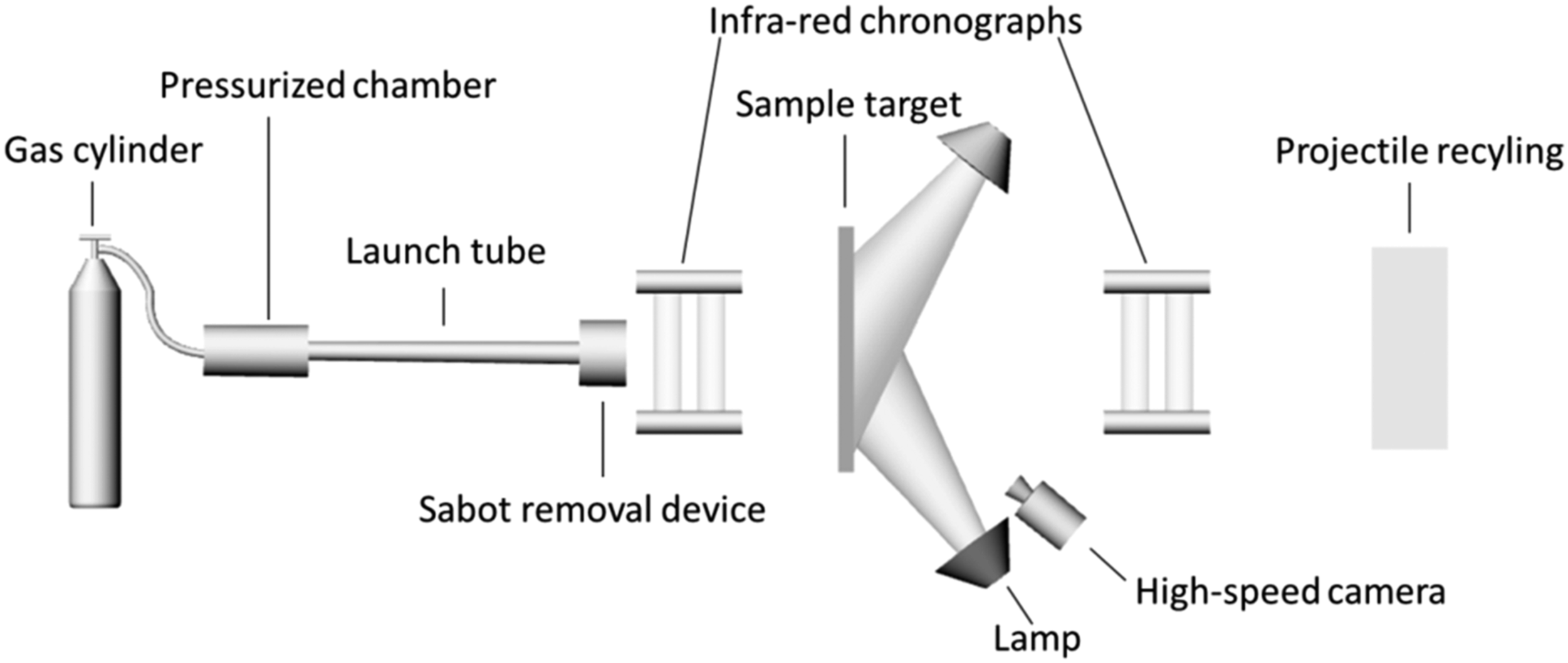
The ballistic tests were performed on a set-up shown in Figure 3. In this ballistic apparatus, the spherical steel projectile in use is 2 g in weight and 8 mm in diameter. The projectile is propelled by compressed gas, and the impact velocity varies with the range of 0∼400 m/s. The impact and the residual velocities of the projectile were obtained by using two sets of infrared chronographs. The energy loss of the projectile can be determined by (a) A schematic diagram of the set-up for the penetration test, (b) Ballistic apparatus.
A corner-clamped frame was designed to clamp the sample target (Figure 4). In this frame, the fabric was gripped at its corners to allow yarn pull-out during the ballistic event. Fixing bolts were through-bolted with the backplate and fastened by screw nuts. The resistance against yarn pull-out arises solely from the frictional force at the crossovers and the stitching lines. The sample was cut into 25 × 25 cm to fit the size of the frames. Both of the single-ply and triple-ply fabric systems were clamped on this set-up. Schematic diagram and photographs of the corner-clamped frame.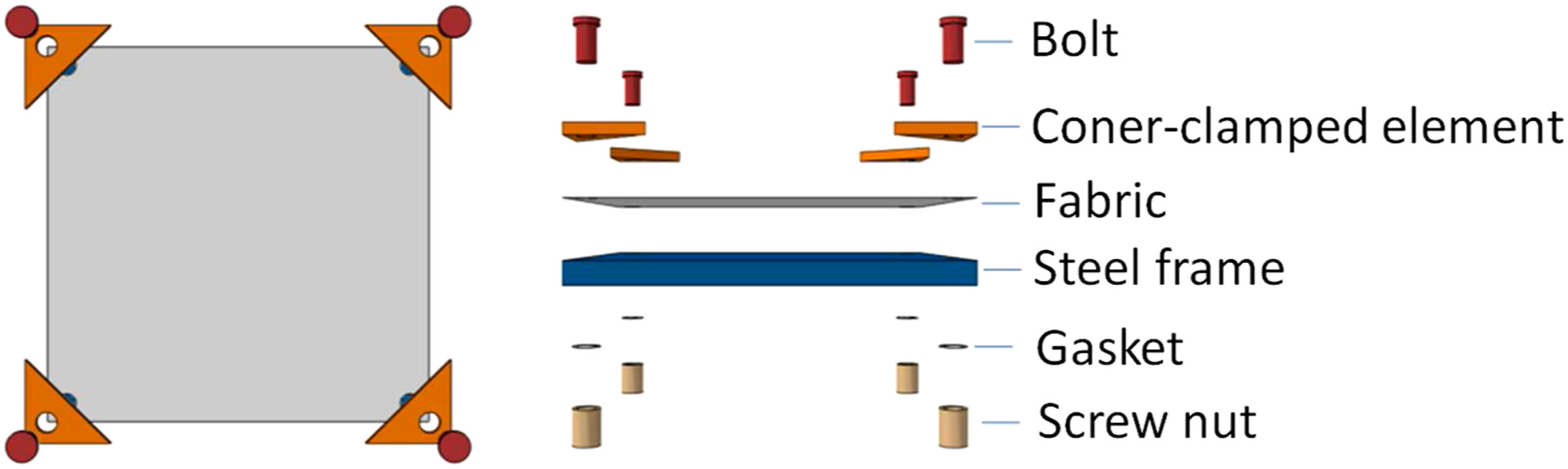
Finite element model
Commercial FE software ABAQUS® 6.14 was used to model the ballistic event on fabric samples, aiming to study the mechanism of energy absorption evolution and stress distribution of different fabric systems. In this research, FE simulation is limited to colliding between a projectile of rigid material and single-ply PW and SL2S at impact velocities of 160 m/s and 400 m/s, respectively. The projectile model is spherical, with the diameter being 8 mm, and the mass of the projectile being 2 g, identical to the real projectile used for the penetration tests. Fabrics were simulated at the yarn level to construct a plain weave of 125 × 125 mm. The warp and weft yarns were modeled as 3D solid geometry with cross-sections and crimps according to their corresponding fabric sett. The yarn cross-section is considered to be lenticular23,24 and is defined by two arcs having radii r. According to Equation (2), the parameter r can be calculated from the width w (0.985mm) and height h (0.16mm) in Figure 5. A schematic diagram of the lenticular yarn cross-section.
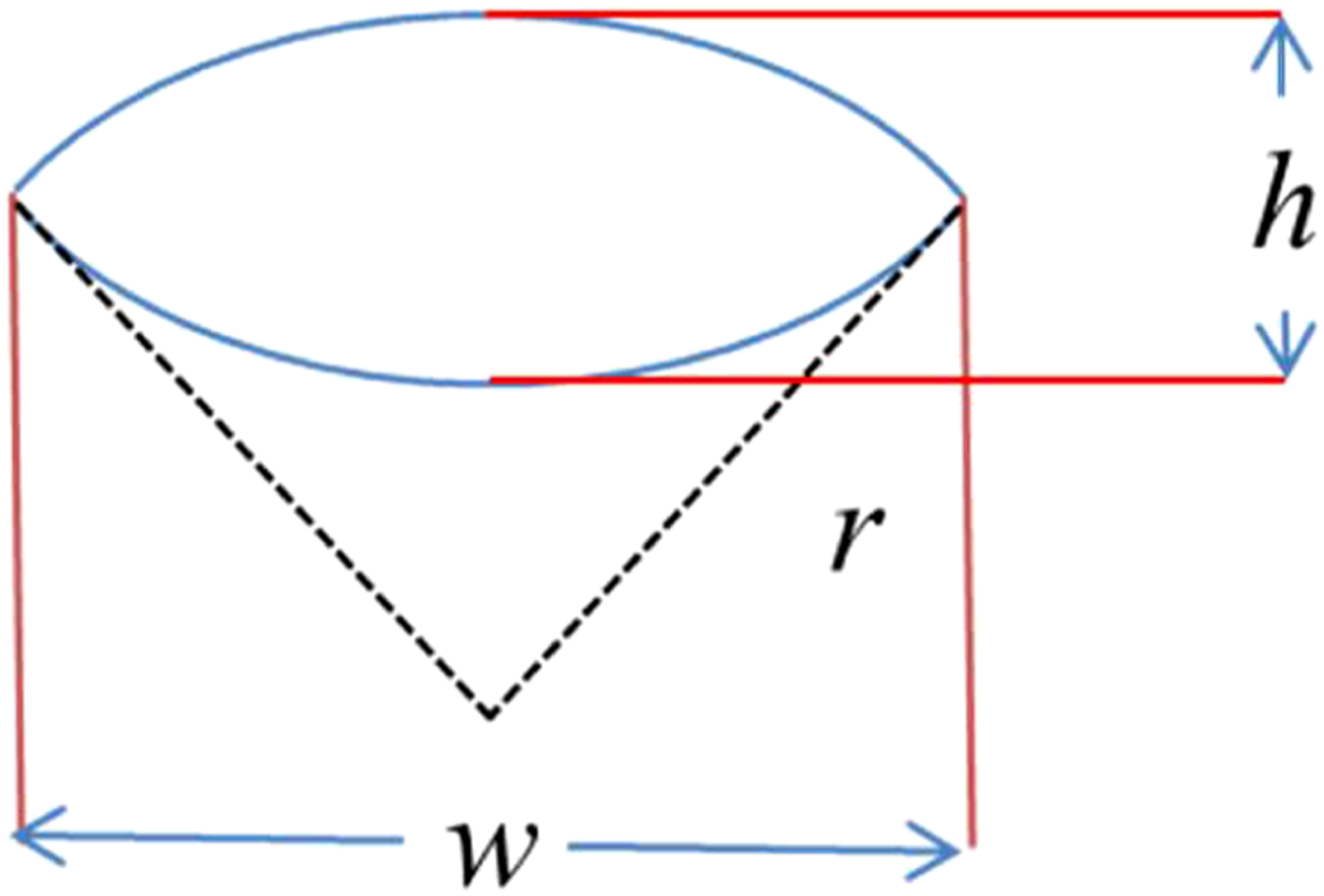
The undulated yarn path is also formed by a series of arcs to match the geometry of the yarn cross-section. The width and height of the yarn crimp are 1.11 mm and 0.165 mm, respectively.
Eight-node hexahedron elements (C3D8R) and ten-node tetrahedral elements (C3D10 The meshing of FE models for a single-ply (a) PW and (b) SL2S.


Material properties.
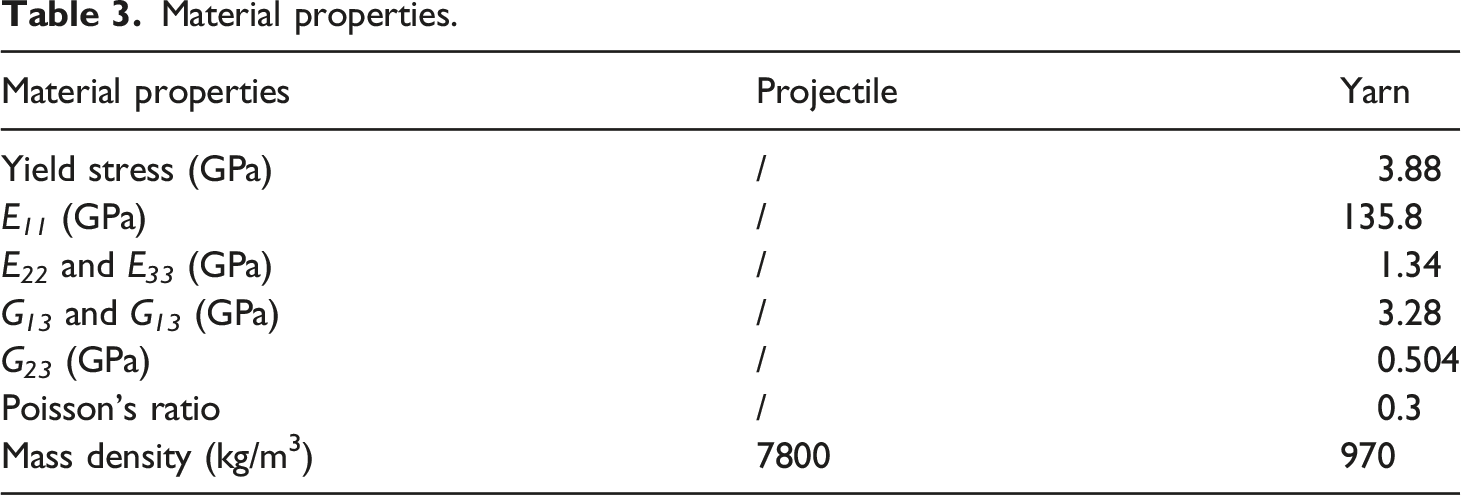
The projectile was modeled as a rigid body and was not deformed during the impacting process. The material properties are listed in Table 2. A general contact interaction was used to define the contact between the projectile and the sample target and between the interlaced warp and weft yarns. The coefficient of friction was set to 0.14. 20
Results and discussions
Yarn pull-out behavior and fabric stiffness
Inter-yarn friction is characterized by performing the yarn pull-out test, measuring the force required to pull a single yarn out from the stitched and unstitched plain weaves. Figure 7 displays the force-displacement curves and peak-load forces of the yarn pull-out test performed at different loading rates. The peak-load force increases with the loading rates, and the stitched samples are more sensitive to the loading rate than the unstitched samples. Since the rate of pull-out is far lower than that of a ballistic event, a greater resistance against yarn pull-out is expected when impacted by a projectile. It was also found that thread stitching contributes to a significant increase in pull-out force, and the maximum pull-out force increases with the number of stitching lines. Sample with four lines exhibits a peak-load force of approximately 55 N at a pull-out rate of 500 mm/min, which is more than 15 times greater than that of PW. It must be noted that the load-displacement curves of stitched samples increase rapidly beyond the displacement of 10 mm, indicating that the constraint mechanism of thread stitching is activated at a later stage of the pull-out process. Therefore, the effect of stitching is “delayed” to some extent. When the projectile impacts the plain weave region, stitching plays a limited role in resisting yarn pull-out until and unless the primary yarns are pulled to a certain extent. The pulled yarns provide additional length for the projectile to push the yarns aside and consequently increase the probability of “windowing.” Pull-out force as a function of displacement for a plain weave with (a) zero, (b) one, (c) two, and (d) three stitching lines.
Figure 8 displays the results of the fabric stiffness test according to ASTM D1388-18 (cantilever method). The value shown on the vertical axis is the fabric flexural rigidity in μJ/m. PW exhibits the least flexural rigidity. Stitching stiffens the originally soft plain weave, and the magnitude of stiffness increases exponentially with the density of the stitching lines. The constraint provided by the stitching lines increases the friction between the warp and weft yarns, restricts the yarn displacement, and impedes the inter-fiber and inter-yarn motion. This mechanism inevitably increases the rigidity of the plain weave. A detailed explanation of the relationship between friction and stiffness was provided by McNeil and Standard in their investigation of the bending rigidity of sol-gel coated wool fabrics.
27
The flexural rigidity of the stitched and the unstitched fabrics.
The ballistic performance of the stitched and unstitched UHMWPE fabrics
Single-ply fabrics
Figure 9 shows the plot of the residual velocity of the spherical projectile against its impact velocity for different samples. The impact velocity varies from the ballistic limit to approximately 400 m/s. The dots representing the stitched and unstitched sample targets exhibit a concave upward increase in residual velocity near the ballistic limit and a linear increase thereafter, indicating that the flexible systems absorb more kinetic energy of the projectile at low impact velocities and less at high velocities. This phenomenon was explained by Guo et al. their investigations of the responses of fabric upon ballistic impact.
28
They suggested that fabrics behave elastically when the impact velocity is near the system’s ballistic limit, and the majority of the kinetic energy of the impacting projectile is absorbed in the form of the strain and the kinetic energy of the impacted fabric; at higher impact velocities, the elastic response converted into an inelastic one. This results in a decrease in the strain and the kinetic energy absorbed by the fabric, making the system contribute less in slowing the projectile. It can be seen in Figure 9 that the ballistic limit of PW is approximately 111 m/s, which is lower than those of the stitched fabrics. In terms of the stitched fabrics, the ballistic limit increases with the density of the stitching lines, with SL2S being the most protective (a 57% increase in the ballistic limit when compared with PW). The ballistic performance of the stitched and unstitched plain weaves.
Figure 10 shows the energy absorption capacity of different samples at impact velocities of approximately 160 m/s, 230 m/s, 300 m/s, 350 m/s, and 400 m/s. In Figure 10(a), the vertical axis indicates the kinetic energy loss of the projectile after removing the portion dissipated by air drag. The energy absorbed by the sample target decreases as the impact velocity of the projectile increases. The most dramatic reduction in energy absorption was found on sample SL2S, being approximately 63.3% from 25.6 J at an impact velocity of 160 m/s to 9.4 J at an impact velocity of 397 m/s. Among single-ply fabric systems, SL2S exhibits the best ballistic performance at all velocities. PW exhibits inferior energy absorption capability when compared with the stitched samples. For instance, at impact velocities of approximately 160 m/s, the energy absorption of SL2S is around 150.7% greater than that of PW. At impact velocities of approximately 400 m/s, the improvement in energy absorption is 133.8%. SL4S and SL6S exhibit similar performance. It also appears that the influence of stitching on ballistic performance is more pronounced when the fabric is densely stitched. Figure 10(b) shows the specific energy absorption (SEA) of different sample targets. When the energy absorption is normalized by areal density, the SEA of SL2S is approximately 64.2% and 51.4% greater than that of PW at impact velocities of 160 m/s and 400 m/s, respectively. (a) Energy absorption as a function of impact velocity; (b) Specific energy absorption as a function of impact velocity.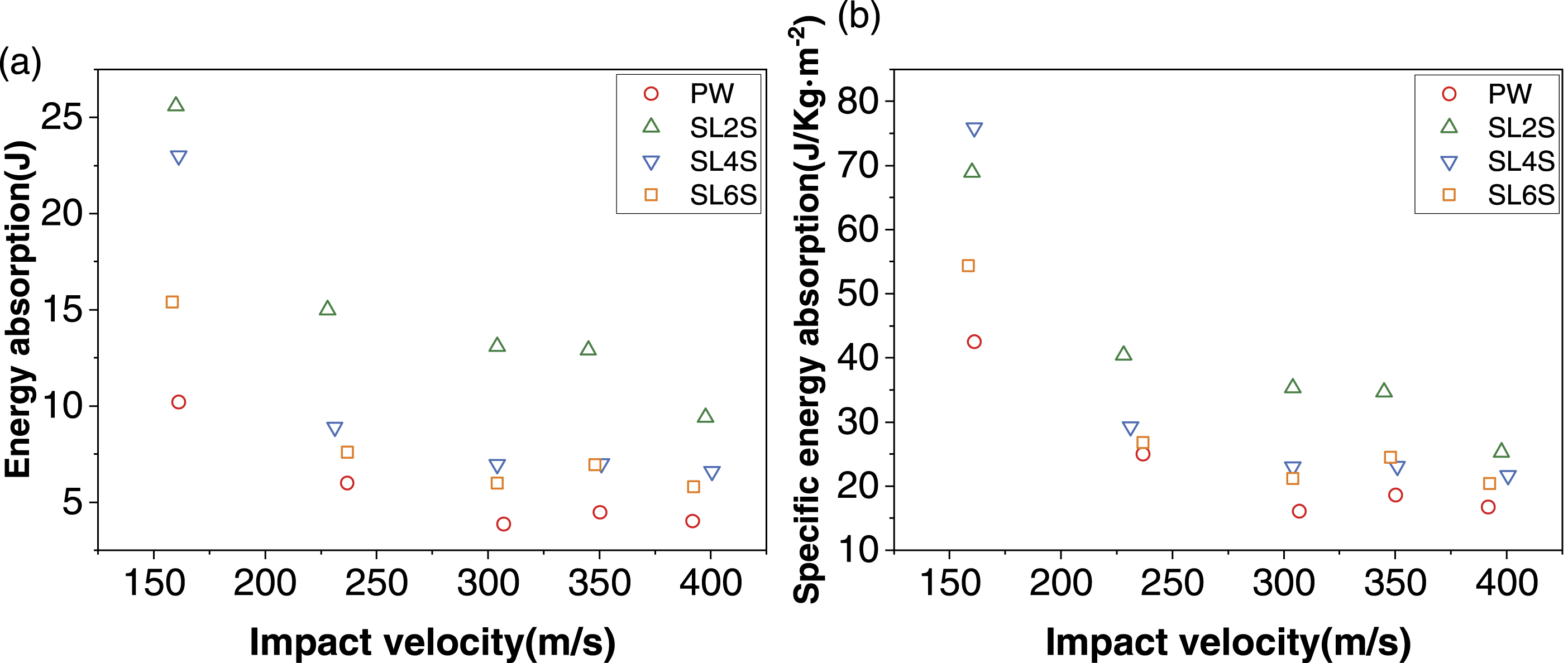
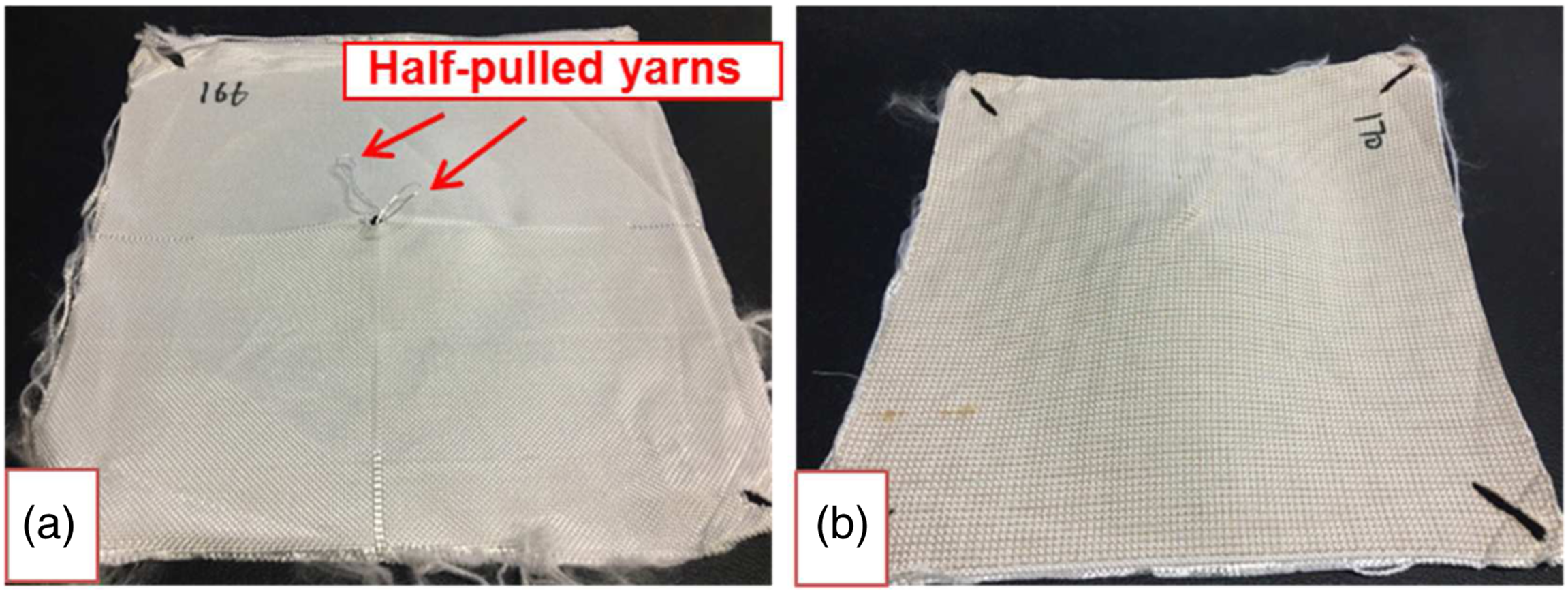
Figure 11 shows the images of PW and SL2S at impact velocities of approximately 400 m/s. The penetration of PW was largely accommodated by yarn pull-out. The impacting projectile was loaded by a primary weft yarn and primary warp yarn at the initial stage of the ballistic event. The warp yarn slipped aside from the projectile surface and was disengaged with the projectile at 160 μs after impact, resulting in a half-pulled yarn in Figure 12(a). The yarn pull-out marker in the weft direction indicates that the primary weft yarn was entirely removed by the projectile. In addition, yarn windowing was also observed at the impact site of PW. It can be concluded that the majority of the projective kinetic energy loss was dissipated by the frictional sliding between the primary yarns and their crossover secondary yarns. Compared with PW, SL2S exhibited a more localized penetration mode where fiber failure contributes significantly to energy dissipation. It can be seen in Figure 12(b) that fabric penetration was mainly driven by yarn windowing and damage. Although the primary warp yarn displaces during the ballistic event, the extent of yarn displacement was limited to a minimal extent by the stitching thread. Thread stitching reduced the yarn mobility and prevented the primary yarns from being pulled out by the projectile. Therefore, the primary yarns were either damaged by the impact loading or pushed aside due to the damage of sewing thread, allowing the projectile to “wedge-through” the fabric. Fabric deformation of (a) PW and (b) SL2S at an impact velocity of approximately 400 m/s. Post-impact close-ups of (a) PW and (b) SL2S at an impact velocity of approximately 400 m/s.

At an impact velocity of approximately 160 m/s, PW was penetrated by the projectile in Figure 13(a), leaving two half-pulled primary yarns in Figure 14(a). SL2S stopped the impacting projectile and did not show any markers of yarn displacement and fiber damage. The width of the transverse deflection is more defined and wider in SL2S than that in PW. It is interesting to find that the velocity of the transverse wave decreases as time elapses, for example, the average velocity in SL2S is approximately 233.5 m/s from 10 μs to 110 µs and is 13 m/s from 210 μs to 310 µs, respectively. This is probably because that the kinetic energy of the projectile was progressively absorbed and dissipated by the fabric system, slowing the propagation of the transverse wave. This can be supported by Smith et al., who correlates the propagation of the transverse wave with projectile impact velocity in their investigations of a single yarn subjected to rapid impact loading (Stress–Strain Relationships in Yarns Subjected to Rapid Impact Loading). Fabric deformation of PW and (b) SL2S at an impact velocity of approximately 160 m/s. Post-impact close-ups of (a) PW and (b) SL2S at an impact velocity of approximately 160 m/s.
Multi-ply fabrics
In order to further investigate the ballistic performance of the stitched and unstitched plain weaves, penetration tests were performed on multi-ply fabric systems at impact velocities of approximately 400 m/s. The results are shown in Figure 15. It seems that the SEA of multi-ply systems is not sensitive to the number of plies. The SEA of PW keeps constant as the number of fabric plies increases, being approximately 17 J/kg.m2. Similar trends were also observed on SL2S, SL4S, and SL6S. The energy absorption capability increases with the density of stitching lines for multi-ply systems. Nevertheless, it can be concluded that the stitched systems exhibited better performance over PW in a panel, for example, the improvement in SEA ranges from 31.8% to 64.4% when comparing SL2S and PW. The energy absorption capability of multi-ply systems at impact velocities of approximately 400 m/s.
Stitched fabric panels
When stitching a fabric, the additional weight of the sewing thread is non-negligible and must be considered when designing a ballistic panel with an improved performance-to-weight ratio. It was found from the ballistic results the improvement in energy absorption capability is reduced on mass-normalized metrics. This is because that the use of sewing thread resulted in a 100% increase in the mass of the fabric-forming yarns. In order to reduce the mass of the sewing thread involved in the ballistic fabric, single-ply plain fabrics were stacked up and stitched together to form stitched panels. In this paper, triple-ply fabric systems were selected to investigate the ballistic protection of stitched panels and plain weaves, and the results are shown in Figure 16. Figure 16 reveals the plot of the residual velocity of the projectile against its impact velocity for fabric systems. The ballistic limit of SL2T is approximately 50% greater than that of triple-ply PW, being 234 m/s. The difference between the stitched and unstitched fabrics in residual velocity is also noticeable at higher impact velocities. Figure 17 shows the SEA of the stitched panels and panels consisting of three layers of stitched single-ply fabrics at different impact velocities. It is interesting to find that the stitched panels show better performance than the stacked single-ply fabrics at all velocities. At an impact velocity of approximately 230 m/s, for instance, the SEA of SL2T is approximately one and half times greater than that of SL2S×3 and more than double that of PW × 3. The increase in SEA of the stitched panels is less pronounced at an impact velocity of approximately 400 m/s when compared with plain wave panels. The improvement is less noticeable in sparsely stitched samples, for example, the SEAs of SL4T are 63.8% and 23.9% higher than those of SL4S×3 at impact velocities of 240 m/s and 400 m/s, respectively. The ballistic performance of the stitched and unstitched triple-ply fabric systems. The energy absorption capability of multi-ply systems at impact velocities of approximately (a) 230 m/s, (b) 305 m/s, (c) 350 m/s, and (d) 400 m/s.

The ballistic results obtained from the penetration tests show that thread stitching provides an appreciable increase in the energy absorption capability of the UHMWPE plain weaves. Similar results have been reported by Bilisik 21 and Zhou et al. 22 in their investigations of the performance of stitched Kevlar plain weaves. Bilisik found that the stitched panels exhibited a more defined back face signature than the unstitched panels. Zhou et al. narrowed the stitching lines and discovered that stitching the fabric on every other yarn yields a 146% improvement in SEA when compared with the unstitched samples. Both the publications corroborate the benefit of thread stitching on fabric performance, encouraging us to further explore the penitential applications of dry woven fabrics for ballistic applications.
Finite element Results
For both the stitched and unstitched fabrics, simulations were performed at different impact velocities. The numerical predictions were compared with the deformation of the numerical model with images in Figures 11 and 13. Figure 18 compares the FE and experimental results for the variation of energy absorption as a function of the impact velocity for single-ply PW and SL2S. The numerical predictions and experimental results exhibit a similar trend, that is, the energy absorbed by the fabric decreases with an increase in the impact velocity. The energy absorption of the experimental work was greater than those of numerical predictions. The underestimation of fabric performance by the simulation can be attributed to the reduced size of the model, and probably less material was involved in slowing the projectile. Comparison of experimental results and FE predictions.
Figure 19 and Figure 20 show the fabric deformation and stress distribution of different systems at impact velocities of 160 m/s and 400 m/s. It can be seen in Figure 19(a) that the responses of PW in FE simulation corroborate with that in Figure 11(a), where yarn pull-out was evident, and yarn failure was not observed. SL2S successfully stopped the impacting projectile without yarn displacement and fiber damage (Figure 19(b)), which enhances the coupling between the primary and secondary yarns and enlarges the stress distribution area. Therefore, more material was involved in the energy dissipation process, and the SL2S absorbed more strain energy than the PW in Figure 21 b. Moreover, the transverse deflection of PW was less defined than SL2S in the numerical predictions, resulting in less amount of kinetic energy transmitted to the system (Figure 21(c)). Additionally, as there is less frictional sliding between the primary and secondary yarns, less amount of energy was dissipated by frictional effect in the stitched system than that in the unstitched system (Figure 21(d)). At an impact velocity of 400 m/s, the penetration of PW was still accommodated by yarn pull-out (Figure 20(a)), whereas SL2S was completely penetrated by the projectile at an early stage of the ballistic event (Figure 20(b)). Despite the early failure of SL2S, the stitched system exhibits a greater amount of energy absorbed during the impact process, with the exception of energy dissipated by friction. It is also interesting to find that both the systems responded more rapidly at higher impact velocities than at lower impact velocities. Fabric deformation and stress distribution of single-ply (a) PW and (b) SL2S at an impact velocity of 160 m/s. Fabric deformation and stress distribution of single-ply (a) PW and (b) SL2S at an impact velocity of 400 m/s. Evolution of (a) projectile kinetic energy loss, (b) fabric strain energy, and (c) fabric kinetic energy and (d) frictional energy at the impact velocities of 160 m/s and 400 m/s.


Conclusions
In this paper, the single and multi-plied UHMWPE woven fabrics were fabricated using the stitching technique to increase the yarn-yarn friction. Yarn pull-out tests were performed to characterize the influence of thread stitching, and the ballistic impact tests were performed at the velocity ranging from 0 ∼ 400 m/s to study the energy absorption capability of different fabric systems. It was found that the constraint provided by the stitching lines significantly increased the frictional force between the weft and warp yarns. The peak-load force of the sample with one stitching line is almost 10 times higher than that of the unstitched plain weave, and the maximum pull-out force increases with the number of yarns stitched. Nevertheless, stitching stiffens the woven fabric, making it less comfortable to wear when used in soft body armor interior systems. More importantly, thread stitching significantly improves the ballistic performance of plain woven fabrics. For instance, single-ply SL2S exhibited a ballistic limit that is 57% higher than that of PW. The SEA of the stitched fabric is over 50% greater than that of PW. High-speed photography showed that thread stitching constrains the yarn displacement and therefore eliminates the possibility of yarn pull-out. This enables the primary yarns to be well-engaged with the projectile at low impact velocities and to be stretched to fail at high impact velocities, increasing the amount of energy dissipated by the systems. The superior performance of SL2S was less pronounced in multi-ply systems. When the multi-ply plain weave systems were stitched together, the energy absorption capability was found to be better than layered up multi-ply systems, for example, the SEAs of SL4T are 63.8% and 23.9% higher than those of SL4S × 3 at impact velocities of 240 m/s and 400 m/s, respectively. In FE models, the element was merged at the nodes to simulate the yarn-constraining effect of thread stitching. The numerical predictions showed that thread stitching enlarges the area of stress distribution and transverse deflection and consequently enables the quilted systems to absorb more strain and kinetic energy than the PW system. In the stitched fabrics, the energy dissipated by yarn friction was much lower than the unstitched fabric due to the elimination of yarn pull-out during a ballistic event.
This work provides an alternative to improve the ballistic performance of plain weaves by increasing the friction between the crossover-forming yarns. Compared with conventional chemically related treatment, thread stitching produces limited mass and rigidity penalty on the fabrics. In addition, the performance of the stitched fabrics is not sensitive to service time, that is, this system can serve for a couple of years without significant property degradation. Those benefits offer potential as to the use of the stitched woven fabrics in flexible protective systems, for example, the engineering design of soft personal body armor.
Footnotes
Declaration of conflicting interests
The author(s) declared no potential conflicts of interest with respect to the research, authorship, and/or publication of this article.
Funding
This work was supported by the Hubei Province Science and Technology Project (2020BED004 and 2021BAA069), and National Natural Science Foundation of China (51708553).
