




Abstract
The aim of this study was to determine the pull-out properties of the para-aramid woven fabrics. Para-aramid Kevlar 29® (K29) and Kevlar 129® (K129) woven fabrics were used to conduct the pull-out tests. K29 and K129 woven fabrics had high and low fabric densities, respectively. For this reason, yarn pull-out fixture was developed to test various K29 and K129 fabric sample dimensions. Data generated from single and multiple yarn pull-out tests in various dimensions of K29 and K129 woven fabrics included fabric pull-out forces, yarn crimp extensions in the fabrics, and fabric displacements. Yarn pull-out forces depended on fabric density, fabric sample dimensions, and the number of pulled ends in the fabric. Multiple yarn pull-out force was higher than single yarn pull-out force. Single- and multiple-yarn pull-out forces in K29 (tight fabric) were higher than those of K129 (loose fabric). Yarn crimp extension in K29 and K129 fabrics depended on crimp ratio in the fabrics and fabric density. High crimp ratio fabrics showed high yarn crimp extension compared to that of the low crimp ratio fabrics. Long fabric samples also showed high yarn crimp extension compared to that of the short fabrics. Fabric displacement in K29 and K129 fabrics depended on fabric sample dimensions and the number of pulled yarns. Long fabric samples showed high fabric displacement compared to that of short fabric samples. Fabric displacement from multiple yarn pull-out test was also higher than that of the single yarn pull-out test. It was considered that fabric pull-out properties can play important roles for absorption of impact load due to the yarn frictions in the fabric structures.
Keywords
Introduction
Ballistic fabrics with higher pull-out force have been shown to perform favorably in impact tests [1]. Some studies have stated that to understand the mechanism of yarn pull-out, it is necessary to understand the role of yarn pull-out friction in fabrics and engineering frictional properties to enhance their ballistic performance. Yarn pull-out was defined as one end of the yarn pulled out from the fabric structure by the motion of the penetrator. The force required to pull the yarn from the fabric structure was the sum of the frictional forces between the yarn sets at all intersecting points [2]. Ballistic performance depends upon friction and material properties such as elastic modulus and strength of the yarn. While friction improved ballistic performance by maintaining the integrity of the weave pattern, material properties of the yarns had a significant influence on the effect of friction [3]. Another study revealed that very high inter-yarn friction could lead to premature yarn rupture during impact load and eventually reduce the energy-absorbing ability of the fabric. The crimp in the woven fabric could be considered as another factor [4,5]. On the other hand, linear density and woven structure had the largest impact on friction [6]. The softening treatment of fabric was shown to reduce inter-yarn adhesion and inter-yarn sliding friction. It also reduced the tensile modulus of the yarn and increased the deformability in the shear of the fabric [7]. It was found that fabrics with high friction and the lowest effective moduli dissipated larger amounts of energy relative to fabrics with lower friction. Relatively small changes in friction produced much greater changes in the deformational behavior of an assembly of crossover contacts [8].
Modeling studies showed that friction contributed to delaying fabric failure and increasing impact load, allowing the fabric to absorb more energy [9]. Projectile-fabric and yarn-to-yarn friction were investigated and it was shown that reduction of lateral yarn mobility allowed the projectile to load and bring more yarns so that fabric possessing a high level of friction absorbed more energy than fabric with no friction. Projectile-fabric friction delayed yarn breakage by distributing the maximum stress along the periphery of the projectile-fabric contact zone. The delay of yarn breakage substantially increased the fabric energy absorption during the later stages of impact. Yarn-to-yarn friction hindered the relative motion between yarns and thus resisted decrimping of fabric weave tightness. It induced the fabric to fail earlier during the impact process [10]. The effect of yarn slippage at the crossover point as well as within the clamp was modeled and yarn fracture during impact in single ply woven fabric was determined using a kinetic energy relation [11].
The aim of this study was to determine the friction behavior of para-aramid single woven fabric under single and multiple yarn pull-outs by the newly developed yarn pull-out test.
Materials and methods
Para-aramid fiber and woven fabrics

Pull-out tests
Pull-out tests were conducted to determine the yarn-to-yarn friction on single or multiple yarn ends in the frayed edge of the plain fabric structure under no pretension. For this reason, the pull-out fixture was developed. The fixture consisted of a base plate to hold the testing instrument; a sliding frame to adjust the position of the yarn end to be pulled from the testing instrument; and a fabric holder with nine screws to apply the required pressure to each of the fabric sample sides that are parallel with the thread to be pulled via a metal plate [13]. Figure 1 shows the fixture and the pull-out test carried out in the testing instrument. The testing instrument used was the Instron 4411 and the testing speed was 100 mm/min.
Pull-out fixture with fabric on the tensile testing instruments [13].
Fabric dimensions for performing the pull-out test were defined. Fabric width was 360 mm with 30 mm of either side held in the clamping system. Fabric lengths were measured between 50 and 350 mm at 50 mm increments. The pull-out direction was in the warp direction of the fabrics. Frayed yarn length in the sample was 150 mm and total edge length holding the sample in the fixture edge was 60 mm. An individual yarn end from the frayed edge was clamped by the Instron 4411 pull head. The positions of the single and multiple end pull-out fabric samples are shown in Figure 2. In pull-out test, fabric displacement, crimp extension, and fabric pull-out force were measured. The crimp extension was defined as ‘yarn length that is received under the applied tensile load on a single yarn end in the fabric structure due to interlacement.”
Kevlar 29 fabric samples for single (left) and multiple pull-out (right) tests.
Results and discussion
Single yarn pull-out result
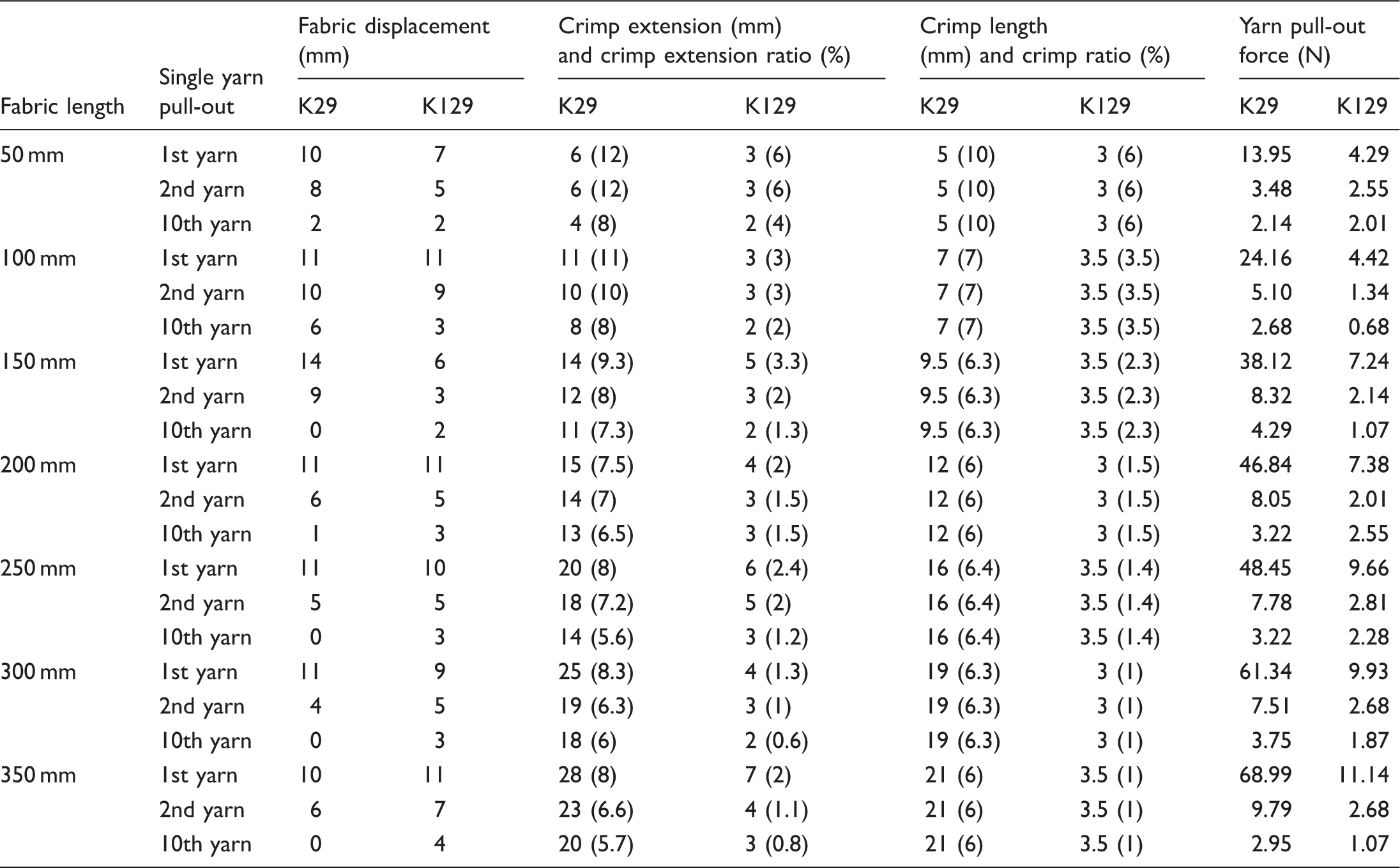
Single end pull-out test results from K29® and K129® single fabrics
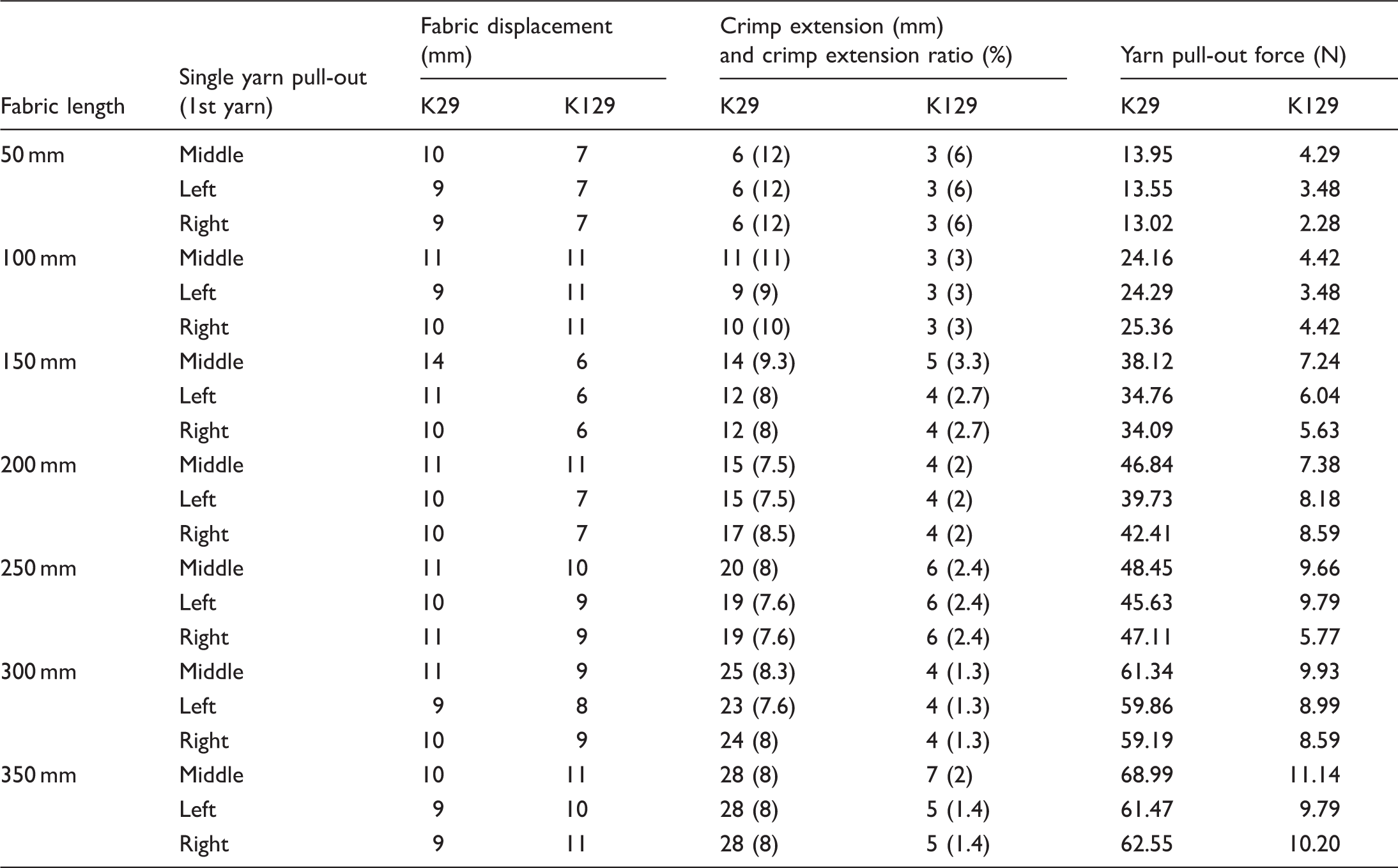
Single end pull-out test results from various regions of K29® and K129® single fabrics

Yarn pull-out force–displacement curves with fabric cross-section represented consecutive each fiber crossing force based on the fabric position (width: 300 mm, length: 300 mm); starting position of the pull-out (a); fabric displacement stage (b); crimp extension stage (c); yarn pull-out stage (d–g); end of the yarn pull-out stage (h) [14].
When the pull-out curve reaches the maximum pull-out force point where the yarn is still being pulled from the end of the fabric, the curve has fabric displacement and crimp extension regions. The fabric displacement is at its maximum value in the fabric displacement region as shown in Figure 3(b). The maximum pull-out force has occurred in the crimp extension region as shown in Figure 3(c). These two regions are called the static friction regions. The kinetic region is defined as the yarn is pulled through all crossing points in the fabric. In this region, the curve has one maximum and one minimum for each two crossing points as seen in the cross-section of the fabric in Figure 3(d–g). The region which has the one minima/one maxima region is called the slip-stick region; where the warp passing over or under the filling is described as the stick motion, whereas where the warp passing between two pick sections is described as the slip motion, as seen in Figure 3(h).
Yarn pull-out force
Single yarn consecutive yarn pull-out force–displacement curves for K29 and K129 fabrics are seen in Figure 4. The first yarn pull-out forces for both fabrics were the highest. However, the pull-out forces of the 2nd–10th yarns were low for both fabrics. The first yarn pull-out force of the K29 was higher than that of the K129. The main reason was that warp directional density of the K29 fabric was high (12 ends/cm) compared to that of the K129 fabric (8.5 ends/cm). Another reason was that lateral pressure exerted between intra-yarn frictions to the pull-out direction of the fabric.
Single yarn consecutive yarn pull-out force–displacement curves for K29 fabric (top), and K129 fabric (bottom), (sample width: 300 mm, length: 300 mm).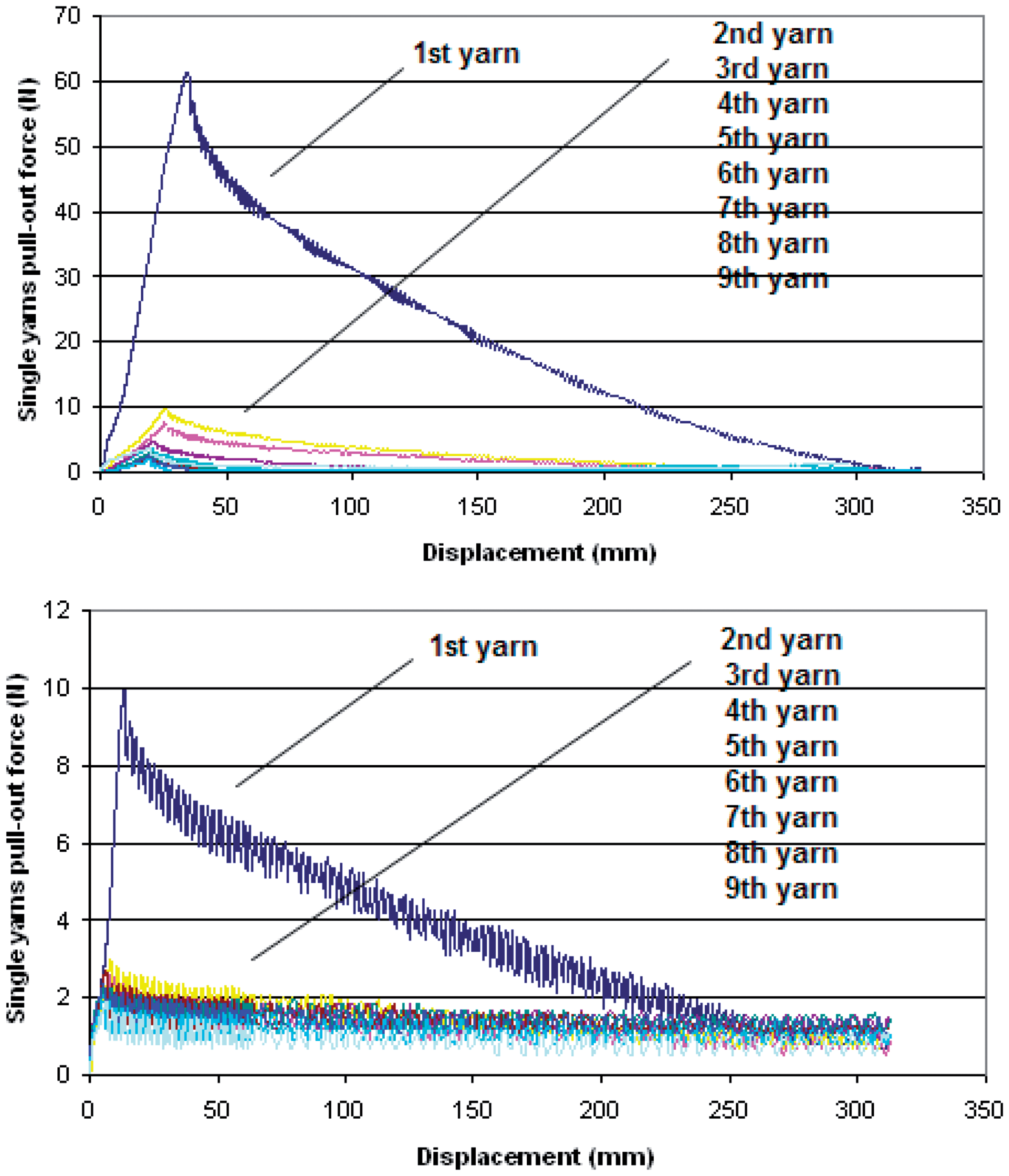
Single yarn consecutive yarn pull-out force–displacement curves for K29 and K129 fabrics for various fabric lengths are seen in Figure 5. The first yarn pull-out forces of K29 and K129 fabrics increased when the fabric length increased, whereas 10th yarn pull-out forces of K29 and K129 fabrics did not considerably change when the fabric length increased. The first yarn pull-out forces of K29 and K129 fabrics were higher than those of 10th yarns. The first yarn pull-out force of K29 fabric was higher than that of K129 fabric. Fabric lengths considerably affected the pull-out force of fabrics K29 and K129 due to the increasing number of crossing points.
Relationship between single yarn consecutive yarn pull-out force and fabric length in K29 and K129 fabrics.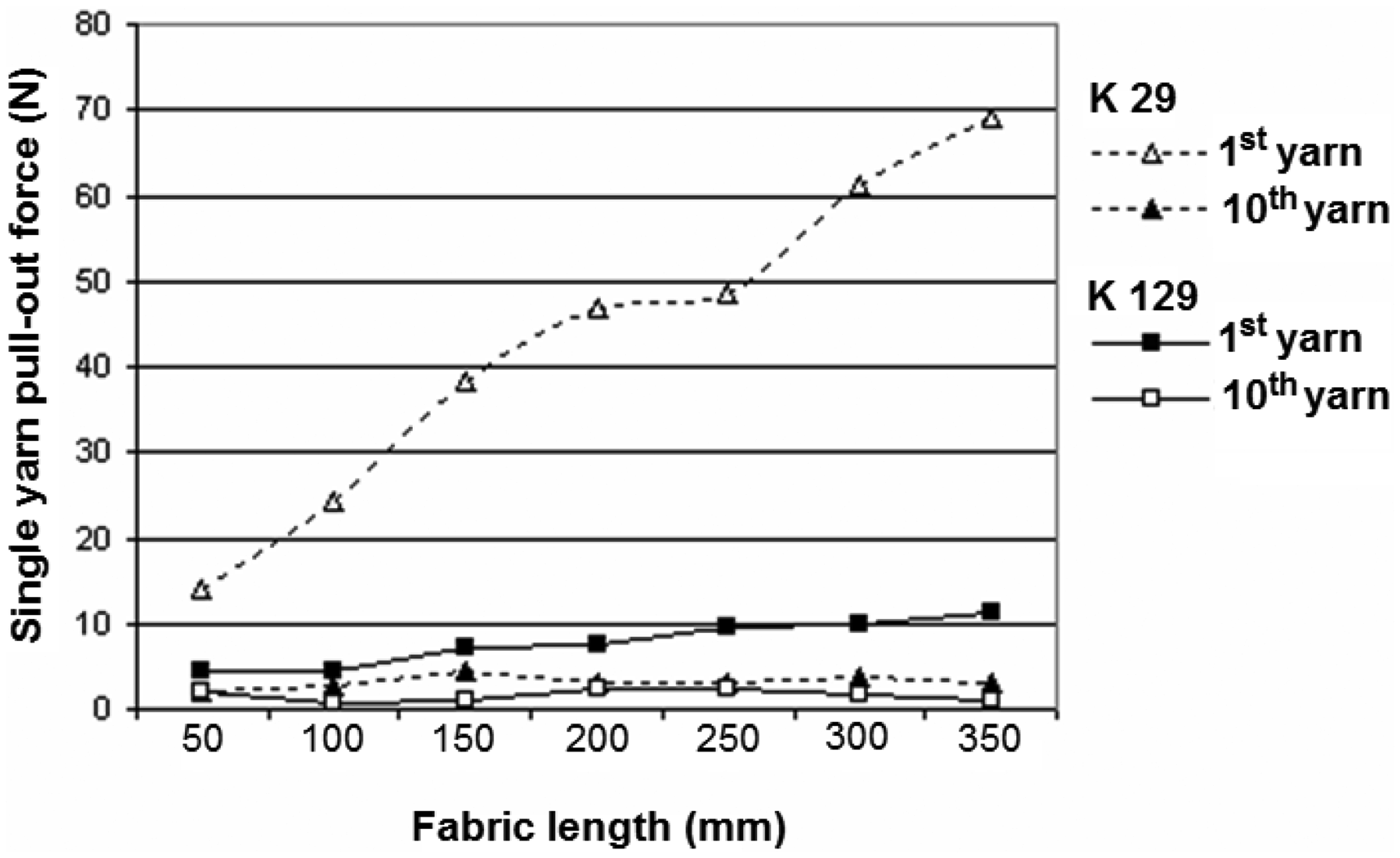
Yarn crimp extension
Yarn crimp extensions (mm) in single consecutive yarn pull-out for K29 and K129 fabrics are seen in Figure 6. The first yarn crimp extension (mm) of K29 and K129 fabrics increased when the fabric length increased. The 1st and 10th yarn crimp extensions (mm) of K29 fabrics were higher than those of K129 fabrics. It was understood that crimp extensions (mm) in the fabrics were proportional to their crimp ratios (%). Fabric lengths considerably affected yarn crimp extension (mm) of fabrics K29 and K129 due to the increasing number of crossing points.
Relationship between crimp extension (mm) during single yarn consecutive yarn pull-out test and fabric length in K29 and K129 fabrics.
Fabric displacement
Fabric displacements in single consecutive yarn pull-out for K29 and K129 fabrics for various fabric lengths are seen in Figure 7. Fabric displacements in the 1st yarn pull-out test for samples of K29 and K129 fabrics were higher than those of 10th yarn pull-out test. Fabric displacements in the 1st yarn pull-out tests of K29 fabrics were slightly higher than those of K129 fabrics, whereas fabric displacements in 10th yarn pull-out tests of K29 and K129 fabrics were close to each other. Fabric displacements in the 1st and 10th yarn pull-out tests of K29 fabrics did not considerably change when the fabric length increased. However, fabric displacements in the 1st and 10th yarn pull-out tests of K129 fabrics slightly increased when the fabric length increased.
Relationship between fabric displacement during single yarn consecutive yarn pull-out test and fabric length in K29 and K129 fabrics.
Multiple yarn pull-out result
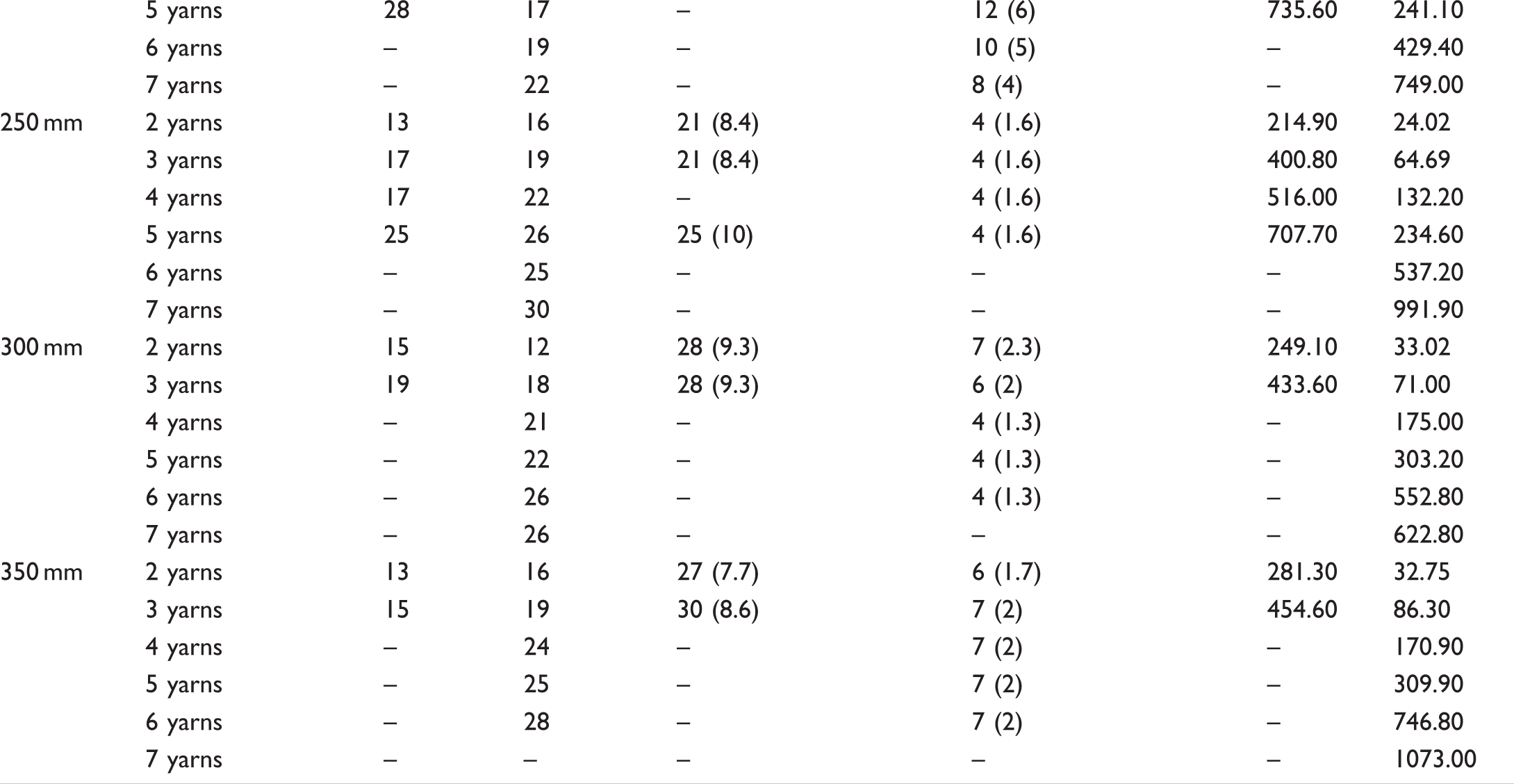
Multiple yarns pull-out test results from K29® and K129® single fabrics

Yarn pull-out force
Multiple yarn pull-out force–displacement curves for K29 and K129 fabrics are seen in Figure 8(a) and (b). When the number of pulled yarn ends increased, the pull-out forces also increased as seen clearly in pull-out force–displacement curves. Also, it was observed that increasing the pulled yarn ends caused the curve to increase its initial slope and move to the right of the force–displacement graph. This indicated that multiple yarn pull-out affected the fabric displacement region. The amount of pull-out forces generated from multiple and single yarns were not linearly proportional with regard to pulled ends. This was due to nonlinear intra-yarn and yarn-crossing frictions in-plane and out-of-plane regions of the fabric. Multiple-yarn pull-out force–displacement curves of K29 fabric were generally higher than those of K129 fabrics. The reason was the high fabric density of K29 fabric.
(a) Multiple yarn pull-out force–displacement curves for K29 fabric (sample width: 300 mm, length: 100 mm) (top) and (sample width: 300 mm, length: 300 mm) (bottom). (b) Multiple yarn pull-out force–displacement curves for K129 fabric (sample width: 300 mm, length: 100 mm) (top) and (sample width: 300 mm, length: 300 mm) (bottom).
Multiple yarn pull-out forces for K29 and K129 fabrics for various fabric lengths are seen in Figure 9. Multiple yarn pull-out forces of K29 and K129 fabrics increased when the fabric length increased. When the number of yarn ends increased, the pull-out force increased rapidly as fabric length increased. Multiple yarn pull-out forces of K29 fabrics were higher than those of K129 fabrics. This was because high density of K29 fabric. Also, fabric lengths considerably affected the pull-out force of fabrics K29 and K129 due to the increasing number of crossing points.
Relationship between multiple yarn pull-out force and fabric length for K29 (top) and K129 (bottom) fabrics.
Yarn crimp extension
Yarn crimp extensions (mm) in multiple yarn pull-out for K29 and K129 fabrics for various fabric lengths are seen in Figure 10. In general, multiple yarn crimp extensions (mm) of K29 and K129 fabrics increased when the fabric length increased. Multiple yarn crimp extensions (mm) of K29 fabrics were higher than those of K129 fabrics. There was no obvious relationship between the number of pulled ends and crimp extension (mm) in K29 and K129 fabrics. When the number of pulled ends increased, multiple yarn crimp extensions (mm) of K29 and K129 fabrics slightly increased. It was understood that crimp extensions (mm) in the fabrics were proportional to their crimp ratios (%). Fabric lengths considerably affected yarn crimp extension (mm) of K29 and K129 fabrics due to the increasing number of crossing points.
Relationship between crimp extension (mm) during multiple yarn pull-out test and fabric length in K29 (top) and K129 (bottom) fabrics.
Fabric displacement
Fabric displacements in multiple yarn pull-out for K29 and K129 fabrics for various fabric lengths are seen in Figure 11. In general, fabric displacements in multiple yarn pull-out test of K29 fabrics decreased when the fabric length increased, whereas fabric displacements in multiple yarn pull-out test of K129 fabrics slightly increased when the fabric length increased. Multiple yarn fabric displacements of samples of K29 and K129 fabrics increased when the number of pulled ends increased. Also, multiple yarn fabric displacements of K29 fabrics were slightly higher than those of K129 fabrics. These indicated that fabric lengths effected fabric displacement during multiple yarn pull-out tests.
Relationship between fabric displacement during multiple yarn pull-out test and fabric length in K29 (top) and K129 (bottom) fabrics.
General results
The research showed that yarn pull-out force depends on fabric density, sample dimensions, and the number of pulled yarn ends. In general, multiple yarn pull-out forces of fabrics were higher than single yarn pull-out forces of fabrics. Single and multiple yarn pull-out forces of tight fabrics were higher than those of loose fabrics. Single and multiple yarn pull-out forces of long length fabric samples were higher than those of fabrics at short length samples. It was found from the force–displacement curve that multiple pull-out force was nonlinear compared to the single pull-out force.
Relevance of results to ballistic impact resistance
In previous study, some of the impact loads are absorbed by yarn frictions in the fabric structures [13]. For instance, multiple yarn pull-out force represents the frictional base of the impact phenomenon during projectile–fabric interaction where more than one yarn is pulled by the projectile tip. Yarn crimp extension (mm) generated from pull-out test depends on crimp ratio (%) of fabric and fabric sample dimensions. The higher the crimp ratio (%) in the fabric is the higher the yarn crimp extension (mm) in the fabric. Yarn crimp extension (mm) of long fabric length was higher than that of short fabric length.
Upon impact, yarn crimp extension (mm) is especially important with regard to out-of-plane deformation in the fabric for soft ballistic structure. Out-of-plane deformation is the indication of back face signature for soft ballistic structures.
Fabric displacement generated from pull-out test depends on sample dimensions and number of pulled yarn ends. Fabric displacement in multiple yarn pull-out test was higher than those of single yarn pull-out test. Fabric displacement in ballistic structure could be considered, especially bending type deformation generated during impact, and this affects out-of-plane deformation of soft ballistic structures. However, fabric displacement from the multiple yarn pull-out test could be considered to determine the fabric local shearing properties.
Conclusions
Single and multiple yarn pull-out tests have been conducted to understand the pull-out properties of high- and low-density para-aramid fabrics in soft ballistic applications. For this reason, the fabric pull-out test was developed. Single and multiple yarn end pull-out data were generated for high-density K29 and low-density K129 para-aramid fabrics.
Single and multiple end pull-out forces depend on fabric density, fabric sample dimensions, and the number of pulled yarn ends. Multiple yarn pull-out forces of high- and low-density fabrics were higher than single yarn pull-out forces. High-density fabric showed high pullout forces compared to that of the low-density fabric. Yarn crimp extensions (mm) generated from single and multiple pull-out tests depend on crimp ratios (%) in the fabric and fabric sample dimensions. Fabric which has high crimp ratio (%) showed high yarn crimp extension (mm) compared to that of the low crimp ratio (%) fabric. Fabric displacements generated from single and multiple pull-out tests depend on fabric sample dimensions and the number of pulled yarn ends. Fabric displacement from long fabric samples showed slightly high fabric displacement compared to that of short fabric sample. Fabric displacement in multiple-end pull-out showed high fabric displacement compared to that of the single pull-out.
Future research should be conducted on finding the analytical relations between pull-out and yarn-fabric structural parameters. This could result in multiaxially interlaced fabric to improve frictional properties in soft ballistic applications.
Funding
This research received no specific grant from any funding agency in the public, commercial, or not-for-profit sectors.
Footnotes
Acknowledgments
The author would like to thank Du Pont de Nemours International S.A. for this research work. The author also thanks Research Associate Mr Mahmut Korkmaz and Research Assistant Miss. Gaye Yolacan for helping during preparation of the manuscript.
Notes