




Abstract
In this paper, the high velocity impact (HVI) behavior of epoxy-based Kevlar-Basalt hybrid composites was studied experimentally and numerically. The composite specimens were manually placed in nine layers classified into six types of stacking sequences: non-hybrid, sandwich hybrid, and intercalated hybrid. The impact tests were conducted by using a ballistic apparatus at three different energy levels: 150 J, 200 J, and 250 J, and the amount of absorbed energy was calculated based on input velocity and residual velocity of the projectile. The results demonstrated that hybridization improves the behavior of composites in high velocity impacts compared to that of specimen that are not hybridized. The absorption of sandwich hybrids on average increased 23.25% and 11.3% compared to pure Basalt and Kevlar, respectively. Moreover, the intercalated hybrids showed an efficiency of about 35.6% and 21.76% better than that of pure Basalt and Kevlar, respectively, in absorbing energy. The same energy absorption pattern was observed in numerical simulation performed in ABAQUS/Explicit. Also, the highest amount of energy absorption and the lowest residual velocity as well as damage occurred when Kevlar was attacked by the projectile and the layers were intercalated.
Introduction
Composite materials have replaced metals in industries such as aerospace, marine, and automobile because of their relatively higher strength and module proportionate to their weight. Using these materials in aerospace industry reduces the structure weight and, therefore, fuel consumption. As a result, the high initial expenses for making these structures will be compensated. Moreover, composite materials are stronger and more resistant to fatigue, impact, and corrosion [1].
One of the most popular composites are polymer-based composites, which are composed of a polymer resin –as base– and fiber reinforcements. Thanks to their attractive characteristics such as easy fabrication and reasonable price, these materials are widely produced and used. In this context, because of its appealing mechanical features, optimum sticking, strong chemical resistance, and wide variety, Epoxy resin is frequently used in making polymer-based composites [2,3].
Given the applications of composites in different sections of the military and aerospace industries, the resistance of these composites against impacts has always been a major concern for researchers. Since fibers such as Kevlar, Basalt, Carbon, and Glass each has its own advantages and disadvantages in terms of mechanical properties and response to different impacts, it seems that hybridization is one of the best techniques to improve the overall properties of composites. This technique raises the quality of composites and overcome their shortcomings. It improves the mechanical properties of composites and their resistance to fatigue and impact and reduces their total cost. Extensive research has been done on hybridization of fibers in different materials. Thus, glass types E and S2 together have been studied under high and low velocity impact [4]; also, hybrid carbon-glass [5,6], Kevlar-carbon [7], Kevlar-glass [8], glass, carbon, and Kevlar [9], and woven Kenaf and Aramid [10] have been tested under high velocity impact.
Due to its strength and favorable reaction against impact, Kevlar is among fibers that have been traditionally applied in bullet-proof vests [11] and military helmets [12].
Until now, some experimental and numerical researches have been published on the behavior of Kevlar under high and low velocity impact testing [13–16]. Kevlar fibers have high tensile strength and elastic module, high resistance to impact and fire, and a relatively low density [17]. However, they have low resistance to chemical materials and show a weak reaction to pressure [18]. Although Kevlar possesses good longitudinal qualities, its transverse properties are not desirable. To improve these features, it is helpful to hybridize it with other fibers such as glass and carbon [19–21], nanoparticles [22], and ceramics [23]. Recent studies have been attracted to Basalt owing to its remarkable mechanical features, chemical stability, and heat behavioral reactions [24]. The mechanical properties of Basalt fibers [25–28] and Basalt-carbon hybrid under ballistic impact [29] have been studied too. The results of these investigations demonstrate that hybridization of Basalt fibers with Kevlar fibers highly improves the performance of composites.
Bandaru et al. (2016) probed the mechanical behavior of polypropylene-based composites reinforced with 2 D plane woven Kevlar-Basalt fibers. Thus, five types of layers were manufactured and the static tensile and in-plane compression were done. The results demonstrated that the hybridized specimens were improved in terms of their elasticity module, strength, and failure strain under tensile and compressive conditions [30]. They also studied the effect of low velocity impact on 3 D angle-interlock Kevlar-Basalt reinforced polypropylene composites. The hybrid produced samples were compared with Basalt and Kevlar samples alone. It was found that the Basalt specimen had the highest peak force, and the hybridized specimens absorbed more energy than did other specimens [31].
Bandaru et al. (2017) investigated the high velocity impact of hybrid composite armors strengthened by 2 D and 3 D Basalt and Kevlar. Two types of layering with symmetric and anti-symmetric polypropylene matrix were considered for Kevlar and Basalt. The results demonstrated that symmetric specimens have better properties and functions. The ballistic limit of the specimens improved 26.27% when the 3 D specimen was attacked. Overall, hybridization improved the ballistic behavior of specimens [32]. Another research dealt with the high strain rate of intra-ply and inter-ply hybrid thermoplastic composites which were reinforced with Kevlar/Basalt fibers [33]. Khazai et al. (2018) explored the effect of Kevlar-Basalt laminate thickness on resistance against repetition of high velocity impact. The composites had three layers and were repeatedly impacted by the following velocity: 40, 50, and 60 m/s. Repeated velocity here means the specimen was not replaced by another one after being hit by the first projectile, and the next loadings were done on that same specimen until the specimen was completely perforated. The authors used the Taguchi method to predict the results as well as the impact of different parameters (including number of layers, thickness of each layer, and the velocity of each impact) on resistance against repetition of high impact velocity. The results suggested that reinforced composite of Basalt fiber was more resistant to damage [34].
Some studies have employed finite element simulations to investigate composite materials under hypervelocity impacts (HVI) [35–37].
The main purpose of our research is to evaluate the effect of hybridization of Kevlar and Basalt fibers –i.e., adding Basalt fibers to Kevlar fibers– and study their resistance to high velocity impacts. Thus, we studied six different types of stacking sequences, including pure Basalt, pure Kevlar, sandwich hybrid (two types), and alternate (intercalated) hybrid (two types). Experimental specimens were manually layered and nine specimens of each type were prepared for testing based on three different energy levels (three specimens for every level). Next, entrance velocity and residual velocity were measured and the amount of energy absorption was obtained via kinetic energy formulas. The mean of each specimen was calculated to reduce numerical errors. Numerical simulation of Kevlar/Basalt hybrid was also developed in ABAQUS/Explicit. Finally, the numerical and experimental results were compared and the best method of stacking sequence was determined.
Based on the literature review, there wasn’t a comprehensive study to investigate the Basalt-Kevlar hybridization under HVI test. So that, the stacking sequence effect of Kevlar and Basalt under HVI test is a new idea. Furthermore, no numerical simulation has been performed for ballistic properties of the Kevlar-Basalt hybrid. These were the driving force for the selection of this study.
The main innovation of the current research consists in studying the effect of layering on energy absorption of Kevlar-Basalt hybrid composites with an epoxy base under high velocity impacts.
Experimental
Materials and methods
In this research, plain Kevlar (Aramid fabrics 200GSM) with a density of 200 gr/m2 produced by Fiber Tech Co. (Korea) and Atlas Basalt (BAS 350.1500.A) with density of 350 gr/m2 produced by Basaltex-Flocart (Belgium) were used to make composite reinforcements. For matrixes, we used epoxy resin (Epon-828) mixed with hardener (aliphatic amine), produced by Kumho P&B chemicals (Korea), at a weight proportion of 10:1 (suggested by the producer company). The specimens were manufactured in six types using hand lay-up process. All laminates had nine layers of Kevlar and Basalt in sandwich form, alternate hybrid, and alternate non-hybrid the thickness of which was 3.5 mm. Figure 1 shows different stacking sequence of specimens along with their acronyms; thus, white and black colors show Kevlar and Basalt, respectively. A total of nine Kevlar layers or nine Basalt layers were utilized for non-hybrid samples. In KB-HS specimens, two Kevlar layers in the front and two in the back cover five Basalt layers; also, two Basalt layers in the front and two others in the back cover five Kevlar layers. For alternate specimens, in the KB-HI case, first the Kevlar layer next Basalt layer continue alternately to the end; thus, we have five Kevlar and four Basalt layers. In BK-HI specimens, Basalt is layered first and then followed by Kevlar, and then interchanging Kevlar; this process continues until there are five Basalt and four Kevlar layers. Table 1 summarizes the thickness and fiber volume fraction of the fabricated specimens.
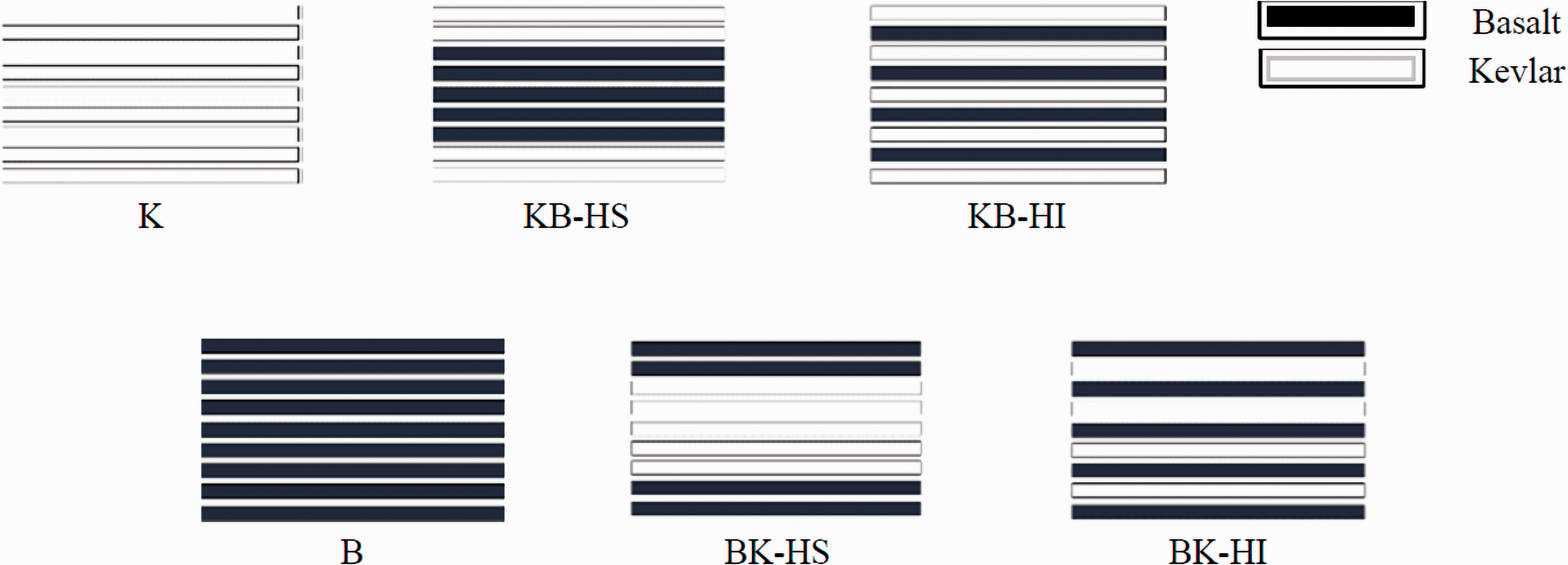
Layer configurations of composite laminates.
Physical parameters of specimens.

To fabricate the specimens, first the anti-adhesive material was put on the mold surface; then, the fibers were cut into rectangle forms (10 × 30 cm) and laid upon each other; afterward, epoxy mixed with hardener was poured between the layers. This was performed to provide similar fabrication conditions for all specimens. Finally, 0.5 MPa pressure [38] was exerted upon the pieces to make air bubbles exit in case there were any. These conditions were preserved 24 hours at 25°C. Next, the pieces were cut into square forms with an area of 10 × 10 cm, which is standard for high velocity impact testing.
High velocity impact (HVI) test
For experimental high velocity impact test, we used a pneumatic accelerator with maximum pressure of 80 Bar. The projectile was sharp-tipped (36.9°) with a conical head; it was made of tempered steel, weighed 11.1 gr, and was shot toward the target at three different velocities of 165, 190, and 213 m/s. Based on the MIL-P-46593A standard, the projectile had a total length of 30 mm, shank length of 15 mm, and diameter of 10 mm. The target was completely clamped. The velocity was measured both before and after shooting by utilizing a laser speedometer with Cortex-M microprocessor with a precision of one microsecond. Figure 2 shows the clamped sample and the bullets.

Projectile shape (left) and clamped sample (right).
Considering the mass of the projectile, velocity and kinetic energy, the amount of impact energy, and absorbed energy were calculated using equation (1)

Software simulation
The finite element simulation (FEM) was performed in ABAQUS/Explicit. The boundary condition for the specimens was clamped from four sides. The initial velocity of the specimens equaled the experimental velocity of 165, 190, and 231 m/s. The elements used for laminate were 4-node quadrilateral plane stress (S4R), and the projectile was rigid element R3D4. The sizes of the elements were optimized based on repetition and fault until the exit velocity in the specimens was stabilized. The properties of materials used for Basalt and Kevlar epoxy (Table 2) were derived from ESAComp software and references [26] and [39].
Mechanical properties of basalt and Kevlar.

The Hashin damage model [40] was used as a FE code to predict the failure of composites. The details of the four failure modes included in the criteria are given in equations (2) to (5) σ11> 0, tensile fiber failure σ11< 0, compressive fiber failure σ22+ σ33> 0, matrix tensile failure σ22+ σ33< 0, matrix compressive failure
where X, Y, and Z are ultimate tensile strength of laminates in directions 1, 2, and 3, respectively; X*, Y*, and Z* are ultimate compressive strength of laminates in directions 1, 2, and 3, respectively; and S12, S13, and S23 are the ultimate shear strength of laminates in planes 12, 13, and 23, respectively.


Figure 3 exhibits meshed and boundary condition of laminates

Boundary condition (a) and meshed laminate (b).
Figure 4 illustrates grid study and a close-up view of elements projectile hit point.
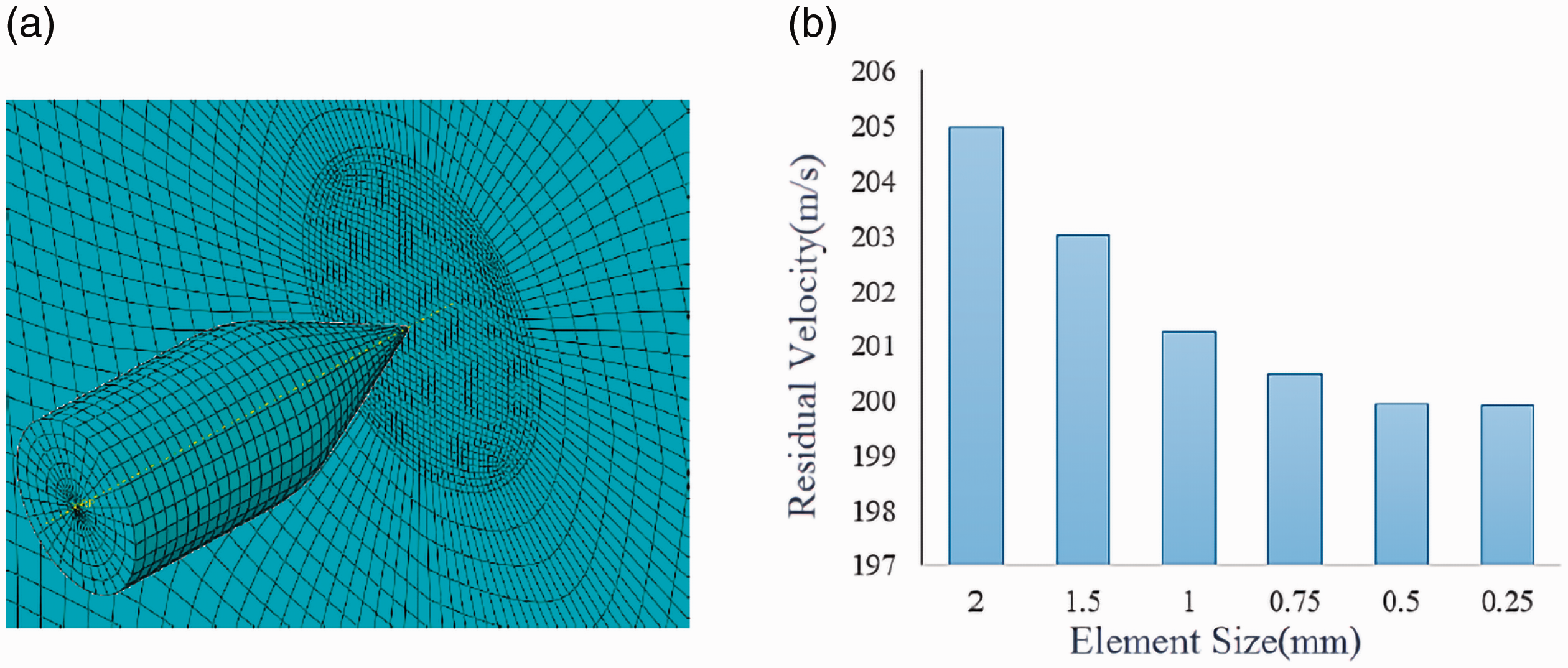
A close-up view of meshing in the central part of laminate (a) and grid study chart (b).
Results and discussion
Impact performance
Table 3 presents velocity changes before and after hitting the target. Accordingly, as the hitting velocity increases, the velocity drop decreases. The reason for this is the high kinetic energy of the projectile at high velocities, because this energy is proportional to the second square of velocity. The highest and the lowest speed drop were associated with KB-HI specimens at 165 m/s and pure Basalt specimens at 213 m/s, respectively.
Input and residual velocity changes for all specimens at different velocities.

Pure specimens
Figure 5 shows the damage area of the pure Kevlar and Basalt composite at different impact velocities. As can be observed, the fibers at entrance and exit points of the projectile show a small damage area for pure Kevlar but a much larger damage area for pure Basalt. Another notable issue is that as the velocity increases, the damage area increases too. In the Kevlar specimen, the damage at entrance and exit points is almost a circle concentrated in one region, while in the Basalt specimen the damage is in the form of a line or a cross. This difference is because of variations in the behavior of the two fibers. The damage in Kevlar specimens resembles brittle cuts due to the brittleness of fibers, whereas the break or damage in Basalt fibers occurs because of their flexibility.

Damage area for pure Kevlar (left hand) and basalt (right hand).
In Figure 6, the energy absorbed by pure Kevlar and Basalt is shown in experimental and numerical forms for three velocity tests. It could be understood that the absorption rate slightly increases with velocity increase, which could be because of strain rate results. The error in the results of experimental and numerical tests of Kevlar and Basalt specimens is less than 5% and 10%, respectively.

Energy absorption of pure Kevlar (left) and pure basalt (right).
Sandwich specimens
Figure 7 indicates the extent and form of damage to Kevlar-Basalt specimens layered in sandwich style. Comparing the pictures up to this stage clarifies that when the Kevlar fiber layer is impacted first and the final or external layer is Kevlar too, the diameter of the hole and damage area is minimized at entrance and exit area. Also, the damage rate in hybrid layering is less than that in pure Kevlar and pure Basalt layering. On the other hand, the damage form in the impact area of BK-HS differs from that in pure Basalt; thus, it is in diamond form and no severe damage is seen unlike what occurred in the case of pure Basalt specimen. Another point about BK-HS concerns the separation or splitting of Kevlar and Basalt layering at the exit point of the projectile. This is visible in the experimental pictures as the background color of Kevlar specimen has changed. Furthermore, in the BK-HS specimen, as velocity increases, the damage area at entrance point decreases, but it increases at exit point and even the form of damage changes.

Damage area for KB-HS (left hand) and BKHS (right hand).
Figure 8 shows the amount of energy absorbed by sandwich-layered Kevlar-Basalt in numerical and experimental forms at different velocities. In this case, unlike the previous situation, the increase in velocity does not lead to an increase in energy absorption rate.

Energy absorption of hybrid KB-HS (left) and hybrid BK-HS (right).
Intercalated specimen
Figure 9 shows the type and area of damage in intercalated Kevlar-Basalt composite samples (KB-HI and BK-HI). As was the case when Kevlar layer existed at entrance and exit points of the projectile, the damage area is almost limited to the exit area and the further fibers are not much damaged. At a small area of the exit point, the composite shows delamination, which is visible by a change in color (light yellow). In Figure 6, the entrance area of the BK-HI specimen shows a comparatively lower damage compared to that of B and BK-HS specimens, but a considerable damage is visible at the exit point of all three specimens. This damage is in the form of a rupture in a large part of fibers and also layer separation, and it increases with rising velocity. In the specimen with a velocity of 231 m/s, the cutting behavior is like a long line and in other cases it is diamond-shaped.

Damage area of KB-HI (left hand) and BKHI (right hand).
Figure 10 shows energy absorption in the intercalated Kevlar-Basalt layer specimen under experimental and numerical simulations. This amount of energy, as mentioned before, exceeds that associated with all other layering formats. Also, the fault rate between the experimental and numerical simulation tests was 12% in one case and less than 10% in another case.

Energy absorption of KB-HI (left) and pure BK-HI (right).
General conclusions
Figure 11 provides a comparison between the energy absorption of numerical and experimental cases for all specimens at the velocity of 165 m/s.

Energy absorption of all specimen at the velocity of 165 m/s.
Based on the experimental results, the energy absorption rates are B < K<BK-HS<KB-HS<BK-HI<KB-HI, and based on the numerical results, the energy absorption rates are B < K<BK-HS<KB-HS<BK-HI<KB-HI.
As can be seen, the highest and the lowest energy absorption rates belong to KB-HI and pure Basalt specimens, respectively. Also, fiber hybridization positively affects the initial qualities of materials and increases energy absorption in both Kevlar and Basalt cases. Figure 12 shows energy absorption rates of the specimens at the velocity of 190 m/s.

Energy absorption of all specimen at the velocity of 190 m/s.
Based on the experimental results, the energy absorption rates are B < K<BK-HI<KB-HS<BK-HS<KB-HI, and based on the numerical results, the energy absorption rates are B < K<KB-HS=BK-HS=BK-HI<KB-HI.
Accordingly, the highest and the lowest absorption rates belong to KB-HI and pure Kevlar, respectively. Here, the three specimens of KB-HS, BK-HS, and BK-HI show similar behaviors in terms of energy absorption in numerical cases, yet they differ slightly in experimental tests.
Figure 13 shows energy absorption rates of different specimens at the velocity of 213 m/s.

Energy absorption of specimens at the velocity of 213 m/s.
Based on the experimental results, the energy absorption rates are B < K<KB-HS<BK-HS<BK-HI<KB-HI, and based on the numerical results, the energy absorption rates are B < K<BK-HS<KB-HS<KB-HI<BK-HI.
In Figure 14, the ratio between the energy absorbed by hybrid composites and pure Kevlar are reported for different velocities in experimental and numerical tests.

Energy absorption by hybrid composites compared to pure Kevlar in experimental and numerical states.
In the experimental tests, the absorption of energy at the three related levels respectively increased by 10.6%, 10.7%, 30.53%, and 18.23% in KB-HS, BK-HS, KB-HI, and BK-HI specimens compared to its rate in the case of pure Kevlar. On the other hand, in numerical simulations, the absorbed energy at the tested velocities increased by 12.6% for KB-HS, 10.2% for BK-HS, 21.3% for KB-HI, and 16.99% for BK-HI. It could be inferred that energy absorption in experimental and numerical tests have the same procedure, but sometimes they are different in values. This difference is due to the fact that everything is ideal in numerical simulation, while experimental tests are associated with faults in fabrication and testing, which cause errors in the results.
Figure 15 shows the energy absorption rates of hybrid composites compared to pure Basalt. As expected, comparison of absorbed energy by hybrid composite with pure Basalt is more considerable because energy absorption of pure Basalt is less than that of pure Kevlar. Thus, energy absorption at the three levels of energy on average increased 19.6% for KB-HS, 19.11% for BK-HS, 40.45% for KB-HI, and 27.24% for BK-HI compared to pure Kevlar. On the other hand, in numerical simulation, the energy absorption at the tested velocities increased 28.78% for KB-HS, 26.04% for BK-HS, 38.75% for KB-HI, and 33.82% for BK-HI.
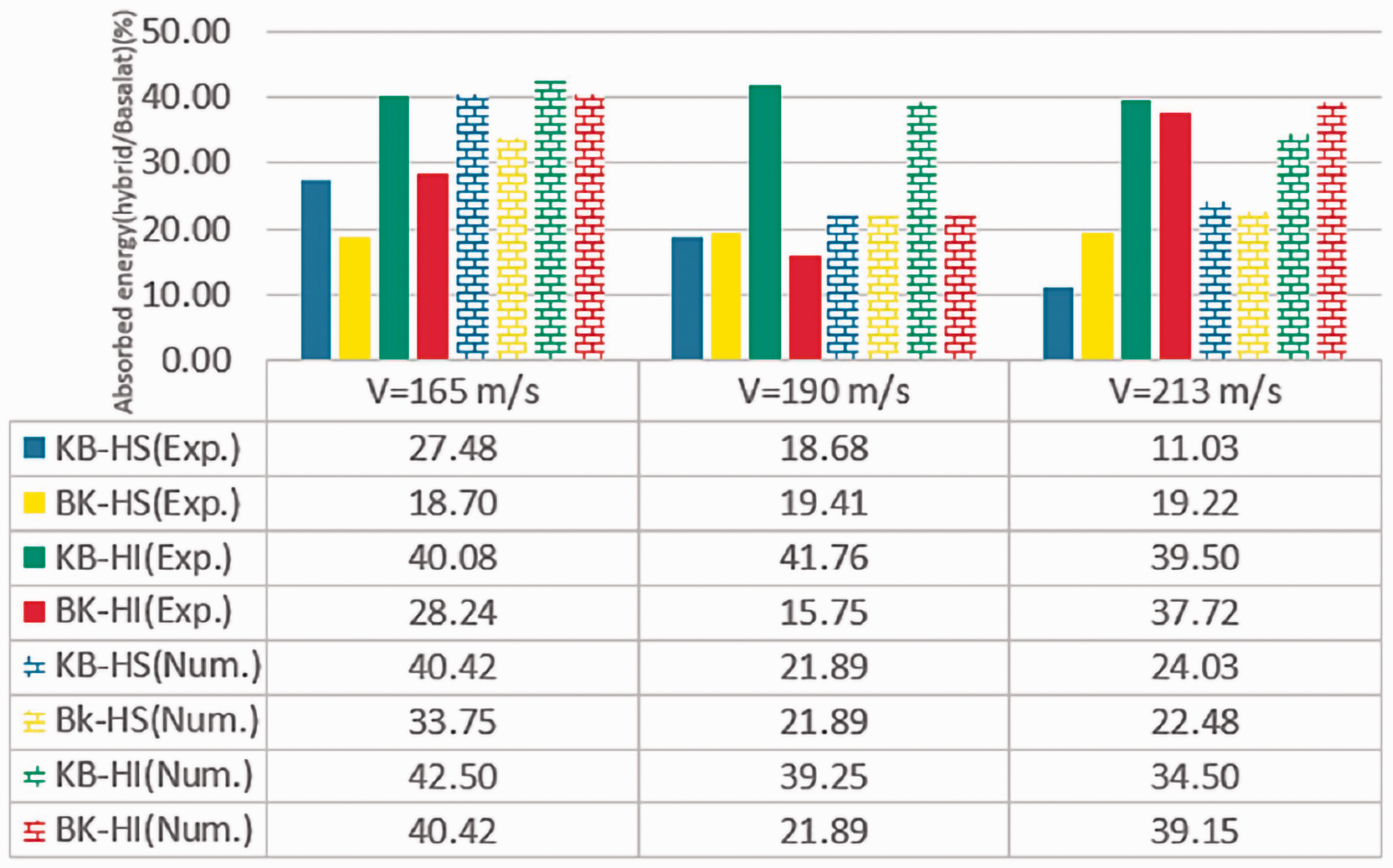
The energy absorption of hybrid composites compared to pure Basalt in experimental and numerical states.
In experimental tests, the highest and the lowest absorption rates respectively belong to KB-HI and pure Basalt; but in numerical simulation, the highest energy absorption belongs to BK-HI. Thus, the best and worst layering combinations can be distinguished for the specimens. Meanwhile, no definite energy absorption behavior can be predicted for sandwich layering. However, it can be generally concluded that hybridization of Kevlar and Basalt will certainly have positive effects on their high-velocity impact behavior. Furthermore, given the cost differences of Basalt and Kevlar fibers, using the inexpensive Basalt instead of Kevlar is more economical.
Conclusion
This research explored the behavior of Basalt-Kevlar hybrid composites. Six kinds of layering were studied at three velocities higher than the ballistic limit of the specimens. The most important results of the current research can be presented as follows: In most of the studied specimens, increasing the projectile velocity leads to an increase in energy absorption, which can be because of two reasons. First, as velocity increases, the strain rate effects become more substantial. Moreover, since more fibers of the specimens are damaged at higher velocities, energy absorption increases. It must be noted that as velocity increases, in most specimens, the damaged area enlarges as well, especially at the exit area. Hybridization of Kevlar and Basalt improves the behavior of both fibers. The results confirmed that in all cases where Kevlar and Basalt fibers are utilized simultaneously, regardless of the type of their layering, energy absorption increases compared to what occurs in the case of pure Kevlar and pure Basalt specimens. This can be due to the improvement of composite functions as a result of combining the strong breaking property of Kevlar with the desirable elastic property of Basalt. In Kevlar specimens, the damage area shrinks considerably when hit by the projectile or when Kevlar covers the external layer of the hybrid composite. On the contrary, when Basalt covers the external side of the specimen, the damage area especially at the exit point is exposed to jagged scars and the fibers are deeply ruptured. As velocity increases, the splitting of layers at the damage area especially at the exit point of the projectile becomes more visible. Among different types of layering, intercalated Kevlar-Basalt has the highest energy absorption rate compared to other cases with sandwich and pure layering. More specifically, among intercalated layered specimens, when Kevlar covers the external side, energy absorption behavior is better. In this case, besides the increase in energy absorption, one can observe a reduction in both splitting of the layers at the exit point and the scars of fibers at the entrance and exit points of the specimen. Therefore, this type of layering combination yields the best behavior for hybrid composite specimens. The energy absorption of sandwich hybrids and intercalated hybrids on average increased 23.25% and 35.6% compared to pure Basalt and also raised 11.3% and 21.76% compared pure Kevlar, respectively.
Summary, hybridization of Kevlar and Basalt can improve considerably the impact properties of the epoxy based composites. The results of this study can be used in practice to optimize the energy absorption of Kevlar-Basalt hybrid composites with polymeric matrix.
Footnotes
Declaration of conflicting interests
The author(s) declared no potential conflicts of interest with respect to the research, authorship, and/or publication of this article.
Funding
The author(s) received no financial support for the research, authorship, and/or publication of this article.
