




Abstract
In order to alleviate the problems caused by electromagnetic pollution and simultaneously adapt to the future development trend of flexible wearable electronic equipment, it is high time to focus on the research of light weight, flexible and efficient electromagnetic interference (EMI) shielding material. A graphene aerogel composite EMI shielding composite fabric was prepared by combining graphene aerogel with fabric through the connection of waterborne polyurethane. The influence of aerogel amount on the EMI shielding function of fabric was discussed, and the waterborne polyurethane dosage on fabric mechanics and fabric style was also investigated. The result shows the composite fabric EMI shielding effectiveness reached 28 dB when the graphene aerogel amount was 25 mL (only 0.066 mL/cm2), which has satisfied the civilian requirements (20 dB). A good adhesion fastness between graphene and cotton fabric was obtained and the mechanical strength was also improved when the content of waterborne polyurethane was 20 mL. Graphene aerogel electromagnetic shielding composite fabric with good electromagnetic shielding performance and less consumption of nano carbon materials will have a good industrial application prospect.
Keywords
Introduction
With the development of science and technology in recent years, the electronic devices are entering our lives constantly. These devices not only bring convenience to people's lives, but also have some negative effects. For instance, some precise electronic components may be interfered even can’t work normally, or some important information may be electromagnetic leaked, and even the electromagnetic waves will also do harm to our human health [1–3]. In order to deal with the theses problems and meet the requirements of the next generation of flexible and wearable electronic devices (such as flexible electronic screen), it is imperative to prepare an efficient flexible electromagnetic shielding material [4–6]. Therefore, the objective of this paper is to prepare a flexible electromagnetic shielding material.
There are several kinds of flexible EMI shielding materials, as follows:
The metal fibers are often used to make electromagnetic shielding materials, which have excellent electromagnetic shielding effect, however, the metal based materials also have some serious defects, such as heavy weight, manufacturing difficulty and poor chemical stability [7–9].
Ozen et al. [10] used stainless steel fiber and polyester as the raw materials and acupuncture as the method to prepare a series of non-woven fabric. The EMI shielding effectiveness of this kind of material improved with the increased content of stainless steel, however, the electromagnetic shielding efficiency is only 18 dB at the highest in 0∼3000 MHz. Palanisamy et al. [11] chose stainless steel fiber and polypropylene fiber to spin a blended yarn with different blending ratios. The EMI shielding effectiveness of the fabric weaved by the blended yarn reached up to 40 dB in 2–14 GHz. However, the stainless steel fiber may do harm to human body, and the softness of the fabric was poor.
In order to overcome the disadvantages of materials prepared by metals, the carbon materials with excellent electric conductivity, such as graphene, carbon nanotubes and carbon black, are widely applied in the EMI shielding field [12]. Compared to traditional metal materials, the carbon based materials are not only lightweight but also have the merits such as chemical stable. Moreover, most of the EMI shielding composite materials at present are not flexible, which is difficult to produce the intelligent electronic devices and the wearable electronic devices at present [13–15]. Therefore, a sort of materials made by carbon based materials that are flexible is what indeed meets the requirements of EMI shielding while applied upon people.
Liu et al. [16] combined both graphene and graphite together into waterborne polyurethane to obtain the EMI shielding functional paint, which was used to coat on the surface of fabric. The maximum EMI shielding effectiveness of prepared fabric reached 22 dB in the range of 0–40 MHz. However, the graphene was difficult to disperse evenly in the paint in this study, besides, this method requires a large amount of graphene which is expensive, so the application of this material is restricted.
Zhang et al. [17] prepared EMI shielding material with graphene aqueous solution and fabric through polypyrrole polymerization. The polypyrrole/graphene fabric reached a maximum EMI shielding effectiveness of 25 dB in X band (8.2–12.4 GHz). The disadvantages of the method were the low utilizaion rate of graphene and the weak binding strength between the graphene and fabric.
Based on the aforementioned studies, the carbon nano-materials with good conductivity, light weight, chemical stability and other advantages are suitable for EMI shielding field, but the EMI shielding performance of current flexible nano-carbon composite materials are not good enough due to the poor structure. If carbon nanoparticles are made with a porous structure, electromagnetic waves can be reflected and absorbed effectively in the multi-space structure [18]. In addition, the porous structure is also a continuous conductive network, which can ultimately improve the electromagnetic shielding performance. Then the flexible electromagnetic shielding material can be prepared by combining the carbon material with the flexible fabric. Therefore, in order to prepare a flexible material with high EMI effectiveness and solve the problems existing in the nano carbon materials application in flexible electromagnetic shielding materials, the graphene aerogel, waterborne polyurethane (WPU) and cotton fabric were used to prepare a composite fabric in this work.
Materials and methods
Materials
The graphite powder with a particle size of <50 μm was purchased from Sinopharm Chemical Group Chemical Reagent Co. LTD. KMnO4 (analytical grade), NaNO3 (analytical grade), H2SO4 (98%), H2O2 (35%), ascorbic acid (analytical grade) and ethyl alcohol (analytical grade) were all purchased from Shanghai Sinopharm Group Reagent Co. LTD. Waterborne polyurethane (WPU, 40% solid content) was purchased from Sinopac Chemical Reagent Co., LTD. The cotton fabric (100 weft/cm, 150 warp/cm, 295 g/m2) and deionized water were made in our laboratory.
Pretreatment of cotton fabric
For remove the impurities and improve the flexibility of the fabric, it is essential to pretreat the fabric. First, 32 g NaOH and 10 mL fatty alcohol polyoxyethylene ether (JFC) Low foam refined penetrant were added into 800 mL deionized water with a mechanical stirring until all the NaOH was dissolved in the solution. The fabric samples which was cut into rectangular pieces (25 × 15 cm) were immersed in the solution, then heated in an oven (DZF-6020, Ningbo Textile instrument Factory) at 80°C for 4 h. Finally, the cotton fabric was washed by deionized water 3 times and dried in room temperature.
Preparation of reduced graphene oxide (RGO) hydrogel
The graphene oxide was prepared by the modified Hummers method [19]. 1–g graphite and 1 g NaNO3 were added into 50 mL H2SO4, and then 6 g KMnO4 was added in 3 batches in order to keep the reaction in a stable situation. The aforementioned reaction process was controlled at 10°C by using ice bath. After that, a digital magnetic heating jacket (ZNCL-TS, Shanghai Yuezhong Instrument Co., Ltd.) was used to raise the temperature to 35°C for 3 h. And then 80 mL deionized water was added and the solution was heated at 90–100°C for another 20 minutes. 10 mL H2O2 was used to exhaust the remaining KMnO4. The graphene oxide sediment was washed by 10% dilute hydrochloric acid 3 times and then washed by deionized water until the solution was neutral. In order to improve the crystal structure and conductivity, 1 g ascorbic acid was used to reduce the oxygen-containing groups of the graphene oxide. Finally, the homogeneous reduced graphene oxide (RGO) solution (5 mg/mL) was hydro-thermal treated in 75°C to form RGO hydrogel.
Preparation of graphene aerogel/cotton composite fabric
A certain volume of graphene hydrogel (10 mL, 15 mL, 20 mL, 25 mL, 30 mL, and the WPU amount was constant at 15 mL) was evenly coated on the surface of cotton fabric with the help of a press roller. After that the RGO composite cotton fabric (composite fabric for short) was froze at −20°C for 24 h. The obtained frozen composite fabric frozen drying at −20°C for 8 h to remove the ice crystal in the RGO hydrogel which was coated on the surface of the cotton fabric. To ensure the fastness of bonding between RGO aerogel and cotton fabric, waterborne polyurethane (WPU) acted as agglomerant in the composite material. A certain amount of WPU (5 mL, 10 mL, 15 mL, 20 mL, 25 mL, and the graphene amount was constant at 20 mL) was evenly sprayed onto one side of composite fabric by the use of a sprayer, and the fabric was pressed by roller to remove bubbles. Finally, the composite fabric samples were put into a vacuum oven (DZF-6020, Ningbo Textile Instrument Factory) and heated at 60°C for 4 h to make the WPU solidified, the graphene aerogel electromagnetic shielding fabric was obtained in the end.
The preparation process of graphene aerogel composite fabric was shown as Figure 1.

Schematic diagram of graphene aerogel electromagnetic interference shielding composite fabric preparation process.
Characterization and tests
The morphology of the composite fabric was characterized by field-emission scanning electron microscopy (FESEM) (JEM-2100F, Kabuskiki Kaisha, Japan).
X-ray diffractometer (TD-3700, Dandong Tongda Technology Co., LTD) analysis was carried out using a Rigaku Smartlab diffractometer with Cu Kα radiation (40 kV and 44 mA) in the 2θ range of 10-80° at a scan rate of 2°/min.
The tensile breaking strength of the fabric (25 cm × 5cm (zonal length is 25 cm)) was tested by strength tester (YG (B) 026 D-500, Wenzhou Darong Textile Standard Instrument Factory).
Drop hammer type fabric tear instrument (YG033A, Wenzhou Darong Textile Standard Instrument Factory) with double seam method were used to measure the tearing strength of the composite fabric.
The tensile tester was modified (the upper and lower clamps were replaced by a pair of brackets) in order to test the bursting strength of the fabric samples (diameter: 8 cm).
Bevel method was took to test the flexibility of the composite fabric samples (15 × 2 cm). The samples were put on a trapezoidal wood block, and were pushed in a constant speed. The bending length (C) can be calculated according to the slide length of the fabric (l0) and the angle of the wood block. The test schematic is shown in Figure 2.

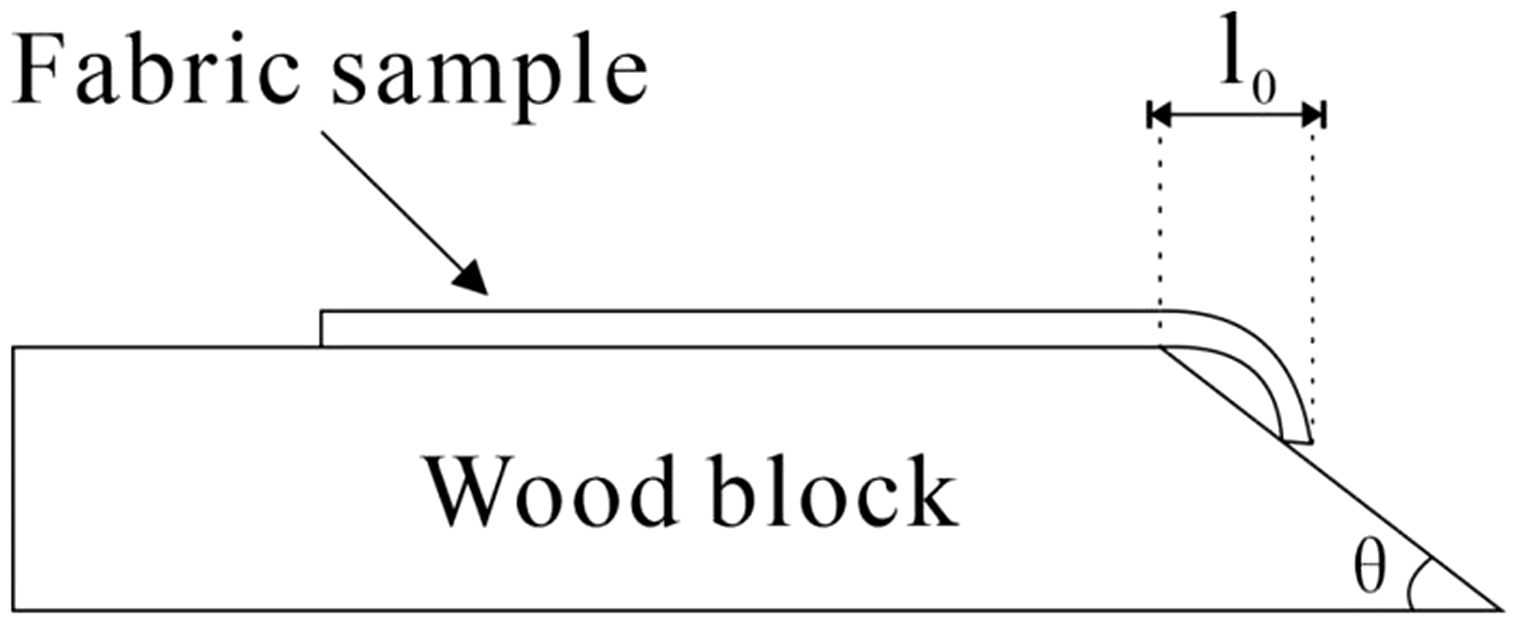
Schematic diagram of fabric flexibility test.
The angle of wood block in this test was 45°, according to equation (1)

The bend stiffness (B) and bending modulus of elasticity (EB) can be calculated by equations (3) and (4).


In which, ω: fabric area weight (g/m2); TF: fabric thickness (mm).
To test the fastness of graphene aerogel on the fabric, the fabric samples (5 × 5 cm) were dried for 2 h at 60°C and the weight was measured. Then the samples were placed in an ultrasonic cleaning machine (contained with deionized water) to oscillate for 2 h. After that the weight was tested again and the weight retention was calculated.
The fabric samples were cut into a dimension of 2 × 1 cm, and both two ends of the sample were affixed by a conductive adhesive electrode. The conductivity resistance (R) was measured by high voltage source table (type 2410, Beijing Saifan Instrument Co. LTD), and the surface resistivity (ρ) of composite fabric was calculated by equation (5)

In which, ρ: surface resistivity (Ω·m)
R: the conductivity resistance value (Ω)
k: geometric factor of the electrode, k = 19.8 in this test.
The electromagnetic interference shielding effectiveness of the composite fabric was examined using a Vector Network Analyzer (MS4644A, Anritsu, Japan) in X-band (8.2–12.4 GHz). The samples were cut into rings with an outer diameter of 7 cm and an inner diameter of 3 cm, the EMI performance were tested by using the coaxial-line method.
Results and discussion
The macro and micro morphology of graphene aerogel composite fabric
Figure 3 exhibited optical photograph of composite fabric with different graphene aerogel contents. In Figure 3(b), it was obvious that when the fabric was coated with 10 mL graphene aerogel, the surface of fabric had a significant appearance change compared to the pure cotton fabric. The surface of the composite fabric with 10 mL graphene aerogel was black, but it was uneven enough since the amount of graphene aerogel was limited to cover the whole surface of the fabric. Moreover, the limited amount of graphene aerogels only formed a conductive network in regional areas of the fabric but not throughout the entire material, which also limited the electromagnetic shielding effectiveness of the material. With the increase of the usage of graphene aerogel, the morphology and luster of the fabric also changed. When the amount of aerogel reached 25 mL and 30 mL, the composite fabric presented uniform black luster similar to that of metal, which indirectly indicated that graphene aerogel had formed a relatively complete conductive network layer on the fabric surface.
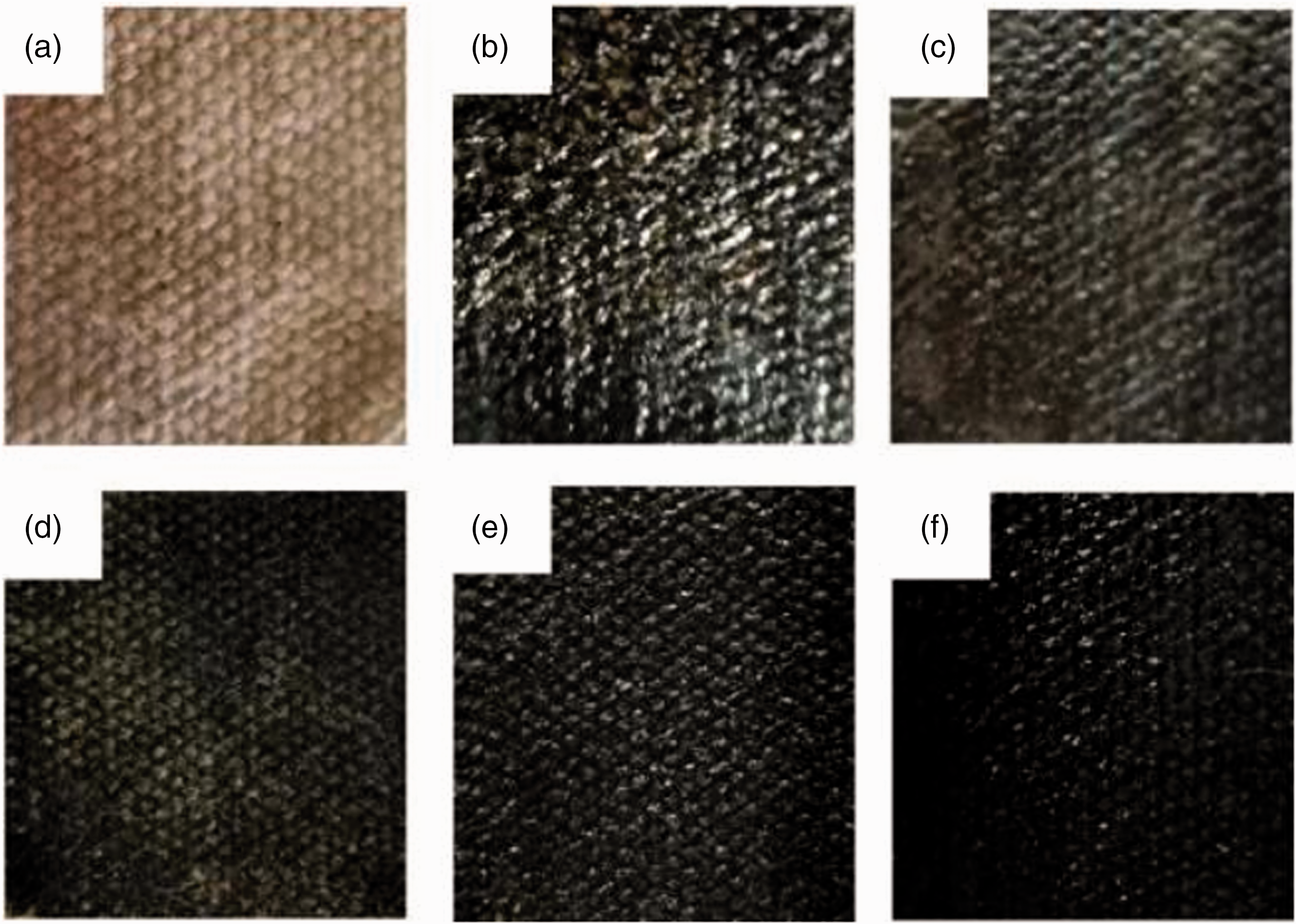
The optical photographs of composite fabric with different graphene aerogel content: (a) cotton fabric; (b) composite fabric: 10 mL/dm2; (c) composite fabric: 15 mL/dm2; (d) composite fabric: 20 mL/dm2; (e) composite fabric: 25 mL/dm2; (f) composite fabric: 30 mL/dm2. (The width of every sample was 1 cm).
SEM images (a), (b) and (c) in Figure 4 exhibited the surface morphology of the composite fabric. It can be seen that the fabric surface was covered by polyurethane polymer, cotton fibers and graphene fragments were dispersed in the WPU layer. Some pores were formed during the process of WPU filled into graphene aerogel. Figure 4(d) showed the morphology of the graphene aerogel before it was filled by WPU. The porous structure of the graphene aerogel was clearly visible, and the electromagnetic shielding performance of the material also benefits from the porous network structure of graphene, which can play a role of reflection and absorption of electromagnetic waves. The cross section exhibits the clear structure of graphene aerogel composite fabric, from Figure 4(e) the composite fabric can be divided into 2 layers, the graphene aerogel layer and cotton fabric layer.

The SEM images of graphene aerogel composite fabric surface and the porous network structure graphene aerogel: (a) graphene aerogel composite fabric with 10 mL graphene aerogel; (b) graphene aerogel composite fabric with 20 mL graphene aerogel; (c) graphene aerogel composite fabric with 30 mL graphene aerogel; (d) the porous architecture of graphene aerogel; (e) cross section diagram of graphene aerogel composite fabric.
X-ray diffraction analyse
As shown in Figure 5, sharp characteristic peaks appeared in the graphite curve at 2θ = 29.02° indicating that the particle size of graphite was large and the crystal was high. While the main peak of graphene oxide moved to the left side at 14.08° and became wider, this indicated the graphitization structure of graphite layer was partially destroyed because of the strong chemical oxidation, since van der Waals force between the graphite piece of interlayers was broken during strong oxidation process. In addition, the oxygen containing functional groups also lead to the increased distance of graphene interlayers. The RGO curve exhibited that the oxygen-containing functional groups on the graphene surface were reduced and the RGO interlayer distance decreased after chemical reduction [20]. At the same time, the regularity of RGO decreased, which caused the peak became lower at 2θ = 28.12°.

The XRD spectrum of graphite, graphene oxide and RGO aerogel.
The influence of waterborne polyurethane (WPU) coating content on the tensile strength of composite fabric
The tensile strength of composite fabric improved with the increased amount of WPU was shown in Figure 5(a). It can be seen that the tensile strength increased linearly in the WPU dosage of 0-15 mL, and it slowed down with further increase of WPU dosage of 20-25 mL. The polyurethane covered on the surface of the composite fabric and caused different yarns to be connected. Therefore, when the fabric was stretched, the slip between fibers would be hindered by the surface polyurethane film, and the polyurethane film itself had mechanical properties and good elongation, which could also reinforce the composite fabric. However, when the polyurethane amount was enough to cover the surface of yarn and fabric completely, the effect of polyurethane on the slip resistance between fibers and yarns was also saturated.
Figure 6(b) exhibited the burst strength tendency with the variation of WPU amount. The burst strength of composite fabric was also enhanced after coating by polyurethane.
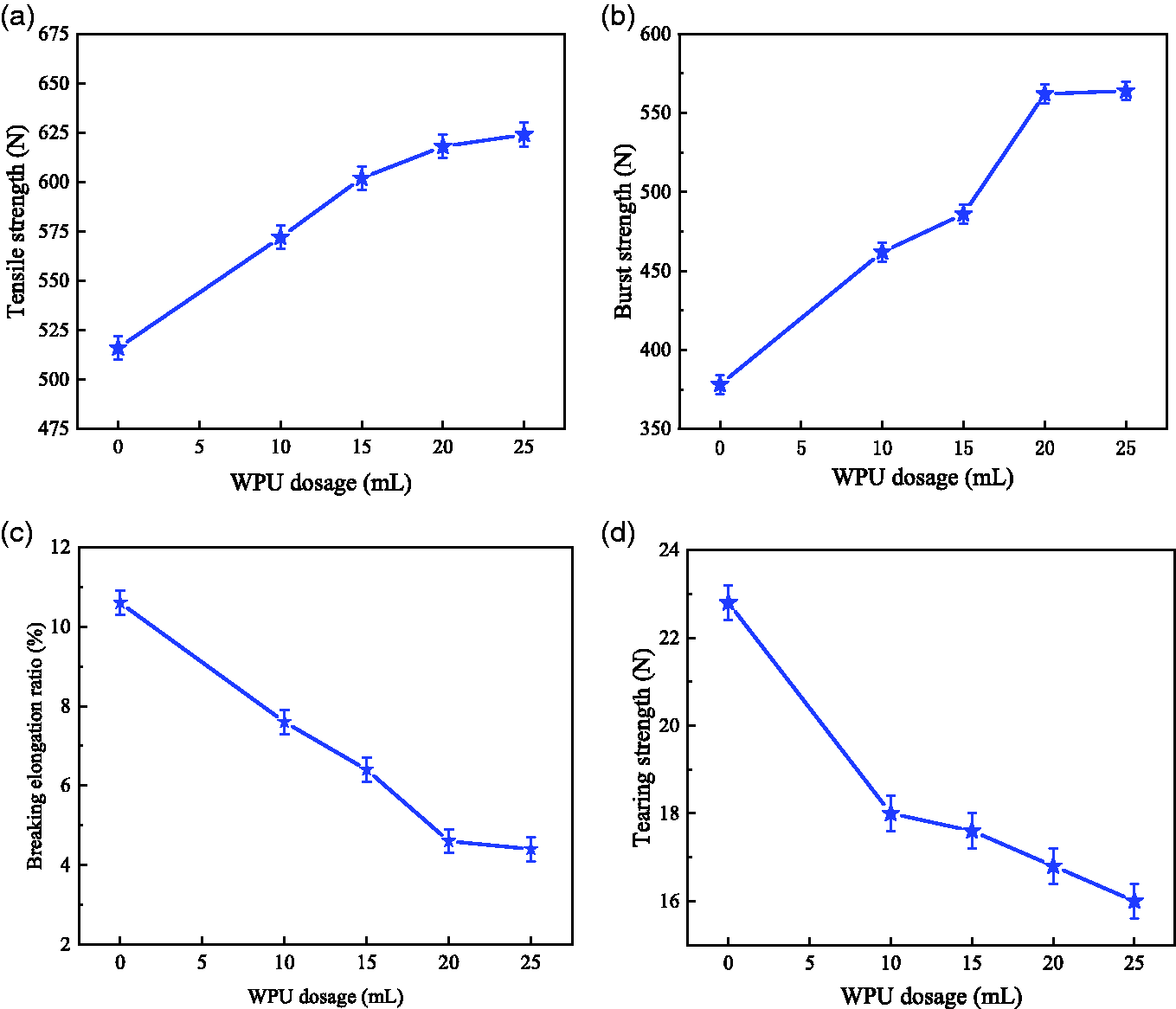
The mechanical properties of the composite fabrics. (a) The tensile strength of the composite fabrics with different WPU amounts; (b) The burst strength of the composite fabrics with different WPU amounts; (c) The breaking elongation ratio of the composite fabrics with different WPU amounts; (d) The tearing strength of the composite fabrics with different WPU amounts.

The flexible properties of the composite fabrics. (a) The bending stiffness of the composite fabrics with different WPU amounts; (b) The bending modulus of elasticity (EB) of the composite fabrics with different WPU amounts.
Since the anisotropic of composite fabric reduced due to the surface cover of polyurethane film. The burst strength value of the composite fabrics with 20 and 25 mL WPU were nearly the same, because it is enough to cover the whole fabric surface when the WPU dosage reached 20 mL. If the WPU dosage increased continuously, the main function of WPU would improve the mechanical property of the fabric by the strength of polyurethane itself. Therefore, when the polyurethane dosage increased to a certain extent, the bursting strength of the fabric did not change significantly.
In contrast, the breaking elongation ratio and tearing strength of composite fabric with different WPU dosage presented a decreased trend with the increased amount of WPU. Since the mechanical mechanism was quite different between these 3 mechanical broken types. The elongation of cotton fabric was limited after covering the polyurethane film on its surface, and the major factor influenced the tearing strength of fabric was the fabric elongation, a bigger elongation lead to the bigger tearing strength of fabric, which caused the reduction of fabric tearing strength.
The influence of waterborne polyurethane (WPU) coating content on the flexibility of composite fabric
Both the bending stiffness and the bending modulus of elasticity were rise with the increase dosage of WPU as shown in Figure 7, which means the fabric was more rigid after coating by the WPU. WPU will be dried and become a thin film applied on the fabric surface. This polymer film makes the fibers and the yarns connected more tightly, which caused the decrease flexibility of the fabric. Although the introduce of WPU has a impact on the fabric flexibility, but the WPU plays a role of protection of the graphene aerogel porous structure and ensure the binding strength between aerogel and cotton fabric. Moreover, the polymer chain of polyurethane is composed by the soft chain of non-crystalline polyester and the hard chain of diisocyanate, which is characterized by crystallinity and can be cross-linked laterally, and the polymer homopolymer with good elasticity, which has ensured the flexibility of fabric.
The influence of WPU dosage on the adhesion fastness of graphene aerogel and cotton fabric
It can be seen from the Figure 8, because of the limitation of WPU dosage, weight retention rate is low when the dosage of waterborne polyurethane was only 10 mL. when the dosage of WPU up to 20 mL retention rate more than 98% and in a stable level, which indicate to guarantee engugh combination fastness of aerogel and fabric, WPU dosage should not be less than 20 mL.

The weight retention of composite fabric with different WPU dosage.
The influence of graphene coating content on the surface resistivity of composite fabric
Figure 9 exhibited that the surface resistivity of composite fabric decreased significantly with the increased amount of graphene aerogel. The cotton fabric without covering graphene aerogel had a biggest surface resistivity of 5.23 × 10⁸ Ω·m, since the main component of cotton fiber is cellulose which is an insulating material. With the increased amount of graphene aerogel, the composite fabric surface resistivity decreased significantly. Because the two-dimensional planar structure of graphene had good conductivity, in addition, the sp2 hybridized carbon atoms facilitates the migration of electrons [21,22], and the conductive network structure of graphene aerogel on the fabric surface was gradually complete [23,24]. When the dosage of the graphene aerogels increased to 25 mL and 30 mL, the composite fabric surface resistivity decreased to 1.21 × 10² and 9.89 × 10 Ω·m respectively,

The surface resistivity of composite fabric with different graphene aerogel amount.
The influence of graphene coating content on the EMI shielding effectiveness of composite fabric
According to the results, it can be found that the composite fabric EMI performance significantly influenced by the surface resistivity value, which is because that the EMI shielding mechanism of composite fabric is mainly based on the dielectric loss. Therefore, the improvement of the conductivity of materials will remarkably improve the electromagnetic shielding performance of materials.
As shown in Figure 10(a), the EMI shielding effectiveness of cotton fabric without graphene aerogel was less than 1 dB, which cannot play the role of electromagnetic shielding at all. Since the main chemical composition of cotton fabric is cellulose which is insulation material.

The EMI shielding property of composite fabric with different graphene aerogel amounts. (a) The total EMI effectiveness (SET) of composite fabric samples; (b) The EMI absorption effectiveness (SEA) of composite fabric samples; (c) The EMI reflection effectiveness (SER) of composite fabric samples.
With the increase of graphene aerogel amount, the EMI shielding performance was significantly improved while the composite fabric samples EMI shielding effectiveness reached in the range of 8.9−9.6 dB and 12.8−14.3 dB, corresponding to that the amount of graphene aerogel were 15 mL and 20 mL, respectively.
When the amount of graphene aerogel further increased to 25 and 30 mL, the electromagnetic shielding effectiveness of composite fabric reached 24.8−26.8 dB and 26.4−28.3 dB, respectively, which exceeded the application standard of civil electromagnetic shielding materials.
And it can be calculated by the following equation [25–27]:

In which, SET: total EMI shielding effectiveness; PI: incident wave power; PT: transmitted wave power
According to the calculated results from equation (6), 99.68% and 99.8% ([(PI−PT)/PI]×100%) electromagnetic waves were shielded by the two composite fabrics, respectively, which were covered by 25 and 30 mL graphene aerogel. The electromagnetic shielding effectiveness of these two samples were exhibited almost the same performance, since 25 mL aerogel was able to effectively cover the fabric surface, and the porous conductive network on the fabric surface was basically constructed and almost saturated absorbed the waves, which caused the excess aerogel did not improve the conductivity and electromagnetic shielding effectiveness significantly. If the sample of 20 mL aerogel is calculated, the composite fabric with excellent electromagnetic shielding performance of 1 m2 only needs 2 g graphite, which greatly reduces the amount of conductive material, saves the preparation cost, and is conducive to the wide use of this material in the future.
The total EMI effectiveness (SET) is consisted by two parts, EMI absorption (SEA) and EMI reflection (SER).

SEA and SER were obtained from calculating the test parameters S11 S21 by the following equations [28,29], as shown in Figure 10(b) and (c).




The EMI effectiveness of composite fabric mainly derived from absorption effectiveness. While, the impedance of the graphene aerogel was almost the same as that of air, it meant that most of waves passed through the interface and were absorbed once the electromagnetic waves reached the surface of the fabric. As shown in Figure 10(c), the electromagnetic wave reflection effectiveness of composite fabrics was at a low level, which was beneficial for avoiding the secondary electromagnetic pollution caused by reflected waves.
Zou et al. [30] prepared a graphene oxide/polyaniline cotton fabric by a layer-by-layer assemblying method, this fabric reached 19.91 dB after 4 times assemble of graphene oxide, which is far below of the EMI value of graphen aerogel composite cotton fabric. Ghosh et al. [31] utilized the silver nanoparticles and graphene to coating on the surface of cotton fabric, after dip coating of graphene and silver for 30 times, the highest EMI shielding value was 27.36 dB in X-band, which is very close to the EMI result of graphene aerogel composite cotton fabric. However, the silver nanoparticles will raise the cost of the material, and the preparation process of dip coating for 30 times is too complicated to apply in a large-scale. Cheng et al. [32] coated the MXene (MXene is also a kind of two-dimensional material and some properties are similar to graphene) on cotton fabric. The EMI shielding property of the MXene-coated cotton fabric reached 31.04 dB when the amount of Mxene was 5.2 mg/cm2. Although the MXene-coated cotton fabric EMI shielding value is higher than the graphene aerogel composite cotton fabric which is 28.3 dB, but the graphene aerogel amount was only 0.53 mg/cm2 (the density of our graphene was 6.6 ± 0.04 mg/cm3) when calculated by weight, which is far lower than the MXene. In conclusion, the graphene aerogel with porous structure and excellent electrical conductivity not only exhibits good electromagnetic shielding effect but also greatly reduced the filler amount, therefore graphene aerogel composite cotton fabric will also has high development potential and application prospect.
Conclusion
In summary, a graphene aerogel electromagnetic interference shielding composite fabric was prepared using graphene aerogel, cotton fabric and waterborne polyurethane. The result showed that when the amount of graphene aerogel is larger than 20 mL, the composite fabric EMI effectiveness exceeds 25 dB in X-band which is a satisfied EMI shielding result. Moreover, with the further increase of the amount of graphene aerogel, the EMI shielding effectiveness is almost changed barely. The waterborne polyurethane improved the tensile strength and bursting strength of composite fabric, however, the tearing strength and flexibility were observed decreased. According to the results from the characterization and tests, it could be concluded that the graphene aerogel EMI shielding fabric successfully solved the problems of agglomeration of nano-carbon materials in composite materials and the high cost caused by the large amount of nano-filler. The composite fabric achieved a good electromagnetic shielding effect. Therefore, it can be believed that this series of materials have the application ability and industrialization possibility in the future.
Footnotes
Declaration of conflicting interests
The author(s) declared no potential conflicts of interest with respect to the research, authorship, and/or publication of this article.
Funding
The author(s) disclosed receipt of the following financial support for the research, authorship, and/or publication of this article: This work was supported by the MOE (Ministry of Education in China) Project of Humanities and Social Sciences (No. 18YJC760051), Transformation of Scientific and Technological Achievements Programs of Higher Education Institutions in Shanxi (TSTAP) (No. 2020CG014), the Postgraduate Education Innovation Project in Shanxi (No. 2020SY466), the Students Innovation and Entrepreneurship Training Program Project of Taiyuan University of Technology (No. 202085) and the Program for the Philosophy and Social Sciences Research of Higher Learning Institutions of Shanxi (PSSR) (No. 201803060).
