




Abstract
The present article highlights a novel approach towards investigating the memory behaviour of shape memory filaments integrated into a knitted textile structure. This study is the first step to investigate the interaction behaviour of such smart materials within textile structures. This integration can further open vast possibilities in designing smart textiles with unique functionalities such as sensing and actuating. A shape memory fabric (SMF) was successfully knitted using shape memory filament and polyester yarn. A systematic investigation is carried out to quantify the memory behaviour of SMF by thermo-mechanical tensile test. The experimental results reveal excellent shape recovery (R r ) (>90%) and good shape fixity (R f ) (∼80%) at strains of 20% and 60%, and temperatures of 30°C and 50°C. Memory filament behaves differently in a fabric structure compared to its pristine state at different temperatures and strains, as confirmed by experimental results. Under various thermo-mechanical conditions, the cyclic test of SMF revealed almost complete R r with an improvement in R f .
Keywords
Introduction
The introduction of high-performance fibres and smart textiles has resulted in the development of innovative textiles with sensing, adapting and reacting capabilities. Current advancements in functional fabrics are primarily motivated by their intriguing mechanical properties.1–4 These fabrics are integrated with multifunctional fibres within conventional fabric architectures like knits, braids, nonwoven and woven.5–10 Knitted functional fabrics are novel architecture capable of utilizing the unique properties of multifunctional materials. 11 Knitted fabrics can be produced relatively easily and quickly at a lower cost as compared to woven fabric. These structures can create functional clothes more efficiently because the loop structure provides good intrinsic elasticity of up to 200%. Knitted fabrics have also been incorporated with shape memory alloys (SMA),12–19 shape memory polymers (SMP),20–26 electroactive polymers, 27 and carbon nanotubes,28–30 as they respond to different stimuli.
Among all multifunctional materials, shape-memory materials have a unique ability to remember the permanent shape after being deformed by the programming process and retrieving the original shape as per requirement using suitable stimuli like heat, light, water and electric.31–35 Literature highlights different approaches towards a new fashion design of shape memory materials with fabrics.36,37 Berzowaska and Coelho constructed two electronic animated dresses as sculpture fashion artifacts that exploit the integration of Nitinol (NiTi) wires into textiles. 38 Most of the shape memory textiles are based on the SMA, but SMP is gaining tremendous research interest due to low cost, low density, high shape recovery, and easy processability. Shape memory polymers can be integrated into textiles by different methods in order to impart shape memory properties to a textile structure. George et al. focused on the fabric designs to enhance and control the aesthetic appeal of woven textile fabrics by using SMA, SMP yarns and SMP coating for specific requirements. They observed that the textile recovers from curled state to a relatively flat state depending on the fabric design and specific training art from external temperature.39,40
The majority of the research in shape memory textiles has been done by using coating and finishing methods.41,42 However, poor washing fastness limits the use of these methods as there is a possibility of SMP peeling away from the fabric surface due to wear and tear. Apart from finishing and coating of SMP on textiles, shape memory textiles can also be prepared by incorporating memory fibres into textile structures in various ways to get the required properties. Scanty literature has been published on the integration of memory filament with knitted structure.43–46 Mı´riam Sa´enz-Pe´rez et al. evaluated the shape memory capabilities of plain knit memory fabrics showing excellent recovery of more than 99.9%. 47 Yan Liu et al. studied the bagging deformation and recovery of SMPU-knitted fabrics at different temperatures. They reported that the bagging behaviour strongly depends on the SMPU fibre transition temperature and the amount of SMPU fibres knitted inside the fabrics.43,48 Limited studies have investigated the shape memory behaviour of fabric structures integrated with shape memory filament. Moreover, the quantification of shape memory performance of shape memory fabric (SMF) is still a challenge.
The present study is focused on designing memory knitted fabric and quantify its shape memory properties under different thermo-mechanical conditions. This study also enlightens combined effect of filament properties and fabric characteristics on the shape memory behaviour of memory knitted fabric under different strains and temperatures. Therefore, it is envisioned that the integration method of shape memory material can serve as a potential for smart wearable technologies.
Material and methods
Material
Specification of yarns used.

Manufacturing of shape memory fabric structure
The main requirement of SMF structures includes the smooth embedding of SMP filament with PET yarn so that it does not protrude from the main body or edges of the fabric. It was also desirable to integrate SMP filament to achieve good memory properties in small-size SMFs. The way for smooth embedding of SMP filament into a knitted structure is a plied structure, in which both yarn and filament make loops. 1×1 rib knitted fabric is produced by two sets of latch needles being alternately gated, as shown in Figure 1(a). Samples were fabricated on a 12-gauge V-bed flat knitting machine by employing one feeder, as shown in Figure 1(b). The feeder has two guide holes (inset Figure 1(c)) for supplying both PET yarn and SMP filament to avoid any tension variation in the feeding materials. Smooth unwinding and constant tension in the feed material are prime requirements for manufacturing a plied structure. Therefore, the SMP filament was wound manually on a cone from cheese package to prevent filament breakage during knitting. Manufacturing of shape memory fabric on flat V-bed knitting machine (a) needle and feeder arrangement, (b) loops formation during the knitting process and (c) filaments passing through the feeder.
Fabric analysis
Loop length is the fundamental unit of knitted structures that controls all properties of the fabric. An entire course comprising 84 loops was unravelled from the fabric sample for measuring the loop length. The crimp of yarn was removed by straightening the same using the Paramount Crimpmaster instrument with 7.44 gms tension. The length of straightened yarn was then measured by a measuring scale. Loop length was calculated using equation (1)
Courses per inch (CPI) and wales per inch (WPI) were counted with the help of a needle and counting glass according to ASTM D8007-15 (2019). Stitch density is the product of course per inch and WPI, and it was calculated by equation (2). Loop shape factor is the ratio of course per inch and WPI, and it was calculated by equation (3)

The areal density (GSM) of samples was tested with the help of an electronic weighing balance, and the thickness of fabric samples was measured by a thickness gauge. The tightness factor shows the level of fabric density, and it is the ratio of the square root of yarn linear density and loop length. The tightness factor was calculated by equation (4)
Characterizations
Tensile behaviour
The tensile properties of rib knitted fabric were tested according to the standard ASTM D5035 on Tinius Olsen H5KS Universal Testing Machine. The tensile properties of PET yarn and SMP filament were tested according to the standard ASTM D2256 on Instron 3365 Universal Testing Machine. SMP filament and PET yarn were also subjected to a tensile test at 30°C and 50°C. The test was carried out at 10 cm gauge length and 50 mm min−1 strain rate. The elastic behaviour of knitted fabric was also measured by elastic recovery. Elastic recovery was calculated by equation (5)
Shape memory behaviour
Figure 2 represents the integration concept of SMP filament with PET yarn into a rib knitted structure in the plied form. Shape memory characteristics were determined by heating, deforming and cooling the memory fabrics and measuring the resulting fixation. (a) SMP-PET plied rib knitted fabric (b) schematic of loop configuration of SMFs.
Thermo-mechanical test was conducted on the tensile testing machine with an attached heating chamber that employed loading and unloading under controlled temperature conditions. The parameters under observation were strain and temperature. The level of strain was selected by results obtained from the tensile test of fabric and filament, while the level of temperature was determined by transition temperature (T
s
) of the SMP filament obtained from the DSC thermogram.
49
There were two levels of temperature (30°C and 50°C) and two levels of strain (20% and 60%) for testing. Figure 3 shows the schematic of sequential steps followed in the thermo-mechanical process for shape memory programming: (i) heating up to the transition temperature, (ii) stretching up to the required strain, (iii) cooling to fix the temporary deformation below 20°C, (iv) lowering the stress value to zero and (v) re-heating up to 60°C to activate the recovery process. Steps (i) to (iv) allowed the fixing of a new temporary shape by freezing the stress in a deformed specimen, while step (v) allowed recovery from the deformed shape to the original shape by releasing the stored frozen stress. Heating was done at a constant rate of 4°C min−1. The gauge length for the specimen was 100 mm, and the cross-head speed was set at 50 mm min−1. Schematic representation of steps for shape memory characterization of SMFs (a) shape memory thermo-mechanical cycle (b) stress-strain behaviour in thermo-mechanical cycle.
Two important shape memory characteristics, namely, shape fixity (R
f
)and shape recovery (R
r)
, were measured by using thermo-mechanical characterization. Shape fixity indicates the ability of the material to retain its temporary shape. Shape recovery determines the ability of a material to attain its original state from a deformed state under the exposure of external stimuli. Shape fixity and shape recovery were measured using equations (6) and (7). Multiple cycles were performed to evaluate the behaviour of R
f
and R
r
under cyclic strains

Results and Discussion
Fabric structure analysis
Constructional parameters of fabric samples.

The change in CPI and WPI ultimately affects the stitch density and loop shape factor. Stitch density and loop shape factor are both increasing in SMF with respect to PBF. The areal density of SMF is higher than PBF because of the presence of SMP filaments in the structure. Also, the areal density of the fabric is increasing with an increase in stitch density. The tightness factor is increased for SMF as compared to PBF due to the presence of SMP filament in the structure. The point diagram shows the pattern of integration of SMP filament with PET yarn in a knitted fabric platform. Microscopic images of PBF and SMF show the loop shape in both conditions.
Mechanical properties
The stress–strain behaviour of PET yarn and SMP filament is shown in Figure 4(a) and results are tabulated in Table 3. From Figure 4(a) and Table 3 it is observed that, PET is less extensible while SMP is highly extensible in nature. PET and SMP filaments show the breaking strain 23.67% and 84.71%, respectively. Breaking stress for PET and SMP is observed at 8.42 MPa and 1.84 MPa, respectively. Figure 4(b) shows the stress–strain behaviour of PBF and SMF and results are tabulated in Table 3. Both PBF and SMF fabrics shows almost similar stress–strain behaviour. However, SMF shows nominal increase in stress and strain at first breaking point, that is, at 112% and 130% in PBF and SMF, respectively, and after that, loops started breaking continuously. The value of modulus for PBF and SMF is 0.00,594 MPa and 0.00,603 MPa, respectively, which are almost equal. There is no significant change is observed in the tensile behaviour of PBF and SMF. From the inset Figure 4(b), it is visible that the stress increases abruptly with a non-linear profile after 60% strain for both PBF and SMF. Therefore, the strain applied to the fabric during shape memory behaviour testing should not be more than 60%. Moreover, PBF and SMF show the elastic behaviour before 60% strain, so it is good to consider the applied strain range below this elastic limit of the fabric. Stress–strain curve for (a) SMP filament and PET yarn, and (b) PET rib knitted fabric (PBF) and SMP-PET rib knitted fabric (SMF). Mechanical properties of yarn and fabric samples.
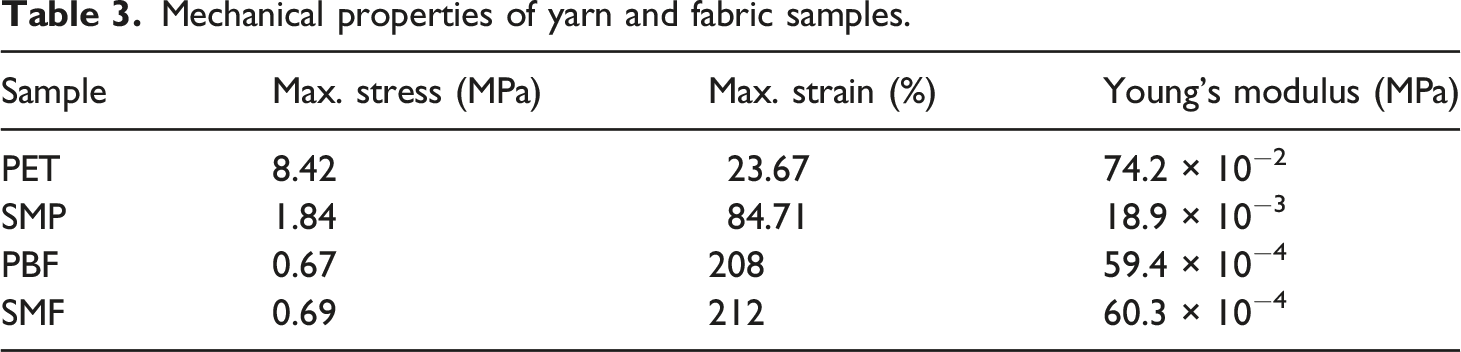
Figure 5 and Table 4 illustrate the effect of temperature on the stress–strain behaviour of PET multifilament yarn and SMP filament at 30°C and 50°C. From Figure 5(a), it is observed that the modulus of PET decreases from 0.68 MPa at 30°C to 0.457 MPa at 50°C. Breaking stress and breaking strain of PET is 8.627 MPa and 52%, respectively, at 30°C, while at 50°C, breaking stress and breaking strain is 6.812 MPa and 36%, respectively. From Figure 5(b) the modulus of SMP filament is observed at about 0.00,546 MPa at 30°C and 0.00,462 MPa at 50°C. Breaking stress and breaking strain of SMP filament is 0.995 MPa and 170% at 30°C, while at 50°C, breaking stress and breaking strain are 0.551 MPa and 163%, respectively. The reason for the reduction in breaking stress and breaking strain at a higher temperature is the higher molecular mobility of polymer chains, and due to this, filament deformation and breakage occur at a low level of stress and strain. Stress–strain curve depicting the effect of temperature on the mechanical behaviour of (a) PET yarn and (b) SMP filament. Effect of temperature on mechanical properties of yarns.

Shape memory properties
Effect of temperature
The effect of temperature on the R
f
and R
r
of SMF is depicted in Figure 6. From Figures 6(a) and (c), it is observed that the R
f
at 50°C is higher than the R
f
at 30°C for different strain levels (20% and 60%). This is because, at a higher temperature, the SMP filament gets softer and deforms easily than at a lower temperature. Due to this, at the time of cooling, a higher temperature deformed structure is easily fixed than that of a lower temperature deformed structure. R
f
and R
r
are both observed to increase with the number of cycles. From Figures 6(b) and (d), it is observed that R
r
is almost 100% for all the conditions after the first cycle. In the first cycle, there is permanent deformation in the fabric structure which is not recoverable; thus, the recovery is not 100%. After the first cycle, the permanent deformation has vanished, and therefore, in the subsequent cycles, the fabric shows 100% R
r
. The statistical analysis (ANOVA: Single Factor) was performed to comment on the level of significance for the different observed values. Effect of temperature is highly significant at 60% strain for R
f
at 95% confidence level with p value 0.002 (p value <0.05), whereas, not significant at 20% strain with p value 0.154 (p value > 0.05). However, no significant effect of temperature is observed for R
r
at 20% and 60% strain with p value 0.666 and 0.446, respectively (p value > 0.05). Effect of temperature on shape fixity at (a) 20% strain and (c) 60% strain, and shape recovery at (b) 20% strain and (d) 60% strain of SMF.
Figures 7(a) and (b) show the effect of temperature on cyclic behaviour as well as stress behaviour of SMF at 30°C 20% strain and 50°C 20% strain. It is found that the stress of SMF increased with an increase in strain applied by an external force. At maximum strain, stress is reducing with time, and SMF is getting fixed to a deformed shape. Once the external force is removed, the stress of SMF is zero, and at this time, the temporary shape of SMF is regained. On increasing the temperature, SMF tries to recover to its original length. It can be seen from Figures 7(a) and (b), keeping the maximum strain Cyclic behaviour of SMF under different thermo-mechanical conditions (a) 30°C 20% strain (b) 50°C 20% strain, (c) 30°C 60% strain, and (d) 50°C 60% strain.
Effect of strain
The effect of strain on R
f
and R
r
of SMF is depicted in Figure 8. From Figures 8(a) and (c), it is observed that the R
f
at 60% strain is higher than the R
f
at 20% strain for different temperatures (30°C and 50°C). This is because, at higher strain, the fabric gets higher deformation to fix than that at the lower strain. Due to this, at the time of cooling, a higher strain deformed structure having a higher length for fixing of structure than that of a lower strain deformed structure. Moreover, fabric deforms more at higher strain as compared to at lower strain for same time cooling. Thus, higher strain leads to freezing of more deformation, whereas lower strain leads to the freezing of lower deformation. Rf and R
r
are both observed to increase with respect to the number of cycles. From Figures 8(b) and (d), it is observed that R
r
is almost 100% for all the conditions after the first cycle. For the first cycle, as aforementioned, there is permanent deformation in the fabric structure which is not recoverable and is not observed after the first cycle. Therefore, except for the first cycle, the fabric shows 100% R
r
. Effect of strain on shape fixity at (a) 30°C and (c) 50°C, and shape recovery at (b) 30°C and (d) 50°C of SMF.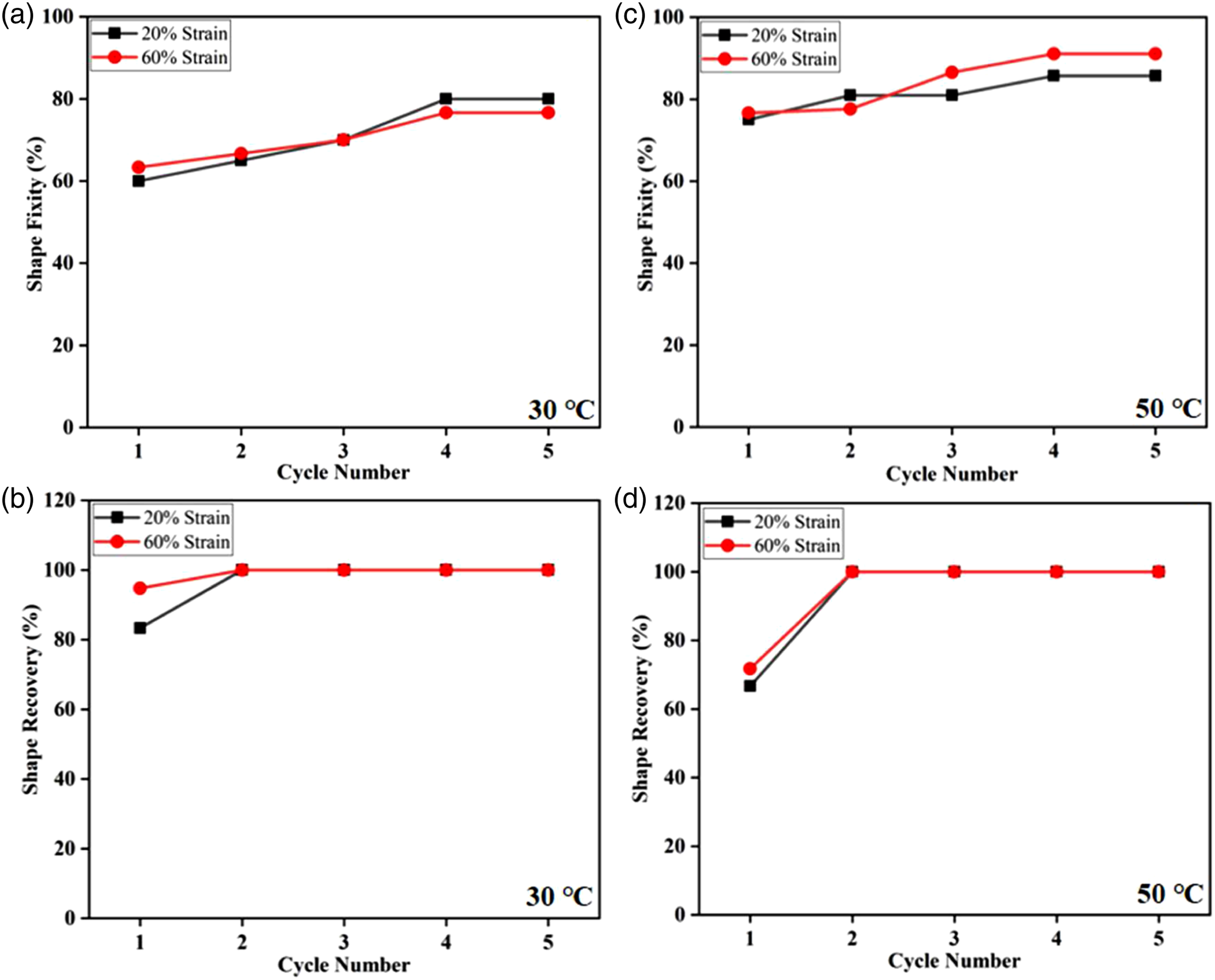
Figures 7(a) and (c) show the effect of strain on cyclic behaviour as well as stress behaviour of SMFs at 30°C 20% strain and 30°C 60% strain. It is observed that the stress of SMFs increases with an increase in a strain that is applied by an external force. At maximum strain, stress is reducing with time, and SMFs are getting fixed to deformed shape. Once the external force is removed, the stress of SMFs is zero, and at this time, the temporary shape of SMFs is received. On increasing the temperature, SMFs try to recover to their original length. It can be seen from Figures 7(a) and (c), keeping the maximum strain
Shape memory filament versus Shape memory fabric
Shape memory properties of SMP filament (memory filament) and SMP filament integrated PET rib knitted fabrics (memory fabric) are analysed at different thermo-mechanical conditions. Figure 9 shows the behaviour of SMP filament into a rib-knitted structure in different thermo–mechanical conditions. In each situation, memory fabric shows higher R
f
than that of memory filament except 30°C 60% strain, where a reduction in R
f
is observed for memory fabric with respect to R
f
of memory filament. Shape memory of memory filament and memory fabrics under different conditions (a) 30°C 20% strain, (b) 30°C 60% strain, (c) 50°C 20% strain, and (d) 50°C 60% strain.
For 30°C 20% strain, R f and R r of filament are observed 57.9% and 99.6%, respectively, while in the case of fabric, R f and R r are observed 67.8% and 93.8%, as shown in Figure 9(a). An increase of 17.1% in R f and a reduction of 5.8% in R r are observed in the case of fabric compared to that of filament. For 30°C 60% strain, R f and R r of filament is observed to be 74.7% and 99.2%, respectively, while in the case of fabric, R f and R r are observed to be 62.6% and 93.7%, respectively, as shown in Figure 9(b). A reduction of 16.2% in R f and 5.5% in R r is observed as compared to the filament.
Statistical analysis at 95% confidence level for shape fixity and shape recovery of filament and fabric.

The stress–strain behaviour of memory fabrics is evaluated at different temperatures and strains in Figure 10(a). Each cycle shows the change in fixed strain and stress behaviour due to different thermo-mechanical conditions. The R
f
of memory fabrics compared to memory filament is affected by the R
f
of PBF. From Figure 10(b), it is observed that PBF shows higher R
f
at higher temperature and strains. The reduction in R
r
is due to the presence of PET yarn with SMP filament in the fabric structure. PET yarn shows very less extensibility (24%) than that of SMP filament (85%), as shown in Figure 4. Moreover, PBF shows higher permanent deformation and lower elastic recovery at higher temperature and strain, as shown in Figures 10(c) and (d). This permanent deformation of PBFs is responsible for reducing R
r
and increasing R
f
of memory fabrics than memory filament. (a) First thermo-mechanical cycle of SMF under different conditions, (b) shape fixity of PET bare fabric, (c) permanent deformation of PET bare fabric (d) recovery of PET bare fabric.
The change in R
f
and R
r
from the filament to the fabric stage also depends on the state of memory filament in both conditions. Considering the state of filament, it is in a straight form in the pristine stage while loop form in the fabric stage, as shown in Figures 11(a) and (b). For the same length of samples, that is, 10 cm, filament length is higher in fabric state, that is, 17 cm, due to loop structure. This increase in filament length in fabric structure further affects the deformation length in both situations when samples are subjected to the same amount of strain-induced deformation. It is, therefore, concluded that the increase in length of memory filament helps in increasing the R
f
and the R
r
of memory fabrics. Loop structure at the different strains in (a) memory fabric, and (b) schematic representation of memory filament in pristine and fabric form.
Potential applications of SMF
Shape memory polymers can be employed to demonstrate the memory effect from textile structures. It can be used to create smart textiles that respond to change in temperature. The unique ability of these smart textiles to change structure and properties quickly and reversibly in response to relative changes in the environment is what makes them so appealing. These smart textiles provide additional benefits to innovative and traditional interiors by performing as decorative features and functional textiles, as shown in Figure 12. A thermally sensitive shape memory polyurethane filament that can be easily inserted into fabric structures has the potential to be used in functional textiles, medical textiles, pressure garments, compression stockings, elegant curtains, fashion areas and other applications. The selection of the fabric design and its structural engineering should be therefore optimized for the development of active garments. Multifunctional properties of textiles integrated with stimulus-responsive polymers.
Conclusions
This study reports a novel method for integrating SMP filament with PET yarn in rib knitted structure to produce memory fabrics using a V-bed knitting machine. It can be observed that the appearance of SMF is the same as PBF, with minimal changes in structural parameters. The mechanical properties of PET yarn and SMP filament show that SMP filament is highly extensible while PET yarn has high breaking stress with low breaking strain. Temperature also affects the tensile behaviour of SMP filament and PET yarn, as evidenced by a decrease in the modulus of PET yarn and SMP filament at higher temperatures. PET bare fabric shows elastic behaviour before 70% strain with higher extensibility up to the breaking extension of 310%. Furthermore, the extensibility of knit construction has limited the working strain range for the SMP filament in the structure. A thermo-mechanical test quantified the shape memory effect of SMF. Shape memory fabric shows 60%–80% shape fixity (Rf) with more than 90% shape recovery (R r ) under different temperatures and strains.
Moreover, SMF shows higher R f with reduced R r as compared to pristine SMP filament. The thermo-mechanical cyclic test shows that the stress-strain curve becomes similar and reproducible with an increased number of cycles. An increase in R f is observed after each cycle, with constant R r after the first cycle. Hence, thermally sensitive SMP filament could be easily integrated into knitted textile structures to fabricate SMF with the adaptive features of memory filament and the yarn. These integrated SMF have the potential to be used in numerous applications at different thermo–mechanical conditions.
Footnotes
Acknowledgements
The authors would like to thank the financial assistance of the Ministry of Human Resource Development, India, and the Department of Science and Technology, India.
Declaration of conflicting interests
The author(s) declared no potential conflicts of interest with respect to the research, authorship, and/or publication of this article.
Funding
The author(s) received no financial support for the research, authorship, and/or publication of this article.
