




Abstract
The mechanical properties and biocompatibility of hernia repair mesh have been difficult to achieve an optimal balance. In this paper, polypropylene (PP)/Poly(glycolide-ε-caprolactone) (PGCL) partially degradable hernia repair meshes were prepared through the warp-knitting process and its advantages were demonstrated. Basic properties of the materials and the mechanical properties of the meshes were tested and compared. Furthermore, in vitro accelerated degradation tests were performed on meshes (E14) by using five kinds of alkali solution. The degradation effect was reflected by the apparent morphologic change, weight, and strength loss rate of the mesh. The results show that the mesh has excellent mechanical properties, and accelerated degradation in vitro provides degradation results quickly. Among them, the degradation situation of meshes in Na2CO3 solution was more similar to that of phosphate buffered solution solution. The PP skeleton of mesh remains relatively stable after the degradation of PGCL, and the residual strength can still meet the clinical requirements. This study presents a promising step for the preparation and subsequent degradation of partially degradable hernia repair mesh.
Keywords
Introduction
Hernia is a condition caused by the protrusion of interior body tissues or organs from the abdominal wall, groin, or other parts of the body. It occurs mostly in children and the elderly, and tens of millions of people suffer from hernias each year. 1 A common clinical approach to hernia repair is to patch and strengthen the damaged gap by using an artificial mesh that is larger than the hernia gap. The principle is to resist the pressure within the tissue by strengthening the support and creating a crusted tissue that is elastic and conforms to the body’s structure. This method overcomes the disadvantages of traditional suturing procedures, with low pain, short recovery time and low recurrence rate. 2 The hernia repair mesh plays a very important role in the surgery, 3 if the mesh is not strong enough, it may break and lead to the failure of surgery. In addition, it can also affect patients’ discomfort and postoperative quality of life.
Currently, artificial hernia meshes that have been widely used internationally are divided into two main categories 4 : non-absorbable meshes and composite meshes. Polypropylene (PP) has been the most popular material used for non-absorbable patches for decades, due to the very stable mechanical properties of pure PP mesh and the fact that it is not costly. 5 However, as patients demand more comfort in surgery, lighter weight, less inflammatory and adhesive materials are sought. 6 Previously, PP meshes were post-treated to modulate their biological properties. For example, anti-adhesive and antibacterial effects were obtained by nanofiber coating, plasma treatment of the mesh surface or loading the mesh surface with antimicrobial peptides.7–9 However, due to some drawbacks such as the difficulty of stable retention of these coating substances and the treatment methods that damage the mechanical properties of PP meshes, the use effect often fails to meet expectations. 10 Gradually, repair meshes using non-absorbable materials and other biodegradable polymer materials have been developed to obtain composite hernia repair meshes with both excellent mechanical properties and biocompatibility. Composite meshes usually retain the good physical properties of non-absorbable meshes while giving them the biological properties of absorbable materials. After the partially biodegradable patch is implanted into the human body, its pore size is small in the early stage, which provides more contact points for tissue cell growth. As the degradable portion is gradually absorbed by the body, the mesh porosity increases, releasing more space for cell growth. 11 The contact surface between the mesh and the tissue has a better environment for cell growth into the tissue, which is conducive to the patient’s post-surgical recovery.12–14 Therefore, the development and research of composite patches has attracted great interest. Polylactic acid is often used as a degradable raw material, but it has been limited to be widely used due to its long degradation time.15,16 Poly(glycolide-ε-caprolactone) (PGCL) copolymer is an aliphatic polymer that has been widely used in the medical field for its good biocompatibility, excellent degradability, and durable mechanical properties. 17 It can be decomposed into small molecules by hydrolysis, with decreasing molecular weight and gradual weight loss of the material, which is then absorbed and excreted by the body. It has been commonly used to produce surgical sutures, drug-controlled release carriers and tissue engineering materials.18–20 However, the research on the performance of composite hernia repair mesh prepared by PP and PGCL has not been reported.
In this paper, PP/PGCL composite repair mesh was produced using a warp-knitting process due to its compact and stable structure and the appropriate adjustable aperture size, etc. 21 Then, essential is the mechanical characterization of the repair mesh, 22 and obviously, the mesh needs to have sufficient tensile strength. The tensile direction of the mesh also needs to be considered due to the anisotropy of the mesh and the muscle of the abdominal wall.23,24 The bursting experimental method was considered as a suitable method to evaluate the mechanical properties of hernia patches, 25 since its pattern is very similar to the physiological conditions of the abdominal wall under intra-abdominal pressure. Not only that, in vitro degradation experiments are also one of the key items to be evaluated.26,27 In vitro degradation can predict the degradation behavior of the material in vivo, and performing in vitro degradation experiments before animal experiments can be cost-effective. Also, due to the long time period of in vitro real-time degradation, this paper focuses on evaluating the degradation of mesh by accelerated in vitro degradation. 28 There are no special studies or standards for degradation experiments using this method, and the innovation of this paper is to perform accelerated degradation in vitro by simulating the alkaline environment of body fluids with five alkaline solutions. It can provide a theoretical basis for the production and evaluation of PP/PGCL composite meshes.
Materials and experimental
Materials
Poly(glycolide-ε-caprolactone) monofilaments and PP monofilaments were used in this study to fabricate the hernia repair mesh. Phosphate buffered solution (PBS), sodium hydroxide (NaOH), and sodium carbonate (Na2CO3) were purchased from Sinopharm Chemical Reagent Co., Ltd. Shanghai, China. All reagents were used as purchased without further purification, and degradation aqueous solutions were prepared with deionized water.
Fabrication
The structure of the mesh is particularly important,
29
so the organization of the mesh was designed according to the characteristics of the raw materials used, combined with the performance requirements of the hernia repair mesh. First, the same as ordinary mesh, thickness, size stability, and strength need to be considered. In addition, the location and proportion of PGCL monofilaments should be reasonably arranged to maximize their degradable performance. By the design of fabric organization, the position of PGCL monofilaments are arranged reasonably so that it will not be wrapped inside the PP monofilaments. Thus it can be in uniform contact with the solution during the degradation process. Moreover, after the complete degradation of PGCL, the residual mesh part should still retain sufficient strength and support action. The tissue structure can be clearly seen in the fabric simulation image (Figure 1). Five guide bars were used to fabricate, GB1-3 were PP monofilaments, and they were used as the basic skeleton of the mesh sheet with pillar stitch and inlay organization (thin loops). GB4 and GB5 were two colors of PGCL monofilaments, purple and beige, respectively. They were inserted into the PP skeleton through the warp in inlay manner. (a) Fabric simulation image of mesh (* The annotations are as follows: thin-PP, red -beige PGCL, blue-purple PGCL); (b) and (c) Optical microscope (OM) image of mesh.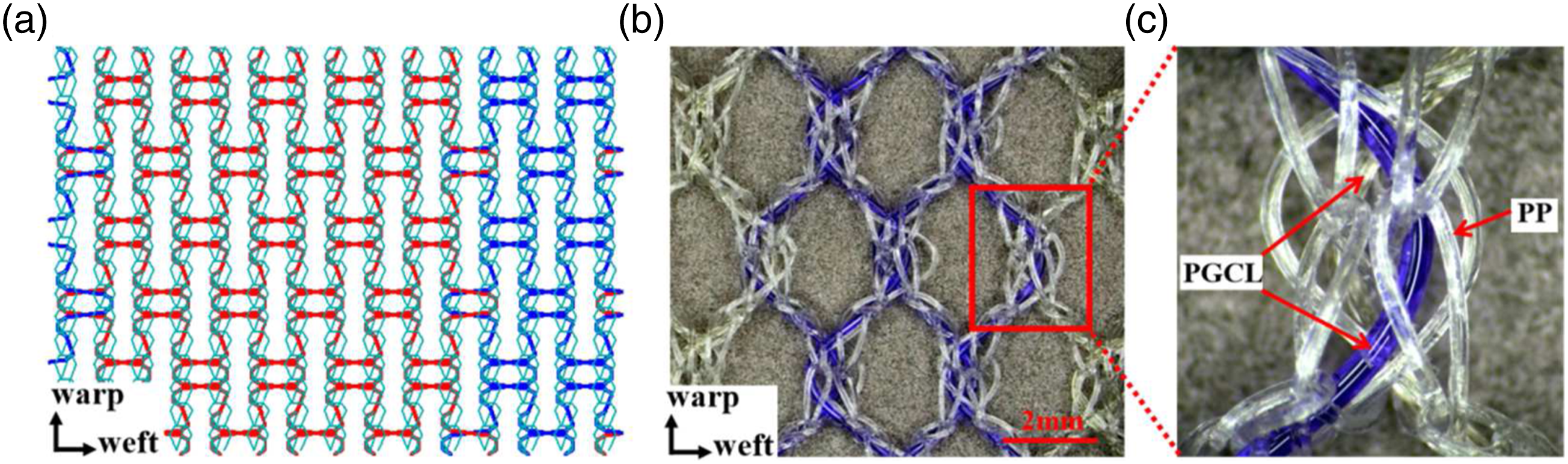
Technological parameters of two kinds of PP/PGCL meshes.

awhere A, B, and C represent PP, purple and beige PGCL, respectively.
bmeans non-threading.
Characterizations
All samples were conditioned for 24 h at the standard atmospheric environment with a temperature of 20 ± 2°C and relative humidity of 65 ± 2% before testing.
Monofilament quality
First, the linear density of monofilaments was test based on the standard of GB/T 4743-1995 Textiles-Yarn from packages-determination of linear density (mass per unit length) by the skein method. The quality of the yarn can be reflected by breaking strength and elongation at break. According to the standard of GB/T3916-2013, textile reel yarns-Determination of breaking strength and elongation at break of single yarn (CRE method) and the breaking strength and elongation at break of monofilaments were tested using an XL-2 yarn tensile tester (Shanghai Xinxian Instrument Co., Ltd, Shanghai, China). The gap between the upper and lower chucks was 250 mm with a pretension of 1 cN, and the speed was 500 mm/min. All the measurements were taken 10 times and were averaged.
X-ray diffraction and FTIR test
Cut monofilaments into 2 mm particles for the X-ray diffraction (XRD) analysis. The XRD measurements were conducted on a D2 PHASER X-ray diffractometer (Bruck AXS GMBH, Karlsruhe, Germany). CuKα radiation generated at a voltage of 40 kV and current of 40 mA was utilized. The scanning range varied from 5° to 50° and the scanning speed was 0.02° 2θ step size and 0.2 s time/step.
Fourier transform infrared spectroscopy (FTIR) spectra was acquired using a spectrometer (Nicolet iS10, Thermo Fisher Scientific (China) Co., Ltd, USA) over the range of 500–4000 cm−1, The scanning resolution is 0.05 cm−1.
Morphology
Morphology of PP/PGCL mesh before and after degradation was measured by using an optical microscope (RX20-9108, Runxing Optical Instrument Co., Ltd, Shenzhen, Guangdong, China).
Mechanical properties of mesh
Uniaxial tensile test
Uniaxial tensile properties of PP/PGCL meshes were measured and tensile load-Displacement curves were obtained by MTS Exceed E43 (MTS Systems (China) Co., Ltd, Guangzhou, Guangdong, China). This test is used to ascertain the warp and weft strength of the fabric because the warp-knitted fabric tensile properties show the greatest difference between the warp and weft directions, and it is representative to choose these two directions for uniaxial tensile tests. This method is made on the standard of GB/T3923.1-1997 Textiles-Tensile properties of fabrics-Part 1: Determination of breaking force and elongation at breaking force-Strip method. There were five samples with a size of 200 mm × 50 mm from two kinds of mesh, cut in the warp and weft direction, respectively. The sample was stretched at a constant speed of 100 mm/min until it broke, clamping length was 150 mm, and the pretension was 2 N.
Bursting test
Bursting refers to the phenomenon in which the fabric expands and gradually destroys under the external force perpendicular to the fabric plane, is one of the key parameters used to evaluate the clinical applicability of the mesh. 30 When the mesh was implanted, it is susceptible to compressive pressure from the abdominal tissue if the patient takes some actions such as bending, walking, and coughing. The damage of mesh will result in the surgical failure and high recurrence rate. According to the standard of GB/T19976-2005 Determination of bursting strength of textiles-steel ball method, the bursting strength of meshes was tested by the HD026N+ electronic fabric strength tester. Five samples were prepared with a size of 60 mm diameter. The clamping distance was 350 mm with a speed of 300 mm/min.
In vitro accelerated degradation test
Degradation method
Five different in vitro degradation solutions were prepared for this study, they were phosphate buffered solution (PBS, pH = 7.4), 2.5% sodium carbonate solution (2.5 g Na2CO3 powder was weighed and dissolved in water and slowly stirred and fixed into 100 mL solution), 0.5%, 1.5%, and 2.5% sodium hydroxide solutions (0.5 g, 2.5 g, and 1.5 g of NaOH powder were dissolved in water and stirred to fix the volume to 100 mL of solution).
First, the samples were cropped into sizes of 50 mm × 50 mm and 40 mm × 100 mm. To clean the oil and impurities adhered to the mesh during the knitting process, the samples were placed in a beaker with deionized water, washed by shaking for 3 min using an ultrasonic cleaner (KH-400KDE Ultrasonic Cleaner, Kunshan Hechuang Ultrasonic Instrument Co., Ltd, Jiangsu, China), followed by washing in anhydrous ethanol for 60 s, and the residual liquid on the samples was blotted out with filter paper, weighed after dried for 12 h. Next, the cleaned samples were put into reagent bottles with five kinds of degradation solutions, and all reagent bottles were placed in a constant temperature incubator at 37°C, and the caps were tightened to prevent the concentration of the solution from evaporating, and the samples were taken out periodically for cleaning and testing after the experiments started. Samples in NaOH solution were taken every 2 days, and those in Na2CO3 solution and PBS solution were taken every 4 days.
Surface morphology
The samples of 50 mm × 50 mm size were magnified and photographed with an optical microscope. Since some of the PGCL monofilaments were purple, the degradation process could be observed by comparison with the color change of the mesh.
Weight loss rate
The degree of degradation was assessed based on the percentage reduction in mass of the same sample of 50 mm × 50 mm size. The weight of the sample after washing and drying was recorded as W1. Once the specified time was reached, the samples were removed. Rinsing and drying were performed and weighed as W2. Weight loss rate was calculated as following equation
Strength loss rate
Since the tensile strength test is a destructive test of the mesh, the strength loss rate cannot be compared to the same sample like the weight loss rate. However, because the samples came from the same piece of fabric and care was taken to control the cutting position during sample preparation, all samples used for strength testing were from the same longitudinal row of the fabric. It also ensured that the amount of PGCL in the sample was maintained at a medium value. Two types of samples cutting were shown in Figure 2. For samples of size 40 mm × 100 mm, the breaking strength was measured after removal from the degradation solution at the specified time, as described in 2.4.1. The clamping spacing was changed to 80 mm, and the stretching speed was set to 100 mm/min with a preload of 2 N. The strength loss rate was calculated according to equation Diagram of sample cutting method.

Results and discussion
Basic properties of PGCL monofilament
Properties of the monofilaments.

X-ray diffraction and FTIR test
As shown in Figure 3(a), around 1378 cm−1 is the symmetrical deformation vibration absorption peak of -CH3 in PP; and around 1456 cm−1 is the bending vibration peak of -CH2-; there are four sharp peaks in the range of 2800–2960 cm−1 for the stretching vibration of -CH2- and -CH3.
31
PGCL has a C–O telescopic vibration absorption peak around 1188 cm−1; a hydroxyl -OH bending vibration peak around 1380 cm−1; the absorption peak around 1750 cm−1 was a carbonyl C=O telescopic vibration; and telescopic vibration peaks of C–H around 2945 cm −1 and 2858 cm−1.
32
(a) FTIR spectra; (b) X-ray diffraction curve of PGCL and PP monofilaments.
In Figure 3(b), the XRD curve of PP appeared four major diffraction peaks in the 2θ angle range of 10°–25°, and the peaks were high and sharp. It indicated that the PP monofilaments were highly crystalline and firmly connected between the macromolecules, thus the structure and properties were stable. Comparatively, PGCL had only two lower peaks around 22.72° and 29.28°, thus making it susceptible to degradation. 33
Properties of mesh
Basic performance
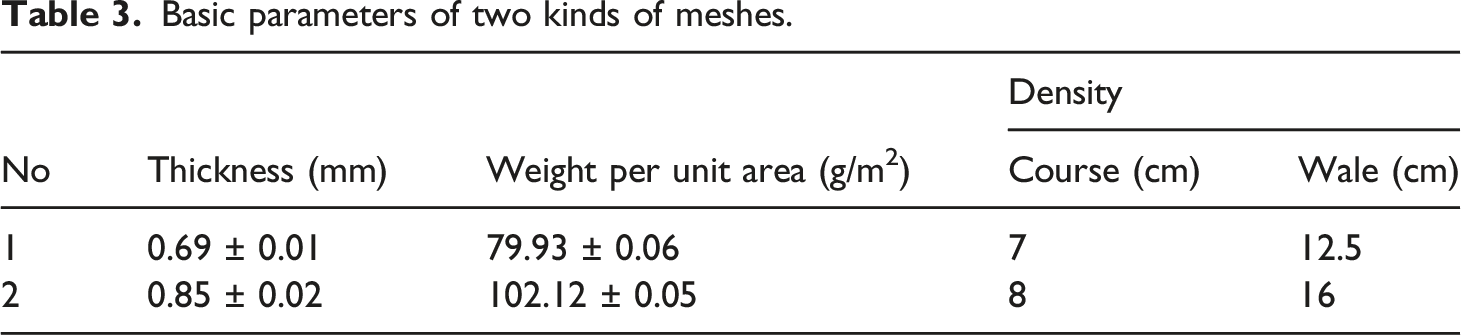
Basic parameters of two kinds of meshes.
Mechanical properties
Once implanted in the body, the primary role of the repair mesh is to support the body’s tissues, resist internal stress, and support new tissue growth. The mesh needs to be strong enough to resist breakage to cope with the patient’s daily movements. Since the mesh is connected to the body tissue by sutures, the tensile fracture property is also an important point to evaluate the mechanical properties of the repair mesh. The tensile properties of the two sizes of repair meshes are shown in Figure 4. Tensile properties of two kinds of mesh. (a)Warp; and (b)Weft tensile fracture; (c) Warp; and (d) Weft tensile curve.
Figure 4(a) and (b) show the morphology of the repair net when it is stretched along the warp and weft directions, respectively. It can be seen that the edges of the sample are rapidly taut and concave inward on both sides at the beginning of stretching because the edge was incomplete when it was cut. In addition, due to the characteristics of warp-knitted fabrics, the monofilaments in the repair net are arranged along the longitudinal direction of the fabric. In warp stretching, the main reason for breakage is the breakage of monofilaments, and the unbroken part still maintains a relatively good fabric shape. As for the weft stretching, it is obvious that there is a separation between the longitudinal rows of the fabric, it is because the connection between the longitudinal rows of the fabric is mainly undertaken by the inlay yarn, and the strength of inlay is not as strong as it provided by the loops. And the overall structure is completely destroyed, accompanied by monofilament breakage.
The tensile curves also show the difference when the mesh was stretched in the warp and weft directions. In Figure 4(c) and (d), the warp stretching curves have many small and frequent fluctuations, which are formed by the asynchronous breakage of the monofilaments. In contrast, the fracture process in the weft direction has no obvious fluctuations and the curve is relatively smooth. Since the breaking strength and elongation of PGCL are higher than those of PP, the fabric’s tensile breaking strength in the warp direction is almost 10 times higher than that in the weft direction, but the elasticity in the weft direction performs better.
Bursting properties of meshes.

Combining the basic and mechanical properties of the two sizes of samples, the strength of E14 has fully met the needs of the repair network application, which is lighter and thinner, so the samples of E14 were used in the subsequent in vitro accelerated degradation experiment in this study.
Evaluation of in vitro accelerated degradation experiment
Changes of mesh appearance
In this paper, the accelerated degradation in vitro is to perform by simulating the alkaline environment of body fluids with five alkaline solutions. In the in vitro accelerated degradation experiment of PP/PGCL repair mesh, samples in each degradation solution were removed at a specific time, and macroscopic photographs of the samples were taken (Figure 5). It can be clearly seen that the degradation rates of the samples in the five degradation solutions differed significantly. The purple part of the monofilament in the repair net can provide a basis for judgment. As the number of degradation days increases, the purple area of the sample in the figure gradually decreases and the color becomes lighter until it turns to completely white. Representative macro-photos of PP/PGCL repair meshes at different degradation days: (a) Phosphate buffered solution; (b) Na2CO3; (c)–(e) NaOH solutions with concentrations of 0.5%, 1.5%, and 2.5%.
More specifically, the degradation of the samples in the PBS solution was not sufficiently evident at degradation of 20 days, although a slight fading of the color could be seen (Figure 5(a)). In contrast, the samples in Na2CO3 solution, although the first half of the time was similar to the degradation in PBS solution, it was clear that the purple color was lighter by 20 days (Figure 5(b)). As for the NaOH solution, three low concentration solutions were set up because of its strong alkalinity. Its degradation effect was very obvious, and the effect became stronger as the concentration increased. The morphology of the samples changed very significantly in a short time (Figures 5(c) and (d)). In the solution with 0.5% concentration, the PGCL monofilament was almost completely degraded at 5 days. In the NaOH solutions (1.5% and 2.5%), the degradation period of the samples was about only 2 days.
Weight and breaking strength loss rate
The weight loss rates of PP/PGCL meshes after degradation in five kinds of solutions were shown in Figure 6(a). In the figure, the curve of PBS grows very slowly by 20 days and the weight loss rate was still quite low at 4.5%. The rate of mass loss in Na2CO3 solution was higher than in PBS solution, with a significant loss of mesh weight occurring after 16 days and with only a small residual degradable fraction in the mesh at the 20th day. Thus, in comparison, the alkali solution was more likely to contribute to the reduction of PGCL weight in the meshes. It is clear from the figure that the accelerated degradation effect of NaOH solution was very significant. A large fraction of the mass of the sample was lost after only 1 day in the solution. The degradation rate also becomes significantly faster as the concentration of the solution increase. At a concentration of 0.5%, the mass loss of the meshes already reached 29.39% on the fifth day of degradation. The degradation rate increased further afterwards, and after 10 days, the weight loss rate of the samples remained essentially flat, indicating that the PGCL fraction had been completely degraded. The weight loss of the samples reached 21.86% and 48.38% on the first day in NaOH solutions with concentrations of 1.5% and 2.5%, respectively. The degradation was over after the fifth day. Overall, the mesh quality loss rates were all around 55%, which was in line with the raw material ratios designed for the preparation of the repair mesh, indicating that the PP monofilaments remained relatively stable. Although the later stages of the curve fluctuated slightly, which was caused by the differences between individual samples. (a) Weight and (b) breaking strength loss rate of samples in various solutions.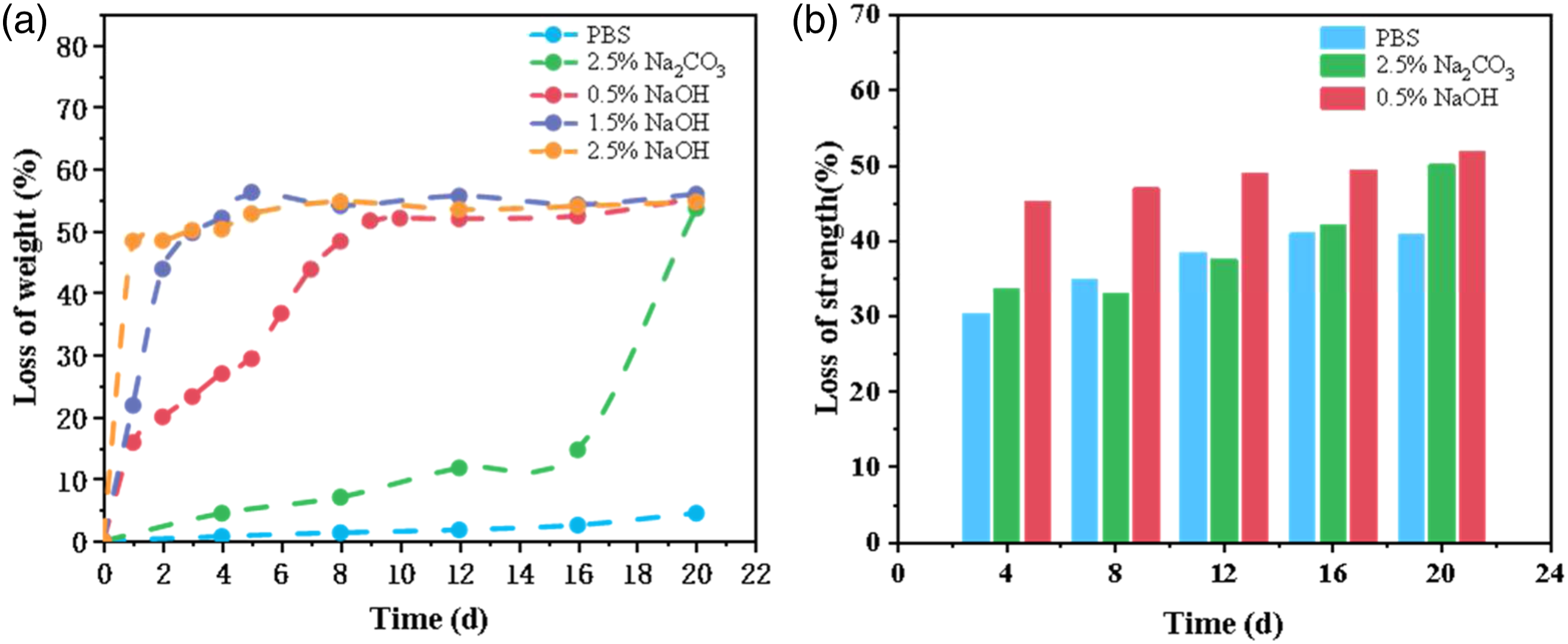
Combined with the degradation situations of meshes in Figure 5, the PGCL monofilaments were essentially completely degraded in 1–2 days when samples were kept in 1.5% and 2.5% NaOH solutions. Therefore, in order to be able to see the trend of increasing weight loss rate of the samples at different time points during the degradation process, only the tensile strength of the samples after degradation in three solutions of PBS, 2.5% Na2CO3 and 0.5% NaOH were compared (Figure 6(b)). The figure shows, as soon as the degradation started, the strength loss rate of the sample in NaOH solution reached about 45%, which was much higher than the other two. The trend in the rate of strong loss of samples degraded in 2.5% Na2CO3 solution was similar to that of mass loss, increasing slowly in the first 16 days and then rapidly growing to a maximum loss after 20 days. It is thought that this may be due to the fact that the water molecules in the solution first entered the interior of the polymer structure in large quantities in the early stage, after which the ester groups were hydrolyzed massively, 34 leading to a rapid short-term decrease in weight.
The images of the five liquids at the end of degradation can be seen in Figure 7. It was clearly seen that there was a large amount of purple flocculent precipitate in the 2.5% NaOH solution, and only a small amount of precipitation in the other four kinds of solutions. A point worth noting is the presence of small purple monofilament particles in some of the solutions (locations indicated by arrows in the Figure 7), which were analyzed as monofilaments broken into small segments falling into the solution and not being completely disintegrated, due to the highly destructive effect of strong alkaline solutions. Based on the results of the evaluation of the degradation experiments described above, it was concluded that even if the solution is more alkaline, the accelerated degradation effect is more obvious, but for polymer meshes, choosing excessively high concentration of alkali for degradation would result in great a loss of performance. The PP monofilament will also suffer more severe erosion. Accelerated degradation can be achieved by using a low concentration weak alkali solution and the trend is more similar to that of the PBS solution. Pictures of solution after degradation.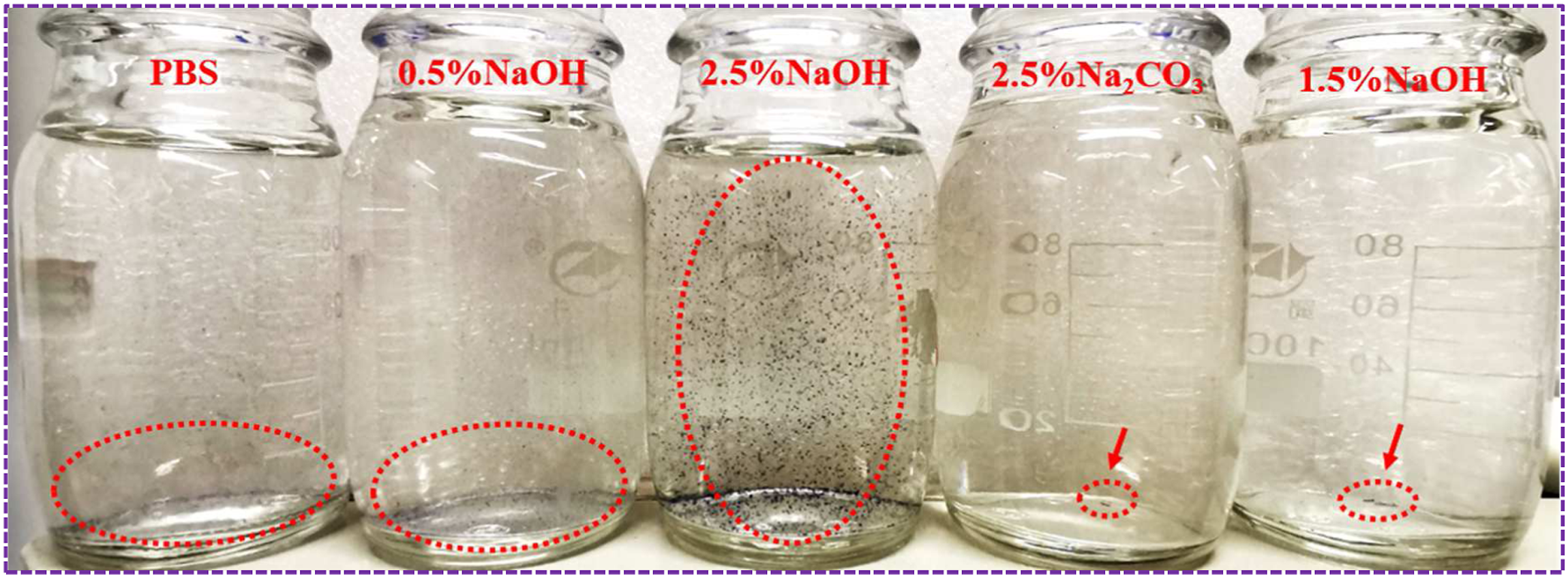
Conclusions
In this paper, the properties of PP and PGCL monofilaments were tested first. The results show that the PGCL monofilaments have good mechanical properties conforming to the warp-knitting requirements. Then two kinds of meshes were fabricated by warp-knitting process. After tested the basic and mechanical properties of these meshes, the E14 mesh would be a better choice considering the application requirements of hernia repair mesh. Subsequently, the mesh was subjected to in vitro accelerated degradation experiment using PBS and other four alkali solutions. All alkaline solutions were capable of achieving accelerated degradation, but the degradation trend of meshes in Na2CO3 solution was more similar to that in PBS degradation. Other than that, the remaining strength of the meshes could still meet the application standard after degraded completely. The disadvantage of this study is that the composition of the accelerated degradation products was not examined, and further work should be done to obtain the most suitable solution concentration for accelerated degradation. However, it can still be concluded that this study can provide a theoretical basis for the production of PP/PGCL composite meshes, and it is expected to promote the improvement and development process of high-performance composite hernia repair mesh in the future.
Footnotes
Declaration of conflicting interests
The author(s) declared no potential conflicts of interest with respect to the research, authorship, and/or publication of this article.
Funding
The author(s) disclosed receipt of the following financial support for the research, authorship, and/or publication of this article: This work was supported by the Fundamental Research Funds for the Central Universities (JUSRP22026), Project of Heze Scientific and Technological Innovation Breakthrough Plan (2021KJTP03), and a Project Funded by the Priority Academic Program Development of Jiangsu Higher Education Institutions (PAP)
